
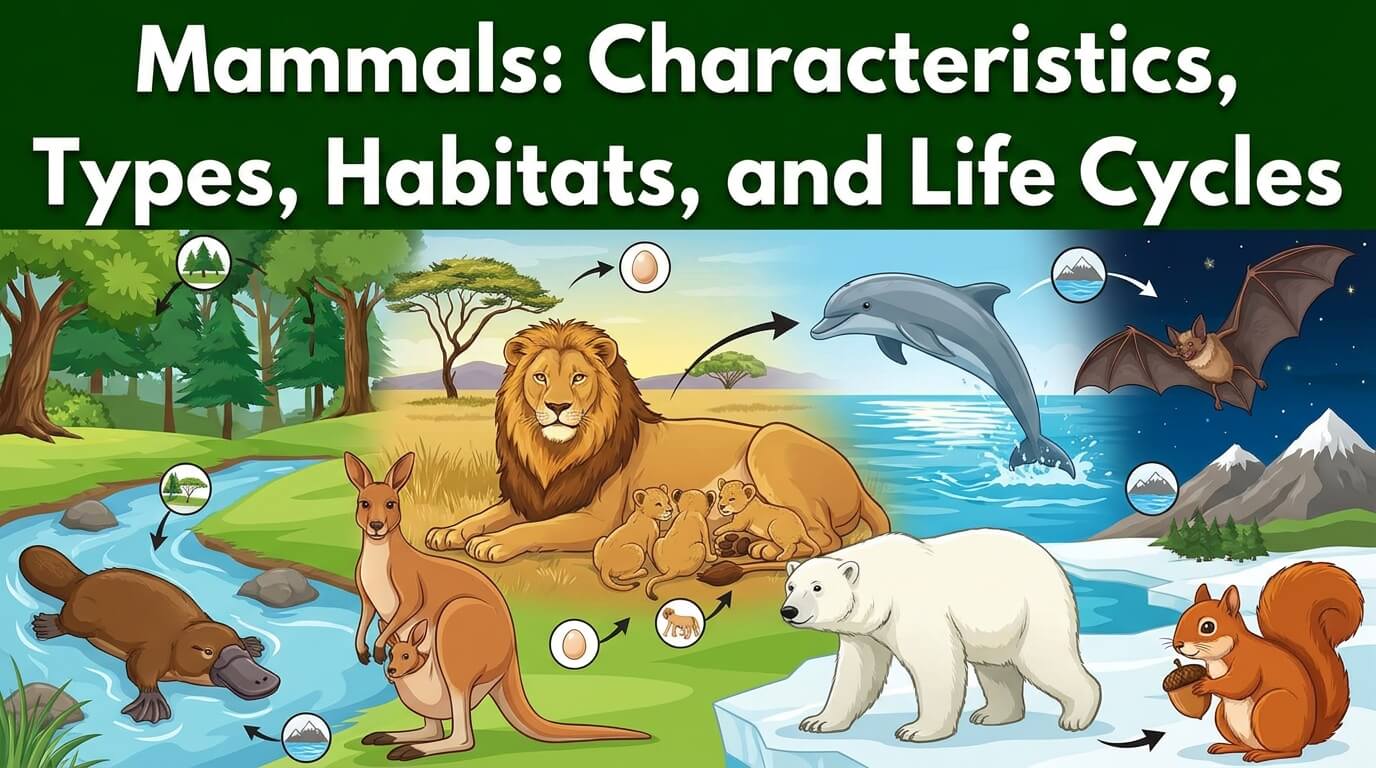
Mammals are vertebrate animals in the class Mammalia. They include familiar animals such as mice, bats, elephants, whales, dogs, cats, and humans, yet their shared identity is based on biology rather than appearance. Mammals produce milk for their young, have hair at some point in development, and possess three tiny middle-ear bones. Most also regulate their body temperature internally, breathe with lungs, and have a lower jaw built mainly from a single bone.
That basic definition covers animals with remarkably different lives. A mole tunnels through soil, a bat flies through the night, a dolphin surfaces to breathe, and a bison grazes on open grassland. Understanding mammals means looking at the body systems they share, the major lineages they belong to, and the many ways evolution has modified the same basic mammalian plan.
Quick Overview of Mammals
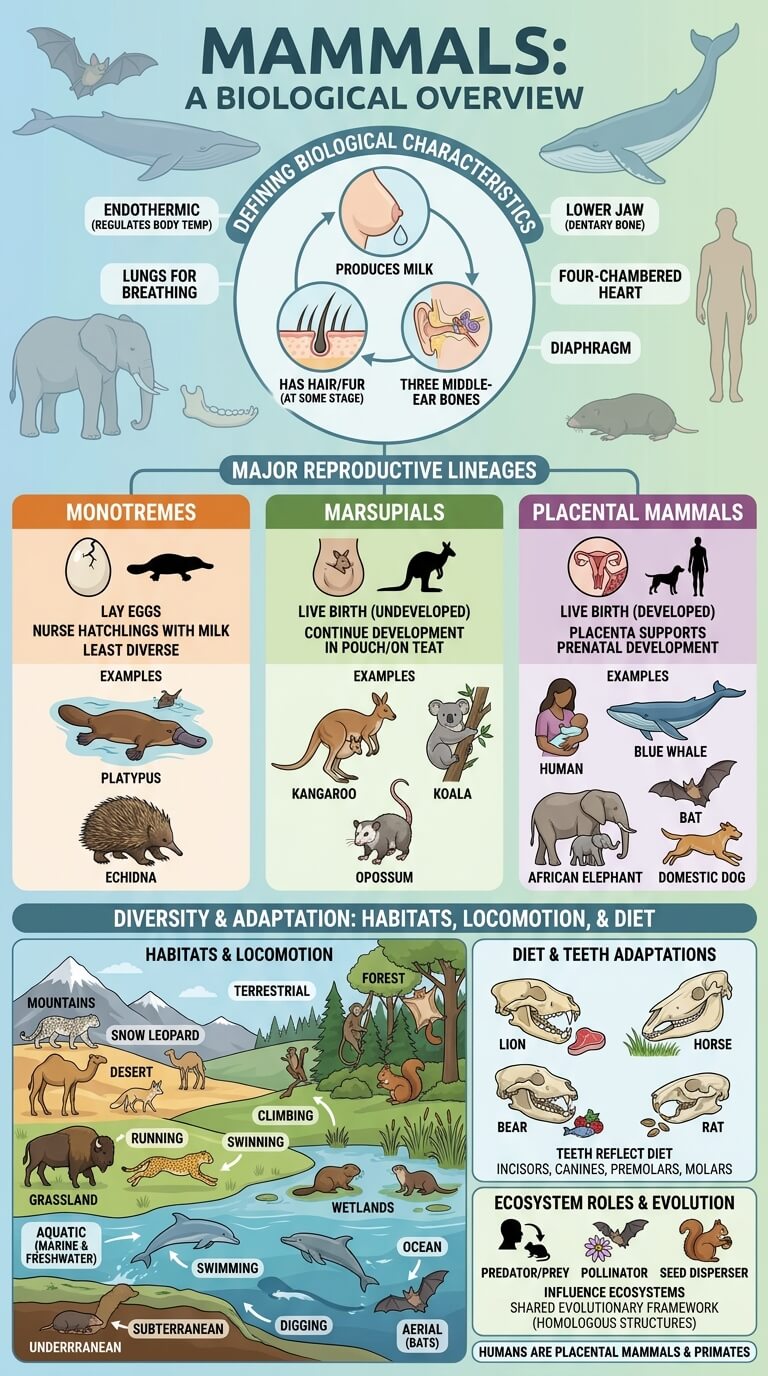
The simplest definition of a mammal
A mammal is a backboned animal whose biology includes a distinct combination of features. The most useful starting points are hair, mammary glands that produce milk, and three middle-ear bones called the malleus, incus, and stapes. The Animal Diversity Web overview of Mammalia identifies these traits as characteristics shared across the class, even when one of them is difficult to see in an adult animal.
No single outward feature tells the whole story. Birds also maintain high internal body temperatures, some mammals have little visible hair, and monotremes lay eggs. Identification therefore depends on anatomy, development, reproduction, and evolutionary relationship rather than one visual test.
Why mammals are biologically diverse
Mammals have spread into nearly every major environment available to vertebrates. They live in forests, deserts, grasslands, mountains, wetlands, rivers, polar regions, cities, and oceans. Bats are capable of powered flight, whales remain fully aquatic throughout life, and many small species spend most of their time below ground or inside dense vegetation.
Taxonomy changes as researchers describe new species and reassess relationships using anatomy, fossils, genetics, and geographic evidence. The American Society of Mammalogists maintains the Mammal Diversity Database, which is updated as scientific classifications change. This is why older references may give different totals for mammal species, families, or orders. A sensible overview should emphasize patterns rather than treat one species count as permanent.
What the Study of Mammals Includes
Anatomy and physiology
Mammal anatomy includes fur, whiskers, claws, hooves, flippers, and wings, along with less visible internal systems. Lungs exchange gases with the air, a muscular diaphragm assists breathing, and a four-chambered heart supports circulation. Sensory systems vary greatly among species.
The mammalian skull is especially informative. Mammals have a lower jaw dominated by the dentary bone, and the jaw joint differs from that of reptiles and birds. Two bones that were associated with the ancestral jaw became part of the mammalian middle ear during evolution. This close relationship between feeding structures and hearing anatomy is one reason mammal fossils can reveal so much about evolutionary history.
Reproduction and development
Milk production is central to mammalian reproduction. Newborn mammals depend on milk for nutrition during an early period of life, although the length and pattern of nursing differ widely. Monotreme mothers produce milk without giving birth to live young. Marsupial young are typically born at an early developmental stage and continue growing while attached to a teat, often within a pouch. Placental mammals generally support more prenatal development through a placenta, but their gestation lengths and newborn condition still vary.
Development continues after birth. Some newborns can stand or swim quickly, while others are blind and highly dependent. Milk, protection, grooming, carrying, teaching, and group care may support survival, but parental patterns differ widely.
Behavior, ecology, and evolution
Mammal behavior ranges from solitary hunting to complex group life. Communication may use sound, scent, touch, posture, facial expression, or vibration. Activity timing can shift with temperature, food, predators, and human disturbance.
Ecology examines how mammals obtain food, avoid danger, compete, reproduce, and affect other organisms. Evolution explains why related mammals share underlying structures even when those structures now perform different jobs. The forelimbs of a horse, mole, bat, seal, and human contain corresponding bones, but selection has shaped them for running, digging, flying, swimming, or grasping.
Defining Features of Mammals at a Glance
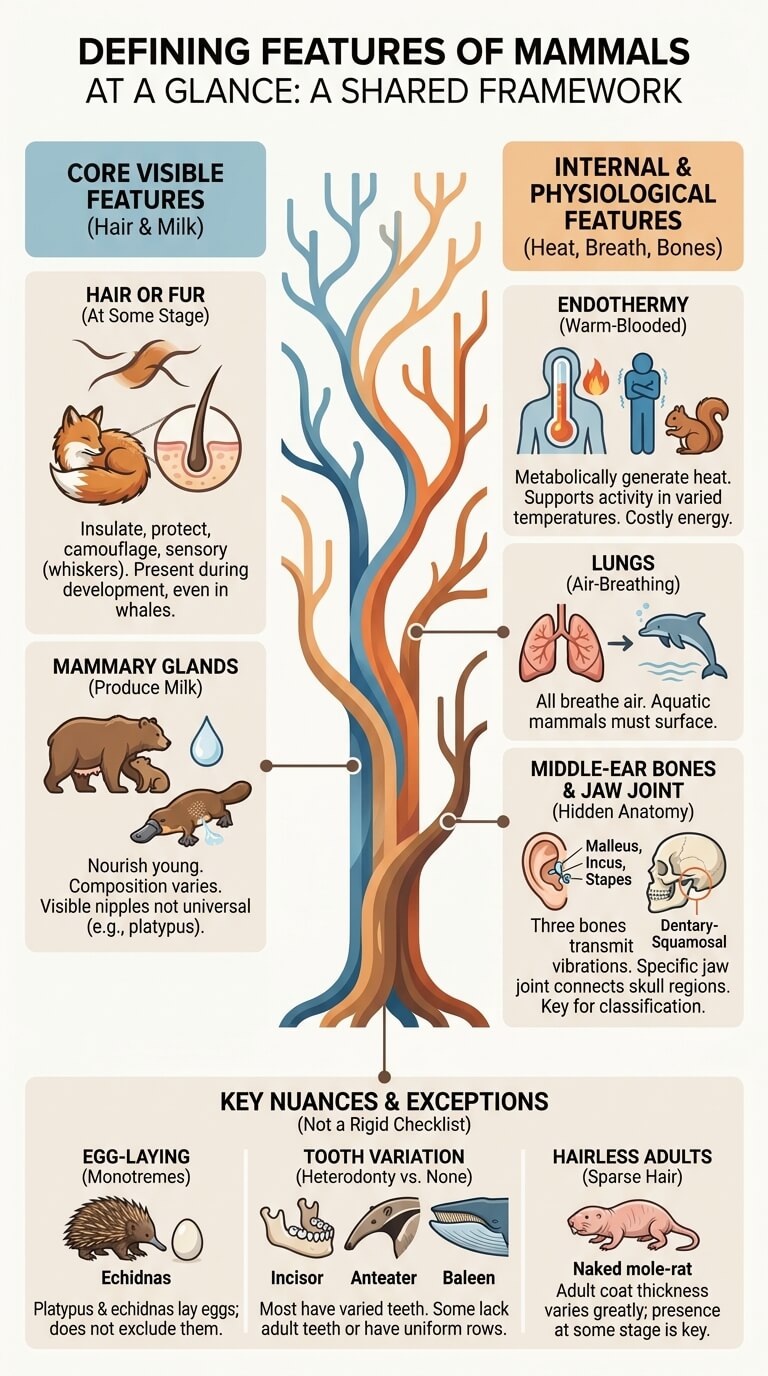
Hair or fur and mammary glands
Hair is made mainly of keratin, a protein also found in claws, nails, and hooves. It can insulate, protect skin, provide camouflage, display warning patterns, and transmit touch. Whiskers are specialized sensory hairs that help detect nearby surfaces and movement.
Not every mammal looks furry. Whales and dolphins may retain only sparse hairs during part of development, while animals such as elephants and naked mole-rats have much less obvious body hair than a fox or bear. The presence of hair at some life stage matters more than a thick adult coat.
Mammary glands produce milk whose composition varies among species and during nursing. Visible nipples are not universal. Female platypuses release milk through skin openings, and their young lap it from mammary areas.
Endothermy, lungs, jaw, and middle-ear bones
Mammals are endothermic, generating much of their body heat through metabolism. This supports activity across varied temperatures but costs energy. Fur, fat, shivering, blood-flow changes, shelter, posture, and reduced metabolic states help balance heat gain and loss.
Every living mammal breathes air with lungs. Aquatic mammals therefore have to surface, even though their bodies may be specialized for long dives. Their ability to live in water does not turn them into fish. They still obtain oxygen from air, nurse their young, and retain the inherited anatomy of mammals.
The three middle-ear bones transmit vibrations toward the inner ear. The jaw joint connects the dentary with the squamosal region of the skull. These hidden features help scientists classify mammals and trace the evolution of hearing and chewing.
Important exceptions that do not break the definition
Apparent exceptions usually challenge a shortcut, not the mammal definition itself. Egg laying does not exclude platypuses and echidnas because live birth is not universal among mammals. A nearly hairless adult whale remains a mammal because hair is present during development and because its other anatomy and reproduction place it within Mammalia.
Teeth also vary. Many mammals have incisors, canines, premolars, and molars with different shapes, a pattern called heterodonty. Yet anteaters and baleen whales lack functional adult teeth, and some toothed whales have rows of relatively similar teeth. Mammal biology is best understood as a shared evolutionary framework with many modified features, not as a rigid checklist in which every trait must look identical.
The Three Major Living Mammal Lineages
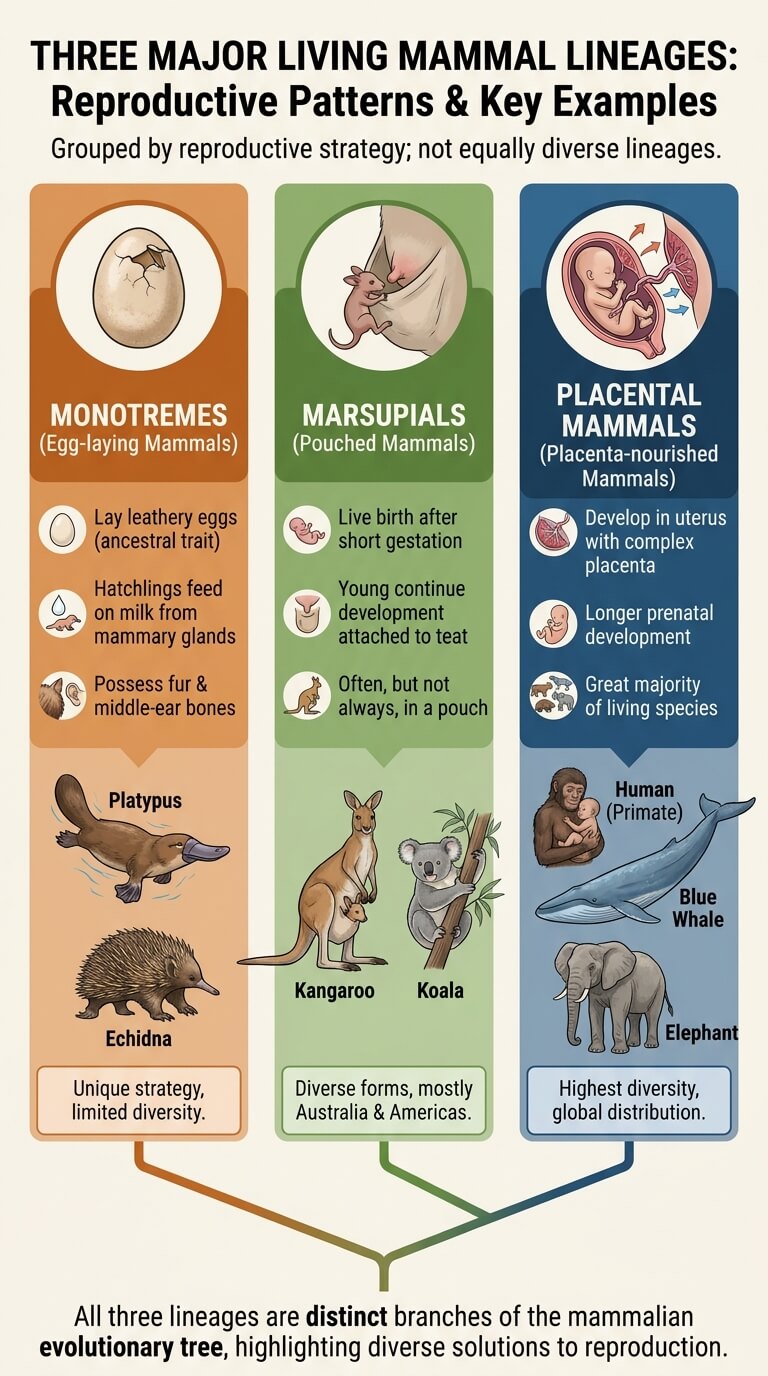
Introductory biology often groups living mammals into three broad reproductive lineages: monotremes, marsupials, and placental mammals. These groupings help explain how early development differs, but they should not be treated as three equally diverse sets of animals.
| Lineage | Basic reproductive pattern | Familiar examples |
|---|---|---|
| Monotremes | Lay eggs and feed hatchlings with milk | Platypus and echidnas |
| Marsupials | Usually give birth to highly undeveloped young that continue development while nursing | Kangaroos, koalas, wombats, opossums |
| Placental mammals | Young develop in the uterus with support from a placenta before birth | Rodents, bats, whales, primates, cats, dogs, elephants |
Monotremes
Monotremes are living mammals that lay eggs. Their egg laying is striking, but they also have fur, mammary glands, three middle-ear bones, and other mammalian structures. Living monotremes are limited to the platypus and echidnas. Their young hatch at an early stage and depend on milk.
Monotremes show why reproduction alone cannot define a mammal. They preserve a reproductive strategy different from that of marsupials and placental mammals while remaining fully part of the mammalian evolutionary tree.
Marsupials
Marsupials give birth to live young, usually after a relatively short gestation compared with placental mammals of similar ecological type. The newborn is often extremely small and continues developing while attached to a teat. A pouch can protect the young in many species, but not every marsupial has a deep, forward-opening pouch.
Most living marsupial diversity occurs in Australia, New Guinea, and nearby islands, with additional species in the Americas. Kangaroos, wallabies, koalas, wombats, bandicoots, Tasmanian devils, and opossums illustrate how varied marsupial diets and body forms can be.
Placental mammals
Placental mammals include the great majority of living mammal species. During pregnancy, a placenta allows exchange between maternal and developing tissues without directly mixing their blood. The details of placental structure, gestation, litter size, and newborn development differ substantially among groups.
The term does not mean that marsupials completely lack placental tissues. The comparison is about reproductive anatomy and the typical pattern of prenatal development. The University of California Museum of Paleontology provides a concise introduction to placental mammals and prenatal nourishment. Rodents, bats, primates, elephants, whales, hoofed mammals, carnivorans, and many insect-eating mammals belong within the placental lineage.
Major Mammal Groups People Commonly Encounter
Primates, bats, and rodents
Primates include lemurs, lorises, tarsiers, monkeys, apes, and humans. Many have grasping hands or feet, forward-facing eyes, and flexible behavior, but their size, diet, and social life vary greatly.
Bats belong to Chiroptera and are the only mammals capable of sustained powered flight. Skin stretched across elongated fingers forms the wing. Different species eat insects, fruit, nectar, fish, small vertebrates, or blood and may act as predators, pollinators, or seed dispersers.
Rodents are generally recognized as the most species-rich mammal order. They have one pair of continuously growing incisors in the upper jaw and one pair in the lower jaw. Mice, rats, squirrels, beavers, porcupines, guinea pigs, and capybaras are rodents, but rabbits and hares belong to a different order.
Carnivorans, hoofed mammals, elephants, and marsupials
Carnivora includes cats, dogs, bears, weasels, raccoons, hyenas, seals, sea lions, and walruses. Not every member eats only meat. Giant pandas belong to Carnivora despite a bamboo-dominated diet, showing that classification reflects ancestry rather than a menu label.
“Hoofed mammals” is an everyday grouping for animals that move on enlarged nail-like structures. Horses, deer, antelope, cattle, pigs, camels, and rhinoceroses fit the broad idea, but they do not form one simple modern taxonomic unit.
Elephants belong to the order Proboscidea and are known for trunks, tusks in many individuals, large bodies, and highly social lives. Marsupials are not one body type. They include powerful grazing kangaroos, tree-living koalas, digging wombats, predatory dasyurids, and omnivorous opossums.
Marine mammals, big cats, bears, and domesticated mammals
Marine mammals include cetaceans, pinnipeds, sirenians, sea otters, and polar bears under common ecological or legal definitions. They do not form one taxonomic rank, but represent separate branches adapted to life in or near the ocean.
NOAA explains that marine mammals retain the defining features of mammals, including breathing air with lungs and producing milk. Some are fully aquatic, while others divide time between water and land or ice. Their insulation, diving ability, movement, and sensory systems reflect different levels of dependence on marine habitats.
“Big cats” is a practical term rather than a formal rank, and its everyday use varies. Bears form the family Ursidae within Carnivora. Dogs and cats are domesticated mammals, but their training, health, and household behavior require separate guidance.
Where Mammals Live
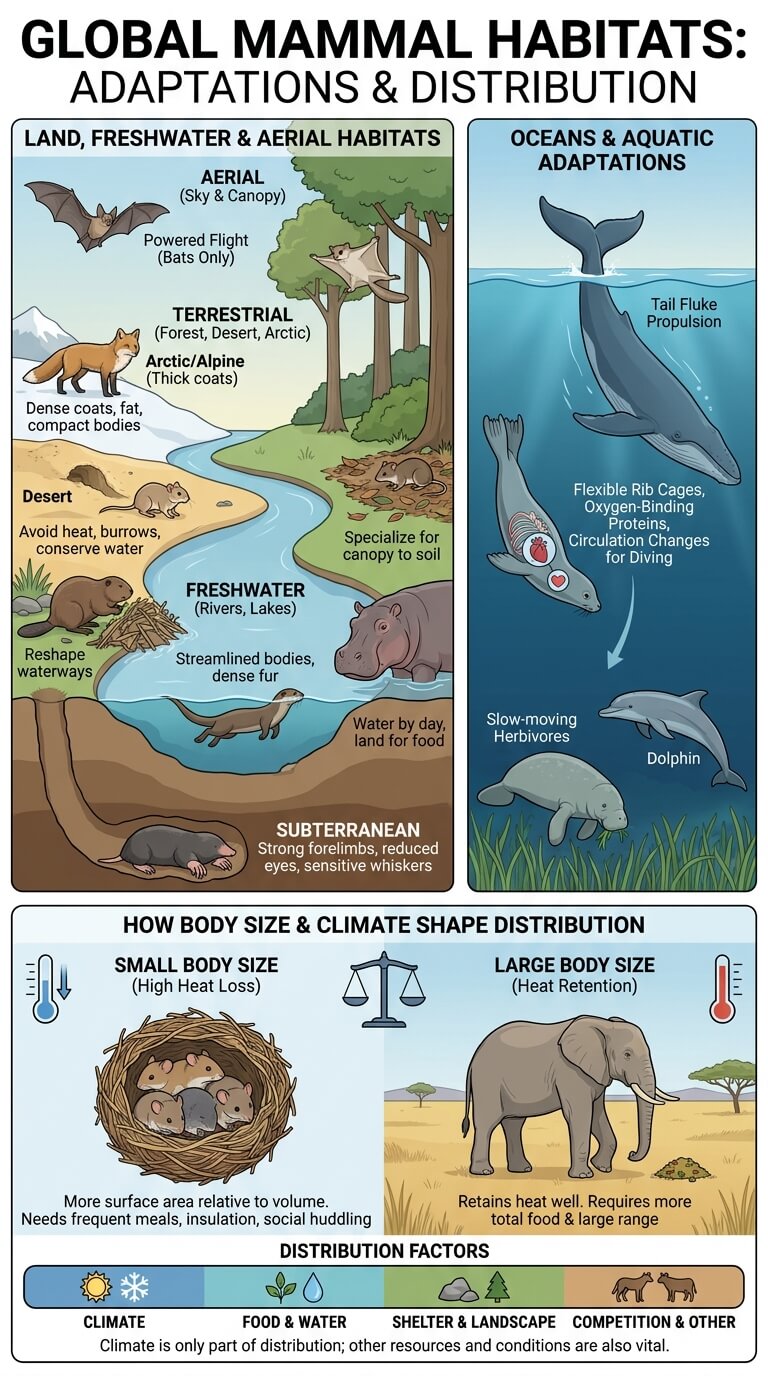
Land, freshwater, underground, and aerial habitats
Terrestrial mammals occupy every major land biome. Desert mammals may avoid daytime heat, conserve water, or use burrows. Arctic and alpine mammals may rely on dense coats, fat, compact bodies, seasonal movement, or sheltered resting sites. Forest species can specialize for the canopy, trunks, understory, leaf litter, or soil.
Freshwater mammals include animals that forage, travel, or shelter in rivers, lakes, marshes, and streams. Beavers reshape waterways by building dams and lodges. Otters use streamlined bodies and dense fur. Hippopotamuses spend much of the day in water but feed mainly on land. Each represents a different path toward using aquatic habitat.
Subterranean mammals face darkness and restricted space. Strong forelimbs, compact bodies, sensitive whiskers, reduced eyes, and digging teeth or claws may help. Gliding mammals travel between trees, but only bats produce powered flight.
Oceans and aquatic adaptations
Aquatic life changes how a mammal moves, stays warm, senses its surroundings, and obtains air. Whales and dolphins propel themselves with tail flukes that move mainly up and down. Seals and sea lions use flippers, but they differ in how they move on land and in water. Manatees and dugongs are slow-moving herbivores with paddle-like forelimbs and broad tails.
Diving mammals must manage oxygen stores and return to the surface. Adaptations can include flexible rib cages, oxygen-binding proteins in muscle, and circulation changes that favor vital organs. Dive time and depth differ greatly among species.
How body size and climate shape distribution
Body size affects heat exchange, food needs, movement, and vulnerability. Small mammals lose heat quickly because they have more surface area relative to their volume. They may need frequent meals, insulated nests, social huddling, or periods of reduced metabolism. Large mammals retain heat more easily but require more total food and may need large ranges.
Climate is only part of distribution. Water, vegetation, prey, shelter, competition, disease, mountains, and development also matter. A species may tolerate the temperature yet be absent because food is unsuitable or the landscape is fragmented.
How Mammals Feed, Move, and Survive
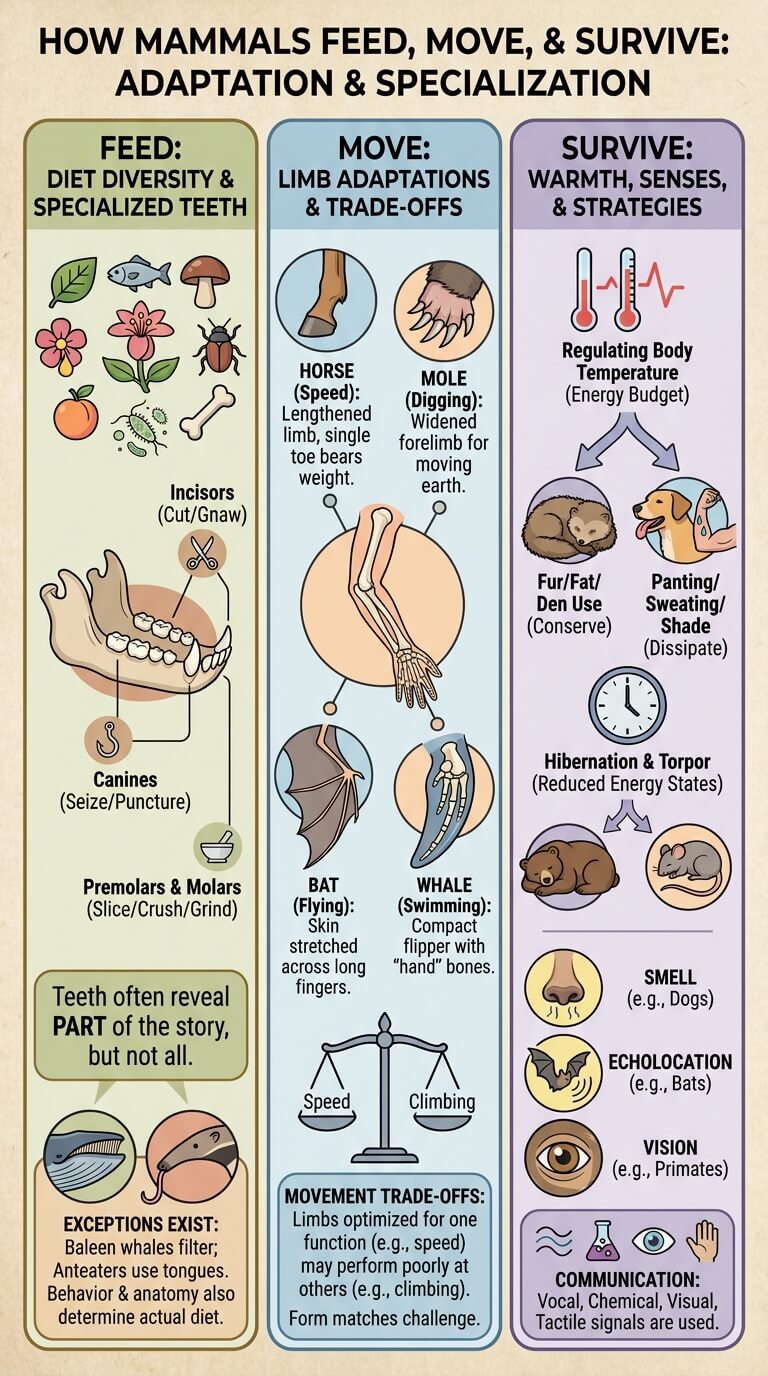
Diet diversity and specialized teeth
Mammals eat plants, animals, fungi, nectar, fruit, seeds, insects, plankton, carrion, and many combinations of foods. Teeth often reveal part of that story. Incisors can cut or gnaw, canines can seize or puncture, and premolars and molars can slice, crush, or grind. The exact arrangement is summarized by a dental formula, but formulas differ among groups and may change between juvenile and adult stages.
Teeth never explain diet by themselves. Baleen whales filter prey without adult teeth. Anteaters collect insects with long tongues. Some carnivorans eat large amounts of plant matter, while many herbivores occasionally consume animal material. Feeding behavior, digestive anatomy, seasonal availability, and learned choices all contribute to what a mammal actually eats.
Walking, running, climbing, flying, swimming, and burrowing
The basic mammalian limb contains the same major bones, but proportions and joints can be transformed. A horse lengthens the lower limb and bears weight mainly on a single toe. A mole widens the forelimb for digging. A bat stretches skin across elongated fingers. A whale has a compact flipper containing recognizable arm and hand bones.
Movement involves trade-offs. Limbs optimized for speed may climb poorly, while streamlining improves swimming but can restrict movement on land. Mammals succeed by matching body form and behavior to recurring challenges.
Warmth, senses, communication, and activity timing
Maintaining body temperature is an energy budget. A mammal must produce or conserve enough heat without overheating. Fur, body fat, blood-flow control, panting, sweating in some species, shade, water, posture, den use, and reduced metabolic states all contribute. Hibernation and daily torpor are related strategies, but they differ in duration, depth, and species-specific physiology.
Sensory priorities vary. Dogs emphasize smell, many bats use echolocation, moles detect touch and vibration, and many primates depend strongly on vision. Communication can be vocal, chemical, visual, tactile, or seismic. Night-active species use different combinations of sight, hearing, smell, whiskers, and echolocation.
Mammal Life Cycles in Broad View
Mating, pregnancy or egg laying, birth, and lactation
A mammal life cycle begins before birth or hatching, with fertilization and embryonic development. Mating may occur seasonally or throughout the year. Environmental cues such as day length, rainfall, temperature, or food availability can influence timing. Some species delay implantation or development so that birth occurs when conditions are more favorable.
Monotremes lay eggs, while marsupials and placental mammals give birth to live young. After hatching or birth, milk provides early nutrition. Gestation length, litter size, milk composition, and nursing duration vary with body size, ecology, evolutionary history, and the developmental state of the young.
Growth, parental care, and independence
Some mammal young are precocial, meaning they are relatively mobile and developed at birth. Hoofed mammals in exposed habitats often need to stand and follow an adult quickly. Other young are altricial, meaning they are born in a less developed condition and require prolonged care in a nest, den, pouch, or protected group.
Parental care can include carrying, warming, grooming, defense, retrieval, teaching, or provisioning. Fathers and other group members help in some species. Weaning, independent foraging, predator avoidance, and dispersal may occur at different times.
Lifespan variation without misleading records
Mammal lifespan ranges from a few years in some small species to many decades in certain bats, elephants, primates, and whales. Size matters, but metabolism, predation, disease, reproduction, and cellular maintenance also contribute.
Record claims require care because a maximum verified age is not the same as a typical lifespan. Captive and wild animals face different risks, and age-estimating methods can change. It is usually more useful to ask how a species balances growth, reproduction, and survival than to focus on a single record-holder.
Mammals in Ecosystems and Human Life
Predators, grazers, pollinators, seed dispersers, and ecosystem engineers
Mammals influence ecosystems through feeding and movement. Predators can change prey behavior and abundance. Grazers and browsers alter vegetation. Fruit-eating mammals move seeds, while nectar-feeding bats can pollinate flowers. Burrowing animals mix soil, and beaver dams modify water flow and create wetlands used by many other organisms.
These roles overlap. A mammal may disperse seeds, prey on animals, and become food for a larger predator. Smithsonian ForestGEO describes vertebrate functions that include pollination, seed dispersal, browsing, soil disturbance, and ecosystem engineering. Population loss can therefore affect plants, water, food webs, and nutrient movement.
Wild mammals versus domesticated mammals
Domestication is a long-term evolutionary process in which human selection changes a population over generations. Domestic dogs, cats, cattle, sheep, goats, pigs, and horses remain mammals, but their relationships with people have shaped their bodies, behavior, reproduction, and distribution.
A tame wild mammal is not automatically domesticated. Tameness describes an individual animal’s response to people, while domestication describes inherited changes across a population. Wild mammals should not be handled, fed, captured, or kept simply because they appear calm. Stress, disease risk, injury, and legal protections can still apply.
Why conservation context matters
Mammal conservation cannot be summarized by saying that mammals as a whole are safe or endangered. Risk is assessed by species and often by population or region. Habitat loss, overexploitation, invasive species, pollution, climate change, disease, vehicle collisions, fishing interactions, and conflict with people affect different mammals in different combinations.
Conservation status can change as evidence improves. Protecting habitat, maintaining connected landscapes and waterways, reducing direct mortality, and using evidence-based management can help, but actions must fit the species and place.
Common Myths and Classification Mistakes
Mammals are not defined only by live birth
Live birth is common among mammals, but it is not universal. Platypuses and echidnas lay eggs. At the same time, live birth occurs in some reptiles and fish, so giving birth to live young would not be enough to identify a mammal even without monotremes.
The more reliable definition combines milk production, hair during development, middle-ear anatomy, jaw structure, and evolutionary relationship. This explains both the usual pattern and the exceptions.
Whales and dolphins are mammals, not fish
Whales and dolphins have streamlined bodies and spend their lives in water, but body shape reflects the demands of swimming rather than membership in the fish groups. They breathe air through lungs, regulate body temperature internally, give birth to live young, and feed their calves milk.
Their tails also move differently from the tails of most fish. Cetacean flukes drive the body mainly through vertical motion, while most fish move the tail side to side. More importantly, whale anatomy and genetics place cetaceans within the same broader placental branch as even-toed hoofed mammals.
Big cats and marine mammals are useful groupings, not equal taxonomic ranks
Everyday animal categories can mix taxonomy with ecology. “Marine mammals” groups mammals that depend on the ocean, even though seals, whales, manatees, sea otters, and polar bears belong to different branches. “Big cats” usually groups several large felids, but its exact everyday use can vary.
Taxonomic ranks such as class, order, family, genus, and species have defined positions in biological classification. Informal groupings are still useful when they describe a shared body size, habitat, or lifestyle, but they should not be presented as though each represents the same level of ancestry.
Questions That Reveal More About Mammal Biology
Which traits truly identify a mammal?
Visible hair and nursing behavior are helpful clues, but a complete answer includes developmental and skeletal traits. Looking closely at mammary glands, middle-ear bones, jaw anatomy, and exceptions such as whales and monotremes shows why mammal identification is a biological question rather than a simple appearance test.
How do reproductive lineages shape early life?
Comparing monotremes, marsupials, and placental mammals reveals different ways to divide development before and after birth or hatching. Egg laying, gestation, placental exchange, lactation, pouch life, and newborn development are connected, but none of the three lineages follows one identical life history.
Why do mammals use so many survival strategies?
Teeth, temperature control, communication, nighttime activity, torpor, hibernation, migration, and conservation risk all reflect the interaction between inherited anatomy and environmental pressure. Exploring each subject separately makes it easier to see the mechanisms and exceptions that a broad overview can only introduce.
FAQ
Are all mammals warm-blooded?
Living mammals are endothermic, which means they generate much of their body heat through metabolism. “Warm-blooded” is a convenient everyday phrase, but body temperature is not perfectly constant in every mammal. Hibernators and animals using daily torpor may allow body temperature and metabolic rate to fall substantially for a period. Environmental conditions, activity, illness, and body region can also affect measured temperature.
Do all mammals give live birth?
No. Monotremes, including the platypus and echidnas, lay eggs. Marsupials and placental mammals give birth to live young, but they differ in how much development usually occurs before birth and how nursing supports later growth. All three lineages produce milk.
What is the largest group of mammals?
Rodents are generally considered the largest mammal order by number of recognized living species. Mice and rats make up part of that diversity, but Rodentia also includes squirrels, beavers, porcupines, guinea pigs, marmots, and capybaras. Exact species totals change as researchers describe species and revise classifications, so the ranking is more stable than any single number.
Are humans mammals?
Yes. Humans are primates and placental mammals. We have hair, mammary glands, three middle-ear bones, a dentary-based lower jaw, lungs, endothermic physiology, and the same basic limb-bone pattern found in other mammals. Human language and culture are unusual in degree and form, but they do not place humans outside Mammalia.
Final Thoughts
Mammals are united by a distinctive biological foundation, not by one body shape or way of life. Hair, milk production, middle-ear bones, jaw anatomy, lungs, and endothermic physiology provide a shared framework, while evolution has produced egg-laying echidnas, pouch-reared kangaroos, flying bats, burrowing moles, running antelope, and fully aquatic whales. Learning the broad pattern makes the diversity easier to understand without erasing the exceptions. It also provides a sound basis for examining mammal teeth, reproduction, temperature control, communication, nocturnal life, hibernation, migration, and conservation in greater detail.

Ethan Walker is the founder and research editor of Animal Fact Central. He creates and reviews educational animal facts content using trusted wildlife, pet care, and science-based sources. His work focuses on making animal behavior, adaptations, habitats, and species facts clear, accurate, and engaging for everyday readers.
Read More Details About Ethan Walker: https://animalfactcentral.com/ethan-walker/