

Mammals communicate by sending and receiving signals through sound, scent, touch, body posture, facial movement, ground vibration, and other sensory channels. A wolf howl, an elephant rumble, a bat social call, a scent mark, and a mother licking her newborn are very different signals, but each can change what another animal does.
No single method defines mammal communication. Species combine channels according to their senses, habitat, body size, activity pattern, and social life. Signals may help animals find mates, recognize family members, defend space, warn companions, maintain bonds, coordinate movement, or reduce conflict. Understanding how mammals communicate therefore means looking at the sender, the receiver, the setting, and the result rather than assigning a fixed human translation to one sound or gesture.
Quick Answer

Mammals Combine Multiple Signal Channels
Most mammals do not rely on one channel alone. A vocalization may occur with a body posture. A scent deposit may be placed at a visually noticeable location. Touch may be paired with soft calls between a mother and her young. Researchers call this multimodal communication when information reaches a receiver through more than one sensory route.
A broad systems approach to animal communication emphasizes that signals can vary across components, receivers, functions, and sensory modalities. This matters because the same signal can work differently depending on who receives it and what other cues are present.
A Signal Is Not Automatically a Language
A signal is a trait or action shaped in part because it affects another animal. Communication occurs when a sender produces information and a receiver responds in a way connected to that information. Some mammal calls are highly specific, while others mainly reveal urgency, arousal, identity, size, or motivation.
Human language includes open-ended combinations, learned symbols, grammar, and the ability to discuss distant or imaginary events. Mammals can show impressive learning, turn-taking, call combinations, and audience-sensitive signaling without necessarily meeting every criterion used for human language. It is more accurate to describe the evidence for each species than to declare that every complex call system is a language.
Why Mammal Communication Matters
Finding Mates and Maintaining Bonds
Communication allows potential mates to locate and assess one another. Calls can advertise presence, scent can carry information about reproductive condition, and visual displays can reveal size or motivation. These signals do not guarantee mating. They help receivers make decisions while also exposing senders to competitors, predators, or energetic costs.
After pairs or groups form, signals help maintain social relationships. Contact calls can keep separated animals aware of one another. Grooming and close touch may reinforce familiar relationships. Repeated exchanges can reduce uncertainty because individuals learn how particular companions sound, smell, move, and respond.
Warning, Defense, Territory, and Group Coordination
Alarm calls can direct attention toward danger, but their structure and use vary among species. Some calls differ with threat type or urgency. Others mainly trigger vigilance or movement without naming the danger. A receiver may also judge whether a caller is reliable, close, familiar, dominant, or frightened.
Territorial signals reduce the need for constant physical confrontation. A roar, howl, scent mark, scrape, or display can announce occupancy before rivals meet face to face. Group-living mammals also use signals to coordinate travel, reunite after separation, recruit allies, begin a hunt, or maintain spacing during feeding.
Parent-Young Communication
Young mammals need warmth, milk, protection, and guidance, while parents must identify and locate dependent offspring. Calls, scent, touch, and movement can all contribute. The importance of each channel depends on the habitat. Voice recognition is especially useful in crowded colonies where many young look similar and parents repeatedly leave to feed.
A review of individual vocal recognition across animals documents parent-offspring recognition in mammals including bats, seals, hyenas, monkeys, and other species. The evidence is not identical in every case. Some studies show mothers distinguishing their own young, while recognition by the young may be weaker, slower, or tested less often.
Vocal Communication

Calls, Songs, Roars, Squeaks, and Alarm Signals
Mammalian sounds range from brief clicks and squeaks to repeated songs, long-distance howls, booming calls, and low rumbles. A vocal signal may attract a mate, maintain contact, warn a rival, beg for care, coordinate a group, or reveal distress. The function must be tested rather than guessed from how the sound feels to a human listener.
Sound is useful when vegetation, darkness, distance, or water makes visual signaling difficult. It can travel around obstacles and reach receivers that are not facing the sender. It also fades, which can be advantageous when an animal needs a temporary signal rather than a long-lasting scent mark.
Frequency, Pitch, Rhythm, and Individual Recognition
A call carries information through its frequency, timing, loudness, duration, rhythm, and spectral structure. Low-frequency sounds often travel farther through air or ground than high-frequency sounds, although habitat, weather, background noise, and source height all affect transmission. Aquatic sound behaves differently because water is denser than air.
The biology of acoustic communication in vertebrates shows how sound production and hearing are shaped by medium, anatomy, and ecological conditions. Receivers may extract more than a message category. Voice features can reveal the caller’s identity, body size, age class, sex, condition, or emotional state, depending on the species and context.
Ultrasound and Infrasound With Careful Examples
Ultrasound is sound above the usual upper limit of human hearing, while infrasound falls below the usual lower limit. These labels describe human hearing boundaries, not special categories that mammals perceive in the same way. Many rodents produce ultrasonic social calls. Bats use high-frequency sounds for echolocation and also produce social calls, some of which overlap in frequency with sonar pulses.
Elephants produce low-frequency rumbles with energy that can extend into the infrasonic range. Such calls can support long-distance social contact, but distance varies with call type, landscape, weather, vegetation, and background noise. A sound being ultrasonic or infrasonic does not prove its function. Researchers still need behavioral evidence showing how receivers respond.
Scent Marking and Chemical Signals
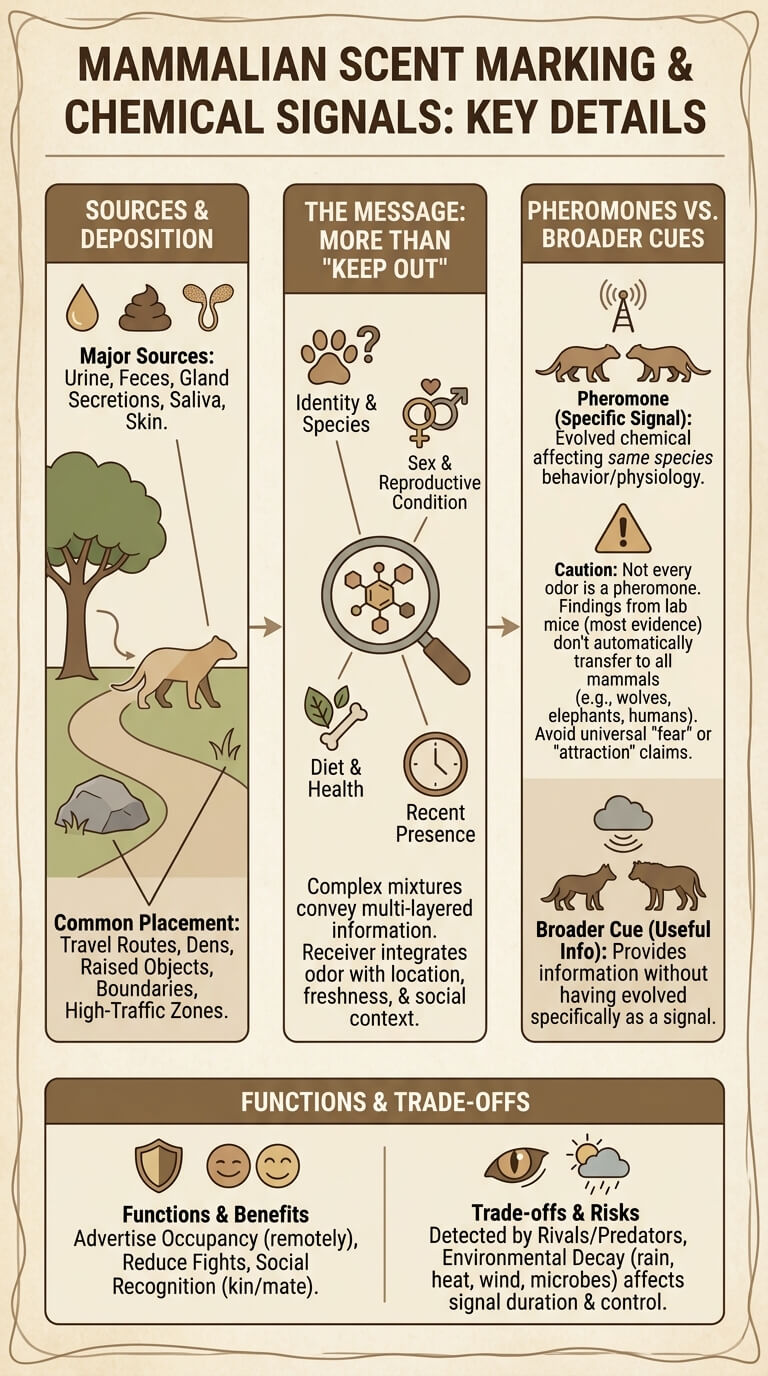
Urine, Feces, Gland Secretions, and Scent Posts
Chemical signals can persist after the sender leaves. Mammals deposit them through urine, feces, saliva, skin secretions, or specialized scent glands. Marks may be placed along travel routes, near dens, on raised objects, at boundaries, or where other animals are likely to investigate.
A scent mark is not simply a smell label saying “keep out.” Its mixture may carry information about species, identity, sex, reproductive condition, diet, health, or recent presence. The receiver combines that odor with location, freshness, social history, and other cues before responding.
Pheromones Versus Broader Chemical Cues
A pheromone is a chemical signal released by one member of a species that affects the behavior or physiology of another member of the same species. The term should not be applied to every odor. Some smells are cues because they provide useful information without having evolved specifically as signals. Others are complex blends whose active components and effects remain uncertain.
A scientific review of mammalian pheromones explains that much of the detailed mechanistic evidence comes from laboratory mice. Findings from mice cannot automatically be transferred to wolves, elephants, cats, humans, or every other mammal. Claims about a single universal “fear pheromone” or “attraction pheromone” should therefore be treated cautiously.
Territory, Reproductive Status, and Identity
Scent marking can advertise occupancy without requiring the sender to remain nearby. It can also help neighbors recognize one another and reduce repeated fights. In some mammals, individuals investigate marks for information about reproductive readiness or competitive status. In others, scent helps group members, mothers, and young recognize familiar animals.
Chemical signaling has trade-offs. Marks can be detected by rivals or predators. Rain, heat, wind, microbes, and substrate can change how long an odor lasts. A long-lasting signal may reach more receivers, but it also gives the sender less control over who finds it.
Touch and Social Contact
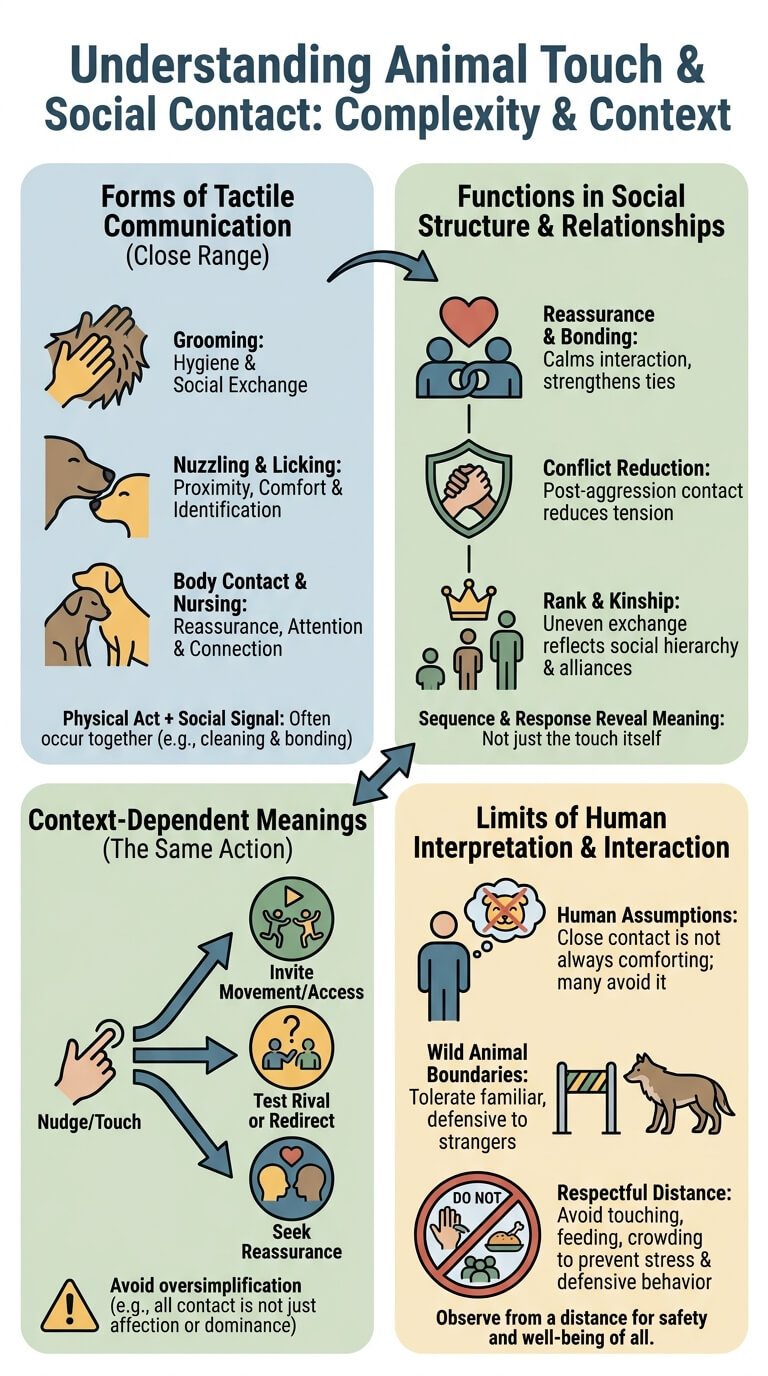
Grooming, Nuzzling, Licking, and Nursing
Tactile communication works at close range. Grooming can remove debris or parasites while also functioning in social exchanges. Nuzzling, licking, rubbing, nursing contact, trunk touches, nose touches, and body leaning may maintain proximity, request attention, reassure a companion, or establish contact after separation.
The physical act and the social signal can occur together. A mother licking a newborn may stimulate, clean, and identify it while also strengthening contact. Two primates grooming may gain hygiene benefits, but the pattern of who grooms whom, for how long, and after which event can also reflect their relationship.
Reassurance, Bonding, Rank, and Conflict Reduction
Touch can calm an interaction when the individuals already have an established relationship. Affiliative contact after aggression may reduce tension or restore tolerance. In some groups, grooming is exchanged unevenly because rank, kinship, alliance value, and access to resources affect who can approach whom.
It is too simple to interpret all grooming as affection or all contact as dominance. The same action can serve several functions. A nudge may invite movement, request access, redirect a young animal, test a rival, or seek reassurance. Sequence and response reveal more than the touch alone.
Limits of Interpreting Touch From a Human Perspective
Humans often assume that close contact is comforting, but many wild mammals avoid touch outside mating, parenting, combat, or brief social encounters. Even highly social species have boundaries. An animal may tolerate contact from a familiar group member but react defensively to a stranger.
Wildlife should not be approached to test whether a gesture is friendly. Touching, feeding, crowding, or imitating contact signals can cause stress and provoke defensive behavior. Observing from a respectful distance protects both the animal and the viewer.
Posture, Facial Expression, and Visual Signals
Ears, Tails, Eyes, Mouths, and Body Orientation
Visual communication can involve the entire body. Ear angle, tail position, gaze direction, eyelid tension, mouth shape, piloerection, head height, stance, and orientation may change together. A receiver reads these features as a pattern rather than as isolated symbols.
Species differ in what they can display and detect. A tail signal is unavailable to a mammal with a very short tail. Facial movement may be easier to see in a close social interaction than across open ground. Nocturnal mammals may rely less on subtle color or facial detail and more on movement, silhouette, scent, touch, or sound.
Displays of Threat, Submission, Invitation, or Attention
A mammal may enlarge its apparent size, expose teeth, stiffen, lower the head, turn sideways, retreat, crouch, or present a play posture. These actions can change the probability of attack, approach, play, mating, or withdrawal. They do not have one universal meaning across Mammalia.
Play signals are especially important because playful biting, chasing, or wrestling can resemble aggression. A relaxed posture, repeated role reversal, inhibited force, pauses, and reengagement may help participants keep the interaction from escalating. Researchers examine the full sequence rather than labeling one open mouth or tail movement.
Why Context Matters More Than One Cue
The meaning of a visible action depends on what happened before it, who is present, how close they are, and what follows. Bared teeth can appear in threat, fear, submission, or play depending on species and posture. Direct gaze can challenge in one context, coordinate attention in another, or simply reflect vigilance.
Multimodal signaling can reduce ambiguity. Research on African elephant greeting behavior found that elephants combined audible, visual, and tactile gestures and adjusted signal use according to whether the receiver was visually attentive. The study illustrates why communication is better understood as an interaction than as a dictionary of body parts.
Vibration, Seismic Signals, and Low-Frequency Sound

Ground-Borne Signals
Seismic signals are vibrations that travel through a solid surface such as soil. They can be generated by foot stamping, drumming, digging, or by the ground component of a low-frequency vocalization. A receiver may detect them through feet, limbs, the jaw, or other vibration-sensitive structures.
Evidence is strongest in particular mammal groups rather than across all mammals. Elephants are the best-known large example. Some subterranean rodents also produce patterned foot drumming that travels through tunnel walls and soil. Researchers must separate deliberate signaling from vibrations that merely reveal movement.
Long-Distance Communication in Open or Dense Habitats
Low-frequency sound and ground vibration can travel under conditions where visual signals are blocked. Dense vegetation may hide the sender, while open terrain can expose an animal that approaches too closely. A signal that propagates through air and ground offers receivers more than one route for detection.
A study using seismic localization of elephant rumbles showed that ground vibrations associated with calls could be detected and used to monitor social interactions. This supports the presence of a seismic component, but it does not mean every distant elephant message can be decoded from the ground alone.
Separating Communication From Navigation and Prey Detection
A sensory signal is not necessarily social communication. Echolocation pulses help bats and toothed whales judge distance, direction, surface structure, and prey movement from returning echoes. Other animals may overhear these sounds, and sonar calls may carry identity information, but their immediate function can still be navigation or foraging.
Likewise, footsteps can alert a receiver even when the moving animal did not intend to signal. Biologists distinguish signals from incidental cues by asking whether the behavior has features shaped to influence a receiver and whether receivers show repeatable, functional responses.
Communication in Different Mammal Lifestyles
Solitary Versus Social Species
Solitary does not mean silent or socially disconnected. A mostly solitary mammal still needs to find mates, avoid rivals, recognize young, and assess neighbors. Long-lasting scent marks and long-distance calls can reduce the need for frequent face-to-face contact.
Group-living species often need rapid signals about movement, conflict, danger, feeding, and relationships. Their communication systems may include many call types and frequent tactile or visual exchanges. Social complexity can favor flexible signaling, but researchers should not assume that a larger group automatically produces a human-like language.
Nocturnal, Underground, Aquatic, and Open-Country Mammals
Habitat filters which signals work well. Nocturnal mammals often favor sound, scent, whisker contact, or high-contrast movement. Underground species operate where light is limited and airborne sound behaves differently in narrow tunnels, so vibration, odor, touch, and low-frequency calls may become more useful.
Marine mammals communicate through water, where sound travels efficiently and visual range can be reduced by depth, darkness, sediment, or distance. Open-country mammals may use conspicuous posture and long-range calls, but wind and exposure influence signal choice. Forest mammals often benefit from signals that bend around vegetation or persist after the sender moves away.
Mothers and Young
Parent-young systems reflect the risk of separation. A mother that carries one infant continuously faces a different recognition problem from a seal that leaves a pup among hundreds of others while foraging. Colonial bats may combine isolation calls, odor, and location to find young in crowded roosts.
Newborn signals also change with development. Begging intensity, call structure, scent, movement, and independence can shift as the young animal grows. Parents may respond differently according to hunger, danger, offspring condition, and their own energetic state.
How Scientists Study Mammal Signals
Observation, Playback, Acoustic Recording, and Chemical Analysis
Field observation reveals which signals occur before and after behaviors such as mating, feeding, aggression, reunion, or predator avoidance. Acoustic recorders capture calls beyond normal human hearing. Spectrograms display how sound energy changes across time and frequency, allowing researchers to compare call structure without relying on the human ear alone.
Playback experiments test responses by broadcasting recorded calls under controlled conditions. Chemical studies collect secretions, identify compounds, and compare receiver behavior with suitable controls. Video analysis can code posture and facial movement, while vibration sensors record seismic energy. Each method answers a different part of the communication problem.
Avoiding Overinterpretation and Anthropomorphism
A response to a playback does not automatically reveal a word-like meaning. The animal may recognize identity, urgency, location, novelty, or emotional state. Researchers compare alternative explanations, repeat trials, control volume and context, and avoid disturbing animals through excessive playback.
Anthropomorphism means interpreting nonhuman behavior mainly through human feelings or intentions. It can inspire useful questions, but it becomes misleading when it replaces evidence. Careful description begins with what the animal did, what signal was available, how the receiver responded, and whether the pattern repeated.
Common Myths and Mistakes
Every Sound Does Not Have a Word-Like Translation
Some mammal calls are strongly associated with particular events, but association is not the same as a spoken noun or sentence. A call may indicate urgency, caller identity, readiness to interact, or a broad class of danger. Its effect may also depend on pitch, repetition, posture, audience, and recent experience.
Translating every bark, grunt, whistle, or rumble into a fixed English phrase creates false precision. A more accurate explanation describes the evidence, such as increased vigilance after a call or stronger responses to a familiar individual.
Scent Marking Is Not Only About Territory
Scent can advertise ownership, but it can also reveal identity, reproductive condition, group membership, recent movement, or social status. Some mammals overmark another individual’s scent, investigate communal marking sites, or use odor to recognize offspring and companions.
The meaning of a scent deposit therefore depends on who left it, where it was placed, how fresh it is, and who encounters it. A receiver may respond by avoiding, approaching, countermarking, mating, or simply gathering information.
Echolocation Is Not Always Communication
Echolocation is primarily an active sensing system. The animal produces sound and analyzes echoes to locate objects or prey. Social information can be embedded in sonar calls, and nearby animals can listen to them, but that does not make every echolocation pulse a deliberate social message.
Bats also produce dedicated social calls that differ from many foraging signals. Toothed whales combine echolocation clicks with whistles and other social sounds. Function should be judged from behavior and experiments, not from frequency alone.
How Signals Shape Other Mammal Behaviors
Nocturnal Senses Influence Signal Choice
Darkness changes the value of each channel. A faint facial movement may be hard to see, while a call, odor trail, whisker touch, or foot vibration remains detectable. Some nocturnal mammals use ultrasound because their hearing and vocal systems are adapted to high frequencies, not because ultrasound is universally superior at night.
Signal design also reflects the receiver. A mother must produce a signal her young can detect. A territorial animal benefits when neighbors recognize its mark. Communication evolves as a relationship between the senses and behavior of both sender and receiver.
Reproduction, Parental Care, and Coordinated Movement
Communication becomes especially important when timing matters. Courtship signals help coordinate approach and reproductive readiness. Parent-young calls and odors support recognition. Group calls can help mammals gather, separate, change direction, or maintain contact during seasonal movement.
These functions overlap without becoming identical. A low-frequency call used during travel is not itself a navigation system. A maternal contact call is part of parental care but does not explain pregnancy or lactation. Looking at communication clarifies how mammals coordinate behavior while leaving the underlying reproductive, sensory, and migratory mechanisms as distinct biological questions.
FAQ
Do Mammals Have Languages?
Some mammals have complex communication systems with learned signals, call combinations, individual recognition, turn-taking, or flexible responses to an audience. These abilities can resemble parts of human language.
Scientists usually avoid calling a system a language unless the evidence supports specific criteria such as symbolic reference, flexible combination, learning, and structure. Human language remains unusual in its open-ended vocabulary and syntax. Describing exactly what a species can do is more informative than applying one broad label.
Which Mammals Communicate With Ultrasound?
Many rodents produce ultrasonic social calls, including calls associated with courtship, isolation, play, or distress. Bats produce ultrasound for echolocation and may use high-frequency social calls. Some other small mammals can hear or produce frequencies above the human range.
Not every call from these animals is ultrasonic, and not every ultrasonic sound is communication. Human hearing limits also vary, so ultrasound is defined by an approximate boundary rather than a perfectly sharp biological divide.
Why Do Mammals Scent Mark?
Mammals scent mark to leave information that can remain after they move away. Depending on the species, the mark may contribute to spacing, neighbor recognition, mate assessment, reproductive signaling, group identity, route use, or parent-young recognition.
Territory is only one possibility. Researchers determine function by studying placement, chemical composition, receiver responses, social context, and how marking changes with season or reproductive state.
Can Mammals Recognize Individual Voices?
Yes, individual vocal recognition has been demonstrated in a range of mammals. Examples include recognition between mothers and young, mates, group members, and familiar neighbors. Voice cues can come from pitch, rhythm, call shape, vocal tract resonances, or combinations of features.
The ability is not assumed for every species or every call. Scientists test it with controlled playback experiments that compare responses to familiar and unfamiliar callers while accounting for location, volume, and previous experience.
Final Thoughts
How mammals communicate cannot be reduced to a list of noises or body-language translations. Mammals exchange information through sound, chemicals, touch, posture, facial movement, and vibration. They often combine several channels, and the receiver interprets them through species-specific senses and past experience.
The most useful way to understand a signal is to ask four questions: who produced it, who received it, what was happening, and what changed afterward. That approach explains why a scent mark can do more than defend territory, why echolocation is not automatically a social message, and why one posture can mean different things in different settings. Mammal communication is diverse because mammal bodies, habitats, and social lives are diverse.

Ethan Walker is the founder and research editor of Animal Fact Central. He creates and reviews educational animal facts content using trusted wildlife, pet care, and science-based sources. His work focuses on making animal behavior, adaptations, habitats, and species facts clear, accurate, and engaging for everyday readers.
Read More Details About Ethan Walker: https://animalfactcentral.com/ethan-walker/