

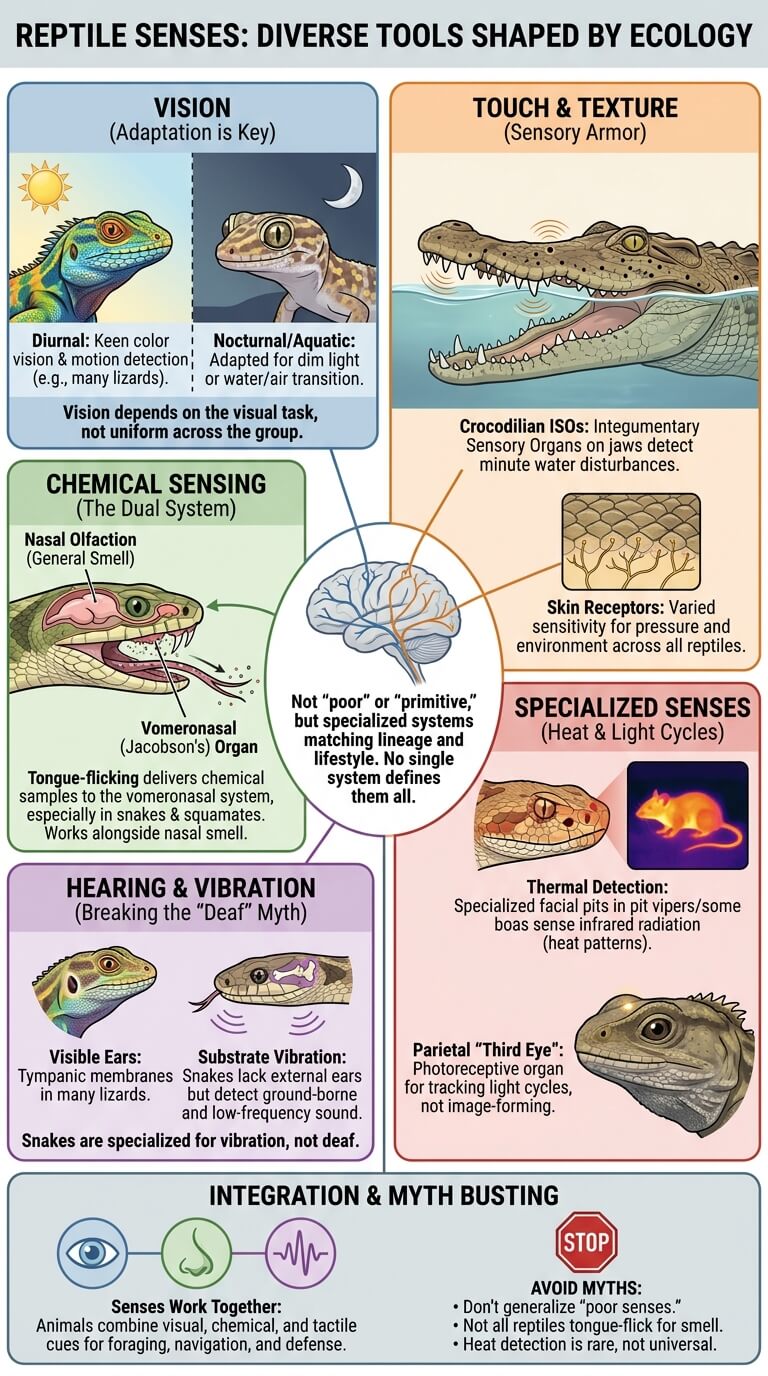
Reptile senses are far more varied than the old stereotype of a slow, poorly aware animal suggests. A day-active lizard may depend heavily on color and motion, a snake may combine chemical sampling with vibration and sound, a crocodilian can detect tiny disturbances around its jaws, and some snakes can detect thermal radiation from nearby surfaces and animals. No single sensory system defines reptiles as a whole.
The best way to understand reptile senses is to ask what information each lineage needs. Animals that hunt in bright open habitats face different sensory problems from burrowers, nocturnal geckos, aquatic turtles, ambush-hunting crocodilians, or snakes moving through leaf litter. Sensory anatomy follows those ecological demands, and different senses often work together rather than operating in isolation.
Quick Overview: Reptile Senses Are Highly Diverse
Sensory systems match ecology and lineage
Living reptiles include squamates such as lizards and snakes, turtles and tortoises, crocodilians, and tuatara. Their sensory systems share a vertebrate foundation, but the details differ greatly. Eyes vary in retinal structure and light sensitivity. Chemical sensing can involve both the nose and, especially in many squamates, a vomeronasal system. Hearing structures range from clearly visible eardrums in many lizards to the highly modified hearing pathway of snakes. Specialized skin receptors add still more variation.
This diversity means that statements such as “reptiles rely on smell” or “reptiles have poor hearing” are too broad to be useful. A reptile may emphasize vision, chemical cues, touch, vibration, sound, or a specialized sense depending on its ancestry and lifestyle. The major living reptile groups emphasize different sensory systems, so there is no single sensory profile shared by every reptile.
Why reptiles should not be described as having poor senses as a group
A sensory system does not have to resemble a human one to be effective. Snakes lack external ear openings, yet they can detect mechanical vibrations and some airborne sound. Crocodilians have armored skin, yet parts of the face are remarkably sensitive to touch and water movement. Some lizards use color signals that would be impossible without useful color discrimination.
It is more accurate to describe reptile senses as specialized. Evolution favors information that helps an animal find food, avoid predators, choose mates, navigate habitat, and regulate daily activity. A sense that seems weak by human standards may be paired with another channel that is much more important to that animal.
Vision
Color vision and daytime activity in many lizards
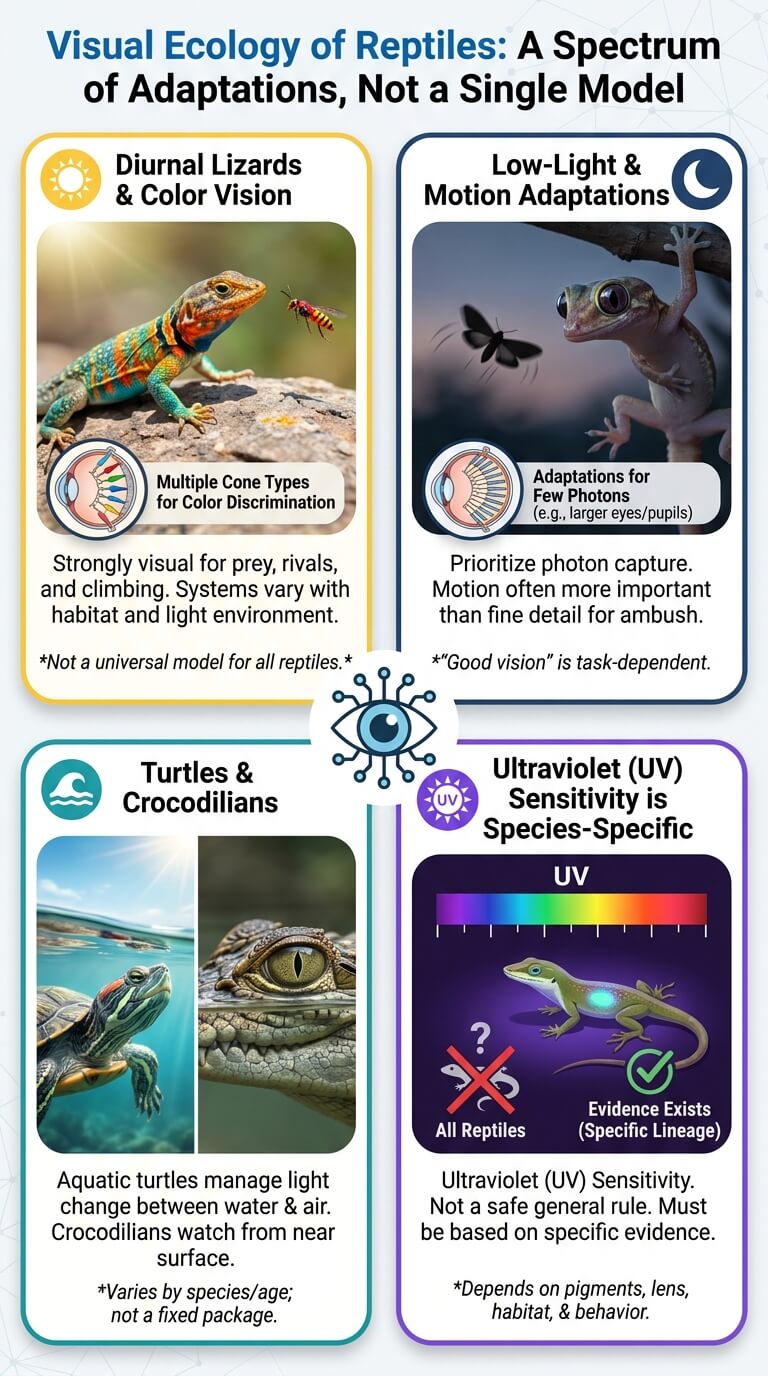
Many diurnal lizards are strongly visual animals. They watch moving prey, monitor rivals, recognize display colors, and judge distances while running or climbing. Their retinas can contain several types of cone photoreceptors, which allow color discrimination over different parts of the spectrum.
A recent review of lizard visual ecology emphasizes that visual systems differ with habitat, light environment, and evolutionary history. That variation is important. A brightly colored, day-active lizard in open habitat should not be treated as a model for every gecko, snake, turtle, or crocodilian.
Low-light and motion-sensitive adaptations
Reptiles active at night or at dusk face a different problem: finding useful visual information when fewer photons are available. Nocturnal species can evolve larger eyes, different retinal organization, pupils that admit more light, or changes in photoreceptor function. These features improve performance in dim conditions, although the exact combination varies among lineages.
Motion can also be more important than fine detail. For an ambush predator, detecting that something moved may matter more than resolving tiny markings. For an arboreal lizard, by contrast, estimating distance to a branch or prey item may be critical. “Good vision” therefore has no single meaning. It depends on the visual task.
Turtle and crocodilian visual ecology
Turtles and crocodilians also rely on vision, but their visual demands differ from those of many terrestrial lizards. Aquatic turtles must process light that changes as it passes between water and air. Crocodilians often watch from near the water surface, where eyes positioned high on the head help them monitor surroundings while much of the body remains submerged.
Vision may contribute to feeding, escape, social behavior, orientation, and daily activity in these groups. The details can vary by species and age, so it is risky to describe “turtle eyesight” or “crocodile eyesight” as one fixed package.
Why ultraviolet sensitivity must be species-specific
Some reptiles can detect ultraviolet wavelengths, but UV sensitivity is not a safe general rule. Studies have demonstrated UV-sensitive systems in particular lizards and other reptiles, while other lineages show different spectral sensitivities. Even within a group, differences in photopigments, lens transmission, habitat, and behavior can change what wavelengths are useful.
For that reason, claims such as “reptiles see ultraviolet” should always be narrowed to the species or lineage for which evidence exists.
Smell and Olfaction
Nasal olfaction across reptiles
Reptiles can detect airborne chemicals through olfactory tissues associated with the nasal passages. This is ordinary olfaction, broadly comparable in principle to smell in many other vertebrates. It can help an animal investigate food, predators, mates, shelter, nesting areas, or unfamiliar habitat.
The importance of nasal smell differs among reptiles. Crocodilians, turtles, lizards, and snakes do not all divide chemical information in the same way. That is why it is misleading to picture every reptile as “smelling with its tongue.” The tongue-based system that attracts so much attention is especially prominent in many squamates and works alongside, rather than replacing, nasal olfaction.
Odor cues in finding food, mates, and habitat
Chemical cues can remain after an animal has moved away. A scent trail, shed skin, feces, glandular secretion, or odor from prey can provide information that is not visible. This can be particularly useful in dense vegetation, burrows, leaf litter, darkness, or other settings where vision is limited.
Chemical information also matters in social behavior. Reptiles may use scent to distinguish potential mates, rivals, or occupied areas. The exact signals vary widely, and evidence should be tied to the species being discussed rather than assumed for all reptiles.
Vomeronasal Sensing and Tongue-Flicking
Jacobson’s organ or vomeronasal organ function
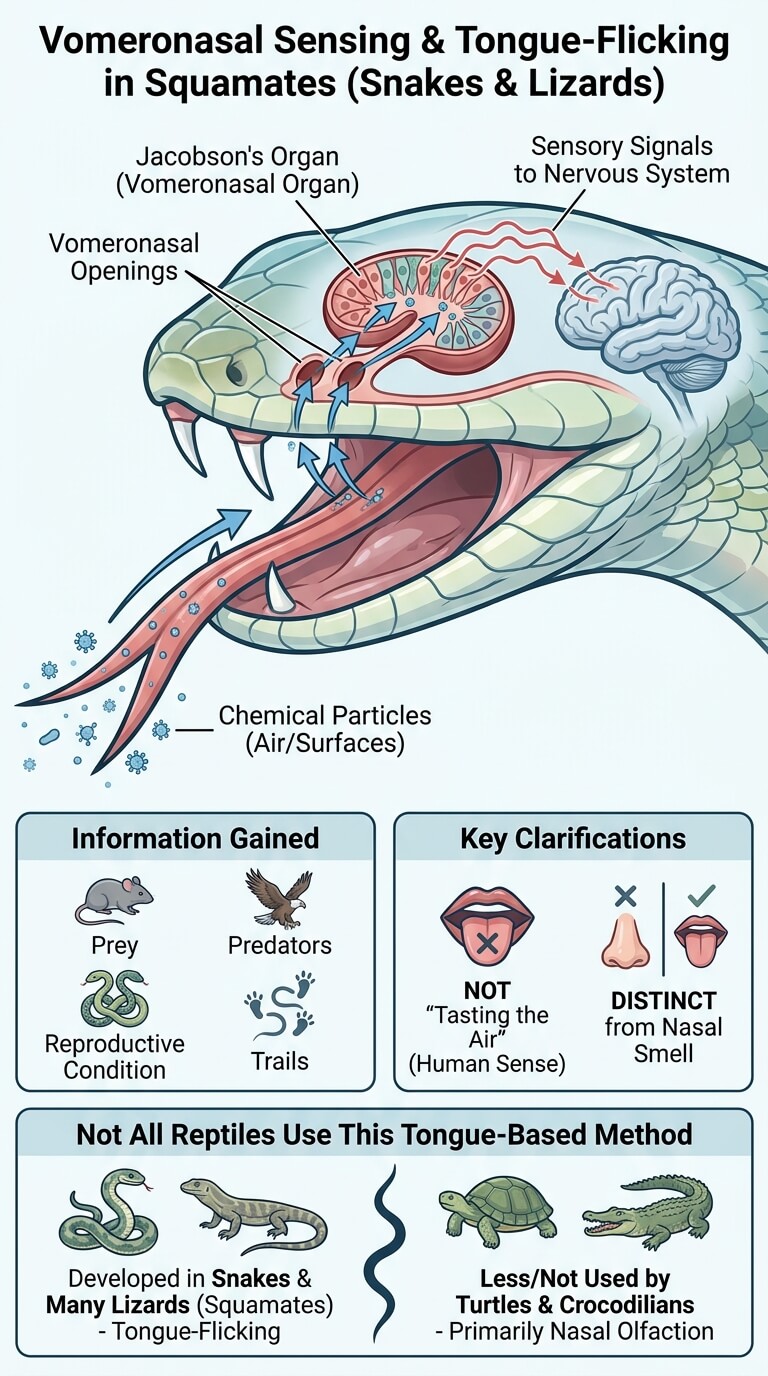
The vomeronasal organ, often called Jacobson’s organ, is a specialized chemosensory system. In many squamates, chemical particles collected from the environment are delivered to openings associated with this organ in the roof of the mouth. Sensory cells then send information to the nervous system.
The system is especially important in snakes and many lizards. It can provide information about prey, predators, reproductive condition, and trails left by other animals. It is best thought of as chemical sampling, not as a reptile literally “tasting the air” in the everyday human sense.
Tongue-flicking in many squamates
A snake or monitor lizard repeatedly flicking its tongue is actively sampling its surroundings. The tongue picks up chemical particles from air or surfaces and then brings them toward the vomeronasal openings when it returns to the mouth.
The Smithsonian National Zoo’s explanation of snake hearing and chemical sensing describes this tongue-to-Jacobson’s-organ pathway while also noting that snakes retain nasal smell. That distinction is useful because it prevents the common mistake of treating the tongue as a replacement nose.
Why not all reptiles smell with their tongues
Tongue-flicking is visually obvious in snakes and some lizards, so it often dominates popular explanations of reptile smell. But turtles, crocodilians, and other reptiles do not all use the same tongue-based sampling behavior. Even among squamates, the structure and relative importance of chemical senses vary.
A better rule is that reptiles can use several chemical-sensing routes. Nasal olfaction is widespread, while vomeronasal sampling is particularly developed in many squamates.
Hearing
External and middle-ear variation across reptiles
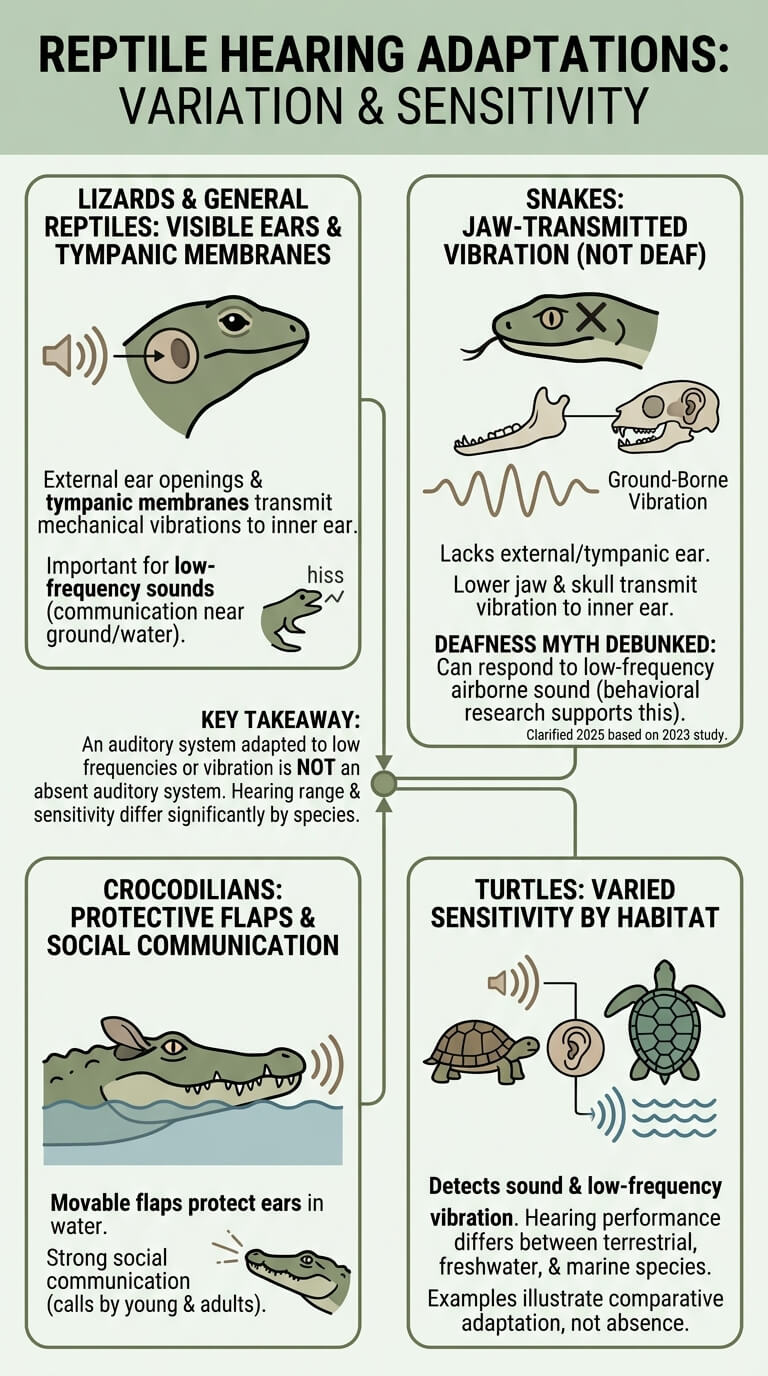
Many lizards have visible ear openings and tympanic membranes, or eardrums, on the sides of the head. Turtles and crocodilians have their own modified middle-ear structures. These systems transmit mechanical vibrations toward the inner ear, where sensory cells convert them into nerve signals.
Hearing range and sensitivity differ by species. Low-frequency sounds can be especially important in animals that communicate close to the ground or in water, while some reptiles also produce calls, hisses, or other acoustic signals.
Snakes, airborne sound, and substrate vibration without the deafness myth
Snakes do not have external ear openings or the same tympanic middle ear seen in many lizards. Their lower jaw and skull can transmit vibration to the inner ear, making ground-borne vibration especially important. That anatomy helped create the persistent myth that snakes are deaf.
Behavioral research has shown that snakes can respond to sound presented through the air, although responses vary among genera and frequencies. A 2023 study of snake responses to airborne and ground-borne sound, later corrected in 2025 to clarify genus-level behavioral patterns, supports a more accurate conclusion: snake hearing is unusual and generally best at low frequencies, but “deaf” is an oversimplification.
Crocodilian and turtle hearing as contrasting examples
Crocodilians use sound in social communication, including calls made by young animals and adults. Their ears can be protected by movable flaps, an advantage for a semiaquatic animal that moves repeatedly between air and water. Turtles also detect sound, including low-frequency vibration, but hearing performance differs among terrestrial, freshwater, and marine species.
These examples show why reptile hearing should be described comparatively. An auditory system adapted to low frequencies or vibration is not an absent auditory system.
Touch and Vibration
Skin receptors and contact sensing
Touch begins when mechanical pressure deforms skin and activates sensory receptors. Reptiles use tactile information when moving through vegetation, contacting prey, interacting during courtship, defending space, or probing surfaces with the body, snout, feet, or jaws.
The distribution of touch receptors is not uniform. Areas used for manipulating food or contacting the environment can be much more sensitive than heavily armored regions that mainly provide protection.
Substrate-borne information
Ground, branches, sand, and water can all carry mechanical energy. A reptile touching those surfaces may detect information that a human standing nearby would miss. Snakes are the most familiar example because ground vibration can reach the inner ear through the jaw and skull, but substrate sensing is relevant to other reptiles as well.
Vibration can signal approaching animals, prey movement, or environmental disturbance. Its usefulness depends on the surface. Loose sand, a rigid branch, soil, and water transmit different kinds of mechanical information.
Integumentary Sensory Structures in Crocodilians
Jaw and body sensory organs
Crocodilians possess small integumentary sensory organs, often visible as tiny spots around the jaws. These structures contain mechanoreceptors connected to sensory nerves and are extremely responsive to touch and water movement. They can help an animal detect disturbances at the water surface and evaluate objects contacted by the jaws.
A detailed study of crocodilian integumentary sensory organs found dense mechanosensory innervation and demonstrated responses to fine touch and vibration. This is a striking example of how armored skin and sensitive touch can coexist in the same animal.
Why function and distribution differ among crocodilians
The distribution of these organs is not identical across every crocodilian. In alligatorids, they are concentrated mainly around the head and jaws. In crocodiles and gharials, similar structures can occur over more of the body surface. Their exact role can also vary with position.
That variation matters because older explanations sometimes treated the structures as if they had one single function. Evidence supports mechanosensation, including water-movement detection and tactile discrimination, but broad claims about electroreception, salt sensing, or identical functions in every species require stronger species-specific evidence.
Thermal or Infrared Detection in Selected Snakes
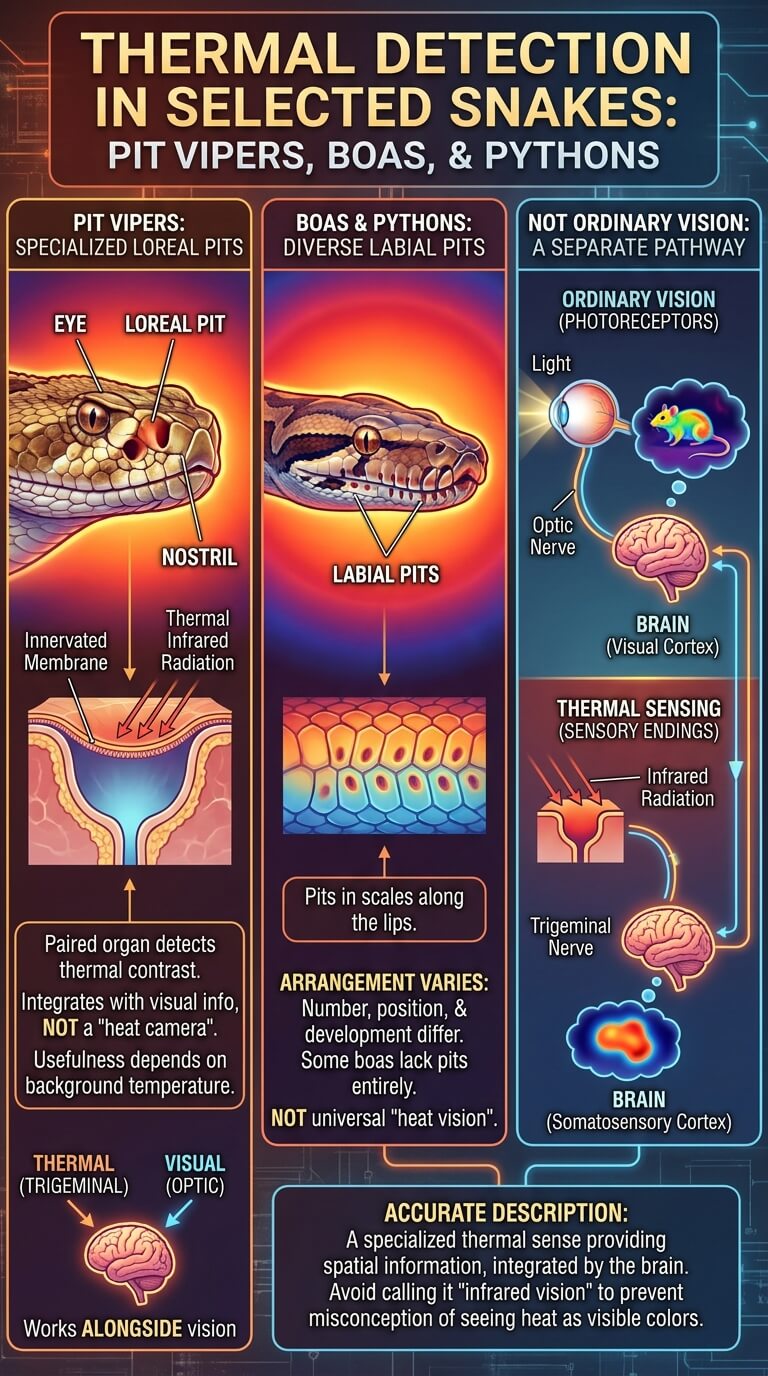
Pit vipers and heat-sensitive facial organs
Pit vipers have a paired loreal pit between the eye and nostril on each side of the head. The pit contains a thin, highly innervated membrane that responds to thermal infrared radiation. Warm and cool surfaces create patterns of thermal energy that the nervous system can use when locating prey and evaluating the thermal environment.
Research on the interaction between infrared sensing and vision in pit vipers shows that the thermal system works alongside visual information rather than acting as a magical heat camera. Background temperature and thermal contrast affect how useful the signal is.
Boas and pythons with different anatomical arrangements
Some pythons and boas also possess heat-sensitive pits, but their structures are arranged differently from the single large loreal pits of pit vipers. In these snakes, heat-sensitive organs may occur in scales along the lips. The number, position, and development of these pits vary among lineages, and some boas lack obvious thermosensory pits altogether.
That diversity is a reminder not to treat “snake heat vision” as one universal feature. Many snakes have no specialized facial heat pits.
Why thermal sensing is not ordinary vision
Thermal sensing detects infrared radiation through specialized sensory endings associated with the trigeminal nervous system. Light vision begins with photoreceptors in the eyes. The brain can integrate information from these different systems, but they are not the same sensory pathway.
Calling thermal detection “infrared vision” can be convenient shorthand, yet it risks implying that a snake’s eyes see heat as visible colors. A more accurate description is a specialized thermal sense that contributes spatial information.
Parietal and Photoreceptive Structures
Tuatara and selected lizards
Tuatara and some lizards possess a light-sensitive structure associated with the pineal complex near the top of the head. In popular writing it is often called a parietal eye or “third eye.” Its anatomy differs from the paired eyes used for ordinary vision.
The Smithsonian’s profile of the tokay gecko’s parietal eye describes a rudimentary light-sensitive structure linked with the pineal gland and notes that it does not form normal visual images. Similar photosensory structures occur in other lizard lineages and are especially prominent in young tuatara.
Why “third eye” is a potentially misleading shorthand
The phrase “third eye” makes the organ sound like an extra forward-looking camera, which it is not. Parietal structures can detect changes in light and are associated with biological timing and responses to the light environment, but they do not provide the kind of detailed image-forming vision produced by the two lateral eyes.
Functions differ among species, and scientists continue to investigate how these organs interact with circadian rhythms, seasonal biology, and thermoregulatory behavior. The safest description is photoreceptive rather than image-forming.
How Senses Work Together
Foraging and prey detection
Finding food often depends on more than one sense. A lizard may see an insect move and then use precise vision to strike. A snake may follow chemical cues, detect vibration, and use sight at close range. A pit viper can combine visual information with a thermal signal. A crocodilian near the water surface may use vision, hearing, and mechanosensation around the jaws.
Using several channels makes behavior more flexible. If light levels fall, chemical or mechanical information may become relatively more important. If a scent trail is weak, movement may provide the decisive cue.
Navigation and orientation require species-specific evidence
Reptiles can orient using landmarks, light, odors, water movement, and other environmental information. Some turtles are famous for long-distance orientation, while many terrestrial reptiles repeatedly return to familiar shelter or activity areas. However, the sensory mechanisms behind navigation differ among species and are not always fully resolved.
Claims about magnetic sensing, polarized light, or long-distance odor maps should therefore be tied to strong evidence from the species involved. A mechanism demonstrated in one turtle or lizard cannot automatically be assigned to all reptiles.
Communication and predator avoidance
Sensory systems also shape social communication. Visual displays only work if the receiver can see the relevant movement or color. Chemical signals only work if the receiver has a pathway for detecting them. Calls, hisses, substrate vibrations, touch, and body postures can all carry information in the right ecological context.
The same senses that find mates and food can warn of danger. Sudden motion, a new odor, approaching vibration, or an unfamiliar sound may trigger freezing, retreat, defensive display, or escape.
Common Myths and Mistakes
Myth: Snakes are deaf
Snakes lack external ears and do not hear in the same way humans do, but they have functional inner ears. They are especially responsive to vibration and low-frequency sound. Their hearing is specialized, not absent.
Myth: All reptiles smell with their tongues
Tongue-flicking is a major chemical-sampling behavior in many snakes and lizards, but nasal olfaction remains important, and not every reptile uses the tongue-vomeronasal pathway in the same way. Turtles and crocodilians should not be explained as oversized versions of a tongue-flicking snake.
Myth: Every snake has heat pits
Specialized heat-sensitive facial pits occur in certain snake lineages, including pit vipers and selected boas and pythons. Many other snakes lack these structures. Heat detection should never be used as a universal snake trait.
Myth: Reptiles have poor eyesight
Some reptiles have limited vision for particular tasks, especially species adapted to burrowing or darkness. Others have sophisticated color vision, strong motion detection, or visual systems well suited to dim light. “Poor eyesight” is not a meaningful class-wide description.
Myth: The parietal eye is a normal image-forming third eye
The parietal organ is light-sensitive in species that possess it, but it does not function like the paired lateral eyes. It is better understood as part of a photosensory and pineal system involved in detecting environmental light conditions.
How Sensory Systems Shape Feeding, Skin, and Communication
Skin can be both armor and a sensory surface
Reptile skin is often discussed mainly as a protective barrier, yet it also contains sensory receptors. Crocodilian integumentary organs are the clearest dramatic example, but touch and pressure sensing matter across reptiles. The skin therefore participates in both protection and information gathering.
Feeding depends on the right sensory mix
Different diets favor different information. A visual insect hunter benefits from rapid motion detection. A predator following concealed prey may depend more on chemical trails. A semiaquatic ambush predator can use ripples and touch. Sensory biology helps explain why feeding strategies differ so widely among reptiles.
Communication only works when the receiver can detect it
A head bob, dewlap display, scent mark, hiss, call, or touch signal has meaning only because another animal can detect it. Reptile communication is therefore inseparable from sensory biology. Studying the signal and the sensory system together gives a more complete picture of behavior.
FAQ
Can snakes hear airborne sounds?
Yes, snakes can detect at least some airborne sound, especially at lower frequencies, although their hearing pathway differs from that of animals with external ears and tympanic membranes. They are also highly sensitive to vibrations transmitted through the ground or another surface. Species and genera differ in sensitivity and behavioral response, so it is more accurate to say snake hearing is specialized than to say snakes are deaf.
Do all reptiles have a Jacobson’s organ?
No simple class-wide rule works here. A vomeronasal or Jacobson’s organ is especially important in many squamates, including snakes and numerous lizards, where tongue-flicking can deliver chemical particles to the system. Other reptiles rely on different combinations of nasal and accessory chemical-sensing pathways. The prominence and anatomy of the vomeronasal system vary among lineages.
Which reptiles can detect infrared radiation?
The best-known reptile thermal sensors occur in particular snakes. Pit vipers have paired loreal pits, while some pythons and boas possess heat-sensitive labial pits arranged differently around the lips. Many snakes lack specialized heat pits, and thermal sensing should not be treated as a general reptile ability. The organs detect infrared radiation as heat-related energy through specialized neural structures, not through ordinary visual photoreceptors.
Can reptiles see color?
Many reptiles can discriminate color, but visual capabilities vary greatly. Numerous day-active lizards have multiple cone types and use color in foraging or social signaling. Turtles, snakes, crocodilians, and nocturnal reptiles differ in retinal organization and spectral sensitivity. Ultraviolet sensitivity is present in some species but should never be assumed for an entire group without evidence.
Final Thoughts
Reptile senses are not a single primitive package. They are a collection of visual, chemical, auditory, tactile, vibrational, thermal, and light-sensitive systems shaped by lineage and ecology. A lizard watching a rival, a snake sampling a chemical trail, a crocodilian feeling a ripple, and a pit viper detecting thermal contrast are solving different sensory problems with different tools. Understanding those differences gives a much more accurate picture of how reptiles find food, communicate, avoid danger, and move through their environments.

Ethan Walker is the founder and research editor of Animal Fact Central. He creates and reviews educational animal facts content using trusted wildlife, pet care, and science-based sources. His work focuses on making animal behavior, adaptations, habitats, and species facts clear, accurate, and engaging for everyday readers.
Read More Details About Ethan Walker: https://animalfactcentral.com/ethan-walker/
3 thoughts on “Reptile Senses: Vision, Smell, Hearing and Heat”