
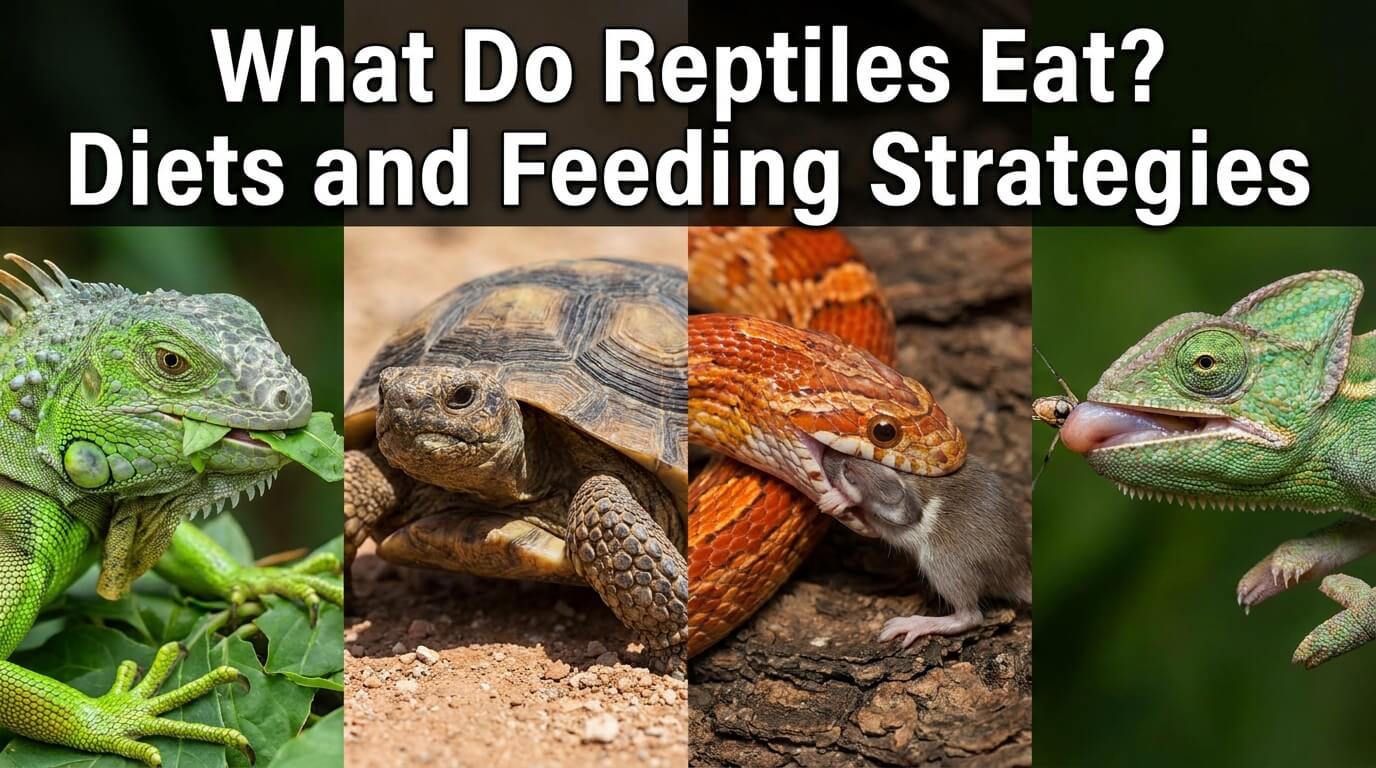
Reptiles do not share one universal diet. Living non-avian reptiles include strict predators, insect eaters, plant specialists, omnivores, scavengers, algae grazers, and species whose diets change as they grow. Snakes are mostly carnivorous, but that familiar example represents only one part of reptile feeding diversity. Turtles, lizards, crocodilians, and tuatara show just how varied reptile diets can be.
To understand what reptiles eat, it helps to look beyond simple labels such as carnivore or herbivore. A reptile’s food choices depend on its species, body size, habitat, age, season, available prey or plants, and the feeding structures it has evolved. Teeth, beaks, jaws, tongues, sensory systems, and movement patterns all shape what a reptile can find, capture, process, and digest.
Quick Answer: Reptiles Eat Far More Than Meat
Dietary diversity across living non-avian reptiles
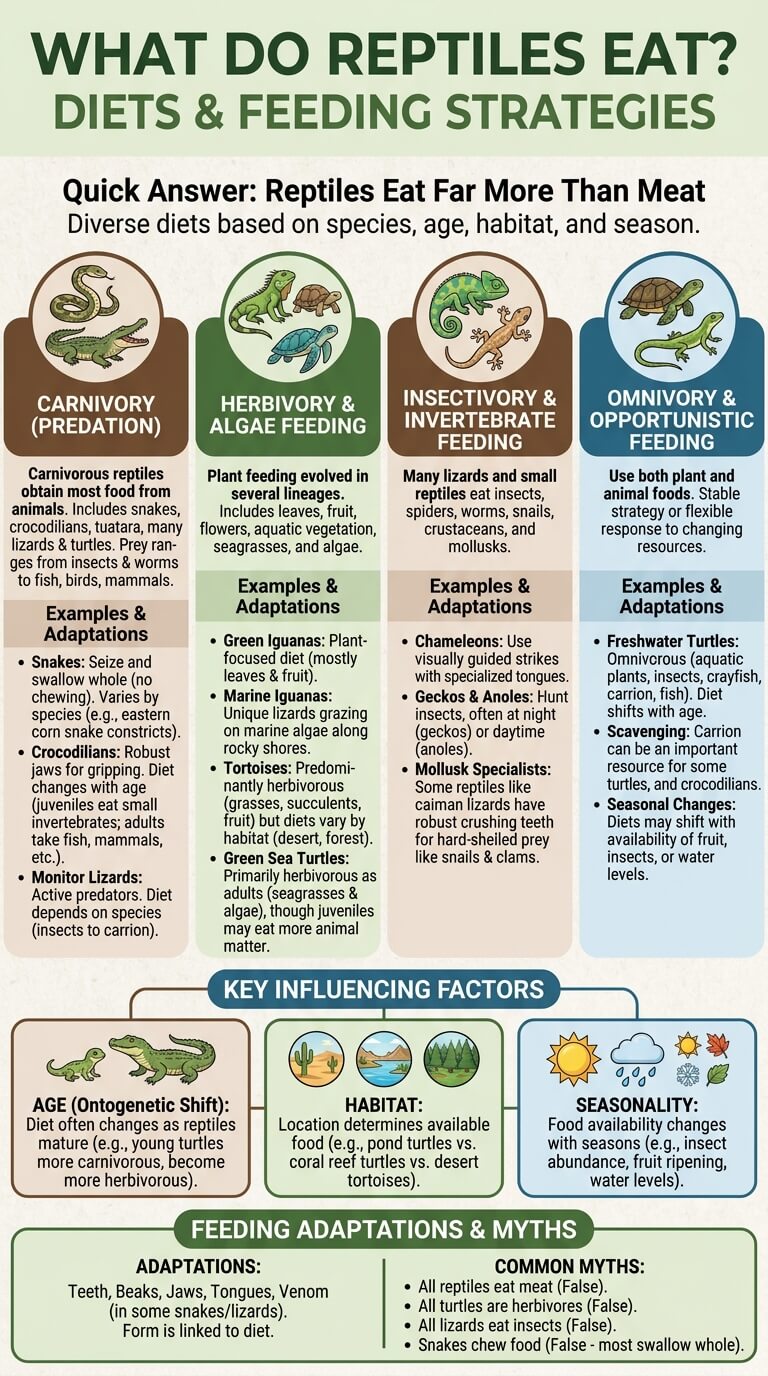
Many reptiles are carnivores, but the group as a whole uses a much wider range of foods. Depending on the species, reptiles may eat insects, spiders, worms, snails, crustaceans, fish, amphibians, birds, mammals, other reptiles, eggs, carrion, leaves, flowers, fruit, seeds, aquatic plants, seagrasses, algae, or combinations of these foods.
Some diets are broad. An omnivorous freshwater turtle may take aquatic invertebrates, small vertebrates, carrion, and plant material. Other diets are highly specialized. A marine iguana grazes mainly on marine algae, while some sea turtles specialize strongly on particular kinds of marine prey. These differences reflect ecology rather than a simple rule shared by all reptiles. The major living reptile groups contain very different feeding strategies, from predatory crocodilians and many snakes to herbivorous tortoises and iguanas.
Why diet must be discussed by species, age, habitat, and season
Even closely related reptiles may eat very different foods. The same species may also change its diet as it matures. Young reptiles often have different energy demands, mouth sizes, digestive capabilities, and foraging opportunities than adults. Habitat matters too. A turtle living in a vegetated pond has access to different foods than a turtle foraging on a coral reef or in the open ocean.
Season can also change what is available. Insects may be abundant during warm or wet periods, fruit may appear only at certain times, and aquatic prey may shift as water levels change. Reptiles that feed opportunistically can take advantage of those changes, but specialists may depend much more heavily on a limited set of foods.
A Framework for Reptile Diets

Carnivory and predation
Carnivorous reptiles obtain most of their food from other animals. This category includes nearly all snakes, crocodilians, tuatara, many lizards, and many turtles. Their prey can range from tiny insects and worms to fish, birds, mammals, and other reptiles. Size strongly influences what an individual can handle, so juveniles often take smaller prey than adults.
Predatory reptiles do not all hunt the same way. Some actively search, some wait in ambush, some probe crevices, some forage underwater, and some use chemical or visual cues to locate prey. The term carnivore therefore describes what an animal eats, not a single hunting method.
Insectivory and other invertebrate feeding
Invertebrates are major food items for many small and medium-sized reptiles. Beetles, crickets, grasshoppers, moth and butterfly larvae, spiders, termites, ants, worms, snails, and crustaceans can provide concentrated animal protein in habitats where small vertebrate prey are scarce or difficult to catch.
Some reptiles are better described as mollusk specialists, crustacean feeders, or general invertebrate predators than simply insectivores. A caiman lizard, for example, has robust rear teeth suited to crushing hard-shelled prey such as snails. Other reptiles pick soft-bodied prey from vegetation or search leaf litter for worms and arthropods.
Herbivory, folivory, and algae feeding
Plant feeding has evolved in several reptile lineages. Herbivorous reptiles may consume leaves, flowers, fruit, stems, aquatic vegetation, seagrasses, or algae. Folivores specialize heavily on leaves, while algivores or algae grazers rely on aquatic or marine algae.
Plant diets create different digestive challenges from animal prey. Tough plant tissues and cellulose are harder to break down, so herbivorous reptiles often depend on digestive anatomy, gut microbes, longer processing times, and behavioral thermoregulation that support efficient digestion.
Omnivory, frugivory, scavenging, and opportunistic feeding
Omnivores use both plant and animal foods. This can be a stable feeding strategy or a flexible response to changing resources. Fruit can be important for some lizards and tortoises, while carrion may supplement the diets of reptiles that normally hunt live prey.
Opportunistic feeding does not mean a reptile will eat anything it encounters. Jaw structure, digestive physiology, sensory preferences, body size, and habitat still limit which foods are practical. A species can be flexible within a biologically meaningful range without being a universal generalist.
Carnivorous Reptiles
Snakes as one broad example of carnivorous feeding
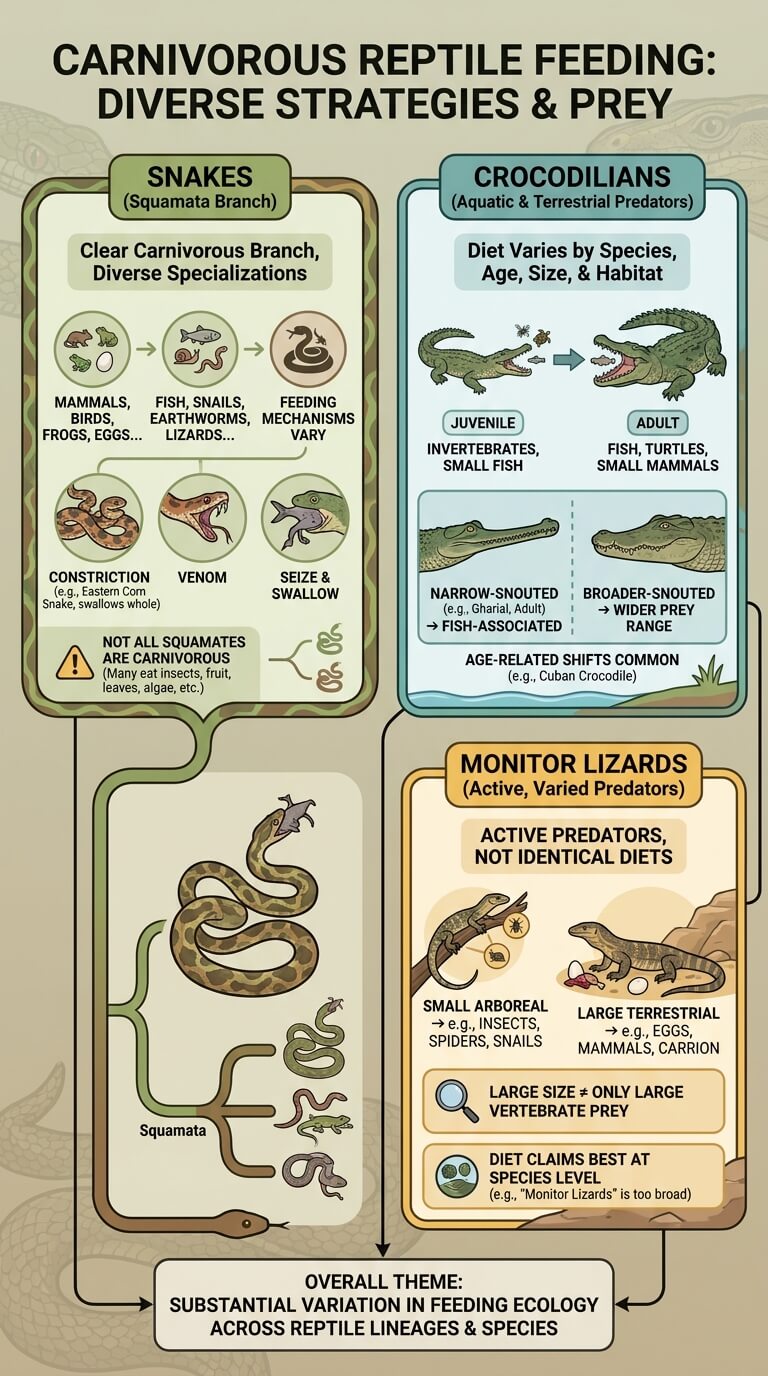
Snakes are one of the clearest carnivorous branches of reptile diversity. Different species specialize on mammals, birds, frogs, lizards, fish, eggs, snails, earthworms, or other prey. Some use constriction, some use venom, and many simply seize and swallow prey that they can subdue. The Smithsonian notes that eastern corn snakes grip prey, constrict it, and swallow it whole rather than chewing it into small pieces.
That example should not be turned into a rule for every snake. Feeding mechanisms vary substantially across snake lineages. More importantly, snakes should not define the diet of reptiles as a whole. They are one branch within Squamata, and many other squamates eat insects, fruit, leaves, algae, snails, or mixed diets.
Crocodilians and aquatic or terrestrial prey
Crocodilians are animal feeders, but their diets vary with species, age, body size, and habitat. Fish, crustaceans, insects, amphibians, reptiles, birds, and mammals can all occur in crocodilian diets. Narrow-snouted gharials are especially associated with fish as adults, while broader-snouted crocodilians may use a wider range of prey.
Juveniles often focus on small prey that they can capture efficiently. Smithsonian information on the Cuban crocodile, for example, describes juveniles taking invertebrates and small fish while adults rely more heavily on larger prey such as fish, turtles, and small mammals. That kind of age-related change is common enough to be useful, but the exact pattern differs among species.
Monitor lizards and other predatory lizards with species-level variation
Monitor lizards are often active predators, but their diets are not identical. Depending on the species and habitat, monitors may consume insects, spiders, snails, crustaceans, fish, eggs, birds, mammals, carrion, or other reptiles. Large size does not automatically mean a diet dominated by large vertebrates. Some monitors still rely heavily on invertebrates.
This variation is a good reminder that common group names can hide major ecological differences. The feeding ecology of a small arboreal monitor is not interchangeable with that of a large terrestrial monitor. Diet claims are most useful when attached to a particular species rather than to “monitor lizards” as though they all forage the same way.
Insectivorous and Invertebrate-Feeding Reptiles
Chameleons, geckos, anoles, and other arthropod feeders
Many lizards obtain much of their food from arthropods. Chameleons commonly use visually guided strikes with highly specialized tongues. Many geckos hunt insects and spiders, often at night, while many anoles take small arthropods from vegetation, trunks, or the ground. These broad patterns still contain exceptions, including species that add nectar, fruit, leaves, or vertebrate prey.
Insect feeding can be highly selective. Body size affects which prey can be swallowed, eye placement and vision affect detection, climbing ability controls access to arboreal prey, and activity timing determines whether the reptile encounters daytime or nighttime insects. Feeding is therefore closely connected with movement, senses, and habitat use.
Mollusks, crustaceans, worms, and specialized prey
Not all invertebrate-feeding reptiles focus on insects. Snails and clams can be important for turtles and specialized lizards, while crayfish and other crustaceans are common prey in freshwater environments. Earthworms and other soft-bodied invertebrates are used by many reptiles that forage in soil, leaf litter, or moist refuges.
Hard-shelled prey can favor crushing structures rather than sharp cutting teeth. Smithsonian information on caiman lizards describes a reptile that feeds heavily on snails, crawfish, and freshwater clams and uses strong rear teeth to break shells. This is very different from the feeding mechanics of a snake or leaf-eating iguana.
Herbivorous Reptiles

Green iguanas and plant-focused diets
Green iguanas are a familiar example of plant-focused feeding. Their natural diet is dominated by leaves and other plant material, with fruit also used. Animal Diversity Web describes green iguanas as primarily herbivorous, while noting that small amounts of animal matter can sometimes occur.
This distinction matters because “primarily herbivorous” is more accurate than pretending every individual consumes only plants throughout life. Diet categories describe dominant patterns. Occasional animal food does not automatically make a species ecologically omnivorous in the same way as a turtle that regularly relies on both plant and animal resources.
Marine iguanas and algae grazing
Marine iguanas of the Galápagos are unusual among living lizards because their feeding ecology is centered on marine algae. They forage along rocky shores and, depending on body size and conditions, may enter the water to reach submerged algae. Research on Galápagos ecology shows that marine iguanas normally feed on algae and can suffer severe food shortages when ocean conditions reduce algal productivity.
Their diet shows why habitat and food supply cannot be separated. A change in marine productivity can directly affect body condition and survival even though the animal itself spends much of its resting time on land.
Tortoises and plant feeding without assuming one universal tortoise diet
Many tortoises are predominantly herbivorous and feed on grasses, leaves, flowers, succulents, or fruit available in their habitat. Their diets can differ substantially between dry grasslands, scrublands, islands, and wetter environments. Some species consume occasional animal material or carrion, but plant foods dominate many tortoise feeding systems.
It is therefore safer to describe tortoises at the species level rather than offer one universal “tortoise diet.” A Galápagos tortoise, a desert tortoise, and a forest tortoise encounter different plant communities, rainfall patterns, and seasonal food supplies. Their ecological similarities do not make their menus identical.
Turtles Have Especially Diverse Diets
Freshwater turtles that shift among animal and plant foods
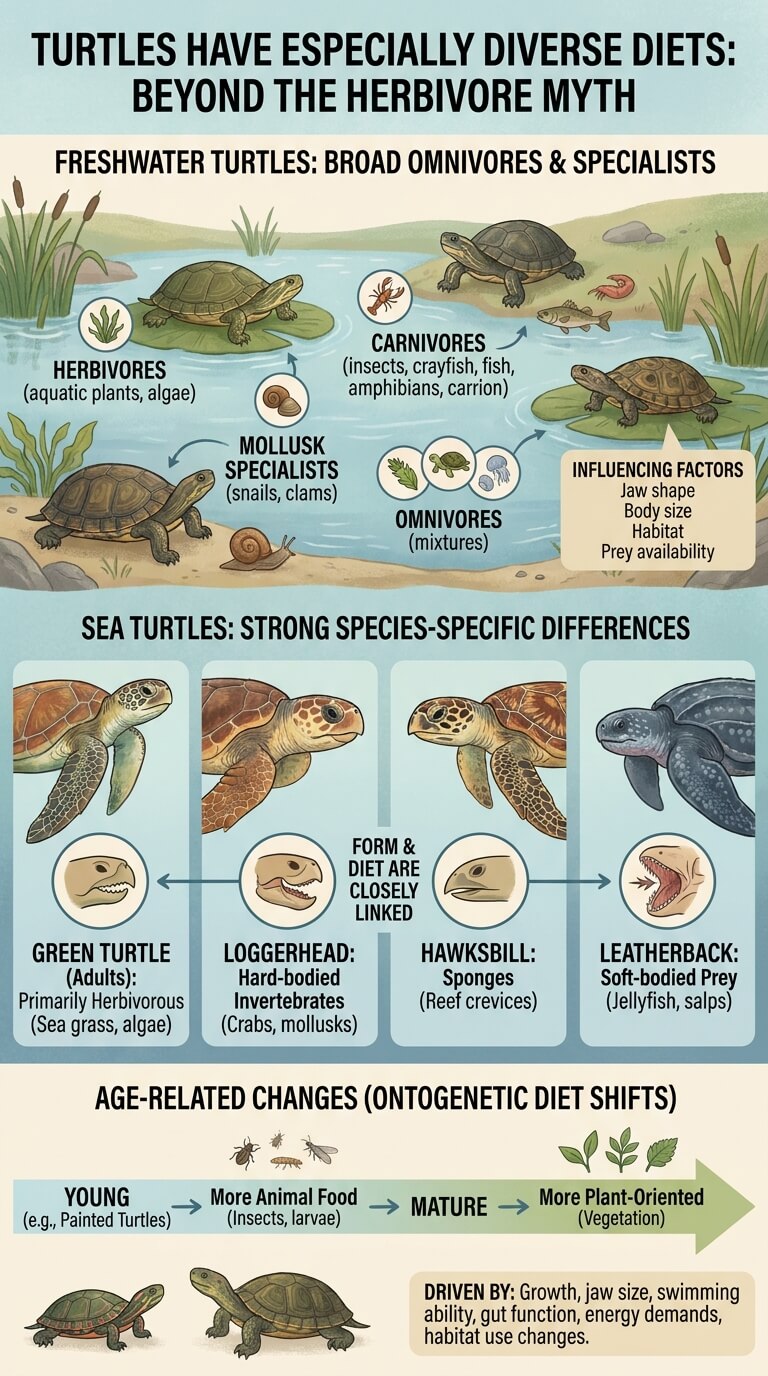
Freshwater turtles include herbivores, carnivores, mollusk specialists, and broad omnivores. Some forage on aquatic plants and algae, while others take insects, crayfish, snails, worms, fish, amphibian prey, carrion, or mixtures of these foods. The U.S. Fish and Wildlife Service describes the western pond turtle as omnivorous, eating both aquatic animal prey and plant material.
Jaw shape, body size, habitat, and prey availability all influence what a freshwater turtle can use. A species with powerful crushing surfaces may exploit hard-shelled mollusks, while another may graze vegetation or search soft sediment for invertebrates.
Sea turtle diets that differ strongly among species
Sea turtles are a particularly strong example of why “turtles are herbivores” is inaccurate. NOAA Fisheries explains that sea turtle diets vary by species: green turtles are primarily herbivorous as adults, loggerheads commonly eat hard-bodied bottom-dwelling invertebrates, hawksbills often focus heavily on sponges, and leatherbacks specialize on soft-bodied prey such as jellyfish and salps.
These feeding differences are matched by different mouth and jaw structures. A crushing jaw is useful for hard prey, a narrow beak can reach food in reef crevices, and structures inside a leatherback’s mouth and throat help retain slippery gelatinous prey. Form and diet are closely linked.
Age-related changes in diet
A reptile’s diet can shift as its body and digestive system change. Young painted turtles, for example, often rely more heavily on animal food and become more plant-oriented as they mature. Similar age-related changes occur in other turtle species, although the direction and degree of change are not universal.
These shifts are called ontogenetic diet changes. “Ontogenetic” simply means related to growth and development. Changes in jaw size, swimming ability, gut function, energy demands, and habitat use can all alter which foods are most profitable at different life stages.
Tuatara Feeding Ecology
Invertebrates and other prey
Tuatara are not lizards, even though their body shape can look lizard-like. They represent Rhynchocephalia, a distinct living reptile lineage. New Zealand’s Department of Conservation reports that tuatara diets are dominated by invertebrates such as beetles, wētā, worms, millipedes, and spiders, with lizards, seabird eggs, chicks, and occasional young tuatara also recorded.
This is a useful contrast with the stereotype that every reptile diet can be predicted from body shape. A tuatara may resemble a generalized lizard to a casual observer, but its evolutionary history and island ecology are distinct.
Island food-web context without turning tuatara into a single-species story
On islands where tuatara occur, available invertebrates, seabirds, burrows, vegetation, and introduced predators all affect the wider food web. Tuatara are consumers, but they are also prey when young. Their feeding role is therefore part of a network rather than a one-way story of predator and prey.
The same principle applies across reptiles. Diet is easiest to understand when the animal is placed inside its habitat, with real food availability, competitors, predators, and seasonal changes.
Feeding Adaptations
Teeth, beaks, jaw movements, and tongue functions
Reptile feeding structures are remarkably varied. Snakes use recurved teeth to grip prey, and some lineages add venom-delivery structures. Crocodilians have robust jaws and teeth suited to gripping and processing animal prey. Turtles lack teeth and instead use keratinized beaks whose shapes differ with diet. Lizards show everything from small pointed insect-catching teeth to broader crushing surfaces or cutting edges associated with particular foods.
Tongues also serve different roles. A chameleon can project its tongue toward prey, while many squamates use tongue-flicking mainly to collect chemical information. In other reptiles, the tongue is more involved in manipulating food. There is no single “reptile tongue” or jaw system.
Venom as a feeding adaptation in selected lineages
Venom can help selected reptiles subdue prey, but it is not a defining reptile trait. Venom systems occur in particular snake groups and in some lizards. The exact toxins, delivery structures, and ecological functions vary, so it is misleading to treat venom as one uniform mechanism shared by all venomous reptiles.
Venom also should not dominate a discussion of reptile feeding. Many successful predators use speed, ambush, constriction, jaw strength, camouflage, or simple capture and swallowing without venom.
Sensory cues used to locate food
Finding food may involve vision, smell, vomeronasal chemical sensing, hearing, vibration, touch, and in a limited number of snakes, specialized heat-sensitive organs. Which sense matters most depends on the animal and its habitat. A visually hunting lizard chasing insects on a tree trunk faces a different sensory problem from a nocturnal snake following chemical traces or a turtle searching for food underwater.
Foraging behavior often combines several senses with movement. A reptile may first detect a cue, approach or stalk, test the object at close range, and only then attempt capture. Feeding is therefore a behavioral sequence, not just the final bite.
Seasonal and Ontogenetic Diet Changes
Prey availability and habitat
Seasonal rainfall, temperature, plant growth, insect emergence, breeding cycles, and water levels can all change food availability. A reptile that feeds broadly may switch among prey types as conditions change. A specialist may have fewer alternatives and may reduce activity or rely on stored energy when its preferred food is scarce.
Habitat use can shift with food as well. Some reptiles move between shoreline and water, canopy and ground, or basking areas and feeding patches. Those movements connect diet with thermoregulation and locomotion because a reptile must be warm enough and physically capable of reaching the resource.
Juvenile versus adult dietary shifts
Young reptiles often cannot handle the same foods as adults. A small jaw limits prey size, while growth can change bite strength, digestive capacity, swimming ability, climbing ability, and foraging range. Some species become more herbivorous with age, some become more predatory, and others simply move from tiny prey to larger versions of the same general food type.
Because these changes differ among species, age should be treated as one of several variables rather than as a universal rule. “Juveniles eat meat and adults eat plants” is true for some turtles but false for many other reptiles.
Opportunistic Feeding and Scavenging
When reptiles use carrion or unexpected resources
Carrion can provide an energy-rich meal without the cost of capturing live prey. Some monitors, turtles, crocodilians, and other reptiles will use carrion when they encounter it. Fruit, eggs, or seasonal prey can likewise supplement the normal diet of species that are flexible feeders.
Unexpected foods should be interpreted carefully. One observation does not necessarily redefine a species’ normal feeding ecology. Researchers distinguish between foods that dominate a diet and rare items that appear only under unusual conditions.
Why opportunism should not be generalized to every species
Specialists may ignore foods that a generalist would readily use. Their jaws may not process them efficiently, their digestive systems may not extract enough nutrition, or their sensory systems may not identify them as food. Ecological opportunity matters only when anatomy, behavior, and physiology allow the animal to exploit it.
This is why broad statements such as “reptiles eat whatever they can catch” are misleading. Reptile diets are constrained and shaped by evolution, even when individuals show flexibility.
Common Myths and Mistakes
All reptiles eat meat
False. Carnivory is widespread, but many reptiles rely heavily on plants, algae, fruit, or mixed diets. Green iguanas, marine iguanas, many tortoises, and adult green sea turtles are familiar counterexamples. Reptile diversity cannot be summarized by the feeding habits of snakes and crocodilians.
All turtles are herbivores
False. Turtle diets range from strongly plant-focused to highly carnivorous. Freshwater turtles may eat insects, snails, crayfish, fish, carrion, and plants. Sea turtles include algae and seagrass grazers as well as sponge feeders, hard-prey specialists, and consumers of gelatinous animals.
All lizards eat insects
False. Insects are important to many lizards, but the group also includes herbivores, fruit eaters, algae grazers, mollusk predators, scavengers, and vertebrate predators. Even within one family, different species may occupy very different feeding roles.
Snakes chew food
Snakes generally do not chew food into small pieces the way mammals do. Their teeth mainly help seize, hold, or manipulate prey, and many snakes swallow prey whole. Some species have highly specialized feeding systems, so the safer generalization is that snake jaws and teeth are adapted for capture and swallowing rather than mammal-style mastication.
How Feeding Fits Reptile Ecology and Survival
Diet shapes food-web roles
What a reptile eats influences its role as predator, herbivore, scavenger, or prey competitor. A snake that hunts rodents occupies a different feeding position from a tortoise dispersing seeds, a sea turtle grazing seagrass, or a small gecko consuming insects. Reptiles participate at many levels of food webs rather than occupying one universal predator role. These feeding strategies also shape the ecological roles of reptiles as predators, herbivores, scavengers, prey, and participants in food webs.
Senses and behavior guide foraging
Diet is closely tied to behavior. Visual hunters need suitable light and vantage points. Chemically oriented foragers may follow scent trails. Ambush predators benefit from camouflage and patience. Active foragers need movement systems that let them search efficiently. The food item alone tells only part of the story.
Habitats determine which foods are available
A desert, tropical forest, freshwater wetland, mangrove, coral reef, rocky island, and open ocean provide very different feeding opportunities. Reptiles survive in these environments partly because their feeding strategies match the resources available there. When habitats change, food supplies can change with them.
FAQ
Are any reptiles vegetarian?
Yes. Several reptiles are predominantly herbivorous, including green iguanas, marine iguanas, many tortoises, and adult green sea turtles. “Herbivorous” does not always mean that no animal material is ever consumed, but plant or algal foods make up the central part of the diet in these species.
Do reptiles eat every day?
Not necessarily. Feeding frequency varies enormously with species, body size, meal size, temperature, activity, life stage, and season. A small insect-eating lizard may forage frequently, while a large snake can go much longer between substantial meals. Wild reptiles should not be assigned one universal feeding schedule.
Do reptiles change diet as they grow?
Many do, but not all in the same way. Some freshwater turtles shift from a more animal-heavy juvenile diet toward more plant material as adults. Other reptiles simply graduate to larger prey as their jaws and bodies grow. Age-related diet change should therefore be evaluated species by species.
Are sea turtles herbivores?
Some are largely herbivorous as adults, but sea turtles as a group are not. Adult green turtles commonly feed on seagrasses and algae, while loggerheads, hawksbills, and leatherbacks use very different foods. Species identity is essential when describing sea turtle diet.
Final Thoughts
So, what do reptiles eat? Almost every major food category found in animal ecosystems appears somewhere in reptile feeding ecology. Some reptiles hunt vertebrates, some specialize on insects or mollusks, some graze leaves or algae, and others combine plant and animal foods. Diet can also change with age, season, habitat, and local food availability. The most accurate way to understand reptile feeding is therefore to ask not only what a reptile eats, but which species it is, where it lives, how it finds food, and which anatomical and behavioral tools make that diet possible.

Ethan Walker is the founder and research editor of Animal Fact Central. He creates and reviews educational animal facts content using trusted wildlife, pet care, and science-based sources. His work focuses on making animal behavior, adaptations, habitats, and species facts clear, accurate, and engaging for everyday readers.
Read More Details About Ethan Walker: https://animalfactcentral.com/ethan-walker/