
Mammal migration is a regular, often seasonal movement between places that provide different necessities at different times of year. A herd may travel between winter and summer ranges, a bat may move between breeding and overwintering regions, and a whale may alternate between productive feeding waters and warmer calving areas. The journey is not movement for its own sake. It is a way of matching food, water, shelter, reproduction, and safety with a changing environment.
Migrations can be short or immense, direct or winding, solitary or social. Some mammals travel every year, while others migrate only when conditions favor it. Individuals from the same population may even use different strategies. Understanding mammal migration therefore means looking at timing, navigation, energy, memory, barriers, and the full annual cycle rather than collecting distance records.
Quick Answer

Migration Is Regular Movement Between Important Areas
Biologists usually recognize migration by its direction, timing, and repeated ecological purpose. A migrating mammal leaves one important area and moves toward another, often returning later or repeating a similar seasonal pattern. The destinations may include feeding grounds, breeding areas, nursery habitat, winter shelter, or reliable water.
Routes can become essential parts of a population’s life. The U.S. Geological Survey overview of migration corridors explains that many animals follow population-specific pathways between seasonal habitats. Protecting only the endpoints may not be enough when the animals must also cross the landscape or ocean between them.
Not Every Long Trip Counts as Migration
A mammal can travel far without migrating. A young animal leaving its birth area to establish a new home is dispersing. A predator roaming widely within its territory is making routine movements. A herd wandering unpredictably after scattered rainfall may be nomadic rather than following a fixed seasonal route.
The boundaries are not always sharp. A movement can be partly migratory and partly opportunistic, especially where rainfall, snow, wildfire, human disturbance, or food pulses vary from year to year. The useful question is not simply, “How far did it go?” It is whether the movement regularly connects places that serve different seasonal functions.
Why Mammals Migrate
Food and Water
Seasonal resources are one of the strongest drivers. Hoofed mammals may follow new plant growth as snow retreats or rains turn dry ground green. Insect-eating bats may move toward regions where flying insects remain abundant. Marine mammals may travel toward feeding areas where currents, sea ice, upwelling, or prey concentrations make foraging more productive.
Water can be equally decisive in dry environments. Herds may shift between wet-season and dry-season ranges or converge on rivers, springs, and floodplains. These movements are not always clockwork. Rainfall can arrive early, late, or unevenly, so animals may combine seasonal memory with current information about vegetation and water.
Breeding, Birth, and Nursery Areas
Migration often separates feeding from reproduction. A place rich in food is not automatically the safest place to give birth. Calving or nursery areas may offer warmer water, reduced predator pressure, gentler terrain, protective cover, or access to other adults. The trade-off is that adults may feed less during part of the reproductive season.
Timing can differ among age and sex classes. Pregnant females, males competing for mates, juveniles, and nonbreeding adults do not always leave together or use identical routes. In some populations, females with newborns move more slowly or choose safer terrain, while other individuals prioritize speed or access to mating opportunities.
Temperature, Snow, Rainfall, and Seasonal Risk
Mammals also migrate to escape conditions that make normal life too expensive or dangerous. Deep snow can cover forage and increase the cost of walking. Drought can empty water holes. Heat can reduce daytime activity and alter plant or prey availability. Storms and sea ice can change access to marine feeding areas.
Migration is one possible response, not the only one. Other mammals remain in place and rely on insulation, food storage, hibernation, torpor, burrows, social huddling, or dietary flexibility. Whether migration is worthwhile depends on the benefits at the destination compared with the energy and danger of getting there.
Different Forms of Mammal Migration
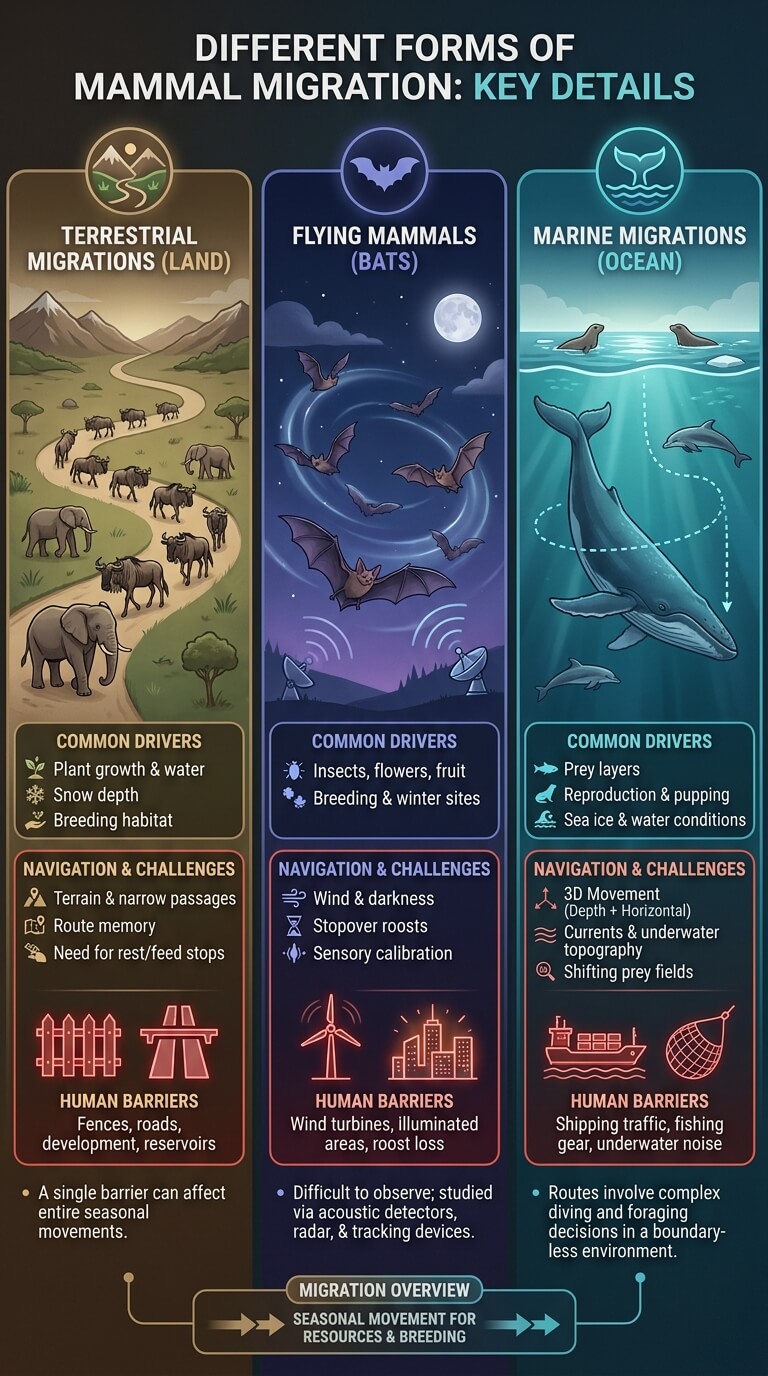
Terrestrial Migrations
Land migrations are shaped by terrain. Deer, elk, pronghorn, caribou, wildebeest, zebra, saiga, elephants, and other mammals may cross valleys, mountains, plains, deserts, rivers, or human-dominated land. Some travel in large herds, while others move as individuals or small family groups.
Terrestrial routes often include narrow passages where geography and development leave few alternatives. A fence, highway, reservoir, settlement, or steep slope can therefore affect an entire seasonal movement. Migrating mammals may also need temporary places to rest and feed, not just an uninterrupted line between two endpoints.
Flying Mammal Migrations
Bats are the only mammals capable of sustained powered flight, and many species use that ability seasonally. Some migrate between summer maternity areas and winter regions. Others move to follow flowers, fruit, or insects. A species may migrate in one part of its range but remain resident or hibernate elsewhere.
Bat migration can occur at night and at altitudes or over routes that are difficult to observe from the ground. Researchers use acoustic detectors, radar, stable isotopes, bands, radio transmitters, and miniature tracking devices to study it. Because bats are diverse, no single route, altitude, season, or navigation method applies to the whole order.
Marine Mammal Migrations
Whales, dolphins, seals, sea lions, and other marine mammals move through an environment without roads or visible boundaries. Their routes may connect feeding areas, breeding grounds, pupping beaches, haul-out sites, and seasonal ice edges. Coastlines can guide some journeys, while others cross open ocean.
Marine movement is three-dimensional. An animal can change depth as well as horizontal position, and it may respond to currents, water temperature, prey layers, underwater topography, sea ice, and sound. A route that looks simple on a flat map can involve complex diving and foraging decisions.
| Migration setting | Common drivers | Navigation challenges | Frequent human barriers |
|---|---|---|---|
| Land | Plant growth, water, snow depth, breeding habitat | Terrain, changing vegetation, route memory | Roads, fences, development, reservoirs |
| Air | Insects, flowers, fruit, breeding and winter sites | Wind, darkness, stopover roosts, sensory calibration | Wind turbines, illuminated areas, roost loss |
| Ocean | Prey, reproduction, sea ice, water conditions | Open water, currents, depth, shifting prey fields | Shipping, fishing gear, noise, coastal disturbance |
How Mammals Know When to Move

Day Length and Internal Rhythms
Day length changes predictably with the seasons, making it a useful timing signal even before local weather shifts. In some mammals, changing photoperiod affects hormones, appetite, reproduction, coat growth, fat storage, and restlessness. Internal daily and annual rhythms help organize these responses.
Photoperiod is not a universal departure command. A mammal may become physiologically ready to migrate but wait for favorable weather, body condition, food, or social conditions. Tropical mammals may respond more strongly to rainfall and plant cycles than to large changes in day length.
Weather, Vegetation, Prey, and Water Cues
Immediate environmental cues help refine departure and pace. Snowmelt can open mountain passes. Fresh plant growth can spread across elevation in a moving wave. Insects may become active after warm nights. Ocean temperature fronts can concentrate prey. Rain can create temporary grazing or drinking opportunities.
Animals do not necessarily chase the single greenest or richest place at every moment. They must balance food with travel costs, predators, competition, reproductive condition, and the risk of arriving too early. Migration timing is a decision under uncertainty, not a perfect response to one signal.
Social Information and Learned Routes
Young mammals can learn where and when to move by following experienced individuals. Mothers, older herd members, and familiar neighbors may provide information about crossings, stopover areas, water, seasonal ranges, and dangerous places. Social learning is especially valuable in landscapes where the best route is not obvious.
A Science study of translocated ungulates found strong evidence that learning and cultural transmission help migrations develop. Newly established populations did not immediately reproduce the sophisticated seasonal movements of long-established herds. Route knowledge accumulated over time as animals learned how to track changing forage.
How Mammals Navigate

Landmarks, Smell, Sound, and Memory
Many mammals navigate with combinations of familiar landmarks and memory. Ridges, rivers, coastlines, valleys, vegetation edges, caves, roosts, and human structures can all provide spatial information. Smell may identify a home area, water, social groups, or local habitat. Sound can reveal coastlines, colonies, running water, or other animals.
Memory does more than store a line on a map. An experienced animal may remember when a route usually opens, where it can rest, which crossing is dangerous, and how conditions differ between years. This is one reason older individuals can matter disproportionately to group movement.
Sun, Stars, Polarized Light, and Magnetic Cues
Celestial and magnetic navigation attract attention because humans cannot directly sense all of the same information. Evidence from animals shows that the sun, star patterns, polarized light, and Earth’s magnetic field can contribute to orientation. For mammals, however, support varies greatly by species and experimental method.
Some bats have shown magnetic orientation, and researchers have proposed that sunset or polarized-light information may help calibrate a compass. Yet bats also use vision, echolocation, smell, wind, memory, and landscape structure. A peer-reviewed review of bat movements emphasizes that bat navigation is multisensory and that major gaps remain. Magnetic sensing should not be presented as the proven master system for all migrating mammals.
Oceanographic and Acoustic Cues
Marine mammals move through a world where visibility may be limited but sound travels efficiently. Calls, echoes, surf, ice noise, seafloor features, and the acoustic character of coastlines may contribute to orientation. Large-scale currents, temperature gradients, salinity, prey distribution, and underwater topography can also provide repeatable patterns.
Scientists are still working out which cues animals actively use as a map or compass and which simply correlate with a preferred habitat. A whale following productive water might appear to follow a temperature boundary without sensing temperature as a navigational coordinate. Careful experiments are difficult in large, free-ranging marine mammals.
Energy Costs and Physiological Preparation
Fat Storage and Feeding Before Migration
Travel requires fuel. Many mammals increase feeding or build fat reserves before departure. Fat stores a large amount of energy for its mass, which is useful when carrying extra weight has a cost. Migrants may also change muscle function, metabolism, water balance, and daily activity as the season approaches.
Preparation depends on feeding opportunities. A bat leaving an insect-rich region may fuel differently from a whale departing a productive feeding ground or a deer moving while continuing to graze. Some mammals complete long sections while fasting, but many feed along the way whenever conditions allow.
Pace, Rest, Stopover, and Recovery
Fast movement is not always efficient. Migrants may alternate travel days with rest and feeding, slow down in productive habitat, or wait for favorable wind and weather. Stopover areas can be small yet crucial because they allow animals to rebuild reserves before the next demanding section.
Recovery also matters after arrival. An animal may need to restore body condition before mating, giving birth, lactating, growing a new coat, or surviving winter. Poor conditions at one stage can carry over into later stages of the annual cycle.
Pregnancy, Lactation, and Migration Trade-Offs
Reproduction raises energy needs and can limit speed or endurance. Pregnant females carry additional mass, while lactating females must produce milk and remain near dependent young. Some species time migration so that birth occurs after arrival. Others move with calves or pups, creating a slower and more vulnerable group.
There is no single best schedule. A female may gain safer nursery habitat but lose feeding time. A young animal may gain protection by traveling with adults but face exhaustion at a crossing. These trade-offs help explain why migration timing can vary by sex, age, and reproductive state.
Representative Migration Patterns

Herding Ungulates and Seasonal Ranges
Many hoofed mammals move between seasonal ranges as snow, rain, plant growth, and water change. Mountain populations may descend to lower elevations in winter and return upward in spring. Plains and desert populations may track rainfall or use traditional corridors between grazing and water.
Herding can reduce the chance that one individual must discover every safe route alone, but large groups also need substantial food and space. Migration may be partial, with some members remaining resident while others travel. That flexibility can spread risk across a population.
Bats and Aerial Routes
Bat migrations range from regional movements between roosts to journeys that cross countries. Insectivorous bats may leave areas where winter eliminates flying prey. Nectar-feeding bats can follow waves of flowering plants. Tree-roosting bats may rely on networks of temporary roosts rather than one cave at each end.
Some bats hibernate, some migrate, and some combine both strategies. A bat may migrate to a suitable hibernation region rather than remaining active through winter. Other populations stay in warmer areas where food remains available. Species name, location, sex, and season are therefore essential when describing a bat’s winter behavior.
Whales, Seals, and Other Marine Examples
Baleen whales provide familiar examples of movement between high-latitude feeding grounds and lower-latitude breeding or calving waters, but routes and reasons differ among species and populations. Some individuals skip or alter migrations, and feeding can occur during travel.
Eastern North Pacific gray whales illustrate the scale without defining every marine migration. NOAA reports that this population travels roughly 12,000 miles round trip between Arctic feeding areas and warmer Mexican waters used in winter and for calf rearing. The NOAA Fisheries gray whale overview also shows why dates, population identity, and route definitions matter when quoting a distance.
Seals and sea lions may move between offshore feeding areas and land or ice used for resting, molting, mating, or pupping. Their annual movements can include long ocean trips and repeated returns to specific colonies. These patterns should not be assumed for every seal species or every age class.
Barriers and Modern Disruption
Roads, Fences, Dams, Shipping, Noise, and Habitat Fragmentation
Migration depends on continuity. Roads can cause collisions or make animals hesitate. Fences can block or funnel herds. Reservoirs, canals, and dense development can remove traditional crossings. In the ocean, ship traffic, fishing gear, industrial activity, and coastal construction can add collision, entanglement, noise, or displacement risk.
A barrier does not need to stop every animal to matter. Repeated delay, stress, detours, or loss of resting habitat can increase energy costs. A route may still appear on a map while becoming less successful for pregnant females, young animals, or individuals in poor condition.
Artificial Light and Altered Timing
Artificial light changes nighttime conditions around cities, roads, coastlines, and industrial facilities. Light-sensitive mammals may avoid illuminated areas, delay leaving a roost, or change where they feed. Other species may exploit insects attracted to lights, which can create a benefit in one setting and a trap in another.
For migrating bats, light can interact with buildings, turbines, weather, prey, and roost availability. Effects differ by species and light type. It is more accurate to say that artificial lighting can alter movement decisions than to claim that it stops all nocturnal migration.
Climate-Driven Mismatches and Uncertainty
Climate change can shift snowmelt, rainfall, plant growth, insect emergence, sea ice, currents, and prey distribution. Migrants may adjust departure, route, pace, or destination, but different cues do not always change together. Day length remains stable while temperature and vegetation timing move.
The USGS assessment of ungulate migration in a changing climate describes both observed changes and major uncertainties. Effects differ among landscapes and populations. Some mammals may track new conditions, while others face a mismatch between inherited timing, learned routes, barriers, and shifting resources.
Migration, Dispersal, Nomadism, and Daily Movement
How the Terms Differ
| Movement type | Main pattern | Typical ecological role |
|---|---|---|
| Migration | Directed, repeated movement between areas | Connects seasonal feeding, breeding, nursery, or winter habitat |
| Dispersal | Movement away from a birth or former home area | Establishes a new range and can reduce competition or inbreeding |
| Nomadism | Flexible movement without a consistently repeated route | Tracks unpredictable rain, food, water, or prey |
| Daily movement | Regular travel within a home range | Connects resting, feeding, drinking, or social sites |
These terms describe patterns, not value judgments. A short seasonal movement can be migration, while a much longer one-way movement can be dispersal. Distance alone does not determine the category.
Why Real Animal Movement Can Fall Between Categories
Animals do not organize behavior to fit human labels. A herd may follow the same broad seasonal direction but choose different branches after rainfall. A bat may migrate in autumn, move among several winter roosts, and disperse to a new breeding region in spring. A marine mammal may combine seasonal travel with continuous foraging.
Modern tracking makes these mixed strategies easier to see. Platforms such as the Movebank animal tracking database allow researchers to manage and share movement records from tagged animals. Tracks reveal individual variation that may be hidden when observations are limited to a few locations.
Common Myths and Mistakes
Migration Is Not Always North to South
Some mammals move east to west, uphill and downhill, inland and offshore, or between wet and dry regions. Tropical migrations can follow rainfall rather than winter cold. Marine routes may curve with coastlines, currents, sea ice, or prey.
Even a generally north-south migration rarely forms a straight line. Animals detour around hazards, stop to feed, follow terrain, and respond to weather. Direction must be described for a specific population and season.
Every Individual Does Not Necessarily Migrate
Partial migration occurs when some members of a population migrate while others remain resident. The decision may relate to age, sex, dominance, body condition, pregnancy, competition, weather, or local food. An individual can also change strategy between years.
This variation can help a population cope with uncertainty, but it complicates simple statements such as “the species migrates.” A better description identifies which population migrates, when it moves, and how much individual variation researchers have observed.
Famous Distance Records Require Careful Definitions
Migration distances depend on what is measured. A straight line between endpoints, the full tracked path, one-way travel, round trip, and annual cumulative movement can produce very different numbers. Tracking duration and device accuracy also matter.
Record claims can become outdated as new tags reveal longer routes or different populations. Distances are most useful when they explain the biological challenge, not when they turn migration into a contest.
Seasonal Strategies and Life-Cycle Connections
Hibernation as an Alternative Seasonal Strategy
Migration and hibernation solve a similar problem in different ways. A migrant moves toward favorable conditions. A hibernator stays and dramatically reduces energy use. Some mammals use neither, relying instead on insulation, food caches, flexible diets, or sheltered microhabitats.
The strategies can also combine. Some bats migrate to hibernation sites. A large herbivore may make a shorter movement when winters are mild and a longer one when snow is deep. Thermoregulation, food availability, body size, and mobility all influence which option is possible.
Communication, Reproduction, and Conservation Along Routes
Migration is embedded in social and reproductive life. Calls, scent, visual signals, and group movement can help mammals maintain spacing or contact. Arrival time may affect access to mates, nursery areas, food, or shelter. Young animals may learn routes while traveling with adults.
Conservation must therefore protect processes as well as places. Seasonal ranges, corridors, stopover habitat, quiet calving areas, safe road crossings, unobstructed flight paths, and lower-risk ocean routes can all matter. Wildlife viewers should keep legal distances from herds, roosts, haul-outs, mothers, and young, especially at narrow passages where disturbance can force costly detours.
FAQ
How Do Mammals Navigate During Migration?
Mammals usually combine several systems rather than relying on one sense. Depending on the species, these may include landmarks, memory, smell, sound, echolocation, sun position, wind, water conditions, social information, and possibly magnetic cues. Experienced animals can also remember route timing, crossings, and feeding areas.
The evidence is uneven. A mechanism demonstrated in one bat or rodent should not be applied to every mammal. Navigation may also change with age, weather, route familiarity, and whether the animal is traveling over land, through air, or across open ocean.
Do Bats Migrate or Hibernate?
Both patterns occur. Some bats migrate to warmer areas where food remains available. Others hibernate near their summer range. Some migrate to a region with suitable caves or mines and then hibernate there. The same species may use different strategies in different parts of its range.
Because winter behavior is species-specific, a bat found near a home should not be assumed to be migrating, hibernating, sick, or harmless. Avoid bare-hand contact and contact a wildlife agency or licensed professional when a bat is grounded, trapped indoors, or in a place where people or pets may be exposed.
Why Do Some Herd Mammals Follow the Same Routes Each Year?
Traditional routes can connect reliable seasonal resources while avoiding difficult terrain. Experienced herd members remember crossings, water, stopover habitat, and the timing of plant growth. Young animals can acquire this information by following adults.
Repeated use does not mean the path is unchangeable. Fire, drought, snow, fences, roads, predators, and development can force detours. If experienced animals or route access are lost, rebuilding a complex migration can take time.
How Does Climate Change Affect Mammal Migration?
Climate change can alter the timing and location of snowmelt, rainfall, vegetation, insects, sea ice, currents, and prey. Mammals may leave earlier, arrive later, shorten a route, extend a route, change elevation, or remain resident more often. Responses vary among species and populations.
The greatest difficulty may occur when cues change at different rates or when animals cannot reach newly suitable habitat because of roads, fences, development, or ocean hazards. Researchers should be consulted for population-specific conclusions because broad predictions do not describe every migration.
Final Thoughts
Mammal migration is a flexible solution to seasonal change. It connects the places where animals feed, breed, give birth, rest, and survive difficult weather. Successful journeys depend on more than endurance. Mammals must time departure, gather fuel, interpret multiple cues, remember or learn routes, and pass through landscapes or oceans that may be changing rapidly.
The most accurate way to understand a migration is to ask which population is moving, what seasonal need the journey serves, how the route was measured, and how much individuals vary. That approach reveals migration not as a simple instinctive march, but as an annual process shaped by physiology, learning, environment, and conservation.

Ethan Walker is the founder and research editor of Animal Fact Central. He creates and reviews educational animal facts content using trusted wildlife, pet care, and science-based sources. His work focuses on making animal behavior, adaptations, habitats, and species facts clear, accurate, and engaging for everyday readers.
Read More Details About Ethan Walker: https://animalfactcentral.com/ethan-walker/