
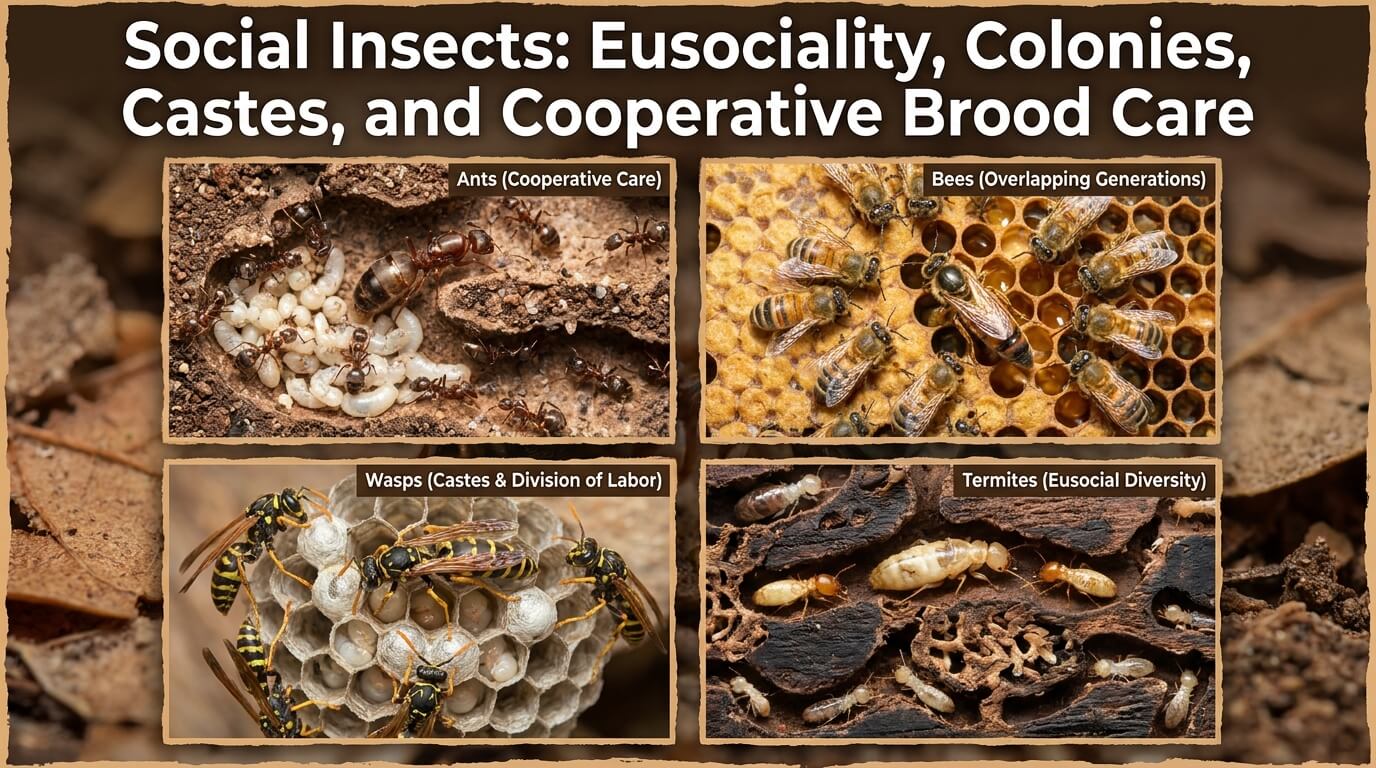
Social insects show some of the most coordinated behavior in the animal world, but not every insect that gathers with others is truly social in the biological sense. Ants, termites, honey bees, some other bees, and some wasps can form societies in which individuals cooperate to raise young, generations overlap, and reproduction is divided among colony members. These features are commonly used to define eusociality, an especially organized form of social life.
The important point is that insect societies are not miniature human kingdoms. A queen is primarily a reproductive individual, not a commander. Workers do not all have identical roles or reproductive abilities. Soldier castes occur in some lineages but not others. Many bees and wasps are solitary, while termites follow a very different developmental and reproductive system from ants, bees, and wasps. Understanding those differences makes social insect biology far more interesting than the familiar queen-worker stereotype.
Quick Answer
Not every group-living insect is eusocial
Insects can gather for many reasons without forming a society. Lady beetles may aggregate for overwintering, caterpillars may feed together, and adult insects may crowd around flowers, sap, dung, carrion, lights, or shelter. Those gatherings can be temporary and may involve little cooperation. Even insects that share a nest are not automatically eusocial.
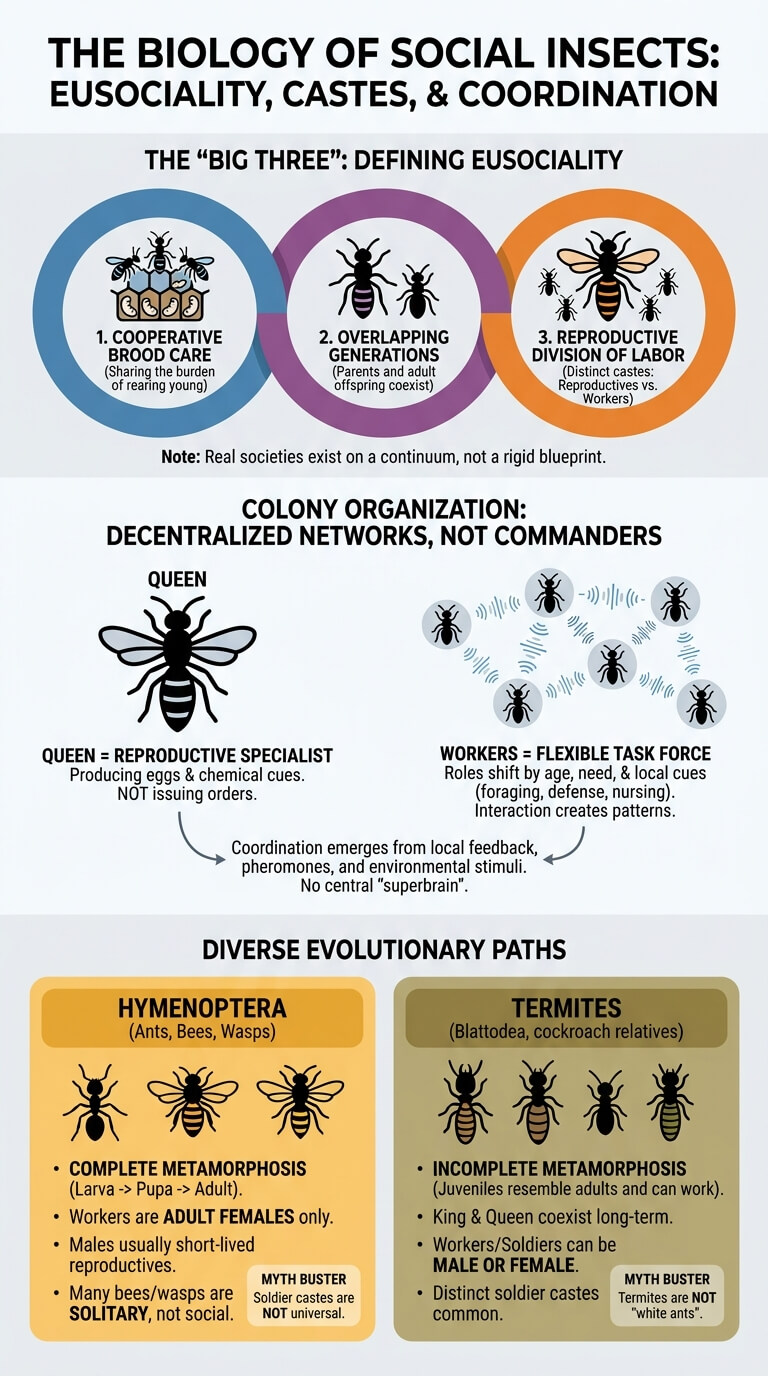
Eusociality is generally identified by three classic features: cooperative care of immature offspring, overlapping adult generations, and a reproductive division of labor in which some individuals reproduce more than others. A recent Current Biology study indexed by PubMed uses this traditional definition while testing how eusociality evolved across insects. Real societies differ in how strongly each feature is expressed.
The classic eusocial criteria in plain English
Cooperative brood care means colony members help raise offspring that are not simply their own individual young. They may feed larvae, clean brood areas, regulate nest conditions, defend developing young, or move brood when conditions change.
Overlapping generations means parents and grown offspring, or otherwise distinct adult generations, live together long enough to cooperate. This matters because young adults can remain in the natal nest and help with later broods rather than leaving immediately to reproduce independently.
Reproductive division of labor means reproduction is unevenly distributed. In many colonies, one or a small number of reproductives produce most offspring while other members perform much of the foraging, brood care, building, defense, and maintenance. The degree of reproductive specialization varies, so it is safer to think in terms of a continuum than a single rigid blueprint.
The Social Continuum
Solitary and gregarious behavior
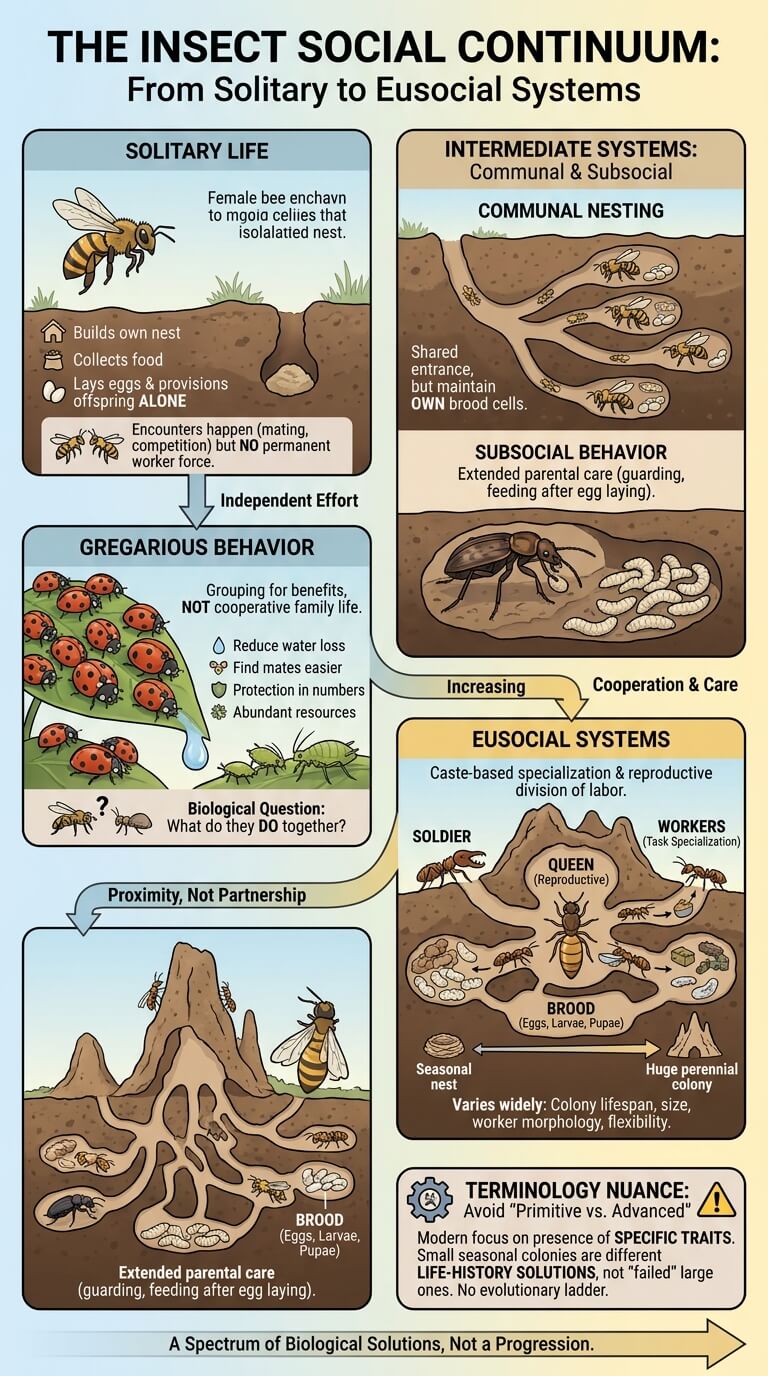
A solitary insect carries out most of the essential work of reproduction on its own. A solitary female bee, for example, may build or occupy a nest, collect food for her brood, lay eggs, and provision offspring without maintaining a permanent worker force. Solitary does not mean that individuals never encounter one another. They still mate, compete, communicate, and may nest near others where good habitat is concentrated.
Gregarious insects spend time in groups, but grouping alone does not imply cooperative family life. Aggregations can reduce water loss, help insects find mates, provide protection through numbers, or simply form where resources are abundant. The biological question is not how many insects are standing near one another, but what they actually do together.
Communal and subsocial systems
Between solitary life and eusociality are many intermediate arrangements. In communal nesting, multiple females may share a nest entrance while maintaining their own brood cells. In other systems, adults cooperate more directly. Subsocial behavior can include extended parental care in which a mother or pair guards, feeds, or otherwise assists offspring after eggs are laid.
A Smithsonian-hosted chapter on communal behavior in bees and wasps emphasizes that shared nesting can occur without caste-based eusocial organization. Shared housing is therefore not the same as a worker system.
Eusocial systems and why terminology requires nuance
Eusocial colonies range from relatively small seasonal groups to long-lived societies with extensive task specialization. Even within one broad insect group, species may differ in colony lifespan, number of reproductives, worker morphology, nest architecture, and how flexible individuals are in changing tasks.
Older literature sometimes used labels such as “primitive eusociality” and “advanced eusociality.” Modern explanations often focus more directly on what traits are present because words such as primitive can suggest an evolutionary ladder that does not exist. A small seasonal colony is not a failed version of a large perennial one. It represents a different life-history solution.
Cooperative Brood Care
Shared care of young
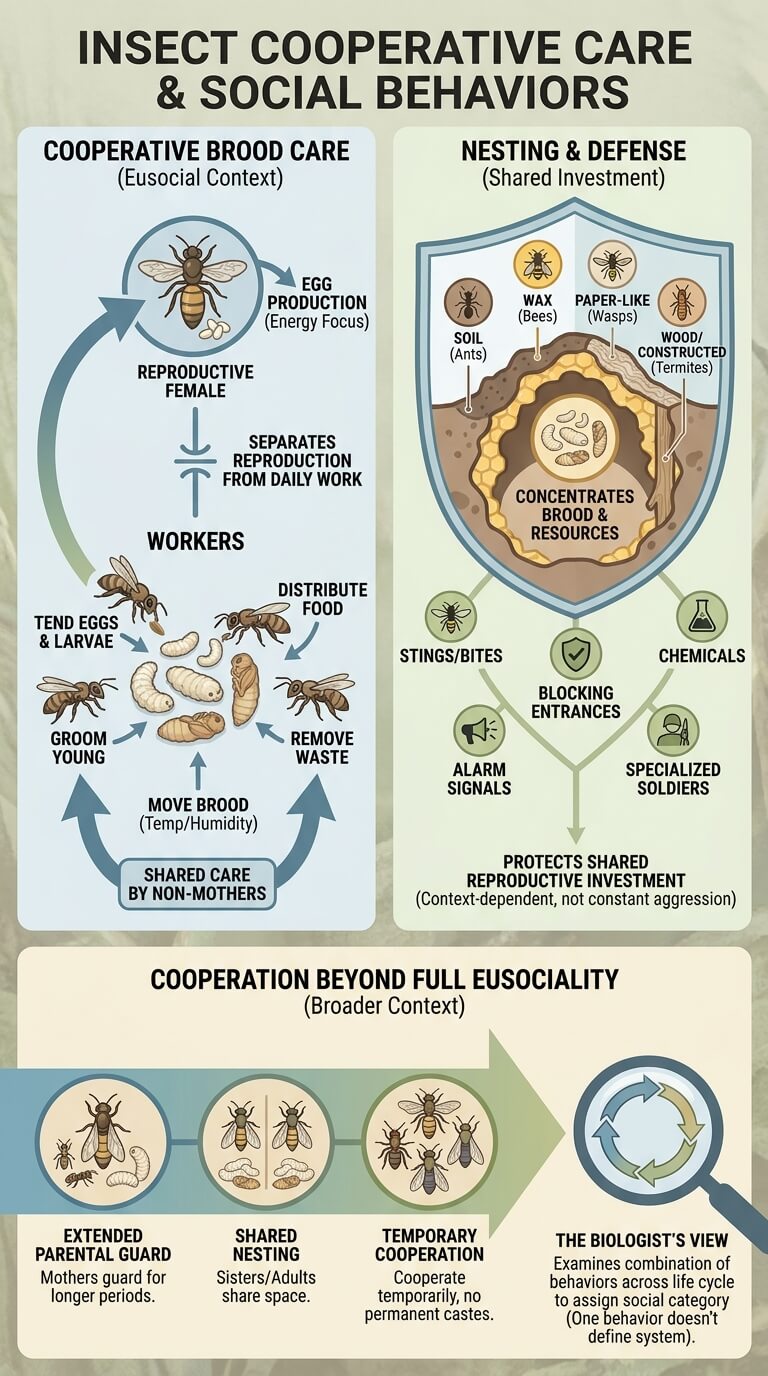
Brood care is one of the clearest ways colony living changes insect life. In a eusocial colony, many offspring can be fed and protected by individuals other than their mother. Workers may tend eggs and larvae, distribute food, groom young, remove waste, or move developing brood among areas with different temperatures or humidity.
This cooperation separates reproduction from much of the daily work required to keep offspring alive. A reproductive female can devote more energy to egg production while other colony members handle foraging and care. The exact balance differs by species, and the term worker covers many different developmental and behavioral arrangements.
Nest building, provisioning, and defense
Social life often centers on a nest that concentrates brood and resources. Ants can excavate soil or occupy cavities, social bees may use wax, wasps may build paper-like comb, and termites can occupy wood, galleries, or constructed nests.
Defense can involve stings, bites, chemical secretions, blocking nest entrances, alarm signals, or specialized soldiers. These defenses protect a shared reproductive investment, but they should not be read as evidence that social insects are constantly aggressive. Defensive responses depend on species, colony state, disturbance, and context. Wild nests should be observed without handling or provoking their occupants.
Why cooperative care can appear outside full eusociality
Cooperative care is not exclusive to highly organized colonies. Some insects show parental or cooperative behaviors without meeting all three classic eusocial criteria. Mothers may guard offspring for extended periods, sisters may share nesting space, or adults may cooperate temporarily without a permanent reproductive caste.
This is why one impressive behavior does not define an entire social system. Brood care, group defense, shared nesting, and coordinated foraging each tell part of the story. Biologists examine how those behaviors combine across the life cycle before assigning a social category.
Overlapping Generations and Reproductive Division of Labor
How generations coexist in colonies
When adult offspring remain with a parent, a colony gains a workforce that can help produce and protect later broods. That overlap allows social roles to persist across time. In many ants and honey bees, multiple generations of workers can coexist while a reproductive queen continues laying eggs. In seasonal bumble bee or wasp colonies, the social phase may last only part of a year before new reproductives leave and the old colony ends.
Termite colonies create another pattern. A founding queen and king can remain together while their offspring take on work or defensive roles. Replacement reproductives may also develop in some species if colony structure changes. Overlapping generations therefore occur in very different developmental systems.
Reproductive and nonreproductive roles
Division of labor reflects anatomy, age, physiology, experience, development, and colony conditions. Some workers change tasks as they age, while others are morphologically specialized. In termites, immature stages may perform substantial colony work, unlike the adult female worker systems of ants and many social bees and wasps.
The reproductive caste also varies. A colony may have one queen, several queens, a queen and king, or replacement reproductives depending on the lineage and colony stage. Calling every social insect colony a one-queen system hides this diversity.
Why workers are not universally completely sterile
Worker status does not automatically mean absolute sterility. In some social Hymenoptera, workers retain ovaries and may lay unfertilized eggs under certain conditions, often producing males. Colony members may also suppress worker reproduction through behavioral or chemical mechanisms. In other species, workers are much more reproductively specialized and have little or no functional reproductive capacity.
The useful generalization is that eusocial colonies show reproductive division of labor, not that every worker in every species is biologically incapable of reproduction. The difference matters when comparing species and when discussing how social systems evolve.
Castes Without the Queen-Rules-the-Colony Myth
Queens as reproductive castes rather than commanders
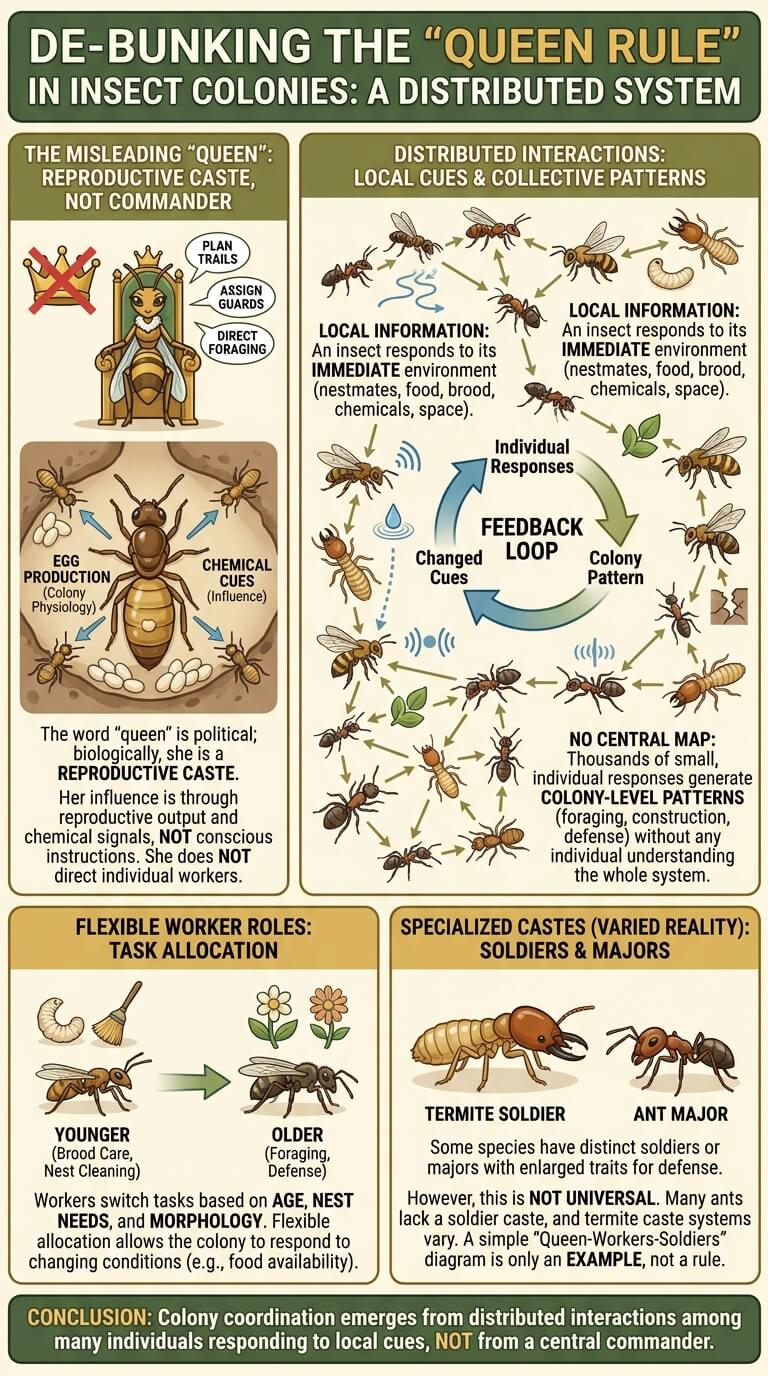
The word queen can be misleading because it sounds political. In insect biology, a queen is primarily a reproductive caste or reproductive individual. She may strongly influence colony physiology through egg production and chemical cues, but that is different from issuing conscious instructions to thousands of workers.
A honey bee queen does not choose which forager visits which flower. An ant queen does not plan trails or assign guards. A termite queen does not direct workers through a chain of command. Colony patterns emerge from interactions among many individuals responding to cues, needs, nest conditions, and one another.
Workers and task allocation
Workers handle brood care, nest construction, cleaning, food collection, defense, waste removal, and care of reproductives. The same individual may switch tasks, while body size or caste morphology can constrain roles in other systems.
Age-based task changes are especially familiar in social insects. Younger workers may remain near brood while older workers are more likely to forage outside, although the pattern is not universal. Flexible task allocation can help colonies respond when food availability, brood demand, temperature, or worker numbers change.
Soldiers or majors where they actually occur
Some social insects have workers with enlarged heads, mandibles, chemical defenses, or other traits associated with defense. Ant biologists may call certain large workers majors or soldiers, depending on the species and context. Many ant species, however, do not have a distinct soldier caste.
Termite soldiers are often more clearly differentiated morphologically and can possess powerful mandibles, defensive secretions, or head shapes suited for blocking tunnels. Yet even among termites, caste systems vary. A simple queen-workers-soldiers diagram is useful as an example, not a universal rule.
Distributed interactions, cues, and feedback
Colony coordination often works through local information. An insect encounters nestmates, food, brood, chemical traces, vibration, temperature, or empty space and responds according to its sensory system and internal state. Thousands of small responses can generate a colony-level pattern without any individual understanding the whole system.
This distributed organization is one reason social insects are studied in collective behavior research. It explains how colonies can adjust foraging, nest construction, brood care, or defense even though no central individual has a complete map of the colony’s needs.
Ant Societies
Why ants are classic eusocial examples
Ants are among the most familiar eusocial insects. Colonies center on cooperative brood care, overlapping generations, and reproductive division of labor. Female workers perform much of the colony work, while reproductive females and males are produced according to the species and colony cycle. The Smithsonian’s overview of ants as social insects uses eusociality as a key concept for understanding ant colonies.
Ants also show why stereotypes fail. Some species have tiny colonies, while others build much larger societies. Some have one reproductive queen, others can have multiple queens. Some workers are similar in size, while others show pronounced size differences. Certain species have workers called majors, but many do not.
Variation in queens, workers, majors, and colony structure
Even within a colony, roles can be dynamic. Worker age, size, hormonal state, previous experience, and recent interactions can affect what an ant does. In some species, workers retain limited reproductive potential. In others, reproductive conflict is strongly suppressed.
Colony founding also varies. A queen may begin a nest alone, multiple queens may cooperate during founding, or new colonies may form through processes in which workers accompany reproductives. These differences make ants excellent examples of eusocial diversity, but they should not be treated as the template for all social insects.
Ant biology extends far beyond colony structure
Ant colonies show how reproductive specialization and worker cooperation can produce stable social organization without centralized command.
Social Bees
Solitary bees versus social bees
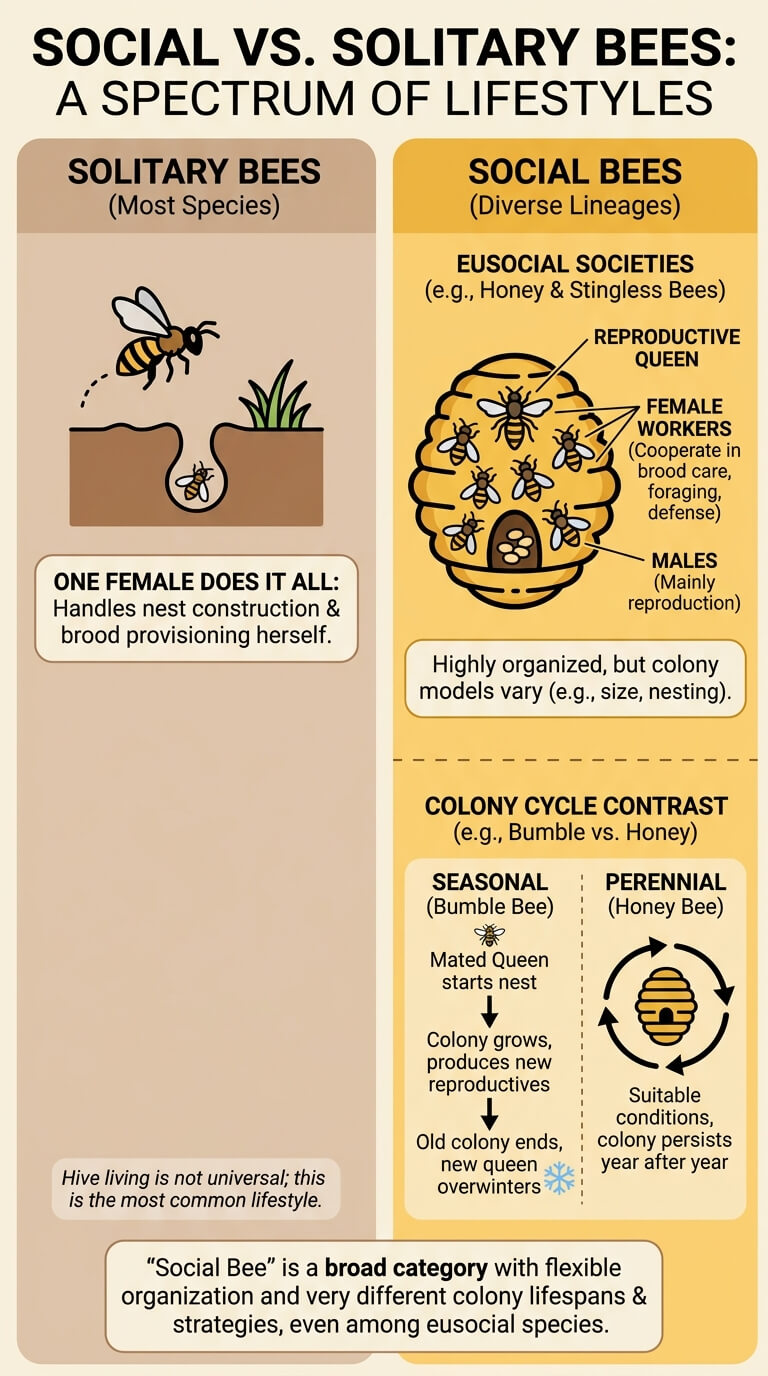
Bees are often pictured as hive-living insects, but many bee species are solitary. A solitary female typically handles nest construction and brood provisioning herself. Social behavior has evolved in particular bee lineages, and even within some groups social organization can be flexible.
The Smithsonian Libraries record for The Solitary Bees highlights the distinction between solitary and social bee biology. That distinction is essential because honey bees are unusually familiar to people and can make their colony lifestyle seem universal when it is not.
Honey bees and stingless bees
Honey bees and stingless bees provide well-known examples of eusocial bee societies. Their colonies include reproductive queens and female workers, with males participating mainly in reproduction. Workers cooperate in brood care, nest maintenance, foraging, defense, food handling, and communication.
Even highly social bees do not share one model. Colony size, nesting biology, defense, and reproduction differ among lineages, and stingless bees are not simply honey bees without functional stings.
Bumble bee colony cycles versus honey bee colony organization
Many bumble bee colonies in temperate regions are seasonal. A mated queen survives the unfavorable season, starts a nest, raises the first workers, and later produces new reproductives. The old colony typically does not persist year after year in the same way a perennial honey bee colony can under suitable conditions.
This contrast shows why “social bee” is a broad category. Two eusocial bee species can satisfy the classic criteria while having very different colony lifespans, founding strategies, and seasonal rhythms.
Social Wasps
Why many wasps are solitary
The word wasp covers an enormous range of Hymenoptera, and many wasps do not live in worker-based colonies. Solitary wasps may build nests, hunt or provision food for offspring, parasitize hosts, or use other reproductive strategies without maintaining a social workforce.
That means a paper wasp or yellowjacket cannot stand in for all wasps. Sociality occurs in particular lineages, especially among familiar vespid wasps, while a large amount of wasp diversity follows solitary or parasitoid life histories.
Vespid and other social systems
Social wasps can form colonies with reproductive females and workers that cooperate in brood care, nest maintenance, foraging, and defense. In some paper wasps, reproductive roles can be more behaviorally flexible than in strongly differentiated caste systems.
Other social wasps build much larger colonies with stronger reproductive specialization. The variety among wasps helps show that eusociality is not one final design. Similar social criteria can be expressed through different colony structures.
A social nest is not the same thing as constant aggression
Social wasps defend valuable nests, and some species can sting when the colony is threatened. That does not justify describing all wasps as aggressive. Solitary wasps, social species, queens, workers, and males can differ greatly in behavior and defensive ability.
For people, the safest approach is simple: do not handle social wasps or disturb occupied nests. Understanding their colony biology does not require approaching a nest closely.
Termite Societies
Termites within Blattodea
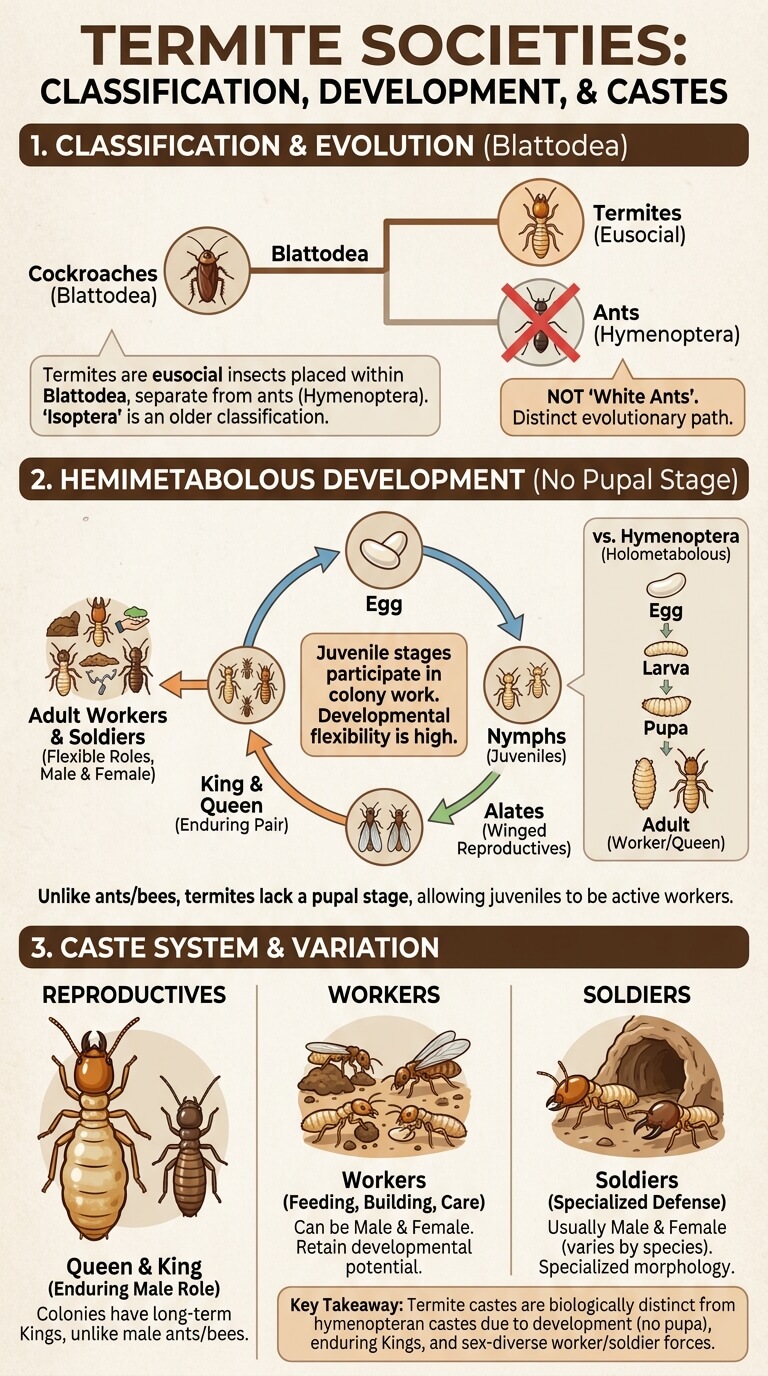
Termites are eusocial insects, but they are not ants. Modern classification places termites within Blattodea, the group that also contains cockroaches. Older books may present Isoptera as a separate order, so readers can encounter both arrangements in older and newer references.
This evolutionary background matters because termite societies are organized differently from ant, bee, and wasp societies. Their developmental system is hemimetabolous, meaning there is no pupal stage separating larva-like juveniles from adults as there is in the holometabolous Hymenoptera.
Queens, kings, workers, and soldiers with lineage variation
Termite colonies commonly include reproductive queens and kings. Unlike social Hymenoptera, where the long-term worker force is female, termite workers and soldiers may include both males and females or show sex-specific patterns depending on the species. A recent Royal Society review available through PubMed Central on termite division of labor emphasizes the developmental flexibility of termite workers and the important differences between termite and hymenopteran caste systems.
Termite soldiers are usually specialized for defense, while workers handle feeding, building, brood care, and maintenance. Developmental pathways vary, and some workers retain more developmental or reproductive potential than the label worker suggests.
Why termite castes are not copies of hymenopteran castes
Ants, bees, and wasps undergo complete metamorphosis. Their worker force consists of adults. Termites develop without a pupal stage, and juvenile stages can participate in colony work. These developmental differences change how castes form and how flexible individuals may remain.
Termites also have enduring male reproductives called kings, while male ants, bees, and wasps generally do not serve an equivalent long-term colony role. Treating termites as “white ants” erases these biological differences and is taxonomically wrong.
How Eusociality Evolves
Relatedness is one part of the story
Eusociality creates an evolutionary puzzle because many colony members reduce or give up direct reproduction while helping relatives reproduce. Kin selection and inclusive fitness provide important ways to understand how helping relatives can still contribute to genetic success. High relatedness can favor cooperation when the benefits of helping relatives outweigh the costs.
But relatedness does not work in isolation. Nesting biology, costs of dispersal, opportunities for repeated brood care, defense, food distribution, season length, and other ecological factors can affect whether cooperation is favored and maintained.
Ecology, nesting, life history, and multiple evolutionary routes
Eusociality evolved in different insect lineages. Defensible nests, extended parental care, repeated contact between generations, and ecological costs of independent nesting can all influence when cooperation is favored.
Because different routes can lead toward complex sociality, researchers examine combinations of genetic, ecological, developmental, and life-history traits. No single feature explains ants, bees, wasps, termites, and the less familiar eusocial examples in exactly the same way.
Why haplodiploidy alone does not explain eusociality
Ants, bees, and wasps use haplodiploid sex determination in which females usually develop from fertilized eggs and males from unfertilized eggs. This system can produce unusually high sister relatedness under particular mating conditions, which historically made it central to explanations of eusociality.
Yet haplodiploidy cannot be the whole answer. Many haplodiploid insects are not eusocial, and termites are eusocial without using the same haplodiploid system. The 2026 Current Biology analysis found that the apparent association between haplodiploidy and eusociality across insects is strongly shaped by the evolutionary history of aculeate Hymenoptera rather than representing a universal effect. Social evolution is therefore better treated as a multi-factor process.
Colony-Level Coordination
Communication and local rules
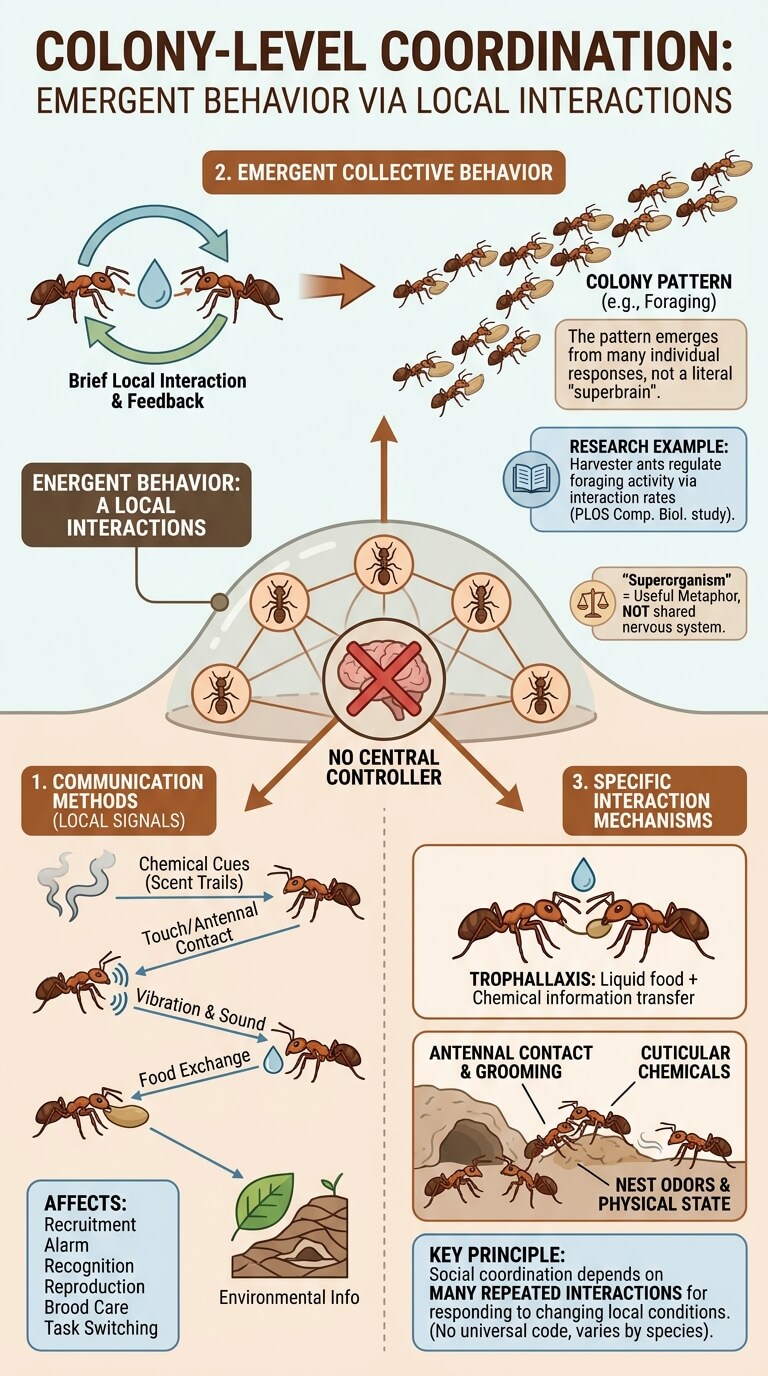
Colonies coordinate through chemical cues, touch, vibration, sound, food exchange, and environmental information. These signals can affect recruitment, alarm, recognition, reproduction, brood care, and task switching.
Communication does not require a central controller. A worker can respond to how often it meets returning foragers, how much brood it encounters, how strong a chemical cue is, or whether a nest area is crowded. Those local decisions can alter what the whole colony does.
Emergent collective behavior without a literal superbrain
The term superorganism is sometimes used to compare a colony’s reproductive and worker roles with the division of function inside a multicellular organism. The comparison can be useful, but it is a metaphor and an analytical framework, not evidence that thousands of insects literally share one nervous system.
Research on harvester ants shows how colony foraging can change through feedback from brief local interactions rather than central instructions. A PLOS Computational Biology study of harvester ant foraging demonstrated how returning and outgoing foragers can regulate activity through interaction rates. The colony-level pattern emerges from many individual responses.
Trophallaxis, contact, and environmental cues
In some social insects, trophallaxis is the transfer of liquid food or other fluids between individuals. Besides nutrition, these exchanges can carry chemical information. Antennal contact, grooming, cuticular chemicals, nest odors, vibration, and the physical state of the nest can also influence behavior.
Different species rely on different combinations of cues. There is no single universal colony communication code. The important principle is that social coordination depends on many repeated interactions that allow individuals to respond to changing local conditions.
Common Social-Insect Myths
Does every colony have a queen, workers, and soldiers?
No. A reproductive queen and worker caste are common features of many eusocial insect colonies, but soldier castes are not universal. Some ant species have majors or specialized defenders, many do not, and social bee and wasp societies usually should not be forced into a termite-style soldier diagram. Colony structure also changes with season and life stage.
Does the queen command the colony?
No. Queens can be physiologically central because they produce offspring and chemical cues can influence colony members, but workers are not receiving conscious orders. Colony behavior is largely organized through distributed interactions, feedback, individual response thresholds, and environmental information.
Are all bees and wasps social?
No. Many bees are solitary, and many wasps are solitary or parasitoid. Honey bees, bumble bees, stingless bees, paper wasps, yellowjackets, and hornets are familiar enough that people often overestimate how common colony living is across the full diversity of bees and wasps.
Are termites ants?
No. Ants are Hymenoptera, while termites belong within Blattodea. Their similar colony features are a striking example of social systems evolving in different insect lineages. Termite queens, kings, workers, soldiers, development, and sex roles should be understood on their own terms rather than copied from an ant model.
How Behavior, Communication, and Ecology Shape Social Life
Social organization depends on behavior
A colony is built from individual actions. Foraging choices, brood care, nest defense, task switching, seasonal timing, and reproductive behavior all contribute to whether a society functions. Studying colony organization therefore requires attention to ordinary insect behavior as well as caste labels.
Signals make coordination possible
Chemical trails, contact cues, vibrations, sounds, food exchange, and other signals allow colony members to respond to one another without central command. The mechanisms are highly diverse, which is why communication is best treated as a biological process rather than as a human-style language analogy.
Colonies also change their ecosystems
Social insects can affect soil, decomposition, food webs, plant interactions, predation, and the distribution of resources. Ants move soil and seeds, termites process plant material and alter physical habitats, and social bees can be major flower visitors. These effects depend on species and ecosystem, so colony life connects individual cooperation with larger ecological processes.
FAQ
What makes an insect eusocial?
The classic definition combines cooperative brood care, overlapping generations, and reproductive division of labor. In practice, social systems vary in how these traits are expressed. Biologists therefore examine the complete life history rather than deciding from colony size or nest appearance alone.
Are all bees social?
No. Many bee species are solitary. Sociality ranges from relatively simple associations to eusocial colonies, depending on the lineage. Honey bees, stingless bees, and bumble bees are prominent social examples, but their biology should not be generalized to all bees.
Do termite colonies have kings?
Yes, termite colonies commonly have a male reproductive called a king as well as a queen. The king can remain associated with the colony after founding, which differs from the usual male role in eusocial ants, bees, and wasps. Replacement or additional reproductives can occur in some termite species.
Why do some insect colonies have soldiers while others do not?
Soldier castes evolve when specialized defensive forms are favored within a lineage’s ecology and developmental system. Some termites and ants have conspicuous defensive castes, while many other social insects rely on ordinary workers for defense. The absence of a soldier caste does not make a colony less eusocial.
Final Thoughts
Social insects are best understood as a spectrum of biological systems, not as copies of one queen-worker-soldier blueprint. Eusociality combines cooperative brood care, overlapping generations, and reproductive division of labor, but ants, bees, wasps, and termites achieve those features in very different ways. Queens reproduce rather than command, workers can vary in fertility and tasks, soldiers are not universal, and termite societies differ fundamentally from those of Hymenoptera.
Colony organization emerges from development, relatedness, ecology, communication, and many local behavioral decisions. That combination explains how insects can build coordinated societies without requiring a central ruler, while still leaving room for enormous variation among species.

Ethan Walker is the founder and research editor of Animal Fact Central. He creates and reviews educational animal facts content using trusted wildlife, pet care, and science-based sources. His work focuses on making animal behavior, adaptations, habitats, and species facts clear, accurate, and engaging for everyday readers.
Read More Details About Ethan Walker: https://animalfactcentral.com/ethan-walker/