
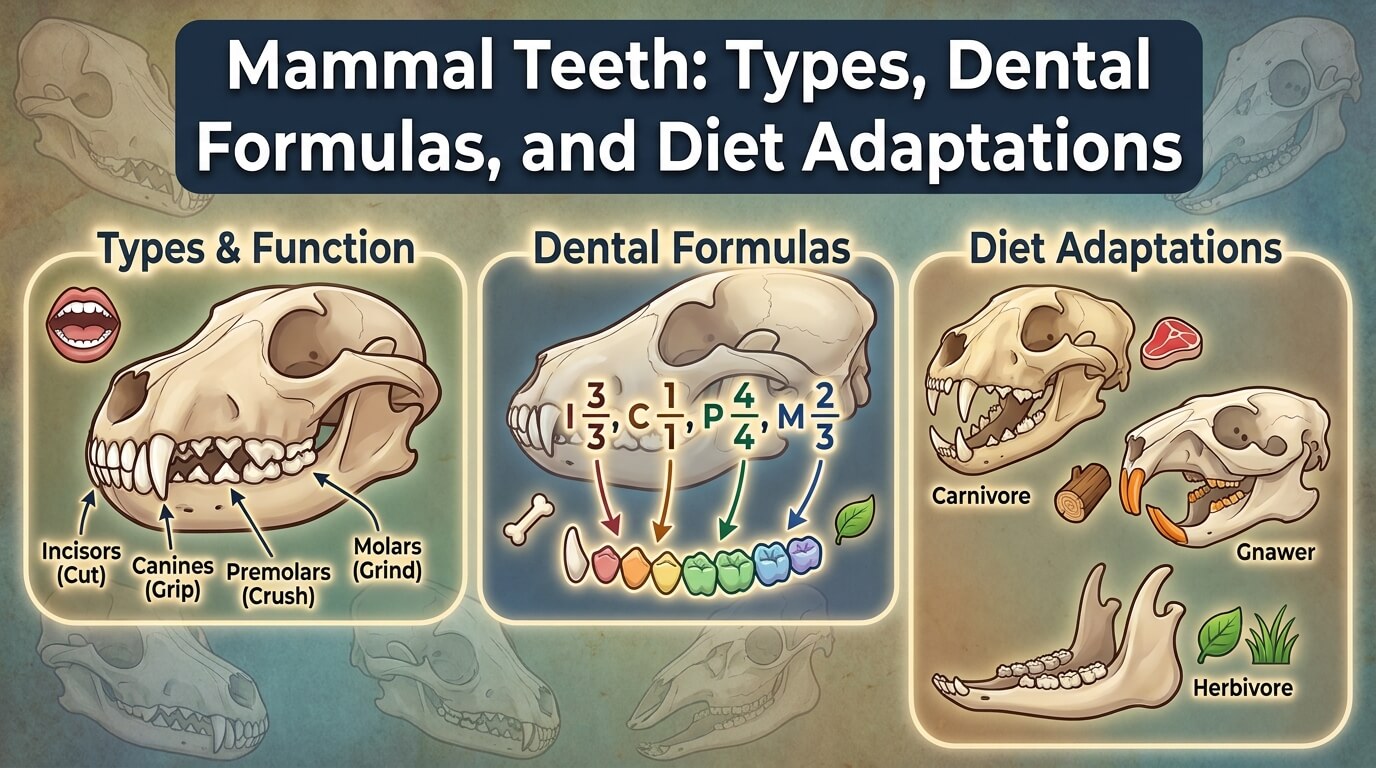
Mammal teeth are remarkably varied because they do more than bite food. They cut, grip, tear, crush, grind, scrape, dig, display, defend, and sometimes even help an animal sense its surroundings. Most mammals have several tooth types in the same mouth, a pattern called heterodonty. Incisors, canines, premolars, and molars can be reshaped, reduced, enlarged, or lost as species adapt to different foods and ways of living.
Teeth can reveal a great deal about an animal, but they are not a perfect label for diet. A sharp tooth may be used for slicing flesh, piercing insects, fighting rivals, or stripping plant material. A flat tooth may crush seeds, fruit, bone, or mixed foods. The most reliable interpretation comes from looking at the entire dentition, jaw movement, tooth wear, digestive system, observed feeding behavior, and habitat together.
Quick Answer
Why Mammal Teeth Are Unusually Specialized
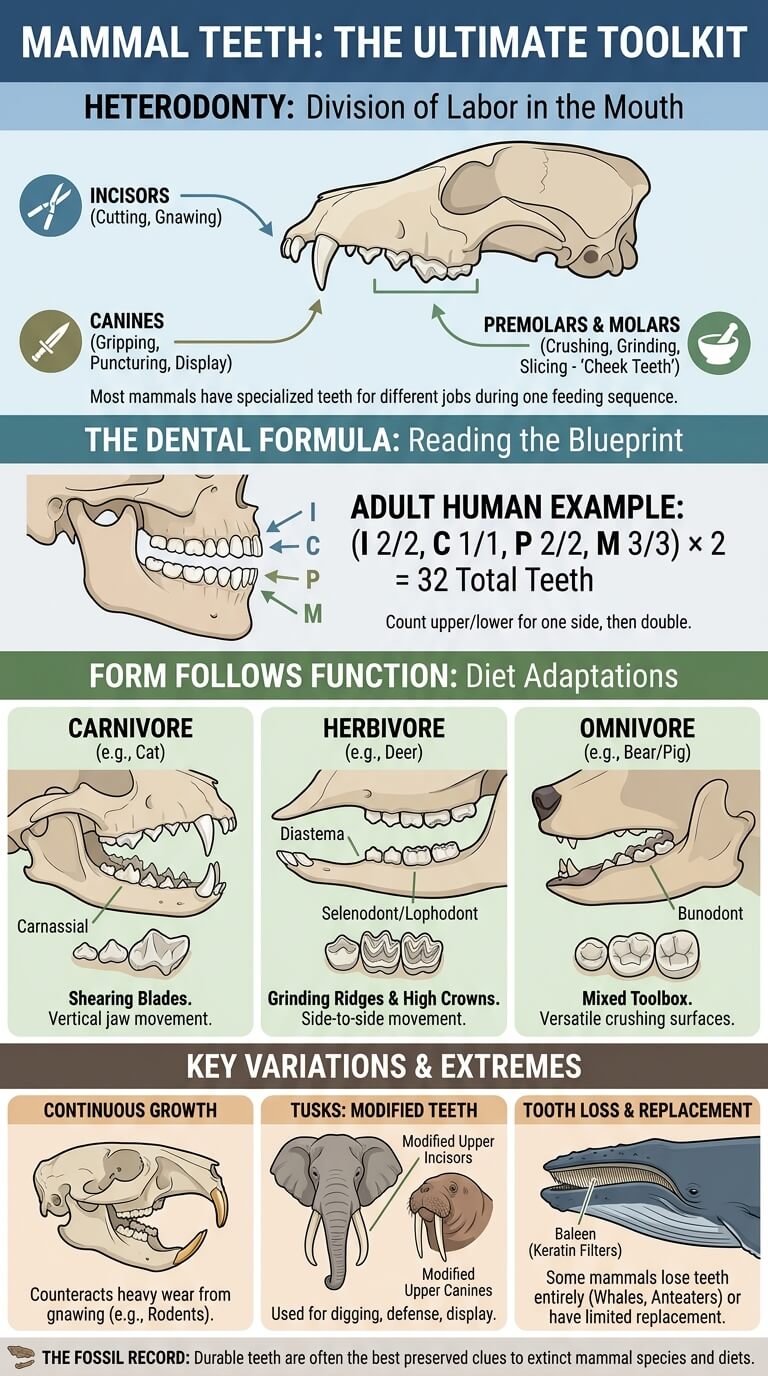
The typical mammalian mouth divides labor among teeth. Front teeth may seize or crop food, while cheek teeth process it before swallowing. This differs from a homodont dentition, in which most teeth have a similar form. Heterodonty allows different parts of the tooth row to perform different mechanical jobs during one feeding sequence.
Specialization does not mean every mammal has all four familiar tooth classes. Some species have lost canines or premolars. Others have nearly uniform teeth, continuously growing teeth, tusks, or no functional adult teeth at all. The Animal Diversity Web overview of mammalian tooth types shows how tooth classes and dental formulas help describe this variation.
What Teeth Can and Cannot Reveal About Diet
Tooth form often reflects the physical challenge presented by food. Tough grasses reward durable grinding surfaces. Meat can favor edges that shear. Hard seeds may favor thick enamel and crushing surfaces. Small arthropods can be handled by pointed cusps that puncture their outer coverings.
Still, tooth shape alone rarely proves exactly what a mammal eats. Many mammals shift diets with season, age, location, or food availability. Teeth may also retain features inherited from ancestors even after feeding behavior changes. Scientists therefore treat dentition as one line of evidence rather than a complete feeding biography.
The Mammalian Pattern of Heterodont Teeth
Incisors
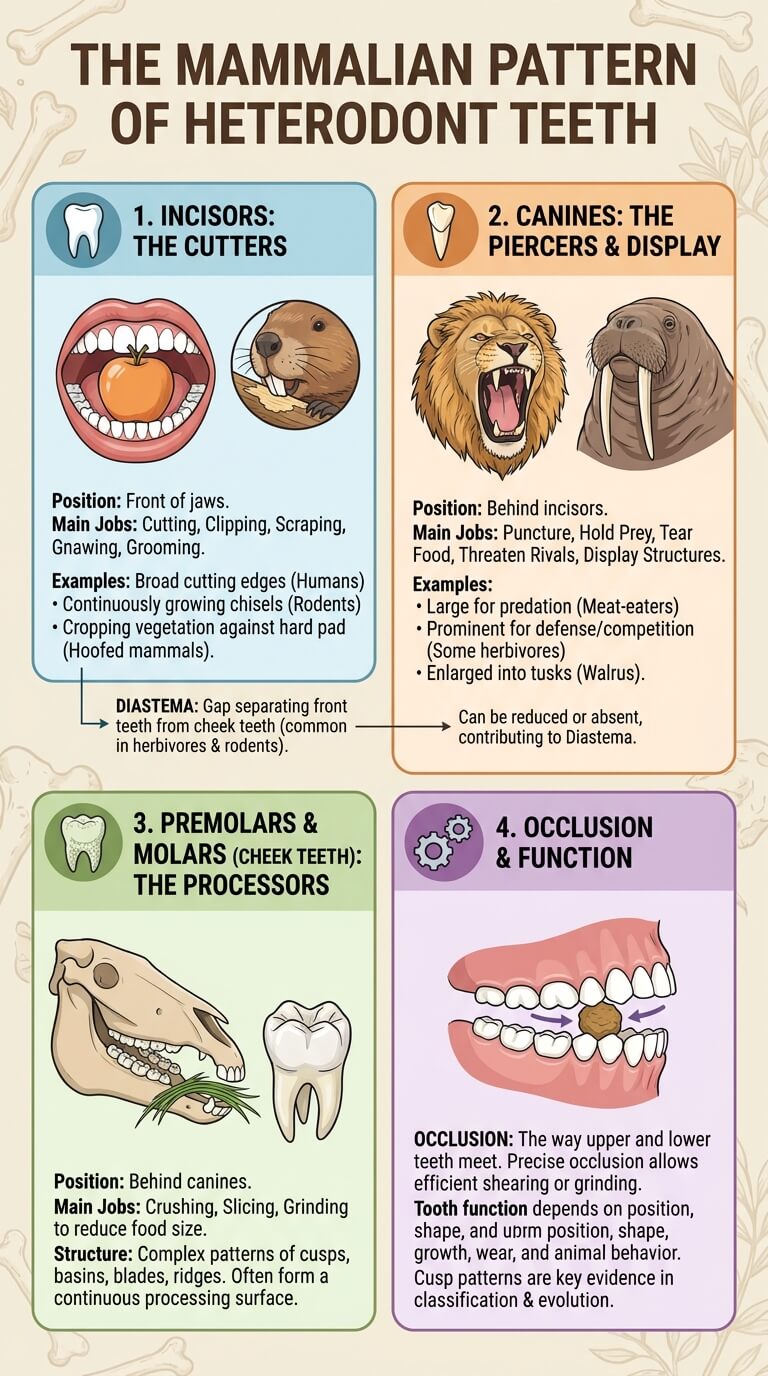
Incisors usually occupy the front of the jaws. Their main jobs include cutting, clipping, scraping, grooming, and gnawing. Human incisors have relatively broad cutting edges. Rodent incisors are enlarged into chisels that grow continuously. Hoofed mammals may use lower incisors against a hardened pad in the upper mouth when cropping vegetation.
The number and size of incisors vary widely. Some mammals retain several in each jaw quadrant, while others reduce them or lose them from part of the mouth. A gap between front teeth and cheek teeth is called a diastema. This space is especially noticeable in many plant-eating mammals and rodents, where it separates cropping or gnawing teeth from grinding teeth.
Canines
Canines usually sit behind the incisors and are commonly pointed. They can puncture, hold prey, tear food, threaten rivals, or function as display structures. Large canines are often associated with predation, but that connection is not universal. Some plant-eating mammals have prominent canines used mainly in competition or defense, while some meat-eating mammals have relatively modest canines.
Canines can also disappear. Many rodents lack them, which contributes to the diastema behind the incisors. In other mammals, a canine can become a tusk. Walrus tusks, for example, are enlarged upper canines. The function of a tooth depends on its position, shape, growth pattern, wear, and the behavior of the animal using it.
Premolars and Molars
Premolars and molars are collectively called cheek teeth. They do much of the crushing, slicing, and grinding that reduces food into smaller pieces. Premolars generally sit in front of molars, but the boundary between their functions is not always obvious. In some species they look and work differently; in others they form a nearly continuous processing surface.
Molar crowns can carry cusps, basins, blades, and ridges arranged in complex patterns. The way upper and lower teeth meet is called occlusion. Precise occlusion lets opposing surfaces shear or grind food efficiently. The Animal Diversity Web guide to cheek-tooth structure explains how cusp patterns became important evidence in mammal classification and evolutionary research.
How Dental Formulas Work
Reading Upper and Lower Tooth Counts
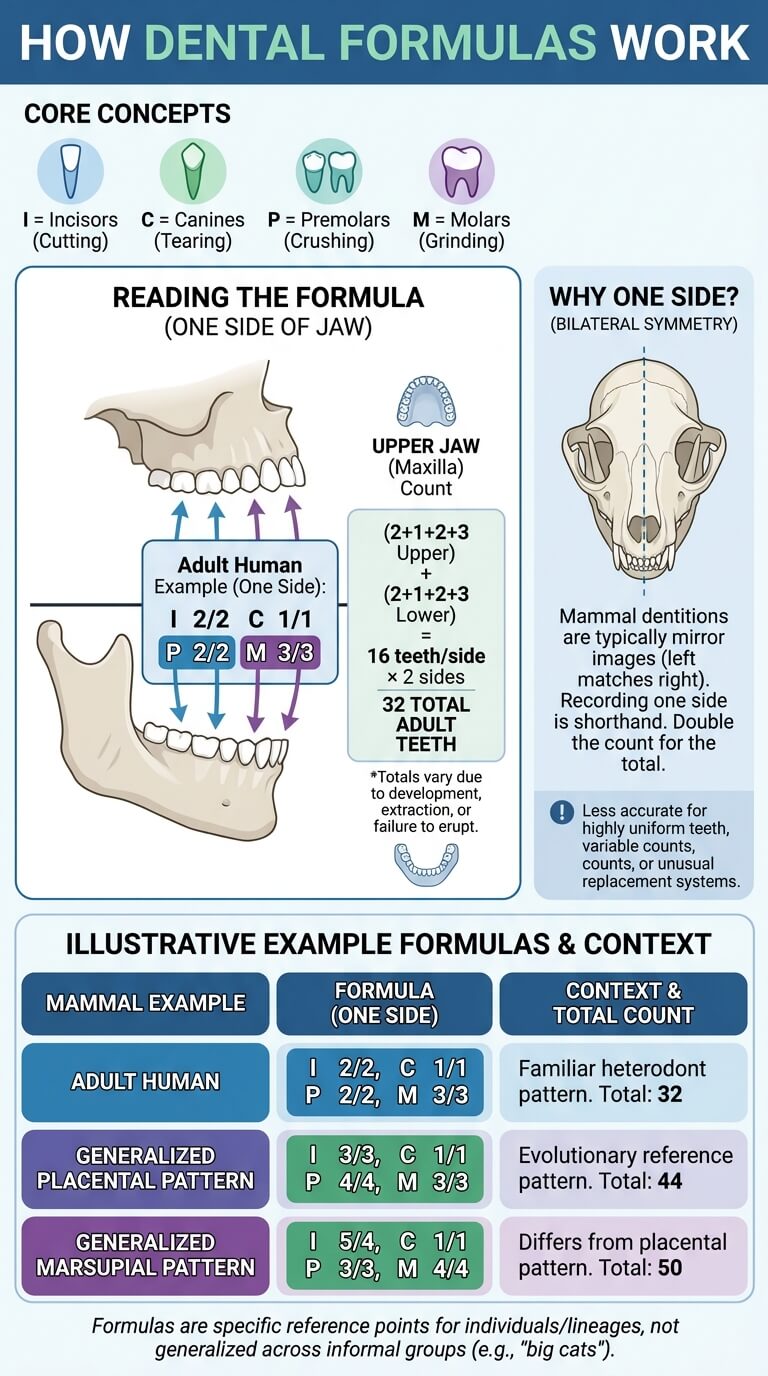
A dental formula is a compact way to record the number of incisors, canines, premolars, and molars. The letters I, C, P, and M represent those four classes. The number above or before the dividing line describes the upper jaw, and the number below or after it describes the lower jaw.
For adult humans, one side of the mouth is commonly written as I 2/2, C 1/1, P 2/2, M 3/3. That means two upper and two lower incisors, one upper and one lower canine, two upper and two lower premolars, and three upper and three lower molars on one side. Adding those numbers and multiplying by two gives a typical total of 32 adult teeth, although individual people may have fewer because of development, extraction, or failure of some teeth to erupt.
Why Formulas Usually Describe One Side of the Jaw
Most mammal dentitions are bilaterally symmetrical, so the left and right sides usually match. Recording one side prevents the formula from becoming unnecessarily long. The final total is normally calculated by doubling the one-side count.
This shorthand works best when tooth classes can be identified clearly. It becomes less tidy in mammals with highly uniform teeth, variable tooth counts, missing tooth classes, or unusual replacement systems. Some references combine premolars and molars as cheek teeth when the distinction is uncertain.
Example Formulas With Careful Species Context
| Mammal example | Formula for one side | What it illustrates |
|---|---|---|
| Adult human | I 2/2, C 1/1, P 2/2, M 3/3 | A familiar heterodont pattern with 32 teeth when both sides are counted |
| Generalized ancestral placental pattern | I 3/3, C 1/1, P 4/4, M 3/3 | A 44-tooth reference pattern used when discussing evolutionary reduction |
| Generalized ancestral marsupial pattern | I 5/4, C 1/1, P 3/3, M 4/4 | A 50-tooth reference pattern that differs from the placental pattern |
These generalized patterns are reference points, not formulas for every living member of a lineage. Tooth counts can differ among families, genera, species, and sometimes individuals. A formula should always be tied to the animal being described rather than copied across an informal group such as “big cats” or “marine mammals.”
Tooth Shape and Feeding Function
Cutting, Gripping, Tearing, Crushing, and Grinding
A tooth works as part of a mechanical system. The jaw muscles provide force, the jaw joint guides movement, and the tooth crown concentrates pressure on food. Narrow points can pierce. Thin edges can slice. Broad surfaces spread force and crush. Repeated ridges can shred and grind fibrous material.
Many predatory mammals combine gripping canines with blade-like cheek teeth. Many herbivores combine cropping structures at the front with extensive grinding surfaces behind. Omnivores often retain a mixed tool kit rather than an extreme version of one design. These are broad patterns, not strict rules.
Cusps, Ridges, Shearing Blades, and Flat Surfaces
Rounded, low cusps are called bunodont when they form broad crushing surfaces. Humans, pigs, bears, and raccoons provide familiar examples. Crescent-shaped ridges are called selenodont and occur in many deer and cattle. Lophodont teeth carry elongated ridges, or lophs, that improve grinding. Carnassials are enlarged blade-like cheek teeth found in many members of Carnivora.
The Animal Diversity Web survey of cheek-tooth diversity emphasizes that these patterns arise through changes in cusp height, shape, connection, and arrangement. A single label is useful, but the full chewing surface matters more than one isolated feature.
Wear Patterns and Continuous Growth
Food changes teeth as teeth change food. Scratches, pits, polished surfaces, broken cusps, and exposed layers record mechanical contact over time. Coarse vegetation, soil, grit, shells, seeds, and bone can produce different wear challenges. Researchers study wear at several scales, from obvious flattening to microscopic marks.
Some mammals compensate with high-crowned teeth that provide extra material for wear. Others have open-rooted teeth that continue growing. Continuous growth only works when use removes material at a roughly balancing rate. If wear and growth become mismatched, the tooth can interfere with feeding or injure surrounding tissues.
Diet Adaptations in Different Mammals
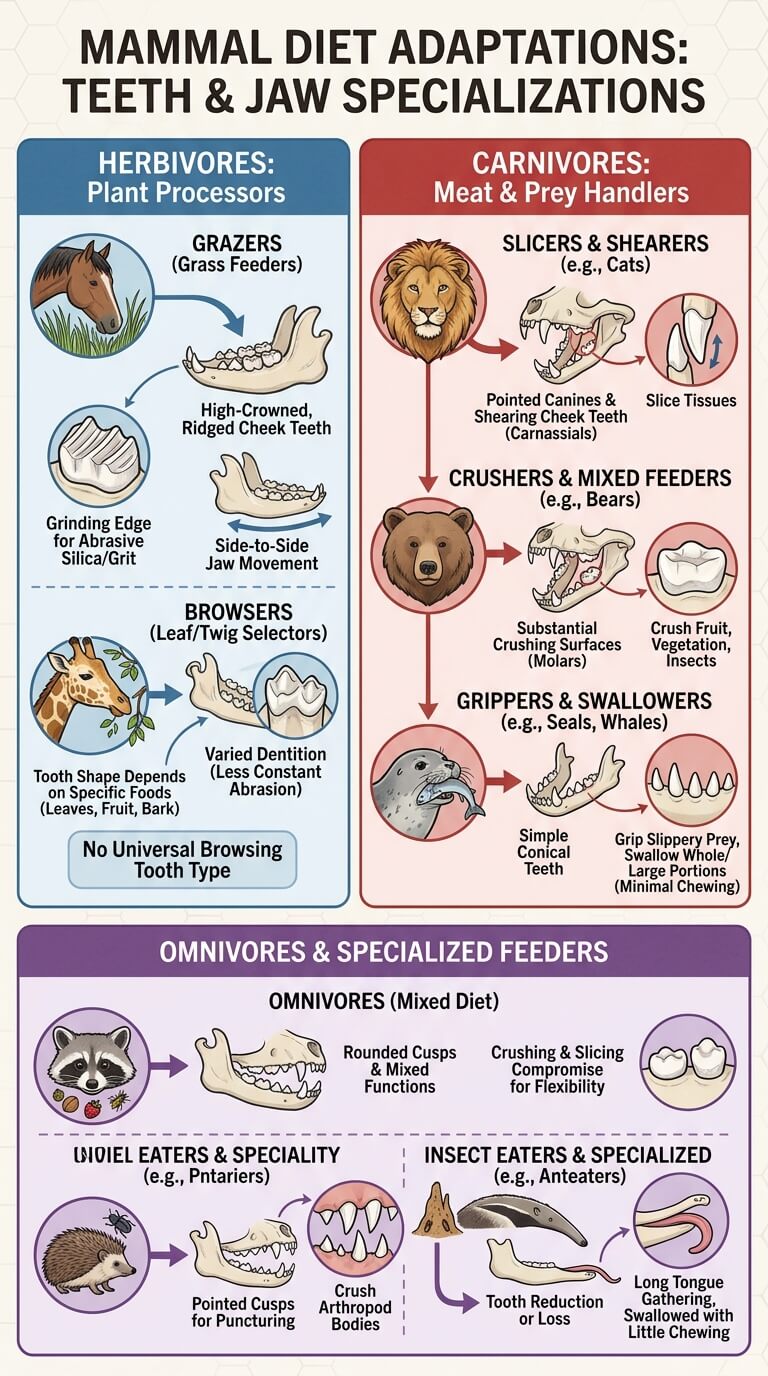
Grazers and Browsers
Grazers feed heavily on grasses, which can be abrasive because of plant silica and external grit. Many grazing mammals have high-crowned cheek teeth and ridged enamel surfaces that maintain a grinding edge as the crown wears. Side-to-side or complex jaw movements help process fibrous plant tissues before digestion.
Browsers commonly select leaves, shoots, bark, fruit, and twigs. Their teeth may face less constant abrasion than those of specialized grazers, but browsing diets vary widely. Deer, giraffes, tapirs, and many primates do not share one universal browsing dentition. Tooth crown height and ridge pattern must be interpreted alongside the foods actually eaten.
Carnivorous Mammals
Mammals that regularly capture vertebrate prey often need to hold struggling animals and divide tissues into swallowable pieces. Pointed canines and shearing cheek teeth can serve those tasks. In cats, the slicing system is highly emphasized. In many bears, crushing surfaces remain substantial because diets can include fruit, vegetation, insects, and other foods.
Not every mammalian predator chews prey into small pieces. Seals and many toothed whales often seize prey with conical teeth and swallow it whole or in large portions. Their teeth are effective for gripping slippery prey even when extensive grinding is absent. Feeding behavior therefore explains why equally carnivorous mammals may have very different mouths.
Omnivores, Insect Eaters, and Specialized Feeders
Omnivores often benefit from rounded cusps and mixed tooth functions. Crushing a nut, slicing soft animal tissue, and chewing fruit place different demands on the same tooth row. Broad dietary flexibility can favor a compromise rather than the most efficient possible design for one food.
Many insect-eating mammals have pointed cusps that puncture and crush arthropod bodies. Yet insect feeding can also lead to tooth reduction when prey is gathered by a long tongue and swallowed with little chewing. Anteaters and pangolins show that losing teeth can be as specialized as elaborating them.
Tooth Replacement and Growth
Deciduous and Permanent Teeth
Most mammals are described as diphyodont, meaning they produce two tooth generations in at least part of the dentition. The first generation is often called deciduous, milk, or baby teeth. It is followed by permanent successors. Molars are different from replacement teeth because they usually erupt behind the earlier tooth row rather than replacing deciduous molars.
The timing of eruption is coordinated with skull growth, weaning, and feeding demands. Young mammals need a working bite before the adult jaws have reached full size. Smaller first-generation teeth can function early, then give way to larger successors as the face grows.
Diphyodonty and Important Exceptions
Diphyodonty is a useful mammalian pattern, but it should not be treated as an absolute rule. Some mammals effectively have one functional generation for certain teeth. Others replace teeth before birth, move cheek teeth through the jaw, or keep adding teeth in unusual ways.
A review in the International Journal of Oral Science explains that limited replacement in mammals is associated with changes to the dental lamina, the tissue involved in generating successive teeth. The developmental mechanisms are complex, and different mammal lineages have modified the basic pattern in different ways.
Ever-Growing Incisors and Tusks
Rodent incisors grow continuously from an open base. Their hard outer and softer inner tissues wear at different rates, helping preserve a sharp working edge during gnawing. Rabbits and hares also have continuously growing incisors, but they are not rodents and have a different incisor arrangement.
Tusks are enlarged teeth that project beyond the mouth. Their identity depends on the mammal. Elephant tusks are modified upper incisors, while walrus tusks are enlarged upper canines. A tusk may keep growing for much of life and can be used in feeding, digging, display, defense, or social competition. Calling every tusk a canine is therefore incorrect.
Mammals With Reduced, Unusual, or No Adult Teeth
Baleen Whales and Toothless Feeding
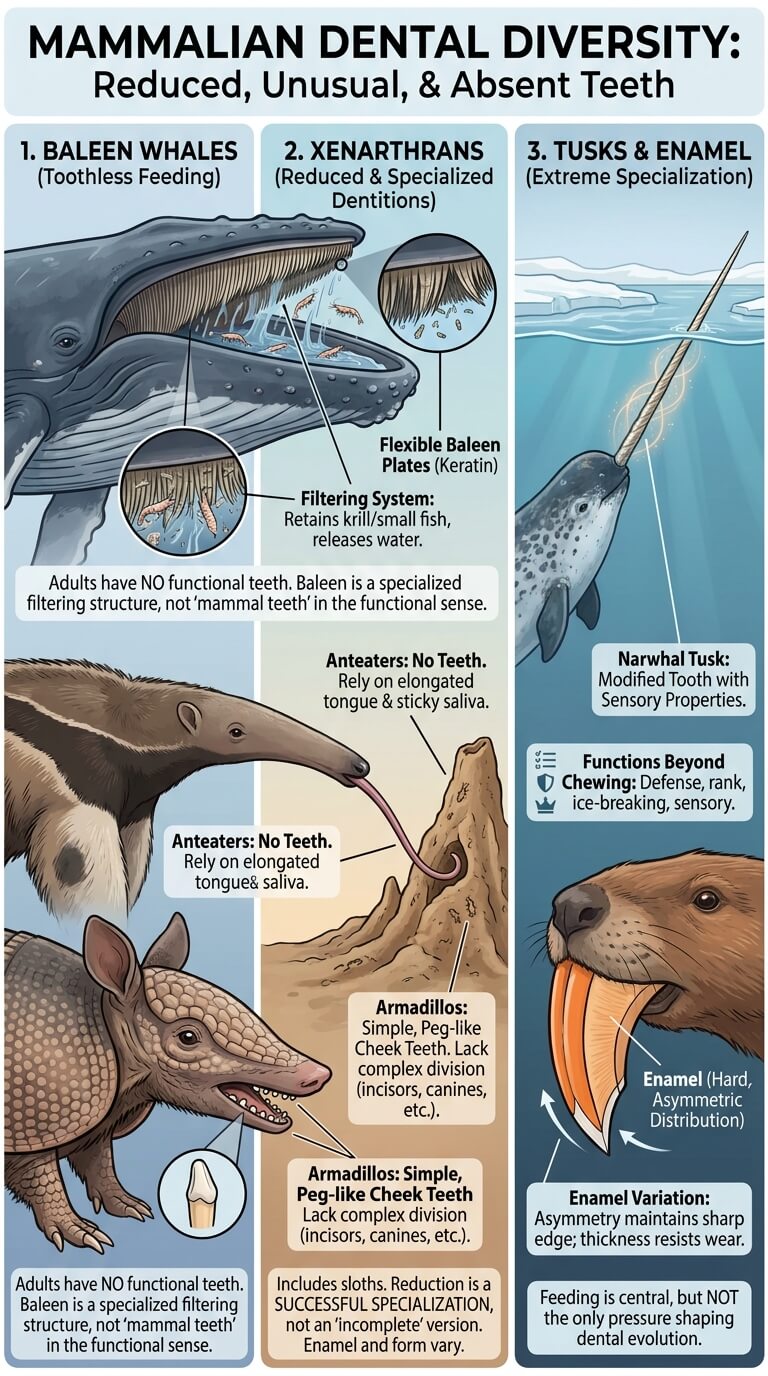
Adult baleen whales do not use teeth. They carry rows of flexible baleen plates made of keratin that hang from the upper jaw. Depending on the species and feeding method, baleen helps retain krill, small fish, or other prey while water leaves the mouth.
NOAA Fisheries’ whale overview distinguishes baleen whales from toothed whales and describes baleen as a filtering system. This difference shows why “mammal teeth” cannot be treated as a feature present in the same functional form throughout adult Mammalia.
Armadillos, Anteaters, and Other Reduced Dentitions
Anteaters lack teeth and rely on elongated tongues, sticky saliva, rapid feeding movements, and strong stomach processing. Armadillos generally have simple, peg-like cheek teeth rather than a strongly divided set of incisors, canines, premolars, and molars. Sloths also have reduced and unusual dentitions that do not fit the familiar classroom model.
These mammals belong to related South American lineages, but they do not all share one identical mouth. Tooth number, enamel presence, crown form, and growth pattern vary. Their diversity warns against assuming that reduced teeth represent an incomplete version of a more “advanced” dentition. Reduction can be a successful specialization.
Tusks, Enamel Variation, and Extreme Specialization
Enamel is extremely hard, but mammals do not distribute it in the same way across every tooth. Some continuously growing teeth use enamel asymmetry to maintain an edge. Some reduced dentitions have little or no enamel. In other species, thick enamel helps resist fracture and wear.
Extreme teeth may also perform jobs unrelated to chewing. Tusks can move soil, strip bark, break ice, carry objects, establish rank, or defend an animal. In narwhals, the projecting tusk is a modified tooth with sensory properties. Such examples show that feeding is central to dental evolution, but it is not the only pressure shaping teeth.
What Teeth Reveal About Evolution and Fossils
Identifying Diet From Tooth Form With Caution
Paleontologists compare fossil teeth with the form and wear of living mammals to infer likely feeding mechanics. Sharp crests suggest shearing, broad basins suggest crushing, and high crowns suggest adaptation to sustained wear. Stable isotopes and microscopic wear can add evidence about the foods or environments associated with an individual.
Inference remains probabilistic. Similar tooth forms can evolve in unrelated mammals facing similar food challenges, a process called convergence. A fossil tooth may also come from a juvenile, an unusual individual, or a species with seasonal dietary flexibility. Good reconstructions combine teeth with jaw shape, limb anatomy, associated plant and animal fossils, and geological context.
Why Teeth Fossilize Well
Teeth contain highly mineralized tissues and often survive conditions that destroy softer body parts. A single fossil site may preserve thousands of isolated teeth even when complete skeletons are rare. Because tooth shape differs among lineages, small dental details can help identify species and track changes through time.
Comparative tooth biology joins development, function, ecology, and evolution. An Integrative and Comparative Biology review describes teeth as a useful system for studying how developmental mechanisms and functional demands produce biological diversity.
Limits of Reconstructing Behavior From Teeth Alone
A tooth is not a video of an animal’s life. It cannot by itself show whether a predator hunted alone, scavenged, stored food, migrated, or changed diets during drought. Even the difference between eating meat and killing prey may be unclear because scavengers and hunters can process similar tissues.
Teeth are strongest when they answer mechanical questions: what kinds of forces the crown could resist, how opposing teeth met, how quickly surfaces wore, and what food textures were plausible. Behavioral claims need additional evidence from skeletons, trackways, stomach contents, chemical signatures, living relatives, or repeated patterns across many specimens.
Common Mistakes and Myths
Sharp Teeth Do Not Always Mean a Meat-Only Diet
Sharp teeth are tools, not dietary labels. Canines may be used for display or competition. Pointed cheek teeth may puncture insects. A mammal with some sharp teeth may still consume substantial fruit, leaves, nectar, or other foods. Diet should be described from direct observation and multiple anatomical traits.
All Mammals Do Not Replace Teeth the Same Way
The simple “baby teeth followed by adult teeth” model fits humans and many other mammals, but it does not cover the full class. Toothed whales, rodents, elephants, manatees, and several other lineages modify replacement, growth, or eruption in different ways. Even within a mouth, one tooth class may follow a different developmental path from another.
Dental Formulas Are Not Universal Across Broad Groups
An order, family, or informal ecological group may contain more than one tooth count. Variation can occur because teeth were lost, fused, reduced, added, or became difficult to classify. A formula should identify the taxon and life stage it describes. It should not be presented as a permanent rule for every mammal sharing a popular group name.
How Teeth Fit Into Mammal Biology
Jaw Anatomy and the Traits That Define Mammals
Mammalian teeth work with a lower jaw dominated by a single dentary bone and a jaw joint between the dentary and squamosal bones. Precise contact between upper and lower teeth supported increasingly complex chewing in mammal ancestors. Changes in the jaw and middle ear are also central to understanding how mammals differ anatomically from other vertebrates.
Teeth are therefore part of a larger system that includes muscles, bone, sensory feedback, saliva, tongue movement, and digestion. An efficient molar crown is useful only when the jaw can place it against the opposing surface with controlled force.
Diet, Habitat, and Ecological Role
A mammal’s mouth reflects repeated encounters with its environment. Grasslands produce different wear challenges from forest canopies. Burrowing rodents use incisors in ways that combine feeding and excavation. Aquatic hunters need to secure prey in water, while filter-feeding whales replace a tooth-based capture system with baleen.
These relationships also influence ecosystems. Grazers crop vegetation, browsers shape shrubs and trees, predators process animal tissues, and seed eaters can destroy or disperse seeds. Teeth help make those interactions possible, but behavior and habitat determine when and how the tools are used.
FAQ
What Are the Four Main Types of Mammal Teeth?
The four commonly recognized types are incisors, canines, premolars, and molars. Incisors often cut or scrape, canines often grip or puncture, and premolars and molars process food by slicing, crushing, or grinding. Many mammals modify or lose one or more types, so the four-part pattern is a useful starting point rather than a universal checklist.
Do All Mammals Have Canines?
No. Canines have been reduced or lost in several mammal lineages. Rodents usually lack canines and have a diastema between the incisors and cheek teeth. Other mammals retain canines but use them for functions beyond feeding, including display, defense, or competition.
Why Do Rodents Have Continuously Growing Incisors?
Rodent incisors face heavy wear from gnawing. Continued growth replaces material removed during use. Their structure helps maintain a working edge, but growth must remain balanced by normal wear. This system is one reason gnawing is a fundamental part of rodent feeding and object interaction.
Can Scientists Identify a Mammal From One Tooth?
Sometimes a tooth has a combination of size, cusp pattern, root form, and wear that allows a confident identification, especially when the local fossil fauna is well known. In other cases, one tooth supports only a broader identification such as a family or genus. Damage, juvenile development, individual variation, and convergent tooth shapes can limit certainty.
Final Thoughts
Mammal teeth are best understood as a coordinated tool set rather than a collection of isolated shapes. Heterodonty divides work among incisors, canines, premolars, and molars, while dental formulas record how many of each type occur. Crown height, cusps, ridges, blades, replacement patterns, and continuous growth reveal how mammals meet different feeding challenges.
No single tooth feature tells the whole story. Reliable interpretation combines the complete mouth with jaw mechanics, wear, observed behavior, habitat, and evolutionary history. That broader view explains both the familiar pattern of human-like tooth classes and the striking exceptions, from rodent incisors and elephant tusks to toothless anteaters and baleen whales.

Ethan Walker is the founder and research editor of Animal Fact Central. He creates and reviews educational animal facts content using trusted wildlife, pet care, and science-based sources. His work focuses on making animal behavior, adaptations, habitats, and species facts clear, accurate, and engaging for everyday readers.
Read More Details About Ethan Walker: https://animalfactcentral.com/ethan-walker/