
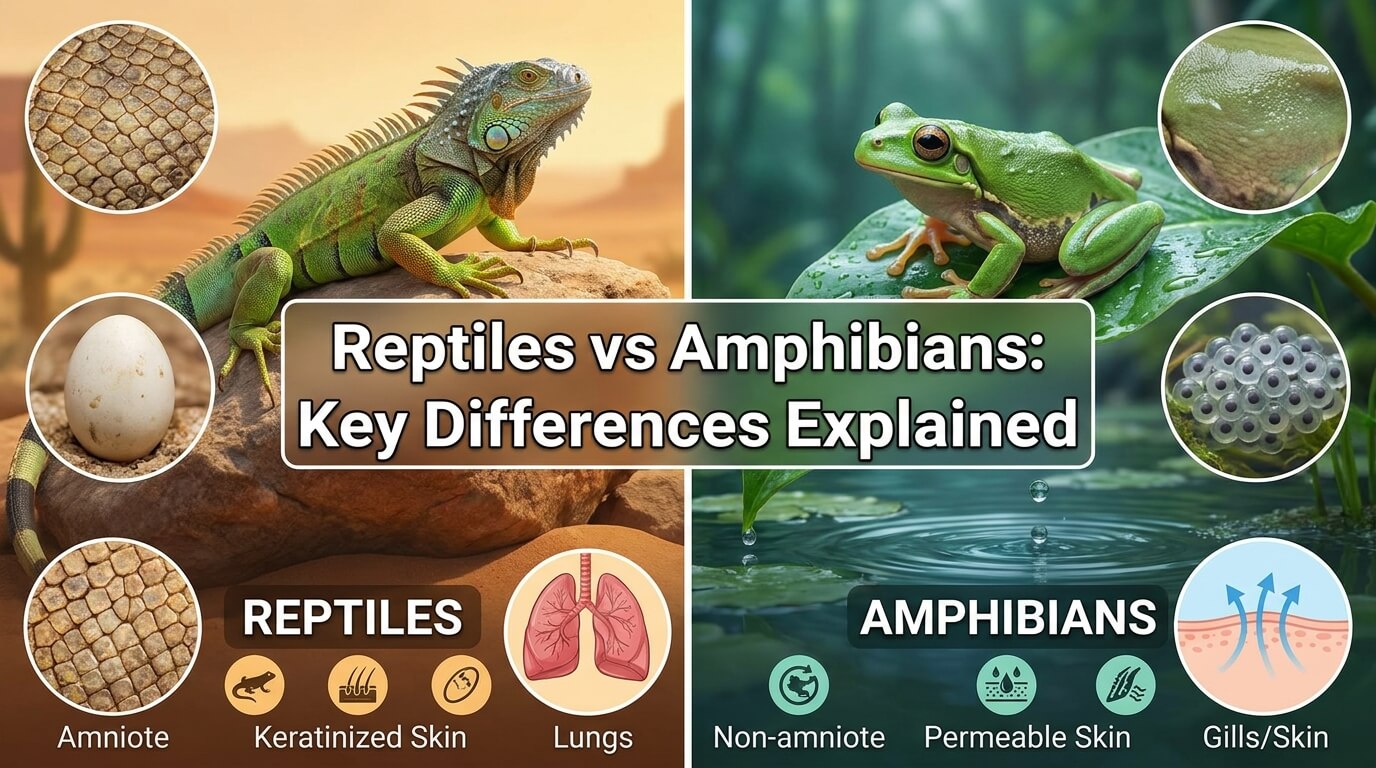
Reptiles and amphibians can look surprisingly similar. A salamander may be mistaken for a lizard, a caecilian can resemble a snake, and turtles are sometimes wrongly grouped with amphibians because many live around water. The most important differences are biological rather than superficial. Living non-avian reptiles are amniotes with keratinized skin and lungs, while amphibians generally have more permeable, glandular skin and a life history that remains more closely tied to water or moist environments.
The comparison becomes clearer when you look at skin, reproduction, development, respiration, and water balance together. No single shortcut works in every case. Not every amphibian has smooth skin or an aquatic tadpole stage, and not every reptile lays a shelled egg on land. Both groups are also primarily ectothermic, so “cold-blooded” is not a useful way to separate them.
Quick Difference: Reptiles vs Amphibians
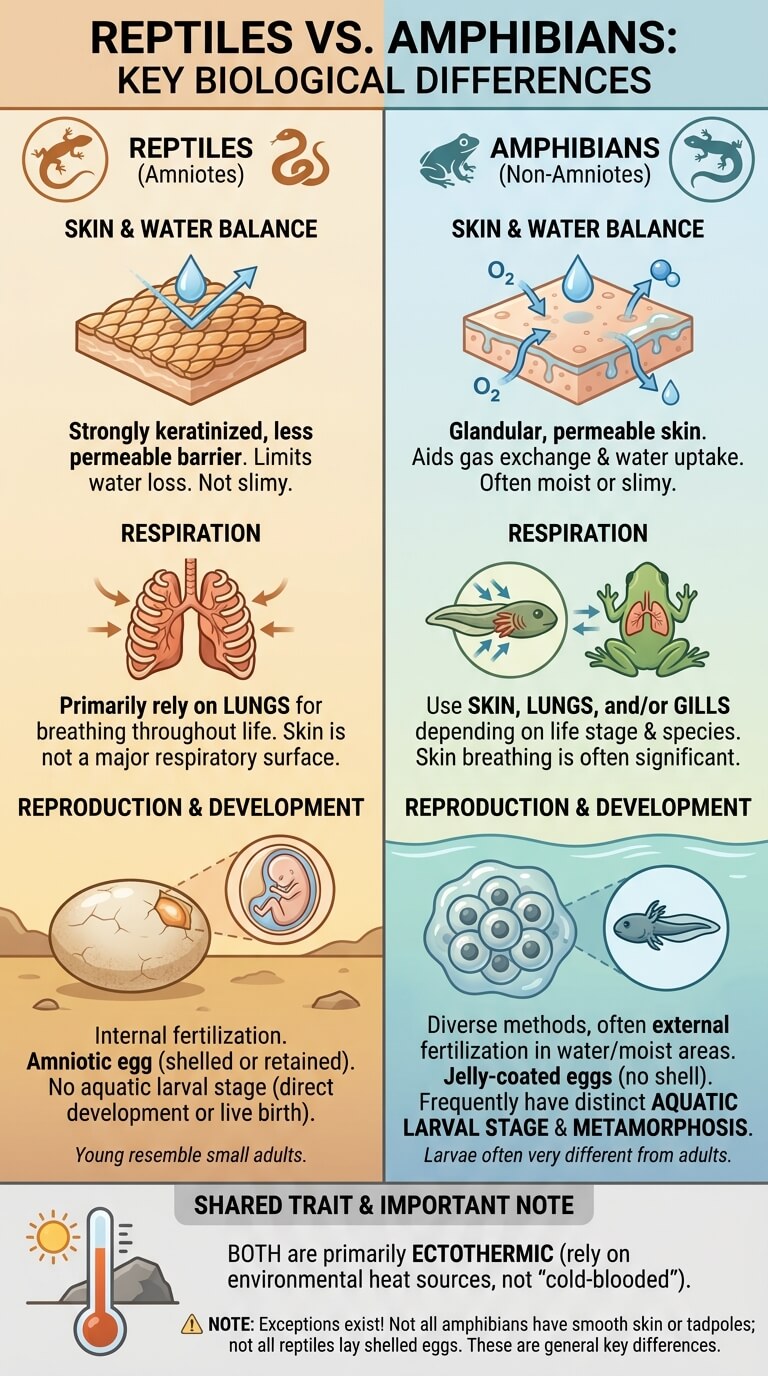
The most useful biological distinctions
Reptiles and amphibians are both vertebrate tetrapod lineages, but they solve the problems of life on land in different ways. Reptiles belong to the amniote lineage. The developing embryo is supported by extraembryonic membranes, including the amnion, a key feature that separates amniotes from amphibians in evolutionary terms. Modern reptiles also have a more strongly keratinized outer skin barrier that helps limit water loss.
Amphibians are not amniotes. Their skin is generally thinner, more glandular, and more permeable to water and gases than reptile skin. In many species, the skin contributes substantially to respiration. Amphibian reproduction is highly diverse, but many species lay unshelled, jelly-coated eggs in water or very moist settings, and many pass through a distinct larval stage before becoming adults.
Those differences affect where each group can live, how they reproduce, and how they interact with moisture. They are more informative than simply asking whether an animal “looks scaly” or “lives near water.”
Why simple dry-skin versus wet-skin rules are incomplete
The familiar classroom shortcut says reptiles have dry, scaly skin while amphibians have moist, smooth skin. It points toward a real difference in skin biology, but it becomes misleading if treated as an absolute rule.
Many amphibians have moist skin because mucus helps maintain a functional surface for water balance and gas exchange. Yet toads and many salamanders can have rough, bumpy, or textured skin. Some newts have comparatively rough skin. Caecilians add another exception because some species possess small dermal scales embedded in the skin rather than obvious reptile-style epidermal scales.
Reptile skin is generally more keratinized and resistant to water loss, but reptile surfaces also vary. Snake scales, lizard scales, turtle scutes, and crocodilian skin are not identical structures arranged in one universal pattern. Skin biology is therefore a strong comparison tool, but texture alone is not enough for identification.
Reptiles vs Amphibians Comparison Table
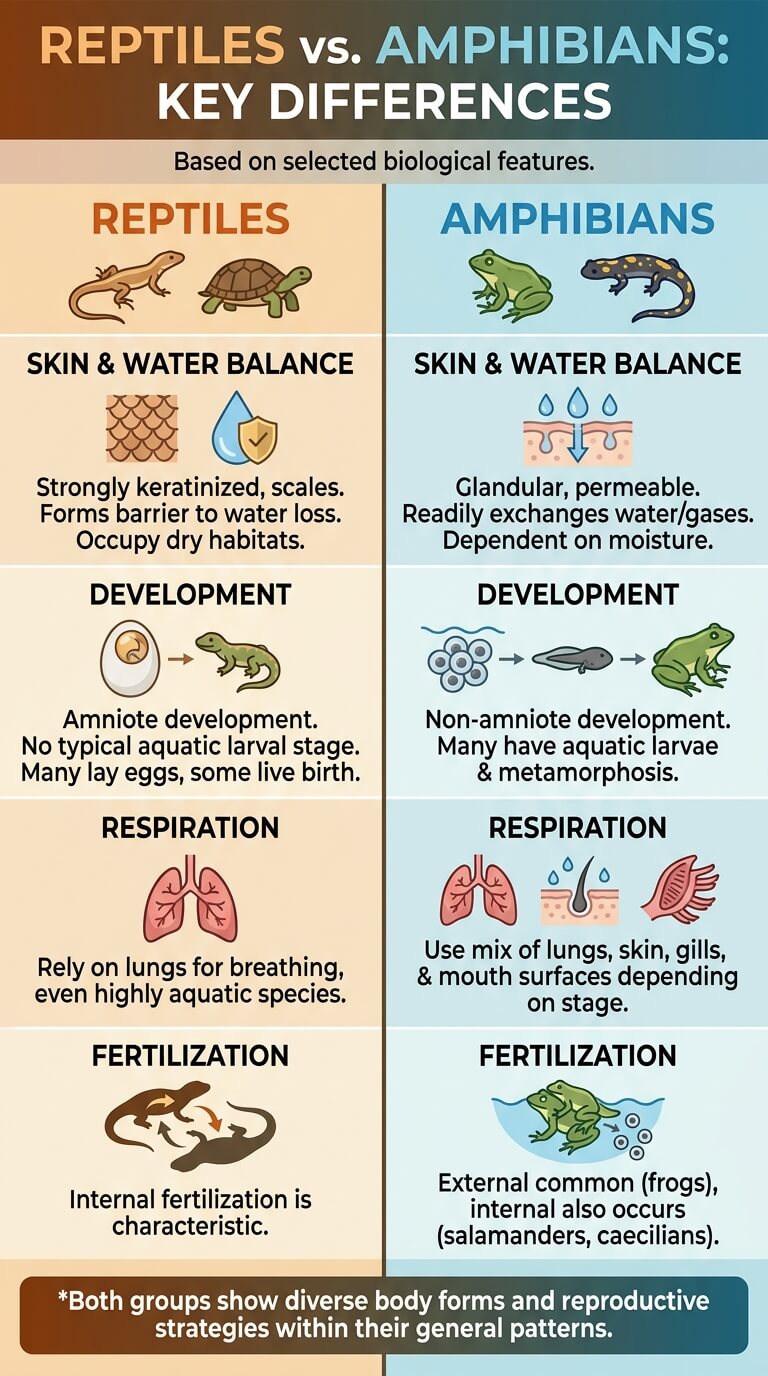
| Feature | Living non-avian reptiles | Living amphibians |
|---|---|---|
| Skin | More strongly keratinized epidermis; scales, scutes, or other keratinized coverings are common | Generally glandular and relatively permeable; texture ranges from smooth to rough or folded |
| Water balance | Skin barrier generally reduces evaporative water loss | Skin often exchanges water readily with the environment |
| Development | Amniote development | Non-amniote development |
| Fertilization | Internal fertilization is characteristic of living reptiles | External fertilization is common in frogs, while internal fertilization occurs in many salamanders and caecilians |
| Eggs and birth | Many lay eggs, but live birth occurs in numerous reptile lineages | Many lay jelly-coated eggs, but reproductive modes include terrestrial eggs and live-bearing species |
| Larval stage | No typical amphibian-style aquatic larva followed by metamorphosis | Many have larvae and metamorphosis, but direct development and other exceptions occur |
| Respiration | Living reptiles rely on lungs for breathing | Depending on lineage and life stage, lungs, skin, gills, and mouth or throat surfaces can contribute |
| Temperature biology | Primarily ectothermic | Primarily ectothermic |
| Typical moisture relationship | Includes species from deserts to oceans; many can function in drier environments | Often more closely constrained by moisture because of skin and reproductive biology, although many adults are terrestrial |
Skin and water balance
A reptile’s keratinized epidermis forms a stronger barrier to evaporative water loss than the skin of a typical amphibian. That does not make reptile skin completely waterproof, but it helps explain why reptiles can occupy extremely dry habitats that would be physiologically difficult for many amphibians.
Amphibian skin commonly takes part in water uptake, ion balance, and gas exchange. The U.S. Fish and Wildlife Service notes that the northern leopard frog has highly permeable skin through which water and gases can pass. This permeability is useful, but it also makes many amphibians closely dependent on suitable moisture conditions.
Eggs, fertilization, and development
Reptile development is amniotic, and fertilization occurs internally. Many reptiles deposit eggs on land or in protected nests, but live birth has evolved repeatedly, especially among squamates. The broader reptile pattern is therefore not “reptiles lay eggs,” but rather internal fertilization plus amniote development expressed through several reproductive modes.
Amphibians show a different range of strategies. External fertilization is familiar from many frogs, but it is not universal. Many salamanders use internal fertilization, and caecilians also use internal fertilization. Some amphibians place eggs in water, others lay them on land or vegetation, and some give birth to live young.
Respiration, habitat dependence, and body form
Modern reptiles breathe using lungs, including highly aquatic reptiles. Sea turtles, crocodilians, and sea snakes still obtain oxygen from air even though they spend long periods in water. Amphibians can use a wider mix of respiratory surfaces across species and life stages. Larvae may have gills, adults may have lungs, and skin breathing can be important or even dominant in some salamanders.
Body shape does not neatly divide the two groups either. Frogs, salamanders, and caecilians are all amphibians despite looking dramatically different. Squamates, turtles, crocodilians, and tuatara are all reptiles despite equally large differences in body plan.
Skin and Water Balance
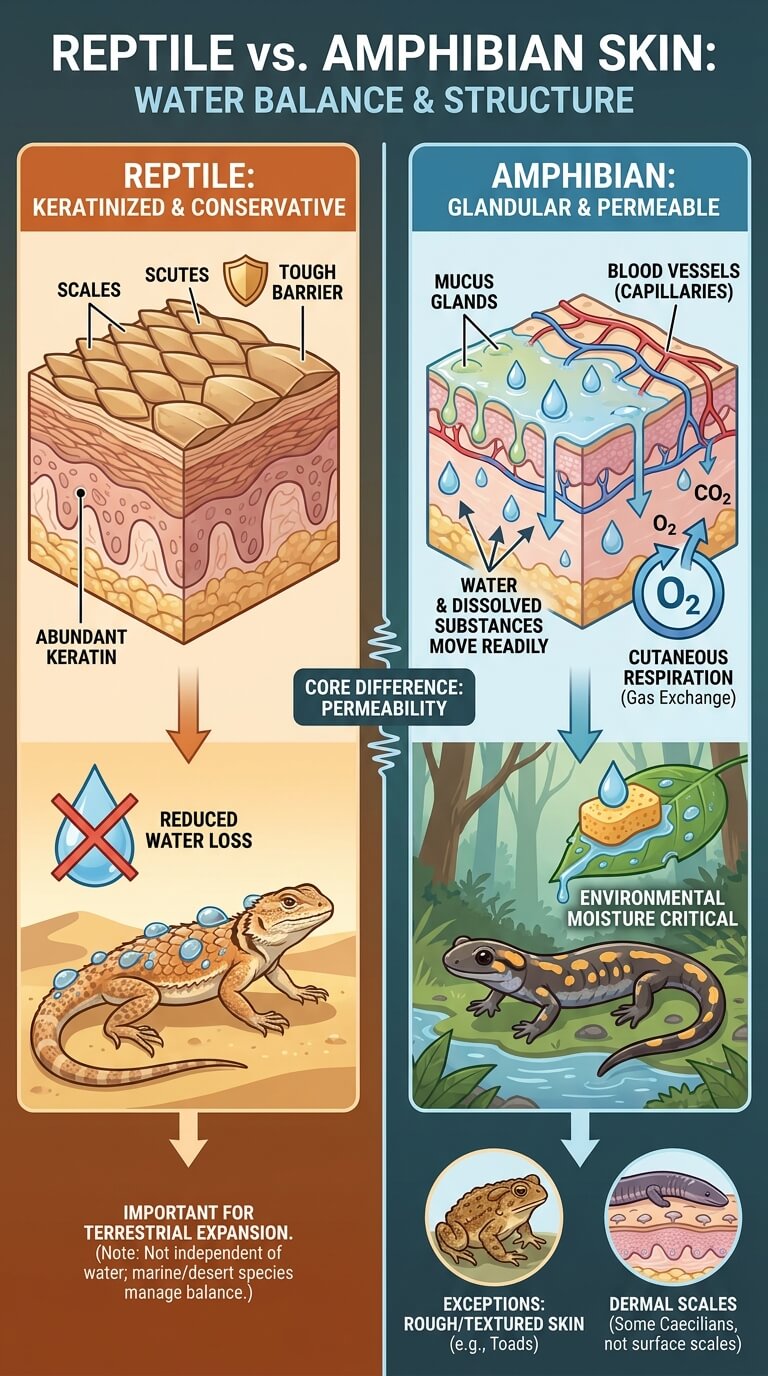
Keratinized reptile epidermis, scales, and reduced water loss
The outer layers of reptile skin contain abundant keratin, producing a relatively tough barrier that helps protect the body from abrasion and slows water loss. The visible covering may take the form of overlapping scales, small granular scales, large scutes, or combinations of keratinized and bony structures depending on the lineage.
This skin barrier was important in the expansion of amniotes into terrestrial environments, but reptiles are not independent of water. Desert lizards still need water balance strategies, turtles can dehydrate, and marine reptiles must manage salt and fresh-water balance. The difference is that reptile skin generally leaks less water than amphibian skin.
Glandular, permeable amphibian skin and cutaneous exchange
Amphibian skin typically contains numerous glands, including mucus glands that help maintain the skin surface. Blood vessels near the skin can permit gas exchange, a process known as cutaneous respiration. How important that pathway is varies widely among amphibians.
The Smithsonian’s Japanese giant salamander profile describes a species that obtains much of its oxygen through highly folded skin. At the other extreme, some amphibians combine skin breathing with lungs, while larvae of many species use gills.
Because water and dissolved substances can move relatively readily across amphibian skin, environmental moisture and water quality can matter greatly. That does not mean every amphibian must sit in water. Many forest salamanders, terrestrial frogs, and burrowing caecilians spend much or most of their adult lives on land.
Exceptions such as rough-skinned amphibians and dermal scales in some caecilians
“Smooth and slimy” is especially unreliable as a universal amphibian description. Toads commonly have rough, glandular skin. Newts may feel textured. Some caecilians have scale-like structures buried in grooves of the skin.
For example, the Animal Diversity Web account for Gymnopis multiplicata notes scales embedded in the skin of this caecilian. These are not equivalent to the familiar surface scales of a lizard or snake, but they show why “amphibians never have scales” is too absolute.
Eggs, Amniotic Development, and Reproduction
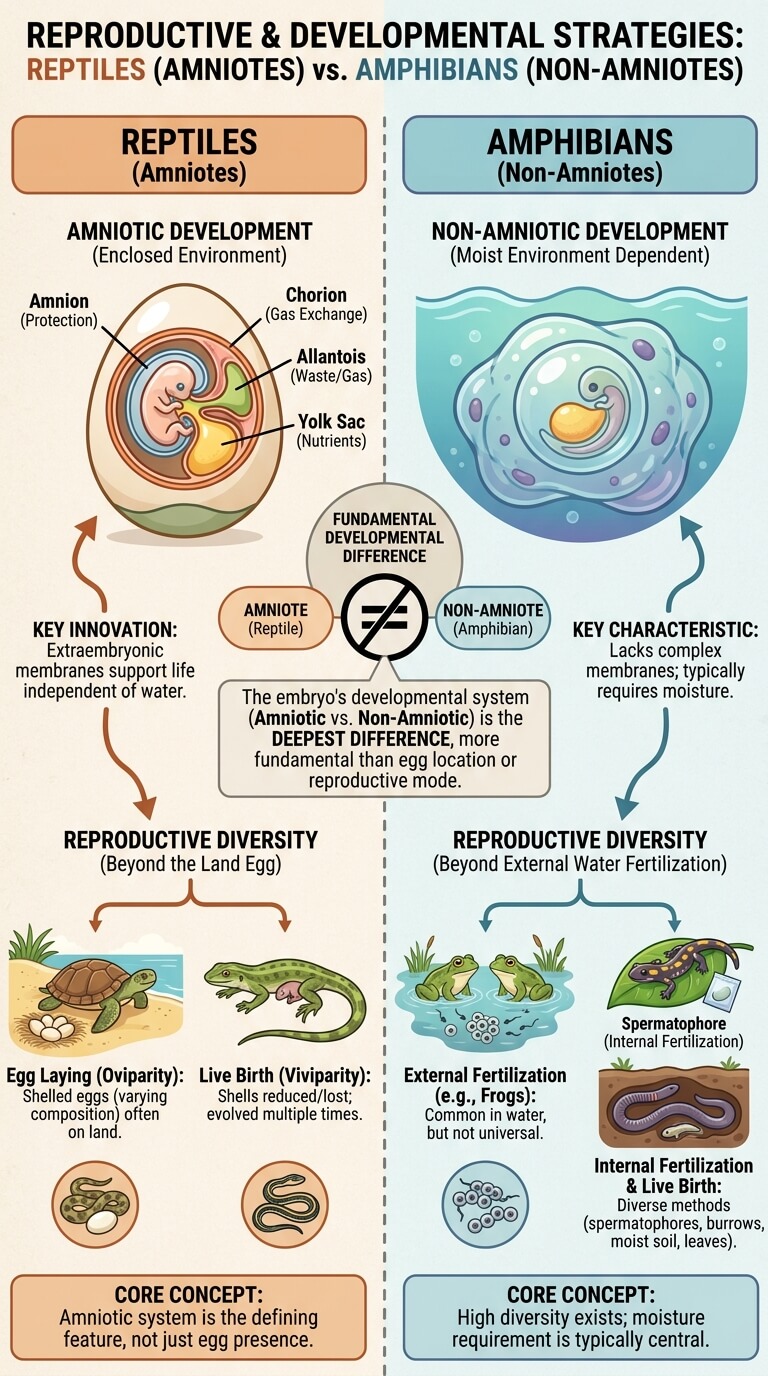
Reptile amniotic development and reproductive diversity
One of the deepest differences between reptiles and amphibians lies in embryonic development. Reptiles are amniotes. Their embryos develop with a set of extraembryonic membranes that support life in an enclosed developmental environment. This evolutionary innovation is shared with birds and mammals, although the details of reproduction differ greatly among those groups.
The Animal Diversity Web overview of Reptilia describes reptiles as amniotes and notes that egg shells can be reduced or lost in species that give birth to live young. That distinction is useful because the amniotic condition is more fundamental than whether a particular species deposits an egg outside the body. Reproduction provides another major contrast, and reptile reproduction includes both egg laying and live birth as well as different sex-determination systems.
Amphibian reproductive diversity beyond external fertilization
The stereotypical amphibian life cycle involves a frog releasing eggs into water while a male fertilizes them externally. That is a real and common pattern in frogs, but Amphibia contains much more reproductive diversity.
Many salamanders use spermatophores, packets of sperm deposited by males and taken up by females, resulting in internal fertilization. Caecilians also use internal fertilization. Eggs may be laid in streams, ponds, moist soil, burrows, leaves over water, or other protected sites depending on the species.
Some amphibians give birth to larvae or fully developed young. The Smithsonian’s aquatic caecilian profile, for example, describes live birth in the species kept at the National Zoo. Amphibian reproduction is therefore too diverse for “external fertilization in water” to serve as a universal definition.
Why all reptiles do not lay shelled eggs on land
Egg laying is common among reptiles, but live birth has evolved many times in snakes and lizards. Even among egg-laying reptiles, shells vary in composition and degree of mineralization. A rigid birdlike shell is not the universal reptile condition.
This is why “reptile equals land egg” should be replaced with a more accurate idea: reptiles are amniotes, and modern reptile species express that reproductive heritage through both egg laying and live bearing. The embryo’s developmental system matters more than whether the reader can see an external egg.
Larvae, Metamorphosis, and Growth
Dramatic metamorphosis in many amphibians
Many amphibians undergo a striking transition between larval and adult life. A typical frog tadpole is aquatic, often uses gills early in life, and has a body plan very different from the adult frog. During metamorphosis, limbs develop, the tail is remodeled, feeding structures change, and respiratory systems shift toward the adult condition.
Salamanders often have larvae that already resemble small, gilled versions of adults, but metamorphosis can still involve major changes such as loss of external gills and changes in skin, skull, and sensory systems. The exact sequence varies by lineage.
Direct development and other amphibian exceptions
Not every amphibian passes through a free-swimming tadpole or aquatic larval stage. Some frogs and salamanders develop directly in eggs, hatching as small versions of the terrestrial adult form. Other salamanders retain larval features into adulthood, a pattern called paedomorphosis.
Direct development is well documented among lungless salamanders. The Animal Diversity Web account of Plethodontidae notes that some lineages develop directly from terrestrial eggs, while others retain an indirect life cycle. This diversity is one reason amphibian life history should not be reduced to “egg, tadpole, frog.”
Reptile development without a typical amphibian-style metamorphic stage
Young reptiles grow, mature, and can change greatly in size, color, proportions, diet, and behavior, but they do not normally pass through the kind of distinct aquatic larva-to-terrestrial-adult metamorphosis associated with many amphibians.
A hatchling turtle already has the basic turtle body plan. A young lizard has the essential lizard form. A crocodilian hatchling is recognizably crocodilian. This does not mean reptile development is simple. Embryos undergo complex development before hatching or birth, and juveniles may occupy different habitats or ecological roles than adults.
Lungs, Skin Breathing, and Gas Exchange
Reptile dependence on lungs
Living reptiles breathe air with lungs. Aquatic species may have impressive diving abilities, but they still need access to atmospheric oxygen. Their skin is not used for whole-body respiratory exchange in the way it can be in amphibians.
Different reptile groups ventilate their lungs in different ways. Lizards and snakes use movements of the rib cage, turtles must work around a rigid shell, and crocodilians have specialized muscular mechanisms that help ventilate the lungs. Those details vary, but the basic comparison remains: lungs are central to respiration in living reptiles.
Amphibian use of lungs, skin, gills, or combinations depending on lineage and life stage
Amphibian respiration is much more variable. Frog tadpoles often use gills and skin before shifting toward lungs and skin as adults. Many salamanders use a combination of skin and lungs. Lungless salamanders lack lungs entirely and depend heavily on cutaneous and mouth-throat gas exchange.
Even within one amphibian body plan, ecology changes the balance. A fully aquatic salamander can rely strongly on skin exchange in oxygen-rich water, while a terrestrial frog may use lungs extensively but still depend on its skin for part of its gas exchange and water balance.
Ectothermy and Temperature
Why both groups are primarily ectothermic
Reptiles and amphibians are both primarily ectothermic, meaning much of the heat that influences their body temperature comes from external sources rather than from sustained internal heat production of the kind seen in birds and mammals.
Ectothermy does not mean an animal’s body simply matches the surrounding air. Reptiles can bask, retreat into shade, move underground, enter water, alter posture, or change daily activity times. Amphibians also choose microhabitats and activity periods that help them manage temperature and moisture.
Why temperature strategy alone cannot separate reptiles from amphibians
Because both groups are ectothermic, “cold-blooded” tells you almost nothing about whether an animal is a reptile or amphibian. Fish and many invertebrates are also ectothermic.
Temperature biology becomes more useful when combined with other traits. A lizard basking on a rock and a frog sheltering in damp leaf litter may both rely on environmental heat, yet their skin permeability, reproductive biology, and moisture constraints differ substantially.
Habitats and Dependence on Moisture
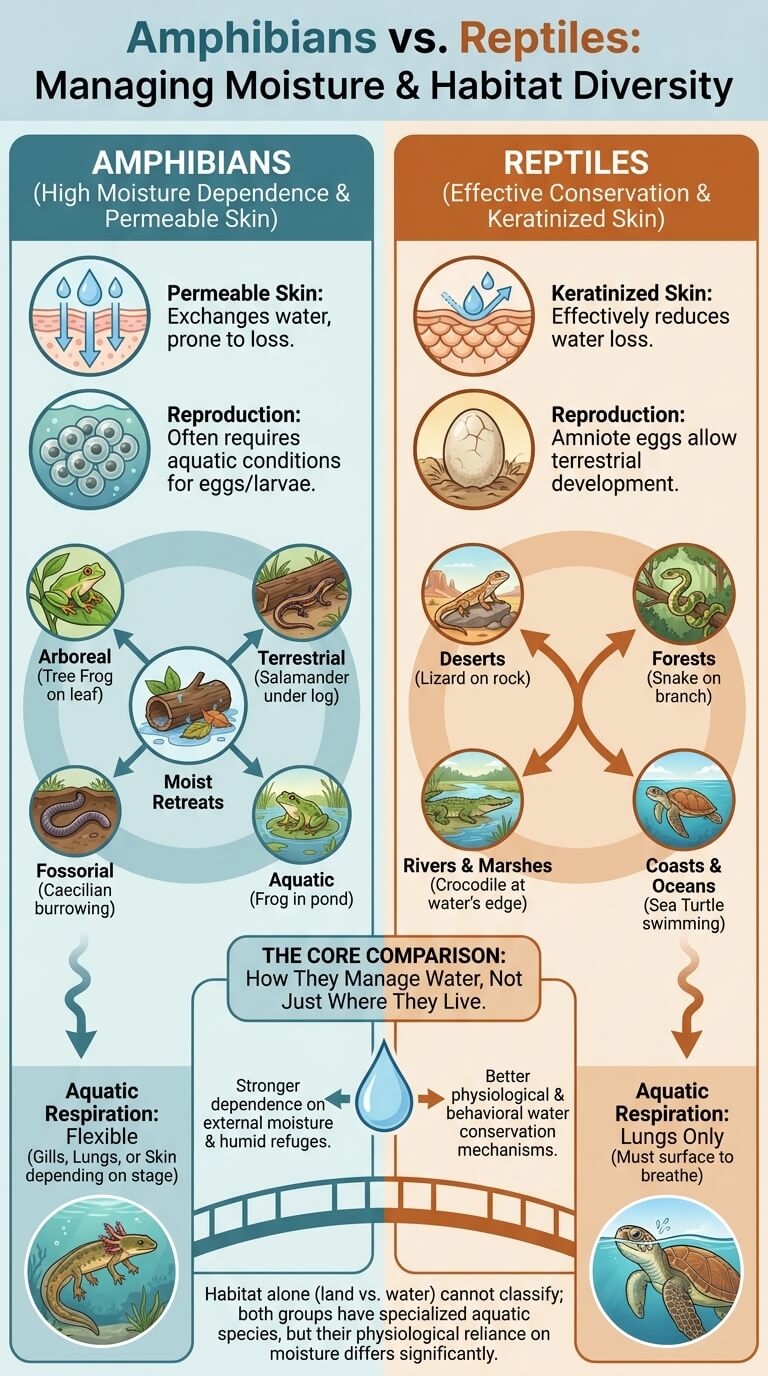
Terrestrial, aquatic, arboreal, and fossorial amphibians
Amphibians are often associated with ponds and wetlands, but adults occupy a much wider range of habitats. Tree frogs live above ground in vegetation, woodland salamanders can spend their adult lives under logs and leaf litter, and many caecilians are burrowers. Some salamanders remain aquatic throughout life.
The common thread is not that every amphibian lives in water. Instead, amphibian skin and reproduction often create stronger dependence on humid microhabitats, moist retreats, or suitable aquatic conditions at some point in the life cycle. The degree of dependence varies enormously.
Reptiles in deserts, forests, freshwater, coasts, and oceans
Reptiles occupy deserts, tropical forests, temperate woodlands, grasslands, mountains, rivers, marshes, coasts, and the open ocean. Their keratinized skin and amniote reproduction opened ecological possibilities that are less available to animals with highly permeable skin and exposed aquatic eggs.
That does not make reptiles strictly terrestrial. Sea turtles and sea snakes are marine, crocodilians are strongly associated with aquatic environments, and many turtles spend most of their active lives in freshwater. All still retain reptile characteristics such as lung breathing and amniote development.
Water dependence versus water-use adaptations
The most useful comparison is how each group manages water, not whether it lives “on land” or “in water.” Amphibians commonly exchange water through the skin and often need moist conditions to prevent excessive water loss. Reptiles generally reduce water loss more effectively through their skin and can use behavioral and physiological mechanisms to conserve water.
Both groups also include specialized aquatic species. An aquatic reptile must surface to breathe. An aquatic amphibian may use gills, lungs, skin, or a combination depending on species and life stage. Habitat alone therefore cannot classify the animal.
Body Forms and Movement
Frogs, salamanders, and caecilians in direct comparison
Living amphibians fall into three major body-plan traditions. Frogs and toads have compact adult bodies with powerful hind limbs and no adult tail. Salamanders and newts generally retain an elongated body with a tail and usually four limbs. Caecilians are elongated, limbless amphibians adapted mainly for burrowing or aquatic life.
These shapes can create confusion. A salamander may resemble a lizard, but its skin and developmental biology reveal a very different lineage. A caecilian may look snake-like, yet its anatomy and reproduction place it with amphibians rather than squamate reptiles.
Squamates, turtles, crocodilians, and tuatara in direct comparison
Reptiles are just as varied. Squamata includes snakes, amphisbaenians, and the many lineages commonly called lizards. Testudines includes turtles and tortoises. Crocodylia includes crocodiles, alligators, caimans, and gharials. Rhynchocephalia is represented today by tuatara.
Movement reflects those different body plans. Snakes move without functional walking limbs, lizards may run or climb, turtles walk or swim with limbs modified for their environments, and crocodilians can both travel on land and swim powerfully with their tails. “Reptile” does not mean “crawling animal.”
Evolutionary Relationship
Shared ancient tetrapod ancestry
Reptiles and amphibians share ancient ancestry as tetrapod vertebrates, but their living lineages diverged long before the origin of modern frogs, salamanders, lizards, snakes, turtles, or crocodilians. The evolutionary split that matters most for this comparison is between amphibian lineages and amniotes.
Amniotes later diversified into the lineages that include reptiles, birds, and mammals. This history explains why traits such as the amnion and strongly keratinized skin carry more biological meaning than surface resemblance.
Why living amphibians are not ancestors of living reptiles
It is inaccurate to say reptiles evolved from modern amphibians. Living frogs, salamanders, and caecilians are not surviving versions of the direct ancestors of reptiles. Modern amphibians and modern amniotes are both the results of long, separate evolutionary histories that trace back to older tetrapod ancestors.
A useful analogy is cousins rather than parent and child. The two groups share deep ancestry, but one living group did not transform directly into the other.
Common Mistakes and Myths
All amphibians are slimy and all reptiles are dry
Amphibian skin is generally more permeable and glandular, but its texture can be smooth, rough, folded, or warty. Reptile skin is more heavily keratinized, yet it also varies from fine scales to large scutes and specialized coverings. Touch is not a safe or necessary identification method, and wild animals should be observed without handling.
Every amphibian has a tadpole stage
Tadpoles are the larval form of frogs and toads, not a universal amphibian stage. Salamanders have their own larval forms, caecilians vary, and some amphibians develop directly in eggs without a free-living aquatic larva.
Every reptile lays eggs on land
Many reptiles lay eggs, but live-bearing snakes and lizards demonstrate that egg laying is not required to be a reptile. Reptile identity is better understood through ancestry and amniote biology than through a single reproductive outcome.
Turtles are amphibians because many live in water
Turtles are reptiles. Their shells are integrated with the skeleton, they breathe with lungs, they have keratinized external coverings, and their embryos develop as amniotes. Aquatic habitat does not turn a vertebrate into an amphibian.
Why These Differences Matter Across Reptile and Amphibian Biology
What reptile traits tell us
Comparing reptiles with amphibians makes reptile identity easier to understand. Keratinized skin, amniote development, internal fertilization, and lung breathing form a more useful biological framework than the old image of a “scaly, cold-blooded crawler.”
Why skin and reproduction need closer attention
Skin and reproduction are where many of the biggest contrasts appear, but both topics contain important variation. Reptile scales and scutes differ among lineages, amphibian skin can be highly specialized, reptiles include live-bearing species, and amphibians include internal fertilization and direct development. Looking at the mechanisms prevents simple rules from becoming myths.
Where amphibian diversity goes beyond this comparison
A reptile-versus-amphibian comparison can explain the boundary between the groups, but it cannot capture the full biology of frogs, salamanders, and caecilians. Amphibians have their own diversity of life cycles, reproductive systems, skin specializations, habitats, and conservation challenges that deserve separate treatment rather than being compressed into the “opposite” of reptiles.
FAQ
Can amphibians have scales?
Some can. Certain caecilians possess small dermal scales embedded within the skin. These structures are not the same as the conspicuous epidermal scales covering most snakes and lizards, so the exception does not erase the broader difference in reptile and amphibian skin biology.
Do all amphibians need to return to water to reproduce?
No. Many frogs and salamanders depend on ponds, streams, or other aquatic settings for eggs and larvae, but amphibian reproduction is much more varied. Some species lay eggs on land, some undergo direct development inside terrestrial eggs, and some caecilians and salamanders give birth to live young. Moisture often remains important even when open water is not required.
Are reptiles and amphibians both cold-blooded?
Both groups are primarily ectothermic. Their body temperature is strongly influenced by environmental heat, but they can regulate exposure through behavior such as basking, seeking shade, burrowing, entering water, or changing activity times. “Cold-blooded” is a common informal term, but ectothermic is more precise.
Can reptiles breathe through their skin?
Not in the amphibian sense. Living reptiles rely on lungs for respiration. Their keratinized skin is comparatively resistant to gas exchange. Amphibians, by contrast, often use the skin as a meaningful respiratory surface, although the importance of skin breathing varies by species and life stage.
Final Thoughts
The best way to understand reptiles vs amphibians is to compare systems rather than stereotypes. Reptiles are amniotes with lung-based respiration and a strongly keratinized skin barrier, while amphibians generally have more permeable, glandular skin and a greater connection between moisture and respiration or reproduction. Yet both groups contain important exceptions to the familiar classroom rules. Not every amphibian has a tadpole stage, not every reptile lays eggs, and both are primarily ectothermic. Looking at skin, development, reproduction, breathing, and water balance together gives a much more accurate picture of what separates these two major vertebrate lineages.

Ethan Walker is the founder and research editor of Animal Fact Central. He creates and reviews educational animal facts content using trusted wildlife, pet care, and science-based sources. His work focuses on making animal behavior, adaptations, habitats, and species facts clear, accurate, and engaging for everyday readers.
Read More Details About Ethan Walker: https://animalfactcentral.com/ethan-walker/
1 thought on “Reptiles vs Amphibians: Key Differences Explained”