
A mammal is a vertebrate whose identity is defined by a combination of inherited features, not simply by looking furry or giving live birth. The most important traits include hair at some stage of development, milk-producing mammary glands in females, three tiny bones in the middle ear, and a lower jaw built mainly from a single bone called the dentary. Living mammals also breathe with lungs and regulate much of their body heat internally, but those features are not unique to mammals.
This combination explains why a whale is a mammal even though it has almost no visible hair, why a platypus remains a mammal despite laying eggs, and why a warm-bodied bird is not a mammal. Some defining traits are easy to see, while others are hidden in the skull or appear only during early development.
Quick Answer
The trait combination scientists use
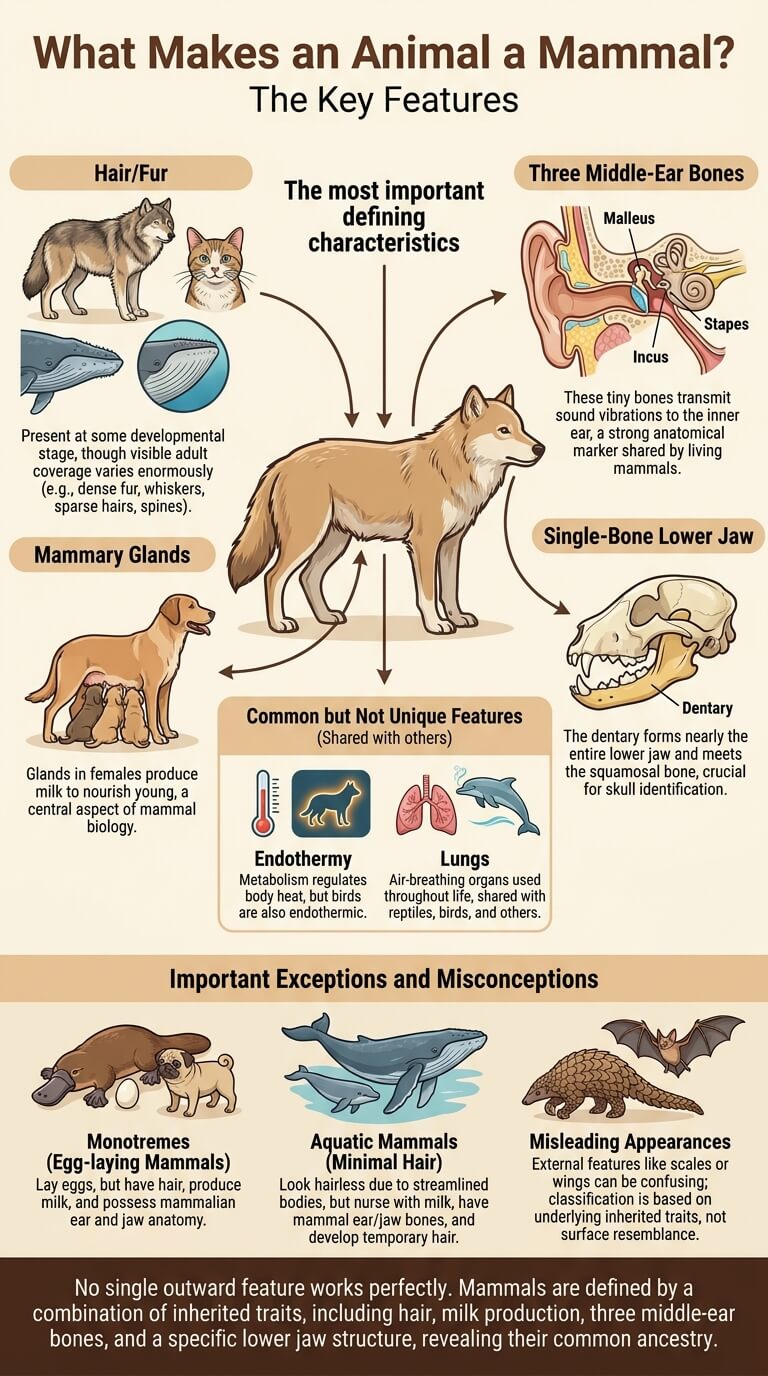
The clearest answer to what makes an animal a mammal is a set of traits shared through mammalian ancestry. The Animal Diversity Web overview of Mammalia highlights three especially distinctive features: hair, milk production by mammary glands, and three middle-ear bones. Skull anatomy adds another powerful marker, because the mammalian lower jaw is dominated by one dentary bone that meets the squamosal bone of the skull.
| Trait | What it means | How useful it is for identification |
|---|---|---|
| Hair | Keratin-based strands that may form fur, whiskers, spines, or sparse body hair | Very useful in living animals, but it may be reduced or temporary |
| Mammary glands | Glands that produce milk for young | Central to mammal biology, although not always visible externally |
| Three middle-ear bones | Malleus, incus, and stapes transmit sound toward the inner ear | A strong anatomical marker shared by living mammals |
| Single-bone lower jaw | The dentary forms nearly the entire lower jaw and meets the squamosal | Especially important when studying skulls and fossils |
| Endothermy | Metabolism supplies much of the heat used to regulate body temperature | Common in mammals, but birds are endothermic too |
| Lungs | Air-breathing organs used throughout life | Universal in mammals, but shared with several other vertebrate groups |
Why one visible feature is not enough
No single outward feature works perfectly in every situation. Thick fur strongly suggests a mammal, but some nonmammals can look furry from a distance because feathers, bristles, or body filaments create a similar texture. Live birth is also an unreliable shortcut because monotremes lay eggs, while some reptiles and fish give birth to live young.
Scientists therefore look for a pattern of anatomy and development. A dolphin’s streamlined body resembles a fish, yet it breathes air, nurses its calf with milk, has mammalian ear and jaw anatomy, and develops a small amount of hair. Classification follows shared evolutionary structure rather than surface resemblance.
Why Mammal Identification Is More Complicated Than It Looks
External appearance can be misleading
Evolution often produces similar shapes in unrelated animals facing similar challenges. A dolphin and a shark both have streamlined bodies because that shape reduces drag in water, not because they belong to the same animal class. Bats and birds both have wings, but bat wings are skin membranes supported by greatly lengthened fingers, while bird wings are feathered forelimbs.
Body covering can also confuse identification. Pangolins are mammals with large protective scales, armadillos carry armored plates, and whales may appear completely hairless. None of those modifications erases the underlying traits inherited from mammalian ancestors.
Traits may appear only during development or in one sex
Some mammalian features are easier to detect in embryos or young animals than in adults. Hair may be present briefly and later lost, as happens with much of the sparse hair of many whales. Mammary tissue occurs in both sexes during development, but it normally develops much further in females and becomes functional for milk production after hormonal changes associated with reproduction.
This matters because a defining trait does not need to be equally obvious in every individual. Antlers are not required for an animal to be a deer, and milk production does not need to be active at every moment for an animal to be a mammal. Classification is based on the inherited body plan of the species.
Hair or Fur
How hair differs from feathers and scales
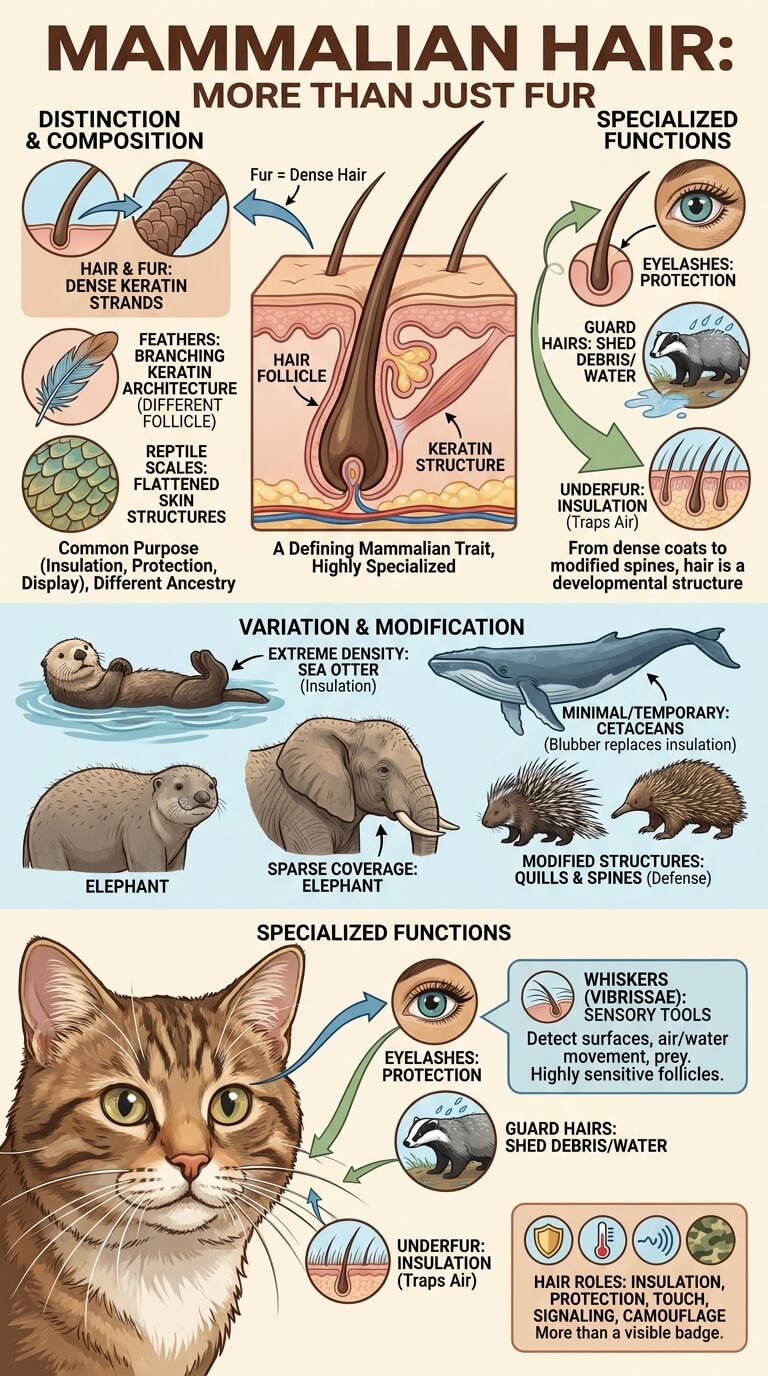
Hair is a structure produced by follicles in mammalian skin. It is made largely from keratin, a tough protein also found in claws and nails. Fur is not a separate biological material. The word usually describes a dense coat of hair, often with different layers or hair types.
Feathers are also made largely from keratin, but they grow from different follicular structures and have a branching architecture unlike a strand of hair. Reptile scales are flattened skin structures with a different developmental pattern. These coverings can perform overlapping jobs such as insulation, protection, camouflage, or display, yet they are not interchangeable evidence of ancestry.
Sparse, modified, or temporary hair
Every living mammal is understood to have hair at some point in its development, but adult coverage varies enormously. Sea otters depend on extremely dense fur for insulation, elephants have scattered hairs across thick skin, and cetaceans such as whales and dolphins usually retain little visible hair. The Smithsonian Ocean explanation of whale anatomy notes that cetaceans may be born with minimal hair that is later lost, while blubber takes over much of the insulating role.
Hair can also be transformed. Porcupine quills are enlarged, stiffened hairs used in defense. The spines of echidnas are modified hairs as well. These examples show why hair should be understood as a developmental structure, not only as a soft coat.
Whiskers and specialized hairs
Whiskers, also called vibrissae, are thick sensory hairs rooted in highly sensitive follicles. Movements of a whisker can help an animal detect nearby surfaces, air currents, water movement, or the position of prey. Cats use facial whiskers while moving through tight spaces, seals can track disturbances left by swimming animals, and many burrowing mammals use whiskers where vision is limited.
Other specialized hairs serve different roles. Eyelashes protect the eye, guard hairs help shed water and debris, and fine underfur traps air close to the skin. Hair is therefore more than a visible badge of mammal identity. It can be part of insulation, touch, protection, signaling, and camouflage.
Mammary Glands and Milk Production
Why lactation is central to Mammalia
Mammary glands produce milk that nourishes young mammals after hatching or birth. Milk supplies water, energy, protein, fat, minerals, and other compounds in proportions that differ among species. This dependable food lets very young mammals grow before they can obtain and process an adult diet on their own.
Lactation is so central that the name Mammalia comes from the Latin word associated with the breast. Other animals can produce nutritious secretions for offspring, such as crop milk in pigeons, but those substances arise from different organs and do not make those animals mammals.
Milk delivery in monotremes, marsupials, and placentals
All three living mammal lineages use milk, but they do not deliver it in exactly the same way. Monotremes such as platypuses and echidnas do not have nipples. Milk reaches the skin through openings associated with mammary tissue, and the young take it from the surface or surrounding hairs. Marsupials and placental mammals generally deliver milk through nipples or teats, although the number, placement, and duration of nursing vary widely.
The Animal Diversity Web description of mammary glands explains that these glands develop from mammary ridges and differ greatly in form and position among mammals. The shared function matters more for classification than the exact external arrangement.
Why mammary glands are not always externally obvious
Mammary glands are soft tissues beneath the skin, so they may be hard to recognize outside a reproductive period. Nipples can be small, concealed by fur, absent in monotremes, or present in individuals that are not producing milk. Male mammals also begin development with mammary structures, although those tissues usually remain less developed and nonfunctional.
Because glands rarely fossilize, paleontologists cannot normally identify ancient mammals by direct evidence of milk production. They depend more heavily on teeth, jaws, and ear-related bones, which are more likely to survive burial and fossilization.
The Three Middle-Ear Bones
Malleus, incus, and stapes
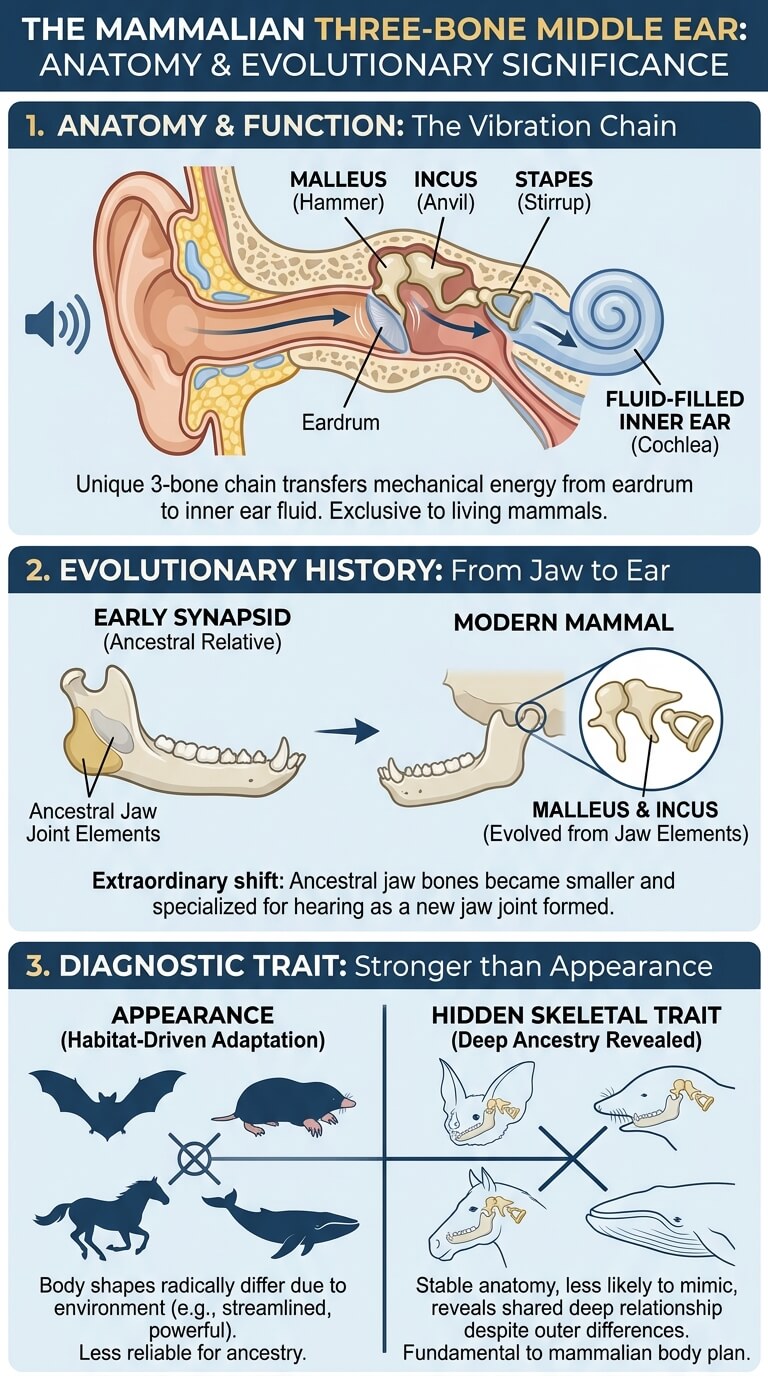
Behind the eardrum of a mammal sits a chain of three tiny bones: the malleus, incus, and stapes. Their everyday names are hammer, anvil, and stirrup. Vibrations reaching the eardrum move this chain, which transfers mechanical energy toward the fluid-filled inner ear.
Other land vertebrates have a middle-ear bone involved in transmitting sound, but living mammals are distinctive in having this three-bone chain. The bones are hidden and tiny, so they are not useful for casual field identification. Anatomically, however, they are among the strongest signs of mammalian identity.
How this anatomy relates to mammal evolution
The malleus and incus have an extraordinary evolutionary history. Their ancestral counterparts once helped form the jaw joint in earlier synapsids, the broad lineage that includes mammals and their extinct relatives. As a new jaw joint became established, some of the older jaw elements became smaller and increasingly specialized for hearing.
This change did not happen as a single simple step. Fossils show intermediate arrangements, and newer work indicates that jaw contacts resembling the mammalian condition evolved more than once among mammal relatives. Even so, the final association between a dentary-based jaw and a three-bone middle ear remains fundamental to the mammalian body plan.
Why this is a stronger diagnostic trait than appearance
Appearance responds strongly to habitat. Aquatic mammals become streamlined, burrowing mammals become compact and powerful, and gliding mammals develop broad skin membranes. The middle ear is less likely to mimic another group’s anatomy merely because two animals live in similar places.
For that reason, hidden skeletal traits can tell scientists more about ancestry than overall silhouette. A bat, a mole, a horse, and a whale look radically different, yet their ear and jaw arrangements reveal the same deep relationship.
The Mammalian Lower Jaw and Skull
A single dentary bone in the lower jaw
In living mammals, each side of the lower jaw consists primarily of one large bone, the dentary. It carries the lower teeth when teeth are present. In many other vertebrates, the lower jaw includes several bones that remain part of the adult jaw apparatus.
The mammalian arrangement provides a durable clue in fossils because jaws and teeth preserve more often than hair or glands. A fossil lower jaw with the right articulation and associated features may reveal mammalian relationships even when the rest of the skeleton is incomplete.
The dentary-squamosal jaw joint
The rear of the dentary meets a skull bone called the squamosal, forming the main jaw hinge in mammals. Recent research on early mammal relatives shows that the transition was more complex than a straight line, but the load-bearing dentary-squamosal joint remains a key feature of mammals. A 2024 study of early mammalian jaw evolution describes this joint and the three-ossicle middle ear as major diagnostic features.
The scientific names can sound intimidating, but the basic idea is simple: mammals chew with a lower jaw built around one dominant bone, and that bone hinges directly against the skull in a characteristic way.
How jaw and ear evolution are connected
The connection becomes clear when the old and new jaw systems are compared. In earlier synapsids, smaller bones behind the dentary helped form the jaw joint. During mammalian evolution, the dentary enlarged and established a new hinge with the squamosal. Several smaller bones were released from bearing chewing forces and became associated with the middle ear.
This history is one reason paleontologists pay close attention to the back of the jaw. A small fragment can preserve evidence about both feeding mechanics and hearing evolution. It also explains why the mammalian ear cannot be treated as an isolated novelty. Its story is tied directly to changes in the skull and jaw.
Endothermy, Lungs, and Other Common Mammal Features
Internal heat production and temperature regulation
Mammals are endotherms, meaning metabolism produces much of the heat used to regulate the body. Many also keep core temperature within a fairly controlled range, although the exact temperature and degree of stability differ among species and conditions. Fur, body fat, blood-flow changes, shivering, posture, shelter use, and temporary metabolic slowing can all contribute.
Endothermy helped mammals remain active in many cold, nighttime, aquatic, and seasonal environments. It is not a unique definition of Mammalia because birds are also endothermic. Some fish and reptiles can warm particular body regions or temporarily raise temperature through activity, which further shows why the term must be used carefully.
Breathing air with lungs
Every mammal breathes air with lungs throughout life. Whales, dolphins, seals, and manatees must therefore reach the surface even though they spend most or all of their lives in water. A blowhole is not a gill. It is a nostril, or a pair of nostrils, positioned on top of a cetacean’s head.
Lungs do not define mammals by themselves. Birds, reptiles, and adult forms of several amphibians also use lungs. What matters is how lung breathing appears alongside hair, milk production, and mammalian skull anatomy.
Traits that are common but not uniquely mammalian
Most mammals have a four-chambered heart, internal fertilization, a muscular diaphragm, specialized teeth, and a relatively large brain for processing sensory information. These features help describe mammal biology, but not every one is exclusive to mammals or expressed in the same way across the class.
Birds also have four-chambered hearts. Some mammals, including anteaters and living baleen whales, lack functional adult teeth. Tooth shape varies with diet, and brain organization varies with evolutionary history and ecology. A good definition separates traits that are truly diagnostic from traits that are simply frequent or highly developed in mammals.
Important Exceptions That Still Count as Mammals
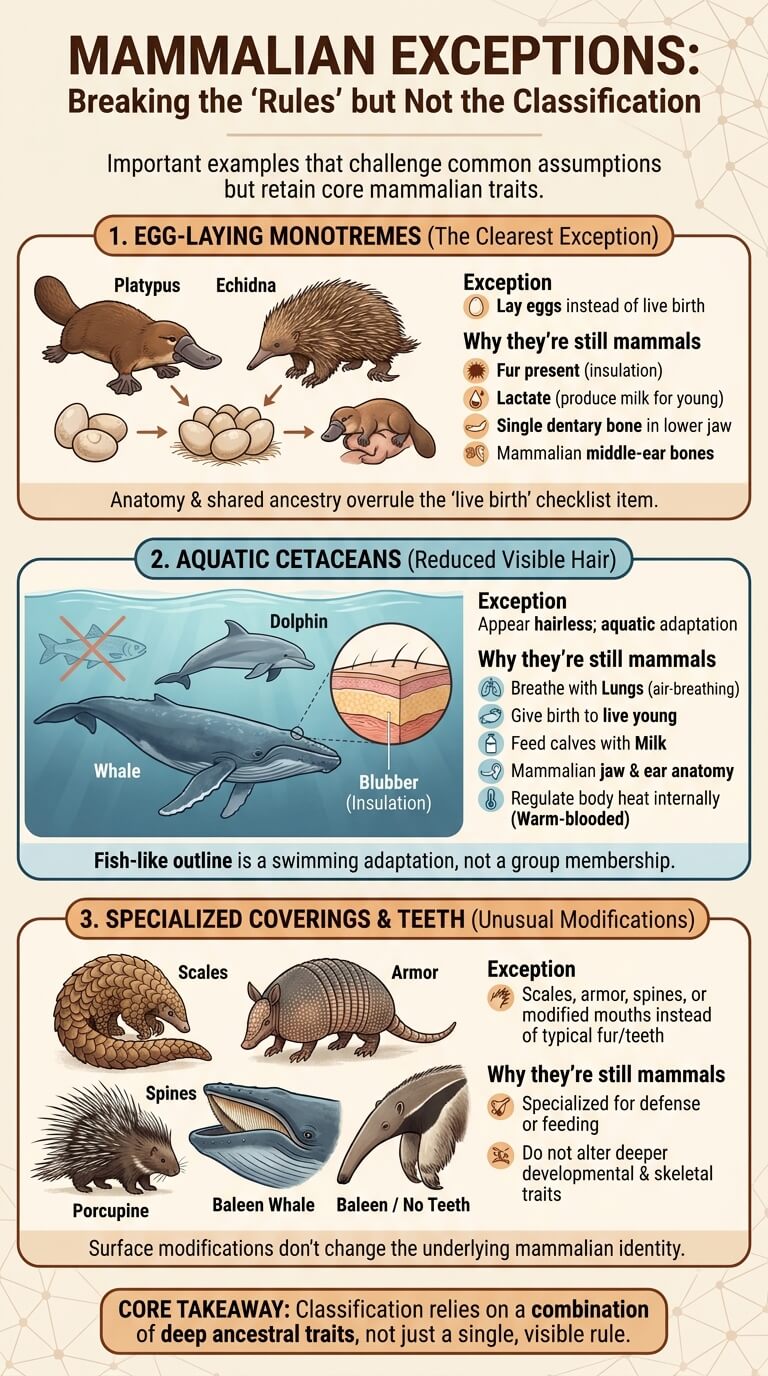
Egg-laying monotremes
Platypuses and echidnas lay eggs, making them the clearest exception to the idea that mammals give live birth. They are still mammals because reproduction is only one part of classification. Monotremes have fur, lactate, possess a single dentary in the lower jaw, and have the mammalian set of middle-ear bones.
The Animal Diversity Web account of monotremes emphasizes this mixture of egg laying and unmistakably mammalian anatomy. Their existence is a reminder that shared ancestry is more informative than a one-rule checklist.
Whales and dolphins with very little visible hair
Cetaceans appear hairless because their aquatic bodies have reduced most external hair. Some retain sensory hairs around the mouth, and others show hair only early in life. Insulation comes mainly from blubber rather than a thick coat.
Their other traits make the classification clear. They breathe with lungs, give birth to live young, feed calves with milk, possess mammalian jaw and ear anatomy, and regulate body heat internally. A fish-like outline reflects adaptation to swimming, not membership in the fish group.
Mammals with unusual teeth, scales, or body coverings
Not all mammals have the familiar combination of fur and varied teeth seen in dogs or deer. Pangolins have overlapping scales and sparse hair. Armadillos have protective armor. Porcupines and echidnas carry stiff spines derived from hair. Anteaters have no teeth, while baleen whales filter food with keratinous baleen plates instead of adult teeth.
These modifications are specialized solutions to defense or feeding. They do not alter the deeper developmental and skeletal traits that place the animals within Mammalia.
Mammals Versus Commonly Confused Animals
Mammals versus birds
Birds and mammals share several abilities. Both breathe air, regulate body heat internally, have four-chambered hearts, and often invest substantial effort in raising young. The differences lie in their inherited structures. Birds have feathers, lay shelled eggs as part of their normal reproductive pattern, and do not produce milk from mammary glands.
A bat is therefore not a bird. Its wing is a modified mammalian forelimb covered by skin, its body bears hair, and its young nurse on milk. Flight describes movement, not animal class.
Mammals versus reptiles
Living reptiles generally have scales rather than hair, lack mammary glands, and retain a jaw and middle-ear arrangement different from that of mammals. Many depend more strongly on environmental heat, although reptile temperature biology is more flexible than the phrase cold-blooded suggests.
Egg laying does not automatically indicate a reptile because monotremes lay eggs. Likewise, live birth does not automatically indicate a mammal because it occurs in some snakes and lizards. Skull structure, body covering, and milk production provide stronger evidence.
Mammals versus fish
Most fish breathe through gills and move with fins, while mammals breathe with lungs and have limbs or limb-derived structures. A whale’s flippers contain the bones of a modified forelimb, and its tail flukes contain no supporting limb bones. Whales move their flukes mainly up and down, whereas many fish propel themselves by moving the tail from side to side.
Some fish give live birth, and a few can breathe air or warm parts of the body. Those unusual features do not make them mammals. They lack the mammalian combination of hair, lactation, three middle-ear bones, and dentary-based jaw anatomy.
Common Myths and Identification Mistakes
All mammals give live birth
Most living mammals give birth to live young, but monotremes lay eggs. This myth persists because placental mammals and marsupials include the species most people encounter. Birth method is useful for comparing mammal lineages, not for excluding an animal that has the rest of the mammalian body plan.
All mammals have thick fur
Hair can be dense, sparse, stiff, sensory, temporary, or almost invisible. Whales, elephants, humans, naked mole-rats, and armored mammals show how greatly the coat can be reduced or modified. The correct statement is that hair is part of mammalian development, not that every adult must wear a thick coat.
Warm-blooded automatically means mammal
The phrase warm-blooded usually refers to endothermy and temperature regulation, but birds share those abilities. It also hides important variation. Hummingbirds, bats, ground squirrels, and other animals may use torpor, temporarily reducing metabolism and body temperature to save energy.
Temperature biology can support an identification, but it cannot settle one alone. Feathers indicate a bird, while hair, milk production, and mammalian skull anatomy identify a mammal.
How Defining Traits Shape Mammal Biology
Why reproductive lineages differ without changing mammal identity
Monotremes, marsupials, and placental mammals differ in egg laying, pregnancy, placental structure, birth stage, and the way young continue development. Yet every lineage depends on lactation. Milk is the shared reproductive feature that remains constant even when gestation and birth differ.
This distinction prevents two common errors. Egg laying does not remove monotremes from Mammalia, and a placenta does not by itself define all mammals. Reproductive diversity sits inside a larger common body plan.
How temperature control expands mammal habitats
Internal heat production, insulation, and behavioral temperature control allow mammals to remain active in environments ranging from polar seas to deserts and high mountains. Different species balance those tools in different ways. Whales use blubber, small terrestrial mammals may shelter in burrows, and many hoofed mammals adjust coat thickness seasonally.
These adaptations explain mammalian success across habitats, but they are consequences of mammal physiology rather than the single defining test. A bird can also live in severe cold through endothermy and insulation. Mammal identity still rests on the full trait combination.
FAQ
Is hair present on every mammal?
Hair is present at some point in the development of every living mammal, but it may not remain obvious in adulthood. Whales and dolphins often lose most early hair, while elephants and humans retain a relatively sparse covering. Quills, whiskers, and some defensive spines are modified forms of hair.
Are mammary glands found in male mammals?
Mammary structures begin developing in both sexes in many mammals, but they usually stop developing early in males and do not produce milk. Functional lactation is overwhelmingly associated with females caring for young. The presence of basic mammary tissue in a male does not mean it normally nurses offspring.
Is a platypus truly a mammal?
Yes. A platypus lays eggs, but it has fur, produces milk, possesses three middle-ear bones, and has a lower jaw made from a single dentary bone. Egg laying identifies it as a monotreme, one of the three major living mammal lineages, rather than excluding it from Mammalia.
Which mammal trait is most useful to paleontologists?
Jaw and ear-related anatomy is especially valuable because bone and teeth fossilize far more readily than hair or mammary tissue. Paleontologists examine the dentary, the way the lower jaw meets the skull, and evidence for changes in the small bones that became the mammalian middle ear. Teeth also provide clues about relationships and feeding, but no single fragment should be interpreted without its anatomical context.
Final Thoughts
What makes an animal a mammal is not one easy-to-see feature. Mammals share a connected body plan that includes hair during development, milk production by mammary glands, three middle-ear bones, and a dentary-based lower jaw. Lungs and internal heat production add important biological context, but they are shared with other vertebrates.
Looking at the full combination resolves the apparent exceptions. Platypuses can lay eggs, whales can look hairless, and pangolins can carry scales while remaining mammals. Their visible adaptations vary, but the deeper anatomy, development, and reproductive biology reveal their common mammalian identity.

Ethan Walker is the founder and research editor of Animal Fact Central. He creates and reviews educational animal facts content using trusted wildlife, pet care, and science-based sources. His work focuses on making animal behavior, adaptations, habitats, and species facts clear, accurate, and engaging for everyday readers.
Read More Details About Ethan Walker: https://animalfactcentral.com/ethan-walker/