
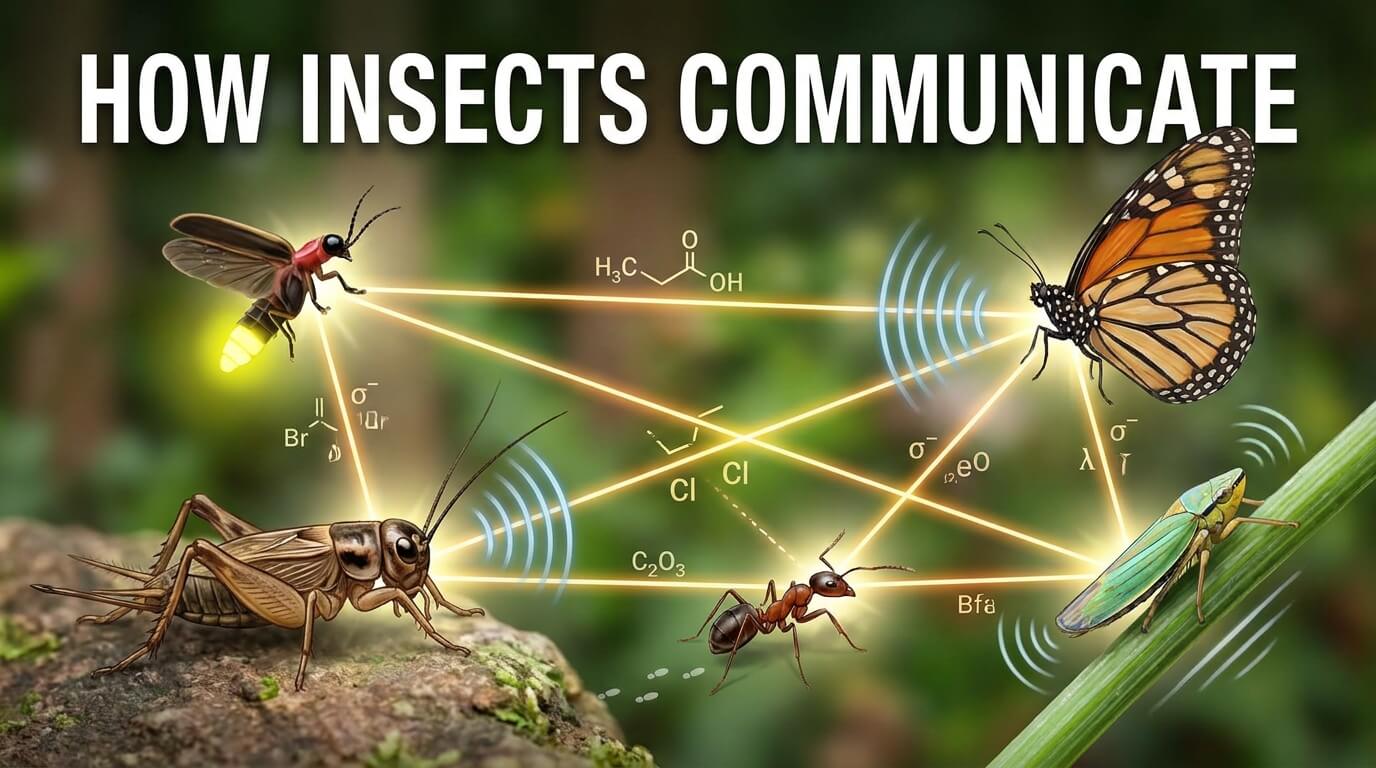
Insects communicate in far more ways than most people notice. An ant may follow a chemical trail, a cricket may broadcast a mating call, a leafhopper may send vibrations through a plant stem, and a firefly may exchange timed flashes in the dark. Other insects rely on body movements, color patterns, touch, or combinations of several channels at once.
There is no single insect communication system. A useful way to understand the subject is to ask three questions: what signal is produced, how it travels, and what sensory system can detect it. The answer changes with the species, habitat, life stage, and behavioral situation.
Quick Answer
Communication requires a signal, a receiver, and a context
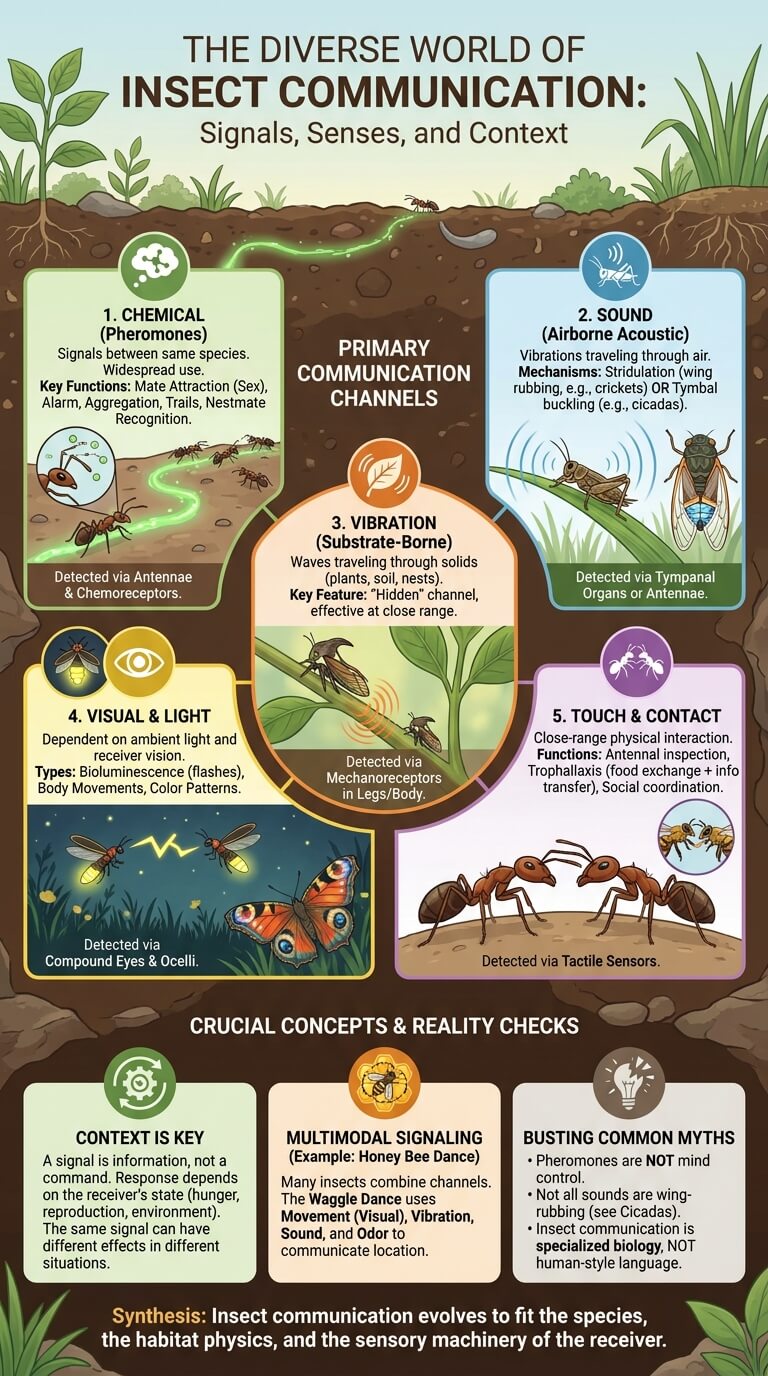
Communication occurs when one insect produces a signal that changes the behavior or physiology of another insect in a way shaped by evolution. The signal may be chemical, acoustic, vibrational, visual, luminous, or tactile. For the signal to matter, another insect must be able to detect it and respond under the right circumstances.
Context is crucial. The same insect may respond differently to a chemical or sound depending on sex, age, reproductive condition, hunger, time of day, or whether it is inside a nest. A signal is not a command that mechanically forces one response. It is information entering a sensory and nervous system that is already influenced by the insect’s internal state and surroundings.
Why no single mode explains insect communication
Insects occupy almost every major terrestrial and freshwater habitat, so their communication systems face very different physical problems. Odor molecules can travel around obstacles but disperse with wind. Sound can cover distance quickly but may be masked by environmental noise. Vibrations travel well through connected plants or nest material but not across open gaps. Visual signals work best when there is enough light and when the receiver can see the relevant colors or movements.
Many insects therefore use more than one channel. A honey bee dance, for example, involves body movement, touch, vibration, air movement, and odor. Courtship in another insect may combine a visual display with pheromones. Thinking in terms of multiple channels explains why insect communication is much richer than a simple “smell, sound, or sight” checklist.
Chemical Signals and Pheromones
Sex, alarm, aggregation, and trail pheromones
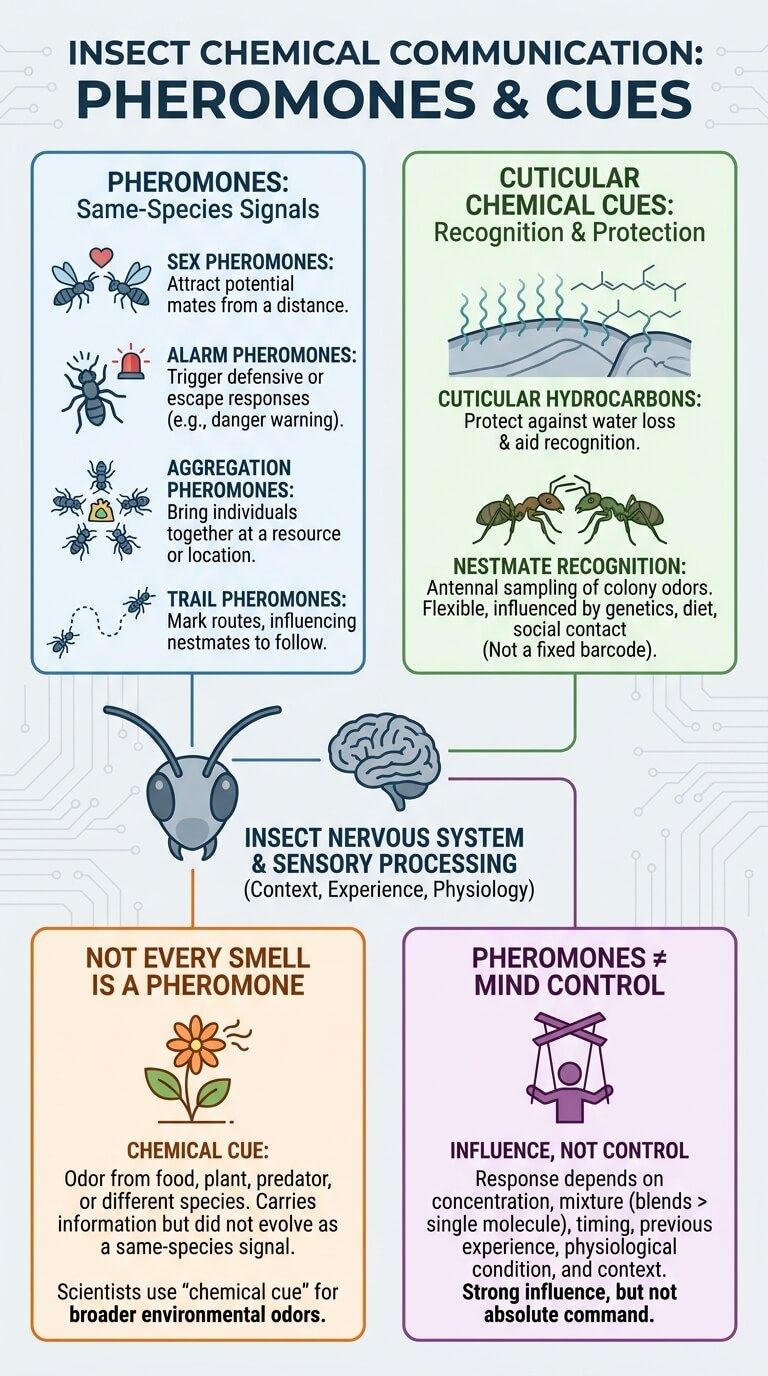
Chemical communication is widespread in insects. Pheromones are chemicals used as signals between members of the same species under the conventional biological definition. Depending on the insect, pheromones can help attract mates, recruit nestmates, bring individuals together, warn of danger, or mark routes. The Smithsonian overview of insect pheromones describes how insect chemical messages can function in mating, aggregation, food finding, and other behaviors.
Ant trails are a familiar example, but they are only one form of chemical signaling. A forager may deposit a trail chemical that changes the probability that nestmates will follow the same route. Alarm chemicals can trigger rapid defensive or escape responses. Sex pheromones may draw potential mates from a distance, while aggregation pheromones can bring multiple individuals to the same resource or location.
Cuticular chemical cues and recognition
An insect’s outer surface also carries chemical compounds, including hydrocarbons that help protect against water loss. In many social insects, variation in these surface chemicals can contribute to nestmate recognition. Ants and other colony-forming insects frequently inspect one another with their antennae, sampling chemical information that can help distinguish familiar colony odors from unfamiliar ones.
Recognition is not equivalent to reading a fixed barcode. Colony odor profiles can be influenced by genetics, diet, nesting material, social contact, and other factors. The insect nervous system compares incoming chemical information with learned or developmentally shaped templates, so recognition can be flexible rather than perfectly rigid.
Why not every smell is a pheromone and pheromones are not mind control
An odor released by food, a plant, a predator, or a different species is not automatically a pheromone. Scientists often use the broader term chemical cue when a chemical carries information without having evolved as a signal between members of the same species. This distinction matters because insects constantly respond to odors that were not produced for communication.
Pheromones also do not function as mind control. They can strongly influence behavior, but the response depends on concentration, mixture, timing, previous experience, physiological condition, and the insect’s sensory abilities. One chemical can have different effects in different contexts, and many natural signals consist of blends rather than a single molecule operating alone.
Sound and Airborne Acoustic Signals
Stridulation in crickets and katydids
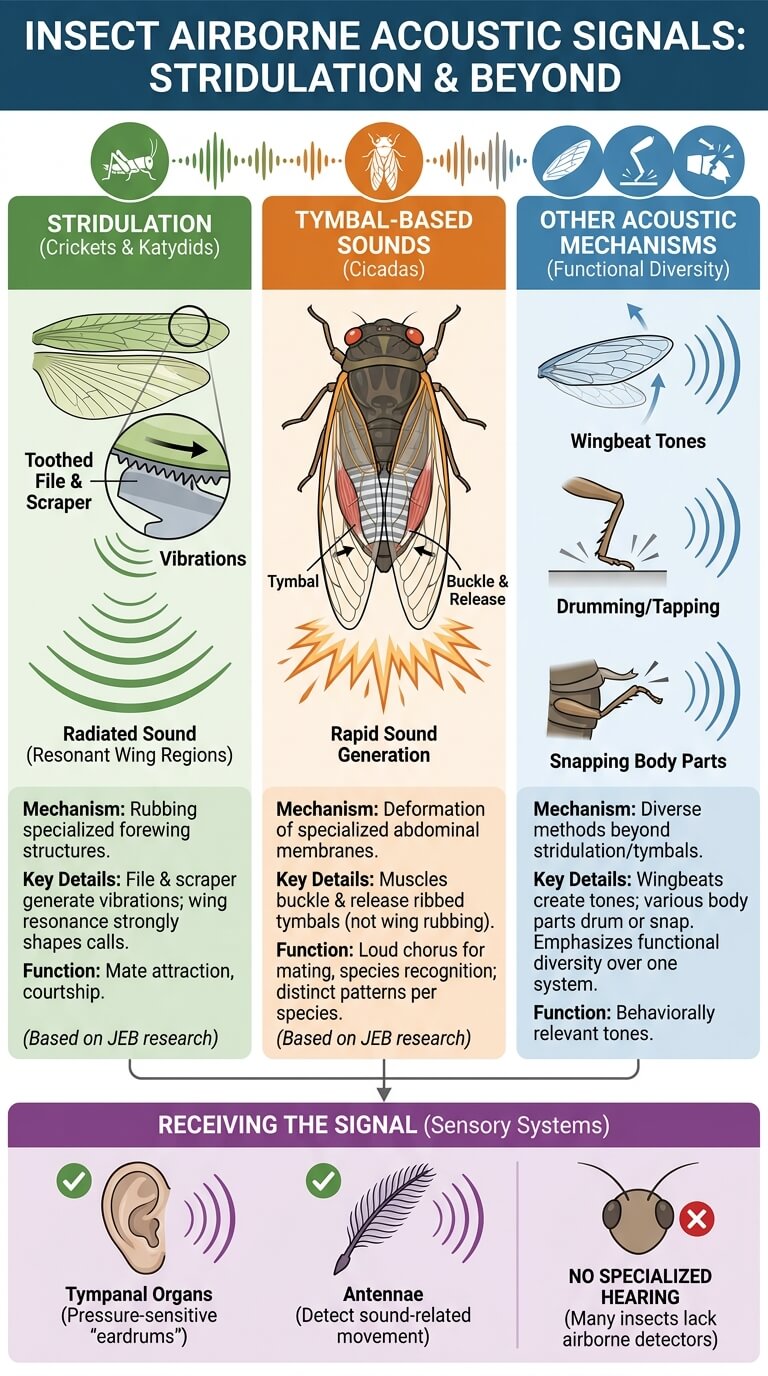
Crickets and katydids are classic examples of acoustic insect communication. In many species, males produce calls by stridulation, a mechanical process in which specialized structures on the forewings move against one another. A toothed file and scraper generate repeated vibrations, while resonant wing regions help radiate sound. Journal of Experimental Biology research on cricket sound mechanics shows how strongly wing structure and resonance shape the calls that crickets can produce.
These calls often function in mate attraction and courtship, but insects do not all produce or use sound in the same way. Signal timing, rhythm, frequency, and repetition can help receivers distinguish appropriate mates from other animals and background noise. Temperature and habitat structure can also affect how calls are produced or transmitted.
Tymbal-based cicada sounds
Cicadas demonstrate why it is wrong to say that insect sounds are always made by rubbing wings together. Male cicadas in many species use specialized abdominal structures called tymbals. Muscles deform ribbed tymbal membranes, which buckle and release rapidly to generate sound. Experimental work on cicada sound production has shown that the tymbal itself is a specialized mechanical sound-producing system rather than a stridulatory wing mechanism. Research on the cicada tymbal in the Journal of Experimental Biology documents this mechanism in detail.
The loud chorus associated with cicadas can contain mating signals, species-recognition information, and interactions among calling insects. Different cicada species have different acoustic patterns, so the familiar summer buzz is not one universal cicada song.
Wing sounds and other acoustic mechanisms
Some insects generate sound with wings even when they are not using cricket-style stridulation. Wingbeats can create tones that are behaviorally relevant, while other insects drum, tap, snap body parts, or use specialized structures. The important point is functional diversity: “insect sound” describes many mechanisms rather than one anatomical system.
Airborne sound also works only if the receiver has a sensory system capable of detecting the relevant vibration. Some insects have tympanal organs that function somewhat like pressure-sensitive eardrums, while others can detect sound-related movement through antennae. Many insects lack specialized airborne hearing altogether.
Substrate-Borne Vibrations
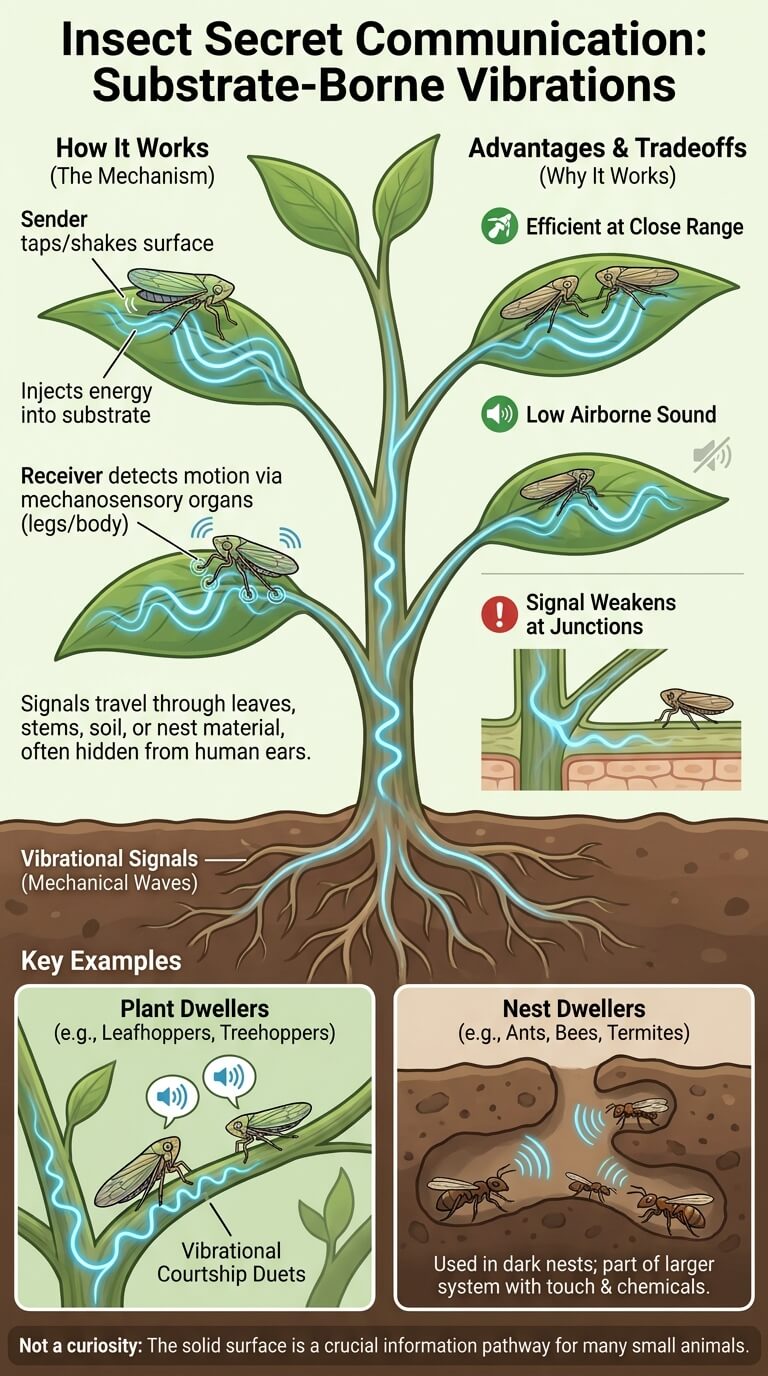
Signals traveling through leaves, stems, soil, or nest material
A great deal of insect communication is effectively hidden from human ears because the signal travels through a solid surface instead of mainly through the air. An insect can shake or tap a leaf, stem, web-like shelter, soil surface, or nest structure. The resulting mechanical waves spread through the material and can be detected by other insects in physical contact with it.
Plant-dwelling insects make especially good use of this channel. Leafhoppers, planthoppers, treehoppers, and many true bugs exchange vibrational courtship signals through stems and leaves. In a study of a leafhopper, researchers showed that males use plant-borne signals while searching for females and must deal with the directionality and noise limits of the substrate. Scientific Reports research on vibration-mediated mate localization illustrates how strongly the physical properties of a plant can shape insect communication.
Why vibration can work even when little airborne sound is produced
A vibrating surface can carry useful information without producing a loud sound that a person would notice. A tiny insect may move its abdomen, legs, or wings in a way that injects energy into a leaf or stem. The receiver detects motion of the surface through mechanosensory organs, often in the legs or body.
This channel can be efficient at close range when sender and receiver share the same plant or nest structure. It can also reduce the need to broadcast a loud airborne signal. The tradeoff is that the signal may weaken sharply at branch points, across different plant tissues, or when sender and receiver are not connected through the same substrate.
Selected examples from bugs, treehoppers, and social insects
Treehoppers and many hemipterans use vibrational duets during mate finding. Social insects can also generate vibrations inside nests, where darkness makes visual signaling less useful. Bees, ants, termites, and wasps may use vibration as one part of a larger communication system that also includes touch and chemicals.
Vibration should not be treated as a rare curiosity. For small animals living on plants or inside nests, the solid surface beneath the feet can function as an information pathway every bit as important as the surrounding air.
Visual Displays and Body Movements
Courtship movement and posture
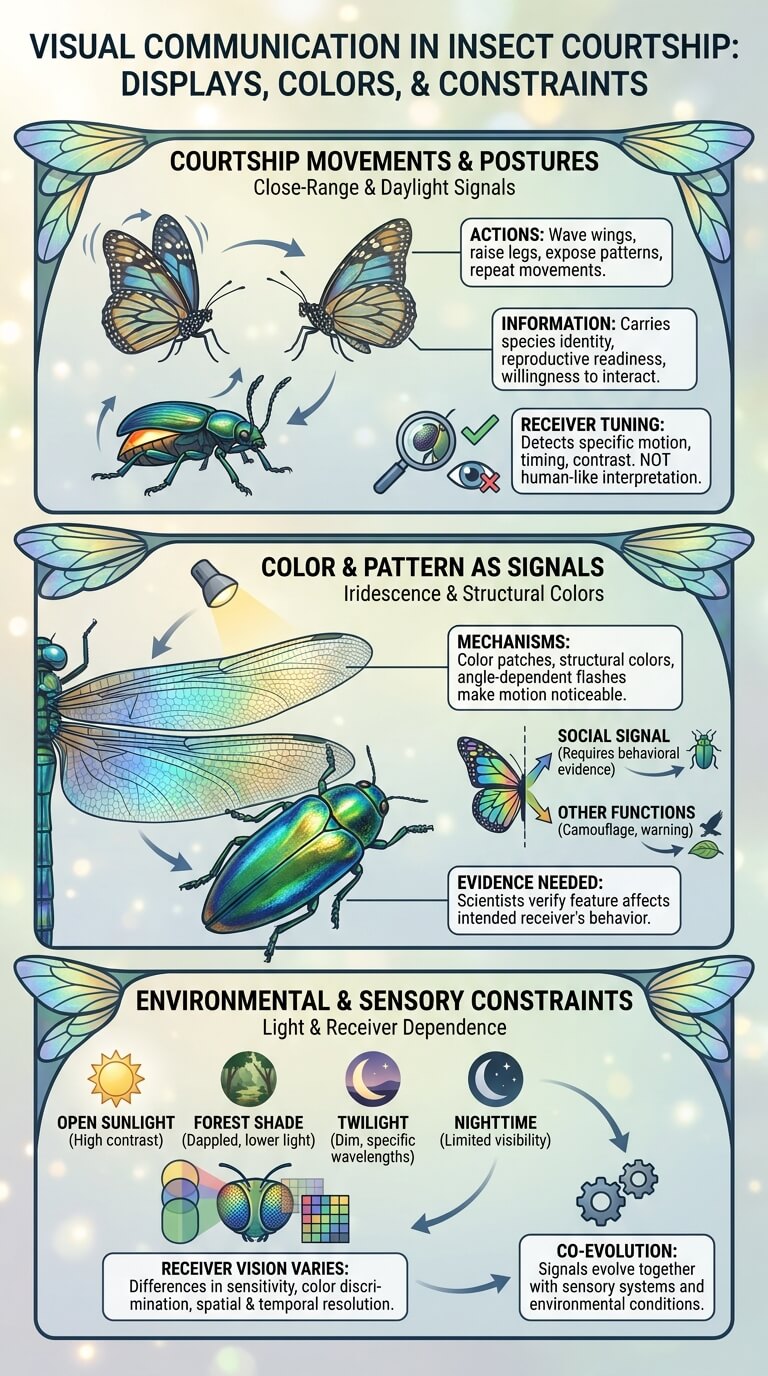
Visual communication becomes especially useful in daylight and at close range. Insects may wave wings, raise legs, orient the body, expose patterned surfaces, or perform repeated courtship movements. The movement itself can carry information about species identity, reproductive readiness, or willingness to continue an interaction.
Visual courtship does not require a human-like interpretation of gestures. Receivers are tuned to particular combinations of motion, timing, contrast, and orientation. A display that is conspicuous to another insect may look subtle or meaningless to a human observer.
Color and pattern as signals
Color patches and structural colors can contribute to communication when receivers can perceive them. Butterflies, dragonflies, beetles, and other insects may use wing or body coloration during courtship or rivalry. In some species, changes in viewing angle create flashes of iridescence that make movement more noticeable.
Color can also serve other functions such as camouflage, temperature regulation, or warning predators, so a colorful body part is not automatically a communication signal. Scientists look for evidence that the feature affects the behavior of an intended receiver before treating it as a social signal.
When visual signals depend on ambient light and receiver vision
A visual signal is useful only under lighting conditions where it can be detected. Forest shade, open sunlight, twilight, and nighttime create different constraints. The receiver’s visual system matters too. Insect eyes differ in sensitivity, color discrimination, spatial resolution, and temporal processing, so a display effective for one species may be nearly invisible to another.
This dependence on the receiver is a recurring theme in communication biology. Signals evolve together with the sensory systems that detect them and the environments through which they travel.
Bioluminescent Communication
Firefly courtship flashes
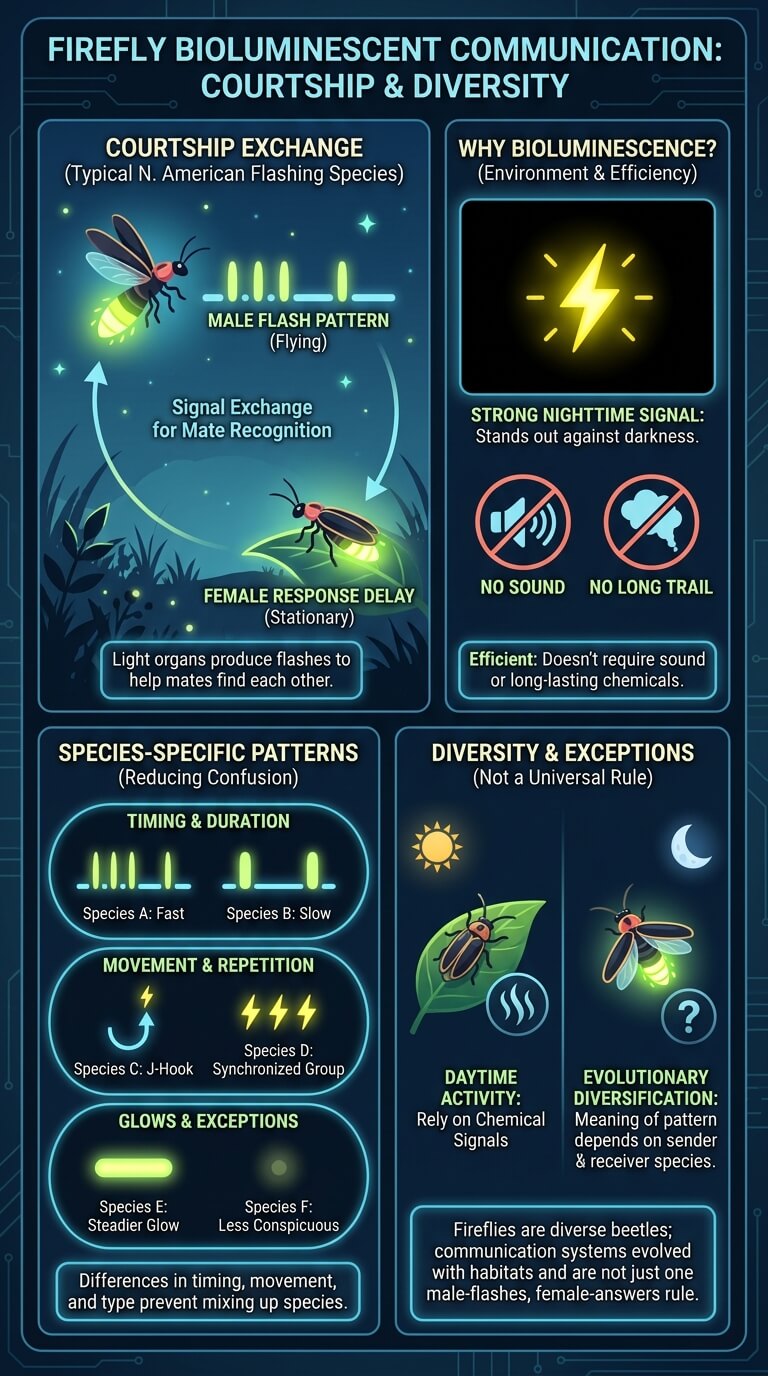
Many fireflies use bioluminescence during courtship. Specialized abdominal light organs produce flashes, glows, or other light patterns that can help potential mates find and recognize one another. In familiar North American flashing species, flying males often produce repeated displays while receptive females respond from vegetation or the ground. The Smithsonian Science Education discussion of insect courtship signals describes species-linked firefly flash exchanges as well as acoustic signaling in other insects.
Firefly light is a strong example of how a communication channel fits the environment. At night, a bright flash can stand out against a dark background without requiring the sender to produce sound or release a long-lasting chemical trail.
Species-specific signal patterns and exceptions
Flash timing, duration, repetition, movement, and response delay can differ among firefly species. Those differences help reduce confusion when several species are active in the same area. Some fireflies also synchronize flashes, creating group displays, while others use steadier glows or less conspicuous light.
Not every firefly communicates in exactly the same way. Some lineages rely more heavily on chemical signals, and some adults are active during the day when bright flashes would be less useful. Fireflies therefore should not be reduced to one universal male-flashes, female-answers rule.
Why not every firefly uses the same flash system
Fireflies are beetles, not a single species. Their communication systems have diversified along with their habitats, activity times, and evolutionary histories. Even among flashing species, the meaning of a pattern depends on which species is sending it and which species is receiving it.
This is also a reminder that a signal has no universal meaning by itself. A pattern that attracts an appropriate mate in one species may be ignored by another insect or may function in an entirely different context.
Touch and Social Contact
Antennal contact
At close range, direct contact can carry information that is difficult to transmit at a distance. Antennae are especially important because they bear many sensory receptors. Ants, bees, wasps, termites, and other insects frequently touch nestmates or potential mates with their antennae while sampling chemical and mechanical information.
Antennal contact is not equivalent to insects “talking with feelers.” The movements may help position sensory organs, inspect surface chemicals, trigger learned interaction patterns, or coordinate exchanges. The signal may therefore be chemical, mechanical, or both.
Trophallaxis as food exchange with information context
In some social insects, individuals exchange liquid food through mouth-to-mouth or mouth-to-anus contact, a process called trophallaxis. The immediate function can be nutrition, but the interaction also creates opportunities to transfer odors and biologically active compounds and to update nestmates about recent feeding activity.
It is safest to think of trophallaxis as a social exchange that can carry information rather than as a coded message system. What is transferred and how it affects colony behavior varies among groups and situations.
Nestmate interactions without a literal spoken language
A busy ant or bee colony can look as though every worker is following instructions from a central controller. In reality, much coordination emerges from repeated local interactions. Individuals respond to odors, touches, food availability, nest conditions, and the behavior of nearby nestmates. Large-scale colony patterns can arise from many small decisions without a queen issuing commands.
This distributed coordination is one reason insect societies are scientifically interesting. Communication can organize complex group behavior while remaining based on simple exchanges among nearby individuals.
Bee Dance Communication as a Specialized Example
What honey-bee dance signals can encode
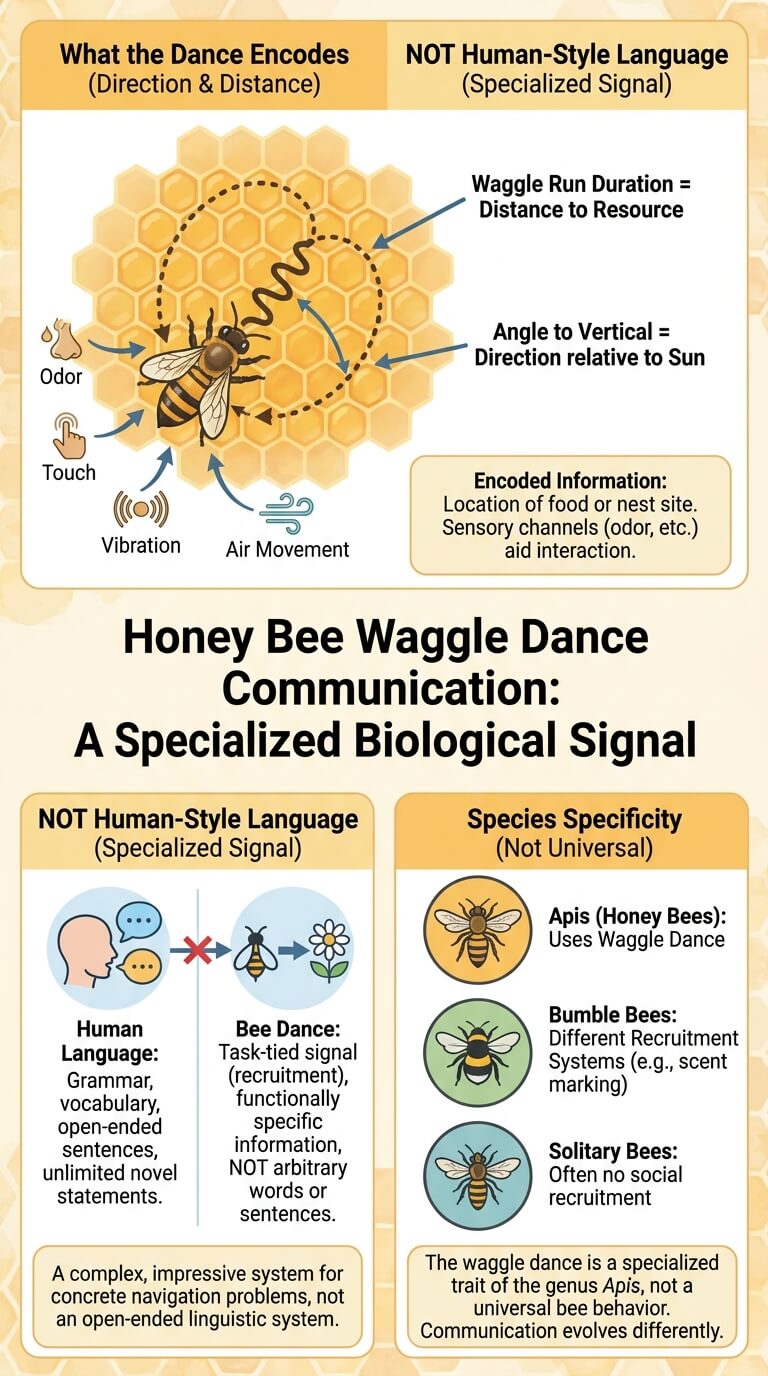
Honey bees provide one of the best-known examples of spatial communication in insects. A successful forager can perform a waggle dance that gives nestmates information related to the direction and distance of a food source or potential nest site. In the well-studied western honey bee, features of the waggle run correlate with resource location, while odor, touch, vibration, and air movement can help recruits interact with the dancer. A Journal of Experimental Biology review of honey bee dance communication explains both the spatial information in dances and the multiple sensory channels involved.
Why it is not human-style language with words and sentences
The waggle dance can communicate functionally specific information, but calling it a language can create confusion if the word is understood to mean human grammar, vocabulary, or open-ended sentences. Bees do not appear to combine arbitrary words into unlimited novel statements. The dance is a specialized biological signal system tied to particular tasks such as recruitment to locations.
That does not make it simple. Recruits must detect the dancer, follow repeated waggle runs, integrate noisy information, and use that information during later flight. The system is impressive precisely because it solves a concrete navigation problem with insect sensory and neural machinery.
Why not every bee species uses a honey-bee-style waggle dance
The familiar waggle dance belongs to honey bees in the genus Apis. Bee diversity is much broader. Many bees are solitary, and even among social bees there are very different recruitment systems. Bumble bees, stingless bees, and solitary bees should not be described as if they all use the western honey bee dance.
Using the waggle dance as one specialized case, rather than a universal bee behavior, gives a more accurate picture of how communication evolves in different social and ecological settings.
How Insects Receive Signals
Antennae and chemoreceptors
Antennae carry sensory structures that can detect airborne chemicals, touch, air movement, and other stimuli depending on the insect. Chemical receptors on antennae and elsewhere help insects detect pheromones and environmental odors. Contact chemoreceptors on mouthparts, legs, antennae, or other body parts can also sample chemicals at close range.
The fact that antennae are important for smell does not make them simple insect noses. They are multifunctional appendages, and their sensory roles differ across species.
Tympanal and vibration-sensitive organs
Airborne sound may be detected by tympanal membranes or by mechanosensory systems that respond to movement of body structures. Substrate vibration is often detected through chordotonal organs and other mechanoreceptors associated with the legs or body. An insect standing on a vibrating stem is therefore receiving mechanical information through a different physical route than an insect listening to pressure waves in air.
These distinctions explain why an insect can be highly sensitive to vibration without necessarily having a conspicuous “ear.” Hearing and mechanosensation in insects include several anatomical solutions.
Vision and light detection
Compound eyes and, in many insects, simple eyes called ocelli provide information about light, movement, contrast, and orientation. Visual communication works only when the relevant pattern falls within the receiver’s sensory capabilities. Firefly flashes, butterfly wing patterns, and courtship movements are effective because the receiver is equipped to detect them in the conditions where the behavior occurs.
Communication therefore cannot be separated from sensory biology. A signal that no receiver can detect is just an environmental event, not an effective communication system.
Communication in Courtship, Foraging, Defense, and Colonies
Same sensory channels, different behavioral contexts
Chemical, acoustic, visual, and vibrational signals are reused in many contexts. Courtship may involve pheromones and song. Foraging may involve trail chemicals, dance signals, or food odors. Defense can involve alarm pheromones, warning displays, or vibrations. Social coordination may combine touch, chemicals, food exchange, and nest-borne mechanical signals.
The mode of communication does not determine the message by itself. A chemical signal can relate to mating, alarm, aggregation, or recognition. A sound can attract a mate, repel a rival, or coordinate an interaction. Meaning comes from the signal pattern, the species, and the circumstances.
Why context changes the response to a signal
An insect’s response can depend on whether it is reproductive, hungry, threatened, searching for a nest, or caring for young. Receivers may also learn associations or become more or less responsive over time. This flexibility is why the same signal does not necessarily produce the same visible behavior in every individual.
Communication is best understood as an interaction between sender, signal, environment, and receiver. Removing any one of those pieces makes the system look simpler than it really is.
Common Communication Myths
Do all insect sounds come from rubbing wings together?
No. Crickets and many katydids use wing stridulation, but cicadas rely on tymbals, some insects drum or tap surfaces, and wingbeats can themselves become behaviorally relevant sounds. Insect acoustic communication evolved through multiple mechanisms.
Do ants speak with pheromones like words?
Ants use chemical signals extensively, but pheromones are not equivalent to words in a spoken sentence. A trail chemical can increase trail-following behavior, an alarm chemical can change defensive behavior, and surface chemicals can contribute to recognition. These are specialized biological signals whose effects depend on context and colony state.
Is every insect signal a language?
No. “Language” is often used casually for any exchange of information, but scientists distinguish among signals, cues, communication systems, and the much more demanding properties associated with human language. Insect communication can be complex without requiring human-like grammar or conscious symbolic conversation.
Signals Only Work When Insects Can Detect and Act on Them
Sensory systems determine which signals are available
Chemical communication depends on receptors that can detect the relevant molecules. Acoustic communication depends on sensitivity to the correct vibration frequencies. Visual communication depends on light and visual processing. Vibrational communication depends on physical contact with a transmitting surface and mechanosensory receptors.
This is why understanding insect senses clarifies insect communication. The sender’s signal and the receiver’s sensory world have to match.
Behavior determines what happens after detection
Detecting a signal is only the first step. The insect may approach, retreat, search, court, recruit nestmates, remain still, or ignore the signal depending on its condition and surroundings. Behavior is the visible outcome of sensory information being processed alongside motivation and environmental constraints.
Social insects use communication intensively, but colonies are a separate problem
Ants, termites, honey bees, and some wasps depend heavily on communication because many individuals must coordinate within nests. Yet colony organization involves more than signals alone. Reproductive division of labor, brood care, caste differences, nest architecture, life cycles, and ecological pressures all contribute to social organization.
Communication helps a colony function, but it does not explain eusociality by itself.
FAQ
What is an insect pheromone?
An insect pheromone is a chemical signal that affects another individual of the same species under the conventional definition. Pheromones can be involved in mating, alarm, aggregation, recruitment, recognition, and other behaviors. Not every insect odor is a pheromone, because many odors come from food, plants, predators, prey, or other species.
How do fireflies communicate?
Many fireflies use bioluminescent courtship signals. Males and females may exchange flashes or glows whose timing and pattern help with mate recognition. The details vary widely among species, and some fireflies rely more on chemical signals or are active in daylight, so there is no single flash code used by all fireflies.
How do crickets make sound?
Many male crickets produce sound by stridulation. Specialized parts of the forewings act as a file-and-scraper system, and resonant wing regions help radiate the resulting vibrations as sound. The exact structure and call pattern differ among species.
Do insects communicate through vibrations?
Yes. Many insects send substrate-borne vibrations through leaves, stems, soil, nests, or other solid materials. Leafhoppers, treehoppers, true bugs, and social insects provide well-studied examples. These vibrations can function in mate finding, recognition, alarm, and group coordination even when little audible sound reaches human ears.
Final Thoughts
How insects communicate depends on the physics of their environment as much as on the animals themselves. Chemicals can linger and spread around obstacles, sounds travel rapidly through air, vibrations move through plants and nests, light works in visually favorable conditions, and touch becomes powerful at close range. Many insects combine several of these channels rather than relying on only one.
The most useful takeaway is that insect signals are specific biological tools, not miniature versions of human speech. Pheromones are not mind control, every insect sound is not wing rubbing, every firefly does not share one flash code, and honey bee dances are not universal bee behavior. Once signal, receiver, and context are considered together, insect communication becomes easier to understand and far more interesting.

Ethan Walker is the founder and research editor of Animal Fact Central. He creates and reviews educational animal facts content using trusted wildlife, pet care, and science-based sources. His work focuses on making animal behavior, adaptations, habitats, and species facts clear, accurate, and engaging for everyday readers.
Read More Details About Ethan Walker: https://animalfactcentral.com/ethan-walker/