
What do insects eat? Almost anything that can be turned into usable nutrients, depending on the species. Some insects chew leaves, seeds, fungi, wood, carrion, or other insects. Others drink nectar, plant sap, fruit juices, or blood. Still others develop as parasitoids inside or on a host. The important point is that there is no single “insect diet.” Feeding changes with anatomy, habitat, life stage, sex, season, and evolutionary history.
That diversity is easier to understand when food and feeding structures are considered together. Insect mouthparts are variations on a shared anatomical plan, but they can be modified into jaws, piercing stylets, coiled tubes, sponging surfaces, and other specialized tools. The Smithsonian National Museum of Natural History provides a useful overview of how insect mouthparts are modified for different feeding methods, from chewing grasshoppers to fluid-feeding flies and butterflies.
Quick Answer
There Is No Single Insect Diet
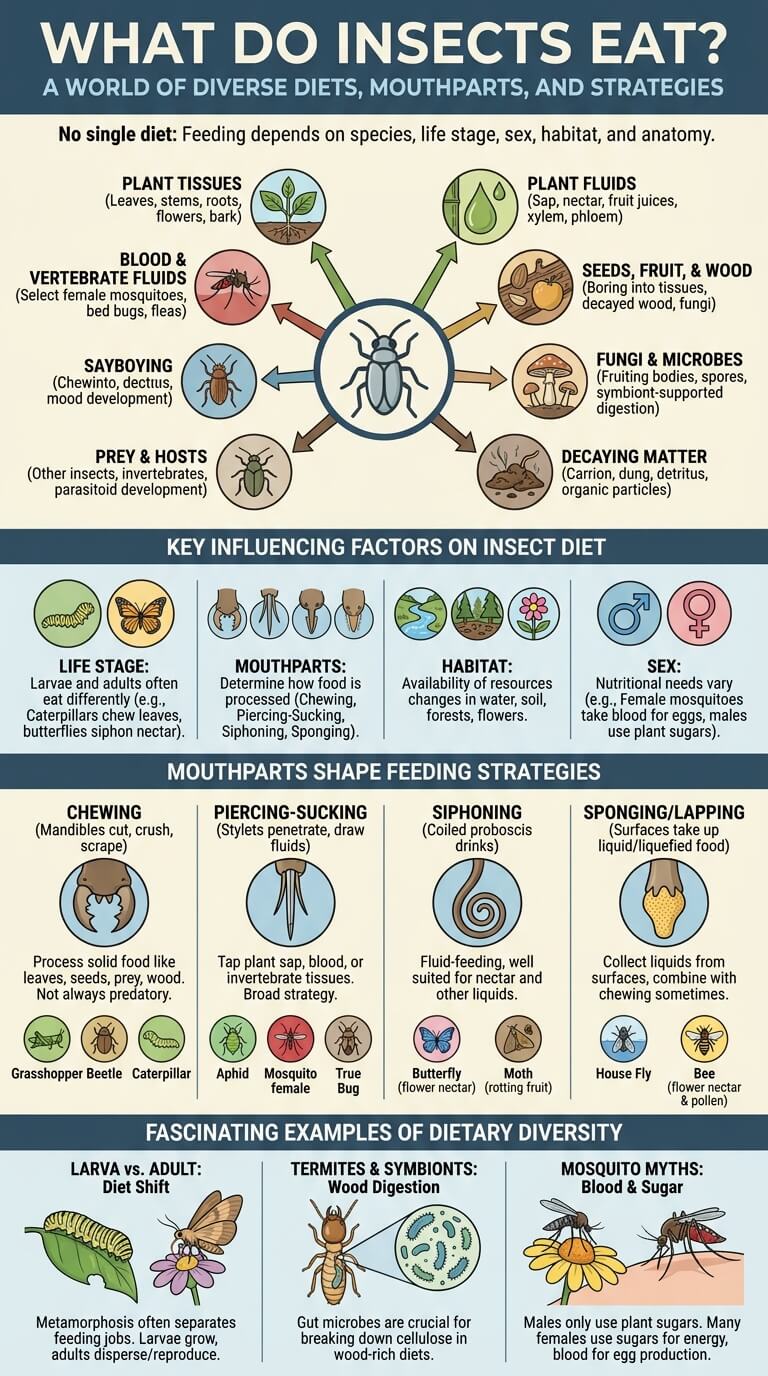
Across Insecta, food can include living plant tissue, sap, nectar, pollen, fruit, seeds, fungi, decaying organic matter, dung, carrion, prey, host tissues, microorganisms, and blood. Some insects are specialists that rely on a narrow set of resources. Others are generalists that can use several foods when conditions change.
Even within the same family, feeding can vary. Lady beetles are famous as predators of aphids and scale insects, but the family also contains plant-feeding and fungus-feeding lineages. A recent genomic study of ladybird beetles highlights this evolutionary range from fungivory to carnivory and herbivory, illustrating why familiar labels such as “predatory ladybug” should not be treated as a rule for every species.
Species, Life Stage, Sex, Habitat, and Mouthparts All Matter
An insect’s diet is often tied to the stage of its life cycle. Caterpillars and adult butterflies can use completely different foods. Aquatic larvae may filter particles or hunt underwater while the winged adults feed differently, or feed very little. In mosquitoes, sex matters too: males do not take vertebrate blood meals, while females of many species use blood as a reproductive resource in addition to plant sugars.
Habitat also changes what is available. A stream insect encounters algae, fine organic particles, aquatic prey, and submerged plant material. A forest-floor beetle may encounter fungi, carrion, seeds, or other arthropods. A flower-visiting insect can find nectar and pollen. Mouthparts influence which of these resources can be collected efficiently, but mouthpart shape alone does not reveal the whole menu.
How Mouthparts Shape Feeding
Chewing
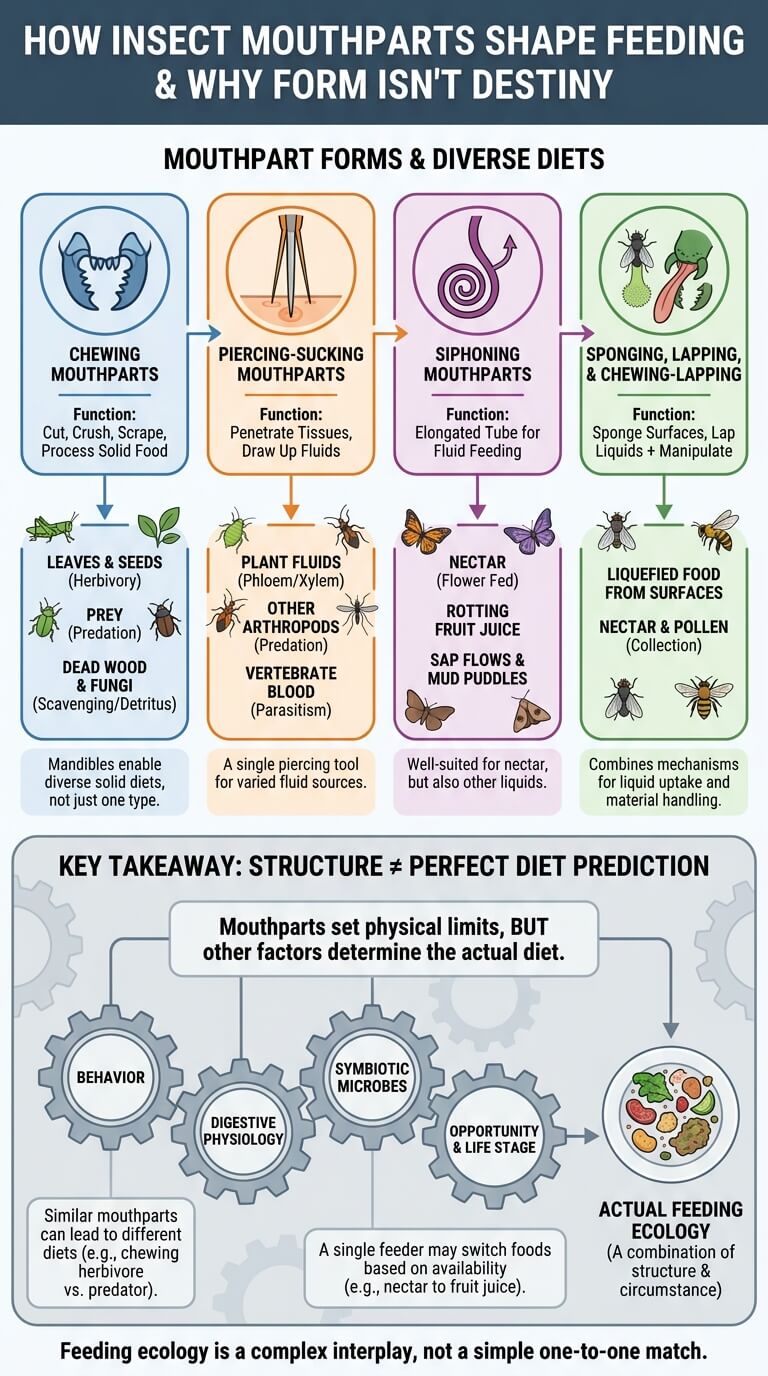
Chewing insects use mandibles to cut, crush, scrape, or process solid food. Grasshoppers are a familiar example, but chewing mouthparts also occur in many beetles, caterpillars, cockroaches, termites, and other groups. What those insects chew can be very different: leaves, seeds, prey, dead wood, fungi, or decaying material.
The same basic jaw-based architecture can therefore support herbivory, predation, scavenging, and detritus feeding. Strong mandibles do not automatically mean an insect is a predator. A grasshopper may clip plant tissue, while a predatory beetle may use mandibles to seize prey.
Piercing-Sucking
Piercing-sucking mouthparts use narrow structures to penetrate tissues and draw up fluids. Many hemipterans tap plant fluids, including phloem or xylem, while predatory true bugs pierce prey. Blood-feeding insects also use piercing structures, although the exact anatomy differs among groups.
This is a good example of why a feeding tool does not equal a single diet. A broadly similar piercing-and-sucking strategy can be used on plants, other arthropods, or vertebrate hosts depending on the lineage.
Siphoning
Many adult butterflies and moths use an elongated proboscis that coils when not in use. It functions as a fluid-feeding tube and is well suited to nectar and other liquids. But “Lepidoptera” does not mean “nectar only.” Some adults take fluids from rotting fruit, sap flows, mud, dung, carrion, or other sources, and some moths have greatly reduced adult mouthparts and do not feed.
Sponging, Lapping, and Chewing-Lapping
House flies and related flies can use sponging mouthparts to take up liquid or liquefied food from a surface. Bees combine mandibular structures with a tongue-like feeding apparatus that can collect liquid foods such as nectar while their jaws remain useful for manipulating material. These categories are helpful teaching tools, but real insect mouthparts are diverse and can combine functions.
Why Mouthpart Form Does Not Perfectly Predict Every Food Item
Mouthparts set physical limits, yet behavior, digestive physiology, symbiotic microbes, life stage, and food availability also matter. Two insects with broadly similar chewing mouthparts may eat very different foods. A liquid feeder may switch among nectar, fruit juice, sap, or animal-derived fluids. Feeding ecology is therefore better understood as a combination of structure and opportunity rather than a one-to-one match between mouthpart type and diet.
Plant-Feeding Insects
Leaves and Other Plant Tissues
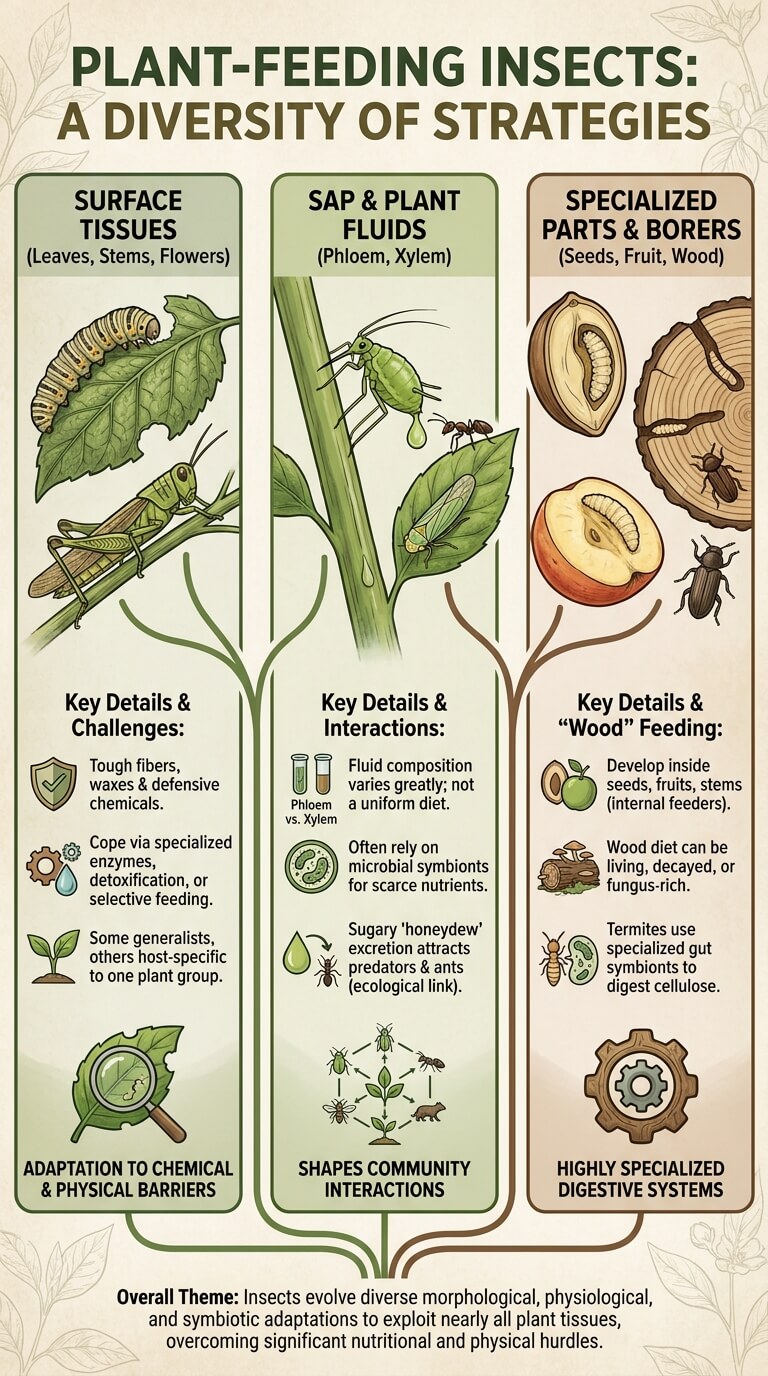
Herbivorous insects may eat leaves, stems, roots, buds, flowers, bark, or other plant tissues. Caterpillars, leaf beetles, grasshoppers, sawfly larvae, and many other insects include plant feeders. Some are broad generalists, while others are tied to one plant species or a small group of related hosts.
Plant tissue is chemically and mechanically challenging food. Leaves can contain tough fibers, waxy surfaces, low concentrations of certain nutrients, and defensive chemicals. Different insects cope through selective feeding, specialized digestive enzymes, detoxification systems, microbial partners, or by choosing particular plant parts and growth stages.
Sap and Plant Fluids
Aphids, leafhoppers, planthoppers, scale insects, and many other hemipterans use piercing mouthparts to feed on plant fluids. Phloem and xylem differ greatly in composition, so feeding on plant sap is not one uniform strategy. Some sap feeders rely on microbial symbionts to supplement nutrients that are scarce in their diet.
Plant-fluid feeding can also shape insect relationships with predators, parasites, and ants. For example, sugary excretions such as honeydew can become food for other animals. That ecological consequence is separate from the insect’s own feeding mechanism, but it shows how diet can influence interactions throughout a community.
Seeds, Fruit, Wood, and Specialized Plant Parts
Some insects bore into seeds, fruits, stems, roots, or wood, placing their feeding site inside plant tissue rather than on the surface. Seed beetles develop inside seeds, bark and wood-boring beetles use tissues beneath bark or within wood, and many fly, moth, or beetle larvae develop in fruits or stems.
Eating “wood” can mean different things. Some insects consume decayed wood rich in fungi and microbes. Others tunnel through living or recently dead plant tissues. Termites are especially famous for cellulose-rich diets, but their ability to use this material depends on a highly specialized digestive system and symbiotic microorganisms rather than on chewing wood alone.
Nectar, Pollen, and Other Floral Foods
Bees and Other Nectar or Pollen Feeders
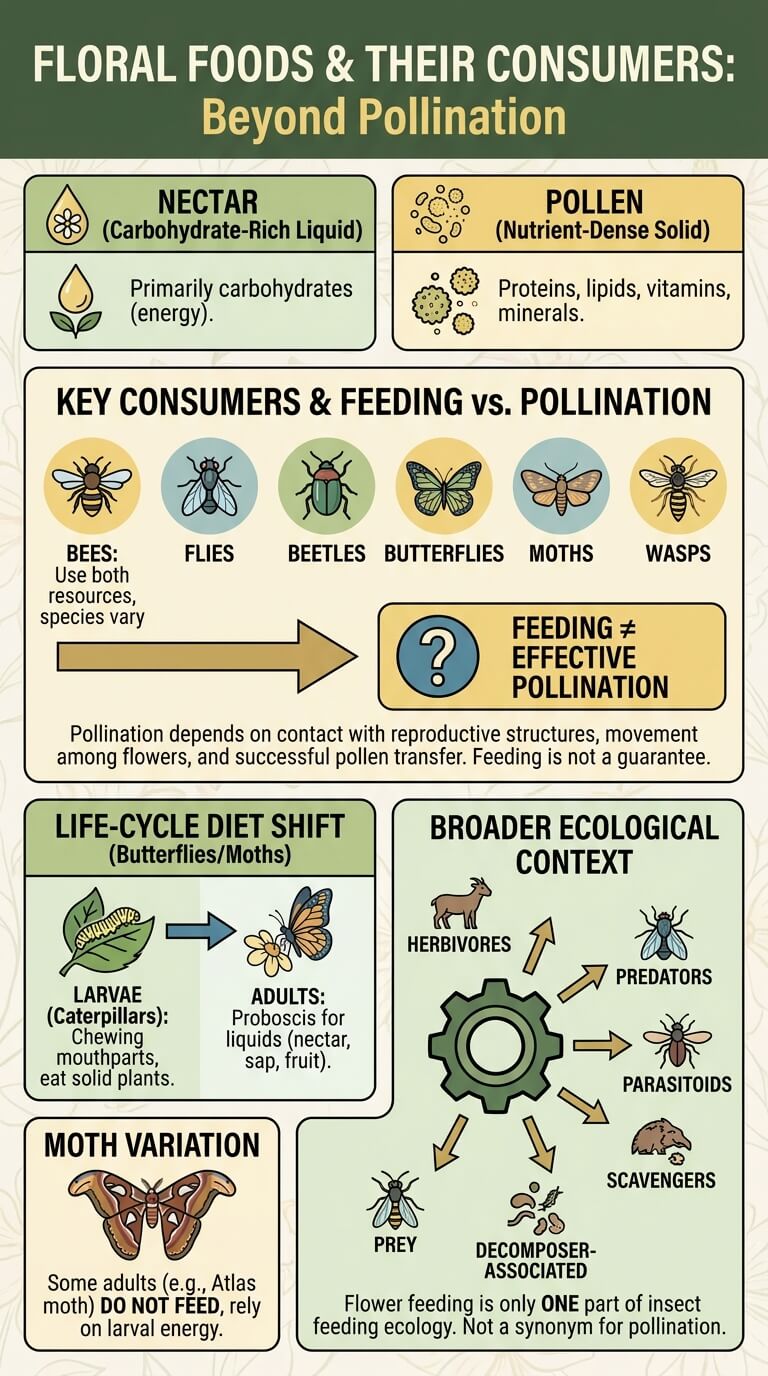
Nectar is primarily a carbohydrate-rich liquid reward, while pollen contains proteins, lipids, vitamins, minerals, and other nutrients. Bees are especially associated with both resources, although feeding patterns vary by species, sex, and life stage. Many other insects also visit flowers for nectar or pollen, including flies, beetles, butterflies, moths, and wasps.
Feeding at flowers does not automatically mean an insect is an equally effective pollinator. Pollination depends on how the insect contacts reproductive structures, how it moves among flowers, and whether pollen is transferred successfully. This article focuses on food use rather than ranking flower visitors by pollination value.
Adult Butterflies and Moths Are Usually Liquid Feeders, With Exceptions
Adult butterflies commonly use a proboscis to drink liquids, and nectar is an important food for many species. But adults may also use tree sap, rotting fruit, mineral-rich moisture, or other fluid sources. Their caterpillars typically have chewing mouthparts and often eat solid plant material, creating one of the clearest examples of a dramatic diet shift across metamorphosis.
Moths add even more variation. Some adults feed readily, while others emerge with reduced or nonfunctional mouthparts and rely largely on energy accumulated as larvae. The Natural History Museum notes that adult atlas moths do not feed, while their caterpillars spend the growing stage consuming plant material.
Flower Feeding Is Only One Part of Insect Feeding Ecology
Nectar and pollen are important resources, but insects also drive ecological processes as herbivores, predators, parasitoids, scavengers, decomposer-associated consumers, and prey. Keeping flower feeding in that broader context avoids treating “insect diet” as a synonym for pollination.
Predators, Parasitoids, and Animal-Based Feeding
Dragonflies, Mantises, and Many Predatory Beetles
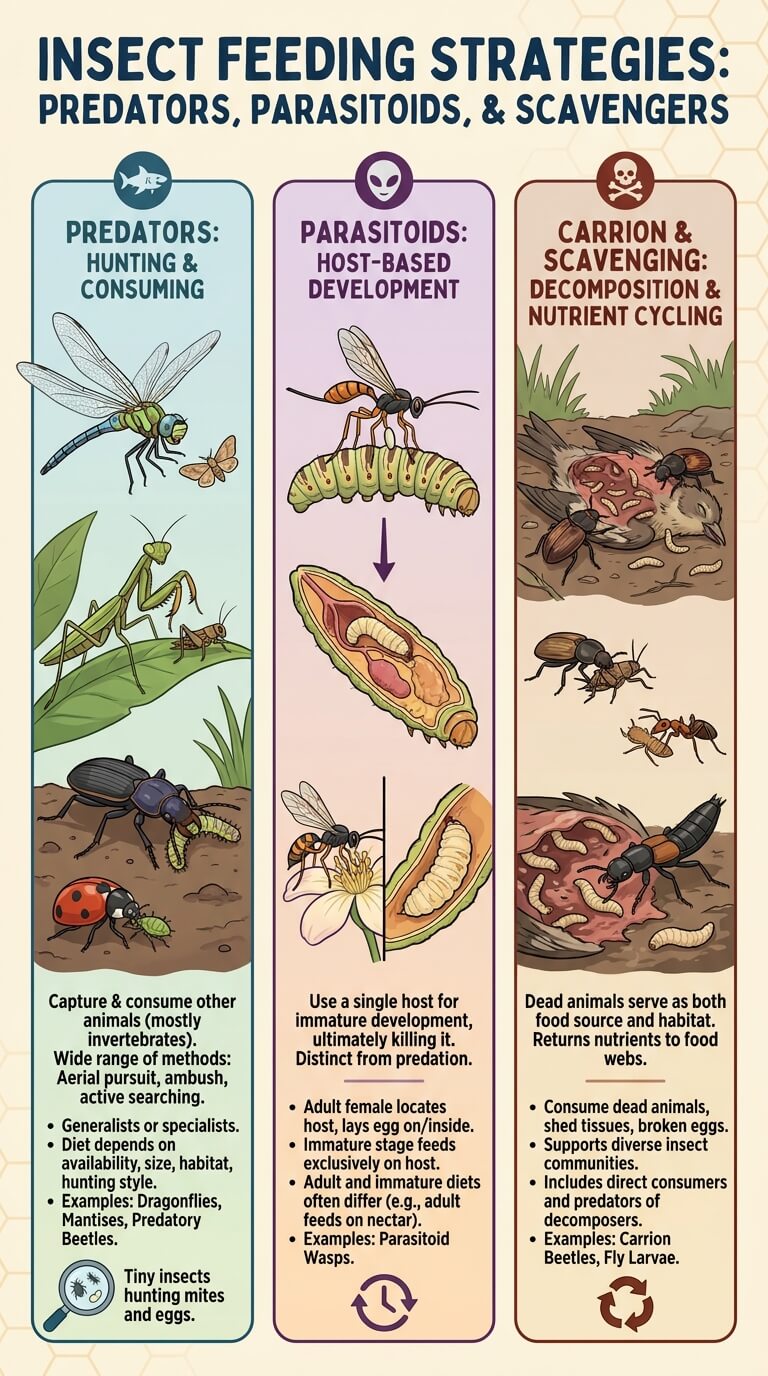
Predatory insects capture and consume other animals, most often other invertebrates. Dragonfly nymphs are aquatic predators, adult dragonflies hunt flying insects, mantises seize prey with raptorial forelegs, and many ground beetles and lady beetles eat smaller arthropods.
Predation is not limited to dramatic ambush hunters. Tiny insects can hunt mites, eggs, larvae, or soft-bodied prey. Some predators are broad generalists, while others specialize. A predator’s actual diet depends on prey availability, body size, habitat, hunting behavior, and what it can physically subdue.
Parasitoid Development Is Different From Ordinary Predation
Parasitoids use a host in a way that differs from a predator eating many prey items. In many parasitoid wasps, the adult locates a suitable host and lays an egg on or inside it; the developing immature then feeds from that host and ultimately kills it. The University of Minnesota’s overview of parasitoid wasp biology describes adults that often feed at flowers while their larvae develop using another insect as a host.
This difference matters because the adult’s diet and the immature stage’s nutritional relationship can be completely different. “What does this insect eat?” may have more than one correct answer depending on which life stage is being discussed.
Carrion and Scavenging
Dead animals support diverse insect communities. Some beetles consume carrion directly, some fly larvae feed on decomposing tissues, and other insects prey on the organisms attracted to a carcass. Carrion therefore functions as both food and habitat.
Scavenging also occurs on smaller scales. Insects may consume dead arthropods, shed tissues, broken eggs, or other animal remains. These feeding pathways return nutrients to food webs rather than leaving all decomposition to microbes alone.
Detritus, Dung, Wood, and Fungi
Dung-Associated Feeding
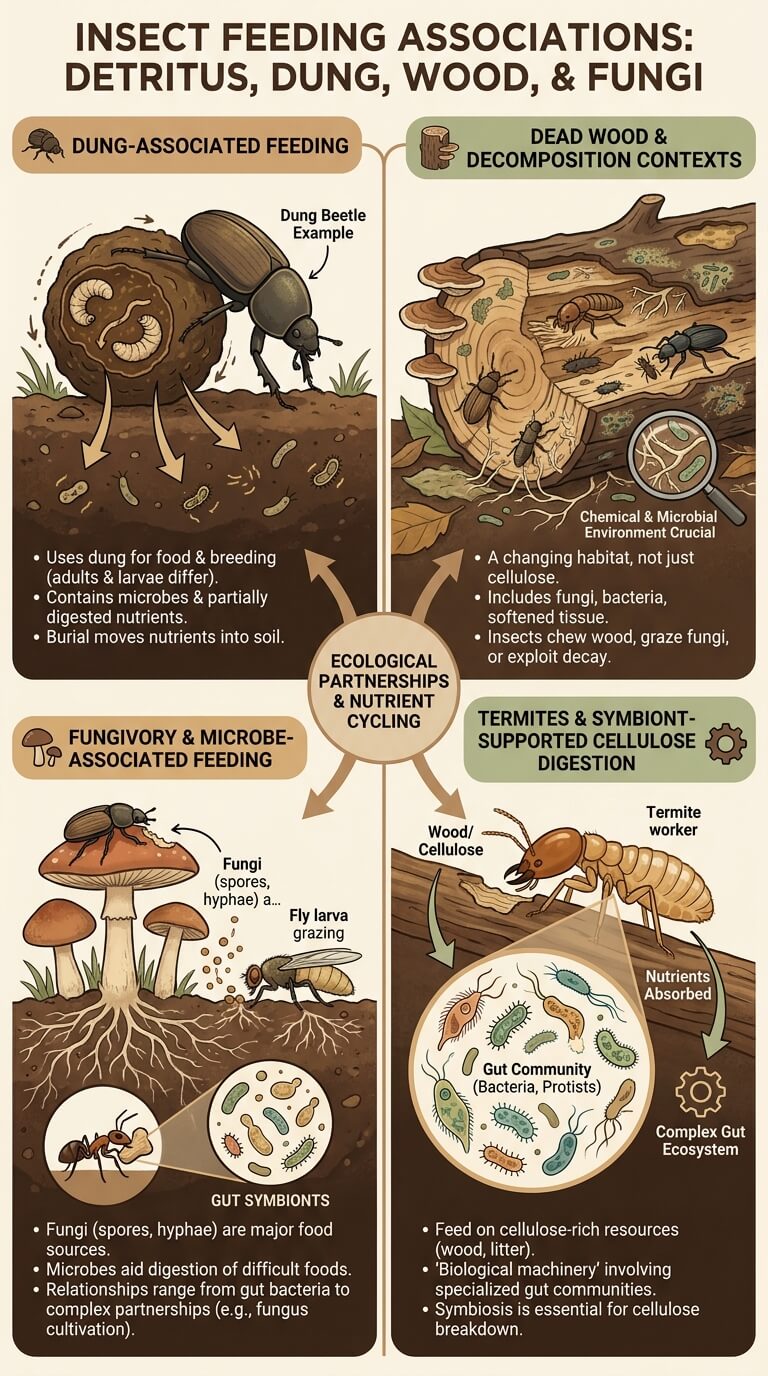
Dung contains partially digested organic material, microbes, and nutrients that some insects can exploit. Dung beetles are the best-known example. Adults and larvae can use dung differently, and not every beetle associated with dung feeds in exactly the same way.
The Natural History Museum explains that many dung beetles use animal feces as food and breeding material. Their feeding and burial behavior can also move nutrients into soil, but the diet itself varies within this large ecological group.
Dead Wood and Decomposition Contexts
Dead wood is not just cellulose. It becomes a changing habitat containing fungi, bacteria, softened plant tissues, and other organisms. Wood-associated insects may chew the wood itself, graze fungi, prey on other inhabitants, or exploit tissues altered by decay.
That makes “wood-eating insect” a useful everyday description but not a complete physiological explanation. The chemical and microbial environment inside dead wood can be as important as the physical material.
Fungivory and Microbe-Associated Feeding
Fungi are major insect foods in forests, soil, stored plant material, and decaying substrates. Fungivorous beetles, flies, and other insects may eat fungal fruiting bodies, spores, hyphae, or fungus-colonized material. In some lineages, insects cultivate or transport fungi as part of a close ecological partnership.
Microbes can also help insects use foods that would otherwise be difficult to digest or nutritionally incomplete. These relationships range from gut bacteria that contribute digestive functions to highly specialized partnerships in which insect survival depends heavily on microbial metabolism.
Termites and Symbiont-Supported Cellulose Digestion
Termites feed on cellulose-rich resources such as wood, plant litter, and related material, but describing them as animals that simply “digest wood” misses the biological machinery involved. Gut communities contribute substantially to cellulose breakdown in many termites. U.S. Forest Service research on subterranean termites describes hindgut bacteria that aid digestion of cellulosic material.
The exact symbiosis differs among termite lineages. Some rely heavily on flagellate protists plus bacteria, while higher termites have lost those protists and use other microbial partnerships. The safest general statement is that termite feeding depends on both the insect and its specialized gut ecosystem.
Blood Feeding Without the Mosquito Myth
Mosquito Males and Plant Sugars
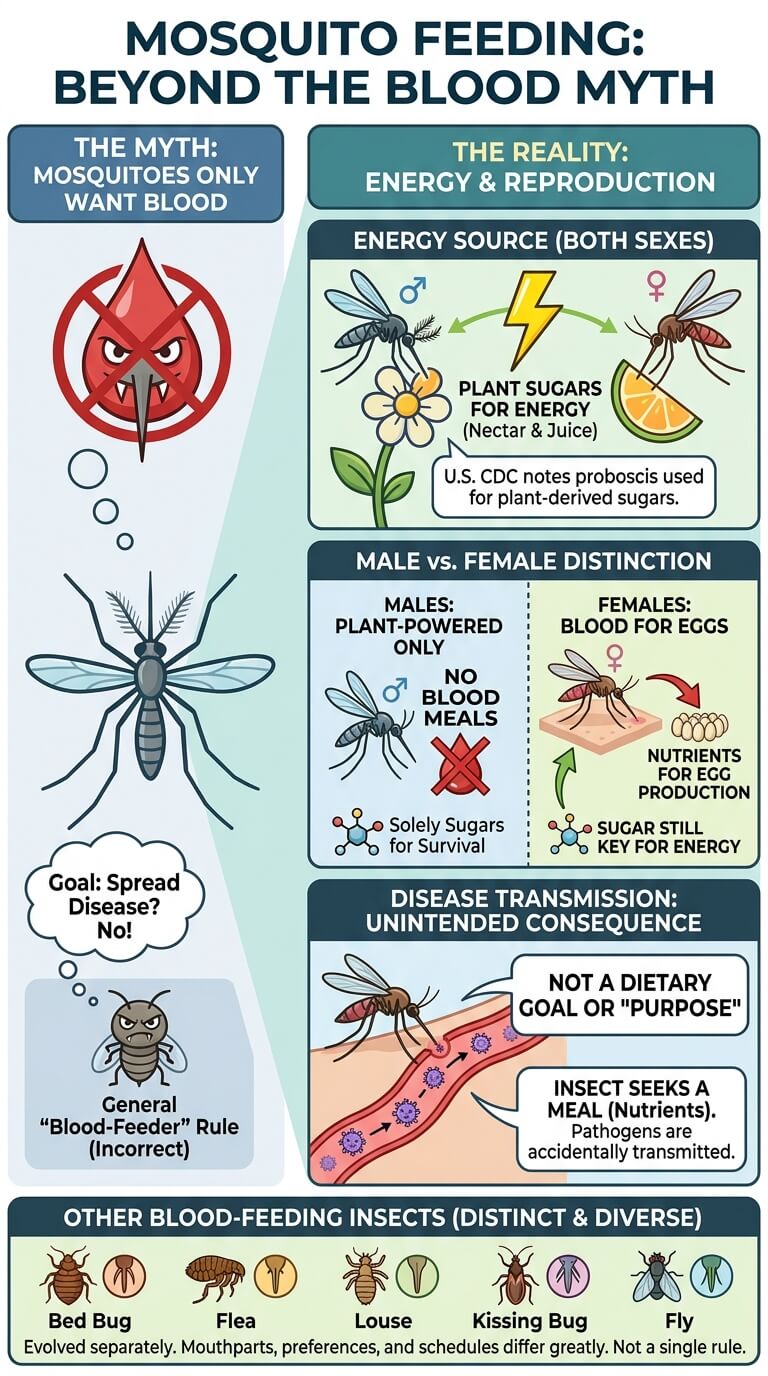
Mosquitoes do not simply live on blood. Both sexes use plant-derived sugars for energy. The U.S. Centers for Disease Control and Prevention notes that male and female mosquitoes can use the proboscis to feed on flower nectar and fruit juices. Males do not take vertebrate blood meals.
Blood Meals in Females of Many Mosquito Species
Females of many mosquito species take blood meals associated with egg production. That does not make blood their only food, and the details vary among species. Sugar feeding remains important for energy, while blood supplies nutrients used in reproduction.
This distinction also prevents a common biological error: disease transmission is not a dietary goal or “purpose” of the mosquito. Pathogens can be transmitted when compatible mosquito species feed on hosts, but the insect is seeking a meal, not intentionally spreading disease.
Other Blood-Feeding Insects
Blood feeding has evolved in several insect lineages, including bed bugs, certain flies, lice, fleas, and kissing bugs. Their mouthparts, host preferences, feeding schedules, and medical relevance differ greatly. Those differences are important, but they belong in species-specific or health-focused discussions rather than being generalized into one “blood-feeding insect” rule.
Larvae and Adults Can Eat Different Foods
Caterpillars Versus Adult Butterflies and Moths
Metamorphosis can separate the feeding jobs of immature and adult stages. Many caterpillars have chewing mouthparts and eat leaves or other plant tissues. The adult butterfly or moth usually has a fluid-feeding apparatus, and in some moths the adult does not feed at all.
This separation can reduce direct competition between life stages. A larva may specialize on growth, while the adult stage emphasizes dispersal and reproduction. That pattern is common in holometabolous insects, although the degree of dietary separation differs among groups.
Aquatic Larvae Versus Terrestrial Adults
Many insects spend immature stages in freshwater and adulthood in the air or on land. Aquatic larvae may scrape algae, shred leaves, filter suspended particles, collect fine detritus, or hunt prey. Once transformed, the adult may switch to nectar, other insects, or little feeding at all.
Mayflies, caddisflies, mosquitoes, and many true flies illustrate how a single insect species can connect aquatic and terrestrial food webs. The exact diet depends on the taxon, so “aquatic insect larvae eat algae” is much too broad as a universal statement.
Adults With Reduced or Nonfunctional Mouthparts
Some adult insects live largely on reserves built during larval development. In those species, the adult stage may have reduced mouthparts, a short feeding window, or no functional feeding apparatus. This is why the adult stage is not automatically the main feeding stage of an insect’s life.
Omnivory and Flexible Diets
Ants Show How Broad Insect Diets Can Become
Ant diets vary enormously among species. Depending on the lineage, colonies may collect sugary liquids, seeds, fungi, dead animals, living prey, or mixtures of resources. Leafcutter ants are especially interesting because the leaves they collect mainly support cultivated fungi that become a major food source for the colony.
That diversity is useful as an example, but it should not be reduced to “ants eat everything.” Individual ant species can have strong preferences, seasonal changes, or nutritional requirements, and worker diets can differ from larval needs.
Opportunistic Feeding and Seasonal Change
Food availability changes through the year. Flowers bloom and fade, prey populations rise and fall, fruits ripen, and decaying material appears unpredictably. Generalist insects may switch among acceptable resources, while specialists are more constrained by the timing and location of their hosts.
Flexible feeding can help insects persist when preferred foods are scarce, but alternative foods are not necessarily equal in nutritional value. A food that keeps an adult alive may not support egg production, larval development, or long-term population growth.
Common Diet Myths
Do Mosquitoes Live on Blood?
No. Mosquito adults commonly use plant sugars for energy. Females of many species also take blood meals related to egg production, while males do not take vertebrate blood meals. “Mosquitoes drink blood” is therefore incomplete unless sex and reproductive context are explained.
Do Butterflies Eat Leaves?
Usually it is the caterpillar stage that chews leaves or other solid plant material. Adult butterflies generally feed on liquids through a proboscis. Some adults use nectar heavily, while others also take sap, rotting fruit fluids, or mineral-rich moisture. Diet should be described by life stage.
Are Lady Beetles Always Predators?
No. Many familiar lady beetles are predators, but the family contains substantial dietary diversity. Peer-reviewed research on ladybird beetles describes fungivorous, carnivorous, and herbivorous feeding histories within the family. Even predatory species may use pollen, nectar, or other supplementary foods.
Do All Adult Insects Eat?
No. Some adult insects have reduced or nonfunctional mouthparts and rely mainly on reserves accumulated earlier in life. In other species, adults feed intensively. Feeding effort therefore cannot be predicted from the word “adult” alone.
How Feeding Fits With Insect Anatomy, Behavior, and Ecosystems
Anatomy Sets the Physical Options
Mouthparts determine whether an insect can efficiently chew, pierce, sponge, lap, or siphon food, but digestion and physiology determine what happens after food enters the body. The same insect can also use legs, antennae, palps, and sensory hairs to handle or evaluate food before feeding.
Behavior Determines How Food Is Found and Chosen
Finding food is a behavioral problem. Insects follow odors, taste surfaces, track visual cues, explore substrates, wait in ambush, search host plants, or return to known resource locations. That process is different from the diet itself: diet describes what is eaten, while foraging behavior describes how resources are located and selected.
Feeding Changes Ecosystems
What insects eat affects plants, prey populations, decomposition, nutrient movement, and food webs. Herbivores remove plant tissue, predators consume other animals, dung and carrion feeders process waste and remains, and insects themselves become food for many other animals. Feeding is therefore both a private nutritional problem for the insect and an ecological process with wider effects.
FAQ
What Do Most Insects Eat?
There is no scientifically useful single food eaten by “most insects.” The group is too diverse. Major feeding modes include herbivory, sap feeding, predation, nectar and pollen feeding, detritivory, fungivory, scavenging, parasitoid development, omnivory, and blood feeding in particular lineages.
Why Do Larvae and Adults Often Eat Different Foods?
Complete metamorphosis allows larvae and adults to develop very different bodies and mouthparts. That can let each stage specialize on a different resource. Caterpillars may chew leaves while adult butterflies drink liquids, and aquatic fly larvae may feed underwater while adults use terrestrial resources.
What Do Mosquitoes Eat Besides Blood?
Adult mosquitoes use sugar sources such as nectar and other plant juices for energy. Males rely on plant-derived sugars rather than vertebrate blood. Females of many species also take blood meals associated with producing eggs, so their diet includes more than one resource type.
Can Insects Eat Wood?
Yes, some insects use wood or wood-associated material, but the process differs among groups. Termites rely on specialized gut symbionts to help break down cellulose-rich food. Other wood-associated insects may eat plant tissues, fungi growing in wood, or material already modified by decay.
Final Thoughts
The best answer to “what do insects eat?” is that insect diets are as diverse as insects themselves. Mouthparts help determine how food can be collected, but life stage, sex, digestive physiology, microbes, habitat, and behavior all shape the final menu. A caterpillar and adult moth may eat completely different foods, a mosquito can use plant sugars as well as a reproductive blood meal, and a termite’s wood-based diet depends on microbial partners. Understanding those differences gives a much more accurate picture than treating insects as one feeding type.

Ethan Walker is the founder and research editor of Animal Fact Central. He creates and reviews educational animal facts content using trusted wildlife, pet care, and science-based sources. His work focuses on making animal behavior, adaptations, habitats, and species facts clear, accurate, and engaging for everyday readers.
Read More Details About Ethan Walker: https://animalfactcentral.com/ethan-walker/