
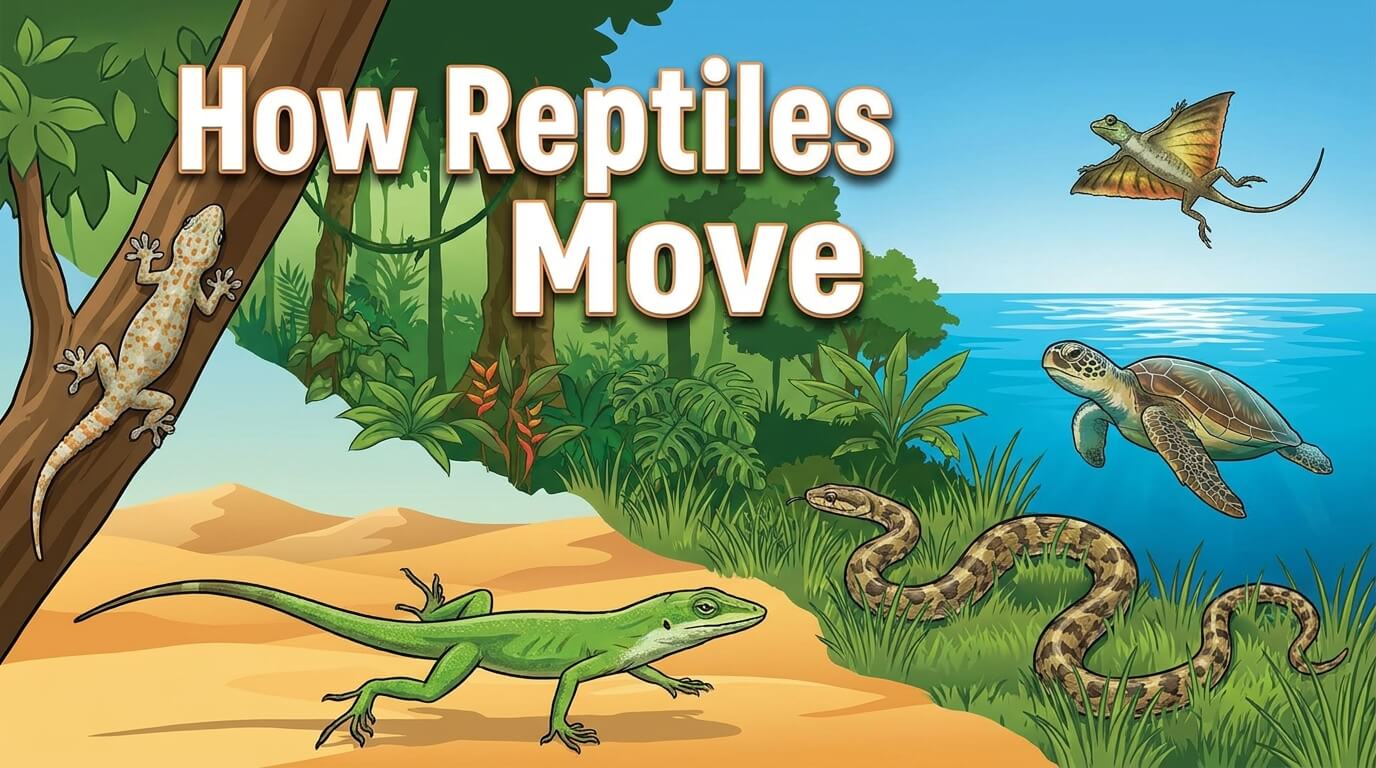
Reptiles do far more than crawl. Depending on the lineage and habitat, they can walk, sprint, climb, burrow, swim, sidewind, move in a straight line without visible body bends, or glide between trees. A gecko clinging to glass, a crocodilian lifting its body into a high walk, a sea turtle sweeping through open water, and a snake crossing loose sand all solve the same basic problem in very different ways: they must push against their surroundings strongly enough to move while keeping balance and controlling energy use.
That diversity comes from equally diverse body plans. Most lizards use four limbs plus flexible trunks and tails. Snakes rely on long bodies, ribs, muscles, belly scales, and carefully controlled friction. Turtles carry rigid shells that limit trunk bending but pair with limbs specialized for land, freshwater, or marine movement. Crocodilians combine powerful tails with limbs that can support several terrestrial postures. Understanding reptile locomotion means looking at how anatomy, surface type, temperature, and behavior work together rather than treating “crawling” as one universal reptile gait.
Quick Answer: Reptiles Use Many Different Locomotor Strategies
Body plan, habitat, and movement
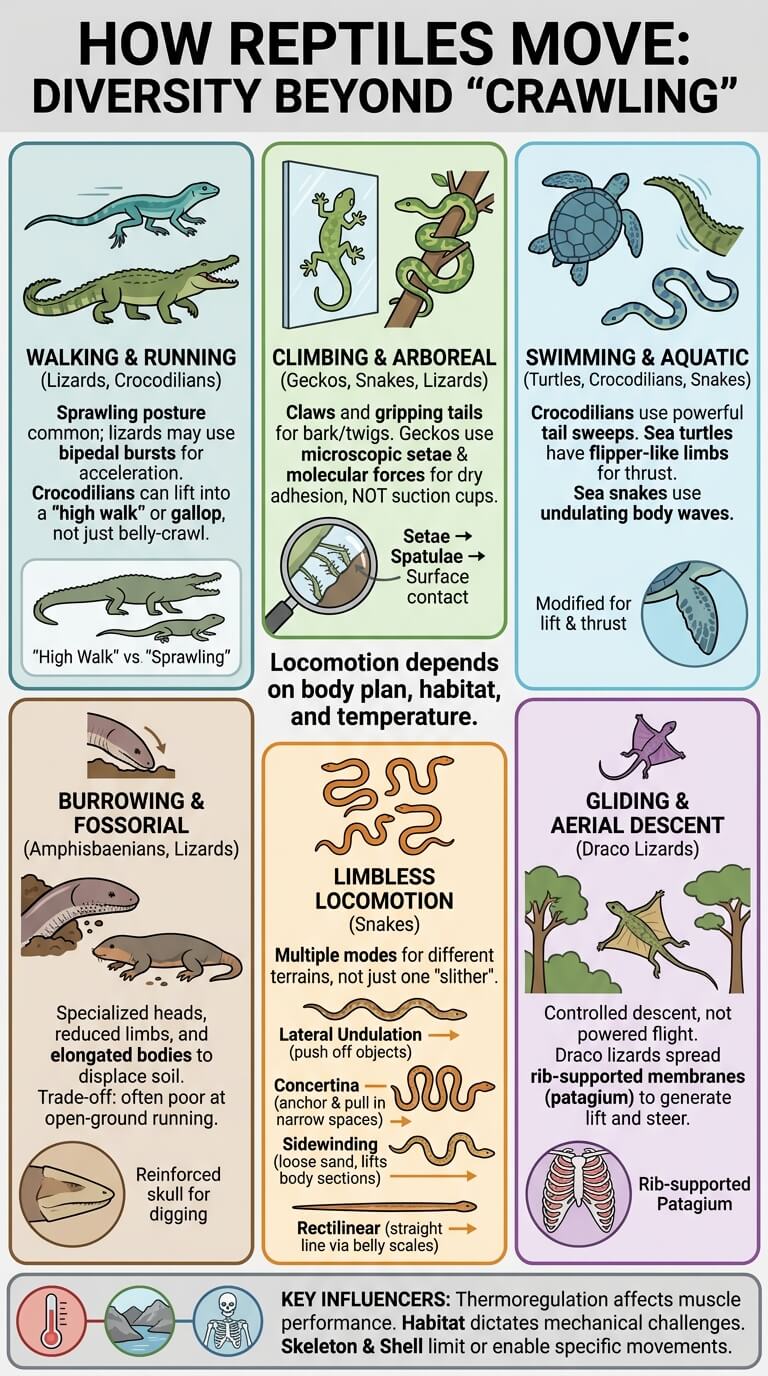
How a reptile moves depends strongly on what its body can do and what the environment demands. A long, flexible snake can send muscular waves down its body and use friction against the ground. A gecko can use claws on rough bark and, in many species, adhesive toe structures on smoother surfaces. A sea turtle has broad flippers that are excellent for swimming but poorly suited to supporting the animal’s weight on land. Crocodilians move efficiently in water with powerful tails yet can also raise the trunk above the ground when walking. The contrast among the major living reptile groups helps explain why limbless snakes, shelled turtles, lizards, and crocodilians move so differently.
These differences are not random. Locomotion is tied to feeding, escape, mate searching, thermoregulation, nesting, and access to shelter. A desert lizard that must dash across exposed ground faces different mechanical challenges from a burrowing amphisbaenian pushing through soil or an arboreal lizard balancing on a narrow branch.
Why “crawl” is an incomplete description
People often use “crawl” for nearly any low-to-the-ground reptile movement, but the word hides important differences. A sprawling lizard is still walking or running on limbs. A turtle is supporting and advancing a shelled body with its limbs. A snake is producing propulsion without functional walking legs. Some crocodilians can use a high walk with the belly well clear of the ground. Several lizards can run bipedally for part of a sprint, while others have body surfaces specialized for climbing or gliding.
Calling all of those motions crawling is a little like calling swimming, walking, and flying the same kind of travel. For basic description it may be convenient, but it is not a useful biological explanation.
The Reptile Body Plan and Locomotion
Sprawling limb posture
Many lizards have a sprawling or semi-sprawling posture in which the upper limbs project partly outward from the body before the lower limbs reach the ground. That geometry places the feet away from the midline and often keeps the body relatively low. It can provide stability and allow effective maneuvering on irregular ground, rocks, branches, and other complex surfaces.
Sprawling does not mean inefficient by definition. Lizards can use walking and running mechanics that share important features with those of other four-legged animals. Their posture simply changes how forces pass through the limbs and trunk. The exact pattern varies with species, speed, substrate, body size, and limb proportions.
Lateral body bending
Many walking and running lizards bend the trunk from side to side as the limbs cycle. This lateral flexion works with limb movement rather than replacing it. The tail can also contribute to balance, turning, acceleration, and body control. In some fast-moving lizards, trunk and tail movements become especially visible during rapid turns or bursts of acceleration.
Lateral bending is one reason reptile movement can look very different from the straighter-bodied stride of many mammals. Yet the underlying problem is the same: the animal must manage forces against the ground while moving its center of mass forward without losing stability.
Semi-erect and high-walk variation in crocodilians
Crocodilians are unusually versatile among living reptiles because their limb posture can change. They can use a low, sprawling-style movement with the body close to the ground, but they can also lift the trunk higher and bring the limbs into a more upright arrangement. Research on American alligator locomotion describes the high walk as an intermediate, semi-erect posture rather than a fully mammal-like erect stance.
This flexibility matters because mud, banks, shallow water, firm ground, and short bursts of movement impose different demands. Crocodilians should not be described as animals that can only drag themselves on their bellies. At the same time, their terrestrial abilities are best discussed as locomotor biology, not as sensational speed rankings.
Walking, Running, and Sprinting
Lizards that walk, run, and sprint
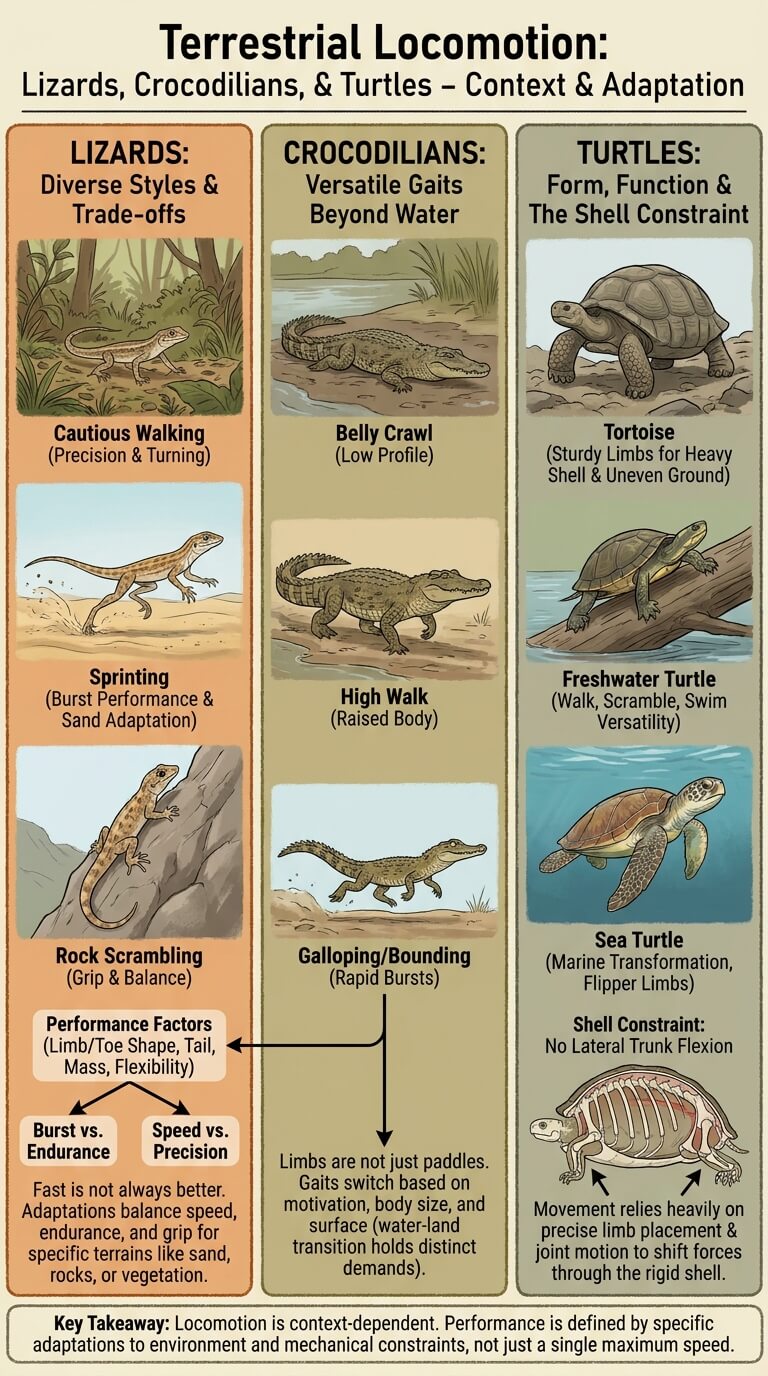
Lizards span an enormous range of terrestrial styles. Some move cautiously with short steps while foraging. Others sprint rapidly between cover, race over sand, scramble across rocks, or make abrupt turns through vegetation. Limb length, foot shape, tail length, body mass, and trunk flexibility all influence performance.
Fast locomotion is not simply “better” locomotion. A lizard that accelerates quickly across open ground may trade endurance for burst performance. A species moving through dense vegetation may benefit more from precise foot placement and turning ability. On loose sand, long toes, altered foot fringes, or changes in stride can help prevent sinking and slipping. On rocks, gripping and balance may matter more than top speed.
Crocodilian terrestrial locomotion without speed hype
Crocodilians can use more than one terrestrial gait. A belly crawl keeps the body low, while the high walk raises it higher. Some smaller crocodilians can also use rapid, bounding or galloping movements under certain conditions. These behaviors demonstrate that crocodilian limbs are not merely paddles for aquatic life.
What matters biologically is not a single maximum speed. Short bursts, posture changes, body size, surface conditions, motivation, and species all affect performance. A crocodilian moving between water and land is switching between environments that place very different mechanical demands on its body.
Turtle walking and why “slow” is not a universal biological description
Many terrestrial turtles and tortoises move deliberately on land, but “all turtles are slow” is too broad to be useful. Different turtles are built for different settings. Terrestrial tortoises need sturdy limbs that can support a heavy shell over uneven ground. Freshwater turtles may walk along the bottom, scramble onto logs or banks, and swim effectively. Sea turtles are transformed for marine travel, with limbs that function as flippers rather than ordinary walking legs.
The turtle shell also changes locomotion because the trunk cannot flex laterally like a lizard’s body. Instead, movement depends heavily on limb placement, joint motion, and how the animal shifts forces through the shell and skeleton.
Bipedal Running in Selected Lizards
When and why some lizards lift the forelimbs
Some lizards can rise onto the hind limbs during rapid acceleration. Basilisks are familiar examples, but facultative bipedal running also occurs in several other lizard lineages. It is not equivalent to the habitual two-legged walking of birds. These lizards normally use four limbs and become bipedal only during certain strides or bursts.
A biomechanical study of Australian agamid lizards found that bipedal strides were more closely associated with acceleration than with simply moving at a higher speed. The researchers concluded that body shape and the position of the center of mass help determine when the front limbs lose contact with the ground during acceleration. The study of bipedal running in agamid lizards also found no general speed advantage for bipedal strides in the species tested.
Limits and trade-offs
Bipedalism therefore should not be presented as a universal “turbo mode.” It is a temporary locomotor option in selected species, shaped by acceleration, body proportions, balance, and behavior. A long tail can help with body control, while long hind limbs can influence stride and acceleration. The same features may be useful for quadrupedal running as well, so it is often difficult to separate one adaptation from another.
Species that regularly use short explosive bursts may have different performance priorities from reptiles that travel slowly for long periods. Locomotion always involves trade-offs among acceleration, endurance, stability, maneuverability, and the terrain being crossed.
Climbing and Arboreal Movement
Claws, body posture, and gripping
Tree-dwelling reptiles face narrow, angled, flexible, and sometimes smooth surfaces. Many lizards use claws to catch irregularities in bark. Toes can wrap around twigs, and a low center of mass can improve stability on narrow perches. Tails may help with balance, while some species can grip with the tail itself.
Arboreal snakes solve the same problem without limbs. They can press and wrap sections of the body against branches or trunks, creating secure contact before moving another section forward. The amount of available texture and the diameter of the support can change which locomotor pattern works best.
Gecko adhesion and microscopic toe structures
Many geckos can move across surfaces that offer little for ordinary claws to grip. Their toe pads contain layered structures bearing huge numbers of microscopic hairs called setae, which branch into even finer contact structures. These create extremely close contact with the surface, allowing intermolecular forces to contribute to adhesion. A Smithsonian description of day gecko toe pads explains how the animal can attach and release its grip rapidly by changing toe angle as it steps.
This system works without sticky glue. It also lets geckos detach quickly, which is essential for running. Adhesion that could not be released efficiently would make movement difficult rather than helpful.
Why gecko feet are not suction cups and not every gecko has adhesive pads
Gecko toes are often described as suction cups, but suction is not the mechanism used by the familiar adhesive toe-pad system. Microscopic surface contact and the orientation of the setae are central to the grip. The misconception probably persists because a gecko can cling to smooth glass in a way that looks similar to a suction device.
It is also wrong to assume every gecko has the same adhesive anatomy. Gecko diversity includes species with reduced pads or no adhesive pads at all, especially where their habitats and movement styles do not require the same climbing system. Claws, posture, friction, and substrate all remain important.
Burrowing and Fossorial Locomotion
Head-first digging, limb use, and body elongation
Fossorial reptiles spend much of their lives in soil, sand, leaf litter, or other concealed spaces. Moving underground is mechanically different from walking on the surface because the animal must displace material while preventing the tunnel from collapsing around it. Some lizards dig with powerful forelimbs. Others use wedge-shaped heads, reduced limbs, elongated bodies, or combinations of these features.
Burrowing forms often sacrifice traits useful for open-ground running. A compact head may push through soil effectively but offer little advantage in fast pursuit. Reduced limbs can make a narrow body easier to move through tight spaces, while reinforced skulls can withstand repeated contact with the substrate.
Amphisbaenians and specialized subterranean movement
Amphisbaenians are a distinctive group of squamates specialized for life underground. Most have elongated, ringed bodies and greatly reduced or absent limbs, although a few retain forelimbs. Their heads are shaped for digging, and the skull is built to transmit forces into soil.
They are useful reminders that limbless or nearly limbless movement did not evolve only in snakes. Reptile body plans have repeatedly been modified for moving through environments where a long narrow form can be more useful than four prominent walking limbs.
How Snakes Move Without Limbs
Lateral undulation
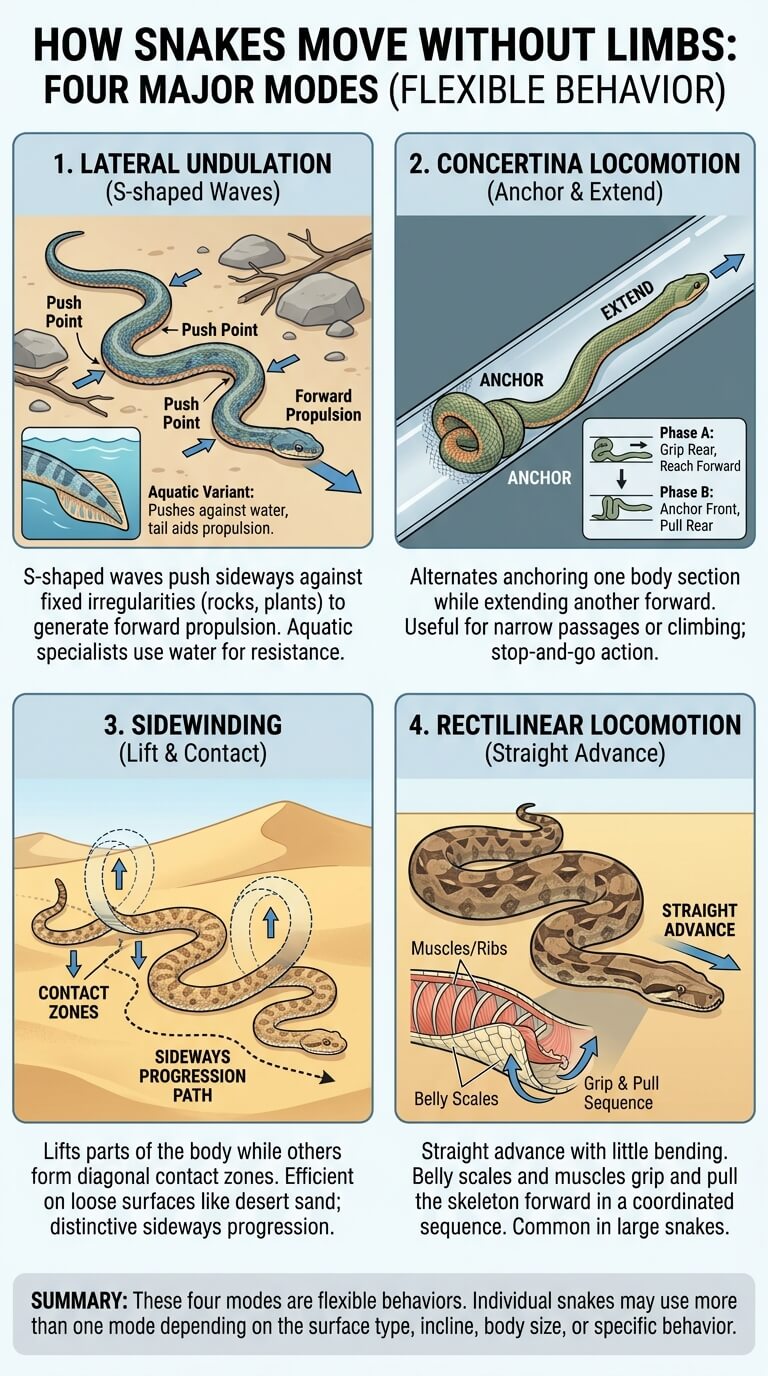
Lateral undulation is the familiar S-shaped movement used by many snakes. Waves of bending pass along the body while the snake pushes sideways against irregularities in the ground, vegetation, rocks, or other contact points. Those sideways forces generate forward propulsion.
In water, many snakes use a related undulatory pattern, but the forces come from pushing against water rather than fixed objects. Aquatic specialists may have laterally compressed tails that improve propulsion.
Concertina locomotion
Concertina locomotion alternates anchoring and extension. Part of the body grips or presses against the surroundings while another part reaches forward. The forward section then becomes an anchor while the rear is pulled ahead. It can be useful in narrow passages and on some climbing surfaces where continuous undulation cannot generate enough secure contact.
The movement is more stop-and-go than lateral undulation, and it can require substantial muscular effort because the snake repeatedly grips, advances, and re-anchors.
Sidewinding
Sidewinding is especially associated with snakes that move across loose or unstable surfaces such as desert sand. Instead of leaving the whole body sliding against the ground, the snake lifts parts of the body while other sections form contact zones. The result is a distinctive sideways-looking progression.
Sidewinding is not the only way a sidewinder snake can move, and many snakes that normally use other locomotor modes can alter their pattern when the substrate changes. Movement is flexible behavior, not a one-mode label attached permanently to a species.
Rectilinear locomotion
Rectilinear locomotion produces a relatively straight advance with little obvious side-to-side bending. Muscles connected to the ribs and skin help move sections of the belly surface relative to the skeleton, allowing the animal to grip and pull forward in a coordinated sequence. The motion is particularly striking in large, heavy-bodied snakes because the body can seem to glide straight ahead.
A recent Smithsonian explanation of snake locomotion describes lateral undulation, concertina movement, sidewinding, and rectilinear locomotion as four major modes. Individual snakes may use more than one depending on surface, incline, body size, and behavior.
Swimming in Reptiles
Tail-driven swimming in crocodilians and many squamates
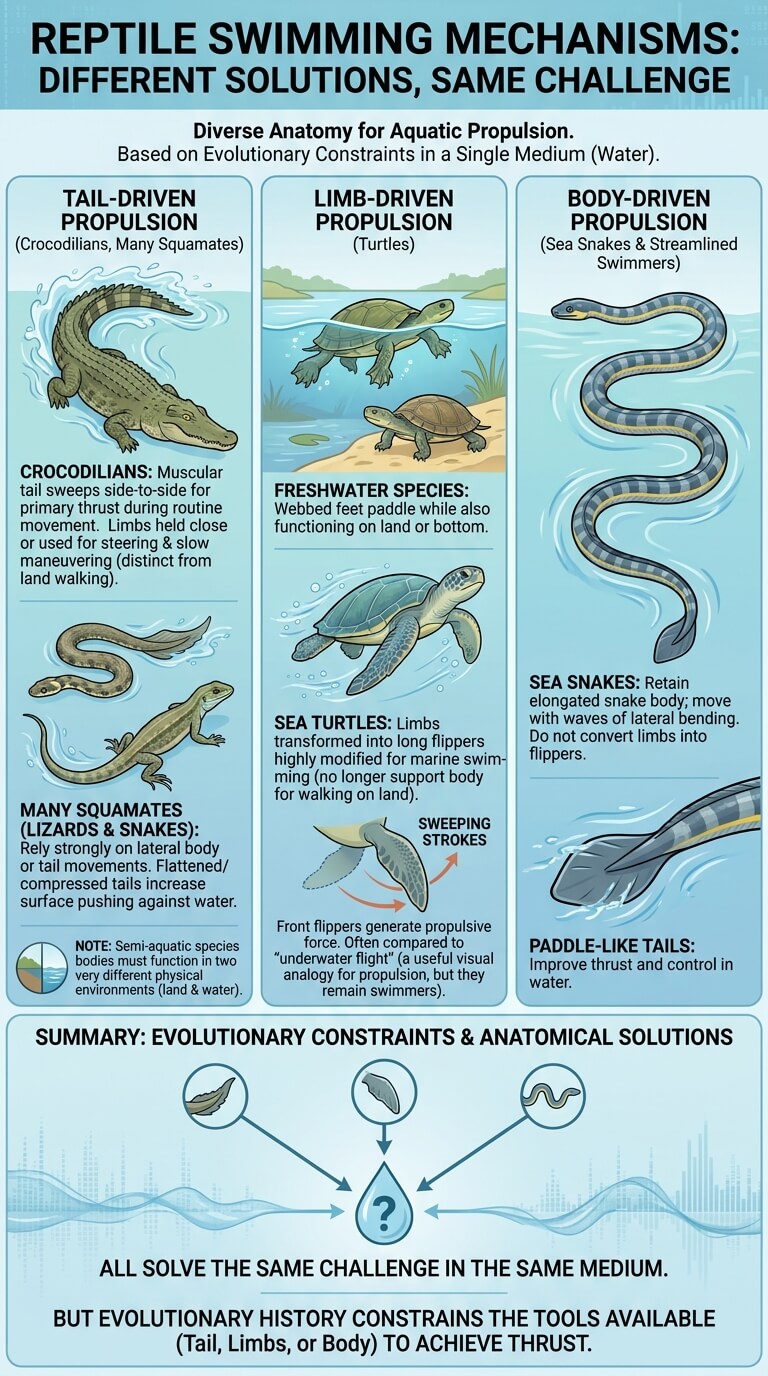
Crocodilians are powerful swimmers because the muscular tail can sweep from side to side and provide most of the thrust during routine aquatic movement. The limbs can be held close to the body or used for steering and slow maneuvering. This is a different mechanical solution from their limb-driven walking on land.
Many swimming lizards and snakes also rely strongly on lateral body or tail movements. A flattened or laterally compressed tail can increase the surface pushing against water. Semi-aquatic species often retain good terrestrial ability as well, so their bodies must work in two very different physical environments.
Turtle propulsion with webbed feet or flippers
Turtles show a wide spectrum of aquatic specialization. Many freshwater species have webbed feet that can paddle while still functioning on land or the bottom. Sea turtles go much further: their limbs are transformed into long flippers specialized for marine swimming. The Animal Diversity Web overview of sea turtles notes that their flipper-like limbs are highly modified for swimming and no longer support the body on land in the way ordinary walking limbs do.
Marine turtle locomotion is often compared with underwater flight because the front flippers generate much of the propulsive force through sweeping strokes. That comparison is useful as a visual analogy, but the animals remain swimmers, not fliers.
Sea snakes and other streamlined swimmers
Sea snakes provide another route to aquatic specialization. Rather than converting limbs into flippers, they retain the elongated snake body and move with waves of lateral bending. Many have paddle-like tails that improve thrust and control in water.
Different aquatic reptiles therefore solve the same challenge with different anatomy. Crocodilians use a large muscular tail, sea turtles use highly modified limbs, and sea snakes use an undulating body plus tail. The surrounding medium is the same, but evolutionary history constrains the tools available.
Gliding and Aerial Descent
Draco lizards and rib-supported gliding membranes
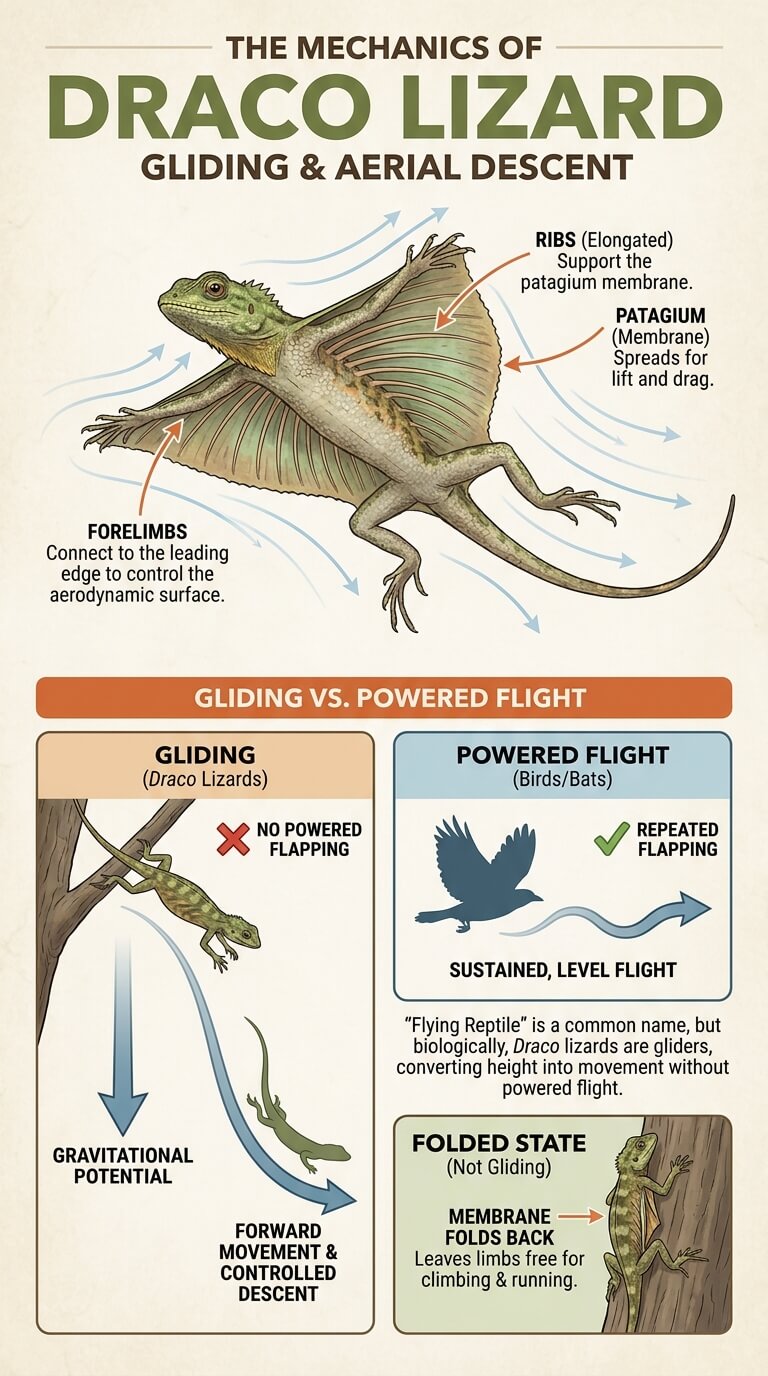
Draco lizards can travel through the air by gliding from elevated perches. They spread a membrane called the patagium, supported by elongated ribs extending from the sides of the trunk. Research on the gliding system of Draco lizards shows that the forelimbs connect with the leading edge of the patagium during a glide and help control the aerodynamic surface.
This system is unusual because the structures supporting the membrane are ribs rather than elongated fingers or arms. When the lizard is not gliding, the membrane can fold back along the body, leaving the limbs free for ordinary climbing and running.
Why gliding is not powered flight
Draco lizards are often called flying dragons or flying lizards, but they do not use powered flapping flight like birds or bats. A glide begins with height and converts that gravitational potential into forward movement while the membrane generates lift and drag. The animal can steer and control the descent, but it does not repeatedly flap an aerodynamic surface to sustain level flight.
Other reptiles can make controlled aerial descents as well, including some geckos and snakes, but their anatomical solutions differ. “Flying reptile” is therefore a useful common-name phrase only if the biological distinction between gliding and powered flight remains clear.
Movement Trade-Offs Across Habitats
Desert surfaces, tree canopies, open water, mud, rocks, and burrows
A locomotor system that works well in one place may perform poorly somewhere else. Loose sand provides fewer firm contact points than rock. Narrow branches demand balance and grip. Water resists movement in all directions and rewards streamlined shapes or efficient paddling surfaces. Burrows limit space and may favor elongated bodies or reinforced digging structures.
Reptiles often adjust behavior before anatomy reaches its limits. A lizard may choose a firmer route across loose ground, a snake may switch locomotor mode, and a crocodilian may alter posture when moving from mud to firmer land. Habitat use and movement are therefore tightly connected.
Speed, stability, maneuverability, and energy use
No animal can maximize every kind of performance at once. Long limbs may increase stride length but can complicate movement through tight spaces. Strong adhesion improves climbing but requires controlled release. A rigid turtle shell provides protection but prevents the lateral trunk flexion used by many lizards. A long limbless body excels in narrow passages yet relies on contact with the environment to generate propulsion. Movement is closely tied to reptile behavior , including foraging, escape, courtship, territorial activity, and daily timing.
Temperature adds another layer because reptiles are ectothermic. Muscle performance, acceleration, digestion, and willingness to move can change with body temperature, although preferred and functional temperatures differ among species. A locomotor study performed under one thermal condition should not be treated as a universal performance value for all reptiles.
Common Myths and Mistakes
All reptiles crawl
Reptiles walk, run, sprint, climb, burrow, swim, sidewind, and glide. Even within one species, movement can change with speed and terrain. “Crawl” may describe low movement in everyday speech, but it should not be used as if it were one shared locomotor mechanism.
All turtles are slow
Turtle movement is habitat-specific. A tortoise walking across land is solving a different mechanical problem from a sea turtle propelling itself through ocean water. Judging the entire group by land speed ignores some of the most specialized swimmers among living reptiles.
Geckos use suction cups
The well-known adhesive toe system of many geckos depends on microscopic structures and close surface interactions, not air-pressure suction cups. Claws may still help on rough surfaces, and some gecko species lack the famous adhesive pads.
Snakes have only one way to move
Snakes can switch among locomotor patterns. Lateral undulation, concertina movement, sidewinding, and rectilinear locomotion differ in how the body contacts and pushes against the environment. Climbing and swimming add still more variation.
How Movement Fits Reptile Life
Habitats shape locomotor options
Locomotion often reveals what a reptile’s habitat demands. Arboreal animals need grip and balance. Aquatic species need effective propulsion and steering. Burrowers must move through confined, resistant material. Desert species may need to manage unstable surfaces and extreme heat. Movement is therefore one of the clearest ways to see the connection between anatomy and environment. How reptiles move also influences their roles in ecosystems by shaping where they forage, hunt, graze, disperse seeds, or serve as prey.
Skin, feet, limbs, and body form work together
Movement depends on more than bones and muscles. Foot scales, claws, toe pads, belly scales, tail shape, shell structure, and body flexibility can all influence how force reaches the surroundings. A gecko’s microscopic toe structures and a snake’s broad ventral scales are very different anatomical features, but both help create controlled contact with the surface.
Thermoregulation changes when and how reptiles move
Because most living non-avian reptiles rely strongly on external heat to regulate body temperature, movement and thermoregulation interact constantly. A reptile may bask before becoming active, retreat to shade during excessive heat, shift activity to cooler hours, or reduce movement during cold periods. The mechanics of locomotion do not operate separately from the animal’s thermal state.
FAQ
Can crocodilians run on land?
Yes. Crocodilians can move on land using several postures, including a belly crawl and a higher walk with the trunk lifted above the ground. Some species and individuals can also use faster bounding or galloping movements. Their ability varies with species, size, motivation, and surface, so dramatic single-number speed claims are not a useful way to describe crocodilian locomotion.
How do snakes move without legs?
Snakes use coordinated muscles, ribs, flexible vertebral columns, skin, and belly scales to push against the environment. Major patterns include lateral undulation, concertina locomotion, sidewinding, and rectilinear movement. The best mode depends on terrain, available contact points, incline, and the snake’s body form.
How do geckos stick to walls?
Many geckos have specialized toe pads covered with microscopic setae. These structures create extremely close contact with a surface, allowing molecular-scale attractive forces to contribute to grip. The toes can be peeled away rapidly by changing their angle. It is not suction, and not every gecko species has the same adhesive system.
Can any reptiles fly?
No living non-avian reptile is known to use sustained powered flight like a bird or bat. Some reptiles do glide or control aerial descents. Draco lizards spread rib-supported membranes to glide between elevated points, while certain snakes and geckos can also use body shape and posture to influence descent. Gliding can be highly controlled, but it is not powered flight.
Final Thoughts
How reptiles move depends on the interaction between body design and habitat. Lizards can walk, sprint, climb, burrow, and sometimes run on two legs. Crocodilians switch between aquatic propulsion and several terrestrial postures. Turtles range from sturdy land walkers to highly specialized marine swimmers. Snakes use multiple limbless locomotor modes rather than one generic “slither,” and Draco lizards turn their rib-supported membranes into controllable gliding surfaces.
The useful takeaway is that reptile locomotion is not a single style inherited by an entire group. It is a collection of mechanical solutions shaped by limbs, trunks, tails, scales, shells, toe structures, muscles, temperature, and the physical environment. Once those differences are visible, the idea that reptiles simply “crawl” stops being a meaningful description of how diverse these animals really are.

Ethan Walker is the founder and research editor of Animal Fact Central. He creates and reviews educational animal facts content using trusted wildlife, pet care, and science-based sources. His work focuses on making animal behavior, adaptations, habitats, and species facts clear, accurate, and engaging for everyday readers.
Read More Details About Ethan Walker: https://animalfactcentral.com/ethan-walker/