

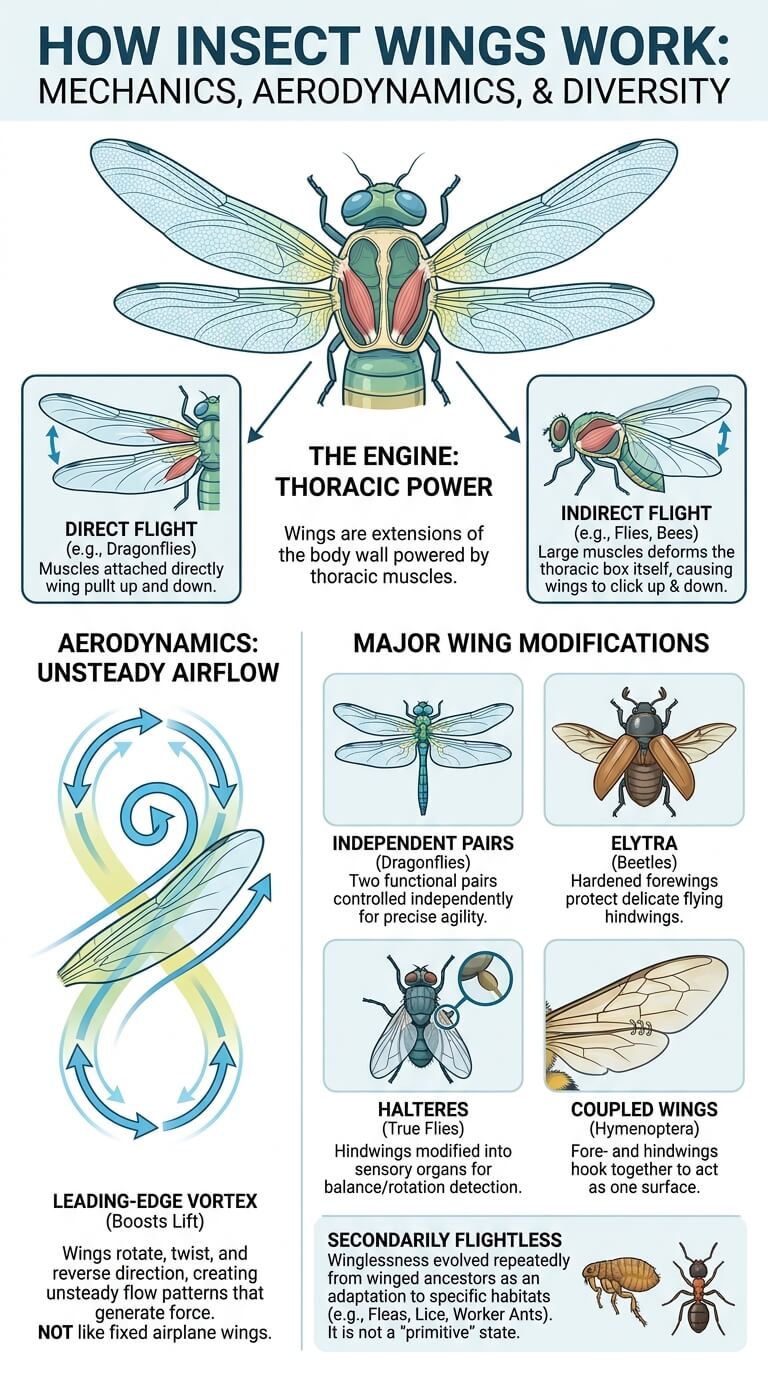
Insect wings work by turning rapid, carefully controlled flapping motions into aerodynamic force. The wings are thin extensions of the insect body wall attached to the thorax, and their motion is powered by specialized flight muscles. Some insects move the wing bases more directly, while many others power flight by deforming the thorax itself. The result is not a tiny copy of bird or airplane flight. Flexible insect wings rotate, twist, reverse direction, and interact with swirling air in ways that are especially important at small body sizes.
Wing design also varies enormously. Dragonflies use two functional wing pairs that can be controlled with considerable independence. Beetles protect their hindwings beneath hardened forewings called elytra. True flies power flight mainly with the forewings while their modified hindwings, called halteres, help sense body rotation. Butterflies and moths have scale-covered wings, and many ants, termites, fleas, lice, and other insects are wingless during some or all of adult life. Understanding how insect wings work therefore means looking at anatomy, muscles, airflow, control, and the evolutionary tradeoffs that make flight useful in some situations and unnecessary in others.
Quick Answer
Why insect wings are not miniature bird wings
Bird wings are modified vertebrate forelimbs containing bones, joints, muscles, and feathers. Insect wings have a completely different evolutionary and anatomical origin. They do not contain a skeleton comparable to a bird’s arm. Instead, an insect wing is a thin cuticular structure supported by veins and articulated at the thorax. Its shape can change under aerodynamic and inertial loads, and that flexibility contributes to flight performance.
Airplanes are another imperfect comparison. A fixed airplane wing typically operates by moving steadily forward through the air, while an insect wing repeatedly accelerates, decelerates, rotates, and reverses direction. A major review in the Journal of Experimental Biology review of insect aerodynamics explains why these rapidly changing motions produce flow patterns that cannot be understood with a simple steady, rigid-wing model.
The thorax as the engine room for insect flight
The thorax is the middle body region of an insect, and it carries both the legs and, when present, the wings. The forewings attach to the second thoracic segment and the hindwings to the third. Large flight muscles occupy much of the thorax in powerful fliers. Their contractions move the wings either through muscles acting on wing-base structures or through changes in the shape of the thoracic box.
Where Insect Wings Attach

Forewings and hindwings on the thorax
A typical winged insect body plan has two potential wing-bearing thoracic segments. The second thoracic segment can carry the forewings, and the third can carry the hindwings. Many familiar insects retain two functional pairs, including dragonflies, grasshoppers, many true bugs, butterflies, moths, bees, and wasps. But “two pairs” does not mean four ordinary flight wings in every species.
Wing pairs can become dramatically modified. In beetles, the forewings form elytra that mainly cover and protect the folded hindwings and abdomen. In true flies, the hindwings are reduced to halteres. In some insects, one or both wing pairs are shortened, lost, or present only in certain castes or reproductive stages. The Smithsonian’s overview of insect flight and wing modifications highlights both the common two-pair arrangement and the important exceptions.
Wing veins, membranes, joints, and flexibility
An insect wing is usually a thin membrane reinforced by a network of veins. Veins provide structural support and can also contain tracheae, nerves, and hemolymph pathways. Their pattern differs among insect groups and is often useful in identification. The spaces between veins remain light and flexible, allowing the wing to bend and twist rather than behaving like a rigid board.
How muscles deform the thorax or move wings more directly
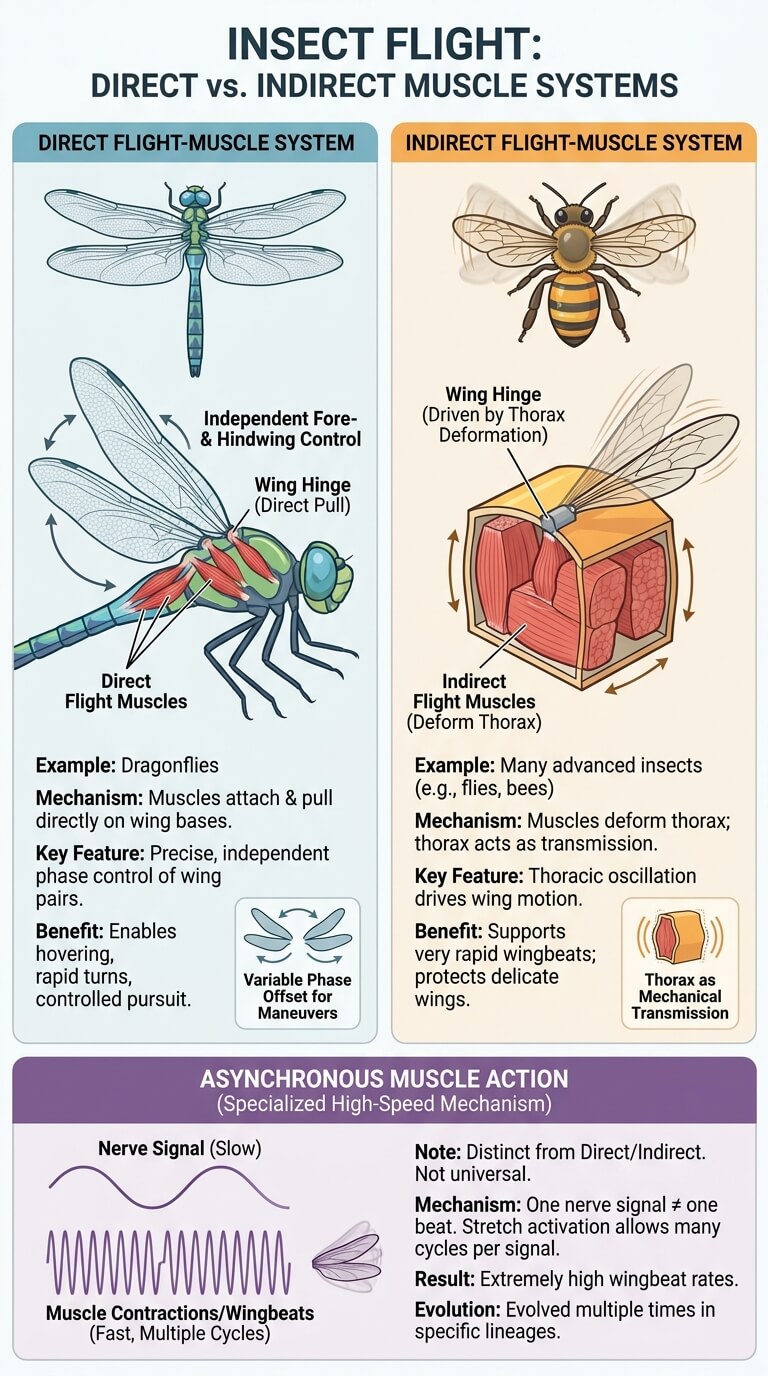
Entomologists often describe insect flight mechanisms as direct or indirect, but these are useful categories rather than a statement that every species fits one simple mechanical diagram. In direct systems, important flight muscles act on structures at or near the wing base and can exert relatively immediate control over wing motion. Dragonflies and damselflies are classic examples in which direct control is especially prominent.
In indirect systems, large muscles attach to the thoracic walls rather than directly to the wing itself. One set shortens the thorax from front to back, causing the roof of the thorax to arch and the wings to move. Another set acts vertically and changes the thorax in the opposite direction. The wing hinges translate those thoracic deformations into wingbeats. Many flies, bees, wasps, and beetles rely heavily on indirect power muscles, although smaller steering muscles can still act at the wing base and fine-tune motion.
How Insects Generate Aerodynamic Force

Flapping motion, angle of attack, and unsteady airflow
To stay airborne, an insect must use its wings to accelerate air and generate forces that support and move the body. During a wingbeat, the wing sweeps through an arc and changes its orientation. The angle between the wing and the oncoming airflow, usually described as angle of attack, influences how much aerodynamic force is produced and in what direction.
Unlike a fixed wing in steady forward motion, an insect wing is constantly changing speed and orientation. It may rotate rapidly near the end of a stroke, interact with air moved during the previous stroke, and experience strong vortices. These unsteady effects help explain how small insects can produce substantial forces even when their wings operate at angles that would cause a conventional rigid wing to stall.
Leading-edge vortices and why they matter in many insects
One of the best-known features of insect flight is the leading-edge vortex, a rotating region of airflow that can form near the front edge of a flapping wing. In many studied insects, this vortex remains attached to the wing for a useful portion of the stroke and helps maintain low pressure above the wing, increasing aerodynamic force.
Leading-edge vortices are not identical in every insect, and their stability depends on wing shape, motion, body size, airflow conditions, and other factors. Researchers have found that different physical mechanisms can help maintain these vortices at different scales. The important lesson is not that insects possess one magical source of lift. Their flight emerges from several interacting aerodynamic effects produced by moving flexible wings.
Why rigid-airplane-wing analogies are incomplete
A rigid-airplane analogy is useful for introducing lift, drag, and angle of attack, but it breaks down quickly. An insect wing can pitch, twist, flex, accelerate, reverse, and interact with its own wake. At the end of one half-stroke, a wing can rotate before moving in the opposite direction. Some insects also bring their wings close together and then fling them apart, a behavior that can alter airflow and increase force under particular conditions.
Direct and Indirect Flight-Muscle Systems
Direct muscle control in groups such as dragonflies
Dragonflies are famous for precise aerial control, and their flight system helps explain why. Their forewings and hindwings can be driven and adjusted with substantial independence, allowing different phase relationships between the two pairs. Depending on the maneuver, the wing pairs can beat more nearly together or with a phase offset. This flexibility can support hovering, acceleration, rapid turns, and controlled pursuit.
Independent control does not mean each wing behaves as though disconnected from the rest of the body. The thorax, nervous system, sensory feedback, and aerodynamic interaction between the two wing pairs all matter. Research on dragonfly flight aerodynamics has shown that wing timing and angle of attack can change with flight mode, producing different patterns of airflow and force.
Indirect muscle systems in many advanced flying insects
In many other insects, the largest flight muscles do not pull directly on each wing during every stroke. Instead, they deform the thorax. The thorax and wing hinge behave like a mechanical transmission, converting changes in body shape into repeated wing motion. This can support very rapid wingbeats because large power muscles can work efficiently without having to attach directly to the delicate wing membrane.
Asynchronous muscle action in selected lineages without overgeneralizing
Direct versus indirect flight and synchronous versus asynchronous muscle are different distinctions. A synchronous flight muscle contracts in a close relationship with motor-nerve activation. In an asynchronous flight muscle, one nerve signal does not correspond to one wingbeat. Instead, stretch activation and the mechanical oscillation of the thorax allow many contraction cycles to occur while calcium remains at an activating level.
Asynchronous flight muscle occurs in several insect groups and can support extremely high wingbeat rates, but it is not a universal feature of flying insects. A scientific review of insect flight-muscle structure and evolution emphasizes both the specialized mechanics of asynchronous muscle and the fact that similar systems evolved in more than one insect lineage. That repeated evolution is a reminder that insects have reached high-performance flight through multiple anatomical pathways.
Major Wing Types and Modifications
Beetle elytra as modified forewings
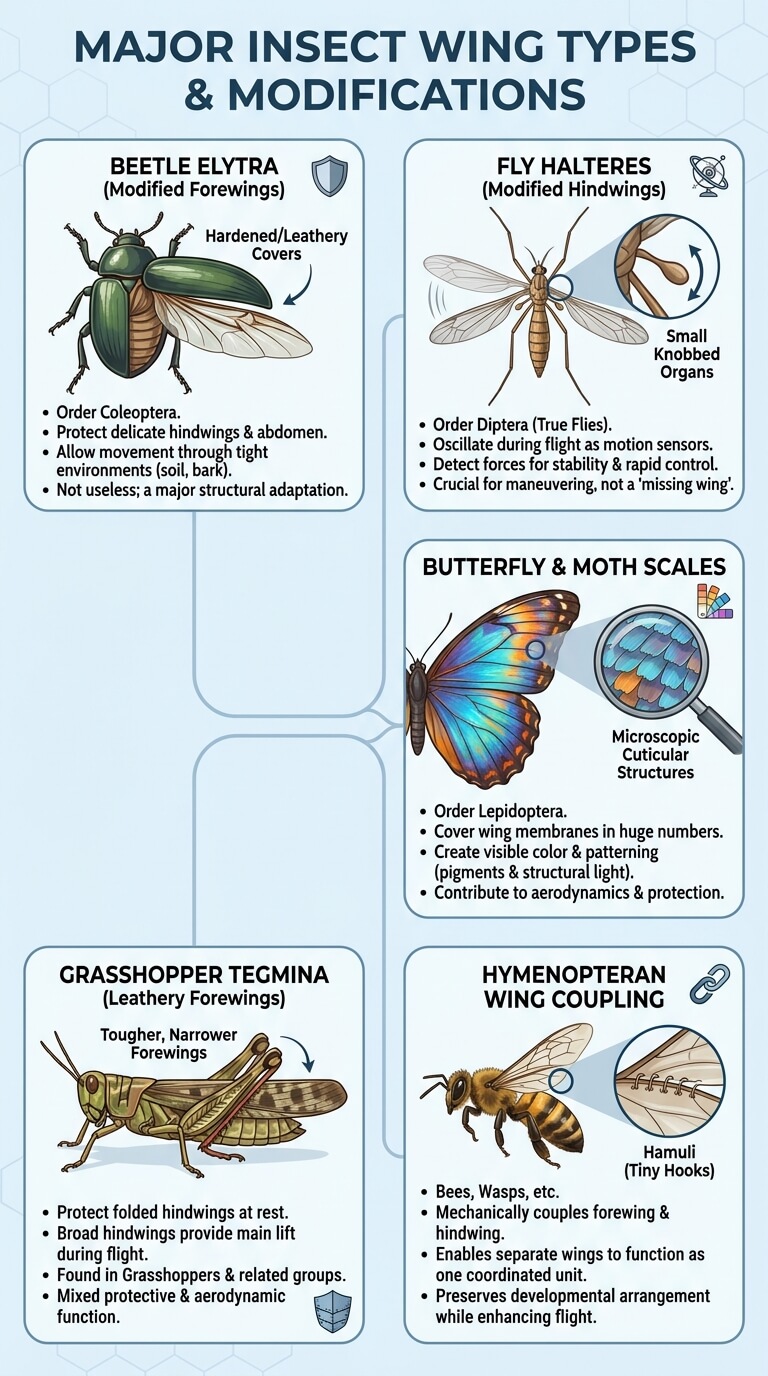
Beetles belong to Coleoptera, a name that reflects one of their defining features: the forewings have been transformed into hardened or leathery covers called elytra. The elytra usually meet over the back and protect the more delicate hindwings and much of the abdomen when the beetle is not flying. Before flight, many beetles raise or reposition the elytra and deploy the folded hindwings.
Elytra should not be dismissed as useless remnants. Their protective role allows beetles to crawl through soil, bark, leaf litter, vegetation, and other tight environments while shielding the flight wings beneath. The Smithsonian’s educational material on beetle elytra treats them as a major structural adaptation, not simply as wings that stopped working.
Fly halteres as modified hindwings
True flies, order Diptera, appear to have only one pair of wings because the forewings provide the main aerodynamic surface. The hindwings are still represented, but they have evolved into small knobbed organs called halteres. Halteres oscillate during flight and act as motion sensors, detecting forces associated with body rotation.
This sensory role is central to rapid flight control. When a fly turns or is disturbed in the air, the halteres experience changes that are detected by sensory structures at their bases. That information helps the nervous system make fast adjustments to wing control. A haltere is therefore not simply a missing wing. It is a highly modified wing-derived organ that contributes to stability and maneuvering.
Butterfly and moth scales
Butterfly and moth wings are covered with huge numbers of microscopic scales. These scales are modified cuticular structures arranged over the wing membrane. They create much of the visible color and patterning associated with Lepidoptera, including colors produced by pigments and, in some species, structural interactions with light.
Grasshopper tegmina and hemipteran forewing modifications
Grasshoppers and many of their relatives have forewings known as tegmina. These are usually tougher and narrower than the hindwings and can protect the folded hindwings when the insect is at rest. The broad hindwings provide much of the aerodynamic area during flight. Similar protective or mixed-function forewings occur in other groups, but the details differ.
Hymenopteran wing coupling
Bees, wasps, and many other hymenopterans have two wing pairs, but the forewing and hindwing on each side can function as a coordinated unit. Tiny hooks called hamuli on the front edge of the hindwing engage a fold or edge on the forewing, mechanically coupling the pair during flight.
Wing coupling lets two separate wings act more like one larger aerodynamic surface while preserving the developmental arrangement of forewings and hindwings. Other insects use different coupling mechanisms. A review of thoracic mechanics and wing coordination notes that insects can either control wing pairs more independently or link them mechanically, depending on lineage.
Different Flight Styles
Hovering and slow flight
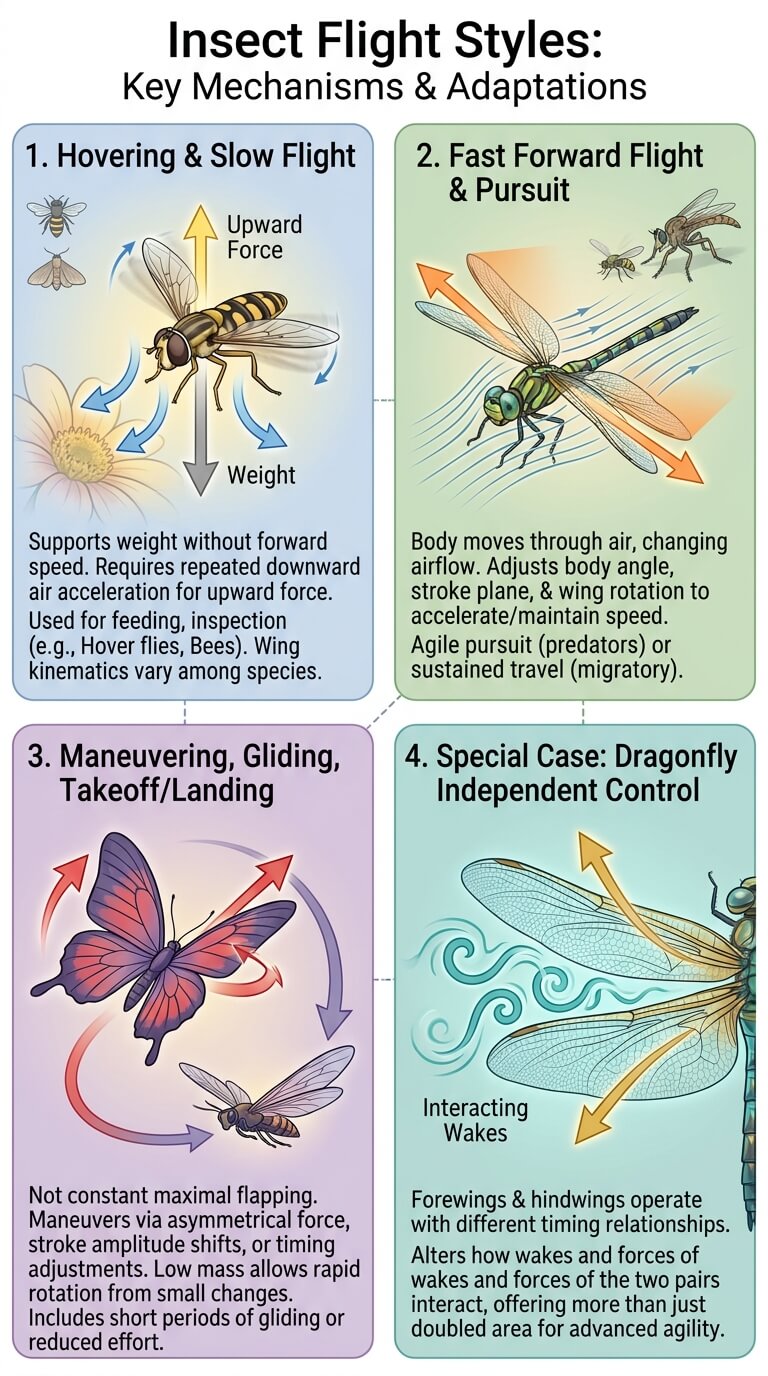
Hovering requires an insect to support its weight without relying on steady forward speed. The wings must repeatedly accelerate air in a way that produces enough upward force over each wingbeat cycle. Hover flies are named for this ability, and many bees, moths, and other insects can also hover or nearly hover during feeding, courtship, or inspection of a landing site.
Hovering does not require every insect to use identical wing paths. Wing stroke angle, rotation, timing, body posture, and vortex behavior vary among species. Some insects can hover efficiently for extended periods, while others hover only briefly. The same insect may also change its wing kinematics when switching from hovering to forward flight.
Fast forward flight and pursuit
Forward flight changes the airflow encountered by the wings because the body now moves through the surrounding air as the wings flap. Insects can adjust body angle, stroke plane, wing rotation, and force direction to accelerate or maintain speed. Predatory dragonflies and robber flies, for example, use agile flight during pursuit, while migratory insects may emphasize sustained movement rather than abrupt chasing maneuvers.
Gliding, maneuvering, takeoff, and landing
Not every moment in insect flight involves constant maximal flapping. Some insects can glide for short periods or reduce wing effort while descending. Maneuvering may involve changing force on one side of the body, altering wing rotation, shifting stroke amplitude, or adjusting the relative timing of the wing pairs. Even very small changes can rotate the insect rapidly because the body has low mass.
Dragonfly independent wing-pair control as a special example
Dragonflies provide one of the clearest demonstrations that having four wings can offer more than simply doubling wing area. Their forewings and hindwings can operate with different timing relationships. Changing that relationship alters how the wakes and forces of the two pairs interact.
Why Some Insects Are Flightless
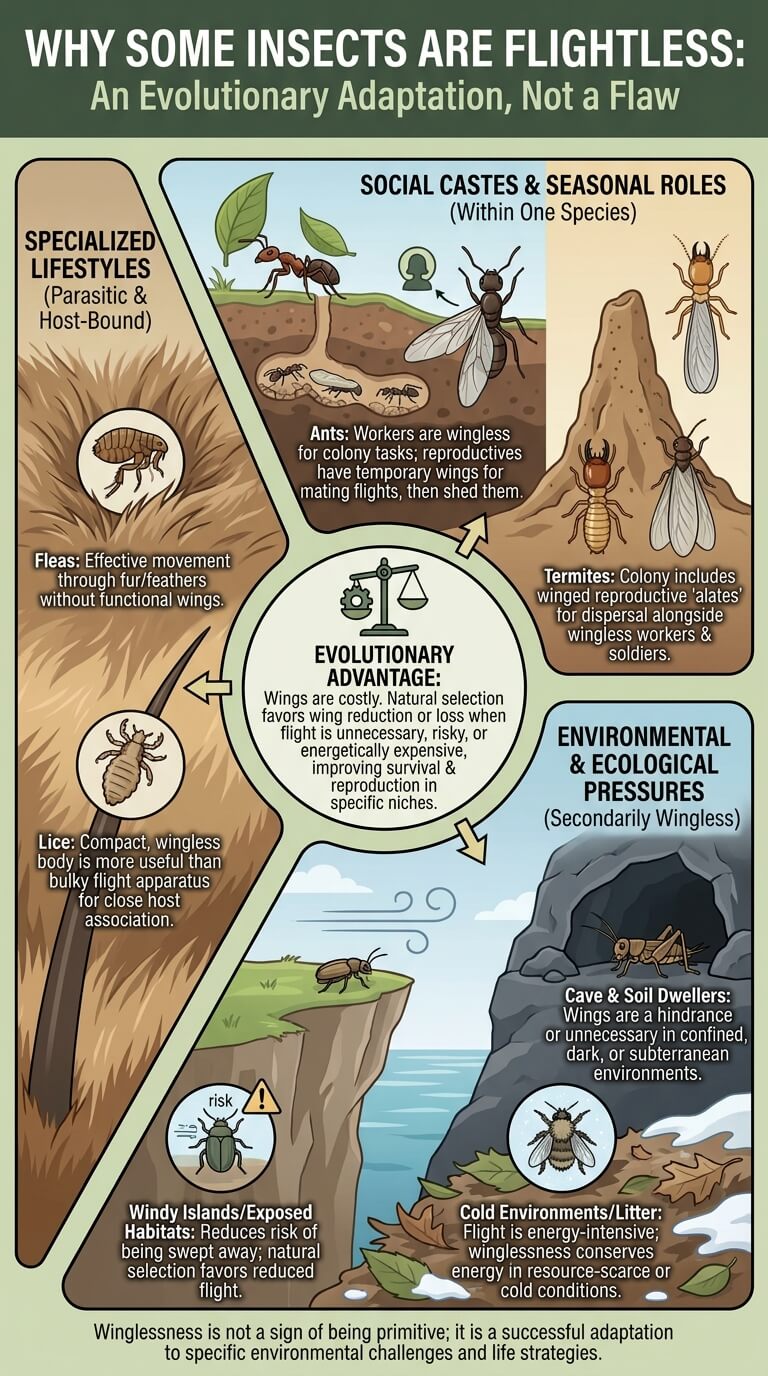
Fleas and lice
Fleas and lice are examples of insect groups in which adult winglessness is tied to specialized lifestyles. Fleas live on animal hosts and move effectively through fur or feathers without functional wings. Lice also live closely associated with hosts, where a flattened or compact wingless body can be more useful than a flight apparatus.
Worker castes and seasonally winged reproductives
Winglessness can also vary within one species. In many ant species, workers are wingless while reproductive females and males develop wings for dispersal and mating flights. After mating, a queen may shed or break off her wings. Termite colonies likewise include winged reproductive forms, often called alates, while workers and soldiers are typically wingless.
Island, cave, parasitic, and other secondarily wingless contexts
Wing reduction or loss has evolved many times in insects. Parasites may lose wings when life on a host makes flight unnecessary. Cave-dwelling insects can experience different pressures from surface species. On windy islands or in exposed habitats, natural selection may sometimes favor reduced flight if flying increases the chance of being swept away, although the pattern is not universal and must be evaluated species by species.
Cold environments, life in soil or leaf litter, and highly specialized reproductive systems can also be associated with reduced wings. Some insects retain small nonfunctional wing remnants, while others lose external wings entirely. In still other species, only one sex is flightless. There is no single ecological explanation that applies to every wingless insect.
Why winglessness is not automatically primitive or inferior
Evolution does not move toward a universal goal of more complex or more mobile bodies. If flight improves survival and reproduction, natural selection can maintain elaborate wings and flight muscles. If flight becomes costly or unnecessary, reduced wings may be favored instead. Both outcomes can be successful in the appropriate environment.
Common Flight Myths
Do all adult insects have two visible pairs of wings?
No. Two wing-bearing thoracic segments are part of the standard winged insect body plan, but adult insects show many modifications. True flies use one visible aerodynamic pair and have halteres instead of ordinary hindwings. Beetles hide functional hindwings beneath elytra. Fleas and lice are wingless. Worker ants are wingless, while reproductive ants may be winged. Some insects have reduced wings, and some species include both winged and wingless forms.
Are elytra nonfunctional shells?
No. Elytra usually do not serve as the main flapping surfaces that produce flight force, but that does not make them nonfunctional. They protect the hindwings and abdomen and can affect body aerodynamics, stability, water balance, defense, or movement through the environment depending on the beetle. During flight, their position also varies among beetle groups.
Can one wingbeat frequency describe all insects?
No. Wingbeat frequency varies widely among species and can also change with temperature, body size, flight mode, and physiological state. Some large insects beat their wings relatively slowly, while many small flies, midges, mosquitoes, and other insects use much faster oscillations. Asynchronous muscle allows certain insects to cycle the wings faster than the nervous system could drive with one motor impulse per wingbeat.
Because the variation is so large, a single “insect wingbeat rate” is not biologically meaningful. Extreme values also require careful measurement and species identification. The useful comparison is how a given insect’s muscle system, wing size, wing stiffness, and body mass work together, not whether one number sounds more impressive than another.
How Wing Design Changes with Anatomy, Behavior, and Habitat
Thoracic anatomy sets the mechanical foundation
Wing performance begins with the thorax. Muscles need attachment points, the cuticle must resist and transmit forces, and the wing hinges must allow controlled motion without failing under repeated stress. A wing can only function as part of this integrated system. Veins, membranes, joints, sensory structures, and the thoracic skeleton all contribute to the final movement.
Behavior determines when flight is worth using
Flight is useful for more than moving from one place to another. Insects may fly to locate mates, search for food, escape predators, patrol territories, migrate, disperse to new habitats, or reach temporary resources. The same species may use very different flight styles in these situations.
Habitats create different pressures on wing form and flightlessness
Open airspace, dense vegetation, flowing water, windy coasts, caves, soil, animal hosts, and social nests impose very different movement problems. Long wings may help some insects travel efficiently in open areas, while compact bodies and reduced wings can be advantageous in confined spaces. Aquatic immature insects may live underwater for months before emerging as winged adults, separating feeding habitat from dispersal and reproductive habitat.
FAQ
How many wings do insects have?
Many winged insects have two pairs, for a total of four wings, attached to the second and third thoracic segments. However, the number of visible functional wings varies. True flies have one main flight pair plus halteres, beetles have elytra over their hindwings, and many insects are partly or completely wingless. The answer therefore depends on whether you mean the basic wing-bearing body plan, visible aerodynamic wings, or modified wing structures.
Why do flies appear to have only two wings?
True flies in Diptera use the forewings as their main aerodynamic wings. The hindwings have evolved into halteres, small club-shaped organs that oscillate during flight and help detect body rotation. That sensory feedback supports rapid stabilization and steering. Flies therefore have one obvious wing pair, but the second ancestral pair is represented by highly modified structures.
Can wingless insects evolve from winged ancestors?
Yes. Wing loss has evolved repeatedly in insects. Fleas, lice, many worker ants, some beetles, cave insects, parasites, and other forms illustrate different routes to reduced or absent wings. The ecological reasons vary, so winglessness should not be explained by one universal rule. In many cases it reflects specialization for life where flight offers less benefit than it costs.
How can insects hover?
Hovering insects keep themselves aloft by flapping their wings so that the average aerodynamic force over the wingbeat cycle balances body weight. Rapid changes in wing speed, orientation, and angle of attack can generate strong unsteady flows, including leading-edge vortices in many species. Different insects use different wing paths and control strategies, so hovering is a general performance outcome rather than one identical mechanism shared by every hovering insect.
Final Thoughts
How insect wings work depends on an integrated system of thoracic muscles, flexible wings, articulated hinges, sensory feedback, and unsteady aerodynamics. Some insects power the wings largely through thoracic deformation, while others use more direct control at the wing base. Their wings can remain as two functional pairs, become coupled, harden into elytra, shrink into halteres, carry scales, or disappear altogether.
The diversity of insect flight makes more sense once wings are viewed as adaptable structures rather than miniature bird or airplane wings. Dragonflies, beetles, flies, bees, butterflies, fleas, ants, and other insects have each modified the same broad flight problem around their own anatomy and way of life. Flight can open access to food, mates, escape routes, and new habitats, but winglessness can be equally successful when the environment rewards a different solution.

Ethan Walker is the founder and research editor of Animal Fact Central. He creates and reviews educational animal facts content using trusted wildlife, pet care, and science-based sources. His work focuses on making animal behavior, adaptations, habitats, and species facts clear, accurate, and engaging for everyday readers.
Read More Details About Ethan Walker: https://animalfactcentral.com/ethan-walker/