
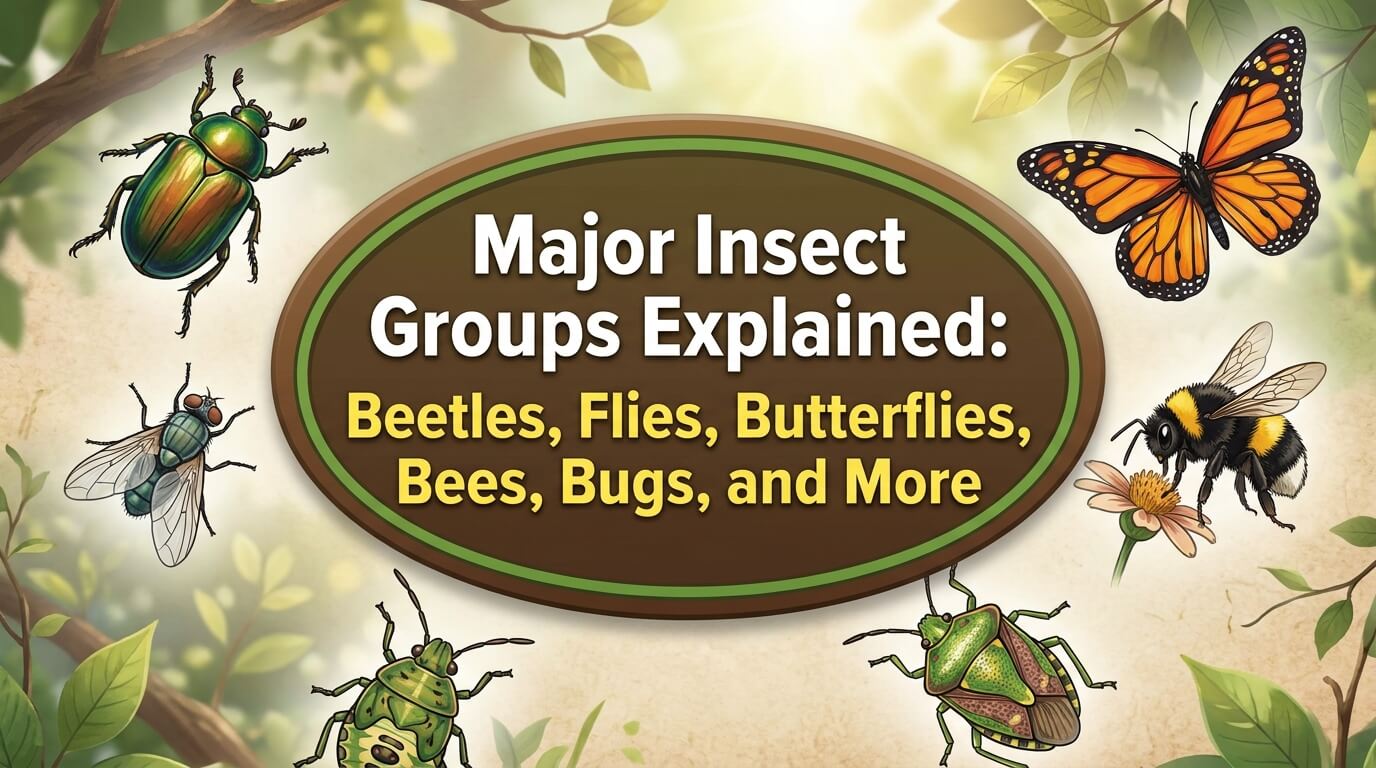
Major insect groups are best understood as orders, large branches of insect classification that contain many related families, genera, and species. Beetles belong to Coleoptera, butterflies and moths to Lepidoptera, true flies and mosquitoes to Diptera, and ants, bees, wasps, and sawflies to Hymenoptera. Other familiar orders include Hemiptera for true bugs and their relatives, Orthoptera for grasshoppers and crickets, Odonata for dragonflies and damselflies, and Blattodea for cockroaches and termites.
This way of organizing insects is more useful than trying to memorize a fixed list of “types.” Common names can be misleading, taxonomic relationships are revised as evidence improves, and some everyday groups sit inside a larger order rather than forming an order of their own. The result is a map of insect diversity that is stable enough for beginners but flexible enough to reflect modern entomology.
Quick Answer

Most of the insects people notice in gardens, homes, forests, fields, ponds, and city streets can be placed into a relatively small set of well-known orders. Those orders are not equal in size or ecological variety, and they are not simply categories invented from appearance. They represent evolutionary groupings recognized through anatomy and, increasingly, molecular evidence.
Why Insect Groups Are Best Understood as Formal Orders Plus Familiar Common Groups
An order is a major taxonomic rank below class and above family. In practical terms, it lets us say that a ladybug and a firefly are both beetles even though they look and behave very differently, or that a mosquito and a housefly are both true flies despite their very different bodies and feeding habits. The order name gives the broader relationship, while family and lower ranks provide finer detail.
The Natural History Museum’s entomology collections are organized around major groups such as Coleoptera, Diptera, Hymenoptera, Lepidoptera, fleas, and a set of smaller orders, illustrating how professional collections use formal taxonomy rather than a short classroom list of insect “types.” the Natural History Museum’s entomology collections also make clear how uneven insect diversity is across orders.
Why There Is No Scientifically Fixed List of Exactly Ten Insect Types
You may see educational pages that present ten or twelve insect groups as if that were the complete system. That can be useful as a teaching shortcut, but it is not a full taxonomic statement. Insects include many living orders, some enormous and familiar, others much smaller or less obvious. The exact arrangement can also change when researchers revise relationships or when names and ranks are updated.
A better approach is to learn the major orders first, then add the smaller ones as needed. That gives readers a usable mental map without pretending that every lineage fits a neat top-ten list.
How Insect Classification Works
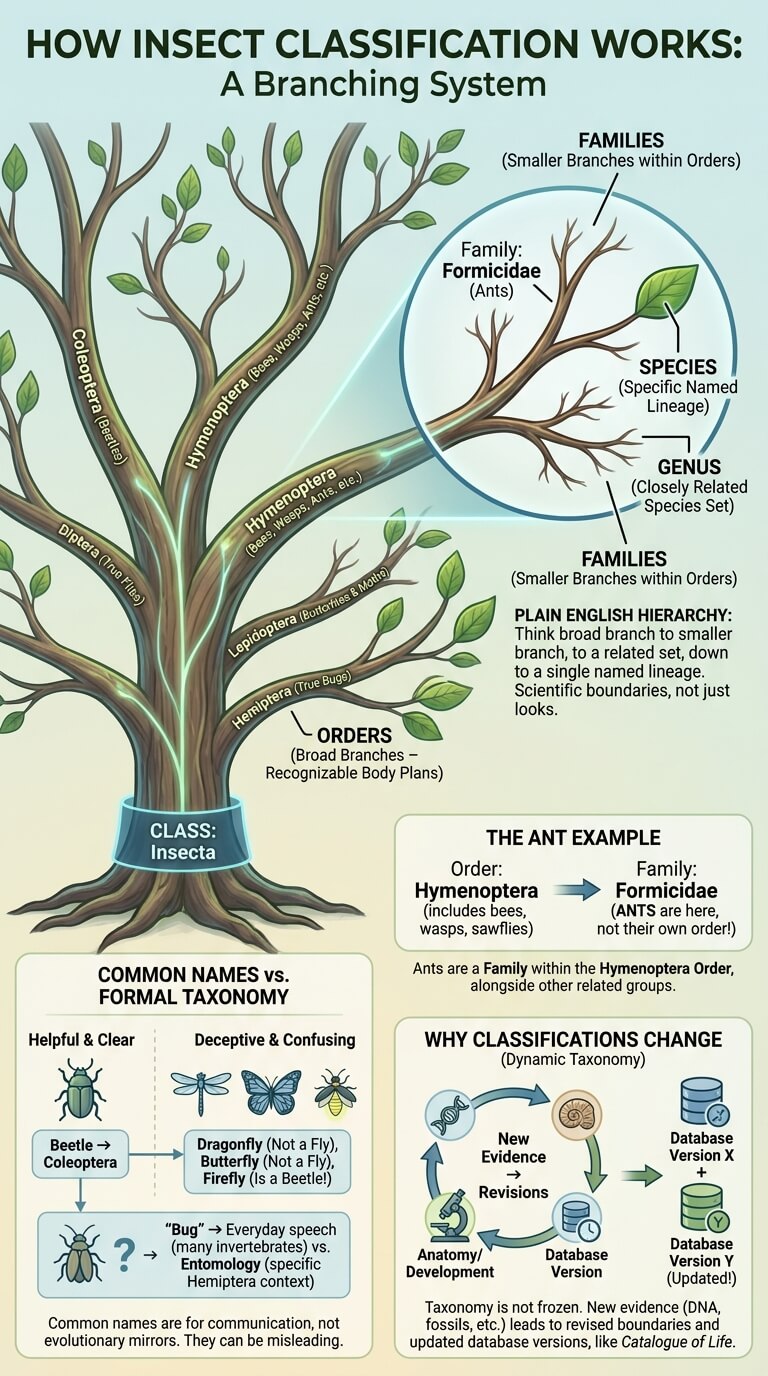
All insects belong to the class Insecta, but the class contains many branches. Orders are among the most useful levels for general readers because they often correspond to recognizable body plans and developmental patterns. Families, genera, and species then narrow the classification further.
Order, Family, Genus, and Species in Plain English
Think of an order as a broad branch, a family as a smaller branch within it, a genus as a set of more closely related species, and a species as a particular named lineage used in biological classification. The boundaries are scientific rather than based on whether an animal seems similar at a glance.
For example, ants do not form their own order. They are the family Formicidae inside Hymenoptera. The ITIS record for Formicidae identifies ants at family rank within Hymenoptera, which also includes bees, wasps, sawflies, and many parasitoid lineages.
Why Common Names Do Not Always Match Formal Taxonomy
Common names are created for communication, not to mirror every branch of evolutionary history. Some are helpful, such as beetle for Coleoptera. Others are deceptive. A dragonfly is not a true fly, a butterfly is not a fly, and a firefly is actually a beetle. “Bug” is even more complicated because everyday speech uses it for many small invertebrates, while entomology uses true bug in a more specific Hemiptera context.
Why Modern Classifications Can Change as Relationships Are Revised
Taxonomy is not a frozen list. Researchers compare anatomy, fossils, development, and DNA to test how groups are related. New evidence can change the boundaries, rank, or placement of taxa. Large databases are therefore updated rather than treated as one-time printed authorities. The Catalogue of Life’s current releases are published in dated versions, a useful reminder that taxonomic information has a version and a context.
Coleoptera: Beetles
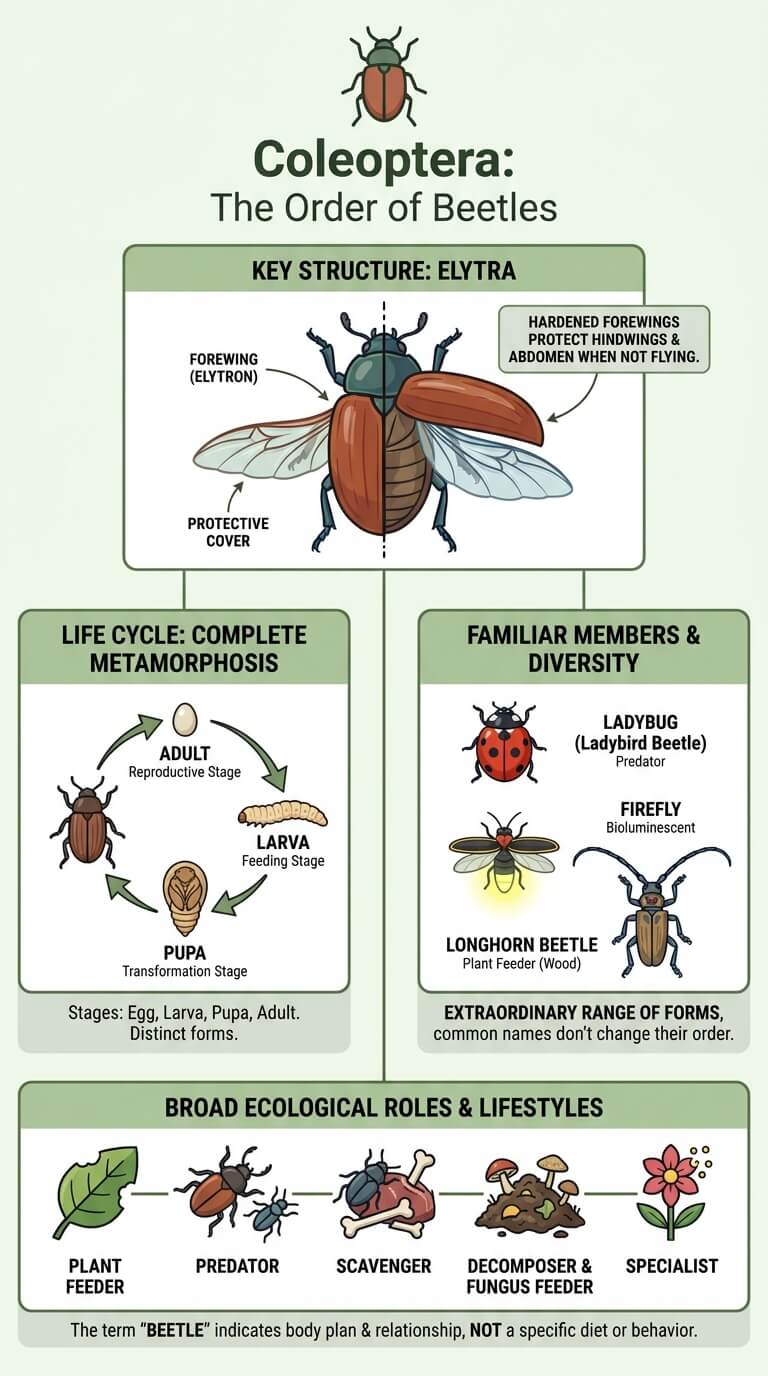
Coleoptera is the beetle order. Beetles occur in an extraordinary range of forms, from tiny species in leaf litter to large tropical longhorn beetles. Ladybugs, also called ladybird beetles, are beetles, and fireflies are beetles too. Their common names do not change their placement in Coleoptera.
Elytra, Familiar Members, Development Pattern, and Broad Diversity
The most familiar structural feature of beetles is the pair of hardened forewings called elytra. These usually cover and protect the hindwings and much of the abdomen when the beetle is not flying. The Natural History Museum’s beetle overview describes the elytra as modified outer wings that protect the flight wings beneath them.
Beetles undergo complete metamorphosis, with larval, pupal, and adult stages. Their ecological roles are far too varied to summarize as one lifestyle. Different beetles can be plant feeders, predators, scavengers, decomposers, fungus feeders, or specialists on particular resources. That variety is one reason the word beetle tells you more about relationship and body plan than about diet or behavior.
Lepidoptera: Butterflies and Moths
Lepidoptera contains both butterflies and moths. They are not separate orders. The distinction between butterfly and moth is useful in everyday natural history, but both belong to the same larger evolutionary group.
Scaled Wings, Larval-Adult Contrast, and Why Butterflies and Moths Share One Order
Adult Lepidoptera are known for wings covered with microscopic scales, though wing form, coloration, activity time, and resting posture vary greatly. The Natural History Museum’s explanation of butterfly and moth wings treats butterflies and moths together as Lepidoptera and highlights their characteristic scaled wings.
Lepidopterans also show a strong contrast between larval and adult life stages. Caterpillars are lepidopteran larvae, not a name for all insect larvae. After a pupal stage, adults emerge with a dramatically different body form. Even so, diet and behavior vary among species, so it is safer to use these features as broad order-level themes rather than rules for every butterfly or moth.
Diptera: True Flies and Mosquitoes
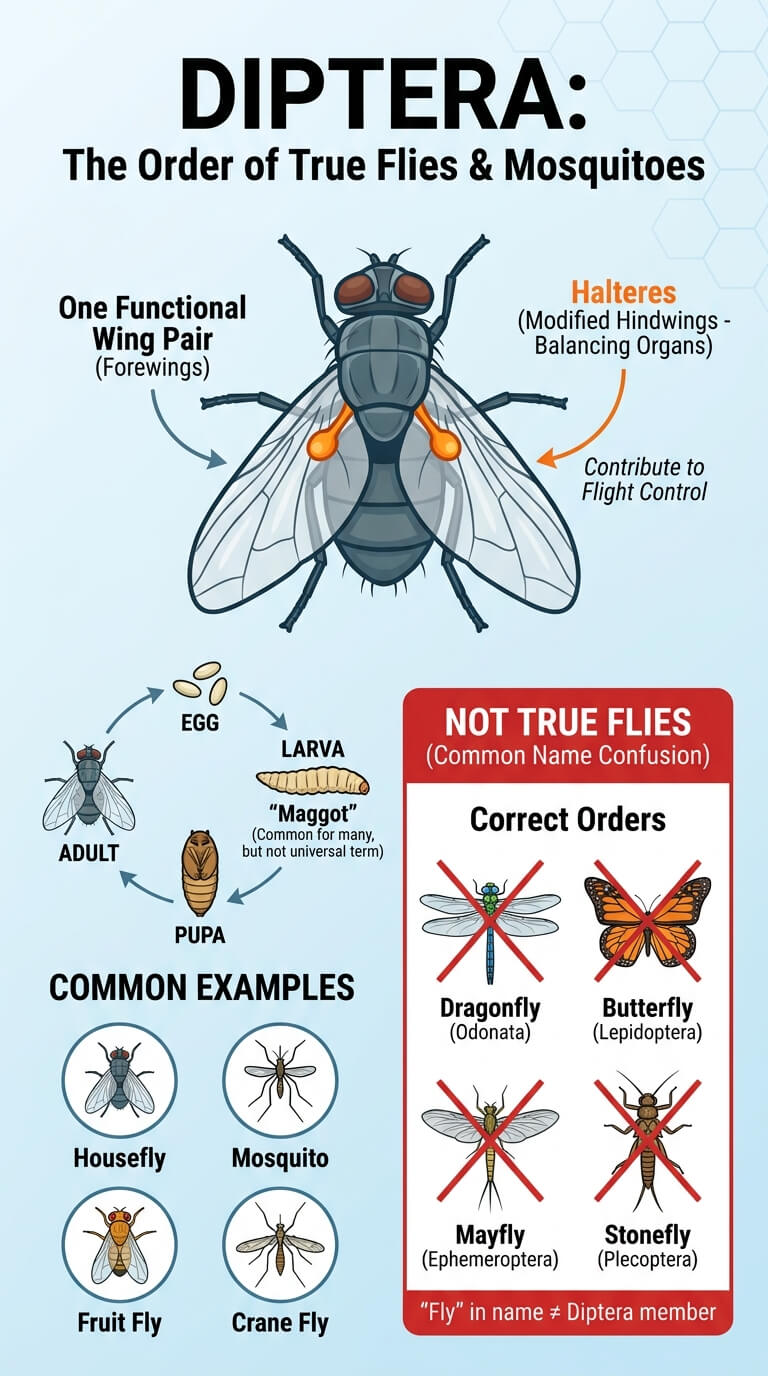
Diptera is the order of true flies. Houseflies, fruit flies, hoverflies, midges, crane flies, and mosquitoes are all dipterans. The name matters because many insects with “fly” in the common name do not belong here.
One Functional Wing Pair Plus Halteres
A classic dipteran feature is a single functional pair of wings. The hindwings are modified into small balancing organs called halteres, which contribute to flight control. The Natural History Museum’s Diptera overview describes true flies as having one pair of wings and a pair of halteres derived from the hindwings.
This does not mean flies have only one pair of wing-derived structures. Their hindwings are still present in a highly modified form. Dipterans undergo complete metamorphosis, and their larvae vary widely in habitat and form. “Maggot” is commonly used for many fly larvae, but it should not be treated as a universal name for insect larvae.
Why Dragonflies, Butterflies, Mayflies, and Stoneflies Are Not True Flies
English common names can hide taxonomy. Dragonflies are Odonata, butterflies are Lepidoptera, mayflies are Ephemeroptera, and stoneflies are Plecoptera. None is a member of Diptera. When a field guide or scientist uses “true fly,” it means a dipteran rather than every insect whose common name ends in fly.
Hymenoptera: Ants, Bees, Wasps, and Sawflies
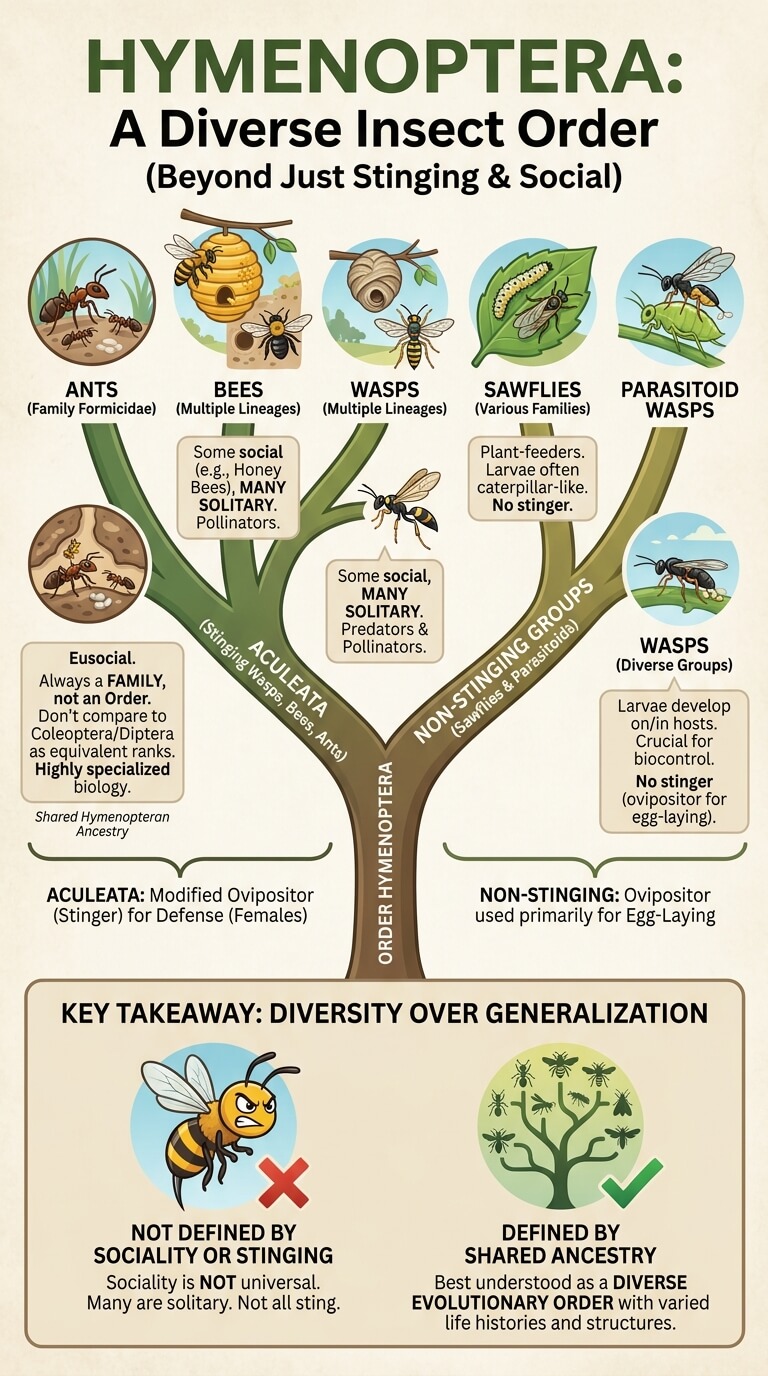
Hymenoptera includes ants, bees, wasps, sawflies, and many less familiar parasitoid groups. It is one of the major insect orders, but its members are too diverse to reduce to stinging or colony living.
Why Ants Are a Family Rather Than an Order
All ants belong to Formicidae, a family within Hymenoptera. This is the same reason “ant” should not be placed beside Coleoptera or Diptera as an equivalent order. Bees and wasps likewise occupy multiple lineages within Hymenoptera rather than each forming a single order of their own.
This matters when comparing insect groups. Ant biology can be highly specialized, but ants still share a deeper hymenopteran ancestry with bees and wasps. The family-level placement is more informative than treating familiar common names as if each represented the same taxonomic rank.
Social and Solitary Diversity
Many people associate Hymenoptera with honey bee colonies, ant colonies, or social wasps, but sociality is not a defining feature of the whole order. Ants are famously eusocial, and some bees and wasps are social, yet many bees and wasps live solitary lives. Sawflies and parasitoid wasps add still more forms of behavior and development.
Likewise, not all hymenopterans sting. The structures used for egg laying and defense vary among lineages and sexes. Hymenoptera is best understood as a diverse evolutionary order, not a category of “stinging insects.”
Hemiptera: True Bugs and Related Hemipterans
Hemiptera includes the insects often called true bugs, along with related groups such as cicadas, leafhoppers, planthoppers, aphids, scale insects, and others under modern broad usage of the order. Many have piercing-sucking mouthparts adapted for taking in plant fluids, prey fluids, or other liquid resources, though the details differ greatly across lineages.
Scientific True-Bug Context Versus Everyday Bug Language
In casual American English, “bug” can mean almost any small crawling insect and sometimes even spiders or other arthropods. Scientific usage is narrower. Hemiptera is the relevant order, while the term true bug is often used more specifically for Heteroptera within that broader hemipteran group.
The Natural History Museum’s small-orders collection places Hemiptera in a formal taxonomic context and separately notes Blattodea, Odonata, Orthoptera, and many other insect orders. This is why a beetle can be a “bug” in everyday conversation but is not a true bug in the scientific sense.
Orthoptera: Grasshoppers, Crickets, and Katydids
Orthoptera includes grasshoppers, crickets, katydids, and close relatives. Many are recognizable by powerful hind legs used for jumping, although not every orthopteran depends on jumping to the same degree.
Jumping Legs, Sound Production, and Incomplete Metamorphosis
Orthopterans commonly have enlarged hind femora associated with jumping, and sound is an important part of communication in many crickets and katydids. Sound production can involve rubbing specialized body parts together, a process called stridulation, but the mechanism differs among groups.
They develop through incomplete metamorphosis. Young nymphs generally resemble the overall body plan of adults more than caterpillars resemble butterflies, but nymphs are not simply tiny finished adults. Wings and reproductive structures develop as they molt through successive stages.
Odonata: Dragonflies and Damselflies
Odonata contains dragonflies and damselflies. Adults are visually oriented aerial predators with two pairs of prominent wings, while the immature stages are aquatic. Their life history makes them a good example of how one insect order can link freshwater and terrestrial environments without belonging to Diptera despite the word “fly” in dragonfly.
Aquatic Nymphs, Predatory Adults, and Two Wing Pairs
Dragonfly and damselfly immatures are commonly called nymphs or naiads. They live in freshwater and are predators. Adults emerge from the final immature stage rather than passing through a pupa, so Odonata is an incomplete-metamorphosis lineage.
Adult dragonflies and damselflies retain two pairs of functional wings. Their wing control differs from that of true flies, which use one wing pair plus halteres. This is a useful reminder that superficially similar flight does not imply close taxonomic relationship.
Blattodea: Cockroaches and Termites
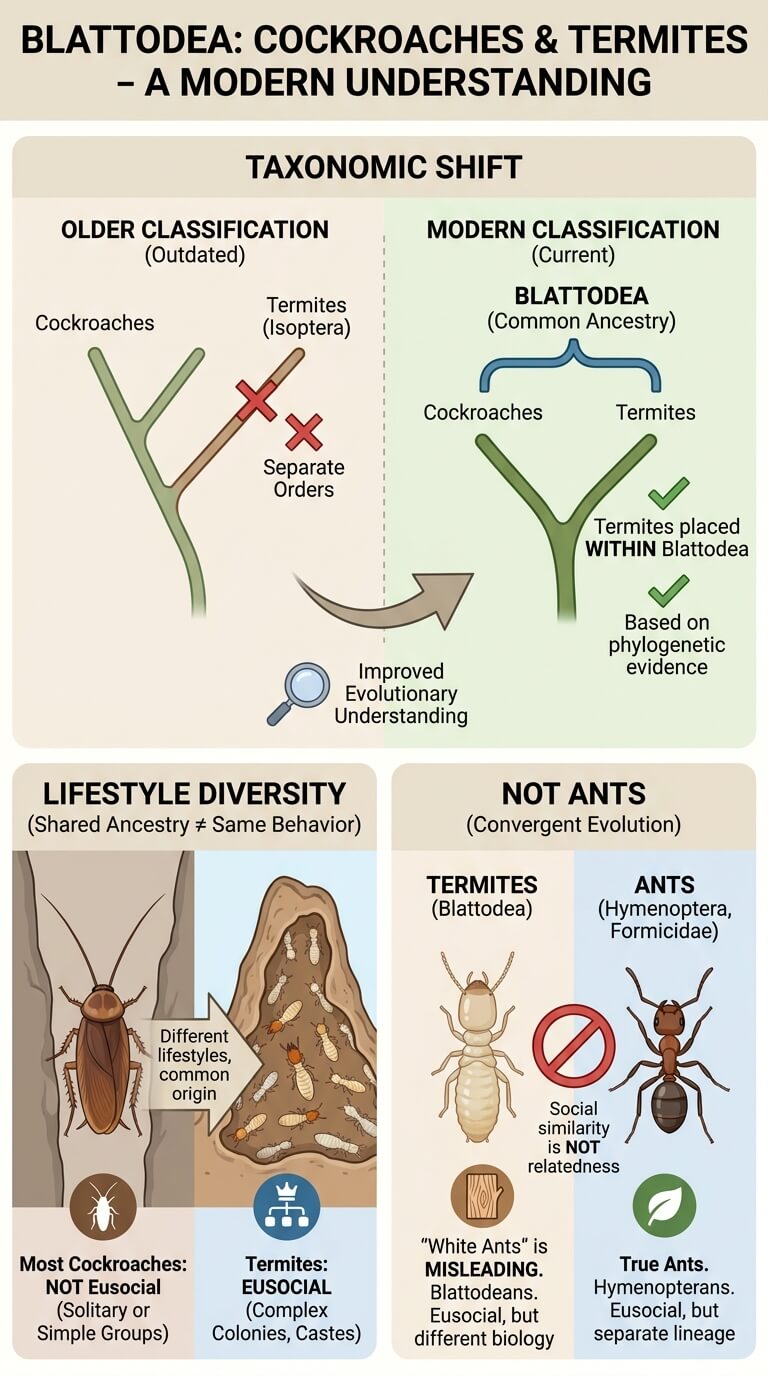
Blattodea is especially important for correcting older classroom classifications. Modern treatments place termites within Blattodea alongside cockroaches rather than as an entirely separate order unrelated to them.
Modern Placement of Termites Within Blattodea
Older references often used Isoptera as a separate termite order. Modern phylogenetic work has changed that picture, and many current classifications include termites within Blattodea. This is one of the clearest examples of why taxonomy can change when evidence about evolutionary relationships improves.
Cockroaches and termites are still very different in lifestyle. Termites are eusocial, while most cockroaches are not. Their placement together reflects ancestry, not an argument that a termite should look or behave like a typical household cockroach.
Why Termites Are Not Ants
Termites and ants can both form large social colonies, which is why termites were historically called “white ants” in some contexts. That name is misleading. Ants are hymenopterans in the family Formicidae, while termites are blattodeans.
The two groups also differ in colony biology, body structure, and evolutionary history. Their social similarities are examples of complex social systems evolving in separate insect lineages, not evidence that termites are a kind of ant.
Mantodea and Phasmatodea
Some insect orders are familiar even though they are much smaller than the most species-rich groups. Mantodea contains mantises, while Phasmatodea contains stick and leaf insects. Both show how distinctive body forms can evolve within separate lineages.
Mantises as Predatory Insects
Mantises are best known for enlarged raptorial forelegs used to seize prey. Their triangular-looking heads and mobile neck region make them visually distinctive, but mantises are not simply “good garden predators” in an ecological sense. They are general predators that can take many kinds of arthropod prey, including insects people may value.
Mantises develop through incomplete metamorphosis. Nymphs resemble the adult body plan but lack fully developed wings and reproductive maturity.
Stick and Leaf Insects as Masters of Body-Form Camouflage
Phasmatodeans include walking sticks and leaf insects whose body shapes can resemble twigs, stems, or leaves. Camouflage is a striking feature, but it is not their only defense. Depending on the species, defensive behavior can also include dropping, swaying, startling displays, chemical secretions, spines, or shedding a limb.
They also develop without a pupal stage. Their nymphs grow through molts and gradually acquire adult features.
Other Living Insect Orders Worth Knowing
The major orders above cover many familiar insects, but they are not the whole of Insecta. A complete taxonomic treatment includes a number of additional living orders, each with its own evolutionary history and body-plan details.
Mayflies, Stoneflies, Caddisflies, Lacewings, Earwigs, Fleas, Silverfish, Bristletails, Barklice, Thrips, Scorpionflies, and More
Ephemeroptera contains mayflies, whose aquatic nymphs and short-lived winged adults are familiar near freshwater. Plecoptera contains stoneflies, another lineage with aquatic immatures. Trichoptera contains caddisflies, whose larvae are often aquatic and may build cases or nets from silk and environmental material.
Neuroptera includes lacewings, antlions, and relatives. Dermaptera contains earwigs. Siphonaptera contains fleas, wingless insects specialized for ectoparasitic life. Zygentoma includes silverfish, while Archaeognatha includes jumping bristletails. These primitively wingless groups should not be confused with springtails, which are hexapods but generally placed outside Insecta in modern classifications.
Psocodea includes barklice, booklice, and lice in many current classifications. Thysanoptera contains thrips. Mecoptera contains scorpionflies and relatives. Other smaller orders include lineages such as webspinners, zorapterans, and twisted-wing parasites. The point is not to memorize every name at once, but to recognize that insect diversity extends well beyond the most familiar garden and household groups.
Common Classification Mistakes
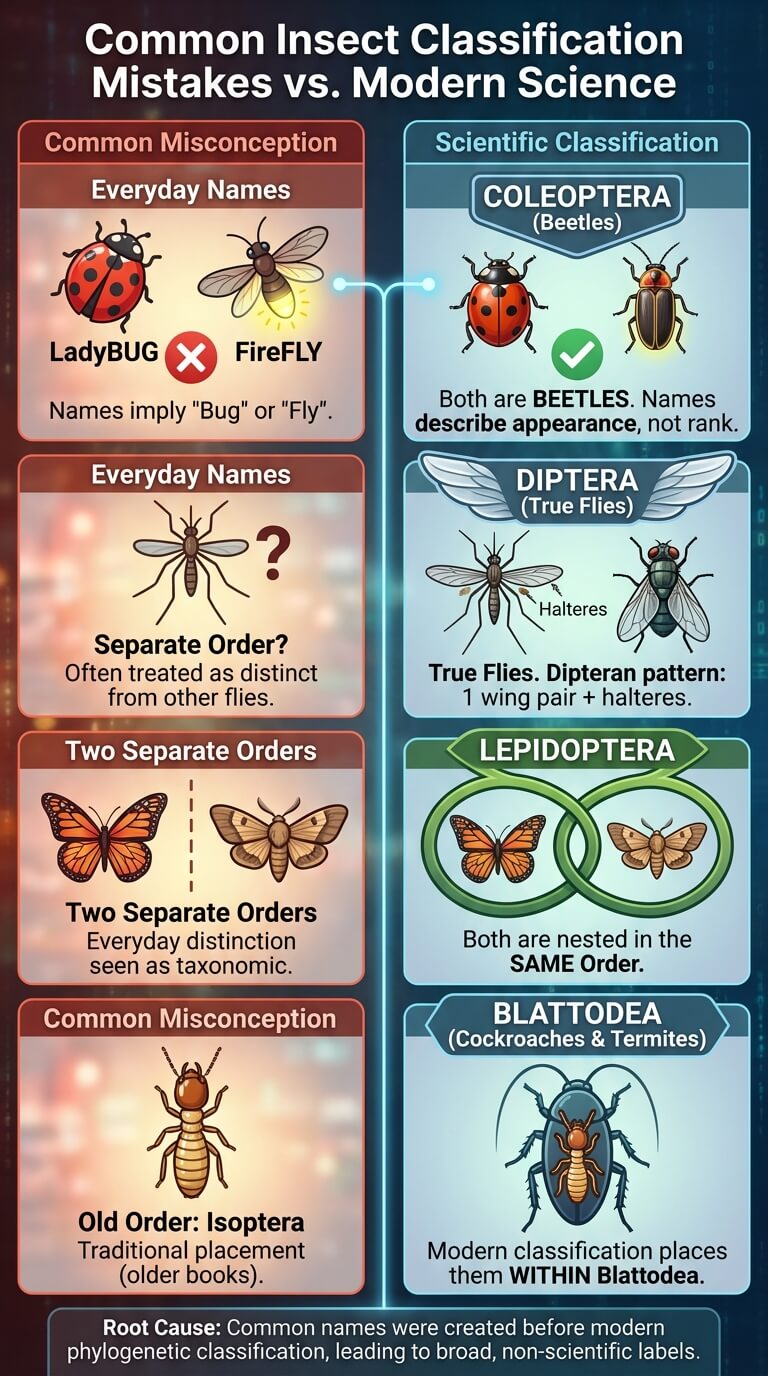
Many insect naming errors happen because common names were created long before modern phylogenetic classification, or because everyday language uses broad labels such as fly and bug in ways that science does not.
Ladybugs and Fireflies Are Beetles
Ladybugs, more formally called lady beetles or ladybird beetles, belong to Coleoptera. Fireflies are also beetles, not true flies. Their names describe familiar appearance or behavior rather than taxonomic rank.
Mosquitoes Are Flies
Mosquitoes belong to Diptera. Their adults have the dipteran pattern of one functional wing pair and modified hindwings called halteres. Treating mosquitoes as a separate order obscures their relationship to other true flies.
Butterflies and Moths Are Both Lepidoptera
Butterflies are nested within the same order as moths. The everyday distinction remains useful for identification and natural history, but it should not be translated into two separate insect orders.
Termites Are Within Blattodea in Modern Classifications
Termites were traditionally placed in Isoptera as their own order, which is why older books may still show that arrangement. Current classifications commonly place termites within Blattodea. When reading older sources, the taxonomic date and system matter.
Patterns That Help You Compare Insect Orders
Once the major orders are familiar, a few broad patterns make the diversity easier to understand. Body plan, wing structure, development, mouthparts, and life stage differences can all help explain why insects that share six legs and three main body regions can still look so different.
Shared Insect Body-Plan Traits Across Orders
Beetles, butterflies, flies, ants, true bugs, grasshoppers, and dragonflies all belong to Insecta, so adults generally share the basic insect organization of head, thorax, abdomen, three pairs of thoracic legs, one pair of antennae, and an exoskeleton. Orders differ in how these structures are modified, not in whether they stop being insects.
Life-Cycle and Wing Differences as Order-Level Patterns
Some major orders, including Coleoptera, Lepidoptera, Diptera, and Hymenoptera, undergo complete metamorphosis with larval and pupal stages. Others, including Orthoptera, Odonata, Mantodea, and Blattodea, develop through nymphal stages without a pupa. Wing structure also provides clues: beetles have elytra, flies have halteres, and butterflies and moths have scaled wings.
These patterns are helpful, but they should not be turned into rigid shortcuts. Winglessness can evolve within winged lineages, some castes or sexes may lack wings, and development can include important exceptions. Order identification usually combines several features rather than relying on a single visible trait.
Why Group-Specific Biology Still Needs Its Own Detail
An order tells you where an insect sits on the evolutionary map, but it does not tell you everything about how that insect lives. Ant colony organization, mosquito feeding, beetle defense, butterfly migration, and dragonfly hunting each involve specialized biology within their larger orders. Understanding the order provides context without replacing that finer level of natural history.
FAQ
What Is the Largest Insect Order?
Coleoptera has traditionally been described as the largest insect order by number of described species, but precise rankings can depend on the taxonomic dataset and how quickly new species are described or reclassified. Some modern analyses emphasize that Hymenoptera or Diptera may rival or exceed beetles in total species richness when undescribed diversity is considered. For a general guide, it is safest to describe Coleoptera as one of the most species-rich insect orders rather than attach a timeless percentage to it.
Are Ants, Bees, and Wasps Separate Orders?
No. Ants, bees, and wasps are all part of Hymenoptera. Ants specifically form the family Formicidae. Bees and wasps occupy multiple hymenopteran lineages, so the three familiar names should not be treated as three equivalent formal orders.
Are Termites a Separate Order From Cockroaches?
Older classifications often placed termites in the order Isoptera. Modern classifications commonly place termites within Blattodea, the same order that contains cockroaches. This does not mean termites and ordinary cockroaches have identical lifestyles. It reflects evidence that termites evolved within the broader cockroach lineage.
Is a Mosquito a Fly?
Yes. Mosquitoes are true flies in the order Diptera. Adult mosquitoes have one functional pair of wings and a pair of modified hindwings called halteres, a key dipteran feature. The common name mosquito hides that relationship, but its taxonomic placement is firmly within the true flies.
Final Thoughts
The major insect groups make more sense when familiar names are anchored to formal orders. Beetles are Coleoptera, butterflies and moths are Lepidoptera, true flies and mosquitoes are Diptera, ants and their relatives sit within Hymenoptera, true bugs belong to Hemiptera, and termites are part of Blattodea in modern classification. Smaller orders add even more diversity, which is why no short list can represent every living insect lineage. Learning the order-level map gives you a reliable way to understand insect relationships without confusing common names for scientific categories.

Ethan Walker is the founder and research editor of Animal Fact Central. He creates and reviews educational animal facts content using trusted wildlife, pet care, and science-based sources. His work focuses on making animal behavior, adaptations, habitats, and species facts clear, accurate, and engaging for everyday readers.
Read More Details About Ethan Walker: https://animalfactcentral.com/ethan-walker/