
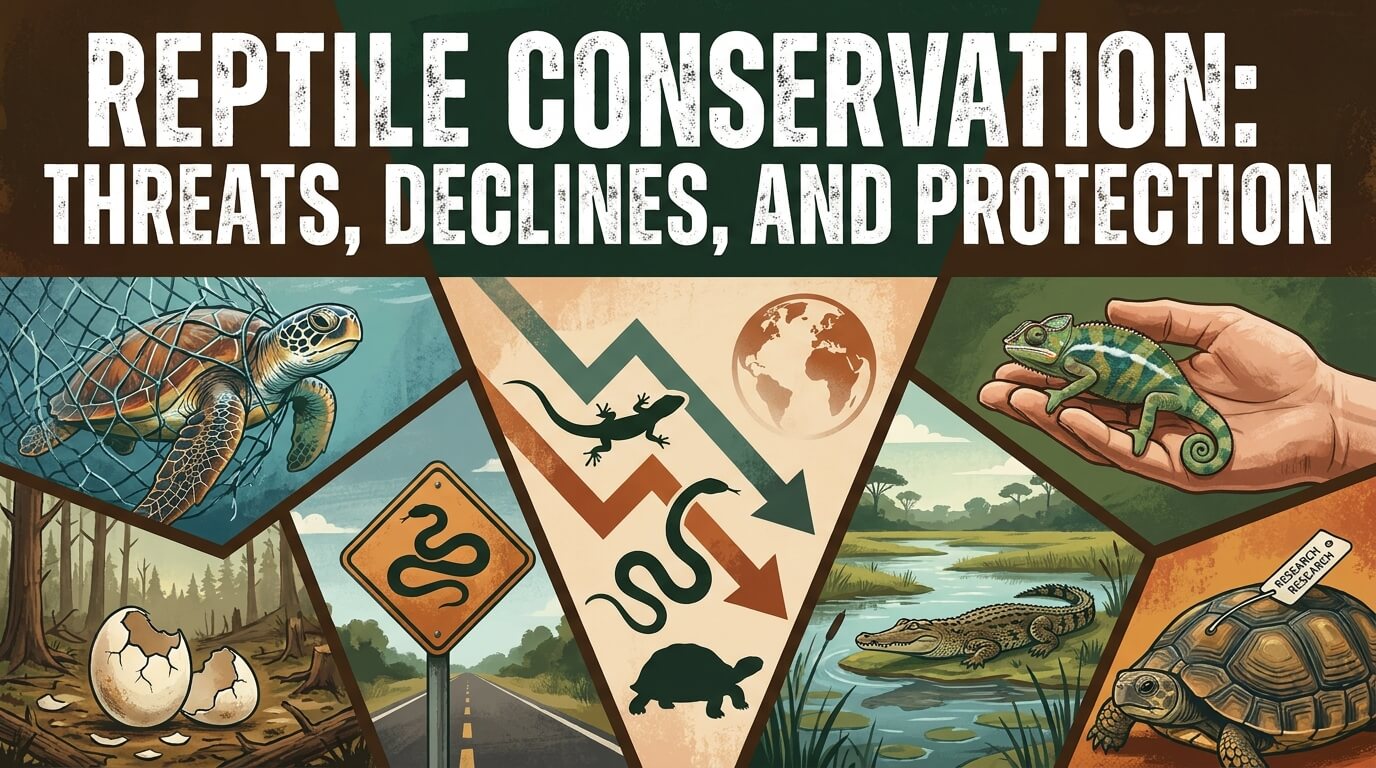
Reptile conservation is not about saving one uniform group from one uniform problem. Living non-avian reptiles include snakes, lizards, amphisbaenians, turtles, tortoises, crocodilians, and tuatara, and their conservation needs differ just as much as their bodies and habitats do. A sea turtle threatened by fisheries bycatch faces a very different set of pressures from an island lizard exposed to introduced predators or a freshwater turtle trying to cross a road between wetlands.
A widely cited global assessment published in 2022 found that at least 21 percent of assessed reptile species were threatened with extinction, but that figure should not be read as a single status for all reptiles. The IUCN global reptile assessment also emphasized that habitat loss, agriculture, deforestation, urban development, invasive species, and unsustainable use affect species in different combinations. Conservation therefore works best when it starts with the biology, range, life history, and actual threats of a particular species or population.
Quick Overview: Reptile Conservation Is Species-Specific
Why reptiles do not have one conservation status
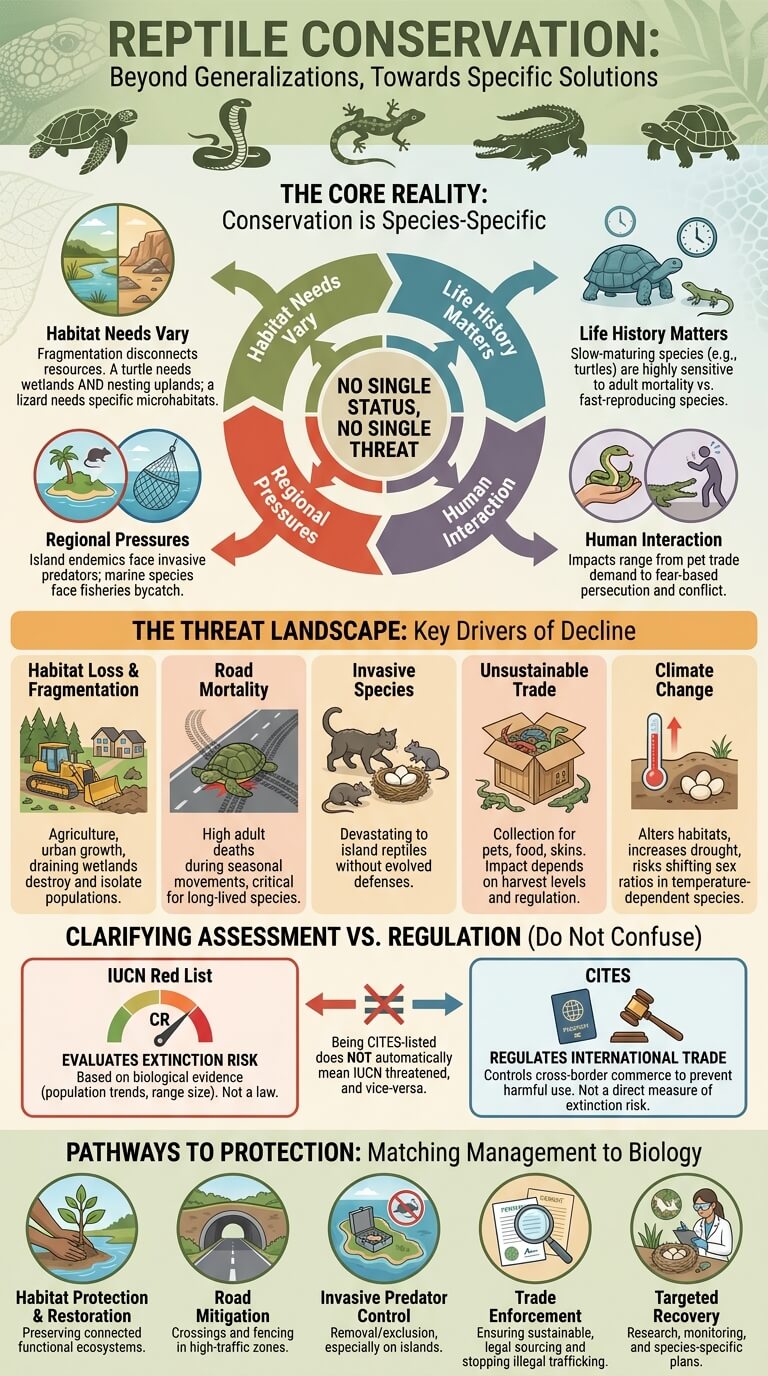
“Reptiles” describes a huge evolutionary and ecological range, not a single conservation category. Some species remain widespread and locally common. Others are restricted to one island, one river system, one mountain range, or a small set of nesting beaches. Some are declining because habitat is disappearing. Others are affected more strongly by collection, invasive predators, fisheries interactions, road mortality, persecution, disease, or climate-related changes.
Even closely related species can have very different risk profiles. A turtle that matures slowly and repeatedly crosses roads to nest may respond poorly to adult mortality. A small lizard with a tiny island range may be extremely sensitive to introduced predators. A crocodilian living in protected wetlands may face different pressures from another crocodilian whose habitat overlaps heavily with fishing communities or livestock areas.
How threat exposure differs across lineages and regions
Conservation problems are shaped by both lineage and place. Turtles and tortoises often attract attention because many species combine long life spans with delayed maturity, low juvenile survival, and exposure to habitat loss, roads, collection, or trade. Island reptiles may be especially vulnerable to invasive mammals. Marine turtles face ocean and nesting-beach threats. Some snakes are deliberately killed because of fear, while some lizards are collected for the pet trade. Crocodilian conservation ranges from major recovery success stories to continuing conflict and habitat pressures. Threats differ among the major living reptile groups , so conservation priorities should not be generalized from one lineage to all reptiles.
This is why a useful conservation question is not “What is the biggest threat to reptiles?” but “What is the biggest threat to this species, in this place, at this life stage?”
How Reptile Conservation Status Is Assessed
IUCN Red List and extinction-risk categories
The IUCN Red List evaluates extinction risk using standardized criteria based on evidence such as population trends, geographic range, population size, and other indicators. Species categorized as Vulnerable, Endangered, or Critically Endangered are collectively described as threatened. The IUCN Red List categories and assessment framework are designed to describe extinction risk, not to function as a law by themselves.
CITES and international wildlife trade regulation
CITES, the Convention on International Trade in Endangered Species of Wild Fauna and Flora, serves a different purpose. It regulates international trade in listed wildlife and plants. Appendix I generally includes species threatened with extinction for which international commercial trade is tightly restricted, while Appendix II includes species that are not necessarily threatened with extinction but whose trade must be controlled to avoid harmful use. The CITES definitions of its Appendices make clear that listing is about trade controls, not a direct copy of IUCN categories.
A reptile can therefore be CITES-listed without being in an IUCN threatened category, and an IUCN-threatened reptile may face problems that have little to do with international trade. Confusing the two systems can make conservation claims sound more dramatic than the evidence supports.
National, state, and local legal protection as separate frameworks
Legal protection also varies by country and jurisdiction. In the United States, the Endangered Species Act creates federal protections for species listed as endangered or threatened and provides a framework for recovery and habitat conservation. The U.S. Fish and Wildlife Service overview of the Endangered Species Act explains that legal listing, recovery planning, and restrictions are separate from IUCN assessment or CITES trade regulation.
Habitat Loss and Fragmentation
Deforestation, agriculture, urban growth, and infrastructure
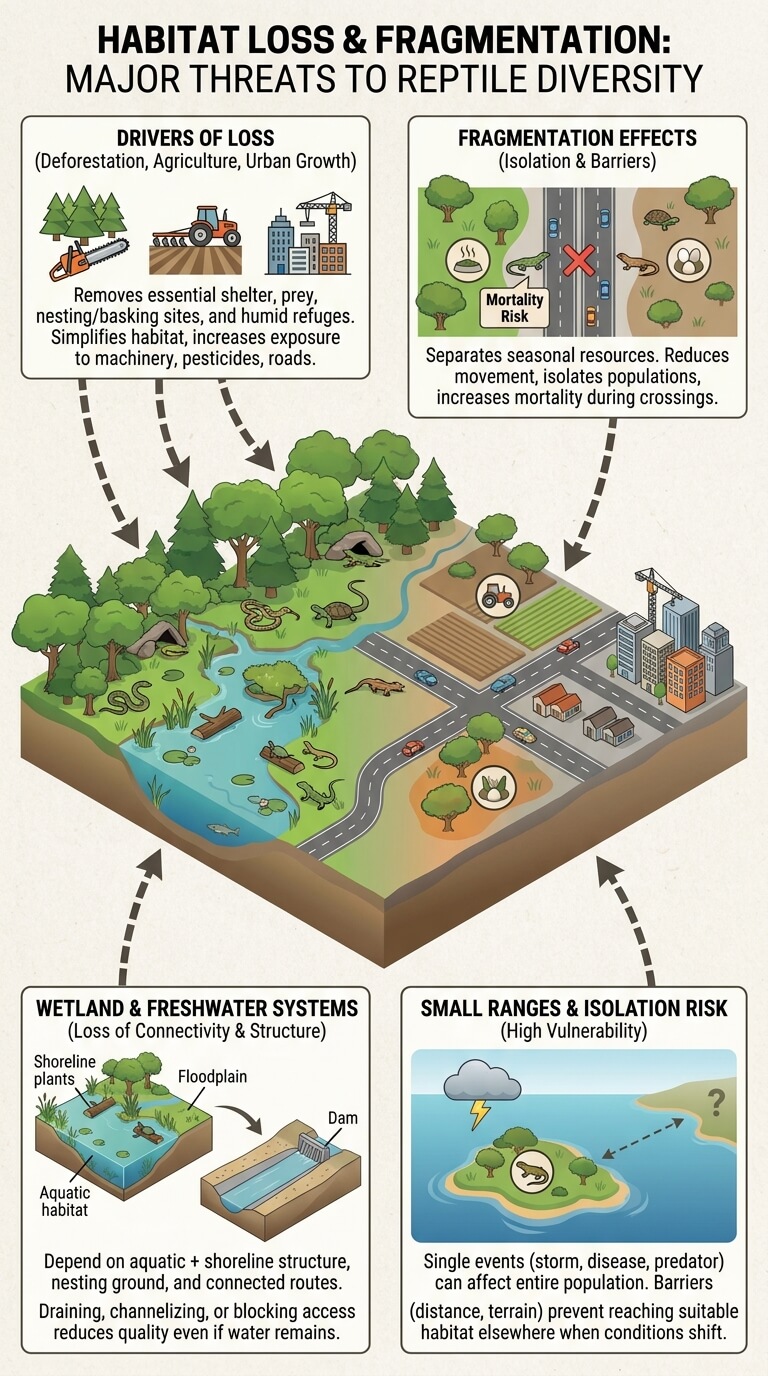
Habitat loss is one of the broadest threats across reptile diversity. Forest clearing can remove shelter, prey, nesting sites, basking sites, and humid refuges used by forest reptiles. Agricultural conversion can simplify habitat and increase exposure to machinery, pesticides, roads, and deliberate killing. Urban growth can replace continuous habitat with smaller patches separated by buildings and traffic.
Fragmentation matters even when some habitat remains. A reptile population may still have feeding areas and nesting sites, but roads or development can separate them. That can reduce movement, isolate populations, and increase mortality when animals attempt to cross between seasonal resources.
Wetland loss and altered freshwater systems
Freshwater reptiles depend on more than open water. Many turtles, crocodilians, and water-associated snakes need a combination of aquatic habitat, shoreline structure, basking areas, nesting ground, seasonal floodplain habitat, and connected movement routes. Draining wetlands, channelizing rivers, changing water levels, removing shoreline vegetation, or blocking access to nesting sites can reduce habitat quality even when water remains present.
Small ranges and isolated populations
Species with naturally small ranges can face high risk because a single wildfire, storm, invasive predator, development project, or disease outbreak may affect a large part of the remaining population. Island reptiles are an obvious example, but narrow-range mountain, desert, cave, or river specialists can face similar problems.
Small populations can also have fewer options when conditions shift. Even if suitable habitat exists elsewhere, a species may not be able to reach it because of distance, roads, unsuitable terrain, or other barriers.
Road Mortality and Barriers to Movement
Turtles crossing roads
Roads can be especially dangerous for turtles because adults may make overland movements between wetlands or travel to nesting areas. Slow movement across pavement increases exposure time, and repeated loss of breeding adults can matter greatly for long-lived species. A U.S. Fish and Wildlife Service project monitoring Western painted turtle road mortality describes turtles entering roadways during seasonal movements for mating and nesting.
Fragmented habitats and seasonal movement
Road impacts are not limited to direct collisions. A road can also discourage movement, split breeding habitat from feeding habitat, or isolate populations that once exchanged individuals. Snakes, lizards, and other reptiles can also be killed on roads, especially where pavement lies between important habitat patches.
Mitigation tools such as crossings and fencing where supported
Wildlife passages, exclusion fencing, culvert modifications, seasonal barriers, warning systems, and road-design changes can reduce mortality in some situations. Their success depends on placement, maintenance, species behavior, and whether animals actually use the structures.
Collection, Wildlife Trade, and Exploitation

Pet trade, food trade, skin trade, and illegal collection
Reptiles enter legal and illegal trade for many reasons, including pets, food, skins, traditional uses, and collections. The conservation impact depends on harvest level, source population, reproductive biology, enforcement, and whether animals are wild-caught or produced under regulated systems.
It is inaccurate to treat all reptile trade as automatically illegal or all trade as harmless. Unsustainable removal can reduce wild populations, while poorly documented supply chains can make it difficult to determine origin. Species with small ranges, slow reproduction, high market value, or strong collector demand may be particularly vulnerable.
Why legal trade, illegal trade, CITES listing, and IUCN status are not the same thing
Legal trade can occur under permits and regulations. Illegal trade violates applicable rules. CITES regulates international trade in listed species. IUCN evaluates extinction risk. National laws may regulate possession, collection, sale, or transport separately.
Persecution and Human-Wildlife Conflict
Snakes killed from fear or misidentification
Some snakes are intentionally killed because people fear venom or misidentify harmless species as dangerous. This can affect local populations and reinforces the false idea that conservation value depends on whether an animal is useful or likable.
Safe coexistence does not require close handling or risky identification. People should keep distance from unknown wild snakes and follow local wildlife guidance when removal is genuinely necessary. Killing an animal simply because its identity is uncertain is neither a reliable safety strategy nor sound conservation practice.
Crocodilian conflict contexts
Crocodilians can create serious safety concerns where people share shorelines, fishing areas, livestock access points, or waterways with large animals. Conservation in these settings must protect people while also avoiding broad persecution of crocodilian populations.
Management can include public education, enforcement against feeding, habitat planning, monitoring, barriers in selected locations, and professional response to problem animals. The details must match local species, laws, and conflict patterns.
Why conservation cannot rely on sensational danger framing
Fear-based descriptions can encourage unnecessary killing and distract from the real causes of population decline. Reptiles are not biologically “vicious,” and dangerous behavior is usually better understood through feeding, defense, territoriality, nesting, or human disturbance.
Invasive Species and Island Reptiles
Introduced predators
Island reptiles may have evolved without mammalian predators such as rats, cats, or mongooses. When these animals are introduced, they can prey on eggs, juveniles, or adults, compete for food, and alter the broader ecosystem.
Introduced predators can be especially damaging when native reptiles reproduce slowly or occupy only a few islands. In those cases, predator removal or exclusion may be one of the most direct conservation tools available.
Small island ranges and endemic reptiles
An endemic species occurs naturally in a limited area. For an island reptile, that may mean the entire global population is exposed to a small number of local threats. Habitat loss, storms, invasive species, disease, or collection can therefore have global consequences for the species.
Tuatara as a localized conservation example
Tuatara show why conservation must be geographically specific. New Zealand’s Department of Conservation identifies introduced rats as an important threat because they prey on eggs and young and can affect the invertebrate communities tuatara depend on. Many naturally wild tuatara populations now persist on offshore islands where introduced mammalian predators are absent or controlled.
Pollution, Marine Debris, and Fisheries Bycatch
Sea turtles and fishing interactions
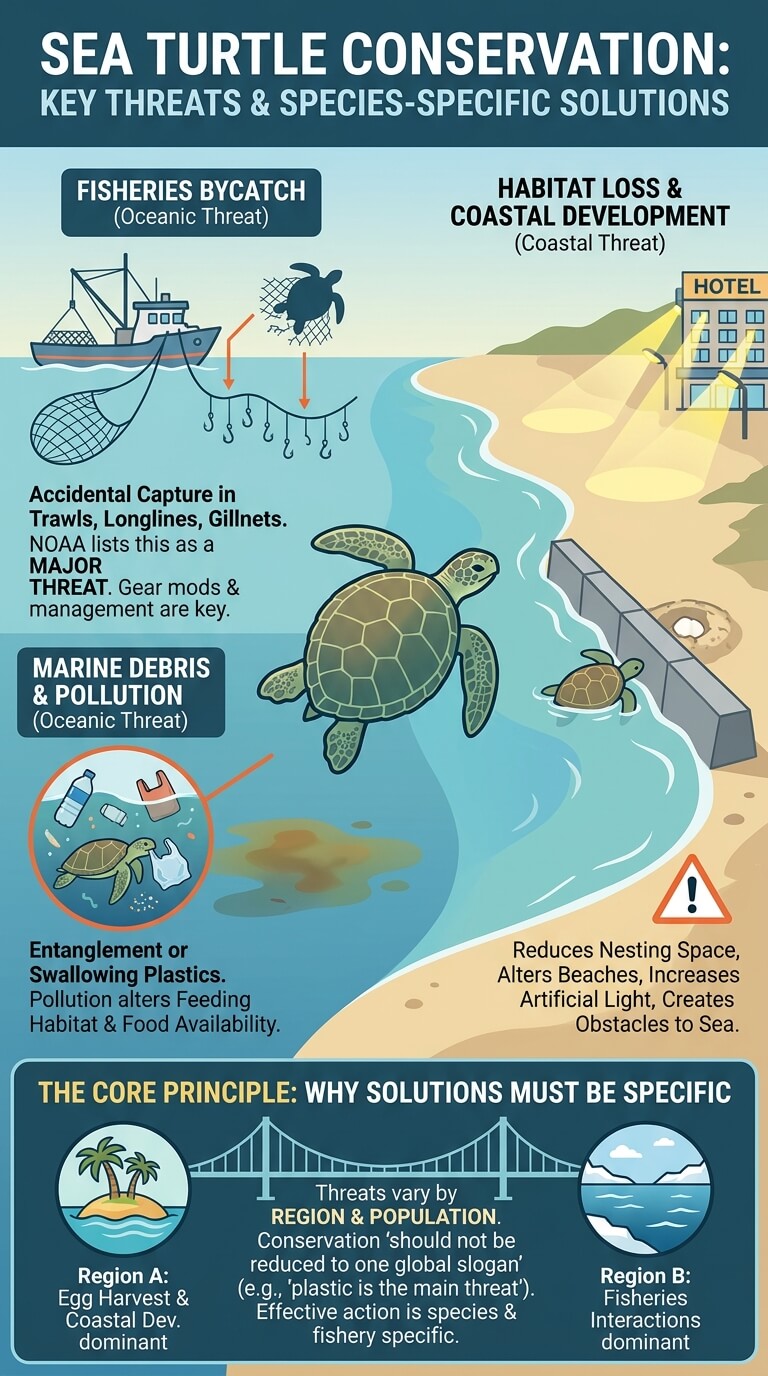
Sea turtles illustrate how reptile conservation can extend far beyond terrestrial habitat protection. In the ocean, turtles may be accidentally captured in trawls, longlines, gillnets, and other fishing gear. NOAA Fisheries lists bycatch among the major threats facing sea turtles and describes gear modifications and fishery-management measures used to reduce these interactions in some fisheries. Its sea turtle conservation overview also identifies nesting-habitat loss, marine debris, vessel strikes, pollution, and climate change as important pressures.
Plastics, debris, and coastal development
Marine debris can entangle sea turtles or be swallowed. Coastal development can reduce nesting space, alter beach shape, increase artificial light, and create obstacles between nesting habitat and the sea. Pollution can also change feeding habitat and food availability.
Why marine threats should remain species and fishery specific
Sea turtle conservation should not be reduced to one global slogan such as “plastic is the main threat.” In some regions and populations, fisheries interactions may dominate. Elsewhere, egg harvest, coastal development, vessel strikes, disease, or nesting-beach change may be more important.
Climate Change and Reptile Vulnerability
Habitat shifts, extreme heat, drought, and sea-level effects
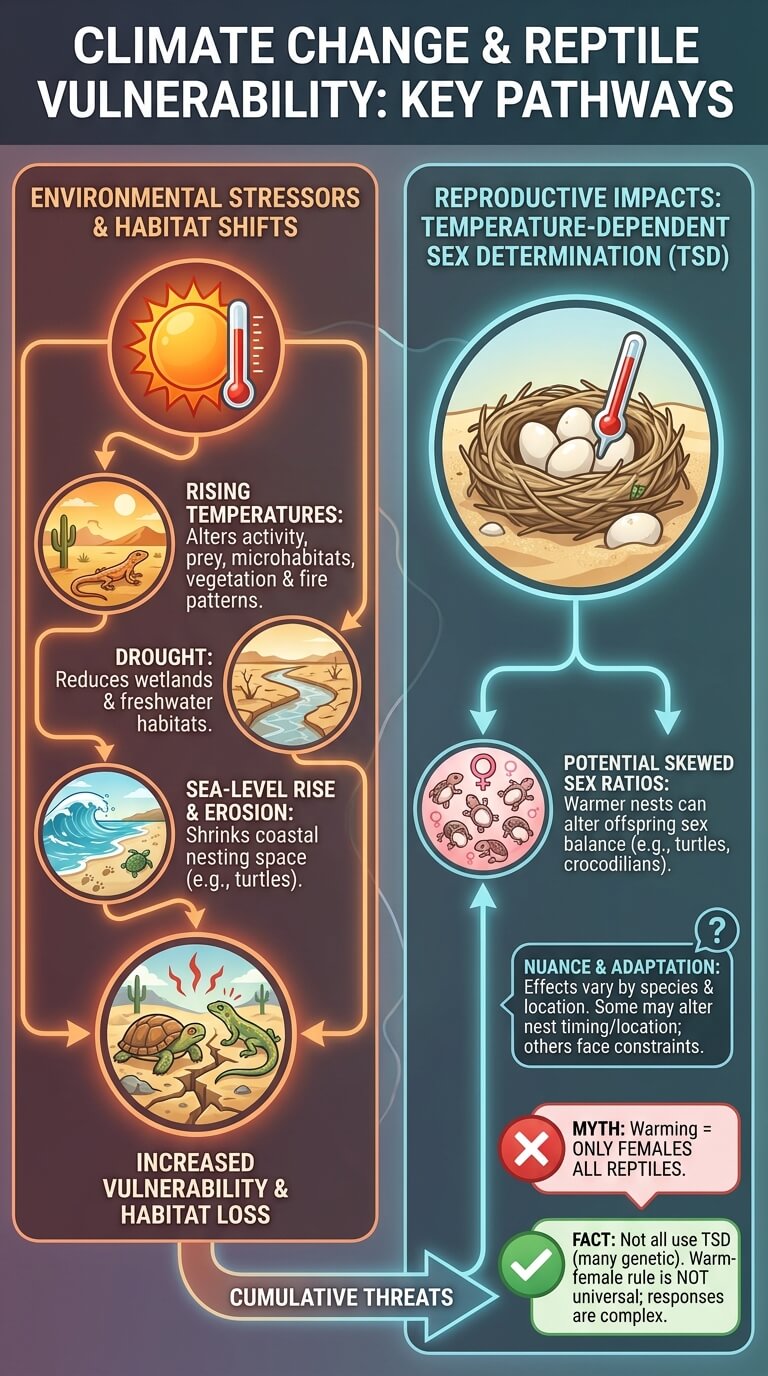
Climate change can affect reptiles through many pathways. Rising temperatures can alter activity windows, water balance, prey availability, fire patterns, vegetation, and the suitability of local microhabitats. Drought can reduce wetland or river habitat. Sea-level rise and stronger erosion can reduce nesting space for coastal turtles. Climate-related risks sometimes intersect with reptile thermoregulation and temperature-sensitive reproduction, but the effects remain species- and population-specific.
Temperature-dependent sex determination in selected taxa
Many turtles and crocodilians, plus some other reptiles, have temperature-dependent sex determination, meaning incubation temperature influences offspring sex. That creates a plausible pathway by which changing nest temperatures can affect sex ratios.
The effect is not identical across reptiles. Different species have different temperature-sex patterns, nesting behavior, and local climates. Some populations may alter nest timing or nest location, while others may face stronger constraints.
Why warming does not mean all reptiles will produce only females
The statement “warming makes reptile eggs female” is too broad. Temperature-dependent sex determination does not occur in every reptile, and the relationship between incubation temperature and sex differs among lineages. Many reptiles use genetic sex determination, and even among temperature-sensitive species the biological response is more complex than one universal warm-equals-female rule.
Disease and Other Emerging Threats
Why disease relevance varies among species and regions
Disease can matter greatly in some reptile populations, but it is not equally important everywhere. Pathogens can interact with stress, habitat degradation, captive-wildlife movement, climate, or invasive species. A disease that is serious in one species or region may be minor or absent in another.
Evidence standards before assigning disease as a major driver
A credible conservation claim should distinguish between detecting a pathogen and showing that the pathogen is driving decline. Researchers may need mortality data, prevalence patterns, experimental evidence, long-term monitoring, or repeated field observations before making that conclusion.
Group-Specific Conservation Patterns
Turtles and tortoises
Turtles and tortoises often face combinations of habitat loss, road mortality, collection, hunting, trade, invasive predators, and slow recovery from adult mortality. Freshwater species may depend on both aquatic and terrestrial habitat. Terrestrial tortoises may be affected by grazing, fire changes, roads, development, or collection. Sea turtles add fisheries, marine debris, coastal nesting, and ocean conditions to the picture.
Crocodilians
Crocodilian conservation is highly variable. Some species have recovered under legal protection, habitat management, regulated use, or reduced hunting pressure. Others remain restricted, threatened, or affected by habitat loss, conflict, or exploitation.
It is inaccurate to call all crocodilians endangered. Conservation status and management history should be checked species by species and region by region.
Lizards and other squamates
Lizards and related squamates include many narrow-range species that can be vulnerable to habitat change, invasive predators, fire, climate shifts, or collection. At the same time, many other species remain widespread. The enormous diversity within Squamata makes generalizations especially risky.
Conservation often depends on habitat specialists: a rock outcrop, dune system, forest canopy, island, cave, or desert microhabitat may support a species with few alternatives elsewhere.
Snakes at overview depth
Snake conservation problems include habitat loss, road mortality, persecution, trade, and prey or habitat changes, but the mix varies greatly. Some snakes are highly specialized predators or habitat users, while others are adaptable generalists.
Venom is not a conservation category. A venomous species can be common or rare, and a nonvenomous species can be severely threatened. Conservation should be based on population evidence rather than fear or perceived danger.
Tuatara and localized conservation context
Tuatara conservation is closely tied to New Zealand’s island ecology, introduced mammalian predators, habitat management, biosecurity, and carefully managed populations. Their story is a reminder that a lineage represented by very few living species can require highly localized management.
It would be misleading to copy the same strategy onto mainland turtles, desert lizards, or crocodilians living in large river systems.
Conservation Tools and Management Strategies
Protected habitat and restoration
Habitat protection is most effective when it preserves the full set of resources a species needs. That may include nesting sites, basking areas, feeding habitat, overwintering refuges, seasonal wetlands, migration routes, or upland areas surrounding water.
Restoration can include wetland recovery, invasive-plant control, reestablishing natural water flow, protecting nesting beaches, restoring native vegetation, or reconnecting fragmented habitat. The best intervention depends on the ecological bottleneck limiting the population.
Population monitoring and research
Managers need to know whether populations are increasing, stable, or declining and which life stages are being lost. Methods may include mark-recapture studies, nest monitoring, camera surveys, genetic work, telemetry, roadkill counts, visual surveys, or community reporting programs.
Trade enforcement and sustainable-management frameworks where applicable
Trade management can involve permits, quotas, chain-of-custody controls, inspections, species identification, export requirements, and enforcement against illegal collection. In some systems, regulated use may be part of conservation management, but it should not be assumed to be sustainable merely because it is legal.
Wildlife trade decisions require reliable population data, traceability, and enforcement capacity. High demand can create incentives for laundering wild-caught animals through supposedly legal channels, so documentation matters.
Road mitigation, bycatch reduction, invasive-species control, and targeted recovery programs
Conservation is often most successful when it addresses a clearly demonstrated source of mortality. Road crossings can reduce vehicle deaths where turtles repeatedly cross. Fishery gear changes can reduce sea turtle bycatch in specific fisheries. Predator removal can help island reptiles where introduced mammals are the main threat. Head-starting or captive breeding may support recovery for selected species when paired with habitat protection and threat reduction.
What Readers Often Misunderstand
“Reptiles are endangered” as one group
Some reptiles are threatened with extinction, many are not, and some have not been studied equally well. The 2022 global assessment showed that extinction risk is a major conservation concern across reptiles, but it did not assign one threatened status to the entire group.
“CITES listing means a species is automatically IUCN threatened”
CITES and IUCN have different purposes. CITES controls international trade in listed species. IUCN assesses extinction risk. The same reptile can appear in both systems, one system, or neither, depending on its status and trade context.
“Captive breeding automatically solves wild declines”
Captive breeding can be valuable for some critically small populations, reintroductions, genetic management, or assurance populations. But it does not remove the threat that caused decline. Releasing animals into habitat where the original problem remains may simply reproduce the same losses.
“Buying captive reptiles is a universal conservation action”
Pet ownership should not be presented as a generic conservation solution. Captive-bred animals can reduce pressure on wild populations in some contexts, but markets can also create demand, mislabeling problems, or laundering risks. Conservation value depends on species, sourcing, regulation, and whether trade actually reduces threats in the wild.
How Reptile Biology Shapes Conservation
Habitats and fragmentation
Habitat protection works best when it reflects how reptiles actually use space. A turtle may need a wetland plus nearby nesting ground. A snake may require seasonal movement between feeding and overwintering areas. A lizard may depend on a narrow temperature range within rock crevices or forest canopy.
This is why fragmentation can matter even when a habitat patch looks intact on a map. Conservation must consider access to all the resources used across the year.
Reproduction and climate-sensitive development
Reproductive biology influences how populations recover. Long-lived species with late maturity may be especially sensitive to adult mortality. Species with temperature-dependent sex determination may require monitoring of nest temperatures and hatchling sex ratios in some locations. Species that lay eggs in concentrated nesting areas may be vulnerable to disturbance concentrated in one season.
The right response depends on reproductive mode, life span, nesting ecology, and which life stage limits population growth.
Ecological roles and broader endangered-animal conservation
Protecting reptiles can also protect habitats and ecological processes shared with many other species. Wetland protection can benefit fish, amphibians, birds, mammals, and invertebrates. Island predator control can help multiple native species at once. Forest protection can conserve entire communities rather than one reptile in isolation.
At the same time, reptiles deserve conservation on their own terms. Their value is not limited to eating pests, attracting tourists, or helping other animals.
FAQ
Are reptiles endangered?
Not as one group. Conservation status is species-specific. The 2022 global reptile assessment reported that at least 21 percent of assessed reptile species were threatened with extinction, but many reptile species fall outside the threatened categories. The status of any particular species should be checked using a current assessment.
What is the biggest threat to reptiles?
There is no single threat that dominates every reptile species. Habitat loss and degradation are major global pressures, but roads, invasive predators, trade, direct killing, fisheries bycatch, pollution, climate change, disease, and small range size can be more important for particular species or populations.
What is the difference between IUCN and CITES?
IUCN evaluates extinction risk using Red List criteria. CITES regulates international trade in listed wildlife and plants. A CITES listing does not automatically mean a species is in an IUCN threatened category, and an IUCN-threatened species is not automatically regulated by CITES.
How does climate change affect reptiles with temperature-dependent sex determination?
In species with temperature-dependent sex determination, incubation temperature influences offspring sex, so sustained changes in nest temperatures can shift sex ratios. The effect is not universal across reptiles, and even among temperature-sensitive species the pattern differs by lineage and population. Climate change can also affect nesting habitat, drought, fire, prey, activity periods, and suitable geographic range.
Final Thoughts
Reptile conservation works best when it is specific. The most useful questions are which species is declining, where the decline is occurring, which life stages are being lost, and which threats are supported by evidence. Habitat loss, roads, trade, persecution, invasive species, fisheries, pollution, climate change, and disease can all matter, but not in the same way for every reptile.
The strongest conservation programs match management to biology. That may mean protecting a wetland and its nesting uplands, reducing turtle road mortality, changing fishing practices, controlling invasive predators on islands, enforcing wildlife trade rules, or monitoring a small population over many years. Reptiles are too diverse for one conservation story, and understanding that diversity is the first step toward protecting them effectively.

Ethan Walker is the founder and research editor of Animal Fact Central. He creates and reviews educational animal facts content using trusted wildlife, pet care, and science-based sources. His work focuses on making animal behavior, adaptations, habitats, and species facts clear, accurate, and engaging for everyday readers.
Read More Details About Ethan Walker: https://animalfactcentral.com/ethan-walker/