Animal Evolution and Common Ancestors Explained

Animal Evolution and Common Ancestors

Animal evolution and common ancestors explain why a whale’s flipper, a bat’s wing, a lizard’s foreleg, and a human arm can be built from the same basic arrangement of bones. Living animals did not appear as separate, finished designs. Their lineages inherited traits from earlier populations, changed across generations, split into new branches, and sometimes … Read more

Major Invertebrate Groups Explained

Major Invertebrate Groups Explained

Invertebrates are animals without a vertebral column, but that simple definition covers an extraordinary range of bodies. A butterfly, an octopus, an earthworm, a jellyfish, and a sea star are all invertebrates, yet they move, feed, sense their surroundings, and reproduce in very different ways. Understanding the major invertebrate groups means looking beyond the missing … Read more

How Scientists Discover and Name New Species

How Scientists Discover and Name New Species

Finding an animal that looks unfamiliar is only the beginning of discovering a new species. Scientists must document where it was found, compare it with known animals, test whether the differences are consistent, decide whether the evidence supports a separate species, and publish a formal description that follows zoological naming rules. The process can begin … Read more

Species vs Subspecies: Key Differences Explained

Species vs Subspecies: What Is the Difference?

The difference between a species and a subspecies is mainly about evolutionary independence. A species is treated as a distinct evolutionary lineage, while a subspecies is a named, consistently different population within a species. Subspecies usually occupy part of a species’ geographic range and remain more closely connected to other populations of that species than … Read more

What Makes an Animal a Species?

What Makes an Animal a Species?

An animal species is usually understood as a distinct evolutionary lineage: a population, or connected set of populations, that is evolving separately from other such lineages. Scientists test that idea with evidence from reproduction, genes, anatomy, behavior, ecology, and geographic history. No single test works for every animal. That is why the familiar rule that … Read more

Species, Genus, Family, and Order Explained

Species, Genus, Family, and Order Explained

Species, genus, family, and order are taxonomic ranks used to organize animals into nested groups. A species is usually the most specific standard rank, a genus contains one or more closely related species, a family contains related genera, and an order contains related families. Moving upward through the hierarchy creates broader groups that include more … Read more

Warm-Blooded vs Cold-Blooded Animals Explained

Warm-Blooded vs Cold-Blooded Animals

Warm-blooded animals produce and retain much of the heat needed to keep their bodies within a useful temperature range. Cold-blooded animals depend more heavily on heat moving between their bodies and the environment. Biologists usually call these strategies endothermy and ectothermy, because the familiar labels can be misleading. An ectothermic lizard basking on a rock … Read more

Mammals, Birds, Reptiles, Amphibians, and Fish

Mammals, Birds, Reptiles, Amphibians, and Fish Compared

Mammals, birds, reptiles, amphibians, and fish are all vertebrates, but they solve the challenges of breathing, temperature control, reproduction, movement, and water balance in very different ways. Mammals have hair and produce milk. Birds have feathers and lay hard-shelled eggs. Nonavian reptiles have keratinized scales and amniotic development. Amphibians usually have permeable skin and life … Read more

Vertebrates vs Invertebrates: Key Differences

Vertebrates vs Invertebrates

The simplest difference between vertebrates and invertebrates is that vertebrates belong to the animal lineage with a vertebral column, while invertebrates are animals outside that lineage. A dog, eagle, frog, salmon, and snake are vertebrates. A butterfly, earthworm, octopus, sea star, coral, and sponge are invertebrates. That quick rule is useful, but it does not … Read more

How Animals Are Classified: Taxonomy Explained

How Animals Are Classified

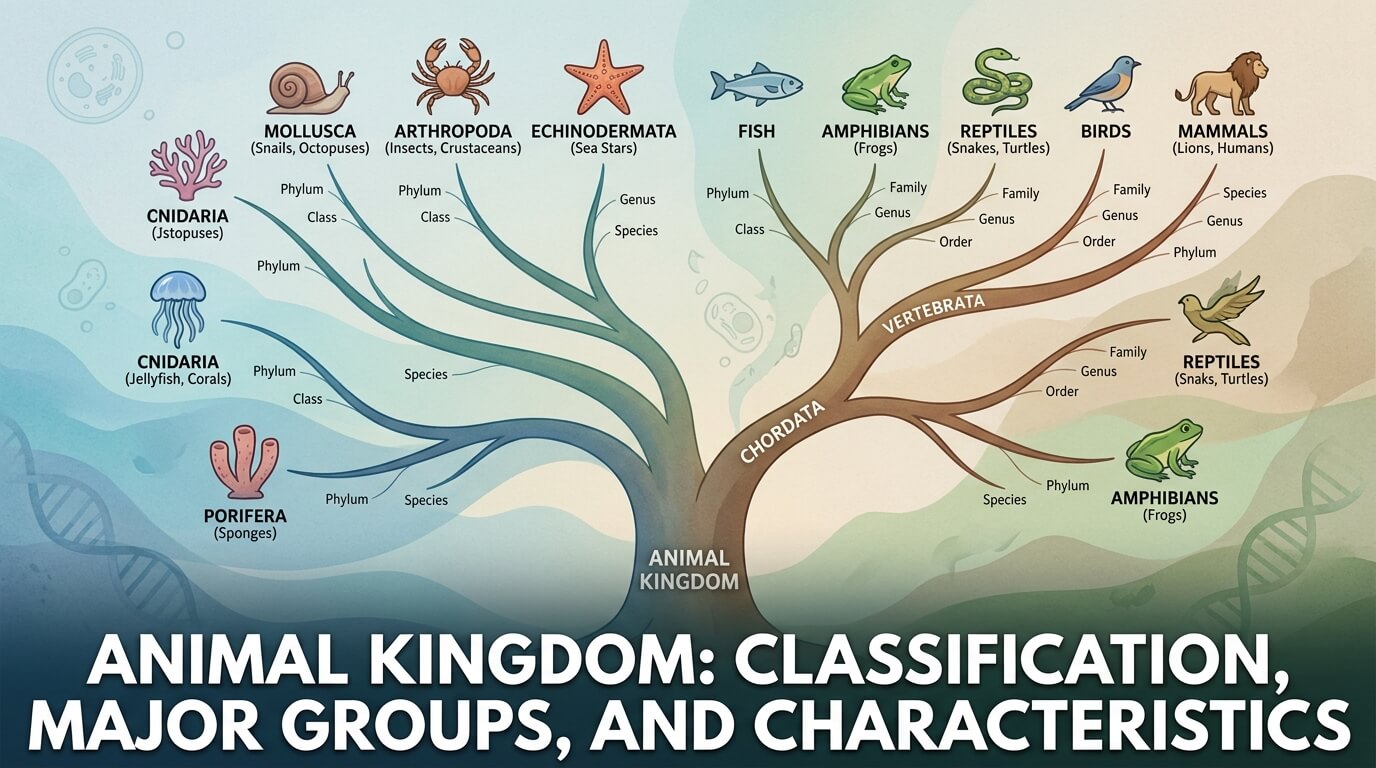
Scientists classify animals by comparing many kinds of evidence, not by choosing one obvious feature such as size, habitat, color, or whether an animal can fly. They examine body structures, development, behavior, ecology, fossils, proteins, and DNA. They then test which grouping best explains the pattern of shared traits and common ancestry. Modern animal classification … Read more