
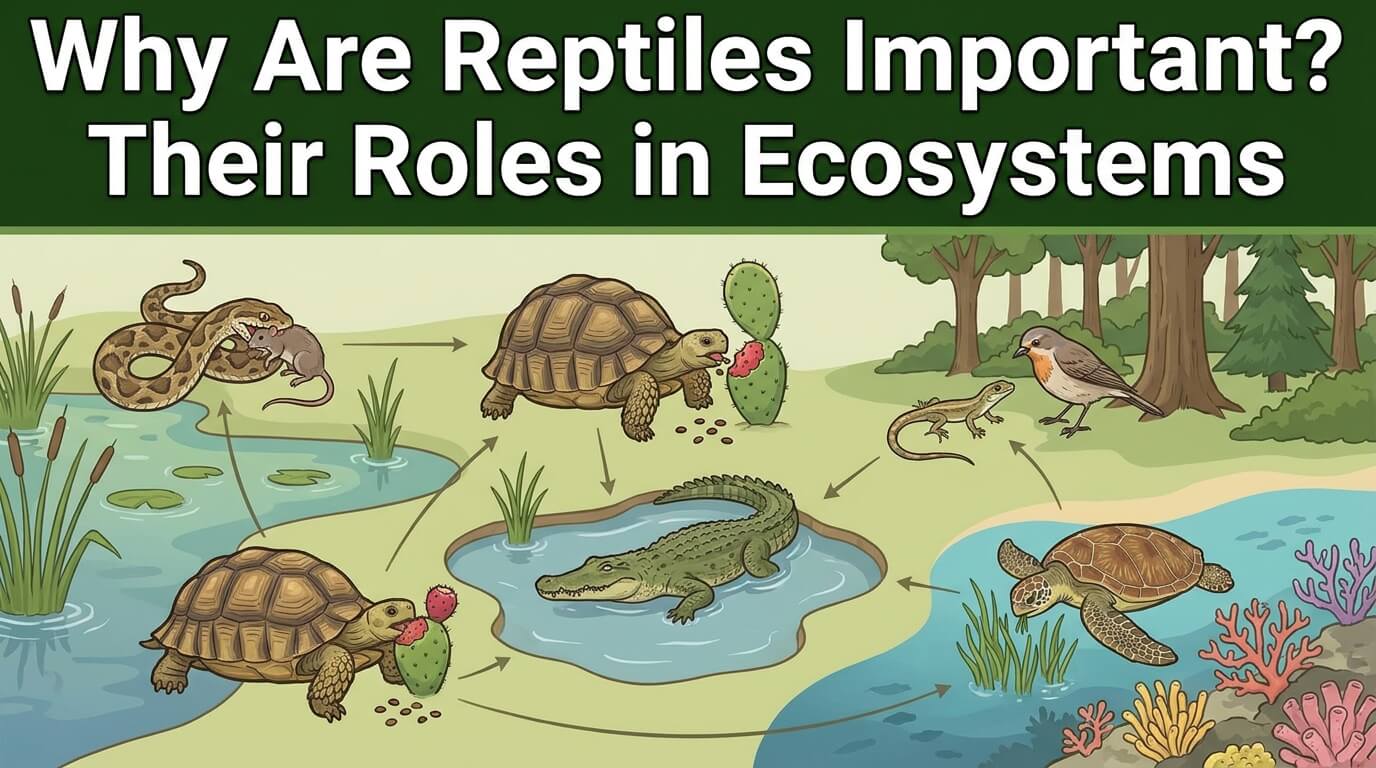
Reptiles matter because they occupy many different positions in food webs. Depending on the species, a reptile may be a predator, prey animal, herbivore, insect eater, fruit consumer, scavenger, seed disperser, or even a habitat modifier. A small lizard hunting beetles plays a very different ecological role from a green sea turtle grazing seagrass or an American alligator digging a water-holding depression in a wetland.
That diversity is the key to understanding why reptiles are important. Their value cannot be reduced to one slogan such as “snakes control rodents” or “alligators are top predators.” Some reptiles do fill those roles, but many do not. The ecological effect of a reptile depends on its species, age, body size, diet, habitat, and local food web.
Quick Answer: Reptiles Fill Many Ecological Roles
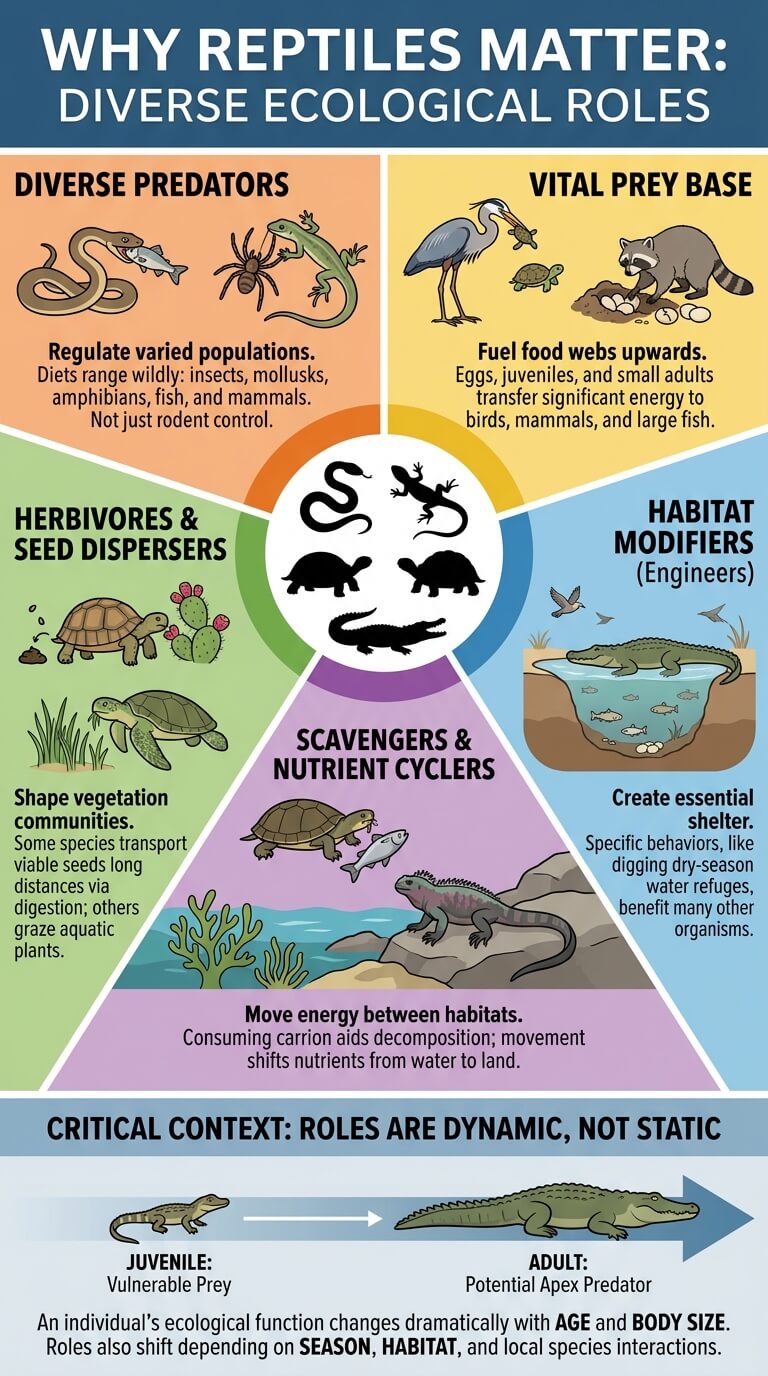
Living reptiles include snakes, lizards, amphisbaenians, turtles, tortoises, crocodilians, and tuatara. Across those lineages, reptiles interact with plants, invertebrates, fish, amphibians, birds, mammals, and other reptiles. They consume food, become food themselves, move nutrients, disturb soil, dig shelters, carry seeds, and alter vegetation in ways that can influence other organisms.
Consumers, prey, seed movers, scavengers, and habitat modifiers
Ecologists often describe animals by the processes they participate in rather than by whether people consider them “helpful.” A tortoise can browse vegetation and later deposit viable seeds. A freshwater turtle can eat both live prey and carrion. A crocodilian can consume fish and other animals while also creating physical features in wetlands. A lizard can eat insects, fruit, or both, depending on the species.
Research has shown that fruit-eating lizards can act as pollinators or seed dispersers, especially on islands, where some species incorporate substantial amounts of plant material into their diets. A review in Trends in Ecology & Evolution described lizard pollination and seed dispersal as more ecologically important than older assumptions suggested, particularly in island systems.
Ecological value goes beyond direct human usefulness
Reptiles do not need to eat agricultural pests, remove carrion, or provide another obvious human benefit to have ecological value. A snake that specializes on frogs, a lizard that consumes fruit, or a turtle eaten by a heron is still part of a network of energy transfer. Even species that people rarely notice can connect trophic levels or habitats in ways that matter locally.
This is why broad claims about reptiles being “good” because they eat pests are too narrow. Ecological importance comes from relationships within ecosystems, not simply from whether an animal performs a service humans happen to prefer.
Reptiles as Predators
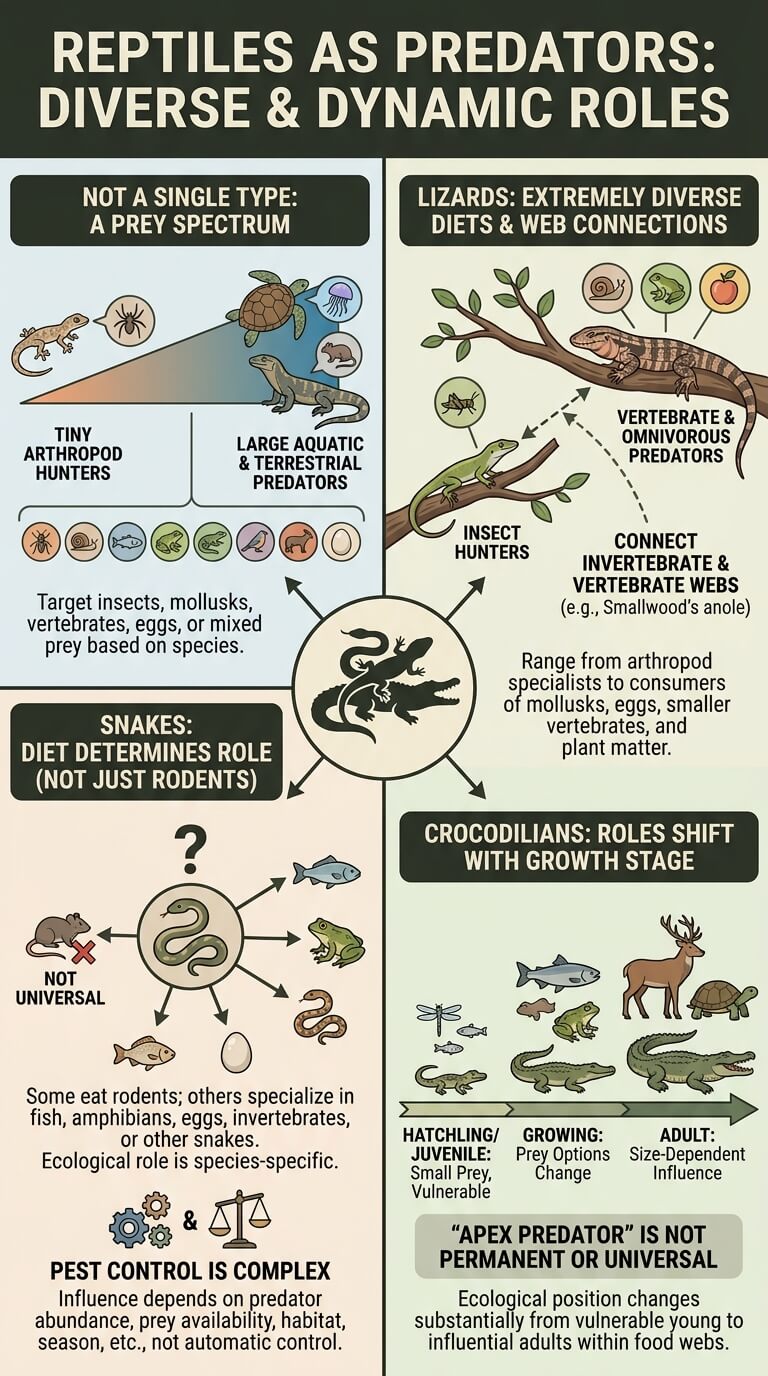
Predation is one of the most visible reptile roles, but reptiles do not form a single predator type. They range from tiny arthropod hunters to large aquatic predators. Different species target insects, spiders, mollusks, fish, amphibians, reptiles, birds, mammals, eggs, or mixed prey.
Snakes eat very different prey depending on species
Some snakes regularly consume rodents, which is why snakes are often described as rodent predators. That is true for certain species and habitats, but it is not a universal snake function. Other snakes specialize more heavily on fish, amphibians, lizards, birds, eggs, invertebrates, or even other snakes. A snake’s ecological role has to be understood from its actual diet rather than from the group name alone.
The same caution applies to claims that the presence of snakes automatically “controls” pest populations. Predation can influence prey, but the size of that effect depends on predator abundance, prey availability, habitat, season, and many other ecological relationships.
Lizards range from insect hunters to vertebrate predators
Many lizards consume arthropods, but lizard diets are extremely diverse. Some small species spend much of their foraging time catching insects and spiders, while larger species may take mollusks, crustaceans, eggs, frogs, smaller reptiles, or other vertebrates. Some species combine animal prey with fruit, flowers, or leaves.
For example, Smithsonian’s profile of Smallwood’s anole describes an arboreal lizard that searches trees for insects, grubs, and frogs. That feeding pattern illustrates how a reptile can connect both invertebrate and vertebrate prey within the same forest food web.
Crocodilian roles change as they grow
Crocodilians are often pictured only as large predators, yet hatchlings, juveniles, and adults do not occupy exactly the same ecological position. Young crocodilians are small enough to be eaten by larger animals and tend to consume correspondingly smaller prey. As individuals grow, their prey options and influence within aquatic and shoreline food webs can change substantially.
That size-dependent shift is important because “apex predator” is not a permanent label that describes every crocodilian at every life stage or in every habitat.
Reptiles Are Also Important Prey
Food webs run in both directions. Reptiles consume other organisms, but reptiles themselves can be a major source of food. Eggs, hatchlings, juveniles, and small-bodied adults may be eaten by birds, mammals, fish, amphibians, invertebrates, and other reptiles.
Eggs and hatchlings feed many other animals
Reptile nests can be attractive food sources because eggs are concentrated in one place. After hatching, young reptiles often face another period of high predation because of their small size. Turtle hatchlings, young lizards, small snakes, and juvenile crocodilians can all enter the diets of other predators.
The common snapping turtle shows this change clearly. Animal Diversity Web notes that its eggs and hatchlings may be eaten by animals including herons, crows, raccoons, skunks, foxes, bullfrogs, water snakes, and large fish, while larger adult snapping turtles have fewer predators. The same species can therefore shift from vulnerable prey to a much harder animal to attack as it grows. Animal Diversity Web’s snapping turtle account provides a useful example of that life-stage contrast.
Small reptiles transfer energy to larger predators
Small lizards and snakes can be routine prey in terrestrial ecosystems. Aquatic turtles can be eaten by large fish, birds, mammals, crocodilians, or other turtles, especially when young. On islands, reptiles may be part of the diets of native birds while also facing pressure from introduced mammals.
Calling reptiles only “predators” hides this half of their ecological importance. A prey species transfers energy from the foods it consumes to the animals that consume it, so being eaten is itself a major ecological function.
Insect and Invertebrate Consumption
Insects, spiders, snails, crustaceans, worms, and other invertebrates are common reptile foods. Many lizards are especially visible insect hunters, while turtles, tuatara, and some snakes also consume substantial amounts of invertebrate prey.
Lizards participate in arthropod food webs
A lizard catching beetles or spiders is not simply “removing bugs.” It is participating in a network that includes the plants those arthropods may feed on, the predators that eat the lizard, and competitors that use the same prey. Changes in lizard abundance can therefore alter interactions within a local food web, although the direction and size of the effect are not identical from one ecosystem to another.
Why pest-control claims need caution
It is reasonable to say that insect-eating reptiles consume invertebrates. It is much harder to promise that a particular reptile will suppress a pest population to a useful level. Ecological control depends on predator density, prey reproduction, alternative foods, weather, habitat structure, and many other factors.
For that reason, reptiles should not be valued only as free pest-control agents, and wild reptiles should not be attracted or fed in an attempt to manipulate local pest numbers.
Herbivory and Plant-Reptile Interactions
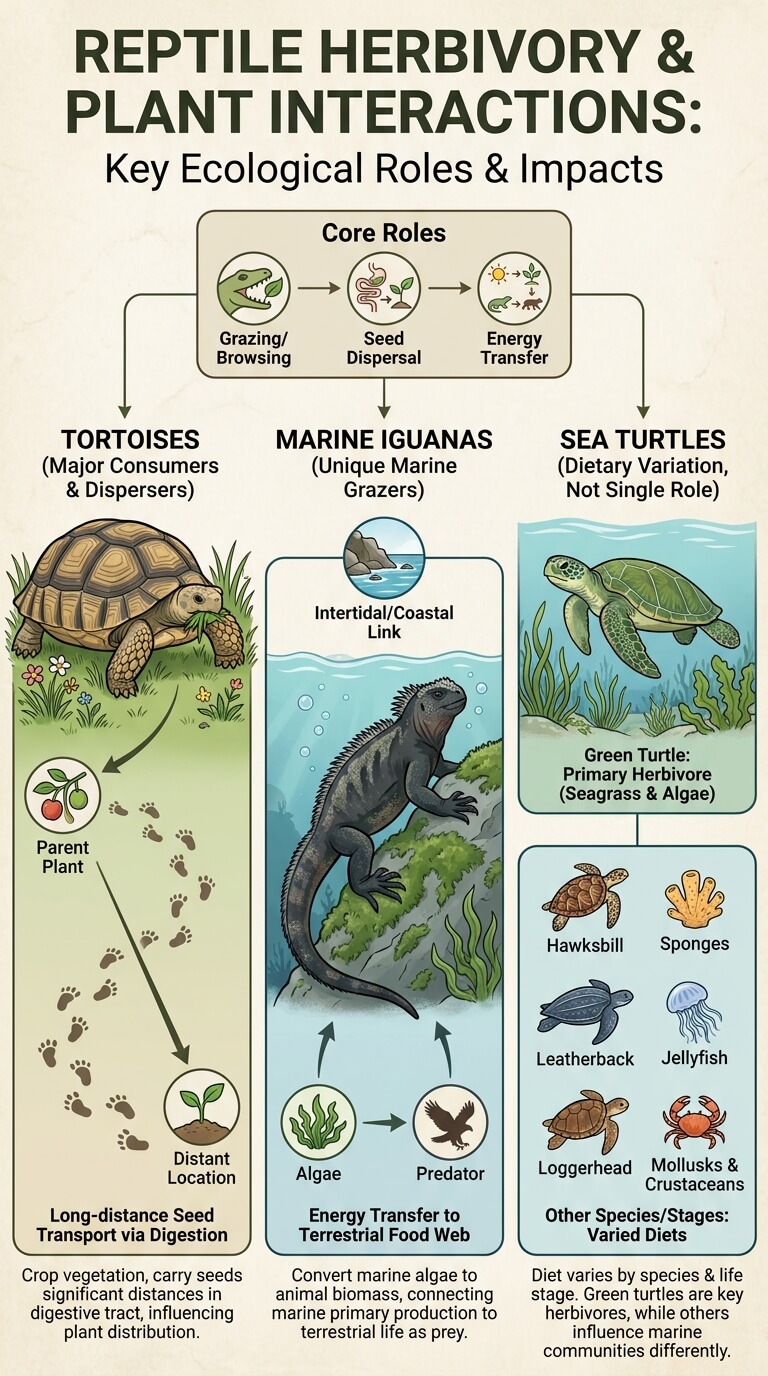
Reptiles are often imagined as meat eaters, but several lineages include important herbivores. Plant-eating reptiles can influence vegetation by grazing, browsing, consuming fruit, and moving plant material through their digestive systems.
Tortoises can be major plant consumers
Many tortoises eat grasses, leaves, flowers, fruits, and other plant material. Their feeding can affect which plants are cropped, while their movements can carry seeds away from parent plants. Large tortoises are especially interesting because they can move substantial distances while retaining plant material in the digestive tract.
Marine iguanas turn algae into animal biomass
Marine iguanas are unusual among reptiles because they forage heavily on marine algae. In doing so, they connect rocky intertidal and coastal primary production with terrestrial life on the Galápagos Islands. They are also prey for other animals, so energy originally captured by algae can move onward through the food web after being consumed by iguanas.
Sea turtles show how different herbivory can be
Green sea turtles are the clearest herbivorous example among living sea turtles, especially in many coastal foraging areas where adults eat seagrasses and algae. Other sea turtle species have very different diets, including sponges, jellyfish, mollusks, and crustaceans. NOAA Fisheries emphasizes this variation in its green turtle species profile, which also notes that diet can differ among life stages and populations.
The broader lesson is that “sea turtle” does not describe a single feeding role. Different species influence marine communities through different diets.
Fruit Eating, Seed Dispersal, and Seed Predation
Some reptiles eat fruit and then pass seeds through the digestive tract. If those seeds remain viable and are deposited away from the parent plant, the reptile can function as a seed disperser. Tortoises and island lizards provide some of the best-known examples.
Reptiles can move seeds across the landscape
Seed dispersal is not limited to birds and mammals. Studies of tortoises show that seeds can remain in the gut long enough to be deposited after an animal has moved away from the feeding site. That can matter especially for large-fruited plants or on islands where the community of fruit-eating vertebrates is limited.
Fruit consumption does not always help the plant
A reptile that swallows a fruit is not automatically an effective seed disperser. Seeds can be damaged, digested, dropped close to the parent plant, or deposited in an unsuitable place. Some reptiles may act as seed predators in one plant interaction and seed dispersers in another.
This is why plant-reptile relationships are best described at the species level. The ecological outcome depends on the reptile, the plant, the seed, gut passage, movement behavior, and the habitat where the seed is deposited.
Scavenging and Nutrient Cycling
Scavenging is another role that receives less attention than active predation. Several freshwater turtles consume carrion when it is available, alongside live prey and plant material. Carrion feeding moves nutrients from dead animals into living consumers and then onward through excretion, growth, and later predation.
Freshwater turtles may eat both live prey and carrion
Common snapping turtles, softshell turtles, mud turtles, and other freshwater species can include carrion in broad omnivorous or carnivorous diets. This does not mean turtles are the main cleanup crew in every wetland. It means scavenging is one of several feeding pathways by which reptiles can participate in decomposition-linked food webs.
Reptiles can move nutrients between places
An animal does not have to migrate across a continent to move nutrients. A turtle that feeds in water and later rests or nests on land, a sea turtle moving between feeding grounds and nesting beaches, or a tortoise depositing feces after traveling can all shift organic material between locations.
The ecological importance of that movement varies with the species and ecosystem, so it is better to describe reptiles as potential nutrient movers than to assume every reptile has a large nutrient-cycling effect.
Freshwater and Wetland Food-Web Roles
Freshwater habitats contain reptiles with very different diets and life histories. Turtles may be predators, herbivores, omnivores, or scavengers. Water-associated snakes can feed on fish or amphibians. Crocodilians consume aquatic and shoreline prey, while young crocodilians are also eaten by other predators.
Turtles and crocodilians can fill several roles at once
A single freshwater reptile can occupy more than one feeding category. An omnivorous turtle may consume aquatic plants, invertebrates, carrion, and small vertebrates. A crocodilian may act as a predator while also physically changing wetland habitat. Ecological categories are useful, but they should not be treated as boxes that animals can occupy only one at a time.
Wetland function is larger than any one reptile
Reptiles interact with hydrology, vegetation, fish, invertebrates, birds, and mammals, but wetlands are not maintained by reptiles alone. Water levels, plant communities, microbes, soils, seasonal flooding, and many other organisms shape the system. Reptiles are participants within that structure rather than a substitute for understanding the whole ecosystem.
Marine Reptiles in Ocean Food Webs
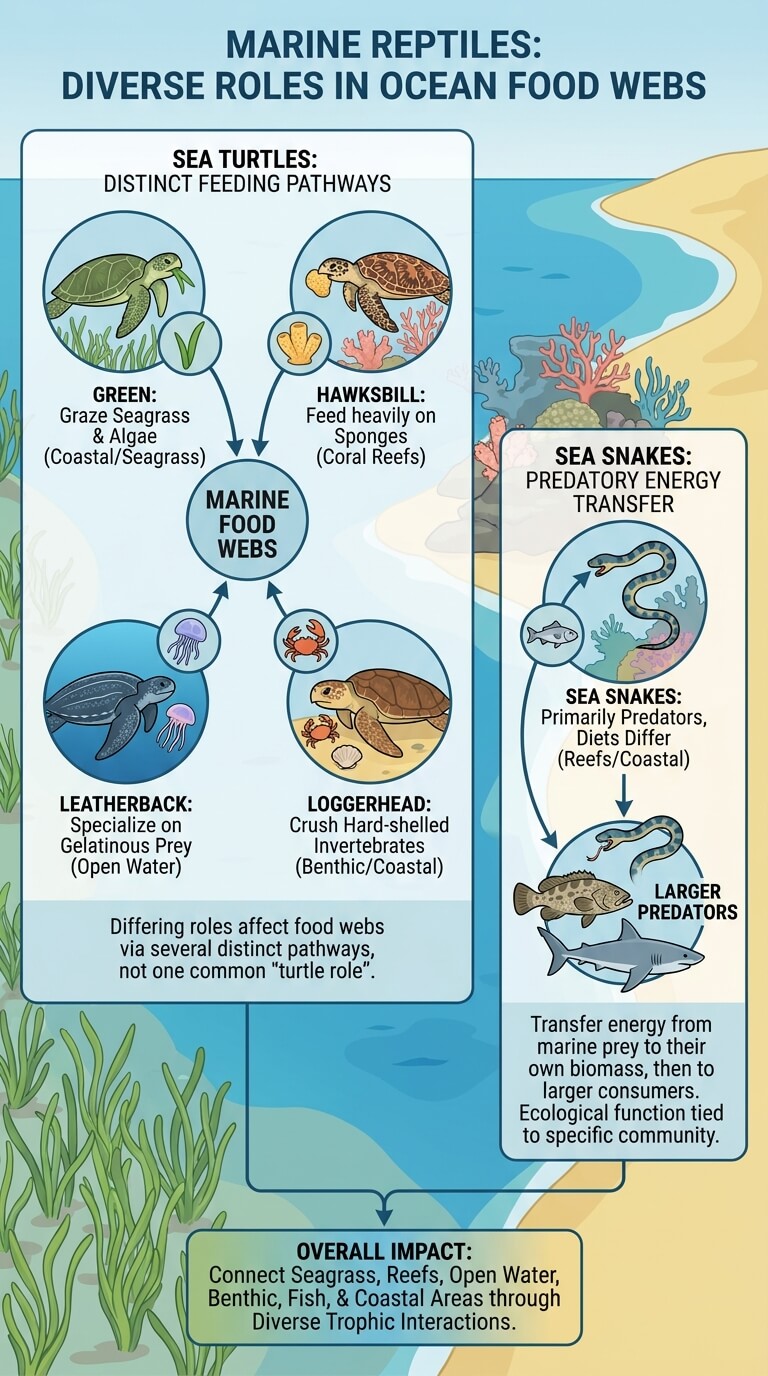
Modern marine reptiles include sea turtles and sea snakes, along with species that divide their time between marine and terrestrial or coastal habitats. Their feeding links them to seagrass beds, coral reefs, open-water prey, benthic invertebrates, fish communities, and coastal nesting areas.
Sea turtles fill very different feeding roles
Green turtles may graze seagrass and algae, hawksbills feed heavily on sponges, leatherbacks specialize largely on gelatinous prey, and loggerheads often crush hard-shelled invertebrates. Those differences mean sea turtles can affect marine food webs through several distinct pathways rather than one common “turtle role.”
Sea snakes add another predatory pathway
Sea snakes are primarily predators, but even within that group diets differ. Many take fish, while others specialize on particular prey types. They transfer energy from marine prey into their own biomass and, in turn, can be consumed by larger predators. Their ecological function is therefore tied to the specific marine community they inhabit.
Burrowing and Habitat Modification
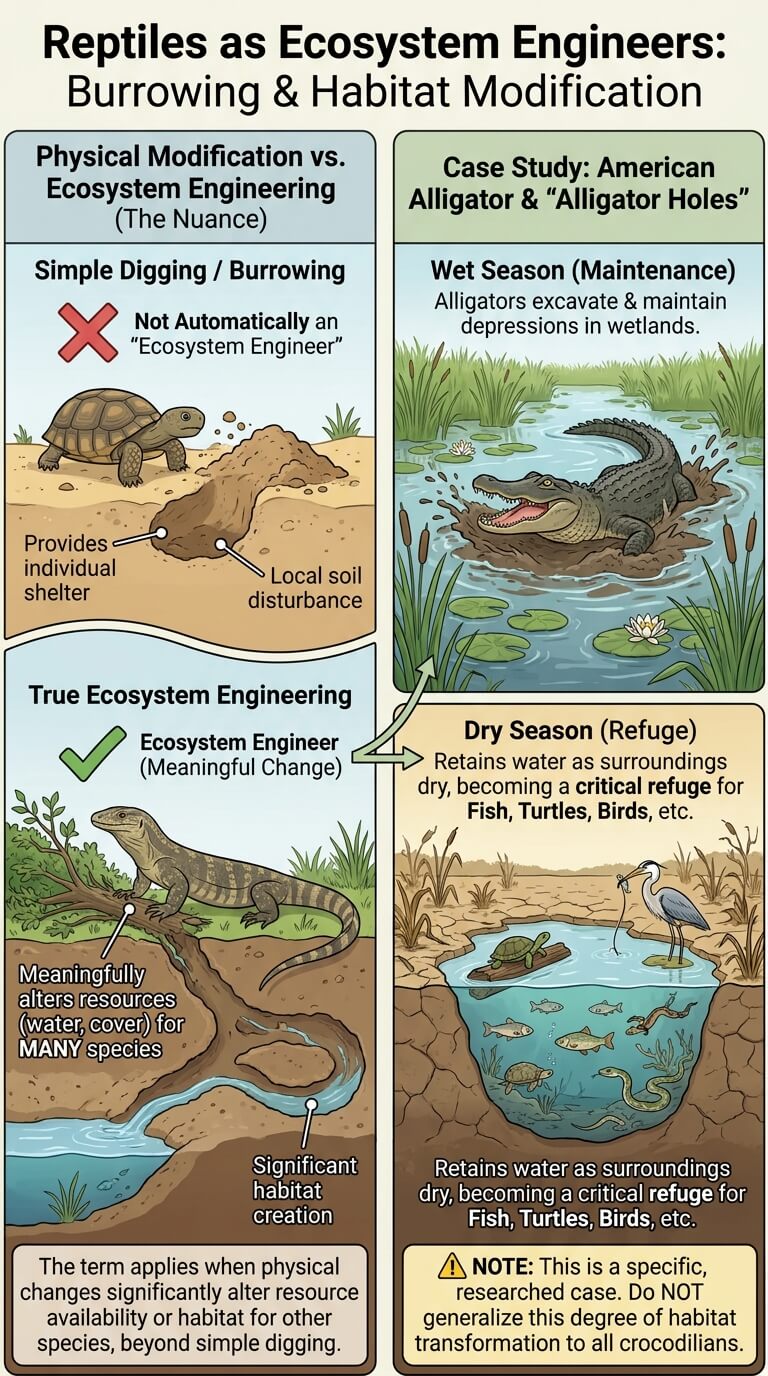
Some reptiles affect ecosystems not only through feeding but also by physically changing habitat. Digging can create shelters, expose soil, redistribute sediment, or produce depressions that hold water. The scale of those effects ranges from small and local to ecosystem-level in a few well-studied cases.
American alligators can create dry-season refuges
The American alligator provides one of the strongest reptile examples of ecosystem engineering. In the Everglades, alligators excavate and maintain depressions that can retain water as surrounding marshes dry. These “alligator holes” can provide refuge and foraging habitat for fish, turtles, snakes, wading birds, and other organisms. The U.S. Geological Survey describes these structures in its American alligator ecology overview.
That is a researched case in a particular wetland system. It should not be generalized into a claim that every crocodilian transforms habitat in the same way or to the same degree.
Not every burrowing reptile is an ecosystem engineer
Many reptiles dig burrows, use existing burrows, or create shallow depressions. Those behaviors may disturb soil or provide shelter, but the term ecosystem engineer is most useful when an organism’s physical changes meaningfully alter resource availability or habitat for other species. Simply digging does not automatically meet that standard.
Island Ecosystems and Tuatara
Islands often make reptile interactions especially visible because food webs can contain fewer large vertebrate groups and because introduced predators can strongly alter native communities. Lizards may act as fruit consumers or pollinators, while reptiles can be both predators and prey within seabird-dominated systems.
Tuatara live within seabird-influenced island food webs
New Zealand tuatara provide a useful example. The Department of Conservation notes that many islands supporting tuatara also hold breeding seabird colonies. Those seabirds enrich soils through marine-derived nutrients, which can support abundant invertebrates and lizards that become tuatara prey. Tuatara may also consume seabird eggs and chicks. This creates a web of interactions rather than a simple one-way predator relationship. New Zealand’s Department of Conservation tuatara profile summarizes this island context.
Island roles are highly local
An ecological interaction documented on one island should not automatically be transferred to another. Reptile abundance, seabird density, vegetation, invasive mammals, climate, and available prey can differ greatly. Island ecology is a strong example of why reptile roles need local evidence.
Ecological Roles Change With Age and Habitat
Reptile ecology is dynamic. A juvenile may eat different foods from an adult. An aquatic juvenile may move into a more terrestrial or coastal adult habitat. Seasonal rainfall can change prey availability. Temperature can alter when reptiles are active enough to forage. Migration can connect feeding and breeding areas.
Juveniles and adults may occupy different trophic positions
Young crocodilians begin with smaller prey and face many predators themselves. Some turtles change diet as they grow. Lizards may shift from insects toward more plant material or larger prey. These changes mean that one species can perform different ecological functions during different stages of life. Many ecological roles begin with what reptiles eat , but diet alone does not capture whether a species acts as a predator, herbivore, scavenger, seed disperser, or prey.
Season and geography can reshape the same species’ role
A reptile living in a wet season full of insects may feed differently during a dry season. A broadly distributed species can encounter different prey communities across its range. Even green turtles show geographic variation in how much animal matter is eaten. Ecological descriptions are therefore strongest when they allow for local and life-stage variation. The way reptiles forage, defend territories, aggregate, or use burrows connects ecological function with reptile behavior .
Common Myths and Mistakes
Myth: All snakes control rodents
Some snakes are important rodent predators. Others rarely eat rodents. Snake diets can center on fish, frogs, lizards, birds, eggs, insects, snails, or other prey. It is more accurate to say that certain snake species can influence rodent populations under some conditions.
Myth: All crocodilians are apex predators everywhere
Large adult crocodilians can be dominant predators in some systems, but hatchlings and juveniles are prey for many animals. Even adults do not occupy identical positions in every food web. Body size, species, habitat, and available competitors all matter.
Myth: Every reptile is a keystone species
A keystone species has a disproportionately large ecological effect relative to its abundance. That is a specific ecological concept, not a compliment for any species considered important. Some reptiles may function as keystone species in particular systems, but the label requires evidence.
Myth: Ecosystems would universally collapse without reptiles
Removing a species can change an ecosystem, sometimes dramatically, but there is no scientific basis for claiming that every ecosystem would collapse in the same way if reptiles disappeared. The consequences depend on which reptiles are present, what functions they perform, and whether other organisms can partly replace those functions.
Why Reptile Ecology Matters for Conservation
Conservation is not only about preserving a species name on a list. When a reptile declines locally, ecological interactions can weaken or disappear as well. A loss of fruit-eating tortoises could reduce a seed-dispersal pathway. Fewer alligators in a wetland could mean fewer maintained alligator holes. A decline in a marine grazer could alter interactions with vegetation or prey.
At the same time, ecological importance should not be exaggerated into a universal prediction. Some functions overlap among species, and ecosystems can reorganize. Understanding what a particular reptile actually does is more useful than assuming every decline produces the same outcome.
FAQ
Do reptiles help control insect populations?
Many reptiles eat insects and other arthropods, especially numerous lizard species and some turtles, snakes, and tuatara. Their feeding can influence local invertebrate food webs. However, it is not safe to promise that the presence of a reptile will control a particular pest population because ecological effects depend on abundance, prey availability, habitat, and season.
Are reptiles important as prey?
Yes. Reptile eggs, hatchlings, juveniles, and small adults are eaten by many other animals. Birds, mammals, fish, amphibians, larger reptiles, and some invertebrates can all prey on reptiles. This prey role transfers energy through food webs and is especially important for species whose young have high predation rates.
Can reptiles disperse seeds?
Some can. Fruit-eating tortoises and lizards may swallow seeds and deposit viable seeds elsewhere after digestion. Whether that interaction is beneficial to the plant depends on seed survival, where the seed is deposited, and the movement of the reptile. A species can also destroy seeds, so fruit eating is not automatically seed dispersal.
Are any reptiles ecosystem engineers?
Yes, in well-supported cases. American alligators in the Everglades are a strong example because the holes and trails they create alter wetland habitat and can provide dry-season refuge for other organisms. The label should not be applied to every reptile that digs, burrows, or changes vegetation.
Final Thoughts
Why are reptiles important? There is no single answer because reptiles do not perform one ecological job. They can hunt prey, become prey, graze plants, eat fruit, move seeds, consume carrion, transfer nutrients, and physically modify habitat. Their roles also change with age, season, location, and species.
The most useful way to understand reptile ecology is to replace broad stereotypes with specific relationships. A snake does not matter only because it might eat rodents, a turtle is not simply a slow grazer, and a crocodilian is not only a large predator. Reptiles are woven into food webs and habitats in many different ways, and those interactions are what make them ecologically significant.

Ethan Walker is the founder and research editor of Animal Fact Central. He creates and reviews educational animal facts content using trusted wildlife, pet care, and science-based sources. His work focuses on making animal behavior, adaptations, habitats, and species facts clear, accurate, and engaging for everyday readers.
Read More Details About Ethan Walker: https://animalfactcentral.com/ethan-walker/