
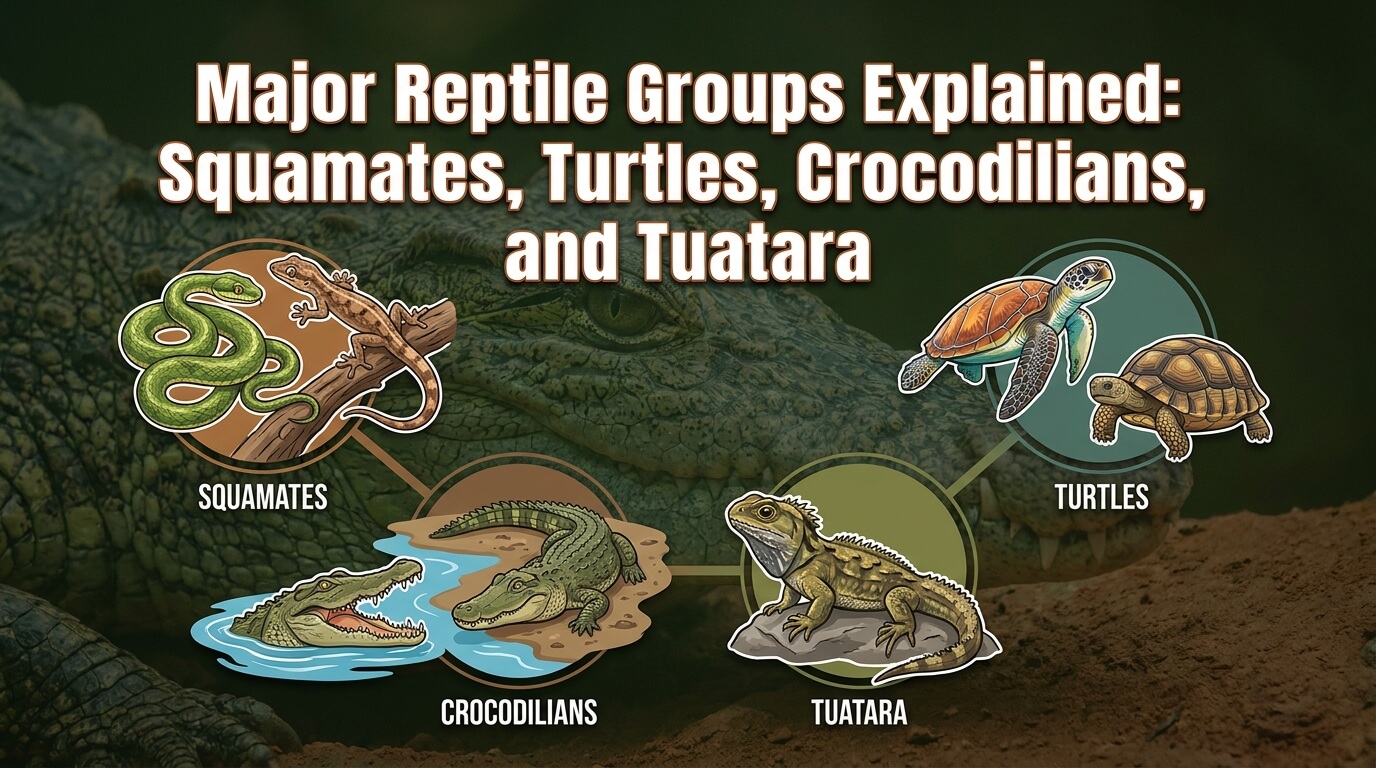
The major reptile groups are easier to understand when familiar animal names are placed inside a modern evolutionary framework. For living non-avian reptiles, four broad lineages provide a useful starting point: Squamata, Testudines, Crocodylia, and Rhynchocephalia. Together they include snakes, the many animals commonly called lizards, amphisbaenians, turtles and tortoises, crocodiles, alligators, caimans, gharials, and tuatara.
The important point is that these names do not all sit at the same taxonomic level. Snakes are part of Squamata, tortoises are turtles, and crocodiles are only one branch within Crocodylia. Tuatara may resemble lizards, but they belong to a separate living lineage. Understanding those relationships makes reptile diversity much clearer than memorizing a list of animal names.
Quick Overview of the Four Major Living Non-Avian Reptile Lineages
Why a living non-avian reptile framework is useful
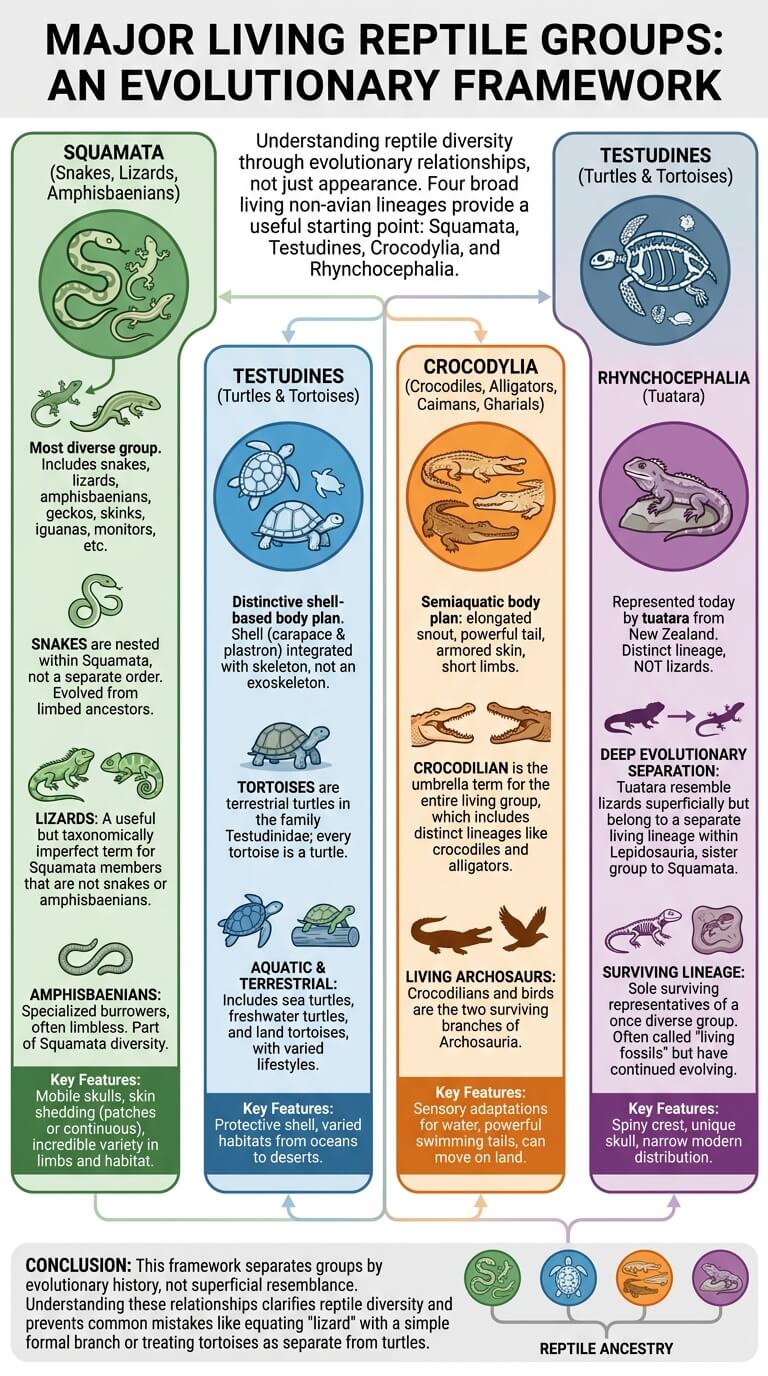
Modern evolutionary classification creates one complication for the word reptile: birds are nested within the broader reptilian evolutionary tree. In everyday animal education, however, birds are usually discussed as their own living vertebrate group because they have a distinctive body plan and their own large body of biological literature. For clarity, the framework here focuses on living non-avian reptiles while keeping the deeper evolutionary relationships accurate.
Within that practical scope, the four major living lineages are Squamata, Testudines, Crocodylia, and Rhynchocephalia. This framework is useful because it separates groups by evolutionary history rather than by superficial resemblance. A snake and a gecko are both squamates even though their bodies look very different, while a lizard-like tuatara is not a squamate at all.
Taxonomy changes as new evidence accumulates
Reptile taxonomy is not frozen. New species are described, names are revised, and relationships are tested with anatomy, fossils, genetics, and increasingly large molecular datasets. The Reptile Database maintains taxonomic information for living reptiles and is one of the most useful references for checking current names and higher-group placement.
The Catalogue of Life also publishes regularly updated global taxonomic releases. That is why a broad explanation of reptile groups is more durable when it focuses on relationships and recognizable lineages instead of locking the reader to a single species total or an old textbook count.
A Simple Framework for Understanding Reptile Diversity
Squamata
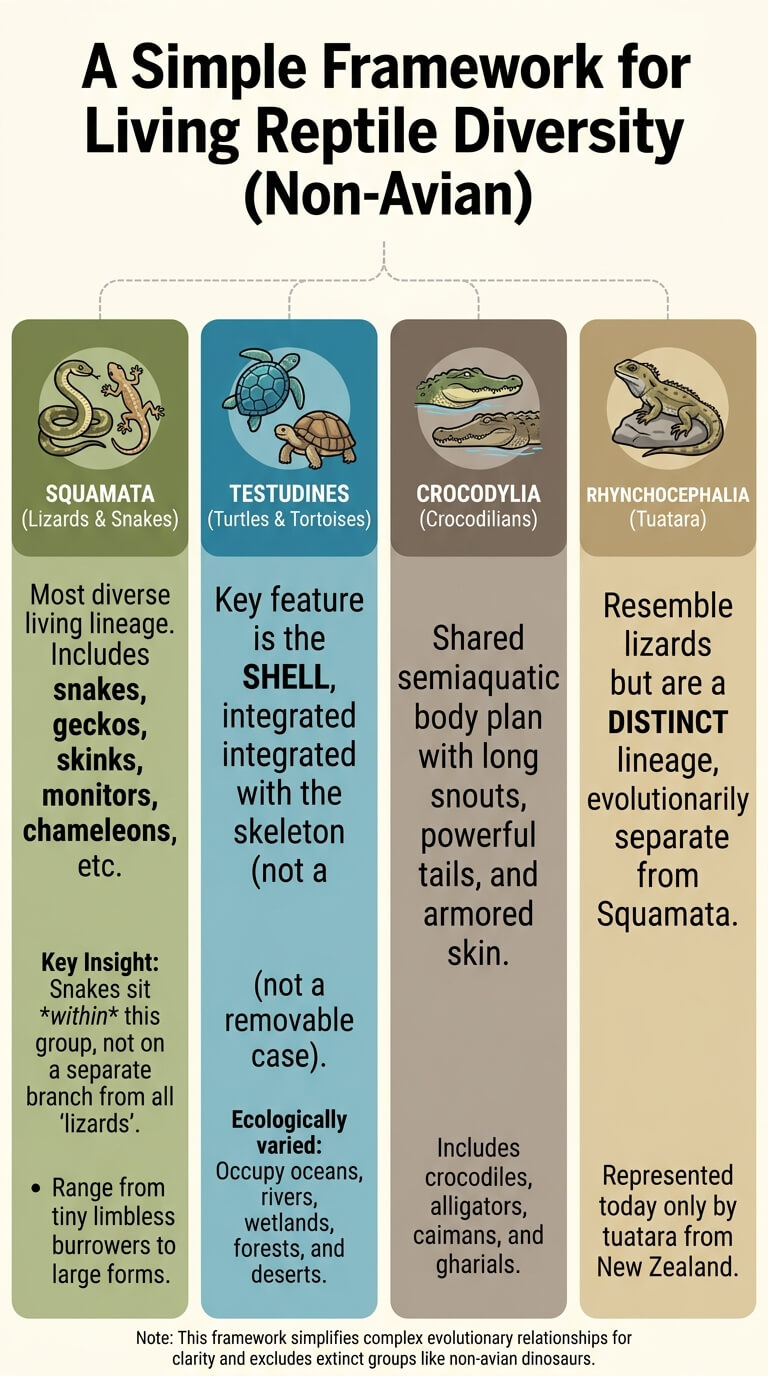
Squamata is the lineage that contains snakes, amphisbaenians, geckos, skinks, iguanas, chameleons, monitors, anoles, and many other reptiles commonly called lizards. It is by far the most diverse of the four major living non-avian reptile lineages. Its members range from tiny, limb-reduced burrowers to large monitors and fully limbless snakes.
For classification purposes, the safest mental model is not “lizards on one side and snakes on the other.” Snakes arose within squamate diversity, and the everyday category “lizard” does not correspond to one simple formal branch that excludes snakes and includes every other squamate.
Testudines
Testudines includes turtles, including the terrestrial forms commonly called tortoises. Their most distinctive feature is the shell, which is integrated with the skeleton rather than being an external case an animal can leave behind. Living turtles occupy oceans, rivers, wetlands, forests, grasslands, scrublands, and deserts, so the group is much more ecologically varied than the familiar pond-turtle image suggests.
Crocodylia
Crocodylia contains crocodiles, alligators, caimans, and gharials. These reptiles share a broadly similar semiaquatic body plan, with long snouts, powerful tails, armored skin, short limbs, and sensory systems suited to life around water. The word crocodilian is the useful umbrella term for the entire living group.
Rhynchocephalia
Rhynchocephalia is represented today by tuatara from New Zealand. Tuatara resemble sturdy lizards at a glance, but that resemblance hides a deep evolutionary separation. They are the surviving representatives of a lineage distinct from Squamata and are therefore not lizards.
Squamata: Snakes, Amphisbaenians, and the Many Lineages Commonly Called Lizards
What unites squamates
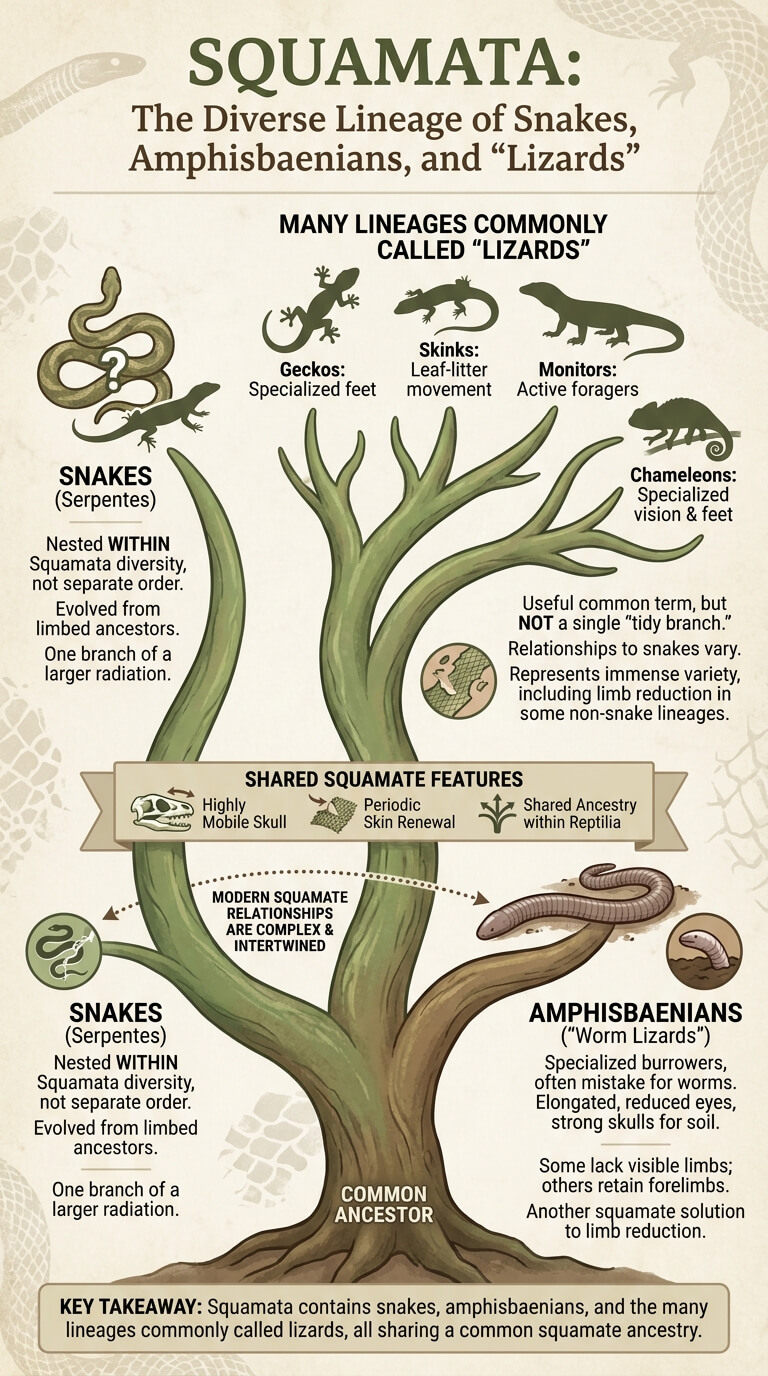
Squamates share ancestry and a suite of anatomical features that distinguish them from turtles, crocodilians, and rhynchocephalians. One important feature is a highly mobile skull compared with many other vertebrates, although the amount and type of skull movement differ greatly among squamate lineages. Squamate skin also undergoes periodic renewal, but the visible pattern of shedding ranges from large continuous pieces in many snakes to patches or flakes in many lizards.
The group displays extraordinary variation in limbs, feeding anatomy, habitat use, and movement. Some geckos have specialized adhesive toe structures, many skinks have compact bodies suited to moving through leaf litter or soil, monitors tend to be active foragers, and chameleons combine grasping feet with highly specialized visual and feeding systems. These differences are modifications within one large evolutionary lineage rather than signs that each body type represents a separate major reptile group.
Why snakes are nested within squamate diversity
Snakes are squamates, not an order standing alongside “lizards” as an equivalent catch-all group. The current current Squamata records in the Reptile Database place the enormous variety of snakes and lizard-like reptiles within the same higher lineage.
Snakes evolved from limbed squamate ancestors, but that does not mean they descended from any modern lizard species. Living snakes and living lizards share extinct common ancestors. Limb reduction also evolved in several non-snake squamate lineages, which is one reason a limbless body alone does not identify an animal as a snake.
Keeping snakes in their correct context helps prevent them from overwhelming the idea of reptile diversity. Snakes are biologically important and extremely varied, but they are one branch within a much larger squamate radiation.
Why “lizard” is useful but taxonomically imperfect
In everyday language, lizard is a useful word. It helps describe familiar reptiles such as geckos, iguanas, skinks, chameleons, anoles, and monitor lizards. The difficulty begins when the word is treated as though all lizards form one tidy branch whose sister group is snakes.
Modern squamate relationships are more complicated. Different lineages traditionally called lizards are related to snakes in different ways, so “lizard” can function as a practical body-form and common-name category without being a single simple formal unit. For general readers, the useful takeaway is that Squamata contains snakes, amphisbaenians, and the many lineages commonly called lizards.
Where amphisbaenians fit
Amphisbaenians are specialized burrowing squamates, sometimes called worm lizards. Most have elongated bodies, reduced eyes, and strong skulls adapted for moving through soil. Many species lack visible limbs, although a small number retain forelimbs.
Their unusual appearance makes them easy to mistake for worms or snakes, but their ancestry places them within Squamata. They are another reminder that squamate evolution produced multiple solutions to burrowing and limb reduction, not just the familiar snake body plan.
Testudines: Turtles and Tortoises
A shell-based body plan with broad ecological diversity
Turtles are defined by one of the most distinctive vertebrate body plans. The shell includes bone integrated with the ribs and vertebral column, with the upper carapace and lower plastron forming a protective structure around much of the body. Many species have keratinous scutes over the bony shell, while others have different outer coverings.
The Animal Diversity Web account for Testudines emphasizes that the shell is part of the skeleton, not an exoskeleton that can be removed. That basic anatomical fact explains why a turtle cannot crawl out of its shell in the way a hermit crab leaves a borrowed shell.
Despite the shared shell, turtle lifestyles vary widely. Sea turtles are powerful ocean swimmers, softshell turtles are highly aquatic, painted turtles and many other freshwater species use ponds and wetlands, box turtles are largely terrestrial, and tortoises have evolved strongly land-based lifestyles.
Why tortoises are turtles, not a separate reptile order
Tortoise is a common name for terrestrial turtles in the family Testudinidae. In other words, every tortoise is a turtle, but not every turtle is a tortoise. Tortoises did not branch off as a separate major reptile order equal to Testudines. They are one specialized part of turtle diversity.
That distinction matters because popular animal lists often treat “turtles” and “tortoises” as parallel categories. It is more accurate to use turtle for the broader group and tortoise for the terrestrial members of a particular turtle lineage.
Aquatic, semiaquatic, and terrestrial turtles
Not all turtles are aquatic, and not all aquatic turtles use water in the same way. Sea turtles spend most of their lives in marine environments but females come ashore to nest. Many freshwater turtles divide their time among water, basking sites, and land. Tortoises live on land and may occupy habitats ranging from dry scrub to grasslands and islands.
Even shell form varies with lifestyle. Streamlined marine shells and flipper-like limbs support open-water swimming, while many tortoises have sturdy limbs and high-domed shells suited to life on land. These are variations on the turtle body plan, not separate major reptile identities.
Crocodylia: Crocodiles, Alligators, Caimans, and Gharials
What makes a crocodilian
Living crocodilians share a recognizable combination of features: elongated jaws, muscular tails, armored skin, short but powerful limbs, and sensory adaptations associated with semiaquatic life. Their eyes and nostrils are positioned high on the head, which allows much of the body to remain submerged while the animal monitors the surface.
They also move more flexibly on land than the stereotype of a belly-dragging reptile suggests. Crocodilians can use a low posture and, in many situations, a higher walk that lifts the trunk farther from the ground. In water, the tail is the primary source of propulsion.
Why crocodilian is the precise umbrella term
The living order includes crocodiles, alligators, caimans, and gharials. The Animal Diversity Web overview of Crocodylia places these animals together as one living reptile group and also notes their archosaur relationship with birds.
Calling every member a crocodile can be convenient in casual conversation, but it hides meaningful differences. Alligators and caimans belong to one major branch, crocodiles to another, and gharials represent a distinctive long-snouted lineage. “Crocodilian” avoids implying that one familiar subgroup stands for the entire order.
Shared body plan, varied habitats
All living crocodilians are strongly associated with water, but they do not all occupy the same environments. Depending on species, they may live in rivers, lakes, marshes, swamps, floodplains, mangroves, estuaries, or coastal waters. Some tolerate saltwater better than others.
Their similar overall shape reflects a shared semiaquatic heritage, yet differences in snout shape, body size, behavior, diet, and habitat use can be substantial. Those differences are best explored at species or subgroup level rather than turning the entire crocodilian lineage into a single generalized profile.
Rhynchocephalia: The Tuatara Lineage
Why tuatara are not lizards
Tuatara have four limbs, a long tail, a low body, and a crest of spines, so a casual observer may reasonably think “lizard.” Evolutionary history tells a different story. The Smithsonian’s overview of rhynchocephalians explains that tuatara belong to Rhynchocephalia rather than to the lizard and snake lineage Squamata.
Tuatara and squamates are close relatives within the broader lepidosaur branch of reptiles, but close relatives are not the same group. Calling a tuatara a lizard would be similar to collapsing two neighboring branches simply because their living representatives have a comparable outline.
Rhynchocephalians are a surviving lineage, not a frozen relic
Rhynchocephalians were much more diverse in the past. Today, tuatara are the only living representatives of that broader lineage. This makes them unusually informative for studying reptile evolution, but it does not mean modern tuatara are unchanged copies of ancient animals.
They have continued evolving like every other living organism. Their present-day anatomy, genetics, physiology, and ecology reflect their own evolutionary history. The fact that close relatives disappeared does not freeze the surviving branch in time.
Why “living fossil” needs qualification
The phrase living fossil is sometimes used for tuatara because their lineage extends far back in the fossil record and has few living representatives. The phrase can be misleading if it suggests that tuatara stopped changing or are identical to Jurassic rhynchocephalians.
A better interpretation is that tuatara preserve a living branch of a once much more diverse reptile lineage. Fossils can help scientists compare ancient and modern members, but the modern animals are not museum pieces that escaped evolution.
How the Major Groups Differ at a Glance
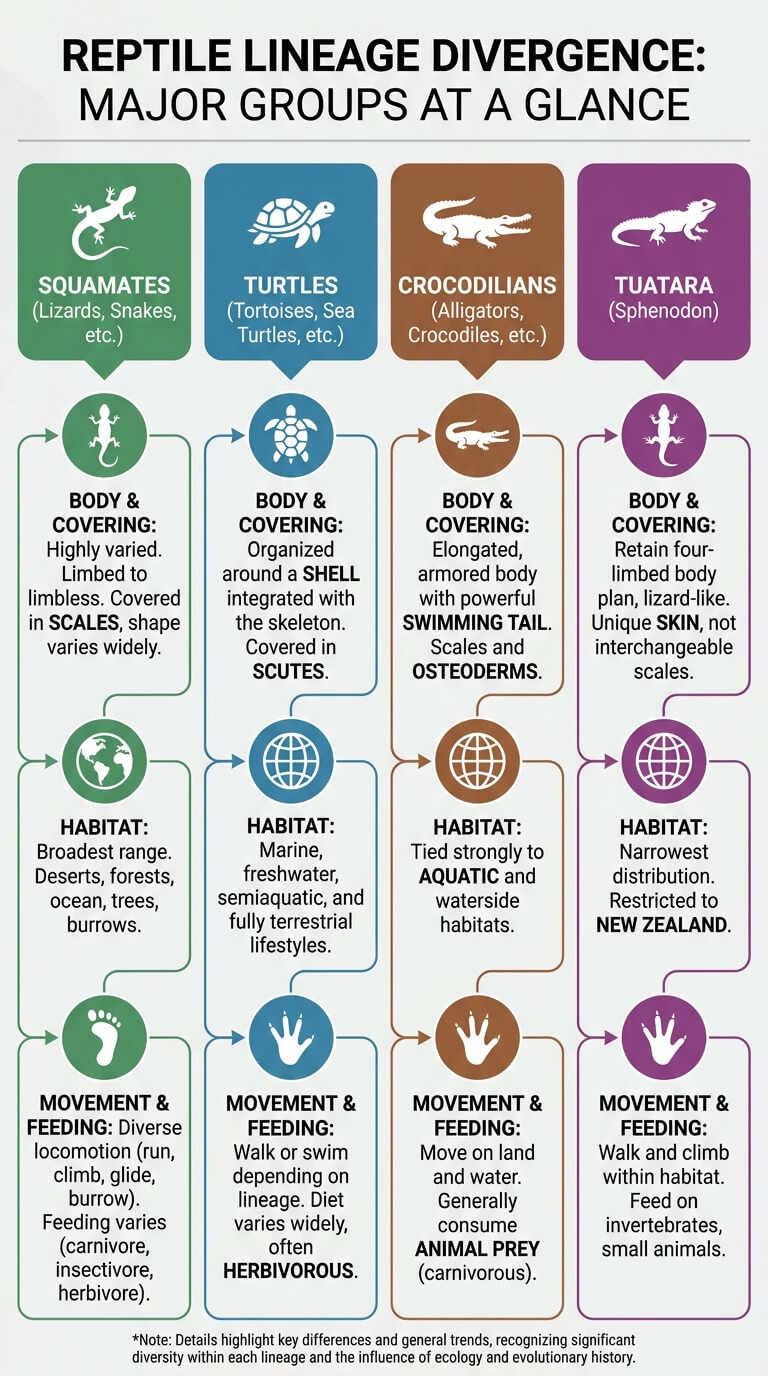
Body plans and external coverings
The four lineages share reptilian ancestry but express it through strikingly different bodies. Squamates range from limbed geckos and monitors to limbless snakes and burrowing amphisbaenians. Turtles are organized around a shell integrated with the skeleton. Crocodilians combine an elongated, armored body with a powerful swimming tail. Tuatara retain a four-limbed body plan that superficially resembles some lizards.
External coverings also differ. Squamate scales, turtle scutes, crocodilian scales and osteoderms, and tuatara skin are not simply interchangeable versions of one surface. Even within a lineage, scale shape and arrangement can vary with ecology and body region.
Habitat breadth
Squamates occupy deserts, forests, grasslands, mountains, wetlands, rivers, coasts, trees, burrows, and the open ocean. Turtles span marine, freshwater, semiaquatic, and fully terrestrial lifestyles. Crocodilians are tied more strongly to aquatic and waterside habitats, while living tuatara have a much narrower natural distribution in New Zealand.
These differences show why “reptile habitat” cannot be reduced to hot deserts. Temperature, water availability, shelter, prey, vegetation, nesting sites, and evolutionary history all shape where particular reptiles can live.
Movement and feeding diversity
Locomotion follows body design. Snakes use limbless locomotor modes, many lizards run or climb, turtles walk or swim depending on the lineage, crocodilians move on land and in water, and tuatara walk and climb within their habitat. Some squamates burrow, glide, cling to smooth surfaces, or move through loose sand.
Feeding is equally varied. Snakes are carnivorous, many lizards eat invertebrates, some iguanas and other lizards rely heavily on plants, tortoises are often herbivorous, freshwater turtles vary widely in diet, and crocodilians generally consume animal prey. These examples show diversity without implying that every member of a lineage eats the same foods.
Reptiles and Birds in the Larger Evolutionary Tree
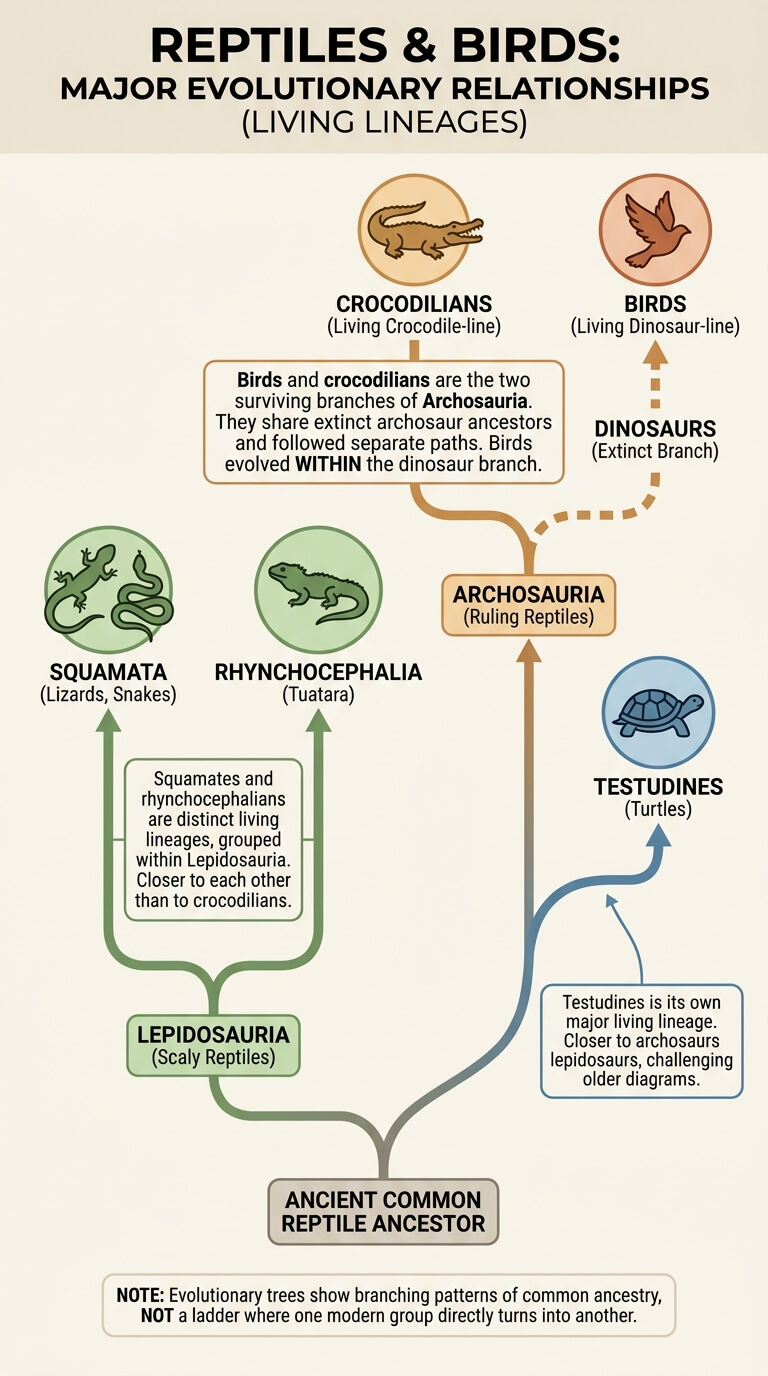
Crocodilians and birds are living archosaurs
One of the most important modern reptile relationships is also one of the least obvious from appearance. Birds and crocodilians are the two surviving branches of Archosauria. A Smithsonian discussion of reptile relationships describes birds as most closely related to crocodilians among living reptiles.
This does not mean birds evolved from modern crocodiles, or that crocodiles are dinosaurs. Birds and crocodilians share extinct archosaur ancestors, then their lineages followed separate evolutionary paths. Birds evolved within the dinosaur branch, while crocodilians represent the living crocodile-line archosaurs.
Squamates and tuatara belong within Lepidosauria
Squamates and rhynchocephalians are grouped within Lepidosauria. That relationship explains why tuatara are closer to lizards and snakes than to crocodilians, while still remaining outside Squamata itself.
For beginners, it helps to picture two levels at once: Squamata and Rhynchocephalia are distinct living lineages, but both sit within a larger lepidosaur branch. The same idea applies to crocodilians and birds within Archosauria.
Where turtles fit
Turtle relationships were historically difficult to resolve because their highly modified skull and shell anatomy made comparisons challenging. Molecular and genomic studies have strongly supported turtles as closer to archosaurs than to lepidosaurs, although the history of the debate explains why older diagrams may place them differently.
For a general classification guide, the safest approach is to recognize Testudines as its own major living reptile lineage and avoid forcing the reader into an outdated ladder. Evolutionary trees are branching patterns of common ancestry, not a sequence in which one modern reptile group turns directly into another.
Common Reptile Classification Mistakes
Snakes and lizards are not two equivalent formal orders
Older educational diagrams often split reptiles into snakes, lizards, turtles, and crocodiles as though each label represents the same kind of taxonomic unit. That is convenient but misleading. Snakes and the reptiles commonly called lizards are both within Squamata.
The corrected idea is simple: start with Squamata, then recognize that it contains snakes, amphisbaenians, and numerous lineages commonly called lizards. That preserves familiar language without pretending the taxonomy is cleaner than it is.
Tortoises are not outside the turtle group
A tortoise is a turtle adapted to terrestrial life, not a separate order. The distinction is useful in common language because tortoises differ from marine and many freshwater turtles in habitat and body form, but the larger classification remains Testudines.
Tuatara are not a type of lizard
The resemblance is real, but ancestry matters more. Tuatara belong to Rhynchocephalia, while lizards and snakes belong to Squamata. Describing tuatara as “lizard-like reptiles” is much more accurate than calling them lizards.
Crocodile is not a synonym for every crocodilian
Crocodiles, alligators, caimans, and gharials are related, but the names are not interchangeable. Crocodilian is the broad term. This is especially useful when discussing features shared across Crocodylia without implying they belong only to crocodiles.
How Classification Helps Explain Reptile Biology
Shared ancestry explains common traits
Classification is useful because it provides a framework for understanding why animals share certain features. Squamates inherit a common body of anatomical traits from squamate ancestors. Turtles share the shell-based body plan of Testudines. Crocodilians share a semiaquatic archosaur heritage. Tuatara retain the only living window into Rhynchocephalia. The lineages share an evolutionary framework, but the traits that define a reptile should not be reduced to any one visible feature.
Those patterns make it easier to understand reptile skin, movement, reproduction, senses, habitat use, and behavior without assuming every reptile works the same way.
Body form and habitat can evolve in different directions
Related animals can become very different when populations adapt to different environments. Squamates are the clearest example, with running lizards, burrowing amphisbaenians, gliding forms, marine snakes, and countless intermediate lifestyles. Turtle evolution likewise produced ocean swimmers, freshwater species, and terrestrial tortoises. The four lineages also face very different pressures, so reptile conservation must be evaluated by species, region, and threat rather than by the group as a whole.
Classification therefore gives a starting point, not a prediction that every close relative must look or behave alike. Evolution modifies inherited structures as lineages respond to different ecological pressures.
Snakes make more sense as one squamate branch
Placing snakes inside Squamata also prevents a common imbalance in reptile education. Snakes can be studied deeply on their own, but they do not define reptiles as a whole. Their limbless movement, specialized feeding systems, sensory adaptations, and enormous ecological diversity are best understood as one remarkable outcome within squamate evolution.
That leaves room to appreciate turtles, crocodilians, tuatara, and the many non-snake squamates on their own biological terms rather than measuring every reptile against a snake-centered model.
FAQ
What are the four major groups of living non-avian reptiles?
A useful modern framework recognizes Squamata, Testudines, Crocodylia, and Rhynchocephalia. Squamata includes snakes, amphisbaenians, and the many lineages commonly called lizards. Testudines includes turtles and tortoises. Crocodylia includes crocodiles, alligators, caimans, and gharials. Rhynchocephalia is represented today by tuatara.
Are snakes lizards?
Snakes are squamates and are evolutionarily nested within the broader radiation that also contains the animals commonly called lizards. It is usually clearer to say that snakes and lizards are both squamates rather than simply calling snakes lizards. The word lizard is useful in everyday language, but it does not describe one simple formal branch that stands opposite snakes.
Are tortoises turtles?
Yes. Tortoises are terrestrial turtles in the family Testudinidae. Turtle is the broader term for members of Testudines, while tortoise refers to a specialized land-dwelling part of that diversity.
Is a tuatara a lizard?
No. Tuatara are rhynchocephalians, not squamates. They resemble lizards superficially and are related to squamates within Lepidosauria, but they belong to a distinct evolutionary lineage.
Are crocodiles and alligators the same group?
They are both crocodilians, so they belong to the same larger order, Crocodylia, but they are not the same subgroup. Crocodiles, alligators, caimans, and gharials represent different branches within living crocodilian diversity.
Final Thoughts
The major reptile groups become much easier to understand once common names are placed inside the correct evolutionary framework. Squamata contains snakes, amphisbaenians, and the many lineages commonly called lizards. Testudines contains turtles, including tortoises. Crocodylia contains crocodiles, alligators, caimans, and gharials. Rhynchocephalia survives today in tuatara. These lineages differ dramatically in body form and ecology, but each represents a distinct part of living non-avian reptile diversity. Keeping those relationships straight prevents the most common classification mistakes and gives a stronger foundation for understanding reptile anatomy, movement, habitats, and behavior.

Ethan Walker is the founder and research editor of Animal Fact Central. He creates and reviews educational animal facts content using trusted wildlife, pet care, and science-based sources. His work focuses on making animal behavior, adaptations, habitats, and species facts clear, accurate, and engaging for everyday readers.
Read More Details About Ethan Walker: https://animalfactcentral.com/ethan-walker/
3 thoughts on “Major Reptile Groups: Squamates, Turtles & More”