
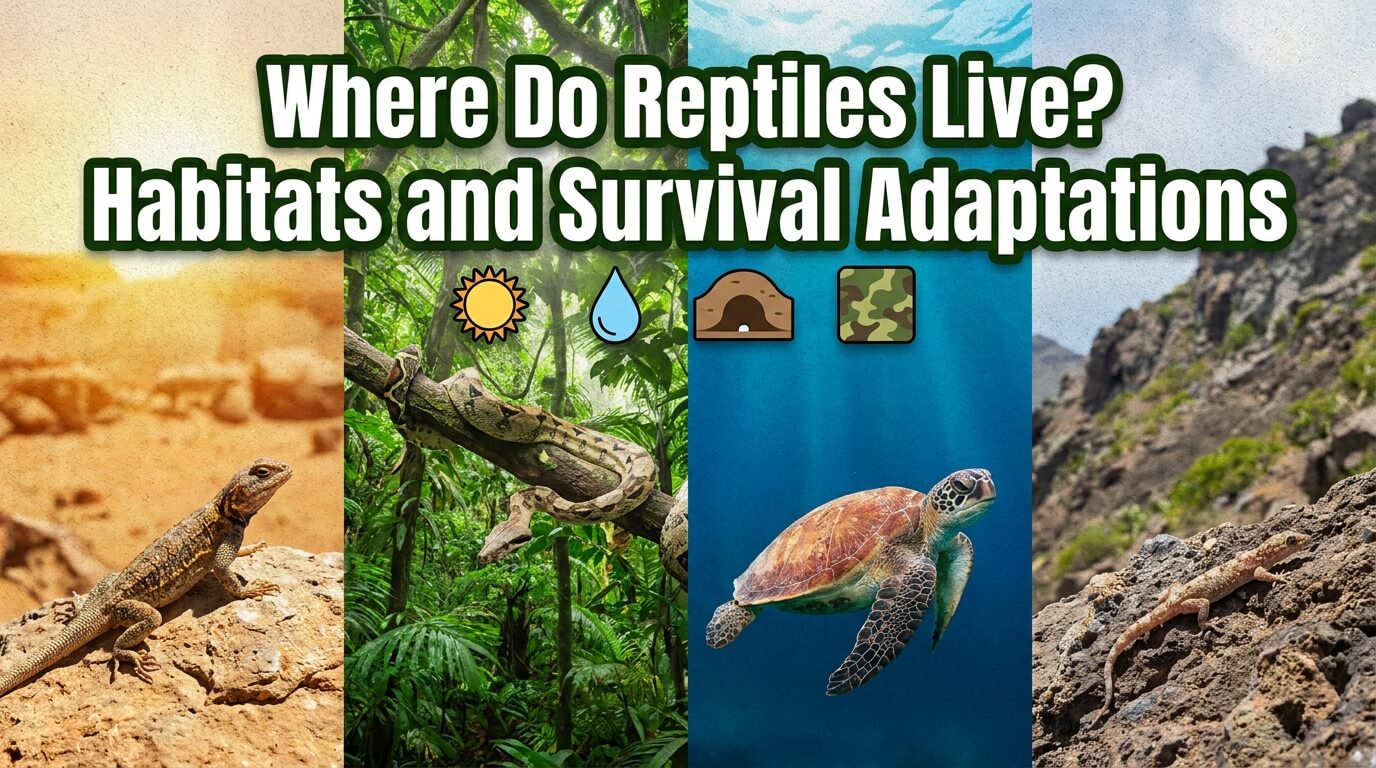
Reptiles live in far more places than hot deserts. Living non-avian reptiles occupy tropical rainforests, temperate woodlands, grasslands, rocky slopes, freshwater lakes, wetlands, mangroves, coastlines, islands, underground burrows, and even the open ocean. Their distribution is shaped by temperature, water, food, shelter, reproduction, and the body features that let each species use a particular environment.
The useful question is not simply whether a place is warm. A reptile needs access to conditions that let it warm up or cool down, avoid dangerous extremes, find food, escape predators, and complete its life cycle. That is why a forest gecko, a desert tortoise, an American alligator, a sea turtle, and a mountain-dwelling snake can all be reptiles while living in very different surroundings.
Quick Overview: Reptiles Live in Far More Than Deserts
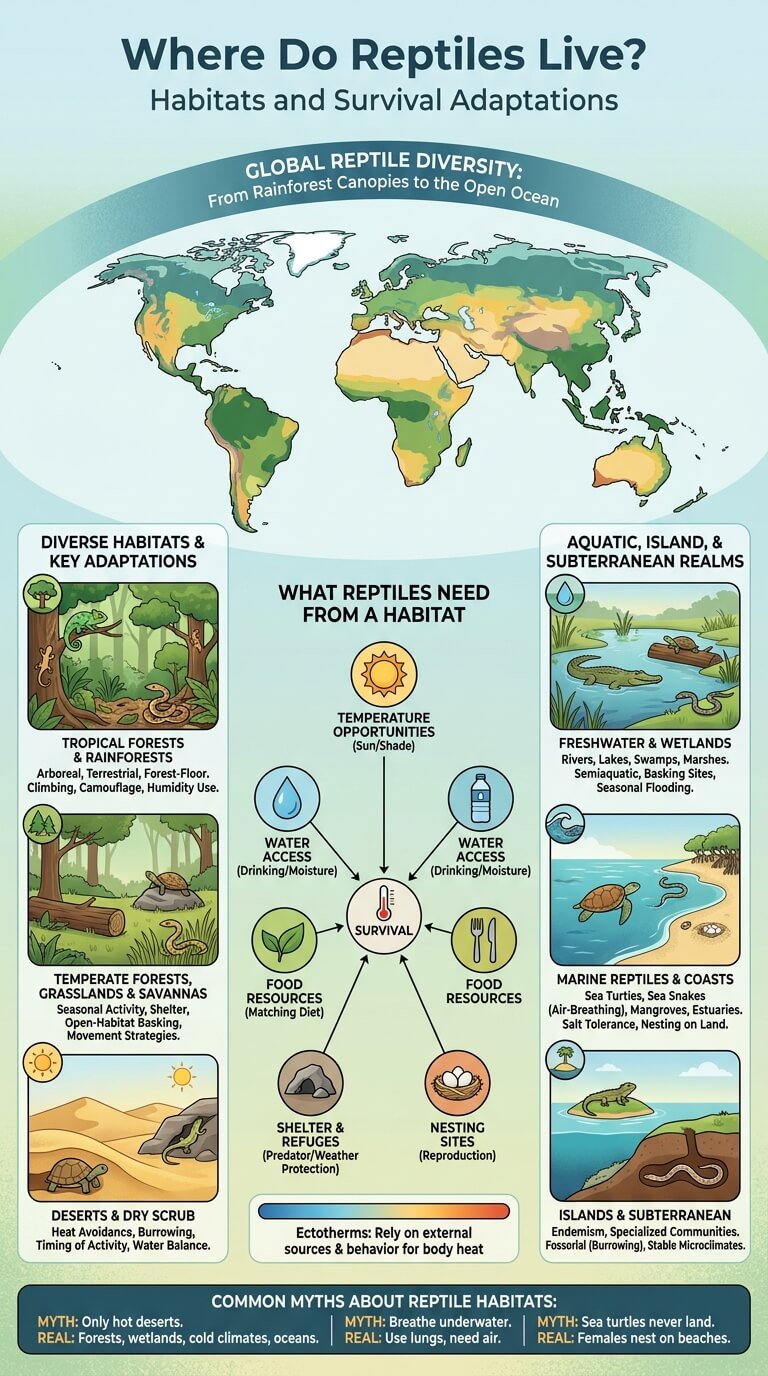
Global diversity of reptile habitats
Reptiles are distributed across most of the world, with especially high diversity in many tropical and subtropical regions. The group includes animals that spend most of their lives on land, species tied closely to freshwater, semiaquatic crocodilians, burrowing squamates, arboreal lizards and snakes, marine turtles, and sea snakes. The Animal Diversity Web overview of Reptilia also emphasizes a basic feature shared across living reptiles: they breathe with lungs rather than gills.
Within any broad habitat label, conditions can vary sharply over short distances. A sunlit rock, shaded crevice, hollow log, deep pond, tree canopy, riverbank, and underground tunnel can all form different microhabitats. For an ectothermic animal, these small-scale differences may be as important as the larger biome.
Climate matters, but reptiles are not restricted to hot places
Living non-avian reptiles are ectotherms, meaning much of the heat that affects their body temperature comes from outside the body. That makes climate important, but it does not mean reptiles can live only where the air is hot. Many species use behavior and microhabitats to create usable thermal conditions even in temperate regions.
Cold winters and short summers can reduce reptile diversity because activity seasons become shorter and suitable body temperatures are harder to maintain. Even so, reptiles occur well into cool temperate zones and in some mountain landscapes. The pattern is better described as a gradient of opportunity than a simple warm-versus-cold boundary.
What Reptiles Need From a Habitat
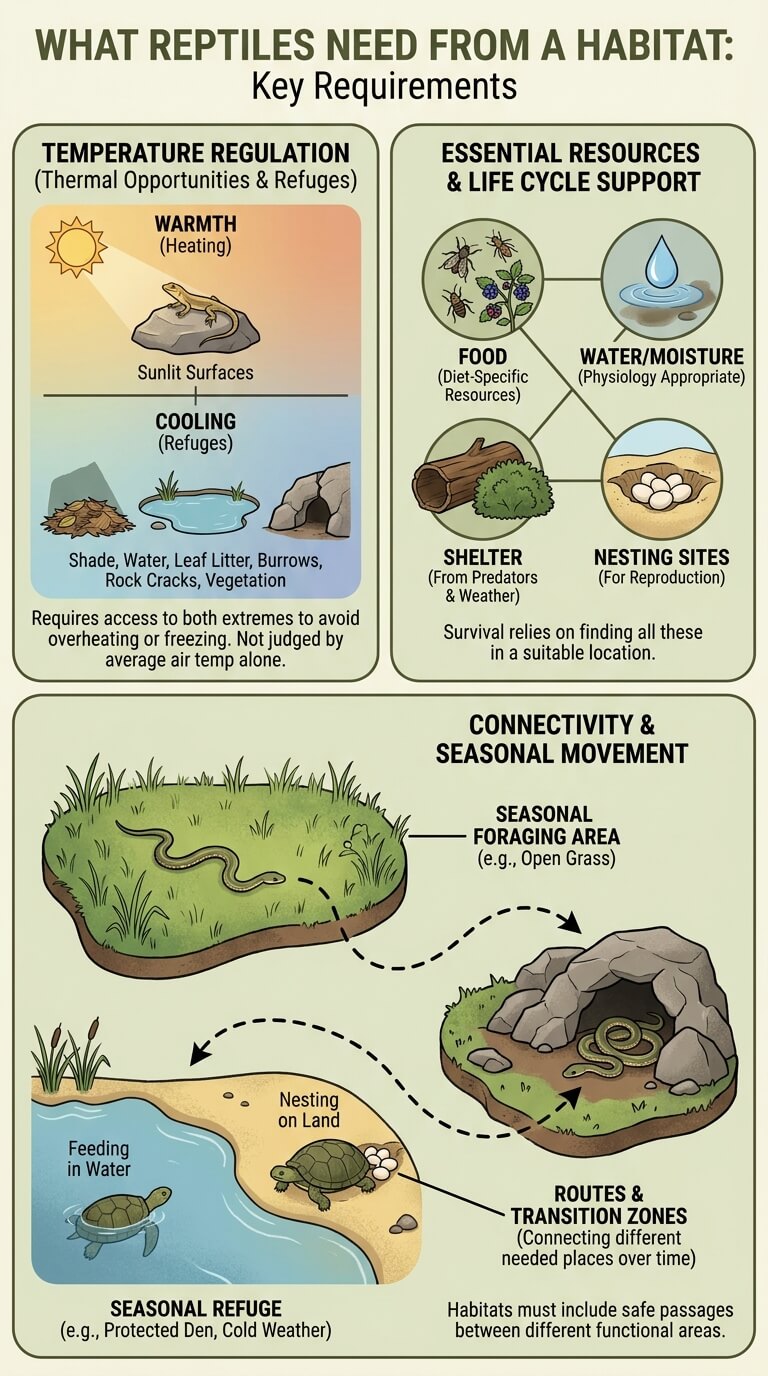
Temperature opportunities and thermal refuges
A usable reptile habitat usually contains both opportunities to gain heat and places to avoid too much heat. Sunlit surfaces can provide warmth, while shade, water, leaf litter, burrows, rock cracks, and dense vegetation can serve as cooler refuges. The exact combination depends on the species.
The National Park Service overview of reptile and amphibian ecology notes that reptiles use protected sites during periods of extreme heat or cold and require access to shelter as well as places where they can warm themselves. This helps explain why habitat quality cannot be judged by average air temperature alone.
Water, food, shelter, nesting sites, and seasonal refuges
Temperature is only one requirement. Reptiles also need food resources that match their diet, shelter from predators and weather, access to water or moisture appropriate to their physiology, and places for reproduction. An animal that can forage successfully in one habitat may still fail there if it cannot find a suitable nest site or seasonal refuge.
Many reptiles also move among habitat patches during the year. A turtle may feed in water but nest on land. A snake may forage in open grass during one season and use a protected den or underground refuge during cold weather. Habitat therefore includes the routes and transition zones that connect the places an animal needs at different times.
Tropical Forests and Rainforests
Arboreal, terrestrial, and forest-floor reptiles
Tropical forests support reptiles at many vertical levels. Geckos, anoles, chameleons, arboreal snakes, and some monitors use trunks, branches, vines, and canopy vegetation. Other species live mainly in leaf litter, around fallen logs, beside streams, or on the forest floor. Some burrowing reptiles spend much of their lives below the surface.
The same forest can therefore contain species with very different body plans and daily routines. A climbing lizard may need gripping feet and stable perches, while a leaf-litter snake may depend more on camouflage, chemical sensing, and access to small prey hidden near the ground.
Climbing, camouflage, humidity, and resource use
Forest habitats create both opportunities and constraints. Vegetation offers shelter and climbing surfaces, but dense shade changes how quickly reptiles can warm. Some species use sun gaps, exposed branches, or forest edges for heat gain, while others are active at night or remain within thermally stable cover.
Humidity can reduce the rate of water loss, but tropical forest reptiles are not simply “humidity-loving” versions of desert reptiles. Species differ in skin permeability, behavior, preferred moisture, and exposure. Camouflage can also depend on matching bark, leaves, shadows, or the irregular patterns of the forest floor rather than one uniform green background.
Temperate Forests, Woodlands, Grasslands, and Savannas
Seasonal activity and shelter
Temperate habitats expose reptiles to larger seasonal changes than many tropical environments. Spring warming can trigger emergence and increased activity, while winter cold may force animals into underground shelters, deep crevices, pond bottoms, or communal den sites depending on the species.
Woodlands provide logs, root systems, rock piles, leaf litter, and sunny openings. Grasslands and savannas provide different combinations of exposure and shelter. A reptile living there may use mammal burrows, dense grass, shrubs, fallen wood, or soil cracks to escape temperature extremes and predators.
Open-habitat basking and movement strategies
Open habitats can create strong contrasts between sun and shade. Lizards may shuttle among exposed ground, grass clumps, fence lines, and burrows. Turtles may use prairie, scrub, woodland edge, or shallow wetland mosaics. Snakes may move through grass, under cover objects, or along edges where prey and shelter are concentrated.
These patterns show why “grassland reptile” does not describe one lifestyle. Body size, limb structure, diet, predator pressure, and reproduction all influence how a species uses open space.
Deserts and Dry Scrub

Heat avoidance, burrowing, and timing of activity
Deserts are famous for reptiles, but survival there often depends on avoiding heat rather than enduring the hottest conditions in the open. Many desert reptiles shift activity to mornings, evenings, nights, or cooler seasons. Burrows, rock crevices, vegetation, and shaded surfaces provide important thermal refuges.
Some species also change posture or move rapidly between exposed and protected patches. A surface that is usable shortly after sunrise may become dangerously hot later in the day, so timing can be as important as anatomy.
Water balance without the myth that desert reptiles need no water
Desert reptiles still need water. What differs is how they obtain it and how efficiently they conserve it. Depending on the species, water may come from drinking, food, temporary pools, dew, moist burrows, or metabolic processes. Keratinized skin helps reduce water loss compared with the highly permeable skin of amphibians, but reptile skin is not perfectly waterproof.
Behavior is equally important. Staying underground during hot, dry periods reduces both heat load and evaporation. Feeding on water-rich prey or plants can contribute to hydration for some species. No single desert strategy applies to all lizards, snakes, or tortoises.
Mountains, Rocky Habitats, and Cool-Season Environments
Sun exposure and microhabitat choice
Mountains can be challenging because temperatures change quickly with elevation, cloud cover, wind, slope direction, and time of day. Rocky terrain can also create a patchwork of warm and cool sites. Sun-facing rocks may heat rapidly, while cracks and shaded ledges remain cooler.
The National Park Service mountain wildlife guidance documents reptiles in mountainous parts of the United States, including parks with cool climates and short favorable seasons. These examples make clear that reptiles are not confined to low, hot landscapes.
Seasonal inactivity and short activity windows
Where winters are long, the active season can be brief. Reptiles may spend extended periods in protected sites and emerge when temperatures permit feeding, digestion, movement, and reproduction. The timing varies by species and latitude.
Cool-climate reptiles often depend heavily on reliable refuges. A south-facing slope, deep rock fissure, underground den, or sheltered wetland edge can make the difference between a usable and unusable site even when the surrounding region seems cold.
Freshwater Habitats
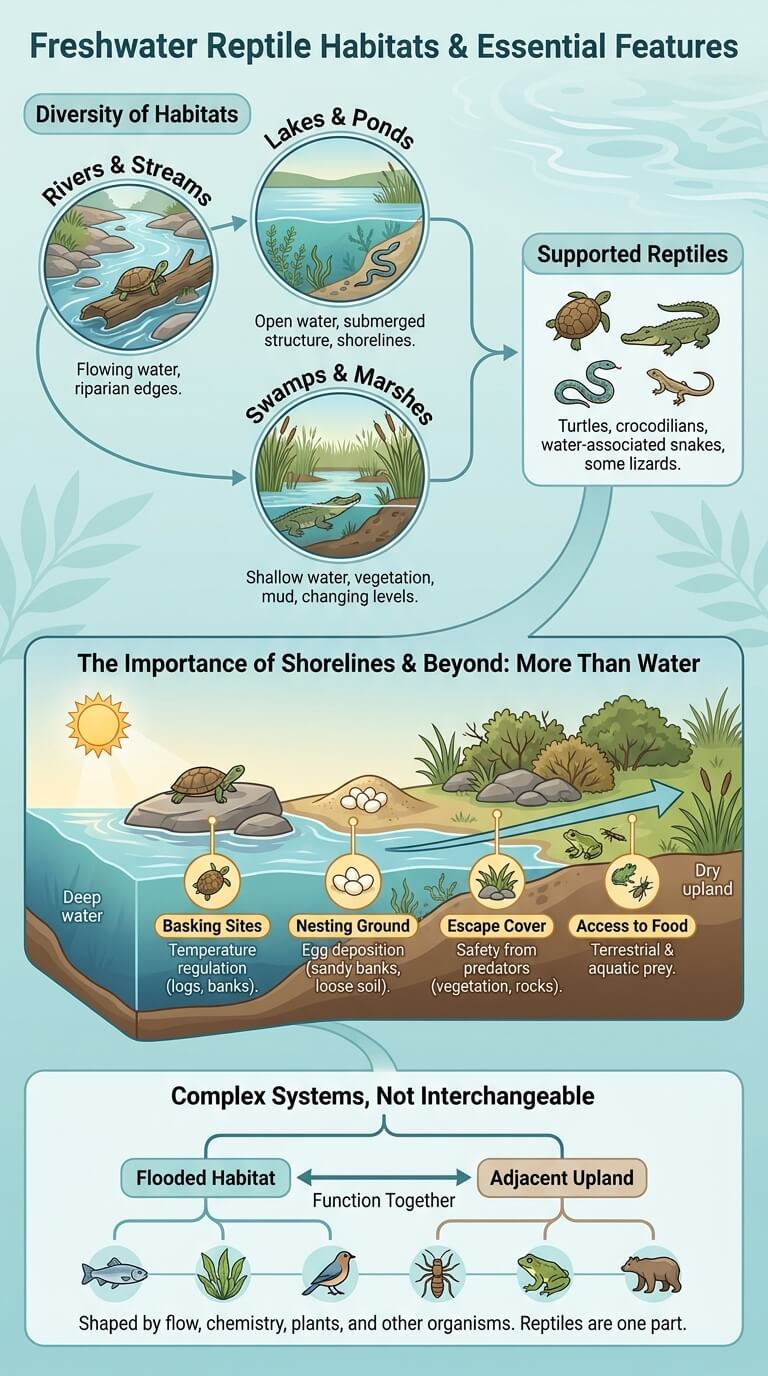
Rivers, lakes, ponds, swamps, and marshes
Freshwater habitats support turtles, crocodilians, water-associated snakes, and some lizards. Rivers and streams offer flowing water and riparian edges. Ponds and lakes provide open water, submerged structure, and shorelines. Swamps and marshes combine shallow water, vegetation, mud, exposed banks, and seasonally changing water levels.
Aquatic or semiaquatic reptiles still depend on features above the waterline. Shorelines can provide basking sites, nesting ground, escape cover, and access to terrestrial food. Flooded habitat and adjacent upland areas often function together rather than as separate worlds.
Freshwater turtles, crocodilians, and water-associated squamates
Freshwater turtles vary widely. Some spend much of the day in water and frequently bask on logs or banks, while others are less conspicuous baskers. Crocodilians move between water and land for resting, nesting, and travel. Water snakes may forage along shorelines or in shallow water and then retreat to vegetation, rocks, or upland cover.
These examples should not be reduced to one “freshwater reptile” formula. Flow speed, water depth, vegetation, prey, bank structure, nesting access, seasonal flooding, and temperature can favor very different species.
Freshwater habitat is more than a list of reptiles
Freshwater ecosystems are shaped by water chemistry, flow, seasonal flooding, plants, fish, invertebrates, amphibians, birds, mammals, and many other organisms. Reptiles are one part of that system. Understanding where they live means recognizing the specific resources they use without treating every river or wetland as interchangeable.
Wetlands and Flooded Landscapes
Seasonal water, nesting, and refuge
Wetlands can change dramatically over a year. Marshes may expand or shrink, floodplains can become inundated, and temporary pools may appear after heavy rain. Reptiles living in these landscapes often respond by shifting where they feed, rest, or travel.
Some species use deeper water as refuge during dry periods, while others rely on nearby uplands for nesting or seasonal shelter. A wetland that looks suitable in one month may offer very different conditions later in the year.
Land and water are often connected
Wetland reptiles commonly depend on both aquatic and terrestrial features. Nesting females may leave the water. Juveniles may use dense shoreline vegetation differently from adults. Animals may travel between ponds during floods or move into adjacent forest, grassland, or scrub.
This movement means conservation and habitat management cannot focus only on the water’s edge. The surrounding landscape can be essential to completing a reptile’s life cycle, even when the animal is usually seen in water.
Coasts, Mangroves, and Estuaries
Salt exposure and semiaquatic lifestyles
Coastal reptiles face conditions that can include salt water, tidal change, intense sun, shifting sand, brackish estuaries, and storms. Some species use mangrove roots and mudflats, while others move among beaches, coastal lagoons, estuaries, and nearby terrestrial habitat.
Salt tolerance varies greatly. Marine reptiles have specialized ways of dealing with salt and water balance, while many freshwater-associated reptiles cannot simply move into seawater. A coastal location therefore does not automatically mean a reptile is physiologically marine.
Crocodilians, turtles, and other coastal reptiles
Saltwater crocodiles can use estuaries and coastal waters as well as rivers and wetlands. Sea turtles feed along reefs, seagrass beds, continental shelves, or open-water areas depending on species and life stage. Mangroves can also support snakes and lizards adapted to brackish, tidal, or shoreline environments.
Coasts are transition zones. They combine land and water in ways that can create rich feeding areas, nesting sites, travel corridors, and refuges, but the exact combination needed differs among reptile lineages.
Open Ocean and Marine Reptiles
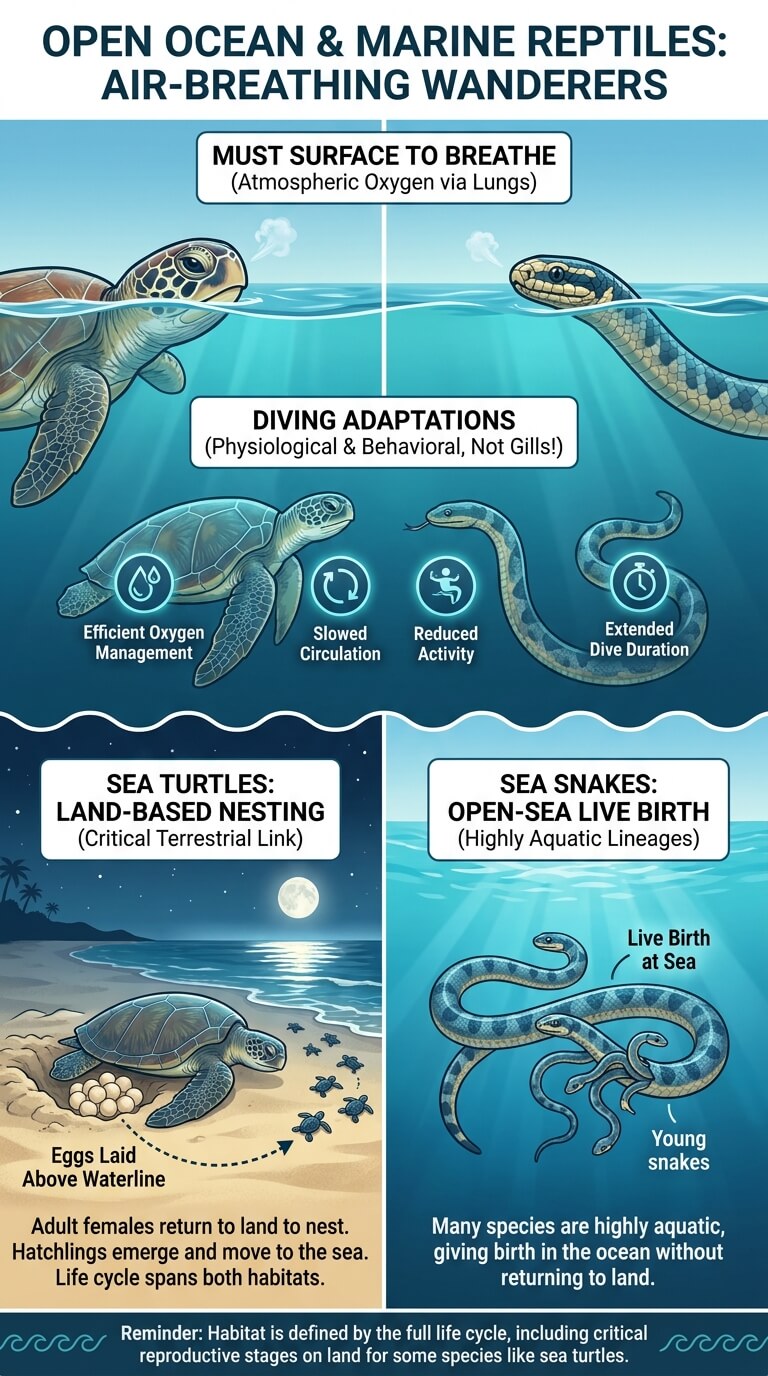
Sea turtles and sea snakes are air-breathing marine reptiles
Some reptiles spend most of their lives at sea. Sea turtles are the most familiar example, and true sea snakes are also highly marine. Neither group breathes underwater like fish. They rely on lungs and must obtain atmospheric oxygen at the surface.
NOAA Fisheries notes that sea turtles are marine reptiles that must surface to breathe, and that adult females return to land to lay eggs. Its olive ridley turtle science profile provides a clear example of this marine-to-beach life cycle.
Diving adaptations do not replace the need for air
Marine reptiles can remain submerged far longer than a human swimmer, but their diving ability comes from physiological and behavioral adaptations rather than gills. They manage oxygen stores, circulation, activity, and dive duration in ways that vary by species and context.
Sea snakes also surface to breathe even though many are highly aquatic. Some lineages give birth at sea, while sea turtles retain a firm reproductive connection to land because eggs are laid in nests above the waterline.
Female sea turtles return to land to nest
Sea turtles may cross enormous ocean areas, but adult females leave the water to dig nests on beaches. Hatchlings then move toward the sea after emerging from the sand. This means a species can be strongly marine while still depending on a terrestrial habitat at a critical stage of reproduction.
That land-sea connection is a useful reminder that habitat should be understood across an animal’s full life cycle, not only by where adults spend most of their time.
Islands and Isolated Habitats
Endemism and specialized communities
Islands often contain reptile populations found nowhere else. Geographic isolation can limit movement between populations and create unusual communities shaped by local climate, vegetation, food, predators, competitors, and geological history.
Island reptiles may occupy forests, scrub, dunes, rocky coasts, caves, or burrows. Some species have narrow ranges, while others occur across multiple islands. Isolation can encourage evolutionary divergence, but it can also make populations sensitive to changes within a small area.
Tuatara show how distinctive an island reptile can be
Tuatara are not lizards. They represent the surviving lineage Rhynchocephalia and are native to New Zealand. The New Zealand Department of Conservation’s tuatara information describes their strong association with offshore island habitats and the importance of those islands to surviving populations.
Tuatara also illustrate why “island habitat” is not a single environment. Their sites can include coastal forest, scrub, burrows, open basking areas, and seabird-influenced ground. The relevant habitat is a combination of structure, climate, food, and refuge.
Burrows and Subterranean Habitats
Fossorial squamates and shelter use
Fossorial means adapted for digging or life underground. Amphisbaenians, some snakes, and many lizards spend substantial time in soil, sand, leaf litter, root channels, or burrow systems. Their bodies may be elongated, compact, reinforced, or otherwise shaped for moving through tight spaces.
Other reptiles are not specialized burrowers but still use burrows opportunistically. A tortoise may excavate a shelter, a snake may use an abandoned mammal tunnel, and a lizard may retreat beneath soil or rocks to escape heat, cold, or predators.
Stable microclimates underground
Below the surface, temperature and humidity often fluctuate less sharply than they do in exposed air. That makes underground refuges valuable in deserts, grasslands, and seasonal climates. Burrows can provide cooler conditions during hot days and protection from freezing air during cold periods.
The benefits are not purely thermal. Burrows can reduce exposure to predators, wildfire, wind, and drying conditions. For some species they are also sites for nesting or long periods of seasonal inactivity.
Urban and Suburban Environments
Buildings, gardens, canals, and fragmented green spaces
Some reptiles can live around people when human-altered landscapes still provide food, shelter, water, and suitable temperatures. Geckos may use buildings, lizards may occupy gardens and walls, turtles may occur in urban ponds, and snakes may move through canals, vacant lots, parks, or fragmented vegetation.
Human structures can create warm surfaces and hiding places, but cities also add hazards such as roads, pets, pollution, habitat fragmentation, and direct persecution. Urban presence therefore does not mean a species is unaffected by development.
Adaptation to cities varies greatly
Some generalist reptiles tolerate disturbance, while specialists may disappear when natural habitat is simplified. Two species living in the same region can respond very differently to lawns, pavement, drainage systems, artificial lighting, or reduced vegetation.
Seeing a few conspicuous reptiles in a city should not be taken as evidence that reptile diversity as a whole is thriving there. Urban ecology is strongly species-specific.
Habitat Adaptations Across Reptiles
Skin and water balance
Reptile skin is keratinized and generally reduces water loss compared with amphibian skin. That helps reptiles use dry environments, but the effect differs among lineages and does not make them independent of water. Skin, behavior, kidney function, diet, shelter use, and activity timing all contribute to water balance. Wetlands and other shared environments also help explain the practical differences between reptiles and amphibians without reducing either group to a single habitat rule.
A turtle living in a pond, a desert lizard, and a sea snake face very different water and salt challenges. Similar broad anatomy can therefore be modified by habitat-specific physiology and behavior.
Locomotion and body form
Habitat structure favors different ways of moving. Climbing species benefit from gripping surfaces and balance. Sand specialists may have fringed toes, streamlined bodies, or movement patterns suited to loose substrate. Aquatic turtles use limbs shaped for swimming, crocodilians rely heavily on powerful tails in water, and snakes use several limbless locomotor modes across land, trees, burrows, and water.
These are trade-offs rather than upgrades. A body specialized for efficient swimming may be less effective on steep rock, while a burrowing body plan may sacrifice speed in open terrain.
Thermoregulation and timing
Habitat determines the menu of thermal choices available to a reptile. A desert species may move between sun, shade, and burrows. A forest species may use canopy gaps, warm trunks, leaf litter, and branches. An aquatic reptile may shift between water depths or move onto land to warm.
Daily timing can be just as important. Nocturnal activity, dawn emergence, midday retreat, seasonal dormancy, and weather-dependent movement all help reptiles use environments that would be unsuitable if they remained exposed continuously.
Common Myths About Reptile Habitats
Myth: Reptiles live only in hot deserts
Deserts support many reptiles, but they are only one part of reptile habitat diversity. Reptiles also live in forests, grasslands, mountains, wetlands, rivers, lakes, coasts, islands, and oceans. Temperate species may survive cold winters by using protected refuges and reducing activity.
Myth: Aquatic reptiles breathe underwater like fish
Living reptiles breathe air with lungs. Aquatic species can remain underwater for varying periods, but turtles, crocodilians, sea snakes, and other aquatic reptiles ultimately depend on atmospheric oxygen. Their ability to dive should not be confused with gill breathing.
Myth: Sea turtles never come onto land
Sea turtles are marine, but adult females come ashore to lay eggs. This makes nesting beaches an essential part of their habitat even though most of their feeding and movement occur in the ocean.
Myth: Every freshwater turtle basks on logs
Visible log basking is common in several familiar freshwater turtles, including painted turtles and sliders, but it is not a universal behavior. Species differ in how, when, and where they regulate body temperature. Some bask less conspicuously or use shallow water, banks, mud, vegetation, or other microhabitats.
How Habitat Shapes Other Parts of Reptile Biology
Thermoregulation depends on microhabitats
Basking, shade seeking, burrowing, and seasonal inactivity only make sense in relation to the places available. A reptile cannot select a cool refuge if the habitat lacks one. The arrangement of sun, shade, water, soil, rocks, and vegetation therefore influences thermal behavior directly.
Movement follows the structure of the environment
Reptile locomotion is also tied to habitat. Climbing, swimming, burrowing, sidewinding, walking, and gliding solve different movement problems. A species’ body form often reflects the surfaces and spaces it uses most often, while behavior lets it switch among them when necessary.
Ecology and conservation begin with place
Habitat determines which prey, plants, predators, competitors, and nesting opportunities a reptile encounters. It also determines which environmental changes matter most. Wetland drainage, road networks, beach development, forest clearing, invasive species, or altered fire regimes do not affect every reptile in the same way. Habitat determines which food webs and interactions are available, helping shape the ecological roles of reptiles in forests, deserts, wetlands, islands, and marine systems.
That is why habitat descriptions are more useful when they identify resources and constraints rather than simply naming a biome. “Forest,” “desert,” and “wetland” are starting points. The real biology lies in how a species uses the fine-scale features within them.
FAQ
Do reptiles live in cold climates?
Yes. Reptile diversity generally declines as climates become colder and activity seasons shorten, but some species live in cool temperate and mountain environments. They use sun exposure, warm microhabitats, underground refuges, seasonal inactivity, and flexible activity timing to cope with cold periods.
Are there reptiles in the open ocean?
Yes. Sea turtles spend much of their lives in marine habitats, and sea snakes include species that are highly adapted to ocean life. These animals still breathe air and must surface for oxygen. Their marine adaptations involve swimming, diving, salt balance, and reproduction that differs among lineages.
Can reptiles live entirely underwater?
Not in the way gill-breathing fish do. Living reptiles use lungs, so even highly aquatic species need access to air. Some can remain submerged for long periods, and a few spend nearly all active life in water, but they still must obtain atmospheric oxygen.
Do reptiles naturally live in Antarctica today?
No native terrestrial reptiles live on the Antarctic continent today. The British Antarctic Survey’s Antarctic wildlife overview notes that the continent has no naturally occurring terrestrial reptiles or amphibians. Extreme cold, ice cover, and the scarcity of ice-free habitat make modern Antarctica unsuitable for the kinds of living non-avian reptiles found elsewhere.
Final Thoughts
Where reptiles live depends on far more than whether a place feels warm. Reptile habitats range from rainforest canopies and desert burrows to mountain slopes, freshwater marshes, mangrove coasts, islands, cities, and the open ocean. What makes each setting usable is the combination of temperature choices, water balance, food, shelter, movement routes, nesting sites, and seasonal refuges available to a particular species.
That diversity is one reason reptiles cannot be understood through a single desert stereotype. Their bodies and behavior are matched to very different environmental problems, and many species use several habitat types during their lives. Looking at those habitat-resource relationships provides a clearer picture of how reptiles survive across such a broad range of environments.

Ethan Walker is the founder and research editor of Animal Fact Central. He creates and reviews educational animal facts content using trusted wildlife, pet care, and science-based sources. His work focuses on making animal behavior, adaptations, habitats, and species facts clear, accurate, and engaging for everyday readers.
Read More Details About Ethan Walker: https://animalfactcentral.com/ethan-walker/
1 thought on “Where Do Reptiles Live? Habitats & Adaptations”