
Insect senses are much more varied than the familiar idea of “eyes for seeing and antennae for smelling.” Insects gather information through specialized sensory cells distributed across the antennae, mouthparts, legs, wings, body surface, and internal joints. Depending on the species, these systems can detect chemicals, light, motion, touch, airflow, vibration, sound, temperature, humidity, and the position of the insect’s own limbs.
The result is not a smaller version of human perception. An insect’s sensory world is built around the signals that matter to its way of life. A moth may depend heavily on airborne chemicals when searching for a mate. A dragonfly relies strongly on vision while intercepting moving prey. A cricket can use sound and vibration during courtship. A mosquito combines chemical, visual, thermal, and humidity cues while locating hosts. Research on mosquito sensory biology, for example, shows that host seeking can involve several sensory systems rather than a single “smell detector.” Journal of Experimental Biology research on mosquito sensory systems describes this multisensory integration in detail.
Quick Answer
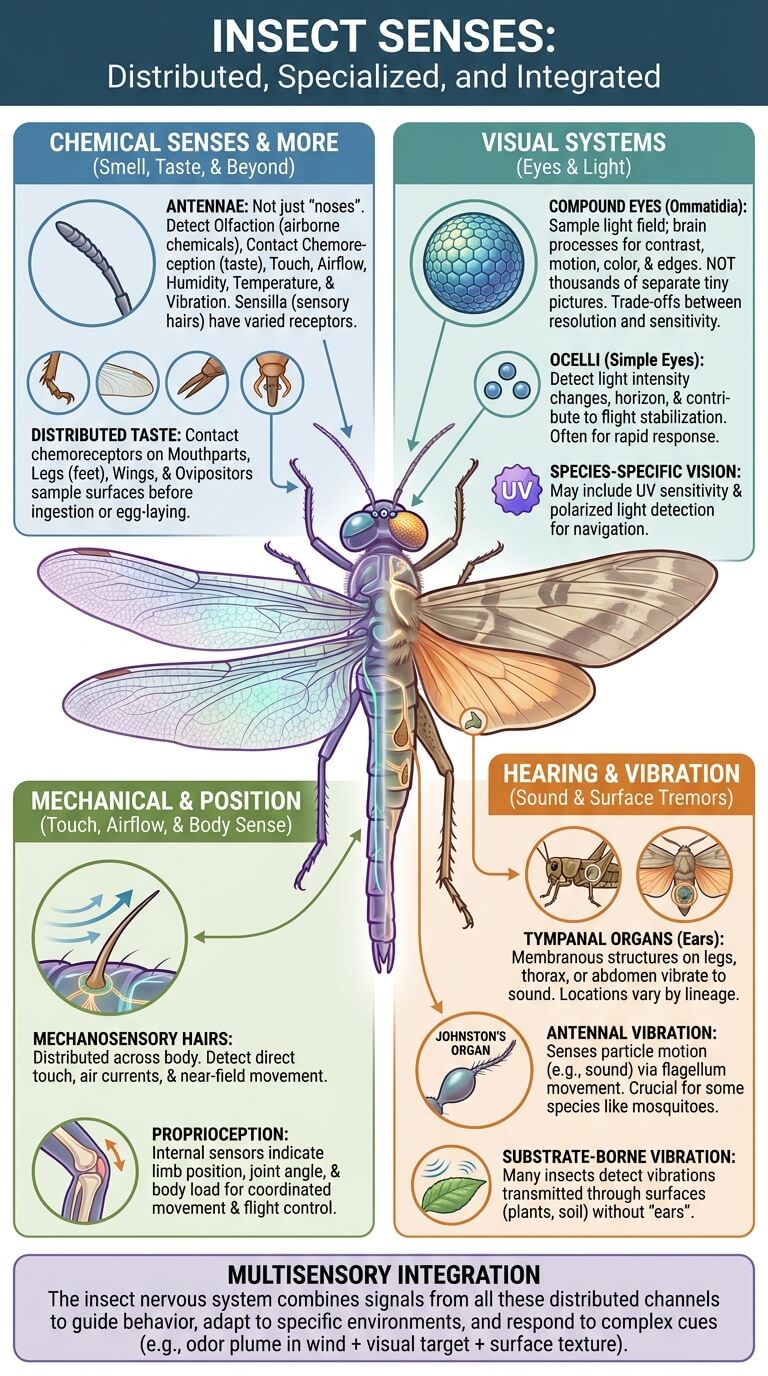
Why insects use many different sensory channels
Insects live in environments where useful information arrives in different physical forms. Odor molecules can travel on air currents. Chemicals on a leaf surface can reveal whether a plant is suitable for feeding or egg laying. Reflected light can show the position of a flower, predator, mate, or horizon. Vibrations can move through air, stems, soil, webs, or other surfaces. Temperature and humidity can indicate whether a site is safe from drying or suitable for development.
No single sensory system can capture all of that information. Insects therefore rely on combinations of receptors and neural processing. Which channels matter most varies among lineages, life stages, habitats, and behaviors. A nocturnal insect may emphasize different visual information than a fast-flying daytime predator. An aquatic immature insect faces a different sensory environment than the winged adult it later becomes.
Sensilla as a unifying concept
A useful word for understanding insect senses is sensillum, plural sensilla. A sensillum is a sensory structure associated with one or more sensory neurons. Many sensilla are tiny hairs, pegs, plates, pits, or other cuticular structures. Their shape, location, and connection to the nervous system help determine what kind of stimulus they detect.
Some sensilla respond to chemicals. Others bend under touch or airflow. Still others participate in temperature or humidity detection. The important point is that insect sensory organs are not limited to a few obvious “sense organs.” Receptors are often spread across the body where they can sample the kinds of information needed at that location.
Antennae: More Than Smell Organs
Chemical detection
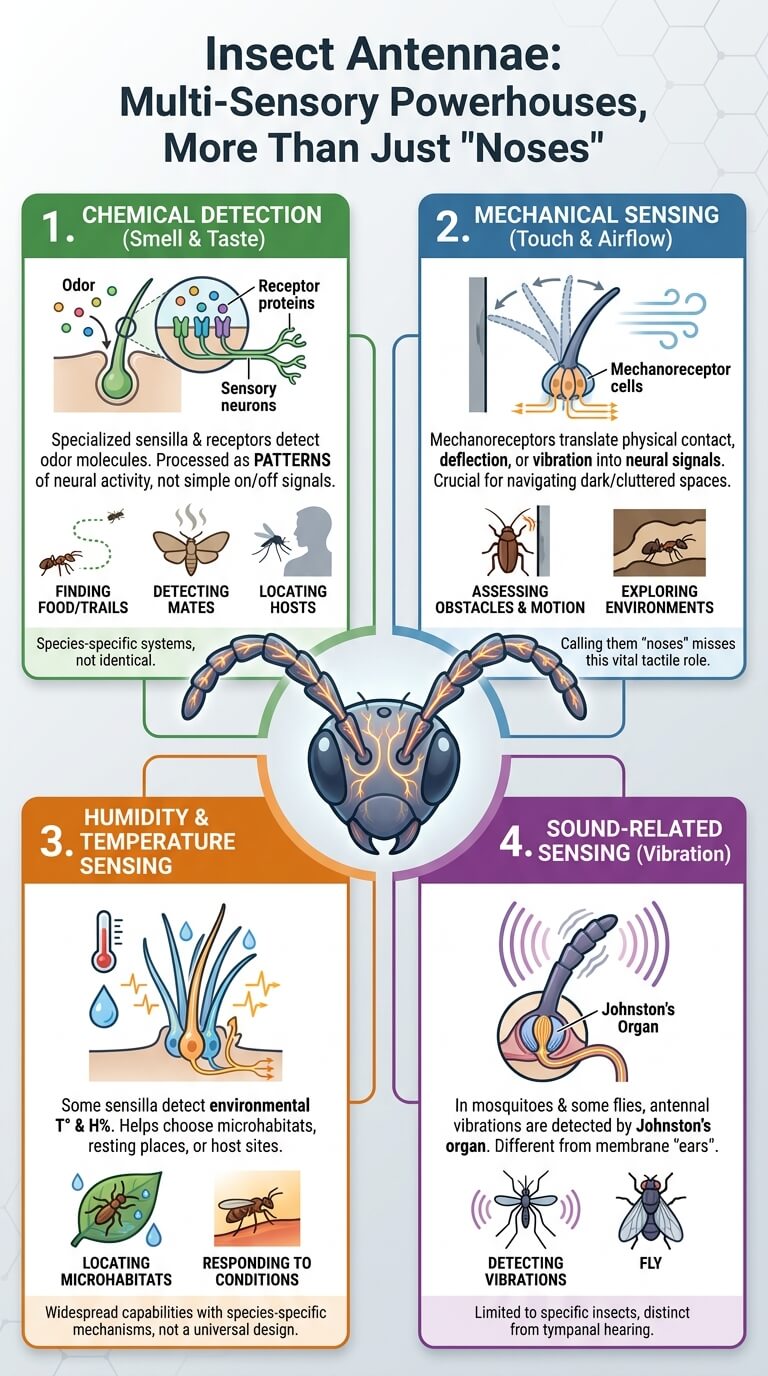
Antennae are among the most conspicuous sensory appendages on an insect, and chemical detection is one of their major jobs. Odor molecules can enter pores in specialized olfactory sensilla and interact with receptors associated with sensory neurons. The nervous system then processes patterns of receptor activity rather than treating every odor as a single on-or-off signal.
This makes insect antennae important for tasks such as finding food, locating hosts, detecting mates, recognizing nesting materials, or responding to chemicals released by other organisms. The details differ sharply among species. An ant following a chemical trail, a moth responding to a mate-produced compound, and a mosquito orienting toward host-related odors all use chemical sensing, but they do not share an identical sensory system or identical behavioral response.
Touch and air movement
Antennae are also mechanical sensors. When an antenna contacts an object, is deflected by moving air, or vibrates in response to nearby motion, mechanoreceptors can translate that movement into neural signals. This helps insects assess obstacles, local airflow, the motion of nearby animals, or changes in their own movement.
For insects that move through dark spaces, dense vegetation, nest tunnels, or cluttered surfaces, antennal touch can be especially important. Cockroaches, ants, and many other insects use antennal contact while exploring their surroundings. Calling antennae “insect noses” misses this mechanical role as well as several other functions.
Humidity, temperature, and sound-related sensing in selected insects
Some antennal sensilla contribute to sensing temperature and humidity. This can matter when insects choose resting places, locate suitable microhabitats, or respond to conditions associated with hosts or breeding sites. The exact receptors and behavioral importance vary by insect, so it is safer to think of temperature and humidity sensing as widespread capabilities with species-specific mechanisms rather than a single universal antennal design.
Antennae can also participate in sound-related sensing in certain insects. In mosquitoes and some flies, vibrations of antennal structures are detected by a mechanosensory organ called Johnston’s organ. This is very different from the membrane-based “ears” found in some crickets, katydids, moths, and other insects.
Smell and Other Chemical Senses
Olfaction and airborne chemicals
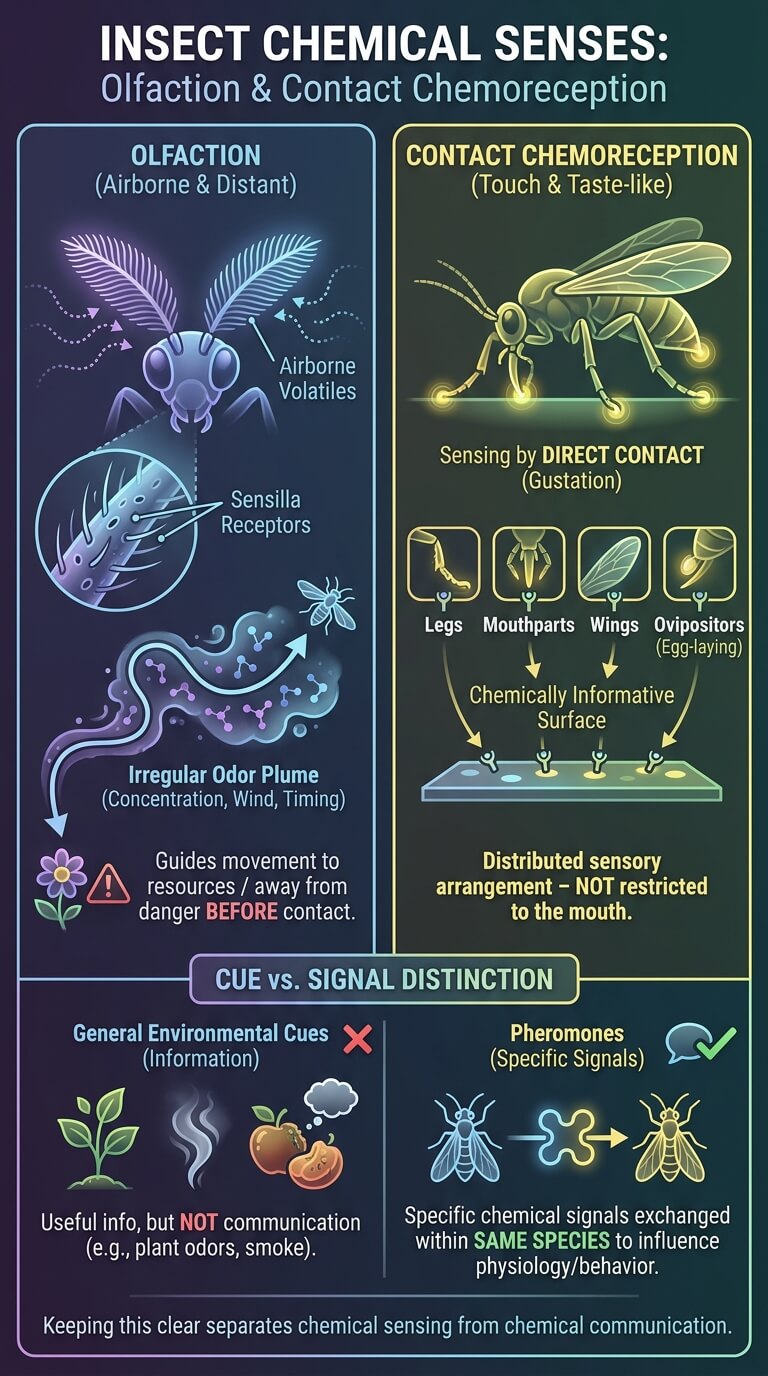
Olfaction is the detection of airborne or volatile chemicals. For many insects, olfactory receptors are concentrated in sensilla on the antennae, although other structures can contribute. Odor detection can guide insects toward resources or away from danger before physical contact occurs.
What matters is not just whether an odor is present but how the insect’s nervous system interprets the combination of compounds, concentration, timing, wind direction, and other sensory information. A plume of odor in moving air is irregular, so an insect may repeatedly lose and reacquire the chemical signal while adjusting its movement.
Contact chemoreception and taste-like sensing
Insects also sample chemicals by direct contact. This is often called gustation or contact chemoreception. Receptors can respond when a leg, mouthpart, antenna, or another body structure touches a chemically informative surface.
This distributed sensory arrangement is well documented. Research on honey bees notes that insect taste receptors are not restricted to the mouth and may occur on structures including antennae, legs, wings, and egg-laying organs, depending on the species. Scientific Reports research on honey bee gustation highlights how different insect taste can be from the vertebrate idea of taste as something that happens only on the tongue.
Why not every odor is a communication signal
An insect can smell many chemicals that were not produced as signals for another insect. Plant odors, fermentation products, host odors, smoke, moisture-associated compounds, and chemicals from damaged tissue can all provide useful information without being communication signals.
A pheromone is more specific. In conventional biological use, it is a chemical signal exchanged among members of the same species that influences physiology or behavior. Smelling a flower is not the same thing as receiving a pheromone. Keeping that distinction clear helps separate chemical sensing from chemical communication.
Taste Beyond the Mouth
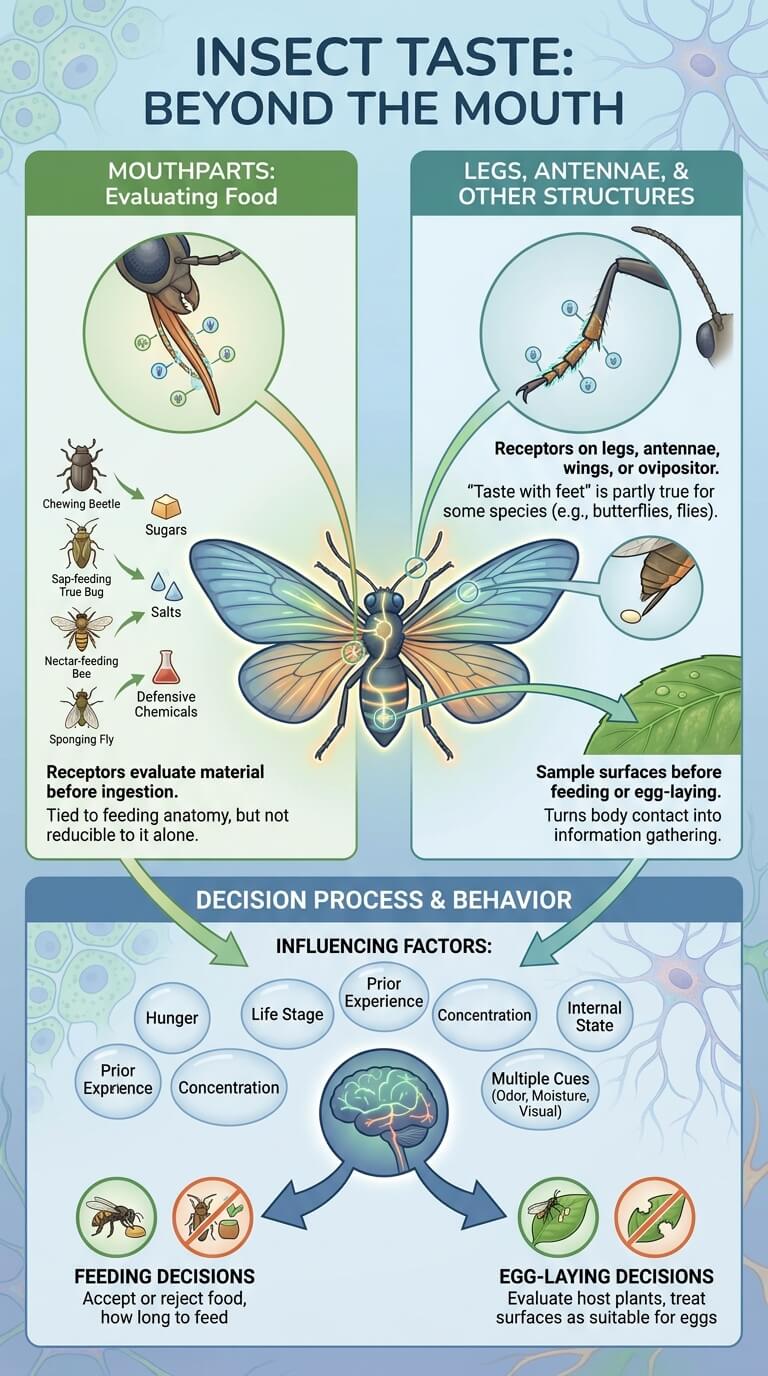
Contact receptors on mouthparts
Mouthparts are an obvious place for taste receptors because insects need to evaluate material they may ingest. Chemical information can help determine whether a potential food item contains sugars, salts, defensive chemicals, or other compounds relevant to feeding. The response is not necessarily a simple “good taste” or “bad taste” judgment. It may depend on hunger, life stage, prior experience, concentration, and the mixture of chemicals present.
Different mouthpart designs also change how insects encounter food. A chewing beetle, a sap-feeding true bug, a nectar-feeding bee, and a fly with sponging mouthparts do not sample food in exactly the same way. Sensory biology is therefore closely tied to feeding anatomy without being reducible to anatomy alone.
Receptors on legs, antennae, and other structures in selected species
The popular statement that insects can “taste with their feet” is partly true, but it should not be generalized to every insect in the same way. Many butterflies and flies have contact chemoreceptors on their legs, and tarsal taste has also been documented in some beetles. Other receptors may occur on antennae, wings, or the ovipositor, the structure used for placing eggs.
These locations make functional sense. A female insect landing on a plant can sample the surface before feeding or laying eggs. A walking insect can gather chemical information before its mouth ever reaches the material. The distribution of receptors turns body contact into an information-gathering process.
How taste guides feeding and egg-laying decisions
Chemical contact can influence whether an insect accepts or rejects a food item, how long it feeds, or whether a female treats a surface as suitable for eggs. In some plant-feeding insects, receptors on the legs help evaluate host plants. In other insects, egg-laying decisions can depend on a combination of contact chemicals, odors, moisture, temperature, visual cues, and the insect’s internal reproductive state.
That combination matters. It prevents a misleading picture in which a single receptor “tells” an insect exactly what to do. Sensory input feeds into neural systems that weigh multiple cues and generate behavior.
Compound Eyes and Ocelli
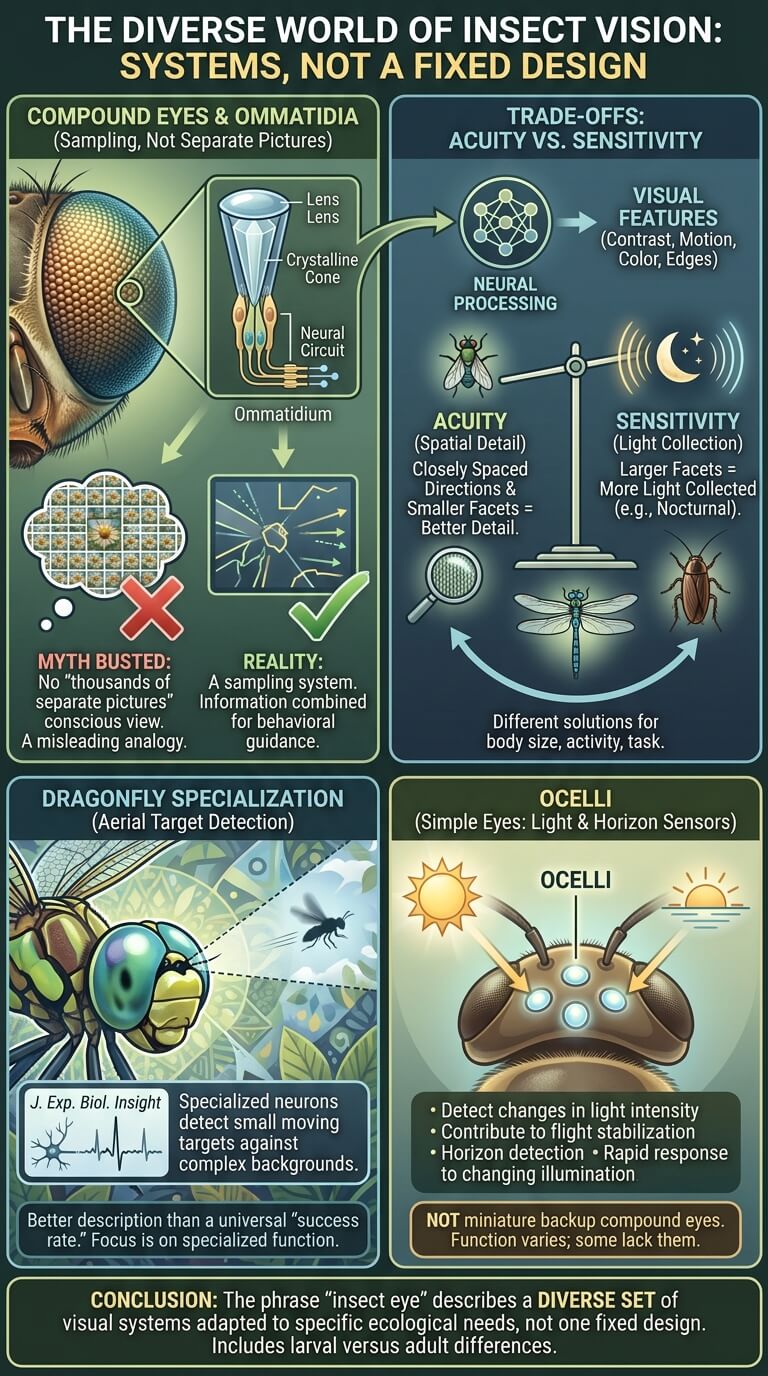
Ommatidia and image formation without the thousands-of-separate-pictures myth
Adult insects commonly have compound eyes made of repeated optical units called ommatidia. Each ommatidium samples light from part of the visual field. The nervous system combines information across many units to guide behavior.
This does not mean an insect consciously sees hundreds or thousands of tiny separate pictures. That familiar classroom analogy is too literal. Compound eyes are sampling systems, and the information from photoreceptors is processed through neural circuits that detect contrast, motion, color, edges, targets, and other visual features.
Motion detection and visual resolution trade-offs
Compound eyes involve trade-offs. Closely spaced viewing directions can improve spatial detail, while larger facets can collect more light. Different insects emphasize different solutions depending on body size, activity period, and visual task. A small fly, a nocturnal cockroach, and a dragonfly do not experience the same balance of acuity and sensitivity.
Dragonflies are a strong example of visual specialization. Their large compound eyes and visual circuits support detection of small moving targets during aerial hunting. Journal of Experimental Biology work on dragonfly target detection shows how specialized neurons can respond to small moving targets against complex backgrounds. This is a better way to describe dragonfly vision than assigning one universal “success rate” to all dragonflies in every hunting situation.
Ocelli and light-level or horizon-related functions
Many adult insects also have simple eyes called ocelli, often arranged on the top of the head. Ocelli are not simply miniature backup compound eyes. In many insects they are especially useful for detecting changes in light intensity and can contribute to flight stabilization, horizon detection, or rapid responses to changing illumination.
Function varies among groups, and some insects lack adult ocelli. Larval visual organs can also differ greatly from adult eyes, especially in insects with complete metamorphosis. The phrase “insect eye” therefore describes a diverse set of visual systems rather than one fixed design.
Color, Ultraviolet, and Polarized Light
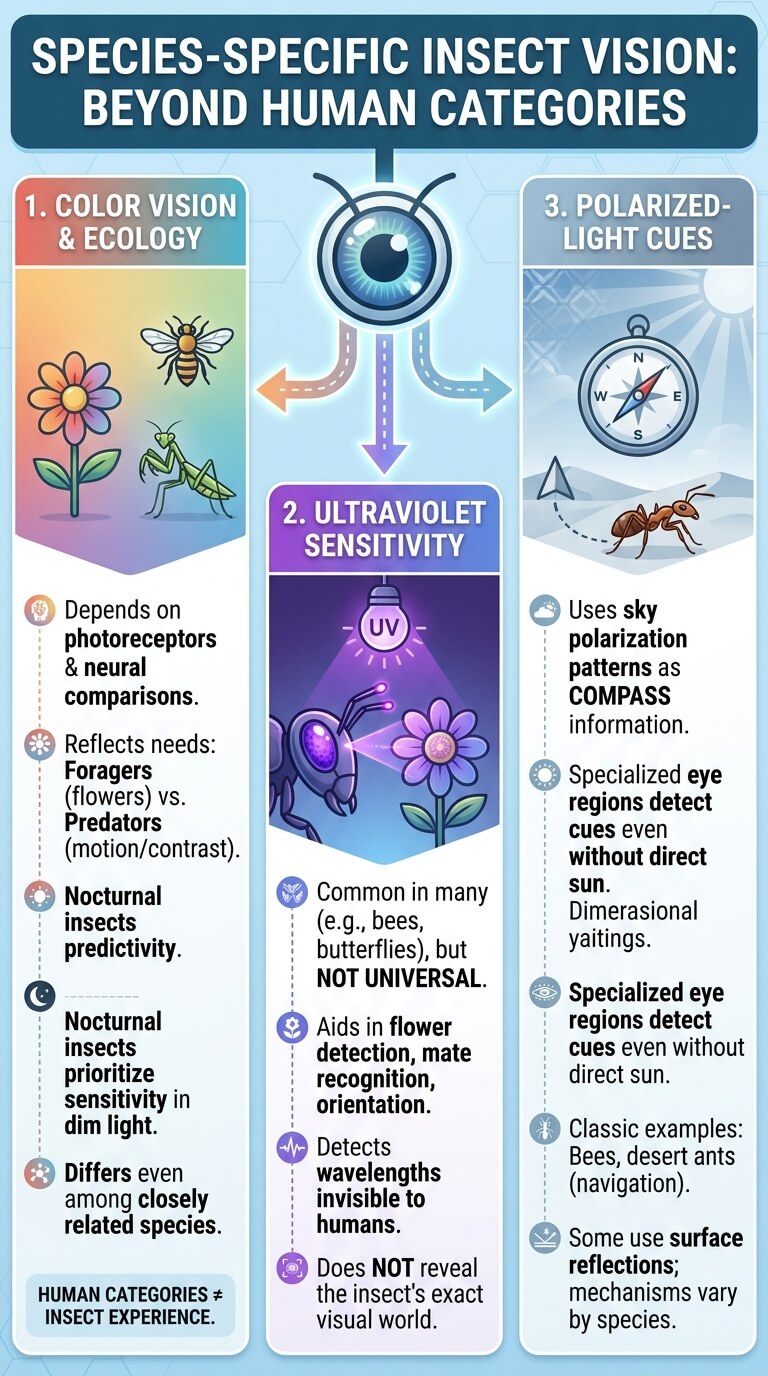
Species-specific color vision
Color vision depends on photoreceptors with different spectral sensitivities and on neural comparisons among their signals. Many insects can discriminate colors, but the range of wavelengths and number of receptor classes differ among species. Human color categories should not be assumed to map directly onto an insect’s experience.
Visual ecology often reflects what the insect needs to detect. Flower visitors may use color in foraging. Predators may depend heavily on motion and contrast. Nocturnal insects may prioritize sensitivity under dim light. Even closely related species can differ in visual capabilities.
Ultraviolet sensitivity where supported
Ultraviolet sensitivity occurs in many insects and is well studied in groups such as bees and some butterflies, but it is not a universal insect trait that should be assigned to every species. UV-sensitive receptors can contribute to flower detection, mate recognition, orientation, or other tasks when those signals are present in the insect’s environment.
Likewise, saying an insect “sees ultraviolet” does not tell us exactly what the world looks like to that insect. It means its visual system can detect wavelengths outside the range visible to humans and use that information in ways shaped by its nervous system.
Polarized-light cues in navigation and orientation
Light scattered in the sky contains patterns of polarization that some insects can use as compass information. Bees and desert ants are classic examples. Specialized regions of their eyes can detect polarization patterns even when the sun itself is not directly visible.
Experimental research has long shown polarization-based orientation in bees. Nature research on polarization vision in bees demonstrated how bees can extract compass information from skylight polarization. Other insects use polarized reflections from water or surfaces, although the function and sensory mechanism should be checked species by species.
Hearing and Vibration
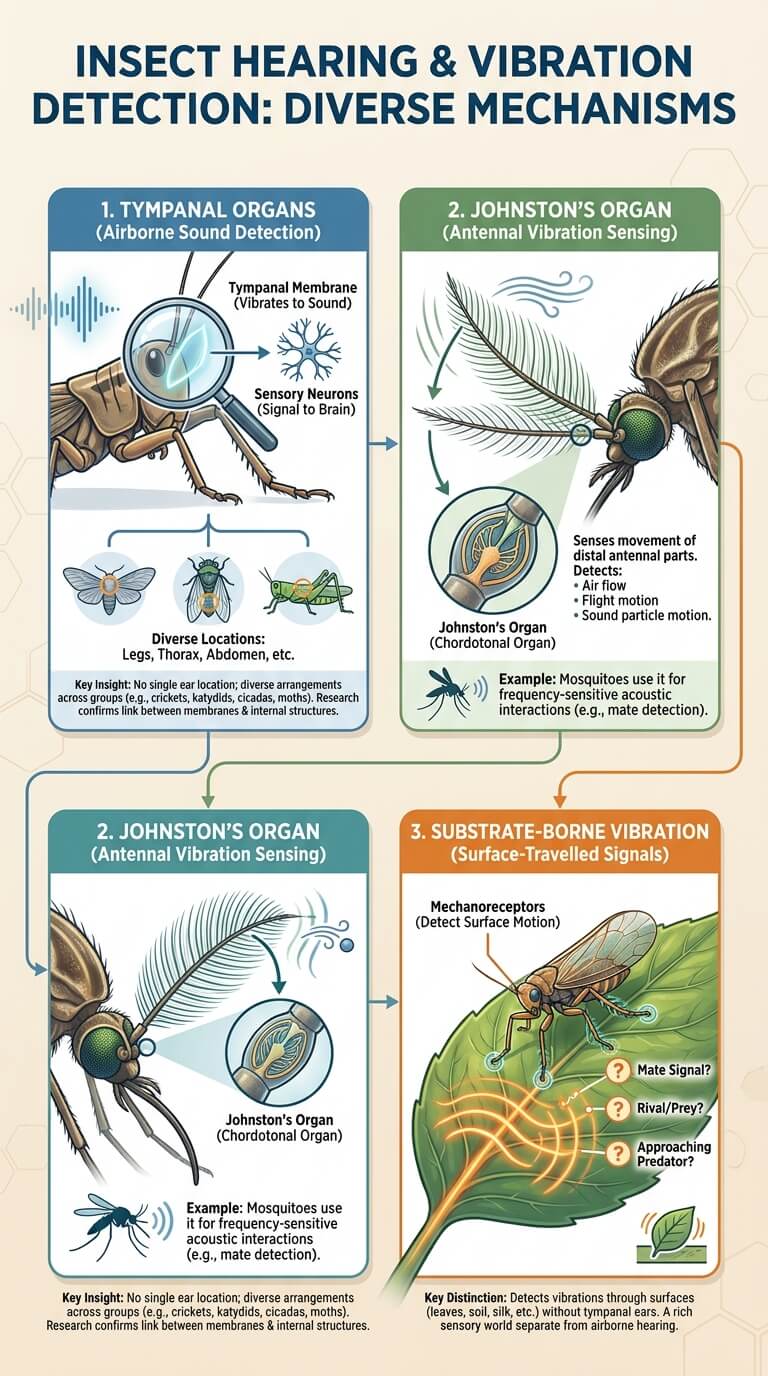
Tympanal organs on legs, thorax, abdomen, or other locations
Insect hearing is remarkably diverse. Some insects have tympanal organs, which include thin cuticular membranes that vibrate in response to sound and connect mechanically to sensory neurons. These organs can occur on different body regions in different groups.
Crickets and katydids provide a familiar example because important hearing structures are located in the forelegs. Other insects may carry tympanal organs on the thorax or abdomen. Cicadas, many moths, grasshoppers, and other lineages show different arrangements. Research on bushcrickets demonstrates the close relationship between foreleg tympanal membranes, internal acoustic structures, and sensory output. Journal of Experimental Biology research on bushcricket hearing illustrates why there is no single insect “ear location.”
Johnston’s organ and antennal vibration sensing
Johnston’s organ is a chordotonal organ found in the second antennal segment of insects. It senses movement of more distal antennal parts and can serve different functions among species, including detecting air movement, flight-related motion, or sound-related vibration.
Mosquitoes are a particularly clear example. Their antennal flagella respond to particle motion associated with sound, and Johnston’s organ converts that mechanical movement into neural signals. Studies of male mosquitoes show frequency-sensitive responses related to acoustic interactions between males and females. Journal of Experimental Biology research on mosquito Johnston’s organs documents this specialized antennal hearing system.
Substrate-borne vibration without airborne hearing
Not every important mechanical signal travels through the air. Insects can detect vibrations moving through leaves, stems, soil, bark, silk, nest material, or other surfaces. A small vibration transmitted through a plant can carry information about a mate, rival, prey item, or approaching predator.
This distinction matters because “hearing” is often used casually for any vibration detection. Some insects detect substrate motion using mechanoreceptors without possessing tympanal ears for airborne sound. Their sensory world may be rich in vibration even when they do not hear in the same way a cricket does.
Touch, Airflow, and Body Position
Mechanosensory hairs
Many insects carry hair-like mechanosensory structures across the body. When a hair bends, sensory neurons can register the direction and amount of movement. These structures help detect direct contact, air currents, movement of neighboring body parts, and disturbances caused by nearby animals.
Mechanosensory hairs can function as an early-warning system because air displacement may reach an insect before a predator makes contact. Sensitivity and placement vary widely. A hair on a leg joint serves a different mechanical problem from a hair exposed on the body surface.
Proprioception and joint-position sensing
Proprioception is the sense of the body’s own position and movement. An insect walking over uneven ground must know where its legs are, how much joints have flexed, and how its body is loaded. Internal mechanosensory organs, hair plates, and other receptors provide that information.
Proprioceptive feedback allows coordinated walking, grooming, jumping, flight control, and precise movements of appendages. It also helps explain why insect movement can be so controlled despite a nervous system organized very differently from that of vertebrates.
Detecting wind and near-field movement
Air movement can carry several kinds of information at once. It transports odors, bends sensory hairs, moves antennae, and can reveal the approach of another animal. For flying insects, airflow also provides feedback about motion through the environment.
Because these cues overlap, an insect often does not rely on one receptor class in isolation. Odor orientation, for example, may require chemical detection plus mechanical information about wind direction. Sensory integration is therefore central to understanding insect behavior.
Sensory Specialization Across Insects
Dragonfly visual systems
Dragonflies are strongly visual predators. Their compound eyes cover a large portion of the head, and different eye regions can be specialized for different parts of the visual field. Neural circuits sensitive to small moving targets help them detect prey against visually complicated backgrounds.
That does not mean dragonflies have “the best eyes” in every possible sense. Vision should be judged against the task. A moth locating a distant mate by odor may outperform a dragonfly in chemical sensitivity that matters to the moth’s biology.
Moth chemical sensitivity
Many moths provide classic examples of sensitive olfactory systems. In species that use long-distance sex pheromones, males can possess elaborate antennae with numerous olfactory sensilla. The system is tuned to biologically relevant compounds and to the timing and pattern of odor encounters in moving air.
It is still misleading to describe pheromone sensing as automatic “mind control.” Detecting a chemical affects neural processing and behavior in a context that includes physiological state, wind, competing odors, distance, and other sensory inputs.
Cricket or katydid hearing
Crickets and katydids use acoustic information in behaviors such as mate attraction, localization, and avoidance. Their foreleg hearing organs are a striking reminder that an ear does not need to be on the head. Species can also be tuned to different sound frequencies and signal patterns.
Some insects additionally respond to predator-generated ultrasound or to vibrations transmitted through plants. The broad lesson is that insect auditory systems evolved around specific communication and survival problems rather than one shared blueprint.
Bee navigation cues
Bees can combine several visual and chemical cues while foraging and returning to nests. Depending on species and context, these may include landmarks, the sun’s position, polarized skylight, color, odor, optic flow, and information learned from previous trips.
This is a good example of why sensory biology should not be reduced to a list of isolated senses. Real behavior emerges when the nervous system combines information from different channels and weights those cues according to conditions.
Common Sensory Myths
Do insects see thousands of tiny pictures?
No. Each ommatidium samples light from part of the scene, but the nervous system processes information across the compound eye. The idea of thousands of separate little pictures is a metaphor that can mislead readers into imagining a tiled set of miniature camera images.
Do all insects see ultraviolet?
No. UV sensitivity is documented in many insects, but visual receptor complements vary among species. A claim about ultraviolet vision should be tied to the group being discussed rather than applied to all insects.
Do all insects hear?
No. Insects differ greatly in their ability to detect airborne sound and vibration. Many lack tympanal organs. Some rely on antennal vibration sensing or substrate-borne signals, while others may have no known auditory behavior comparable with insects such as crickets or cicadas.
Are antennae simply insect noses?
No. Antennae can carry receptors for chemicals, touch, airflow, humidity, temperature, and vibration, depending on the insect. “Nose” is useful only as a rough analogy for one part of their function.
How Sensory Systems Shape Insect Life
Communication depends on sensory receivers
A signal works only if another insect can detect it. Chemical signals require appropriate chemoreceptors. Courtship songs require receptors sensitive to relevant vibrations or sounds. Firefly flashes require visual detection. Social contact can involve combinations of touch and chemistry.
This receiver side is easy to overlook. Communication is not simply an insect producing a pheromone, sound, flash, or movement. The receiver’s sensory equipment and nervous system determine whether that signal is detected and how it influences behavior.
Foraging and navigation combine multiple cues
Finding food often requires a sequence of sensory decisions. An insect may follow odor at a distance, use vision to approach a plant, test the surface with antennae or feet, and finally sample food with mouthpart receptors. Navigation can likewise combine landmarks, light patterns, wind, odors, and proprioceptive information.
The relative importance of each cue changes with weather, distance, habitat complexity, time of day, and species. This flexible weighting helps explain why insects can continue functioning when one signal is weak or temporarily unavailable.
Anatomy determines where sensory structures can work
Sensory structures make sense only in the context of the insect body. Antennae sit where they can sample air and contact objects ahead of the animal. Tarsal receptors meet surfaces during walking and landing. Ocelli occupy positions useful for detecting broad light changes. Tympanal organs occur in locations shaped by each lineage’s evolutionary history and sound-transmission system.
Understanding where a receptor is located often gives a clue to what information it can gather. It also shows why insect anatomy and insect senses are closely connected without being the same subject.
FAQ
Can insects smell?
Yes. Many insects detect airborne chemicals through olfactory receptors, commonly housed in sensilla on the antennae and sometimes on other structures. Smell can help insects find food, hosts, mates, nest sites, or dangerous conditions. The sensitivity and chemical range differ greatly among species, so there is no single insect sense of smell.
Can insects hear without ears on their heads?
Yes. Insects with tympanal hearing organs may have them on the legs, thorax, abdomen, or other body regions. Mosquitoes and some flies can detect sound-related antennal vibrations with Johnston’s organ. Other insects mainly detect substrate vibration rather than airborne sound. Hearing structures therefore vary much more than the familiar vertebrate pattern of ears on the head.
Can insects taste with their feet?
Some can. Contact chemoreceptors occur on the legs of many butterflies and flies and in selected insects from other groups. These receptors can help an insect evaluate a plant, food surface, or egg-laying site before the mouthparts make contact. It is not correct to assume that every insect species tastes with its feet in the same way.
Do insects see color?
Many insects can discriminate colors, but their color vision is not identical to human color vision. The wavelengths detected and the way visual signals are processed depend on the species. Some insects have ultraviolet-sensitive photoreceptors, while others have different spectral capabilities. Color vision should therefore be described in species-specific terms whenever possible.
Final Thoughts
Insect senses are distributed, specialized, and often highly different from our own. Antennae can detect much more than odor. Taste receptors may occur on legs or other body parts. Compound eyes sample visual information through many ommatidia, while ocelli can contribute to rapid light and orientation responses. Sound may be detected by membranes on a leg or abdomen, by antennal vibration, or replaced by sensitivity to vibrations moving through a surface.
The most useful way to understand insect senses is to ask what information an insect needs and which structures can detect it. Vision, smell, taste, hearing, touch, temperature, humidity, airflow, and body-position signals often work together. That combination allows insects to find food, avoid threats, locate mates, navigate complex habitats, and coordinate movements with a level of sensory specialization that simple “bugs have antennae” descriptions cannot capture.

Ethan Walker is the founder and research editor of Animal Fact Central. He creates and reviews educational animal facts content using trusted wildlife, pet care, and science-based sources. His work focuses on making animal behavior, adaptations, habitats, and species facts clear, accurate, and engaging for everyday readers.
Read More Details About Ethan Walker: https://animalfactcentral.com/ethan-walker/