
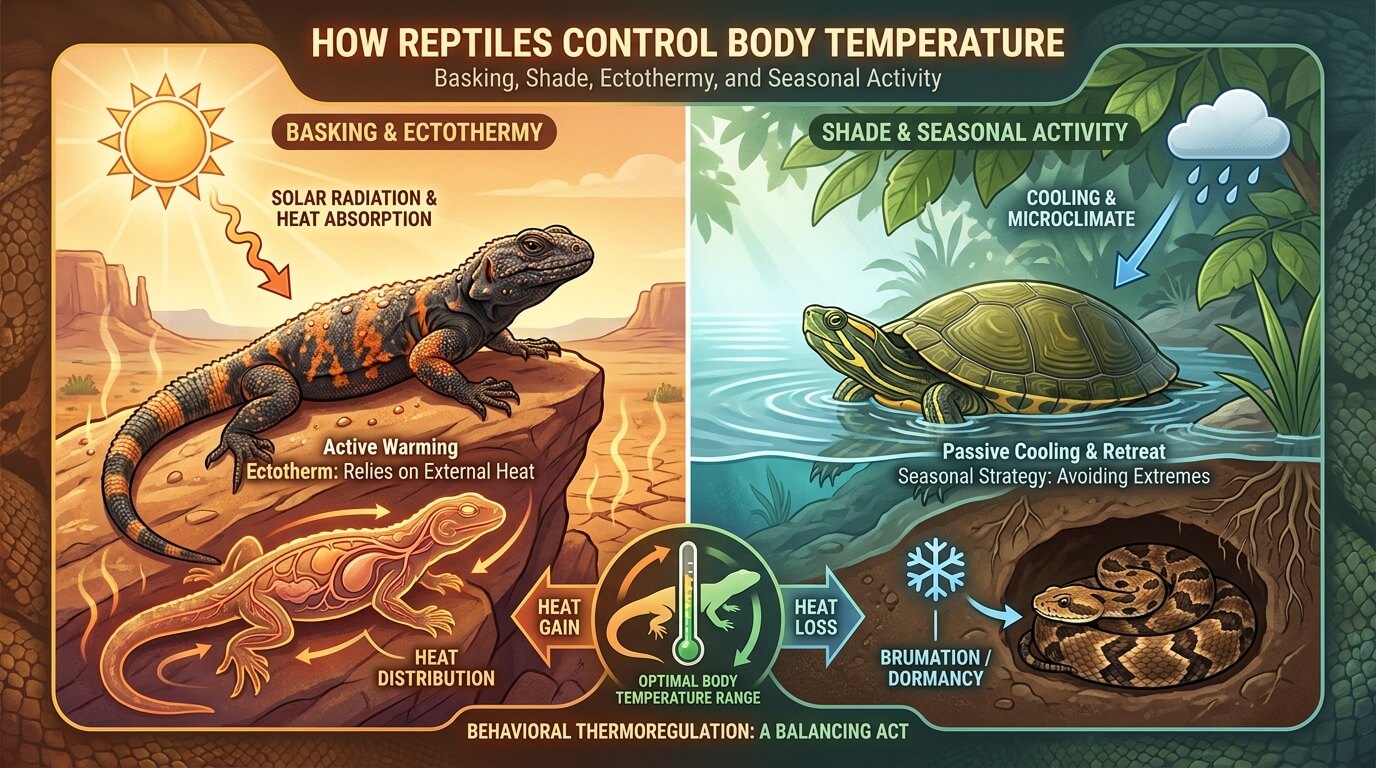
Reptiles control body temperature mainly by changing what they do and where they go. A lizard may move into sunlight, angle its body toward the sun, then retreat beneath a shrub before overheating. A turtle may alternate between water and a warm basking surface. A snake can use sun-warmed ground, shaded cover, a burrow, or different activity times to stay within a workable temperature range.
This is why calling reptiles “cold-blooded” can be misleading. Living non-avian reptiles are ectotherms, meaning environmental heat is a major source of body heat, but they are not passive objects that simply become whatever temperature the air happens to be. Through behavioral thermoregulation, many reptiles use a patchwork of warmer and cooler places to manage body temperature over the day and across seasons.
Quick Answer: How Reptile Thermoregulation Works
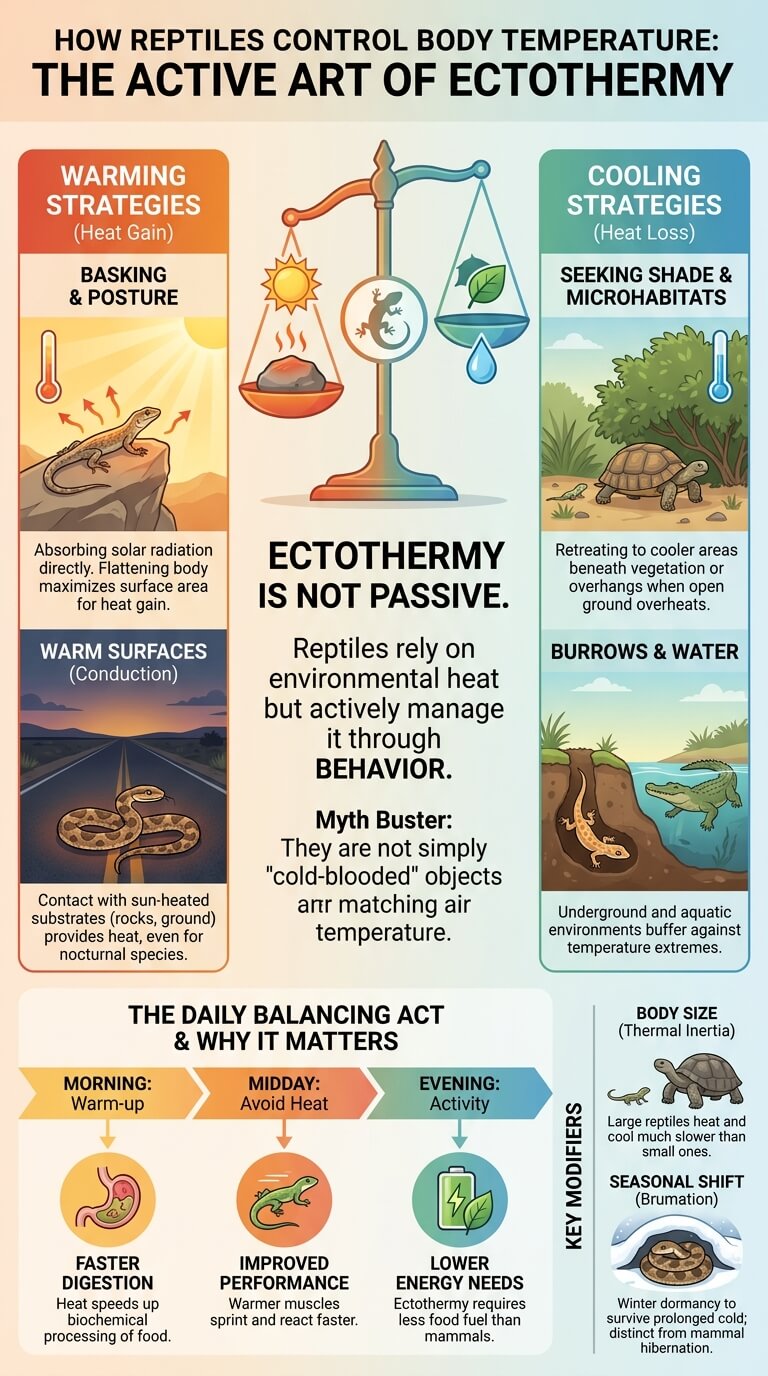
Ectothermy is not passive temperature matching
An ectotherm depends heavily on heat exchanged with its surroundings rather than maintaining a high, nearly constant body temperature through metabolic heat production the way birds and mammals generally do. Reptiles absorb and lose heat through radiation, conduction, convection, and evaporation, and their body temperature can change substantially as conditions change. Ectothermy is common among living non-avian reptiles, but it is not enough by itself to explain what makes an animal a reptile .
That dependence does not mean body temperature simply equals air temperature. Sunlight can warm an exposed reptile above the surrounding air, a shaded crevice can be cooler than nearby open ground, and a warm rock can transfer heat by direct contact. A classic experimental literature on reptiles shows that basking, retreating to shade, and physiological changes in heat transfer can all contribute to temperature control. The Journal of Experimental Biology discussion of thermoregulation in snakes describes this combination of behavioral and physiological control.
Behavior can produce body temperatures different from ambient air
Imagine a sunny spring morning when the air is still cool. A dark rock may already be much warmer than the air because it has absorbed solar radiation. A reptile resting on or near that surface can warm faster than it would in deep shade. Later, when open ground becomes dangerously hot, the same animal may move beneath vegetation or into a burrow where temperatures change more slowly.
This ability to choose among microclimates is central to reptile thermal biology. The animal is not controlling the weather. It is using small differences within the environment to influence how quickly it gains or loses heat.
Ectothermy in Reptiles
External heat sources and internal heat production
Reptiles do produce metabolic heat because every living animal releases heat during cellular activity. The important distinction is that most reptiles do not rely on metabolic heat production to hold body temperature within the narrow, elevated range typical of endothermic birds and mammals. Environmental heat remains a dominant part of the thermal budget.
Heat can come from direct sunlight, warm soil, rocks, water, or surrounding air. It can leave the body through cooler surfaces, moving air, water, radiation to cooler surroundings, and in some cases evaporation. Which pathway matters most depends on body size, posture, habitat, wind, humidity, solar exposure, and whether the animal is on land or in water.
Benefits, constraints, and ecological trade-offs
Ectothermy can reduce the amount of food needed to fuel continuous high metabolic heat production. That helps explain why many reptiles can survive on less frequent meals than similarly sized endotherms. The trade-off is that body performance is more tightly linked to environmental temperature.
Thermoregulation also takes time and can create risks. A lizard that spends longer basking may have less time for foraging or courtship and may become more visible to predators. An animal hiding in a cool refuge may avoid dangerous heat but lose feeding opportunities. Reptile thermoregulation is therefore a balancing act rather than a simple drive to become as warm as possible.
Basking as One Thermoregulatory Strategy
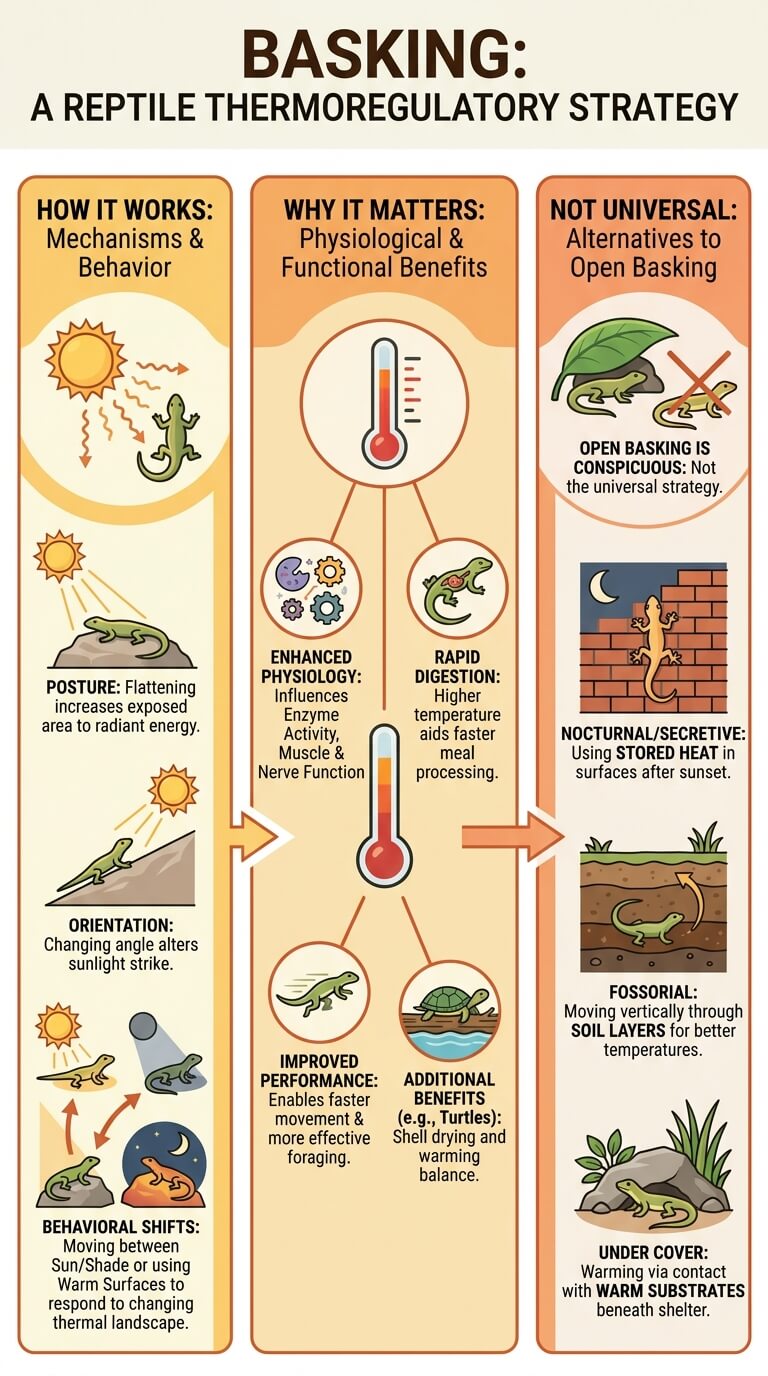
Sun exposure, posture, and orientation
Basking works because sunlight transfers radiant energy to the body. A reptile can change the amount of energy absorbed by moving into full sun, partial sun, or shade. Many species also adjust posture. Flattening the body can increase the area exposed to radiation, while changing body angle can alter how much sunlight strikes the surface.
Some reptiles move repeatedly between sun and shade rather than remaining exposed for long periods. Others use warm surfaces instead of obvious sunbathing. These behaviors let the animal respond to a thermal landscape that changes minute by minute as clouds move, shadows shift, wind increases, or surfaces warm.
Why basking can affect activity, digestion, drying, and other functions
Temperature influences enzyme activity, muscle performance, nerve function, digestion, and many other physiological processes. After warming, a reptile may be able to move faster, forage more effectively, or digest a meal more rapidly than it could at a much lower body temperature. The exact response varies by species and by the temperatures involved.
Basking can have other consequences as well. For some aquatic turtles, time out of the water may help dry the shell surface in addition to warming the body. The Smithsonian Q?rius overview of turtle activity describes basking as part of a daily balance among warming, activity, and foraging, rather than as a behavior with only one purpose.
Why not all reptiles bask openly
Open basking is conspicuous, so it can create the false impression that it is the universal reptile strategy. Many reptiles are nocturnal, secretive, fossorial, or active under vegetation. They may warm by resting beneath sun-heated cover, contacting warm substrates, occupying sheltered crevices, or choosing favorable times of night.
A gecko on a warm wall after sunset, for example, can use heat stored in the surface even though the sun is gone. A burrowing reptile may move vertically through soil layers to find a better temperature without ever sitting in direct sunlight.
Cooling Down: Shade, Burrows, Water, and Retreats
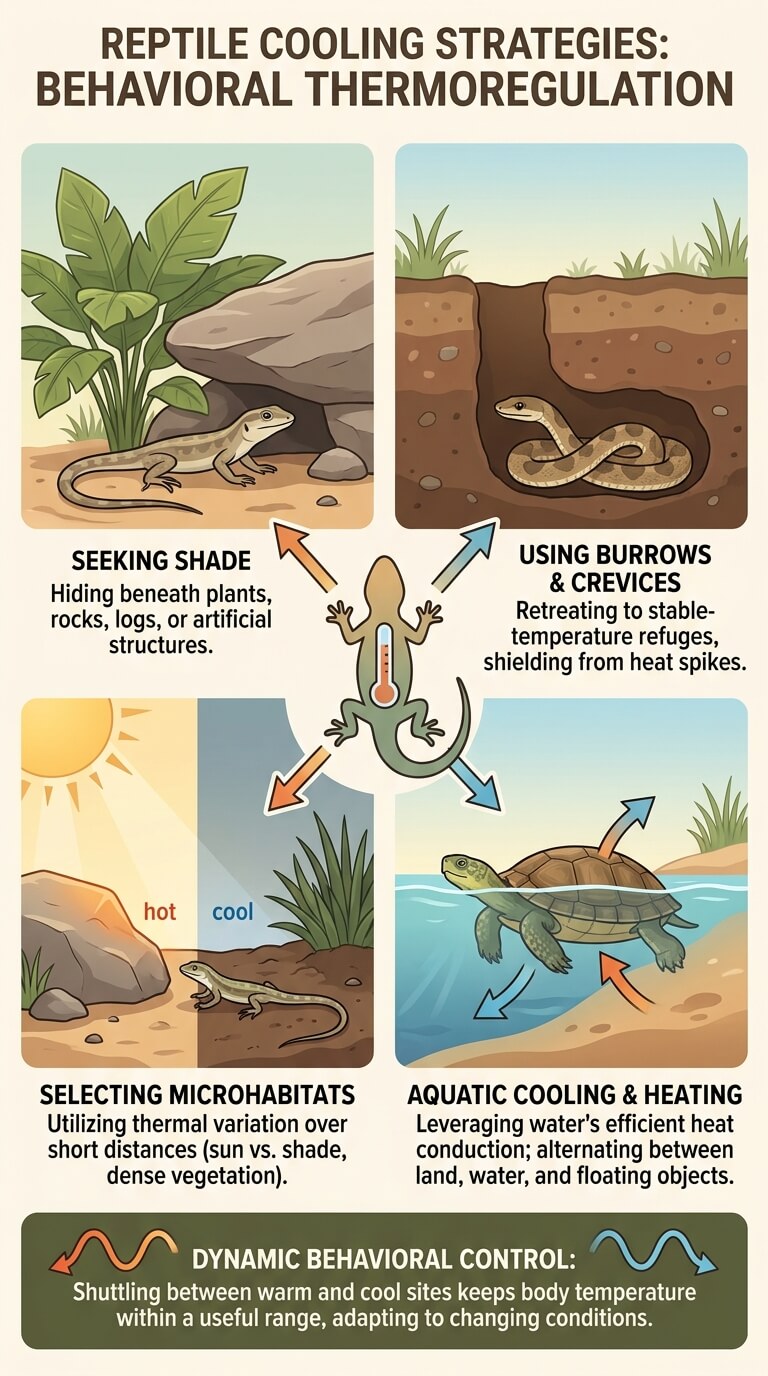
Microhabitat selection
Cooling is as important as warming. When exposed surfaces become too hot, reptiles can seek shade beneath plants, rocks, logs, leaf litter, or artificial structures. Burrows and deep crevices often change temperature more slowly than the surface, providing refuges from short-term heat spikes as well as cold nights.
Microhabitats can differ sharply over distances of only a few feet. A sunlit rock, shaded soil, dense vegetation, and the entrance to a burrow may all have different temperatures at the same moment. Reptiles that move among those sites can use that thermal variation as a behavioral control system.
Moving between sun and shade
Some reptiles shuttle repeatedly between warm and cool sites. This can keep body temperature within a useful range without requiring one location to be perfect. A lizard may bask until warm, forage through partial shade, then retreat when body temperature rises. Later it may return to the sun.
The pattern changes with weather, season, reproductive state, digestion, and habitat. There is no single schedule shared by all reptiles. Even two populations of the same species can face very different thermal opportunities if one lives on an exposed slope and another in dense vegetation.
Aquatic cooling and heating opportunities
Water changes heat exchange because it conducts heat far more effectively than still air. A semiaquatic reptile entering cooler water may lose heat quickly, while warm shallow water can sometimes provide heat. Species that divide time between land and water can use both environments as parts of their thermal landscape.
This helps explain why basking is common in many freshwater turtles and crocodilians but not identical among species. The animal may alternate between water, shoreline, floating logs, exposed banks, or shallow areas depending on temperature, safety, and activity needs.
Daily Temperature Strategy

Morning warm-up, midday heat avoidance, and evening activity
Many diurnal reptiles face a daily sequence of problems. Early in the morning, body temperature may be too low for peak activity. Around midday, open surfaces may become too hot. In late afternoon, the challenge shifts again as solar input declines.
A common pattern in seasonal or arid environments is to use exposed sites earlier in the day, reduce surface activity during the hottest period, then become active again later. This is not a universal reptile schedule. It is one flexible solution to a changing thermal environment.
Diurnal, nocturnal, and crepuscular patterns
Reptiles can be active by day, night, or around dawn and dusk. Nocturnal activity does not mean thermoregulation stops. A night-active reptile may choose warm rocks, tree trunks, sheltered crevices, or other surfaces that retain heat after sunset. It can also avoid locations that cool too rapidly.
Crepuscular activity can be especially useful where daytime heat is intense and nighttime temperatures are too low for efficient movement. Activity timing lets the reptile avoid environmental extremes rather than confronting them directly.
Species differences across habitats
A desert lizard, a temperate garter snake, a rainforest gecko, and a freshwater turtle encounter different combinations of sunlight, shade, humidity, wind, and refuge availability. Their thermoregulatory behavior reflects those differences.
That variation is why there is no scientifically useful “ideal reptile temperature” for reptiles as a whole. Thermal preferences and tolerances are species-specific, and they can shift with age, reproductive condition, season, acclimation, and activity.
Body Size, Thermal Inertia, and Heat Exchange
Why larger and smaller reptiles can heat and cool differently
Body size affects how quickly temperature changes. Small reptiles have a high surface-area-to-volume ratio, so heat can move into and out of the body relatively quickly. Large reptiles generally change temperature more slowly because their volume increases faster than their surface area.
This slower change is often called thermal inertia. It can buffer a large reptile against rapid temperature swings, but it can also mean that warming up or cooling down takes longer. Large crocodilians and giant tortoises therefore experience the thermal environment differently from tiny geckos or hatchling lizards.
Surface area, posture, and environment
Body shape and posture modify heat exchange too. A flattened lizard can expose more surface to the sun. A coiled snake can reduce exposed surface area compared with an extended snake. Limbs, shell shape, skin color, wind exposure, and contact with soil or rock can all alter rates of heating and cooling.
These physical effects interact with behavior. Reptiles do not choose a temperature with perfect precision. Instead, they influence heat exchange using the body and environment they have available.
Color and Surface Effects
When color change can influence heat gain
Darker surfaces generally absorb more solar radiation than lighter surfaces, so color can influence heating under some conditions. Certain reptiles can also change skin reflectance or color, which may alter heat absorption along with serving roles in signaling or camouflage.
Color is only one part of the thermal equation. Wind, posture, body size, cloud cover, humidity, surface contact, and behavior can matter just as much or more. A darker body does not guarantee that a reptile will be warmer in every setting.
Why color change cannot be generalized across all reptiles
Not every color-changing reptile changes color primarily for thermoregulation, and not every species can make rapid color changes. Chameleons are a good example of why simple explanations fail. Their color changes can be associated with social signaling, stress, light conditions, and temperature, with the balance depending on species and context.
It is safer to say that color can affect thermal exchange in some reptiles than to claim that reptiles become dark whenever they need heat or pale whenever they need to cool.
Seasonal Activity and Cool-Weather Inactivity
Brumation terminology and its limits
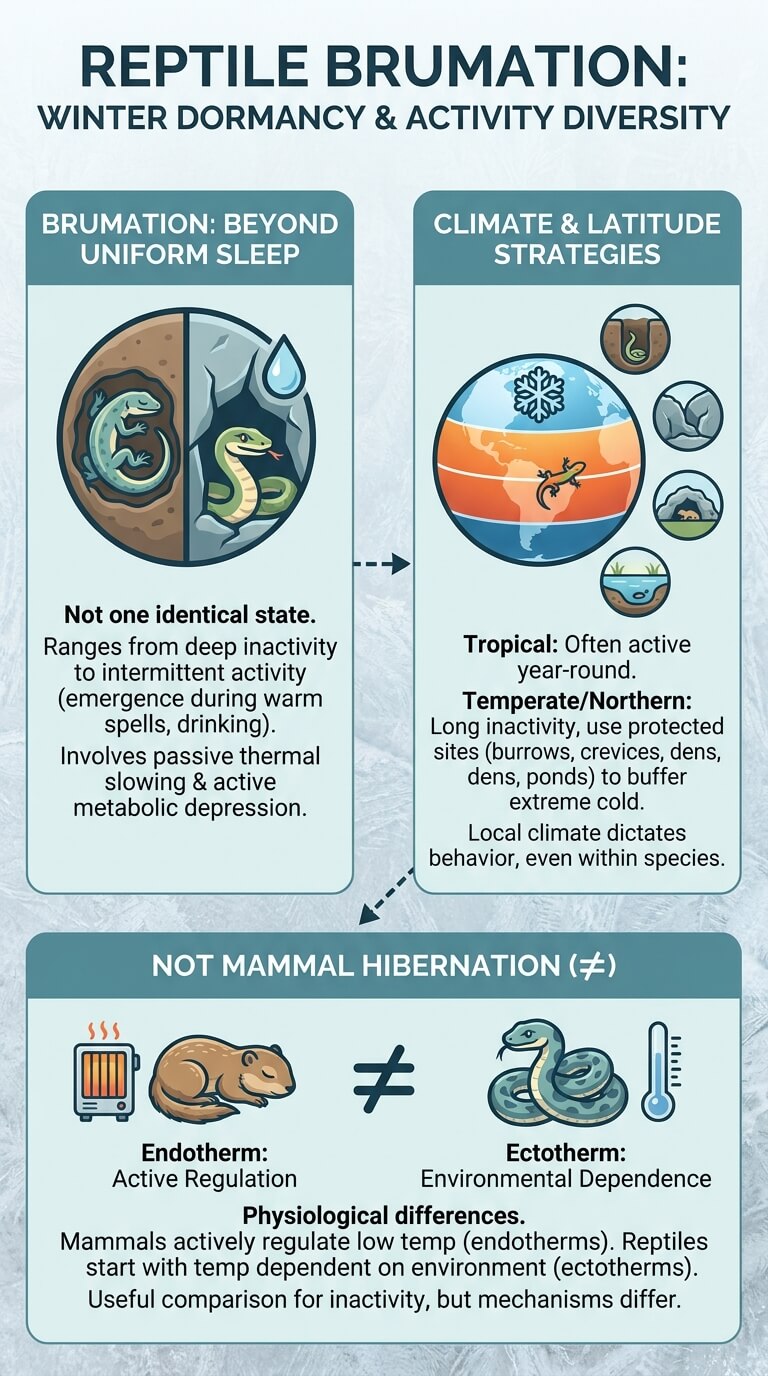
The word brumation is commonly used for winter dormancy or strongly reduced activity in reptiles. It is useful, but it can sound more uniform than the biology really is. Some reptiles remain deeply inactive for long periods, while others can emerge during warm spells, drink, shift position, or show intermittent activity.
A review of reptile winter ecology notes that overwintering strategies vary and that brumation can involve both passive metabolic slowing as body temperature falls and more active metabolic depression. The review of winter warming and reptile brumation emphasizes this diversity rather than treating winter dormancy as one identical state across species.
Latitude, climate, and species-specific winter strategies
Reptiles in tropical climates may remain active year-round if temperatures and resources permit, while animals in temperate regions often face months with few opportunities for normal surface activity. Northern populations may use deep burrows, rock crevices, communal dens, pond bottoms, or other protected sites that buffer extreme cold.
Winter behavior depends on local climate as much as on taxonomic group. A snake in Florida and the same species near the colder edge of its range may experience very different seasonal constraints. Reptiles can also show midwinter activity during unusually warm conditions, so winter dormancy should not be described as an unbroken sleep in every case.
Why reptile dormancy is not simply mammal hibernation
Both reptile brumation and mammalian hibernation can involve major reductions in activity and metabolism, but the physiological systems are not identical. Mammalian hibernators are endotherms that actively regulate metabolic heat production even while allowing body temperature to fall dramatically. Reptiles begin from a different thermal strategy because body temperature already depends strongly on environmental heat.
The everyday comparison is useful for conveying seasonal inactivity, but it should not imply that a brumating snake is doing exactly what a hibernating ground squirrel does.
Temperature Effects on Reptile Biology
Digestion and foraging
Because biochemical reactions are temperature-sensitive, digestion often proceeds more slowly at low body temperatures. Many reptiles therefore choose warmer locations after feeding when conditions allow. This behavior can shorten digestion time, but the pattern varies by species and must be balanced against predation risk and water loss.
Temperature can also change when and how long an animal forages. If the environment is too cold for effective movement or too hot for safe surface activity, feeding opportunities shrink even if prey is present.
Movement and performance
Muscle contraction, nerve conduction, and coordination all respond to temperature. Within a species’ functional range, warming often improves sprinting, climbing, striking, or escape performance up to a point. Beyond the useful range, performance declines and overheating becomes dangerous.
This produces a thermal performance curve rather than a simple “warmer is better” rule. Each species has limits, and the temperatures associated with strong performance depend on ecology and evolutionary history.
Reproductive timing and development at overview depth
Temperature can influence reproductive timing, courtship activity, gestation in live-bearing species, nest conditions, embryo development, and sex determination in reptiles where temperature-dependent sex determination occurs. Those effects are not the same across all reptiles.
For thermoregulating adults, reproductive condition may also change thermal choices. A gravid female may select different temperatures from a non-reproductive individual if those conditions affect embryo development or her own performance. The details vary by lineage and species, so broad claims should be avoided.
Thermoregulation in Aquatic Reptiles
Moving between water and land or surface layers
Aquatic reptiles face a different thermal environment because water transfers heat rapidly and often changes temperature more slowly than air. Freshwater turtles and crocodilians may use land or exposed surfaces for warming, then return to water for feeding, refuge, or cooling.
Diving reptiles can also encounter temperature layers within the water column. A sea turtle may move between warmer surface water and cooler depths during feeding or travel. Because heat loss in water can be rapid, body size, insulation, blood flow, activity, and behavior all become important.
Sea turtles, crocodilians, and semiaquatic reptiles as contrasting examples
Leatherback sea turtles show an unusual combination of large body size, insulation, activity-generated heat, blood-flow control, and behavior that allows them to remain warmer than cold surrounding water. Field measurements in the Northwest Atlantic found that free-swimming leatherbacks could maintain substantial body-to-water temperature differences, with time in warmer surface waters helping explain body temperature. The Journal of Experimental Biology study of leatherback thermal biology shows why large marine reptiles cannot be understood by the simple idea that an ectotherm always matches water temperature.
Crocodilians provide a different example. They can shift between water and land, change posture, bask, gape, or retreat to cooler areas. Large individuals change temperature more slowly than small ones, so thermal inertia can smooth out short-term fluctuations.
Thermal Limits, Heat Waves, and Edge Cases
Heat avoidance and overheating risk
Behavioral thermoregulation works only when suitable choices exist. A reptile cannot move into shade that is not there, and a shallow refuge can become dangerously hot during prolonged extreme weather. If all available microhabitats approach or exceed a species’ thermal limits, behavior alone may not prevent overheating.
Some lizards also use evaporative cooling behaviors such as panting near high temperatures. Experiments on desert lizards found that panting can lower body temperature below air temperature in some species, illustrating that physiological cooling can supplement behavior. The experimental study of panting in lizards also found substantial species differences, so panting should not be treated as a universal reptile response.
Cold tolerance and unusual activity patterns
Cold tolerance varies just as much. Some temperate reptiles survive very low temperatures by using protected overwintering sites, while a small number of species have remarkable physiological tolerance to freezing or low-oxygen conditions. Those abilities are exceptions, not evidence that reptiles in general are unaffected by cold.
Unexpected winter sightings are possible when warm weather temporarily creates suitable conditions. Likewise, a nocturnal reptile can remain active on a warm night even if the daytime pattern of another species would predict inactivity. Reptile activity must be interpreted through the biology of the species and its local environment.
Common Myths and Mistakes
“Cold-blooded” means the blood is cold
The phrase describes a thermal strategy, not the literal temperature of the blood. A basking reptile can have a warm body, and in some conditions its body temperature can exceed that of the surrounding air. Ectotherm is the more informative term because it emphasizes reliance on environmental heat.
Reptile body temperature always equals air temperature
Sunlight, shade, water, wind, substrate temperature, posture, body size, and microhabitat choice all affect heat exchange. Air temperature is important, but it is only one part of the thermal environment.
Every reptile basks visibly
Many reptiles bask, but visible sunbathing is only one strategy. Nocturnal geckos can use warm surfaces after dark, snakes may warm beneath cover, and fossorial species may regulate temperature by changing depth underground.
Every reptile brumates the same way
Seasonal dormancy differs among species and climates. Some reptiles remain inactive for long periods, some show brief activity during warm spells, and many tropical species do not experience a winter season that requires a temperate-style brumation pattern.
How Temperature Shapes Other Parts of Reptile Life
Behavior and daily activity
Many behaviors that look unrelated to temperature make more sense when thermal needs are considered. Time of day, perch choice, burrow use, social displays, foraging location, and retreat behavior can all be influenced by whether an animal is trying to gain heat, avoid heat, or stay within a workable range. Basking, retreating, changing activity times, and selecting microhabitats are all forms of reptile behavior as well as temperature management.
Habitats and microhabitats
A habitat is not thermally uniform. Desert rocks, shaded shrubs, forest litter, pond margins, tree trunks, burrows, and open water create different microclimates. Reptiles often depend on having access to a range of those conditions, not merely on living in a generally “warm” region.
Reproduction, digestion, and movement as temperature-sensitive processes
Thermoregulation matters because temperature affects what the animal can do. Digestion, locomotor performance, reproductive timing, embryo development, and seasonal activity all respond to temperature in different ways. That is why thermal behavior sits at the center of reptile ecology without being the same thing as feeding, reproduction, movement, or habitat biology.
FAQ
Why do reptiles bask in the sun?
Many reptiles bask to gain heat from solar radiation and warm their bodies into a range that supports activity. Depending on the species and context, basking can affect movement, digestion, foraging, and other physiological functions. It is not the only way reptiles warm themselves, and some species rarely bask in full view.
Can reptiles get too hot?
Yes. Reptiles have upper thermal limits, and overheating can impair performance and become life-threatening. They commonly reduce risk by seeking shade, entering burrows or water, changing activity time, or using other cooling behaviors. These strategies work only if suitable cooler microhabitats remain available.
Do reptiles hibernate?
Many temperate reptiles undergo winter dormancy often called brumation. It is sometimes compared with mammalian hibernation because activity and metabolism can fall sharply, but the physiology is not identical. The depth and duration of dormancy also vary by species, climate, and local weather.
Can nocturnal reptiles thermoregulate without basking?
Yes. Nocturnal reptiles can select warm or cool surfaces, sheltered crevices, vegetation, burrows, or different heights above the ground. Surfaces warmed during the day can retain heat after sunset, giving a night-active reptile thermal choices even without direct sunlight.
Final Thoughts
How reptiles control body temperature is best understood as active use of a changing environment. Ectothermy makes sunlight, shade, substrate, water, wind, body size, and season especially important, but reptiles respond through behavior rather than simply matching ambient air temperature. Basking is one strategy among many. Retreating to shade, changing posture, shifting activity time, entering burrows, moving between water and land, and reducing seasonal activity can all help a reptile stay within workable thermal limits. The details differ among lizards, snakes, turtles, crocodilians, and other reptiles, which is why there is no single ideal temperature or universal basking schedule for reptiles as a group.

Ethan Walker is the founder and research editor of Animal Fact Central. He creates and reviews educational animal facts content using trusted wildlife, pet care, and science-based sources. His work focuses on making animal behavior, adaptations, habitats, and species facts clear, accurate, and engaging for everyday readers.
Read More Details About Ethan Walker: https://animalfactcentral.com/ethan-walker/
1 thought on “How Reptiles Control Body Temperature”