

Endangered mammals are species facing a high risk of extinction, but the word endangered has a more precise meaning than simply rare, declining, or difficult to see. A species may be globally Endangered on the IUCN Red List, legally listed as endangered in the United States, protected from international trade under CITES, or covered by several systems at once. Those labels answer different questions and may change as new evidence becomes available.
Mammal declines rarely have a single cause. Habitat loss may combine with hunting, roads, fishing gear, disease, pollution, climate change, or conflict with people. Mammalian biology also matters. A slow-breeding whale, a carnivore that requires a large territory, and a cave bat concentrated in a few roosts face different risks even when all are losing habitat. Understanding endangered mammals therefore requires more than memorizing a list. It requires looking at status, geography, population trend, biology, threats, and whether conservation actions are reducing those threats.
Quick Answer
Endangered Is a Defined Conservation Category, Not a Synonym for Rare
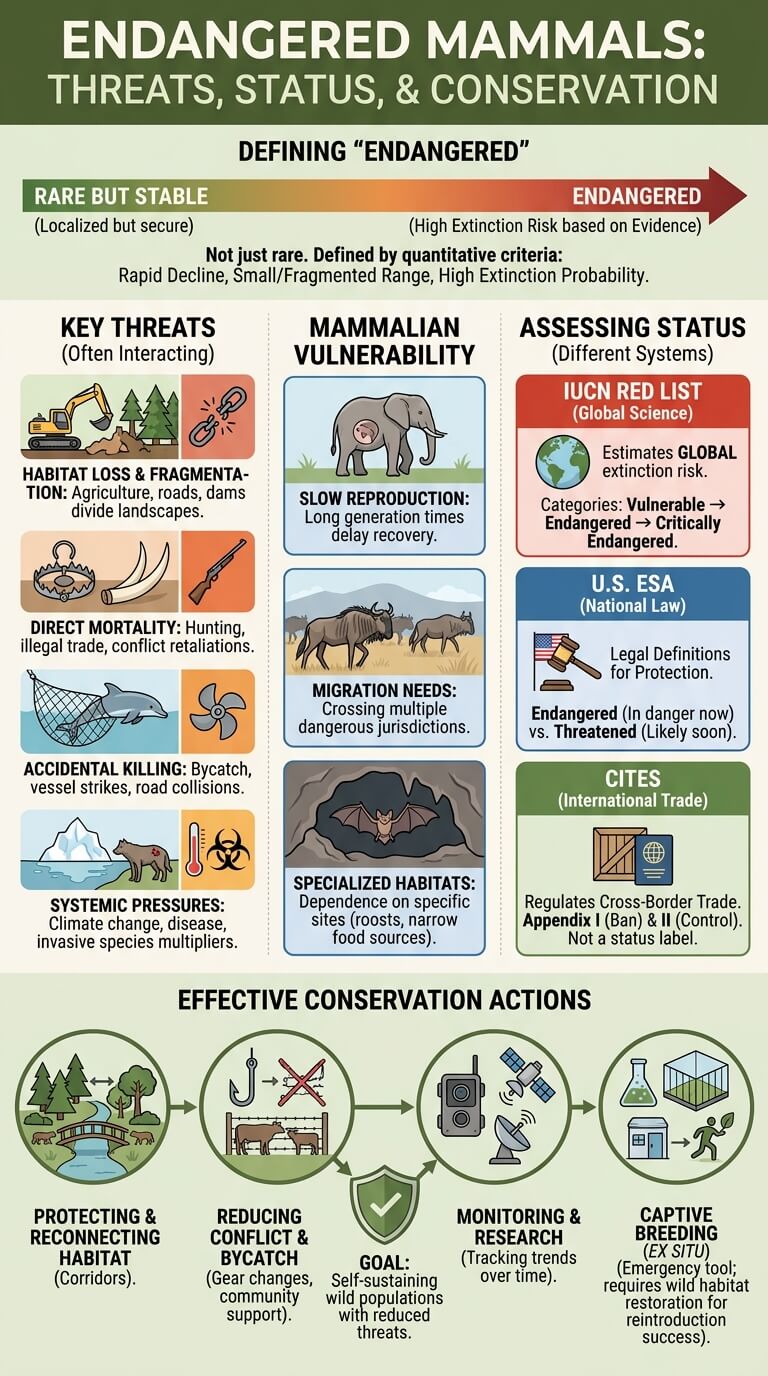
A mammal can be rare without being classified as Endangered. Some species naturally occur in small numbers or in a narrow area but remain stable. Others may still seem common in familiar places while declining across much of their range. Conservation assessments ask whether the evidence indicates a meaningful risk of extinction, not whether an animal is famous, hard to photograph, or uncommon in one backyard.
Under the IUCN system, Vulnerable, Endangered, and Critically Endangered are the three categories collectively described as threatened. Endangered falls between Vulnerable and Critically Endangered. The category is assigned through quantitative criteria involving population decline, geographic range, population size, and extinction probability rather than through public popularity or a simple head count.
Status Can Differ by Authority, Region, and Date
A global assessment and a national law do not have to use the same label. A species can be globally Least Concern while a local population is legally protected because it is disappearing within a country. The reverse can also occur when a species faces severe global decline but is not listed under every national law within its range.
Dates matter as much as labels. A status reflects the data and criteria used during a particular assessment. Surveys may reveal previously unknown populations, detect a sharper decline, or show that recovery actions are working. Responsible writing therefore gives the authority, geographic scope, and assessment date when a current status is important.
How Mammal Conservation Status Is Assessed

IUCN Red List Categories
The IUCN Red List is designed to estimate global extinction risk. Its categories include Not Evaluated, Data Deficient, Least Concern, Near Threatened, Vulnerable, Endangered, Critically Endangered, Extinct in the Wild, and Extinct. The IUCN Red List Categories and Criteria use several routes to a threatened classification, including rapid population reduction, restricted or fragmented range, very small population size, continuing decline, and modeled extinction risk.
No single number automatically decides every case. A population estimate can be uncertain, and two species with similar numbers may face very different futures. Assessors consider whether animals are spread among secure populations, concentrated in one vulnerable place, still declining, or likely to lose more habitat. They also document threats, conservation actions, research needs, and the evidence behind the decision.
National Legal Protections and International Trade Controls
In the United States, the Endangered Species Act uses legal definitions that are related to, but separate from, IUCN categories. The law defines an endangered species as one in danger of extinction throughout all or a significant portion of its range. A threatened species is one likely to become endangered within the foreseeable future. These definitions appear in the U.S. Fish and Wildlife Service text of ESA Section 3.
CITES addresses a different part of conservation: international trade in listed wildlife and wildlife products. Appendix I generally covers species threatened with extinction that are or may be affected by trade, while Appendix II includes species for which trade must be controlled to avoid use incompatible with survival. The CITES explanation of how its appendices work makes clear that a trade listing is not the same thing as a global Red List category or a national endangered-species listing.
Population Trend, Range, Fragmentation, and Uncertainty
Conservation status depends on direction as well as abundance. A population of several thousand animals can be in serious trouble if it is falling rapidly, while a smaller population may be more secure if it is stable, well protected, and spread among several connected areas. Researchers therefore examine trends over time rather than treating one survey as a complete answer.
Range size and fragmentation can reveal risks hidden by a total count. A mammal scattered among isolated habitat patches may have fewer opportunities to find mates, recolonize empty areas, or move when food and climate conditions change. A species occupying one cave system, island, river basin, or coastal corridor can be especially exposed to a single storm, disease outbreak, development project, or other local event.
Uncertainty does not mean that no conclusion is possible. It means the wording should match the evidence. Estimates may be presented as ranges, and assessors may use several data sources, including field surveys, camera traps, acoustic monitoring, genetics, satellite tracking, reports from local communities, and habitat-change measurements. Data Deficient is also not a reassuring category. It means available information is insufficient for a full assessment, not that the species is safe.
Why Mammals Become Threatened
Habitat Loss, Degradation, and Fragmentation
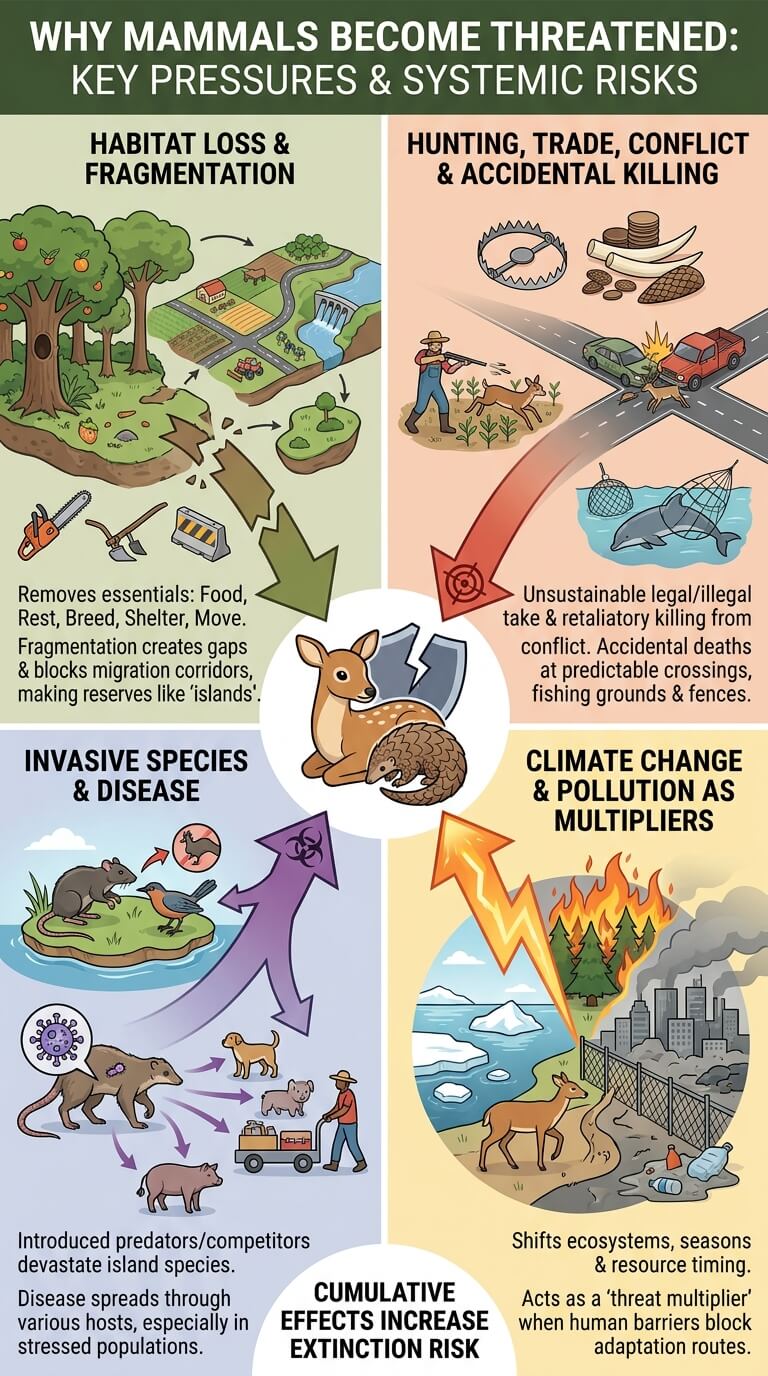
Habitat loss removes places where mammals feed, rest, breed, shelter, and move. Forest clearing can eliminate tree cavities and fruiting plants. Grassland conversion can reduce prey and burrow systems. Wetland drainage can alter water levels and food webs. Coastal development can disturb nursery areas, while dams and roads can block movement between seasonal habitats.
Fragmentation divides habitat into smaller pieces. The gaps may expose animals to vehicles, fences, predators, people, or unsuitable terrain. For wide-ranging mammals, a protected reserve can function like an island if surrounding migration corridors and dispersal routes disappear.
Hunting, Trade, Conflict, and Accidental Killing
Mammals may be killed for meat, trophies, traditional products, pets, or valuable body parts. Legal harvest can also become unsustainable when monitoring and enforcement are weak. Illegal trade adds secrecy, making the true level of removal difficult to measure. The biological effect is especially serious when hunters remove breeding females, socially important adults, or animals from already small populations.
Conflict occurs when mammals damage crops, kill livestock, compete for fish, enter buildings, or pose a perceived danger. Retaliatory killing can continue even when a species is legally protected. Effective conflict reduction often combines prevention, rapid compensation or support, community participation, better livestock practices, and land-use planning rather than expecting people to absorb every cost of living near wildlife.
Accidental killing includes vehicle collisions, entanglement in fishing gear, bycatch, poisoning intended for other animals, and deaths in traps or fences. These losses may seem random, but they often occur repeatedly at predictable crossings, feeding areas, shipping lanes, or fishing grounds. That makes targeted mitigation possible when agencies and local industries share reliable data.
Invasive Species, Disease, Pollution, and Climate Change
Introduced predators and competitors can be devastating on islands, where native mammals may have evolved without them. Invasive plants can alter food and fire patterns. Disease can spread through wildlife, domestic animals, people, or transported materials, and its effect can be greatest when a population is already stressed or genetically limited.
Climate change can shift temperature, rainfall, snow cover, sea ice, fire, vegetation, prey distribution, and the timing of seasonal events. Mammals may move, change behavior, or use different foods, but adaptation has limits. A species cannot simply follow suitable climate if roads, farms, cities, fences, or coastlines block the route. Climate pressure is therefore often a threat multiplier rather than an isolated cause.
Why Mammal Biology Can Increase Vulnerability
Slow Reproduction and Long Generation Times
Many large mammals mature slowly, have long pregnancies, produce one young at a time, and invest heavily in parental care. These traits can support high survival in stable conditions, but they limit how quickly a population can replace adults lost to hunting, vehicles, fishing gear, or habitat change. Even after a threat is reduced, recovery may take decades.
Small mammals are not automatically protected by faster reproduction. A rodent or bat may produce young quickly yet depend on one specialized food, one island, or a small number of breeding sites. If the habitat disappears faster than reproduction can compensate, a short generation time offers little protection.
Large Ranges, Migration Routes, and Specialized Habitats
Large carnivores, migratory ungulates, elephants, bats, and whales may use different places during different seasons or life stages. Protecting a feeding area while losing a breeding site, migration bottleneck, maternity roost, or dry-season refuge can still cause decline. Conservation must match the animal’s full annual cycle.
Small Populations and Genetic Risks
Small populations are vulnerable to chance. A skewed sex ratio, several poor breeding years, a storm, a fire, or the loss of a few breeding adults can change the trajectory. When populations become isolated, mating among relatives may increase and genetic diversity may decline, although the outcome differs among species and populations.
Genetic management can help, but it is not a substitute for habitat. Moving animals or genetic material may reduce inbreeding risk, yet the recipient population still needs enough food, space, disease protection, and safety to grow. Genetic tools work best as part of a broader recovery program.
Threat Patterns Across Mammal Habitats

Forest and Grassland Mammals
Forest mammals often face logging, agricultural expansion, mining, roads, fires, hunting access, and the loss of connected canopy or understory. Arboreal species may be unable to cross open ground. Ground-dwelling mammals may survive in logged forest but experience more hunting, hotter conditions, or reduced cover.
Freshwater and Cave Mammals
Freshwater mammals depend on rivers, wetlands, floodplains, banks, and prey communities that can be altered far upstream. Dams, pollution, boat traffic, fishing gear, water extraction, and channel modification may change flow, fragment habitat, or reduce food. Conservation often requires coordination across an entire watershed rather than one small reserve.
Cave mammals, especially bats, can concentrate in very large numbers at a few roosts. Disturbance during hibernation or maternity periods may affect many animals at once. Cave tourism, mining, sealing entrances, vandalism, and disease can therefore have effects far beyond the physical size of a cave.
Marine and Coastal Mammals
Marine mammals may travel across national borders and encounter shipping, fishing, military activity, energy development, pollution, prey shifts, and underwater noise. Their size does not protect them from risk. A whale that surfaces to breathe can be struck by a vessel, and an animal towing fishing gear may lose the energy needed for feeding or reproduction.
Coastal species also depend on haul-out sites, estuaries, seagrass, reefs, or shallow nursery habitat used heavily by people. Effective protection may require seasonal closures, speed restrictions, gear changes, quieter operations, protected shorelines, and international cooperation.
Three Mammal Conservation Examples
African Forest Elephants: Status Depends on Species-Level Evidence
African elephants were once frequently discussed as one species, but forest elephants and savanna elephants are now assessed separately. The African forest elephant is classified as Critically Endangered, while the African savanna elephant is Endangered. The IUCN assessment announcement for African elephant species identifies long-term population declines associated with ivory poaching and habitat loss.
The example shows why broad common names can mislead. Threat intensity varies across countries and landscapes, and a continent-wide label does not describe every local population equally. It also shows why taxonomy matters for conservation: combining distinct species can hide different trends, ranges, and management needs.
Black-Footed Ferrets: Recovery Requires More Than Breeding Animals
Black-footed ferrets depend heavily on prairie dog colonies for food and burrows. Their recovery has involved managed breeding, preparation for life in the wild, reintroduction, vaccination, disease management, habitat work, and long-term monitoring. The National Black-Footed Ferret Conservation Center explains that the modern breeding program was founded from the last known wild animals captured after disease threatened the rediscovered population.
This is a powerful example of ex situ conservation, meaning work conducted outside the species’ normal wild habitat. Captive breeding prevented immediate loss, but ferrets cannot recover without large, functioning prairie dog landscapes and control of threats such as sylvatic plague. Producing animals is only one step in rebuilding a self-sustaining wild population.
North Atlantic Right Whales: Migration Creates Repeated Human Risks
North Atlantic right whales migrate along a heavily used coastline and overlap with fishing grounds and shipping routes. NOAA identifies entanglement and vessel strikes as leading causes of mortality, while changing prey distribution and other environmental pressures can move whales into areas with different levels of protection. The NOAA Fisheries North Atlantic right whale profile, updated in June 2026, reports a current estimate of roughly 380 whales and emphasizes that long-term recovery still requires substantial reduction of human-caused injury and death.
The whale illustrates how population size, reproduction, migration, and threat geography interact. Protecting one bay or calving area is not enough when individuals travel through multiple jurisdictions and hazards. Monitoring must follow changes in distribution, and management must adjust when whales and fisheries use the ocean differently.
What Conservation Actions Can Work
Protecting and Reconnecting Habitat
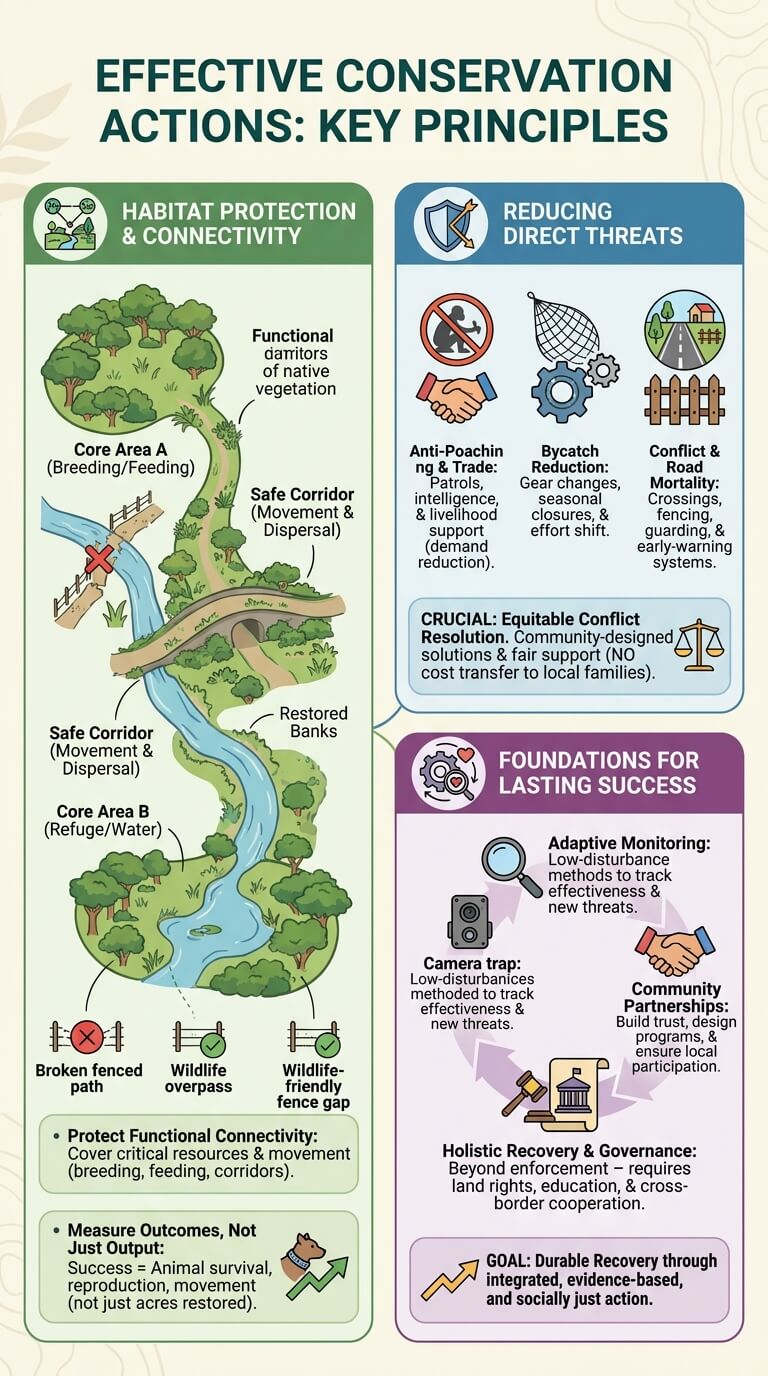
Habitat protection is most effective when it covers the resources and movements that sustain a population. That may include breeding sites, feeding grounds, water sources, migration corridors, dispersal routes, and refuges used during drought, winter, fire, or storms. Corridors do not have to be untouched wilderness, but they must be usable and safe enough for animals to move between core areas.
Restoration can rebuild native vegetation, reconnect rivers, remove or modify fences, improve road crossings, protect caves, or reduce disturbance around roosts and nurseries. Success should be measured by animal survival, reproduction, movement, and population trend, not only by acres planted or structures installed.
Reducing Killing, Bycatch, Trade, and Conflict
Different threats require different tools. Anti-poaching work may combine patrols, intelligence, prosecution, demand reduction, and support for local livelihoods. Bycatch reduction may require gear changes, seasonal closures, real-time animal detection, or moving fishing effort. Road mortality may be reduced through crossings, fencing, speed management, and protection of known bottlenecks.
Conflict programs work best when communities help design them. Predator-proof enclosures, livestock guarding, crop barriers, early-warning systems, land-use planning, and fair support after losses can reduce pressure for retaliation. A solution that protects wildlife but transfers all costs to nearby families is unlikely to last.
Monitoring, Community Partnerships, Law Enforcement, and Recovery Programs
Monitoring shows whether actions are working and whether new threats are emerging. Camera traps, acoustic recorders, genetic samples, individual identification, satellite tags, patrol records, and community observations can answer different questions. Methods should be chosen for the species and should minimize disturbance.
Law enforcement matters where illegal killing or trade drives decline, but enforcement alone cannot solve every problem. Recovery also depends on governance, land rights, education, economic alternatives, veterinary capacity, protected-area management, and cooperation across borders.
Captive Breeding, Reintroduction, and Genetic Management
When Ex Situ Conservation May Help
Captive breeding can buy time when wild numbers are dangerously low, when a threat cannot be controlled quickly, or when managers need animals for reintroduction. Carefully managed programs track ancestry, health, behavior, and breeding to avoid losing genetic diversity or selecting animals poorly suited for the wild.
Why Habitat and Threat Reduction Still Matter
Releasing animals into unsafe habitat does not create recovery. Before reintroduction, managers need to identify why the original population disappeared and reduce those causes. They may need to restore prey, remove invasive predators, control disease, secure community support, reconnect habitat, or change hunting and fishing practices.
Animals may also need preparation. Captive-born mammals can lack hunting, predator avoidance, social, or navigation skills. Soft release, preconditioning, supplemental food, temporary enclosures, or release with experienced individuals may improve outcomes, depending on the species.
Risks, Limits, and Long-Term Monitoring
Reintroductions can fail because habitat is too small, threats return, released animals disperse, disease spreads, or public support collapses. Genetic rescue can introduce useful variation but may also disrupt local adaptation if poorly planned. Veterinary screening and ecological risk assessment are essential.
Success is not the number released. It is survival, reproduction, recruitment of wild-born young, expanding or stable range, and declining dependence on intensive management. Those outcomes may take many years to measure.
What Readers Often Misunderstand
Rare Does Not Always Mean Endangered
Rarity describes abundance or distribution. Endangerment describes extinction risk under a particular framework. A naturally rare mammal can be stable, while a widespread mammal can qualify as threatened after a rapid decline. The two ideas overlap, but they are not interchangeable.
A Charismatic Species Is Not the Whole Ecosystem
Elephants, tigers, bears, and whales can attract funding and public support, but conserving them does not automatically protect every species sharing their habitat. Management for one flagship mammal may help many organisms when it protects large, connected ecosystems. It can also miss specialized plants, invertebrates, freshwater species, or small mammals with different needs.
Good conservation asks what ecological processes and species are being protected, not only which animal appears on the campaign poster. Small mammals can be pollinators, seed dispersers, prey, soil engineers, and indicators of environmental change even when the public rarely sees them.
Population Numbers Without Date, Location, and Method Can Mislead
A viral number may describe one subspecies, one country, one survey area, breeding adults only, or an estimate from years ago. Some counts include wide uncertainty because mammals are elusive, nocturnal, aquatic, migratory, or spread across difficult terrain. Comparing two numbers made with different methods can create a false trend.
Look for the year, geographic scope, unit being counted, survey method, uncertainty, and whether the figure is an estimate or a direct count. A current range is often more honest than a precise-looking total.
How to Evaluate Current Claims About Endangered Mammals
Check the Assessment Date and Geographic Scope
Start with the species name, including the scientific name when possible. Then identify whether the claim refers to the world, a country, a state, a subspecies, or a distinct population. Check when the assessment was published or last updated and whether a newer review exists.
Common names can refer to several species. “Elephant,” “rhino,” “bat,” or “river dolphin” is not specific enough for a status claim. The assessment should match the exact taxon being discussed.
Separate Global Status From National Legal Status
An IUCN category estimates global extinction risk. An ESA listing creates legal protections in the United States. A CITES appendix regulates international trade. State and foreign laws may add other categories. A responsible claim names the system rather than presenting all labels as interchangeable.
Legal status can also cover a population or subspecies rather than the entire species. That distinction matters when explaining whether an animal is protected in a particular place.
Treat Viral Population Claims and Fixed Top-Ten Lists Cautiously
Lists of the “ten most endangered mammals” often mix old assessments, tiny populations, famous animals, and unverified numbers. Extinction risk cannot always be ranked neatly across species because evidence quality, generation time, threat trajectory, and geographic scale differ.
A better approach is to use current assessments and explain why each species is vulnerable. That keeps the focus on evidence and conservation needs rather than turning extinction risk into a contest.
How Threats Connect to Mammal Life
Migration, Reproduction, and Habitat Specialization Shape Risk
Migration can expose mammals to roads, fences, shipping lanes, fishing gear, and changing conditions across several jurisdictions. Slow reproduction can make adult deaths especially costly. Habitat specialization can leave few alternatives when a cave, prairie colony, forest type, sea-ice zone, or nursery ground is altered.
These traits do not doom a species. They identify where conservation must be precise. A migratory mammal may need corridor protection, a slow-breeding species may need very low adult mortality, and a specialist may need management of a particular habitat feature rather than broad land protection alone.
Different Mammal Groups Need Different Conservation Plans
Elephants require large landscapes and conflict reduction. Big cats need prey, space, and protection from retaliation and trade. Bears vary widely by species and population. Bats may depend on caves, forests, insects, and safe migration routes. Marine mammals face fishing, vessel, noise, prey, and coastal-habitat pressures.
Grouping all mammals together is useful for seeing shared patterns, but recovery happens through species-specific and place-specific work. The same action can help one population and do little for another.
FAQ
What Is the Difference Between Endangered and Threatened?
The answer depends on the system. On the IUCN Red List, “threatened” is an umbrella term covering Vulnerable, Endangered, and Critically Endangered. Under the U.S. Endangered Species Act, endangered and threatened are separate legal categories. Endangered means the species is in danger of extinction throughout all or a significant portion of its range, while threatened means it is likely to become endangered within the foreseeable future.
Who Decides Whether a Mammal Is Endangered?
There is no single worldwide authority for every purpose. IUCN assessments are produced through a scientific review process for global extinction risk. National governments make legal listing decisions under their own laws. CITES Parties decide which species are included in international trade appendices. State, provincial, tribal, and regional authorities may also maintain lists and protections.
Why Are Some Common-Looking Mammals Still Declining?
People often see animals in the places where those animals remain abundant. That local experience can hide losses elsewhere. A species may also appear frequently near roads or neighborhoods because habitat has been compressed, not because the total population is healthy. Trend data across the full range are more informative than sightings from one area.
What Can Individuals Do Without Disturbing Wildlife?
Use reputable conservation organizations and government agencies to guide donations, volunteering, and citizen science. Buy products that do not encourage illegal wildlife trade or destructive habitat conversion. Drive carefully in wildlife-crossing areas, reduce unnecessary outdoor lighting, keep pets controlled, follow boating and viewing distances, and report injured or illegally held wildlife to the appropriate authority.
Do not feed, capture, move, treat, or attempt to rescue a wild mammal without direction from a licensed rehabilitator or wildlife agency. Well-intended intervention can injure the animal, expose people and pets to disease, separate young from parents, or interfere with an official recovery effort.
Final Thoughts
Endangered mammals are not defined by fame or rarity alone. Their status comes from evidence about population trend, range, fragmentation, biological vulnerability, and extinction risk within a named assessment or legal system. Habitat loss, killing, trade, conflict, bycatch, disease, pollution, and climate change often interact, while migration, slow reproduction, and specialized habitat can make recovery harder.
Conservation works best when it reduces the real causes of decline, protects the places animals need through their full life cycle, includes local communities, and measures long-term survival and reproduction. Current dates, exact species names, geographic scope, and cautious population estimates help readers separate reliable endangered-mammal information from outdated lists and viral claims.

Ethan Walker is the founder and research editor of Animal Fact Central. He creates and reviews educational animal facts content using trusted wildlife, pet care, and science-based sources. His work focuses on making animal behavior, adaptations, habitats, and species facts clear, accurate, and engaging for everyday readers.
Read More Details About Ethan Walker: https://animalfactcentral.com/ethan-walker/