
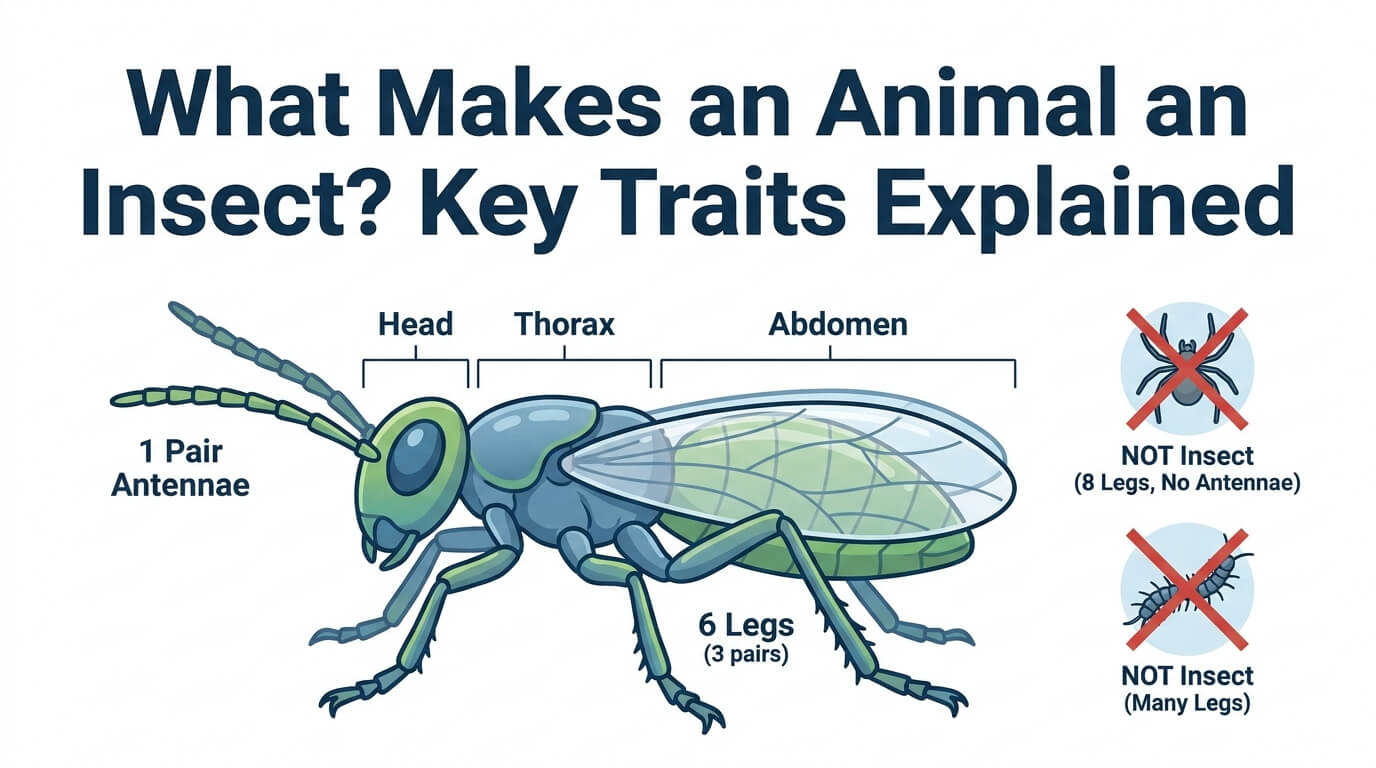
An insect is not simply a small animal with many legs, an exoskeleton, or a habit of crawling around leaves and sidewalks. In biological terms, an insect belongs to the class Insecta and follows a recognizable body plan: three main body regions, three pairs of legs attached to the thorax, one pair of antennae, a jointed exoskeleton, and a set of other anatomical features shared across an enormous range of forms.
That combination is what matters. A spider has an exoskeleton and jointed legs, but it is not an insect. A centipede has antennae and many jointed body segments, but it is not an insect. A springtail has six legs, yet modern classifications generally place springtails outside Insecta. Once you learn to look at several traits together, the word insect becomes much more precise than everyday labels such as bug, creepy-crawly, or tiny animal.
Quick Answer
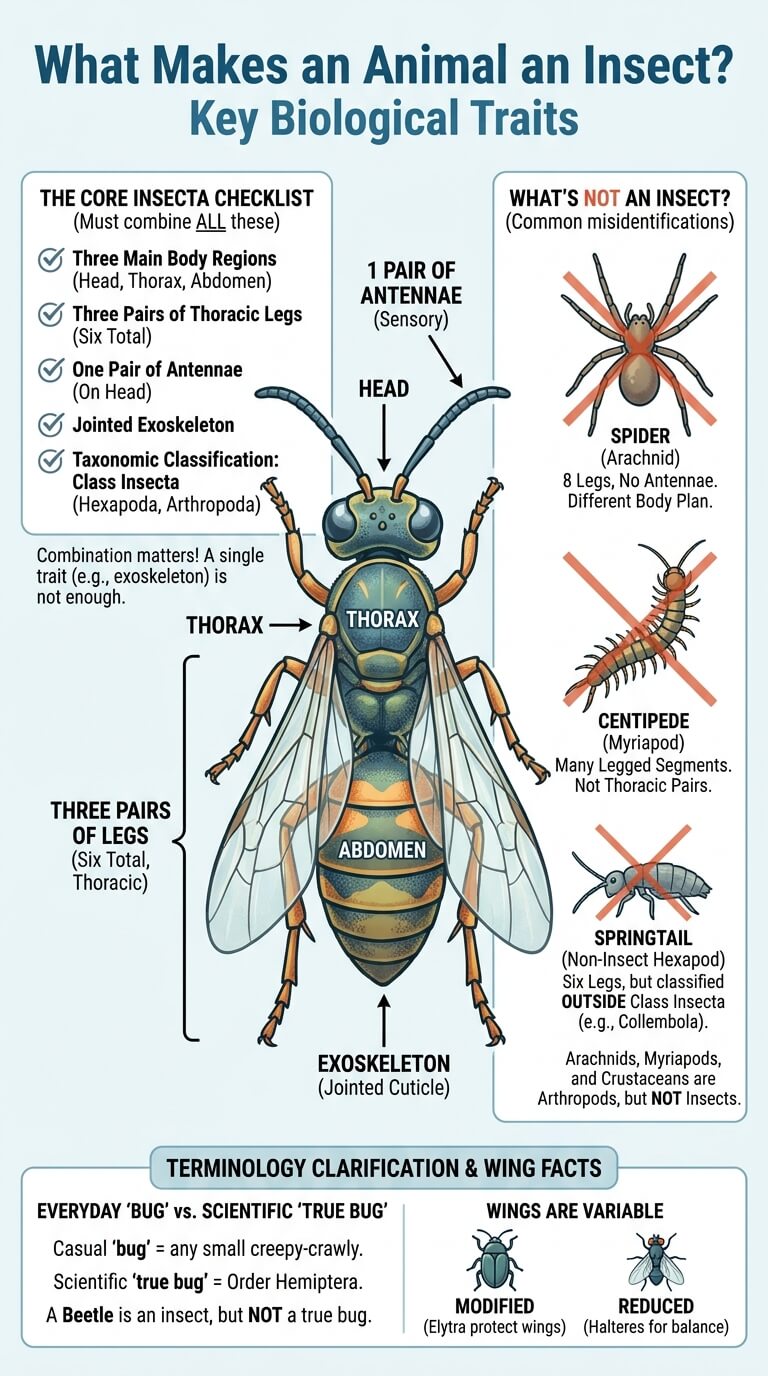
The core Insecta body-plan checklist
Adult insects are arthropods with a characteristic organization. The body is divided into a head, thorax, and abdomen. The thorax bears three pairs of legs, for a total of six. The head carries one pair of antennae, along with the main mouthparts and major sensory structures. The body is supported by an external skeleton made of cuticle rather than an internal bony skeleton.
The Smithsonian National Museum of Natural History’s insect overview uses the same practical combination of three body regions, six legs, one pair of antennae, and wing patterns to help readers separate insects from other arthropods. Wings are useful clues, but they are not required because some insects are naturally wingless and others have wingless life stages, sexes, or castes.
- Three main body regions: head, thorax, and abdomen.
- Six adult legs: three pairs, all attached to the thorax.
- One pair of antennae: attached to the head.
- Exoskeleton: a jointed outer body covering produced by living tissues.
- Jointed appendages: including legs, antennae, and modified mouthparts.
- Wings in many groups: usually attached to the thorax, but they may be modified, reduced, or absent.
Why small size or an exoskeleton alone does not define an insect
Size is a poor definition because insects range from extremely small species to much larger ones, while many non-insect arthropods overlap the same size range. A small spider, mite, woodlouse, or juvenile centipede can easily be mistaken for an insect if size is the main clue.
An exoskeleton is also not enough. Insects are arthropods, and arthropods as a whole include arachnids, crustaceans, centipedes, millipedes, and other groups. They share a jointed external skeleton and jointed appendages, but they organize those structures differently. The best approach is therefore to identify the full body plan rather than rely on one feature.
Where Insects Fit in Animal Classification
Animalia to Arthropoda to Hexapoda context to Insecta
Insects are animals in the phylum Arthropoda, the major lineage that includes animals with segmented bodies, jointed appendages, and an external skeleton. Within Arthropoda, insects belong to Hexapoda, the six-legged arthropod branch. Insecta is the class that contains the insects themselves.
The current Integrated Taxonomic Information System record for Insecta places the class inside Arthropoda and the subphylum Hexapoda. That hierarchy is useful because it explains both the similarities and the boundaries. Insects share deep arthropod features with spiders, crabs, and centipedes, yet their six-legged body plan makes them a more specific branch within that broader group.
Why invertebrate is a useful umbrella term rather than a formal clade like Insecta
Invertebrate is a practical word for animals without a vertebral column, but it does not describe one single evolutionary branch in the same way that Insecta does. Insects, jellyfish, earthworms, snails, spiders, and sea stars can all be called invertebrates, even though they belong to very different lineages.
That distinction matters when classifying an unknown animal. Saying that a creature is an invertebrate narrows things only slightly. Saying that it is an arthropod gives more structural information. Saying that it is an insect is more specific still because the animal must fit the insect body plan and taxonomic placement.
Why springtails and other hexapods need taxonomic caution
Six legs strongly suggest a hexapod, but six legs alone do not automatically make an animal a true insect in modern classification. Springtails, or Collembola, are the best-known example. They are close hexapod relatives of insects, yet they are commonly placed outside the class Insecta.
The ITIS treatment of Collembola lists springtails as a separate class and notes that rank usage for Collembola, Protura, and Diplura has varied among classifications. For a general reader, the safest takeaway is simple: springtails are hexapods closely related to insects, but they should not be casually presented as ordinary members of Insecta.
The Three Main Body Regions
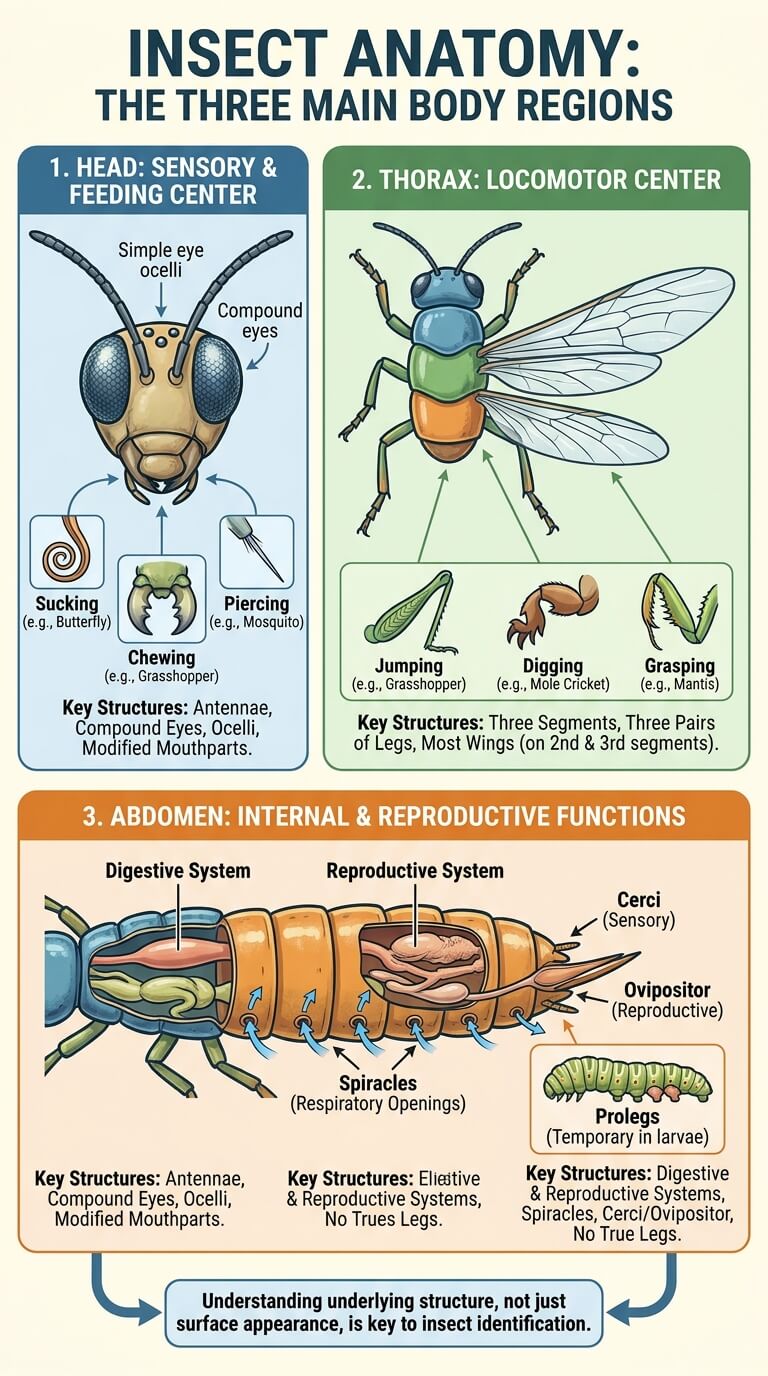
Head and its major sensory and feeding structures
The insect head is the front body region and carries structures used to sense the surroundings and obtain food. It usually bears a pair of antennae, compound eyes in many species, simple eyes called ocelli in many groups, and mouthparts that can be modified for chewing, piercing, sucking, sponging, lapping, or other feeding methods.
These structures can look very different among insects. A butterfly’s coiled feeding tube, a grasshopper’s chewing mouthparts, and a mosquito’s piercing structures are modifications of the same general head region, not signs that these animals belong to unrelated body plans. This is one reason insect identification works best by looking at underlying structure rather than surface appearance.
Thorax as the center for six legs and most wings
The thorax sits behind the head and is the main locomotor region. It consists of three segments, and each segment bears one pair of legs. That produces the defining adult insect total of six legs. In winged insects, the wings are attached to the second and third thoracic segments rather than the abdomen.
Thoracic legs can be heavily specialized. Grasshoppers have enlarged hind legs for jumping. Mole crickets have broad forelegs adapted for digging. Water beetles may have flattened, fringed legs that help with swimming. Mantises have grasping forelegs used to seize prey. These differences show how one basic insect plan can support very different ways of moving and feeding.
Abdomen and major internal and reproductive functions
The abdomen is the rear body region. It contains much of the digestive and reproductive system, and along its sides many insects have openings called spiracles that connect to the tracheal respiratory system. The abdomen may also carry sensory or reproductive structures such as cerci or an ovipositor, depending on the group.
The abdomen does not bear the three pairs of true walking legs that define adult insects. Some immature insects, however, can have additional temporary structures that look leglike. Caterpillars, for example, have fleshy abdominal prolegs in addition to the three pairs of true thoracic legs. That is one reason life stage matters when people count legs.
Six Legs, One Pair of Antennae, and an Exoskeleton

Why adult insect legs attach to the thorax
Each thoracic segment carries one pair of legs, so the basic adult insect arrangement is three pairs. The legs themselves are jointed and divided into recognizable segments. Their shapes vary widely because selection can modify the same underlying appendage for running, jumping, digging, swimming, grasping prey, clinging to surfaces, or carrying materials.
Six thoracic legs are one of the most useful field-level clues, but they should still be combined with the rest of the body plan. A damaged insect may be missing a leg, and an immature stage may look very different from the familiar adult. Classification depends on anatomy and development, not simply on how many legs happen to be visible on one individual.
What antennae do and why they are not simply noses
Insect antennae are paired sensory appendages on the head. They often contain receptors that respond to airborne chemicals, but describing them as noses is too narrow. Depending on the species, antennae can also contribute to touch, air-movement detection, humidity sensing, temperature sensing, orientation, communication, or vibration-related perception.
Antennae can be threadlike, clubbed, feathery, elbowed, or shaped in other ways. Their form often reflects how an insect gathers information. Male moths in some groups, for instance, can have broad, feathery antennae with a large sensory surface, while ants commonly have elbowed antennae that are used during close contact and chemical investigation.
Exoskeleton and jointed appendages in an insect-specific context
The insect exoskeleton is the hardened and flexible outer body covering made from cuticle. It supports the body, provides surfaces for muscle attachment, helps protect internal tissues, and reduces water loss. It is not a lifeless shell placed over the animal. Living epidermal cells beneath it produce the cuticle, and flexible membranes between harder plates allow joints to move.
Chitin is an important component of insect cuticle, but the exoskeleton is not made of chitin alone. Proteins and other materials contribute to different mechanical properties. Harder regions can protect and support, while flexible regions allow the legs, mouthparts, antennae, abdomen, and other structures to bend.
Wings Are Common but Not Required
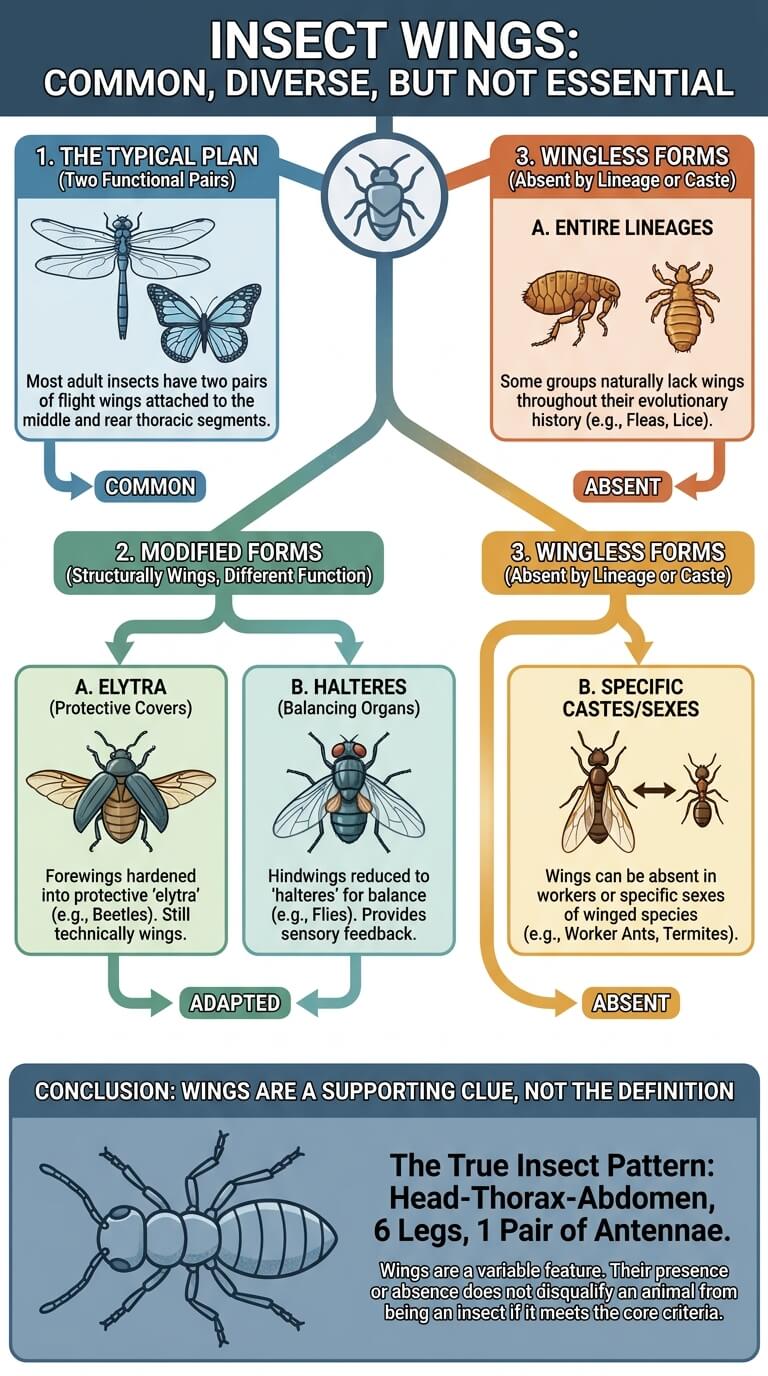
Two wing pairs, one functional pair, modified wings, and wingless forms
Many adult insects have two pairs of wings, one pair attached to the middle thoracic segment and one to the rear thoracic segment. Yet wings are not a universal requirement for being an insect. Some lineages are wingless, some species lose wings during evolution, and some life stages, castes, or sexes can be wingless even when other members of the same species are winged.
Wing structure also varies so much that a casual glance can be misleading. A fly appears to have one pair of ordinary wings because the hind pair has become small balancing organs. A beetle may appear to have a hard shell over one pair of wings because its forewings have been transformed into protective covers. Those modifications still fit the insect thoracic plan.
Beetle elytra and fly halteres as examples of modification
In beetles, the forewings are modified into elytra, hardened covers that protect the folded hindwings and much of the upper abdomen. The elytra are still wings in an evolutionary and anatomical sense even though they usually do not act like the main flight surfaces.
In true flies, including mosquitoes, the forewings provide the main lift while the hindwings are reduced to knobbed structures called halteres. Halteres oscillate during flight and provide sensory feedback that helps with balance and maneuvering. So a fly does not break the insect pattern. It has modified the second wing pair rather than simply losing all trace of it.
Wingless castes, sexes, and lineages
Winglessness can occur for many reasons. Fleas and lice are examples of wingless insect groups. Worker ants are generally wingless even though reproductive males and females can develop wings for mating flights. In termites, reproductive forms can be winged while workers and soldiers are not. Some female insects are wingless while males remain winged.
Because wings can be absent or highly modified, they are a supporting clue rather than the single feature that defines Insecta. An animal with six thoracic legs, one pair of antennae, and the typical head-thorax-abdomen organization can still be an insect even when no wings are visible.
Insects Compared With Other Common Arthropods

Insects versus arachnids
Arachnids include spiders, scorpions, ticks, and mites. Adult spiders and many familiar arachnids have four pairs of walking legs, giving them eight rather than six. They also lack antennae. Their body organization is different from the three-part insect pattern, although the degree of visible fusion varies among arachnid groups.
A Smithsonian comparison of major arthropod groups describes insects as having six legs and one pair of antennae, while arachnids have eight legs and no antennae. The Smithsonian Insect Zoo’s arthropod comparison also contrasts centipedes, millipedes, crustaceans, and insects by their body regions, antennae, and leg arrangements.
Insects versus centipedes
Centipedes are long, many-segmented arthropods in the class Chilopoda. They have one pair of legs on most leg-bearing trunk segments, so adults normally have far more than six legs. They have one pair of antennae, which can make the front end look insectlike, but the long trunk and repeated leg pairs clearly separate them from the compact insect thorax.
The first pair of centipede trunk appendages is modified into venom-bearing forcipules used to subdue prey. That specialized structure is another reminder that arthropod appendages can be modified in many ways. A centipede is an arthropod, but it is not a six-legged member of Insecta.
Insects versus millipedes
Millipedes belong to Diplopoda. Their bodies have many trunk segments, and many of those segments appear to bear two pairs of legs. The total number of legs varies greatly among species, but the overall pattern is completely different from the insect arrangement of three thoracic pairs.
Millipedes have one pair of antennae, yet antennae alone do not make them insects. The combination of numerous trunk segments, repeated leg pairs, and the absence of a distinct three-segment thorax with exactly three adult leg pairs places them outside Insecta.
Insects versus crustaceans
Crustaceans include animals such as crabs, shrimp, lobsters, copepods, barnacles, and terrestrial woodlice. Their body forms are extremely diverse, so no single simple diagram captures the whole group. A common traditional distinction is that crustaceans generally have two pairs of antennae, whereas insects have one.
Woodlice, also called pill bugs or roly-polies in everyday speech, are a useful example because they live on land and are often found under logs or rocks beside insects. They are crustaceans, not insects. Their numerous legs and crustacean body organization separate them from the six-legged insect plan.
What Does Bug Mean?
Everyday bug versus scientific true bug terminology
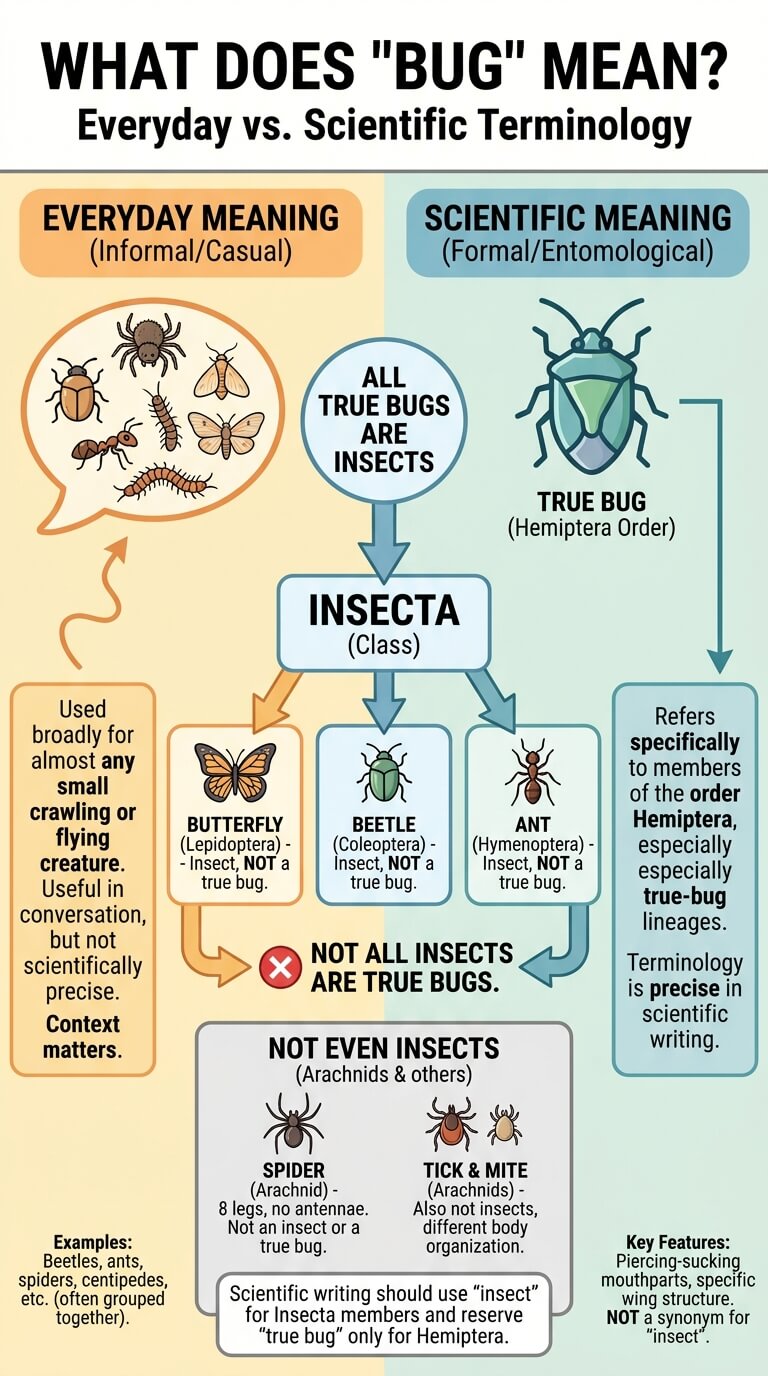
In everyday American English, bug can mean almost any small crawling or flying creature. People may call beetles, ants, spiders, centipedes, and even unrelated tiny animals bugs. That usage is informal and useful in conversation, but it does not match scientific classification.
In entomology, true bug is associated with Hemiptera, especially the true-bug lineages within that order. The ITIS record for Hemiptera lists true bugs and hemipterans as common names for the order. Terminology within Hemiptera can be more precise than everyday speech, so it is best not to treat bug and insect as scientific synonyms.
Why butterflies, beetles, and ants are insects but not true bugs
A butterfly is an insect in the order Lepidoptera. A beetle is an insect in Coleoptera. An ant is an insect in Hymenoptera. None belongs to Hemiptera, so none is a true bug in the formal entomological sense.
This distinction helps explain a sentence that initially sounds odd: all true bugs are insects, but not all insects are true bugs. In casual conversation, however, many people use bug broadly, so context matters. Scientific writing should use insect for members of Insecta and reserve true bug for the appropriate hemipteran context.
Why spiders are not scientific true bugs or insects
Spiders are arachnids. They have eight legs as adults, no antennae, and a body organization different from insects. Calling a spider a bug in everyday speech is common, but it does not make the animal an insect or a true bug in biological classification.
The same caution applies to ticks and mites. Both are arachnids, not insects. Their small size can make them easy to lump together with insects, yet leg number, antennae, and body organization quickly reveal the difference when examined carefully.
Common Identification Mistakes
Counting legs on the wrong life stage
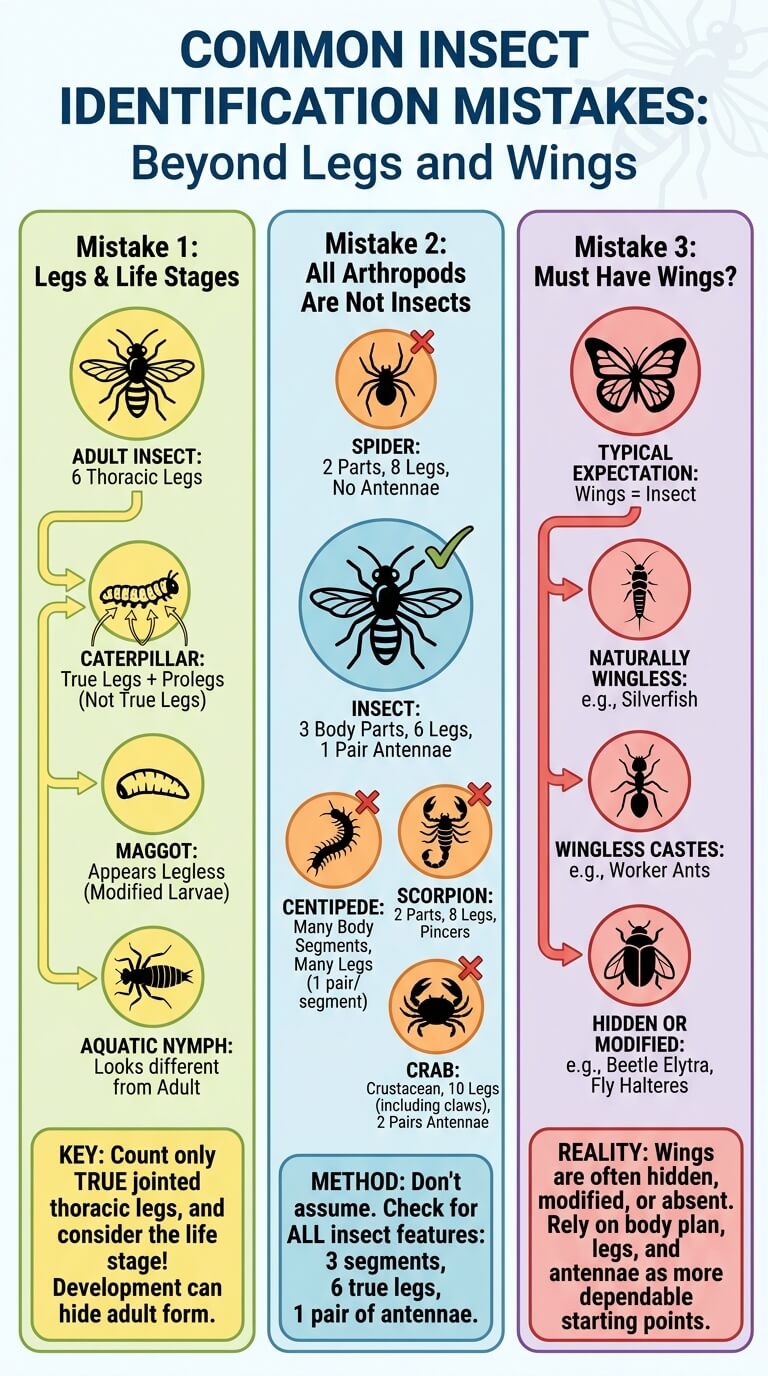
Adult insects have six legs, but immature insects can confuse the picture. Caterpillars have three pairs of true thoracic legs plus several pairs of fleshy abdominal prolegs. Fly maggots may appear legless. Some beetle larvae have obvious thoracic legs, while others are highly modified. Aquatic nymphs may also look unlike their terrestrial adults.
When using leg number as a clue, ask which appendages are true jointed thoracic legs and which life stage you are looking at. Development can temporarily hide the classic adult appearance without changing the animal’s underlying classification.
Treating every small arthropod as an insect
One of the easiest mistakes is to decide that anything small, segmented, and many-legged must be an insect. The arthropod family tree is much broader. Spiders, ticks, scorpions, centipedes, millipedes, crabs, woodlice, and springtails all share some arthropod characteristics without being insects.
A better method is to check several features in sequence: How many true walking legs are present? Are they attached to a three-segment thorax? Is there one pair of antennae? Does the body show the typical head, thorax, and abdomen? The more of these features align, the stronger the identification.
Assuming wings must be visible
Wings are so closely associated with butterflies, flies, bees, and dragonflies that people often expect every adult insect to have them. That expectation fails for naturally wingless lineages, wingless workers, wingless females in some species, and insects whose wings are hidden or modified.
Even among winged insects, the second pair can be easy to miss. Beetle elytra do not look like ordinary flight wings, and fly halteres are small. Wings therefore help with identification, but the three-part body plan, six thoracic legs, and one pair of antennae are more dependable starting points.
Why the Basic Body Plan Matters Across Insects
Anatomy explains how the same plan supports very different lifestyles
Once the insect body plan is clear, the enormous variation among insects becomes easier to understand. A grasshopper, butterfly, beetle, ant, dragonfly, and mosquito can look very different while still being built around the same head, thorax, abdomen, six-leg, one-pair-of-antennae framework.
Differences in mouthparts, legs, wings, sensory organs, and abdominal structures are modifications layered onto that common plan. Those modifications help explain why insects can chew leaves, pierce plant tissues, hunt other animals, swim, dig, jump, fly, communicate chemically, or live in highly organized societies without ceasing to be insects.
Major insect groups modify the same structural framework
Formal insect orders are partly recognized by how they modify shared structures. Beetles harden the forewings into elytra. True flies reduce the hindwings into halteres. Butterflies and moths have scales covering the wings. Grasshoppers often have enlarged hind legs. These differences are useful for classification because they are variations on the same basic insect architecture.
That is why learning the body plan first makes later identification much easier. Instead of memorizing hundreds of unrelated shapes, you can ask how a particular animal has modified the standard structures.
Arthropod comparisons reveal both shared ancestry and real boundaries
Comparing insects with other arthropods also prevents overgeneralization. An exoskeleton, segmentation, and jointed appendages are arthropod traits, not insect-only traits. The six-legged thorax and one-pair-of-antennae pattern narrow the animal to the insect branch much more effectively.
This broader perspective is especially helpful with unfamiliar animals. A creature does not have to look like a butterfly or beetle to be an insect, and an animal can look insectlike without belonging to Insecta. Structure and classification provide a more reliable answer than appearance alone.
FAQ
Are spiders insects?
No. Spiders are arachnids, not insects. Adult spiders have eight legs, no antennae, and a different body organization from the insect head-thorax-abdomen pattern. Both spiders and insects are arthropods, which is why they share features such as jointed appendages and an exoskeleton.
Are ticks insects?
No. Ticks are arachnids. Adult ticks have eight legs and lack antennae. Their larvae have six legs, which can confuse people, but that temporary juvenile leg count does not make them insects. Classification depends on the organism’s full anatomy and development.
Are centipedes and millipedes insects?
No. Centipedes and millipedes are arthropods, but they belong to their own major groups. Centipedes have many trunk segments with one pair of legs on most leg-bearing segments. Millipedes have many trunk segments and typically two pairs of legs on many apparent segments. Neither has the insect arrangement of three pairs of legs attached to a three-segment thorax.
Are all bugs insects?
Not in everyday language. People often use bug for spiders, centipedes, and other small animals that are not insects. In scientific usage, true bug refers to hemipteran insects, so the meaning is much narrower. A beetle, butterfly, or ant is an insect but not a true bug.
Final Thoughts
What makes an animal an insect is a combination of traits, not its size, whether it crawls, or whether people casually call it a bug. Insects belong to Insecta within the six-legged arthropods and are recognized by a three-part body, six thoracic legs, one pair of antennae, a jointed exoskeleton, and a characteristic pattern of appendages that can be modified in remarkable ways.
That framework also explains the common look-alikes. Spiders and ticks are arachnids, centipedes and millipedes have many leg-bearing trunk segments, crustaceans follow a different appendage plan, and springtails are hexapods that modern classifications generally keep outside Insecta. Learn the body plan first, and the diversity of insects becomes much easier to recognize without relying on misleading labels.

Ethan Walker is the founder and research editor of Animal Fact Central. He creates and reviews educational animal facts content using trusted wildlife, pet care, and science-based sources. His work focuses on making animal behavior, adaptations, habitats, and species facts clear, accurate, and engaging for everyday readers.
Read More Details About Ethan Walker: https://animalfactcentral.com/ethan-walker/