
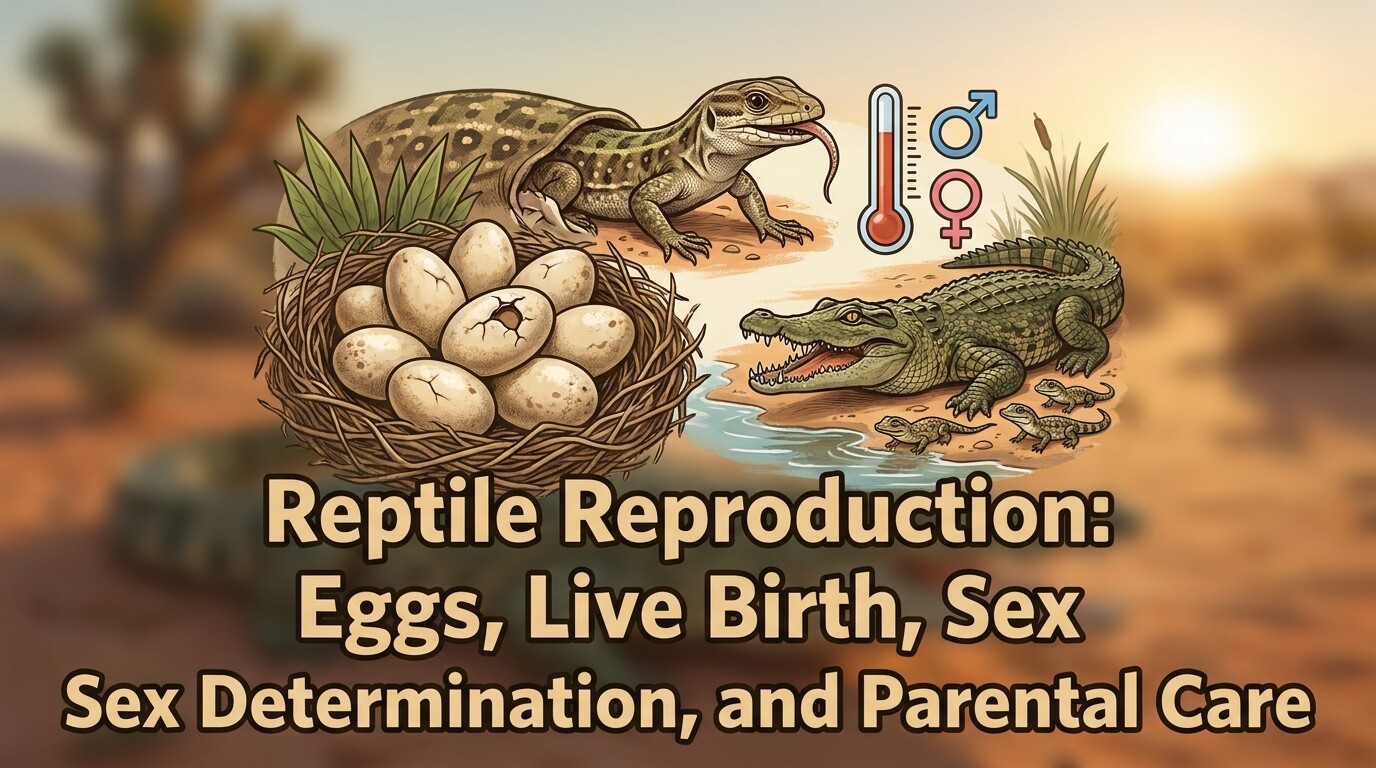
Reptile reproduction is far more varied than the familiar image of a reptile laying eggs and leaving them behind. Living non-avian reptiles reproduce sexually in most cases, with internal fertilization, but what happens afterward differs greatly. Many species lay eggs, many squamates give birth to live young, incubation temperature affects sex in some lineages, genetic systems control sex in others, and parental care ranges from almost none to active nest defense and care of hatchlings.
That diversity matters because reproduction links anatomy, behavior, climate, habitat, and life history. A turtle choosing a nest site, a live-bearing lizard carrying embryos through a cold season, and a crocodilian guarding a nest are solving different reproductive problems. Understanding those differences is more useful than treating one familiar pattern as the rule for every reptile.
Quick Overview of Reptile Reproduction
Internal fertilization and major reproductive modes
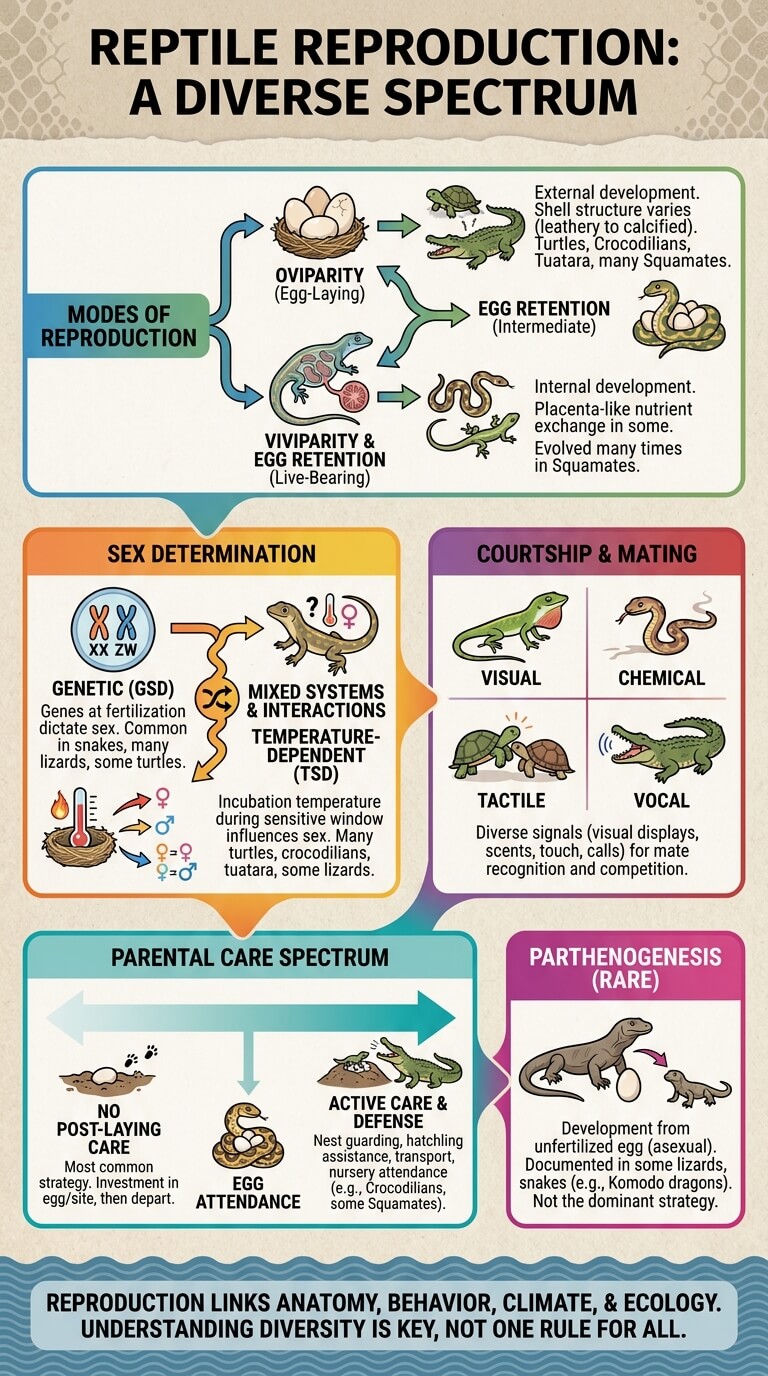
In living reptiles, fertilization is generally internal, meaning sperm reaches the egg inside the female reproductive tract. That arrangement fits the broader amniote reproductive system shared by reptiles, birds, and mammals, even though the details differ among lineages. Courtship and mating may involve visual displays, scent, touch, vocalizations, combat between males, or combinations of these behaviors.
After fertilization, reptiles follow several major reproductive routes. Oviparous species lay eggs that complete most development outside the mother’s body. Viviparous species retain developing embryos and give birth to live young. Between those broad categories are forms with prolonged egg retention and substantial variation in how embryos obtain oxygen, water, minerals, and nutrients. Patterns of egg laying, live birth, and parental care differ among the major living reptile groups , so no single reproductive model fits every reptile.
Why all reptiles do not lay eggs
Egg laying is widespread, but it is not a defining rule for the entire group. Live birth has evolved repeatedly within squamates, the reptile lineage that includes snakes, lizards, and amphisbaenians. A review indexed by the National Library of Medicine on the evolution of viviparity in squamates describes more than 100 evolutionary origins of live birth in that group and emphasizes how much reproductive physiology varies among lineages.
Turtles, crocodilians, and tuatara are egg-laying in their living forms, while squamates show the greatest mix of egg laying and live bearing. That does not make one system more advanced than another. Each can work well under the ecological conditions in which it evolved.
Courtship and Mating in Reptiles
Visual, chemical, tactile, and vocal signals
Reptile courtship can be surprisingly elaborate. Many lizards use head movements, body postures, dewlap extensions, color changes, or push-up displays. Chemical signals carried in skin secretions or deposited in the environment are especially important in many squamates. Tongue-flicking can help some snakes and lizards sample chemical cues associated with potential mates.
Touch also matters. Courtship may include following, nudging, body contact, or species-specific positioning before mating. Crocodilians add another sensory channel: they can use low-frequency calls, water movement, head slaps, and other displays during breeding interactions. These signals help individuals recognize species, reproductive condition, or competitive status without requiring every reptile to use the same communication system.
Sexual dimorphism where it affects reproduction
In some reptiles, males and females differ in body size, coloration, head shape, ornaments, or specialized structures linked to reproduction. Male anoles, for example, may have conspicuous dewlaps used in displays, while size differences in some turtles or crocodilians may influence competition and mate access. These patterns are species-specific rather than universal.
Sexual dimorphism can also affect how readers interpret behavior. A larger individual is not automatically male, and brighter coloration is not a reliable rule across reptiles. Reproductive biology makes more sense when traits are considered in the context of the particular species and its mating system.
Oviparity: Reptiles That Lay Eggs
The amniotic egg and embryonic membranes
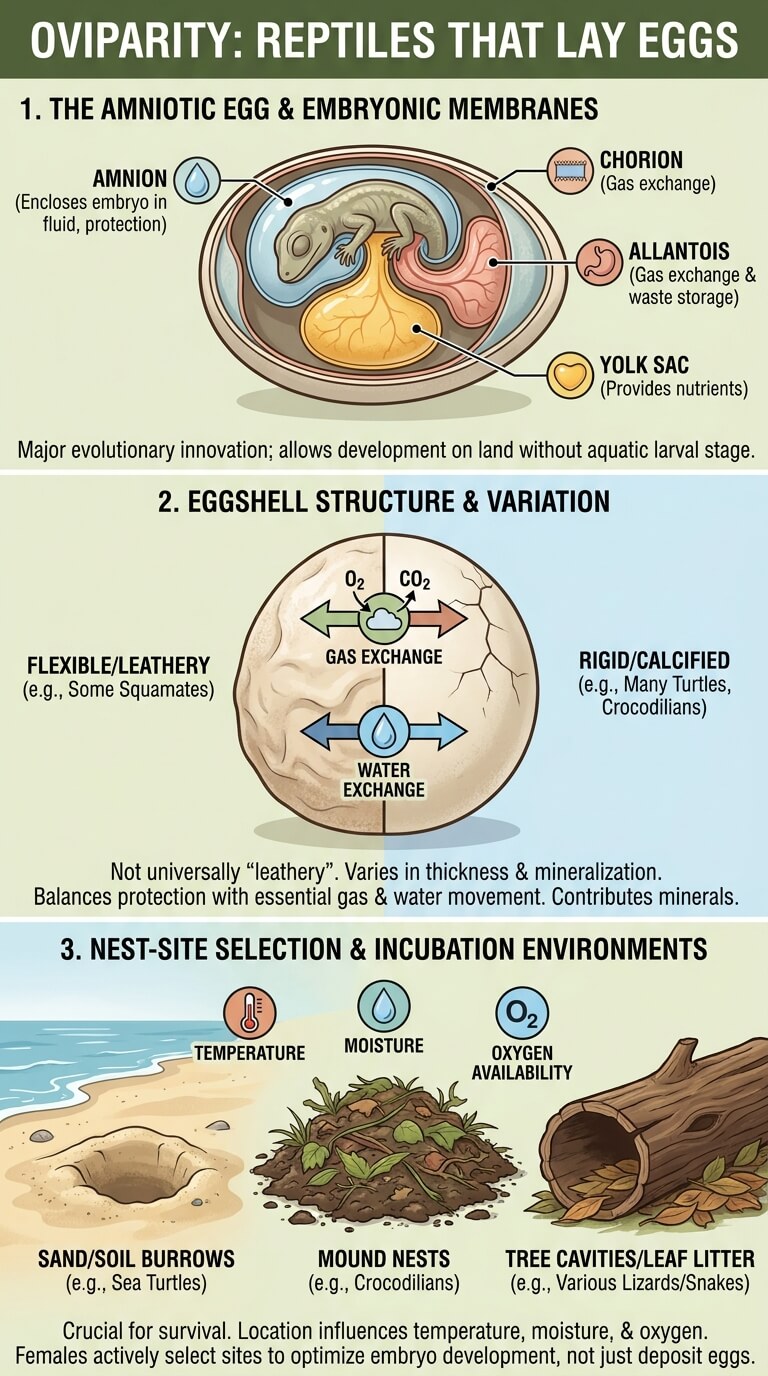
The amniotic egg was a major evolutionary innovation in vertebrate history because it allowed embryos to develop within a protected fluid environment without requiring an exposed aquatic larval stage like that seen in many amphibians. The embryo is surrounded by extraembryonic membranes that help with protection, gas exchange, waste handling, and access to stored nutrients.
The amnion encloses the embryo in fluid, the chorion contributes to gas exchange, the allantois participates in gas exchange and waste storage, and the yolk sac provides nutrients. These structures are part of the amniote condition even though they are modified in different ways among reptiles, birds, and mammals. A Smithsonian overview of the amniotic egg as an adaptation for life on land highlights its importance in vertebrate evolution.
Eggshell structure and why “leathery” is not universal
Reptile eggs are often described as leathery, but that shortcut hides real variation. Some squamate eggs have relatively flexible shells, while many turtle and crocodilian eggs are more strongly calcified. Shell thickness, mineralization, gas conductance, and water exchange differ among species and can also reflect nesting conditions.
The shell is not simply a hard container. It must protect the embryo while still allowing gases to move across it. In many egg-laying reptiles, the shell also contributes minerals used during development. Because eggshell structure varies, it is better to describe a particular group or species than to assume every reptile egg feels or functions the same way.
Nest-site selection and incubation environments
Where eggs are placed can strongly influence survival. Reptiles may lay in soil, sand, leaf litter, rotting vegetation, tree cavities, burrows, termite mounds, or other protected locations. Temperature, moisture, oxygen availability, flooding risk, and exposure to predators can all affect embryo development.
Females may therefore spend considerable time selecting or preparing a nest site even in species that provide no care after laying. For sea turtles, digging a nest above the high-water line is a critical part of reproduction. For crocodilians, mound nests and hole nests create different thermal and moisture conditions. The nest itself is part of the reproductive strategy, not just a place where eggs happen to be deposited.
Live Birth and Egg Retention
Viviparity across squamate lineages
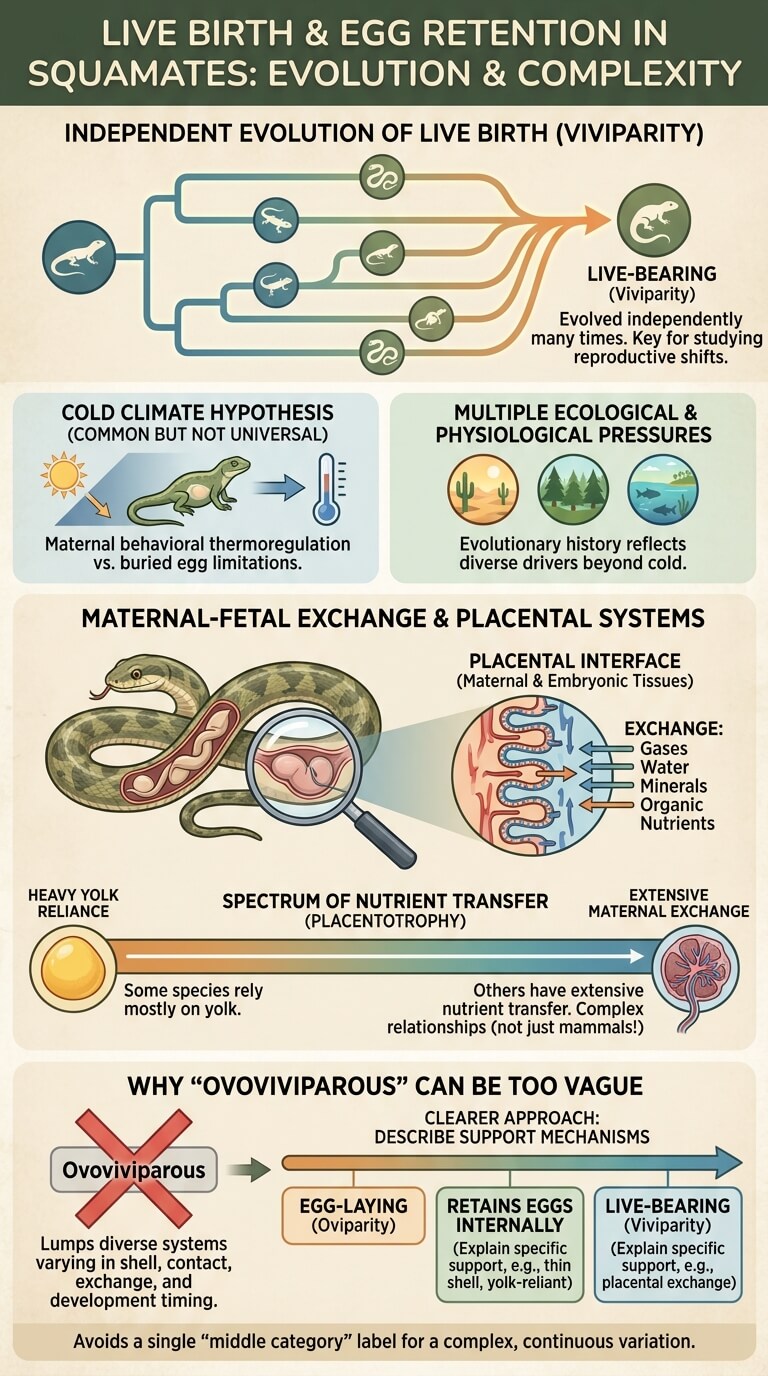
Live birth is especially important in squamate evolution. Some lizards and snakes retain embryos inside the female until development is advanced and then give birth to living young. This pattern has evolved independently many times, which makes squamates valuable for studying how reproductive systems shift from egg laying toward prolonged internal development.
Cold climates have often been discussed in relation to the evolution of viviparity because a pregnant female can move among microhabitats and influence embryo temperatures in ways that a buried egg cannot. That explanation is not universal, however. Live-bearing species occur in many environments, and the evolutionary history of viviparity reflects multiple ecological and physiological pressures.
Maternal-fetal exchange and placenta-like systems
Live-bearing reptiles do not simply carry fully self-contained eggs until birth. In viviparous squamates, maternal and embryonic tissues form placental interfaces that can exchange gases, water, minerals, and in some species meaningful amounts of organic nutrients. The degree of maternal nutrient transfer varies widely.
Research on reptile placentation shows that some species still rely heavily on yolk, while others have evolved much more extensive nutrient exchange between mother and developing young. A review of placentotrophy in viviparous reptiles describes multiple structural solutions for maternal-fetal transfer. Mammals therefore are not the only vertebrates with complex placental relationships.
Why “ovoviviparous” can be too vague
The term ovoviviparous has long been used for animals that retain eggs internally and give birth to live young while embryos depend mostly on yolk. The problem is that it can lump together reproductive systems that differ substantially in shell retention, placental contact, gas exchange, nutrient transfer, and timing of development.
For general readers, it is often clearer to say that a species is egg-laying, live-bearing, or retains eggs internally, then explain how embryos are supported. That wording avoids pretending there is one neat middle category that captures every variation between oviparity and viviparity.
Temperature-Dependent Sex Determination
How incubation temperature can influence sex in some reptiles
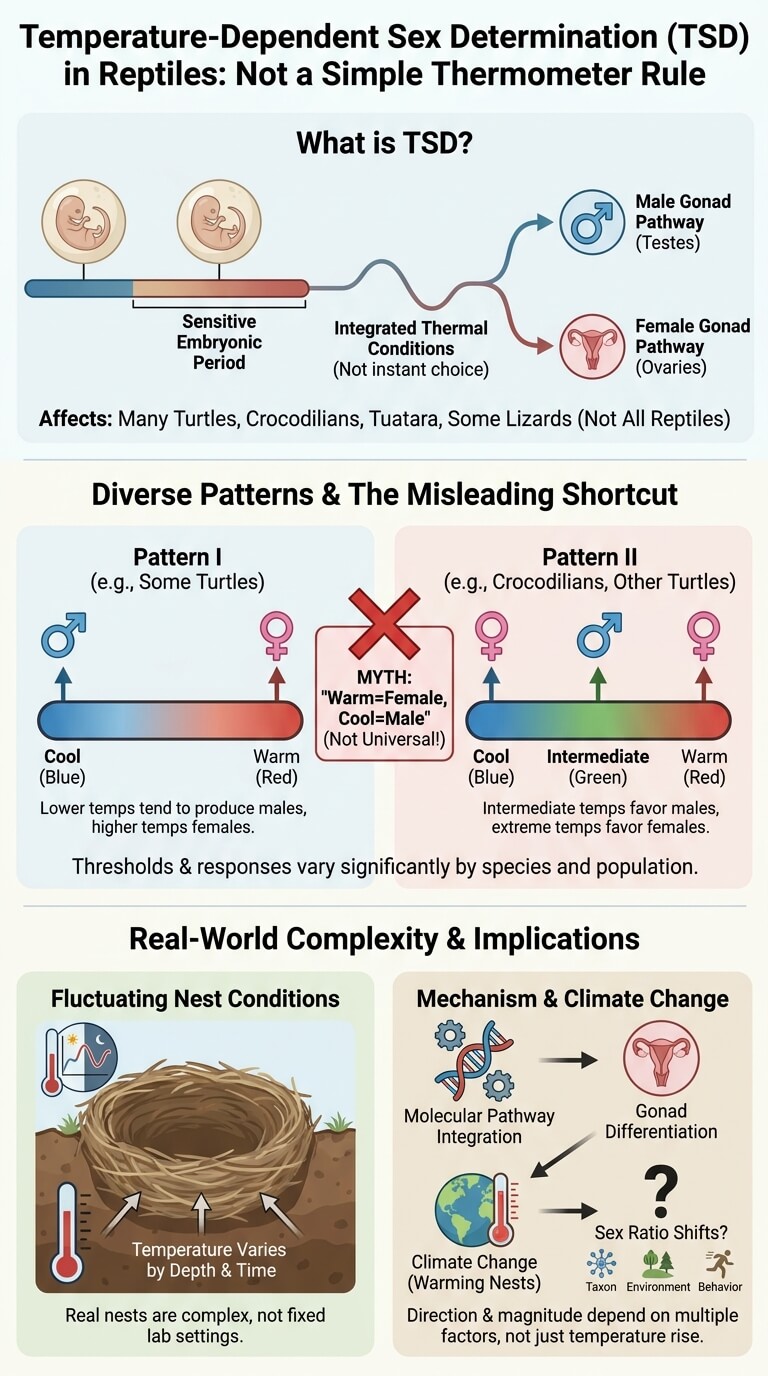
In reptiles with temperature-dependent sex determination, or TSD, the thermal conditions experienced during a sensitive period of embryonic development influence whether the gonads develop along male or female pathways. This does not mean the egg instantly “chooses” a sex based on one temperature reading. Development responds to thermal conditions across a biologically important window.
TSD occurs in many turtles, crocodilians, tuatara, and some lizards, but not in every reptile. A Journal of Experimental Biology review of reptile incubation and TSD emphasizes both the diversity of these systems and their sensitivity to changing nest temperatures.
Turtles and crocodilians show different patterns
One of the most misleading shortcuts is “warm eggs become females and cool eggs become males.” Some turtles do show a pattern in which lower temperatures tend to produce males and higher temperatures tend to produce females, but that is not a universal reptile rule. Other turtles show different reaction norms, and crocodilians commonly show a different pattern in which intermediate incubation temperatures favor males while temperatures toward either end favor females.
Even within one group, the threshold temperatures and developmental responses vary by species and population. Nest temperature also fluctuates naturally over days and across different depths within a nest, so real incubation conditions are more complex than a fixed laboratory setting.
Why temperature rules should not be generalized
TSD is a reproductive mechanism, not a simple thermometer trick. Embryonic development integrates temperature through molecular pathways that influence gonad differentiation. Because these pathways evolved differently among lineages, there is no single temperature that makes a male or female reptile.
This variation becomes especially important when climate change is discussed. Warming nests can shift sex ratios in species with TSD, but the direction, magnitude, and population consequences depend on the taxon, local nesting environment, maternal nesting behavior, and the shape of that species’ temperature response.
Genetic Sex Determination and Mixed Systems
Sex chromosomes and genotypic systems
Many reptiles use genotypic sex determination, or GSD, in which genetic differences established at fertilization play the major role in sex development. Different reptile lineages have evolved different sex chromosome systems, including arrangements that are not identical to the familiar mammalian XX and XY pattern.
Snakes, for example, commonly use ZW systems in which females are the heterogametic sex, while many lizards have other chromosome arrangements. The details vary greatly, and reptile sex chromosomes have evolved repeatedly rather than descending from one single system shared by every living species.
Genes and temperature can interact
The old contrast of “genetic sex determination versus temperature-dependent sex determination” is useful, but nature can be messier. In some reptiles, genes establish a tendency while temperature can alter developmental outcomes under certain conditions. Researchers have documented systems in which unusually warm or cool incubation can override chromosomal sex in particular lizards.
These cases show why sex determination is better viewed as a spectrum of developmental systems than as two boxes with no overlap. They also caution against assuming that knowing a species has sex chromosomes means incubation temperature is biologically irrelevant.
Parthenogenesis in Selected Reptiles
Documented examples in Komodo dragons and other reptiles
Parthenogenesis is development from an unfertilized egg without genetic contribution from a male. It is unusual in vertebrates, but it has been documented in several reptile lineages. Some all-female lizard species reproduce obligately this way, while facultative parthenogenesis has been recorded in normally sexual species.
Komodo dragons are a well-known example. Smithsonian’s National Zoo has documented a male Komodo dragon produced through facultative parthenogenesis, illustrating that a sexually reproducing species can occasionally produce offspring without recent mating. The Zoo’s Komodo dragon account of facultative parthenogenesis provides a clear species-level example without implying that it is the normal reproductive route for Komodo dragons.
Why parthenogenesis is not the dominant reptile strategy
Parthenogenesis can be biologically useful in special circumstances, but it is not a replacement for sexual reproduction across reptiles. Facultative cases can produce offspring when males are absent, while obligately parthenogenetic lineages have their own evolutionary histories. Both situations can reduce the genetic combinations generated by ordinary sexual reproduction.
Long-term success depends on many factors, including genetic diversity, mutation, ecology, and the mechanism by which chromosomes are restored in the egg. For that reason, claims that a female reptile can simply “clone herself whenever needed” are inaccurate. The genetics are more complicated, and offspring may not be exact clones of the mother.
Hatching and Birth
Hatchling emergence and first-life challenges
Egg-laying reptiles face one final developmental transition when hatchlings leave the shell. Many species have a temporary egg tooth or other specialized structure that helps break the shell. Hatching may happen over hours or days, and siblings from one nest do not necessarily emerge at the same instant.
Once above ground, hatchlings face immediate challenges such as predators, dehydration, finding suitable cover, and reaching feeding habitat. In many species, parents are absent by this stage. In others, adults guard the nest, respond to hatchling calls, uncover the nest, or remain near the young for a period after emergence.
Live-born young and developmental variation
Live-bearing reptiles are born outside an eggshell, but they still emerge at different levels of size, independence, and physiological readiness depending on species. Many are capable of moving and feeding relatively soon after birth, while their survival still depends heavily on suitable temperature, shelter, and prey.
Live birth can protect embryos from some nest hazards, yet it also shifts costs onto the pregnant female. Carrying developing young can affect locomotion, energy use, feeding, and thermal behavior. Reproduction therefore involves trade-offs for the parent as well as benefits for the embryos.
Parental Care Is More Diverse Than the Stereotype
Little or no post-laying care in many species
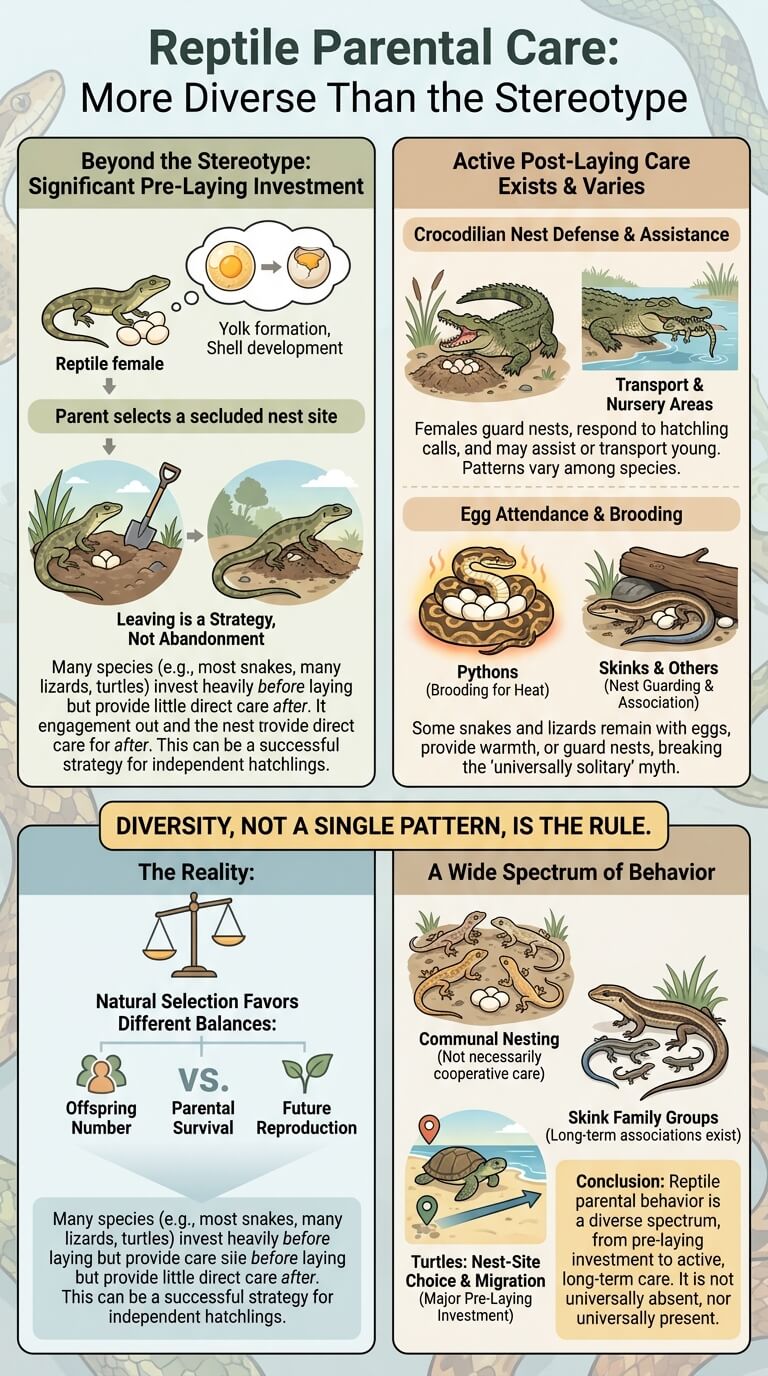
Many reptiles provide substantial investment before laying eggs but little care afterward. A female may produce yolk, form the shell, select a nest site, dig a nest, deposit the clutch, cover it, and then leave. That strategy can still represent a large energetic investment even if no adult remains with the eggs.
Describing this as “abandonment” can sound moralistic. Natural selection favors different balances between offspring number, parental survival, nest protection, and future reproduction. A species with independent hatchlings does not need to behave like a bird or mammal to reproduce successfully.
Crocodilian nest defense and hatchling assistance
Crocodilians provide some of the clearest examples of reptile parental care. Females of many species guard nests, and adults can respond to vocalizing hatchlings, help open the nest, and transport young in the mouth or remain near nursery areas. The exact pattern varies among crocodilian species.
Smithsonian observations of nest guarding in Cuban crocodiles illustrate how strongly a female can defend a nest site. Other crocodilians differ, and there are exceptions to generalized descriptions of care, so it is safer to discuss crocodilian parental behavior as diverse rather than identical.
Egg attendance and brooding in selected snakes and lizards
Some snakes remain with their eggs. Pythons are especially notable because females can coil around a clutch, and in some species muscular activity can contribute heat during incubation. Other snakes may simply stay near eggs for a period, while many species leave after laying.
Lizard care also varies. Some skinks guard eggs, remain with young, or show repeated parent-offspring association. These examples matter because they break the stereotype that reptiles are universally solitary after mating, while still avoiding the opposite error of portraying parental care as universal.
Care in selected skinks and other reptiles
Among lizards, social and parental systems range from no care to long-term associations. Some skinks protect nests, recognize offspring, or live in family groups. Certain geckos use communal nesting sites, though communal egg laying does not necessarily mean cooperative parental care.
Turtles generally provide little direct care after nesting, but even here the broad pattern should not be turned into a claim that turtles have no parental behavior of any kind. Nest-site choice, timing, and migration to nesting areas are major forms of reproductive investment even when adults do not guard hatchlings.
Reproductive Trade-Offs Across Reptile Groups
Clutch size, offspring size, frequency, and survival
Reptiles face a basic allocation problem: energy invested in reproduction cannot also be used for growth, maintenance, escape, or future breeding. Some species produce many relatively small offspring, while others produce fewer larger young. Some reproduce yearly, others may skip seasons when food or body condition is poor.
Records can be misleading if treated as typical biology. The largest clutch ever reported for a species does not tell readers what most females produce. Clutch size, egg size, birth frequency, and offspring survival can vary with female size, age, food availability, geography, and environmental conditions.
Habitat and climate can shape reproductive strategy
Reproductive timing is often synchronized with rainfall, temperature, food pulses, or seasonal access to nesting habitat. Desert reptiles may time reproduction around brief periods of resource availability. Aquatic turtles may depend on suitable terrestrial nesting sites near water. Mountain reptiles may face very short seasons when embryos can develop safely.
Live-bearing species can sometimes reduce the risks of fixed nest temperatures because the female can move among thermal microhabitats while pregnant. Egg-laying species, by contrast, rely more strongly on nest placement and local incubation conditions after laying. Neither strategy wins in every environment.
Common Myths and Mistakes
“All reptiles lay eggs”
False. Egg laying is common, but live birth has evolved many times in squamates. Some lizards and snakes give birth to fully developed young. Reproduction should be described by lineage rather than by one rule applied to all reptiles.
“All reptile eggs are leathery”
False. Reptile eggshells vary substantially. Flexible shells occur in many squamates, while turtle and crocodilian eggs can be more strongly calcified. Shell properties also relate to gas exchange, mineral use, and the moisture conditions of the nest.
“Temperature determines sex in every reptile”
False. TSD occurs in many reptiles, but genetic sex determination is also widespread. Some lineages even show interactions between genetic and thermal influences. No single warm-versus-cool rule can describe every reptile.
“Reptiles always abandon their young”
False. Many species provide little or no post-laying care, but crocodilians, some snakes, skinks, and other reptiles can guard nests, attend eggs, or remain with young. Parental care exists on a continuum rather than as a simple yes-or-no trait.
How Temperature, Behavior, Habitat, and Conservation Shape Reproduction
Thermoregulation and incubation
Adult thermoregulation and embryo incubation are connected in several ways. A gravid female may choose body temperatures that affect embryo development, while an egg-laying female can influence the nest’s thermal environment through timing and site selection. Once eggs are laid, the embryo cannot move to shade or sun in the way an adult reptile can.
This difference helps explain why nest microclimate is such a central part of reptile reproduction. Temperature can affect development rate, hatchling traits, survival, and in species with TSD, sex. Moisture and oxygen conditions also interact with temperature, so nest quality is multidimensional.
Behavior and courtship
Reproductive behavior does more than bring two animals together. Displays help avoid mating with the wrong species, competition can determine access to mates, and chemical signals can advertise reproductive condition. Nest digging, guarding, brooding, and hatchling assistance are also behaviors with direct reproductive consequences.
Because these behaviors are tied to ecology, the same reptile may change reproductive activity with season, weather, body condition, and local population density. Reproduction is therefore not one event. It is a sequence of decisions and physiological changes extending from courtship through embryo development and, in some species, parental care.
Conservation when reproductive systems increase vulnerability
Reproductive biology can shape conservation risk. Species that mature slowly, produce few offspring, depend on restricted nesting sites, or have highly temperature-sensitive development may recover slowly after adult mortality or habitat loss. Road mortality can be especially damaging when nesting females must cross roads, and coastal development can reduce nesting habitat for sea turtles.
Climate change adds another layer for species with temperature-sensitive incubation, but effects must be assessed at the species and population level. Not every reptile has TSD, and not every population will respond in the same way. Conservation planning works best when it considers the actual reproductive system rather than applying one reptile-wide assumption.
FAQ
Which reptiles give live birth?
Live birth occurs mainly in squamates, including many species of lizards and snakes. It has evolved repeatedly rather than appearing once in a single live-bearing group. Turtles, crocodilians, and tuatara are egg-laying in their living forms. Among squamates, even closely related species can differ, with some laying eggs and others giving birth to live young.
Do crocodiles care for their young?
Many crocodilians show parental care. Females commonly guard nests, and adults in several species respond to hatchling calls, open nests, transport hatchlings, or remain near young. The details vary by species, and not every crocodilian provides the same level of care.
Can reptiles reproduce without males?
Some can. Parthenogenesis has been documented in several reptile lineages, including obligately parthenogenetic lizards and facultative cases in normally sexual species such as Komodo dragons and some snakes. It is unusual and should not be treated as the normal reproductive strategy of reptiles as a whole.
Does temperature determine the sex of every reptile?
No. Temperature-dependent sex determination occurs in many turtles, crocodilians, tuatara, and some lizards, but many reptiles use genetic sex determination. Some species also show interactions between genes and incubation temperature, so sex determination varies substantially across reptile evolution.
Final Thoughts
Reptile reproduction cannot be reduced to “lay eggs and leave.” Living reptiles include egg layers and live bearers, species with temperature-dependent or genetic sex determination, rare forms of parthenogenesis, and parental systems ranging from no post-laying care to active nest defense and hatchling assistance. The most useful way to understand reptile reproduction is to follow that diversity across lineages and environments. Once those differences are visible, eggs, live birth, incubation, courtship, and parental care become parts of one larger story about how reptiles successfully produce the next generation.

Ethan Walker is the founder and research editor of Animal Fact Central. He creates and reviews educational animal facts content using trusted wildlife, pet care, and science-based sources. His work focuses on making animal behavior, adaptations, habitats, and species facts clear, accurate, and engaging for everyday readers.
Read More Details About Ethan Walker: https://animalfactcentral.com/ethan-walker/