
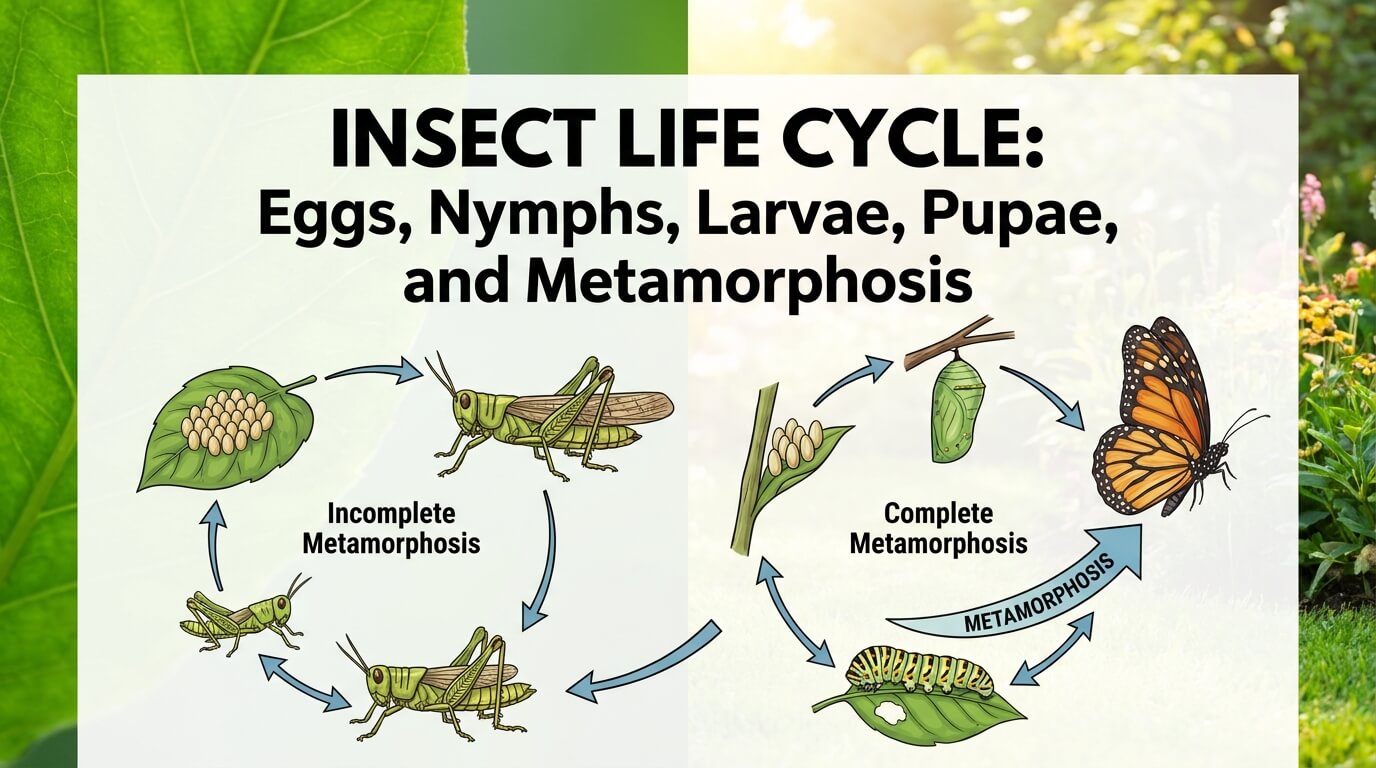
The insect life cycle does not follow one universal pattern. Some insects hatch looking broadly like small versions of the adult, others pass through a nymph stage that changes gradually, and many develop through a larva and pupa before becoming adults. These different pathways help explain why a young grasshopper, a dragonfly nymph, a beetle grub, and a butterfly caterpillar can all be immature insects even though they look and live very differently.
Understanding insect development also clears up several common misconceptions. A caterpillar is not a generic baby insect. A pupa is not asleep. Not every aquatic juvenile is a larva. And although most winged insects stop molting once they reach the adult form, there are notable exceptions. The useful way to think about insect development is to separate growth, molting, and metamorphosis instead of treating them as the same process.
Quick Answer
Why insects do not all develop through the same stages
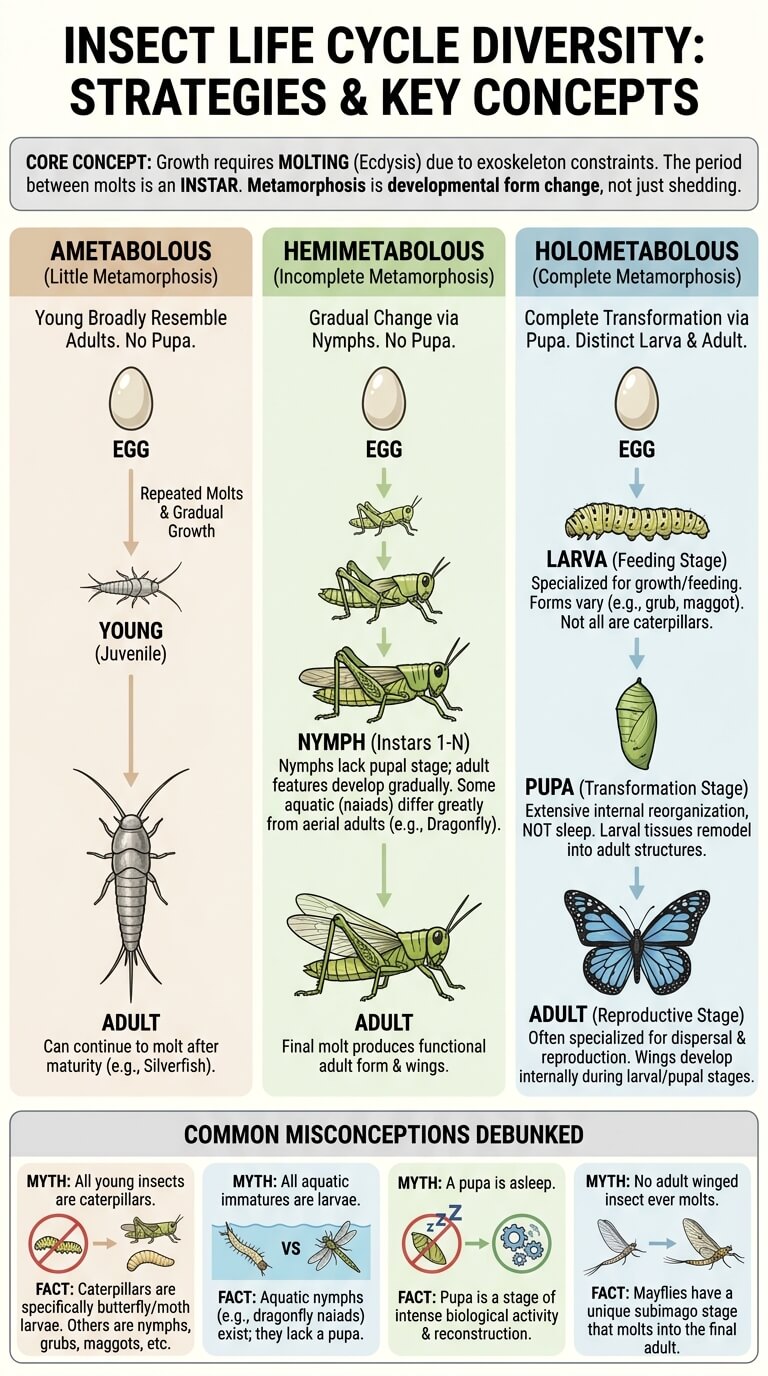
All insects begin life as embryos within eggs, but what happens after hatching depends on the lineage. The familiar four-stage sequence of egg, larva, pupa, and adult belongs to insects with complete metamorphosis. Many other insects never form a pupa. They develop from egg to nymph to adult, with repeated molts between juvenile stages. Still other wingless insect lineages undergo comparatively little outward change as they grow.
The Smithsonian National Museum of Natural History’s Insect Zoo summarizes the two patterns most people encounter: complete metamorphosis, with larva and pupa stages, and incomplete metamorphosis, with nymphs that mature into adults. That distinction is useful, but insect development is more diverse than a simple two-box system.
Three accessible development strategies
For general readers, insect life cycles can be organized into three broad developmental strategies. Ametabolous development involves relatively little change in body form after hatching. Hemimetabolous development, often called incomplete metamorphosis, usually follows egg to nymph to adult. Holometabolous development, or complete metamorphosis, follows egg to larva to pupa to adult.
- Little-metamorphosis development: young stages broadly resemble adults and continue to grow through molts.
- Incomplete metamorphosis: nymphs lack a pupal stage and gradually acquire adult features.
- Complete metamorphosis: larvae and adults can differ dramatically, with a pupal stage between them.
These terms describe developmental patterns, not a ladder from “simple” to “advanced.” Each strategy works within the biology and ecology of the insects that use it.
Why Insects Must Molt to Grow
Exoskeleton constraints and ecdysis
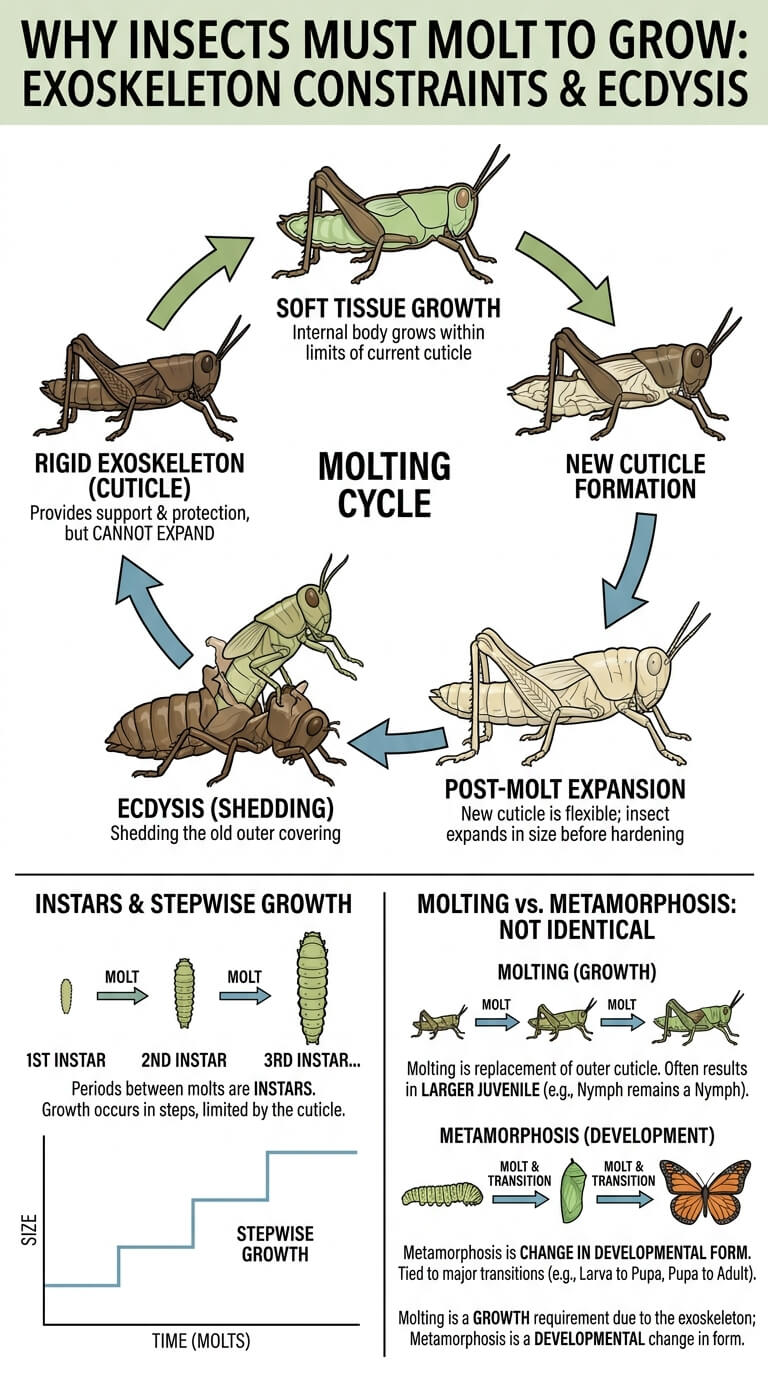
An insect’s outer body covering includes a cuticle that provides support and protection but cannot expand indefinitely. As the insect grows, it periodically forms a new cuticle beneath the old one and sheds the old outer covering. The shedding event is called ecdysis, while the broader physiological process is usually called molting.
Molting is therefore a growth requirement created by the insect body plan. It is not automatically metamorphosis. A young insect can molt several times while remaining the same basic kind of juvenile stage, such as a nymph or larva. Metamorphosis refers to larger developmental changes in form and function.
Instars and growth between molts
The period or form between successive molts is called an instar. A first-instar larva has emerged from the egg and has not yet completed its first larval molt. After that molt, it enters the next instar. The number of instars varies among insects and can sometimes vary within a species depending on factors such as nutrition and environmental conditions.
Growth is therefore stepwise from the perspective of the exoskeleton. Soft tissues can grow within the limits of the current cuticle, but a new, larger outer covering is needed before the insect can expand further. Soon after a molt, the new cuticle is relatively flexible and the insect can increase in size before the cuticle hardens.
Why molting is not the same as metamorphosis
A molt may produce only a larger juvenile or it may accompany a major developmental transition. A grasshopper nymph can molt and remain a nymph. A caterpillar can molt and remain a larva. By contrast, the transition from a final larval stage into a pupa, or from a final nymphal stage into an adult, is tied to a much larger developmental change.
This distinction matters because the words are often used as if they were interchangeable. Molting is the replacement of the outer cuticle. Metamorphosis is the change in developmental form. The two processes often occur together, but they are not identical.
Little-Metamorphosis Development
Ametabolous terminology and when it is appropriate
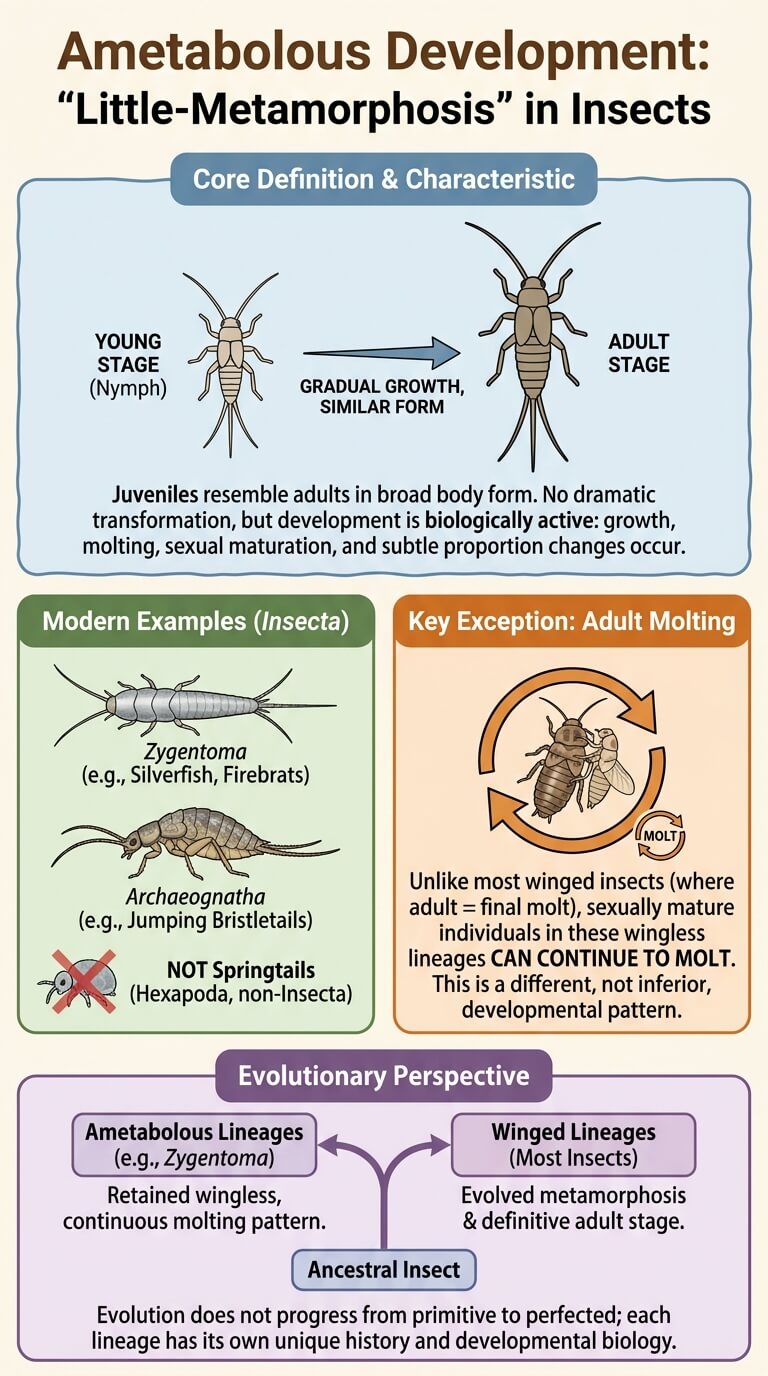
Ametabolous development is used for insect lineages in which juveniles resemble adults in broad body form and do not pass through a dramatic metamorphic transformation. Modern examples include silverfish and firebrats in Zygentoma and jumping bristletails in Archaeognatha. They are insects, but they should not be confused with springtails, which are hexapods generally classified outside Insecta in modern taxonomy.
The term is most useful when it describes limited post-hatching change rather than implying that “nothing happens.” Young insects still grow, molt, mature sexually, and may change proportions or details as they develop. Development is biologically active even when the external transformation is subtle.
Young stages that broadly resemble adults
A young silverfish already has the elongated, wingless body plan associated with an adult silverfish. It does not become a caterpillar, pupa, or winged reproductive form. Instead, it grows through repeated molts while its reproductive system and other adult characteristics mature.
The University of Florida’s silverfish biology profile describes silverfish as ametabolous and notes that adults can continue to molt. That is an important reminder that the standard “adult equals final molt” rule does not apply to every insect lineage.
Adult molting exceptions among primitively wingless lineages
In most familiar winged insects, adulthood marks the end of molting. That pattern is so common that it is often taught as a universal insect rule. Wingless lineages such as Zygentoma and Archaeognatha show why the rule needs qualification: sexually mature individuals can continue to molt after reaching adulthood.
This is not evidence that these insects are inferior or unfinished. It is simply a different developmental pattern. Evolution does not arrange living insect groups into a progression from primitive to perfected forms. Each lineage has its own history and developmental biology.
Incomplete Metamorphosis
Egg to nymph to adult
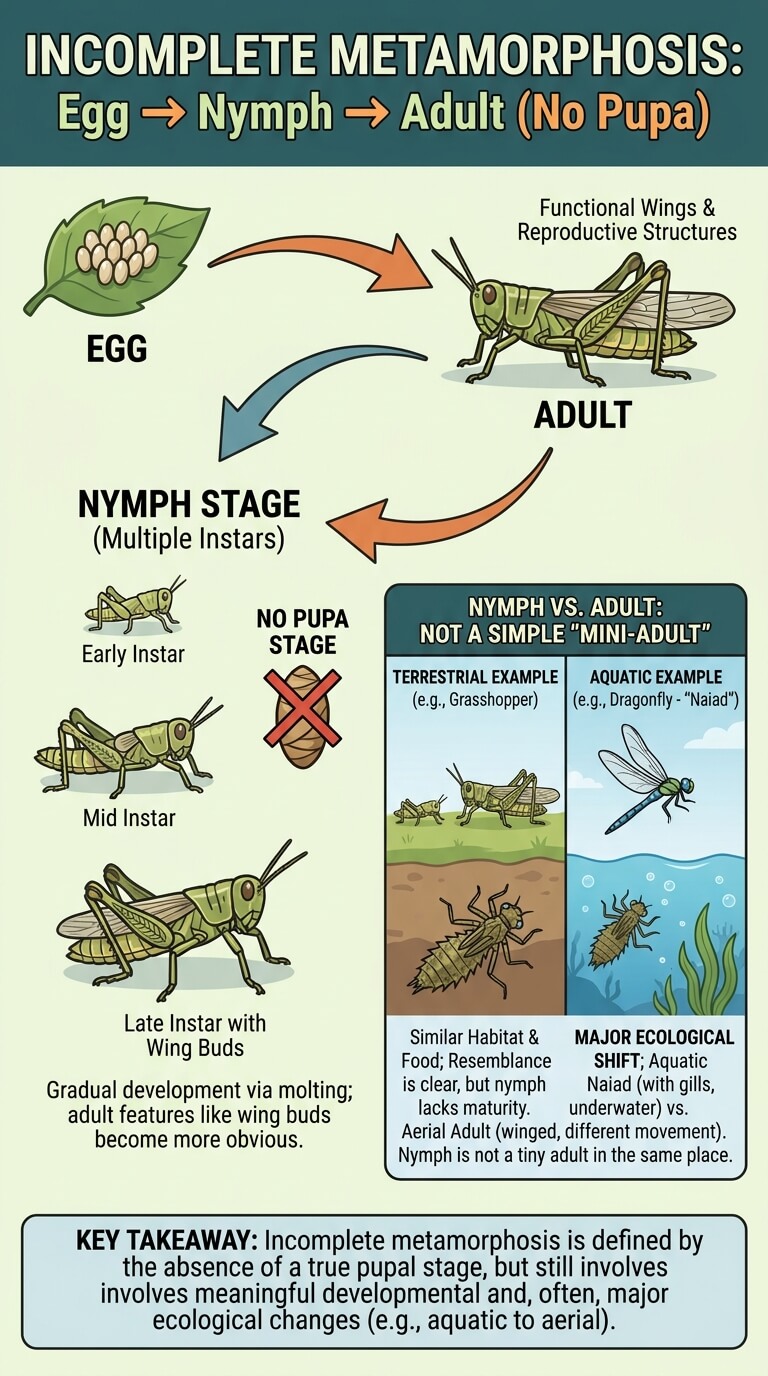
In incomplete metamorphosis, the juvenile stages are called nymphs. The basic sequence is egg, multiple nymphal instars, and adult. There is no pupal stage. Grasshoppers, crickets, many true bugs, cockroaches, mantises, dragonflies, damselflies, mayflies, and several other groups follow versions of this pattern.
As nymphs molt, adult features become more developed. In many terrestrial insects, external wing buds become more obvious in later nymphal instars. The final molt produces the adult body form, including mature reproductive structures and, in winged species, functional adult wings.
Why a nymph is not simply a tiny adult in every detail
Calling a nymph a “miniature adult” is useful only as a rough comparison. Nymphs are not reproductively mature, they may lack functional wings, and their body proportions, coloration, feeding behavior, or habitat can differ from adults. The difference is especially striking in insects whose nymphs live in water while adults live mainly in air.
A young grasshopper and an adult grasshopper may use similar habitats and foods, which makes the resemblance easy to see. A dragonfly nymph, by contrast, is an aquatic predator with a body specialized for life underwater. The adult dragonfly is aerial, winged, and built for a very different style of movement.
Aquatic nymphs and naiads in dragonflies, damselflies, mayflies, and other examples
The traditional term naiad is often used for aquatic nymphs of insects such as dragonflies, damselflies, mayflies, and stoneflies. These immatures may possess gills or other adaptations for aquatic gas exchange, and they can spend a large part of the life cycle underwater before emerging into an aerial adult stage.
That habitat shift is why “nymph” should not be interpreted as “small adult in the same place.” Incomplete metamorphosis can still involve major ecological changes. The key developmental distinction is the absence of a true pupal stage, not the absence of meaningful change.
Complete Metamorphosis
Egg to larva to pupa to adult
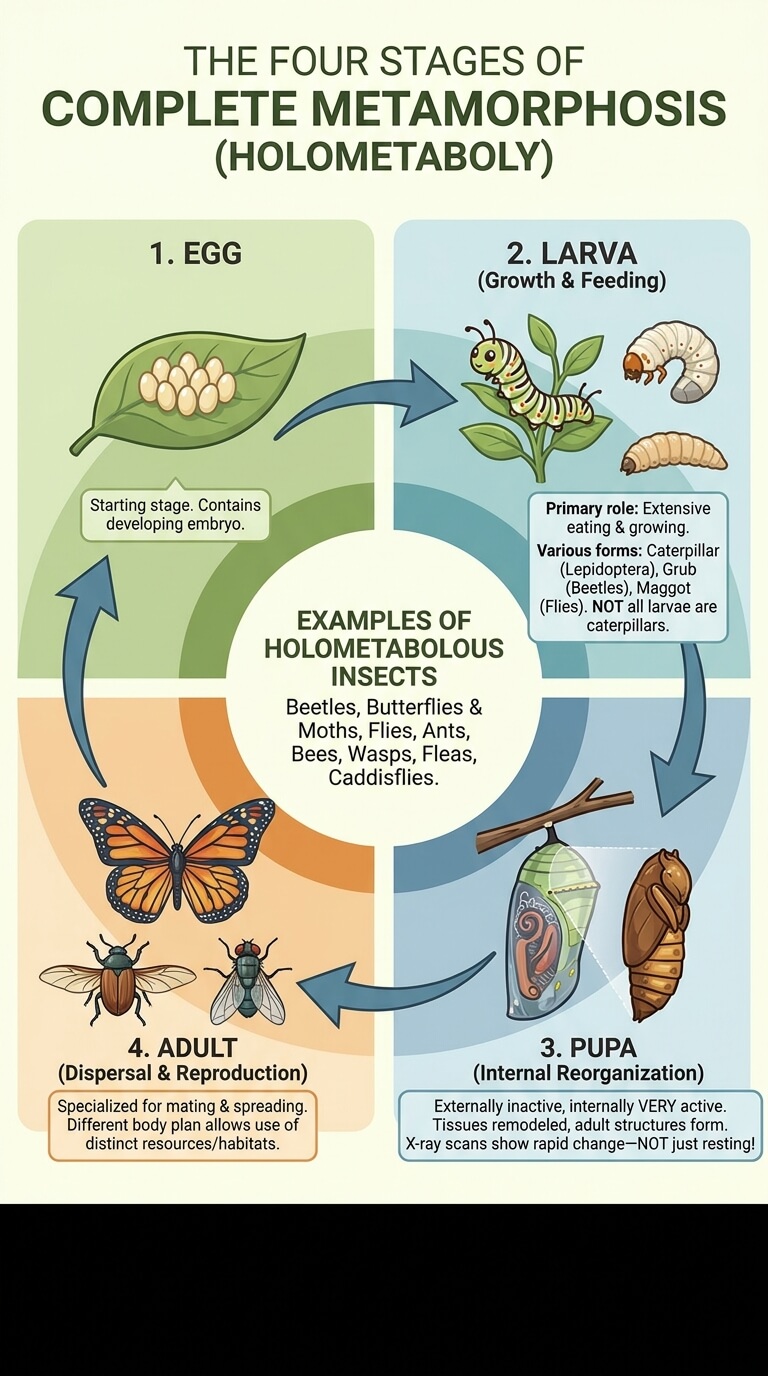
Complete metamorphosis, or holometaboly, follows a four-part sequence: egg, larva, pupa, and adult. Beetles, true flies, butterflies and moths, fleas, lacewings, caddisflies, ants, bees, wasps, and many other insects use this developmental strategy.
The larva is specialized largely for growth and feeding in many species, while the adult may be specialized more strongly for dispersal and reproduction. That division is not absolute, because many adults also feed extensively and many larvae perform complex behaviors. Still, the separation of larval and adult body plans allows the two stages to use different resources or habitats in many lineages.
Caterpillars, grubs, maggots, and other larval forms
A larva is not one particular shape. Caterpillars are larvae of butterflies and moths. Many beetle larvae are called grubs. Many fly larvae are called maggots. Other insect larvae have elongated, flattened, armored, aquatic, predatory, or highly specialized forms that do not fit those familiar labels.
Using “caterpillar” for every insect larva creates confusion because caterpillars are specifically associated with Lepidoptera. A beetle grub is not a caterpillar, and a mosquito larva is not a caterpillar. The shared feature is developmental role, not outward appearance.
What actually happens during the pupal stage
The pupa is the stage between larva and adult in insects with complete metamorphosis. It is often externally inactive, but internally it is a period of extensive reorganization. Some larval tissues are broken down or remodeled, while adult structures develop from cells and tissues already present in the immature insect.
Research on flies makes this transformation visible. The Natural History Museum’s work imaging blow fly pupae used X-ray scanning to document rapid internal shape changes during metamorphosis. The observations directly contradict the idea that a pupa is merely resting.
Larva Versus Nymph
Body-plan differences
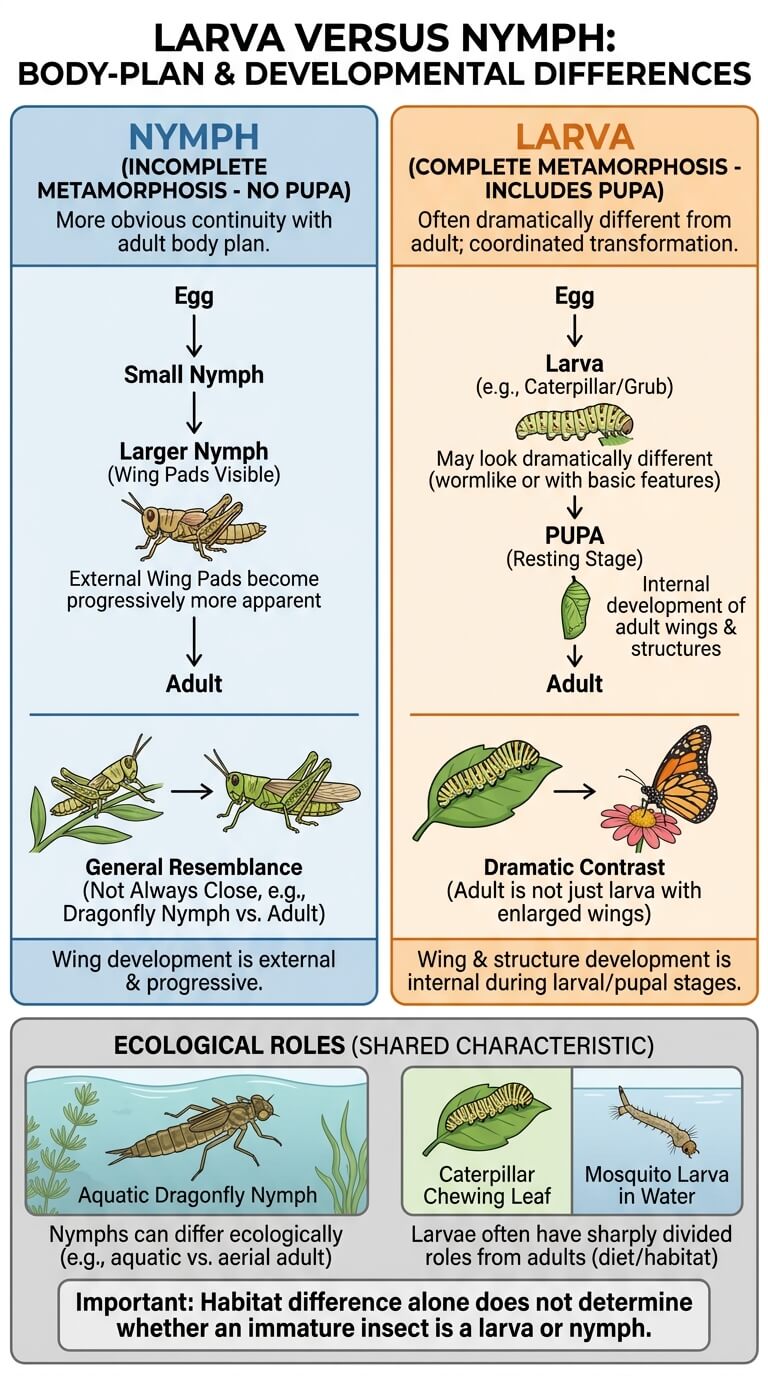
The simplest distinction is developmental. A nymph belongs to an insect life cycle without a pupal stage, while a larva belongs to a life cycle that includes a pupa before adulthood. Nymphs generally show more obvious continuity with the adult body plan. Larvae may look dramatically different from adults.
That does not mean every nymph closely resembles its adult or every larva is wormlike. Aquatic dragonfly nymphs look quite different from adult dragonflies, while some beetle larvae already show recognizable insect features such as a distinct head and thoracic legs. Developmental category is more reliable than superficial shape.
Habitat and diet differences
Larval and adult stages can divide ecological roles sharply. A caterpillar may chew leaves while the adult butterfly drinks liquids. A mosquito larva develops in water and uses feeding methods very different from those of the adult. Many aquatic beetles and flies also separate immature and adult habitats or diets.
Nymphs can also differ ecologically from adults. Dragonfly nymphs are aquatic, while adults are aerial hunters around wetlands and other freshwater habitats. The important point is that habitat difference alone does not determine whether an immature insect is a larva or nymph.
Wing development and reproductive maturity
Neither larvae nor nymphs are sexually mature adults. In many nymphal insects, external wing pads become progressively more apparent as adulthood approaches. In insects with complete metamorphosis, adult wings and many other structures develop internally during larval and pupal development rather than appearing as increasingly large external wing pads through a nymphal series.
This difference is one reason complete metamorphosis can produce such a dramatic contrast between juvenile and adult forms. The adult body is not simply a larva with enlarged wings attached. It is the result of a coordinated developmental transformation.
The Pupal Stage Without Popular Myths
Remodeling, imaginal tissues, and developmental activity in plain English
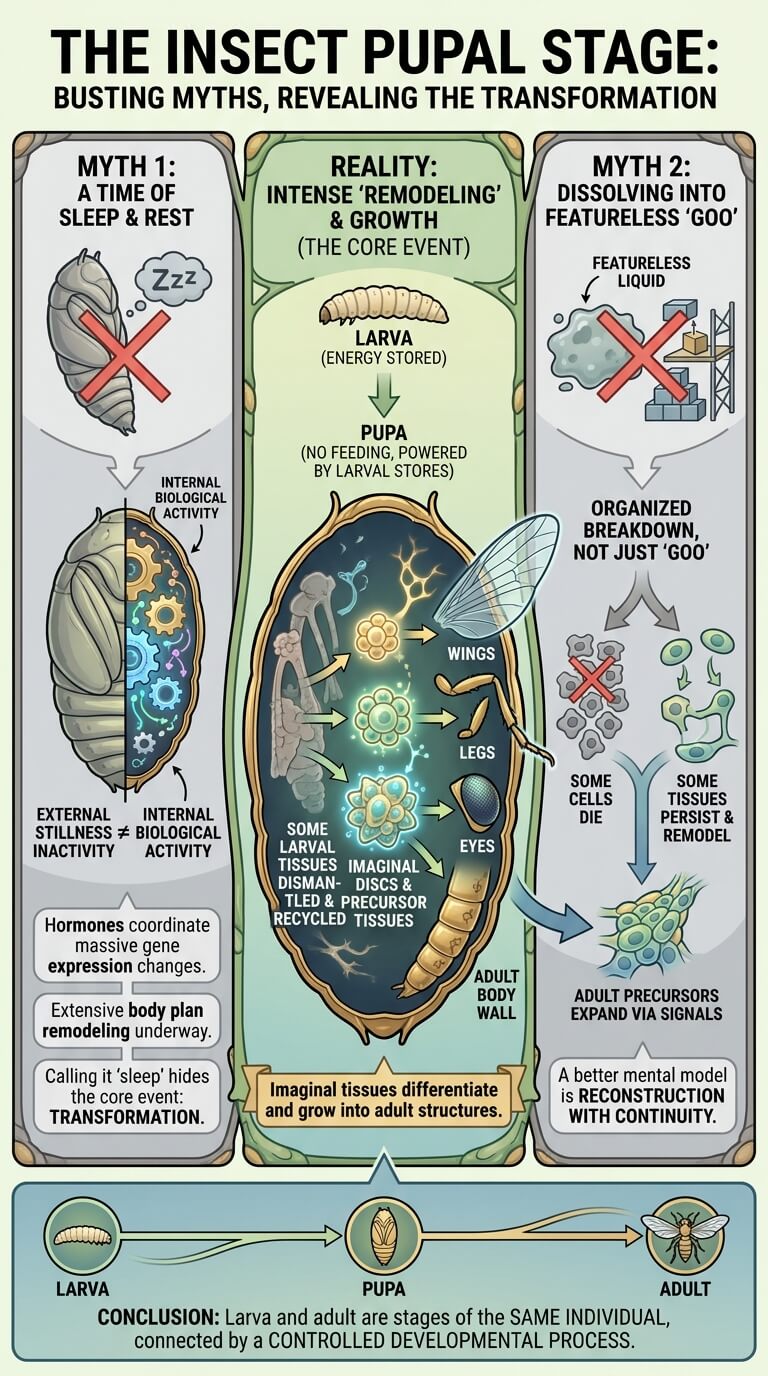
During pupal development, some larval tissues are dismantled, some are remodeled, and groups of cells destined to form adult structures grow and differentiate. In well-studied insects such as fruit flies, imaginal discs and other adult precursor tissues contribute to structures including wings, legs, eyes, and parts of the adult body wall.
This transformation requires energy. Pupae generally do not feed, so energy stored during the larval stage helps power development. A Journal of Experimental Biology study on fruit flies describes how larval nutrition contributes to the energy available through metamorphosis and into early adult life.
Why a pupa is not sleeping
A pupa may be still from the outside, but developmental systems are active. Hormones coordinate changes in gene expression, tissues reorganize, adult structures grow, and the insect’s body plan is extensively remodeled. Calling this stage “sleep” hides what is actually happening.
Some pupae can even move parts of the abdomen or respond to disturbance, depending on the species. External motion is not a good measure of biological activity. The core event of the pupal stage is transformation, not rest.
Why the insect does not simply dissolve into featureless liquid
The popular claim that a caterpillar completely dissolves into undifferentiated “goo” and then rebuilds from nothing is an exaggeration. Extensive tissue breakdown can occur, but metamorphosis is organized. Some cells die, some tissues persist and remodel, and adult precursor tissues expand and differentiate according to developmental signals.
A better mental model is reconstruction with continuity. The larva and adult are not separate organisms. They are stages of the same individual, connected by a controlled developmental process.
Adult Stage and Reproduction
Why adult is not always the longest-lived stage
The adult is the sexually mature stage, but it is not automatically the longest part of the life cycle. In some insects, immature stages last months or years while adults live for a much shorter period. In others, adults can survive for a substantial portion of the total lifespan. There is no single duration that applies across Insecta.
This variation reflects ecology. An aquatic immature may spend a long period feeding and growing before a relatively brief reproductive adult phase. Another insect may overwinter or persist for long periods as an adult. Temperature, season, food, species, sex, and other factors can all affect timing.
Why some adults feed little or not at all
Many adult insects feed actively, but some do not. Certain moths emerge with reduced or nonfunctional mouthparts and rely largely on energy accumulated during the larval stage. Adult mayflies also have greatly reduced feeding structures and generally do not feed.
This does not mean “adult insects do not need food.” The pattern is lineage-specific. Bees, butterflies, many beetles, true flies, grasshoppers, dragonflies, and countless other adults feed as part of normal adult life.
Why most winged adult insects do not molt again
For nearly all living winged insects, the adult molt is the last molt. Once functional adult wings are present, another molt would create major mechanical challenges because the old cuticle must be shed from delicate, expanded structures.
Mayflies are the famous exception among living winged insects. They emerge first as a winged subimago and then molt once more into the sexually mature imago. A PNAS review of mayfly metamorphosis explains this unusual second winged stage and places it in the broader evolution of insect molting.
Life-Cycle Diversity Across Major Orders
Beetles, flies, butterflies and moths, and hymenopterans as holometabolous examples
Coleoptera, Diptera, Lepidoptera, and Hymenoptera all contain insects with complete metamorphosis. Beetles pass through larvae and pupae before adulthood. True flies include larvae such as maggots and mosquito wrigglers. Butterflies and moths develop from caterpillars through pupae. Ants, bees, wasps, and sawflies also belong to a holometabolous order.
These groups share the broad four-stage framework, but the details vary enormously. Larval form, number of instars, pupation site, seasonal timing, and adult lifespan all depend on species and environment. A shared developmental strategy does not make their life cycles identical.
Grasshoppers, true bugs, and dragonflies as hemimetabolous examples
Grasshoppers and crickets in Orthoptera, true bugs in Hemiptera, and dragonflies and damselflies in Odonata develop without a pupal stage. Their juveniles are nymphs. Terrestrial nymphs may resemble wingless versions of adults, while aquatic dragonfly and damselfly nymphs can look and behave very differently from the flying adult.
This range shows why incomplete metamorphosis should not be equated with “almost no change.” Some hemimetabolous insects move between water and air, change feeding context, and gain entirely new locomotor abilities at adulthood.
Silverfish and bristletail context for little-metamorphosis development
Silverfish, firebrats, and jumping bristletails provide useful contrast with the two better-known metamorphic patterns. Their young broadly resemble adults and there is no pupal stage or dramatic transformation into a winged form. Some continue molting after sexual maturity.
These insects are valuable for understanding the diversity of insect development, but they should not be treated as living fossils frozen in time. Their lineages have continued to evolve just as other modern insects have.
Common Metamorphosis Mistakes
Not every insect is a caterpillar first
Caterpillars are the larvae of butterflies and moths. Beetles have beetle larvae, flies have fly larvae, and many insect groups do not have larvae at all because their immature stages are nymphs. Using “caterpillar” as a synonym for insect juvenile obscures both taxonomy and development.
Not every aquatic immature is a larva
Mosquito immatures are larvae because mosquitoes undergo complete metamorphosis and later form pupae. Dragonfly and damselfly immatures are nymphs because they develop without a pupal stage. Mayfly and stonefly immatures are also conventionally described as nymphs or naiads.
Water does not determine the developmental term. The insect’s life-cycle pattern does.
Incomplete metamorphosis is not an inferior version of complete metamorphosis
The labels “incomplete” and “complete” describe how dramatic the developmental transformation is and whether a pupal stage is present. They do not grade the insects by quality, complexity, intelligence, or evolutionary success.
Dragonflies, grasshoppers, true bugs, termites, and many other insects have highly specialized life histories without a pupa. Their developmental strategy is different, not defective.
How Development Links Anatomy, Habitat, and Insect Groups
Anatomy explains why molting is necessary
The insect exoskeleton makes molting fundamental to growth. Understanding the cuticle, body segments, wing development, and adult structures helps explain why insects grow in stages rather than by continuously stretching an external skeleton.
Habitat explains why immature and adult stages may occupy different environments
Life-cycle stages can divide ecological jobs. Aquatic nymphs may exploit underwater prey or plant material, while adults disperse through the air. Larvae may specialize on one food source while adults use another. These shifts can reduce direct competition between stages, although the pattern is not universal.
Major insect groups help predict broad development patterns
Knowing an insect’s order often gives a strong clue about its developmental pattern. Lepidoptera and Coleoptera are holometabolous. Odonata and Orthoptera are hemimetabolous. Zygentoma is ametabolous. But species-level details still matter, especially for timing, number of instars, diet, habitat, and seasonal cycles.
FAQ
Do all insects have a pupa stage?
No. A true pupal stage occurs in insects with complete metamorphosis, including beetles, true flies, butterflies and moths, and hymenopterans such as ants, bees, and wasps. Insects with incomplete metamorphosis develop through nymphal stages and do not form pupae. Ametabolous insects also lack a pupa.
What is the difference between a larva and a nymph?
A larva belongs to a life cycle with complete metamorphosis and is followed by a pupa before adulthood. A nymph belongs to a life cycle without a pupal stage and develops through successive molts into an adult. Larvae often differ strongly from adults, while nymphs usually show more continuity with the adult body plan, although aquatic nymphs can still look very different.
Can adult insects molt?
Most winged adult insects do not molt after reaching adulthood. Important exceptions exist. Mayflies have a winged subimago that molts again into the mature adult, and some primitively wingless insect lineages such as silverfish and bristletails can continue molting after sexual maturity.
Do all adult insects eat?
No. Many adults feed actively, but some species have adults with reduced or nonfunctional mouthparts and rely heavily on energy stored during the immature stages. Adult mayflies are a familiar example, and some moths also feed little or not at all as adults. Feeding patterns must be checked at the species or group level.
Final Thoughts
The insect life cycle is best understood as a set of developmental strategies rather than one universal sequence. Some insects grow with relatively little outward transformation, many pass from nymph to adult without a pupa, and others undergo complete metamorphosis through distinct larval and pupal stages. Molting makes growth possible, but metamorphosis determines how much the body and ecological role change between stages. Keeping larva, nymph, pupa, instar, and adult separate makes insect biology far easier to understand and avoids many of the myths that surround caterpillars, pupae, aquatic juveniles, and adult molting.

Ethan Walker is the founder and research editor of Animal Fact Central. He creates and reviews educational animal facts content using trusted wildlife, pet care, and science-based sources. His work focuses on making animal behavior, adaptations, habitats, and species facts clear, accurate, and engaging for everyday readers.
Read More Details About Ethan Walker: https://animalfactcentral.com/ethan-walker/