

Mammals keep warm by balancing four linked jobs: producing heat, slowing heat loss, moving heat around the body, and changing behavior before conditions become dangerous. Metabolism and muscle activity generate heat. Fur, trapped air, and body fat reduce how quickly that heat escapes. Blood vessels adjust heat transfer between the warm core and the skin, while shelter, posture, huddling, and activity timing change how much cold or heat the animal experiences.
This system is flexible rather than perfect. Mammals do not all maintain one body temperature, and many allow temperature to vary across the day, across body regions, or during torpor. A cold-adapted seal, a desert fox, a tiny shrew, and a whale solve different thermal problems. The same mammal may also need to conserve heat at night, release it after exercise, and avoid losing too much water while cooling during the day.
Quick Answer

Heat Production, Insulation, and Heat Control
The first layer of mammal thermoregulation is internal heat production. Ordinary cellular metabolism releases heat as nutrients are processed. Working muscles add more, and cold can trigger shivering. Many mammals also use brown adipose tissue, commonly called brown fat, to convert stored chemical energy into heat without visible muscle shaking.
The second layer is insulation. Hair does not make heat, but a fur coat can hold a layer of relatively still air close to the skin. Fat beneath the skin can also slow heat transfer, especially in aquatic mammals. The third layer is active control. By narrowing or widening blood vessels near the body surface, a mammal changes how quickly warm blood reaches places where heat can leave.
Why Staying Warm Also Requires Avoiding Overheating
A body that produces heat continuously cannot focus only on conservation. Running, digestion, sunlight, warm air, and social huddling can push heat gain above heat loss. At that point, the same insulation that protected the animal from cold may become a burden. The mammal must move heat toward the skin, expose less insulated areas, seek cooler surroundings, or use evaporation through panting, sweating, saliva spreading, or other species-specific methods.
What Thermoregulation Means in Mammals
Endothermy Versus a Perfectly Constant Body Temperature
Mammals are endotherms, meaning that metabolic processes are a major source of their body heat. That does not mean every mammal keeps every tissue at one fixed temperature. Homeothermy describes relatively stable body temperature, while heterothermy describes controlled variation over time or between body regions. Many mammals combine both patterns.
A whale can protect its warm central organs while its flippers remain much cooler. A small nocturnal mammal may cool during its inactive hours and rewarm before foraging. A hibernator can enter a deep, regulated state of low metabolism and low body temperature. These are not failures of being warm-blooded. They are ways of controlling where and when energy is spent.
The Balance Between Heat Gain and Heat Loss
Heat moves by several routes. Conduction transfers heat through direct contact, such as a mammal lying on cold ground. Convection carries heat away through moving air or water. Radiation exchanges heat with surrounding surfaces without direct contact. Evaporation removes heat when liquid water becomes vapor from the skin, mouth, nose, or respiratory tract.
A useful way to picture the system is as a budget. Metabolic heat, exercise, sunlight, warm surfaces, and warm air add heat. Conduction, convection, radiation, evaporation, and breathing remove it. The balance changes minute by minute. A broad review of physiological and behavioral thermoregulation in mammals emphasizes that skin blood vessels, heat-producing tissues, and behavior work together rather than as isolated mechanisms.
How Mammals Produce Heat

Basal Metabolism and Muscle Activity
Even a resting mammal releases heat because organs and cells require energy to maintain ion gradients, build molecules, circulate blood, breathe, and carry out other basic functions. This resting heat production can be enough to maintain body temperature within a range of mild environmental conditions. That range is often called the thermoneutral zone, although its boundaries differ among species, seasons, ages, and experimental conditions.
Shivering Thermogenesis
Shivering consists of rapid, involuntary muscle contractions that produce little useful movement but release heat. It can be activated when temperature sensors in the skin and body signal that heat loss is threatening the defended temperature range. Shivering is effective, but it consumes fuel and may interfere with fine movement or quiet behavior.
Brown Adipose Tissue and Non-Shivering Thermogenesis
Brown adipose tissue is specialized for heat production. Its cells contain many mitochondria, the structures that process fuel inside cells. In many placental mammals, a protein called UCP1 allows energy from fuel oxidation to be released largely as heat instead of being captured for other cellular work. This is called non-shivering thermogenesis.
Brown fat is especially important in many newborn mammals and small cold-exposed species because they can lose heat quickly. It can also help hibernators rewarm during arousal. However, the distribution and importance of brown fat differ across mammals, and researchers continue to study alternative non-shivering mechanisms. A detailed review of non-shivering thermogenesis explains why heat production must be evaluated alongside ambient temperature, insulation, activity, and metabolic state.
How Mammals Reduce Heat Loss
Fur, Underfur, and Trapped Air
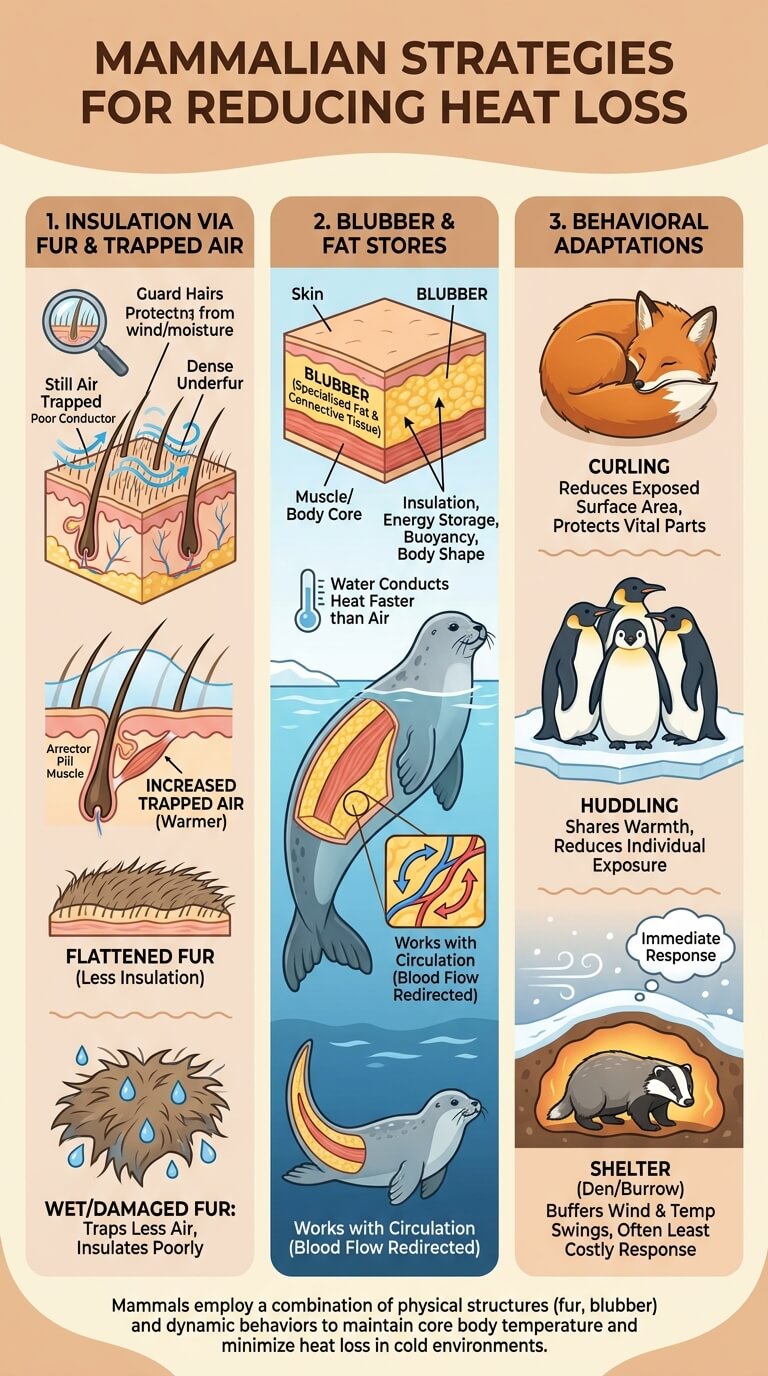
Hair reduces heat loss mainly by holding still air near the skin. Air is a poor conductor compared with body tissue or water, so a deep, dry layer of trapped air slows heat transfer. Many cold-adapted mammals have dense underfur beneath longer guard hairs. The underfur supplies much of the insulation, while guard hairs can protect it from wind, moisture, abrasion, and debris.
Small muscles attached to hair follicles can raise the coat, increasing its depth and the amount of trapped air. Flattening the coat reduces that layer. The Smithsonian’s overview of mammal activity and temperature control notes that fur can be raised or lowered as insulation needs change. The effect depends on coat density and dryness. Wet, matted, damaged, or oil-contaminated fur may trap less air and insulate poorly.
Blubber and Other Fat Stores
Fat beneath the skin can provide both insulation and stored energy, but these functions should not be confused. A fat deposit can supply fuel without being positioned or structured as an efficient thermal barrier. Blubber is a specialized layer of fat and connective tissue beneath the skin of many marine mammals. It can contribute to insulation, energy storage, body shape, and buoyancy.
Blubber is especially valuable in water because water conducts heat away from the body far faster than still air. Its thickness and composition vary among species, individuals, seasons, life stages, and body regions. A seal may also redirect blood flow through the skin and extremities, so the thermal performance of blubber works together with circulation rather than acting as a passive blanket alone.
Curling, Huddling, Shelter, and Posture
Behavior can change heat loss immediately without requiring new tissue. Curling into a compact shape reduces the surface exposed to cold air and can protect less insulated areas. Tucking the nose beneath a tail or wing-like forelimb, drawing the feet toward the body, or lying on insulated bedding can reduce conductive and convective losses.
Huddling allows several mammals to share a warmer local environment and reduce the exposed surface area per individual. It is common in social rodents, bats, primates, and other species, but it has trade-offs. Crowding can restrict movement, increase competition, or raise overheating and disease risks. Shelters such as dens, tree cavities, snow chambers, and burrows buffer wind and rapid temperature swings, often making behavior the least expensive first response to cold.
How Blood Flow Controls Temperature

Vasoconstriction and Vasodilation
Warm blood carries heat from active organs and muscles toward the body surface. In cold conditions, narrowing small blood vessels near the skin, called vasoconstriction, reduces that transfer. The skin and extremities may cool while the core remains better protected. In warmer conditions, increased skin blood flow, often described as vasodilation, brings more heat to the surface for release.
The response is not an on-off switch. Different regions can be regulated separately, and the pattern varies among mammals. Sparsely furred areas with rich blood supplies can function as thermal windows. Ears, tails, feet, noses, flippers, and other appendages may release heat when well perfused, then conserve it when blood flow is reduced.
Countercurrent Heat Exchange
Countercurrent heat exchange occurs when warm blood traveling toward an exposed body part passes close to cooler blood returning toward the core. Heat moves between the two streams before the outgoing blood reaches the coldest region. This cools arterial blood on the way outward and warms venous blood on the way inward, reducing the amount of core heat lost to the environment.
This arrangement is useful in the legs and feet of some cold-adapted mammals and in the flippers or fins of aquatic species. It does not make an extremity warm. In fact, it can allow the extremity to remain cool while conserving heat centrally. Similar vascular arrangements can serve other functions, including protecting reproductive tissues or managing local heat produced by active muscles.
Protecting the Body Core While Allowing Cool Extremities
A cold paw, hoof, ear, or flipper does not automatically mean the entire animal has the same temperature. Mammals often permit peripheral tissues to cool because the temperature difference between the extremity and the environment becomes smaller, slowing further heat loss. The core can remain much warmer as long as blood flow, metabolism, and insulation maintain the separation.
There are limits. Tissues still require oxygen, and prolonged severe cooling can cause damage. Circulation may therefore shift in cycles or increase briefly to protect local tissue. The exact balance differs by species and conditions. This regional control is one reason a single surface reading cannot represent the thermal state of the whole animal.
Body Size, Shape, and Climate
Surface Area-to-Volume Trade-Offs
Heat is produced throughout body tissues but is exchanged mainly across the surface. As an animal becomes larger, its volume increases faster than its surface area. A large mammal therefore tends to have less surface area relative to the amount of heat-producing tissue inside. This can slow cooling in cold environments, but it can make heat release harder during exercise or hot weather.
Small mammals have the opposite challenge. Their high surface area relative to volume allows rapid heat loss, so many require dense insulation, frequent feeding, high metabolic rates, sheltered resting sites, social huddling, or periods of torpor. Size does not determine thermal biology by itself, but it shapes the energetic problem every other adaptation must solve.
Compact Bodies, Ears, Limbs, and Regional Adaptations
Body shape also affects heat exchange. Compact torsos and shorter appendages generally expose less surface area than long, narrow bodies with large ears or limbs. Cold-climate mammals often show compact proportions, while mammals from hot environments may use large, well-supplied ears or other appendages to release heat. These patterns are useful ecological tendencies, not identification rules.
Comparative research on adaptations to polar life shows that resident mammals combine morphology with seasonal changes, behavior, metabolism, and insulation. No single trait explains survival in severe cold. A short ear can conserve heat, but the animal still needs food, circulation, shelter, and a strategy for periods when the environment or food supply changes.
Why Broad Ecological Rules Have Exceptions
Rules linking climate with body size or appendage length describe statistical patterns across populations or related species. They do not predict every animal. Evolutionary history, available food, predation, locomotion, mating displays, burrowing, swimming, and competition can favor features that pull in different directions.
Keeping Warm in Water
Why Water Removes Heat Quickly
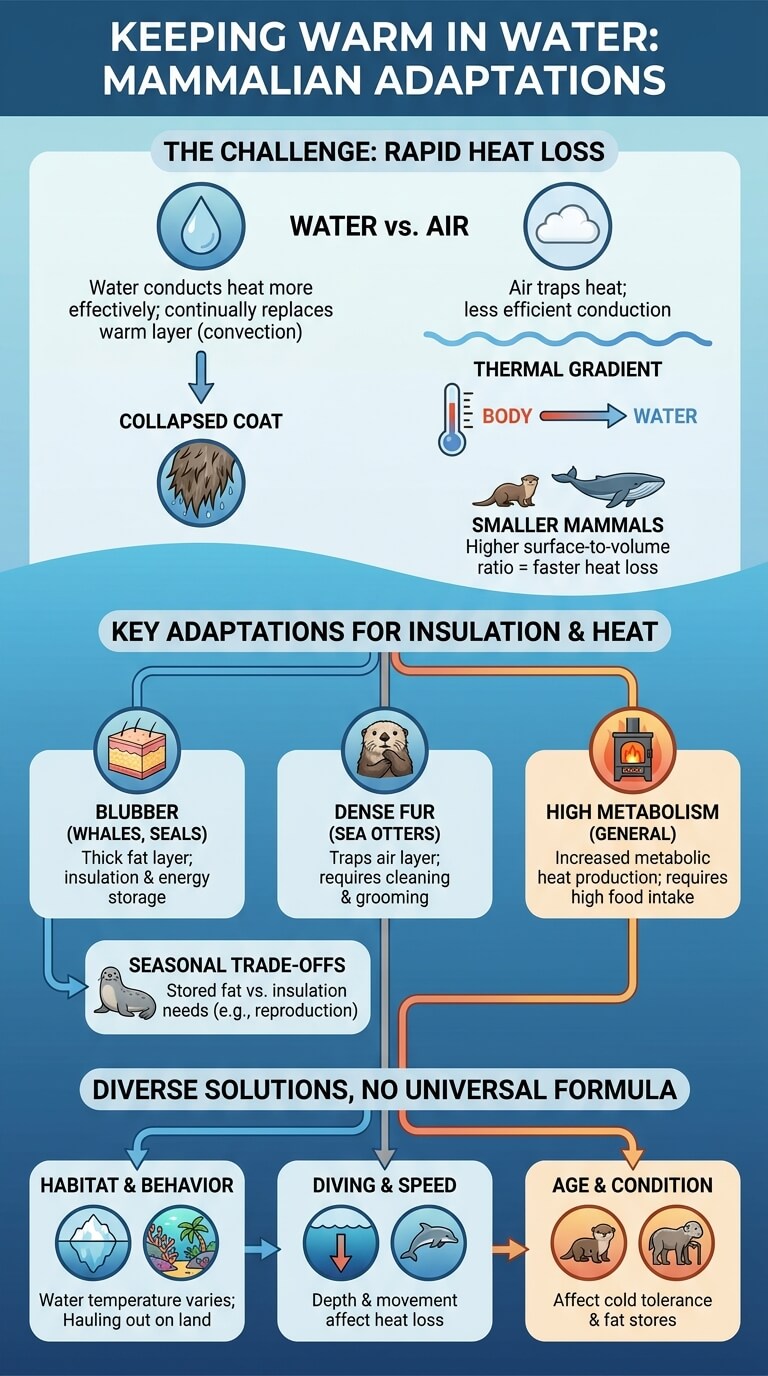
Water presents a severe challenge because it conducts heat away from skin more effectively than air, and swimming continually replaces warmed water near the body with colder water. A wet terrestrial coat may collapse and lose much of its trapped air. Fully aquatic mammals therefore need adaptations that work while submerged and moving.
The thermal gradient matters as well. Heat leaves faster when the difference between body and water temperature is large. Small aquatic mammals face especially strong pressure because they have more surface area relative to volume. They may compensate with exceptionally dense fur, high food intake, high metabolic heat production, behavior that protects the coat, or time spent hauled out on land.
Blubber, Dense Fur, and High Metabolism
Whales, dolphins, porpoises, and many seals rely heavily on blubber, streamlined body shapes, and controlled circulation. Sea otters take a different route. Their dense fur traps air and must be kept clean and groomed to remain effective. These solutions show that aquatic insulation is not one uniform mammalian feature.
NOAA Fisheries describes seal blubber as important for both thermoregulation and energy storage. Those roles can create difficult seasonal trade-offs. An animal may draw on stored fat when food is scarce or during reproduction, while still depending on the remaining layer for insulation. Age and condition can therefore affect cold tolerance.
Aquatic Examples Without One Universal Formula
Marine mammals differ in where they live, how deeply they dive, how fast they swim, and how much time they spend on land or ice. A harbor seal that hauls out regularly does not face the same thermal schedule as a whale that remains at sea. A tropical dolphin and an Arctic beluga also experience different water temperatures and seasonal demands.
Flexible Body Temperature Strategies
Daily Torpor
Daily torpor is a controlled period in which metabolism and body temperature fall for part of the day, often during rest. It can save energy when nights are cold, food is limited, or maintaining a high temperature would be disproportionately expensive. Small bats, rodents, marsupials, and other mammals use versions of this strategy.
Torpor is not ordinary sleep. Metabolic rate, circulation, breathing, and responsiveness change more deeply, and rewarming can require substantial energy. The depth and duration vary widely. Some animals cool only modestly, while others approach environmental temperature. The decision to enter torpor can be influenced by energy reserves, reproduction, predation risk, weather, and expected feeding opportunities.
Seasonal Torpor and Hibernation as Adjacent Strategies
Hibernation usually involves repeated, prolonged torpor bouts separated by periods of arousal. It is more than a long nap and does not mean metabolism stops. The animal actively regulates entry, maintenance, and rewarming. Different species reach different minimum temperatures, remain torpid for different lengths of time, and respond differently to external cold.
A review of the characteristics and control of torpor notes that torpor can be brief in daily heterotherms or prolonged in seasonal hibernators. This continuum is why simple labels can be misleading. Bears, ground squirrels, bats, and dwarf lemurs do not follow one identical winter pattern.
Heterothermy and Why Warm-Blooded Is Not Absolute
Heterothermy allows a mammal to save energy by relaxing tight temperature control at selected times or in selected body regions. Temporal heterothermy includes torpor and daily temperature cycles. Regional heterothermy includes a warm core with cooler limbs, skin, or appendages.
This flexibility can expand the conditions a mammal can tolerate, but it has costs. Cooling may slow movement, digestion, sensory processing, and reaction time. Rewarming requires fuel. A torpid animal may be less able to escape a predator or respond to a sudden disturbance. Thermoregulation is not about maximizing warmth at every moment. It is about allocating energy and risk in a way that supports survival and reproduction.
How Mammals Avoid Overheating
Sweating, Panting, and Evaporative Cooling
Evaporation removes heat because changing liquid water into vapor requires energy. Humans and horses can use substantial sweating, but sweating capacity varies greatly among mammals. Dogs rely heavily on panting, while some rodents spread saliva on parts of the body. Other species increase respiratory evaporation or use smaller areas of specialized skin.
Evaporative cooling works best when water can evaporate readily. High humidity reduces its effectiveness, and any form of evaporation spends body water. A mammal in a dry habitat must therefore balance cooling against dehydration. Panting can also affect feeding, sound production, and acid-base balance if it becomes extreme.
Shade, Burrows, Timing, and Reduced Activity
Behavior often prevents heat gain before expensive physiological cooling is needed. A mammal can enter shade, use a burrow, stand in water, rest on a cooler surface, orient away from the sun, or reduce movement during the hottest hours. Nocturnal or crepuscular activity can separate foraging from peak daytime heat.
Burrows are particularly valuable because soil temperatures change more slowly than air temperatures. A desert rodent may spend most daylight hours underground, then forage after sunset. Large mammals may move between sun and shade, alter posture, or travel to water. These choices also affect exposure to predators and access to food, so the coolest option is not always the safest or most profitable one.
Trade-Offs Between Water Conservation and Cooling
A mammal cannot evaporate unlimited water. Desert species may tolerate wider body-temperature swings, reduce activity, produce concentrated urine, obtain water from food, or use nasal passages that recover some moisture from exhaled air. These adaptations reduce water loss, but each has limits set by humidity, diet, workload, and heat intensity.
Common Myths and Mistakes
Fur Does Not Create Heat
Fur conserves heat that came from metabolism, muscle activity, sunlight, or another warm surface. It works mainly by slowing air movement and heat transfer near the skin. A thick coat cannot replace food, circulation, or metabolic heat production. It can also lose effectiveness when soaked, compressed, dirty, or damaged.
This distinction matters when interpreting animal behavior. Fluffing the coat is not the production of warmth. It increases the insulating air layer. Shivering, brown fat activity, and ordinary metabolism are the processes that add internal heat.
All Mammals Do Not Maintain the Same Temperature
There is no single normal body temperature for Mammalia. Values vary among species and can shift with time of day, age, reproductive condition, activity, measurement location, season, and torpor. Surface temperature can differ greatly from core temperature, especially in cold conditions.
Broad statements that every mammal remains near the human value erase important biology. Monotremes, bats, small marsupials, hibernators, and many other mammals show controlled patterns that differ from the familiar classroom model. Stable temperature is common, but stability has a species-specific range and context.
Large Bodies Are Not Always Better in Every Climate
Large size can slow heat loss in cold surroundings, but it can also make cooling difficult and increase total food and water needs. Small size can allow rapid heating, access to burrows, and short generation times, even though it raises the cost of staying warm. Neither condition is universally superior.
How Temperature Control Shapes Mammal Activity
Nocturnal Activity as a Temperature-Management Strategy
Living at night changes more than vision and hearing. In hot habitats, nocturnal activity can reduce solar heat gain and lower the cost of cooling. In cold habitats, however, nighttime activity may increase the need for insulation and metabolic heat. The thermal benefit depends on local conditions rather than the label “nocturnal” alone.
Torpor, Hibernation, and Winter Energy Conservation
Winter survival may involve thicker fur, larger fat stores, food caching, migration, social huddling, sheltered dens, reduced activity, torpor, or hibernation. Species combine these tools in different proportions. Some remain active all winter, while others lower metabolism because maintaining a high body temperature would consume more energy than available food can replace.
The choice also changes through life. Young mammals, pregnant females, nursing mothers, and adults in poor condition may face different thermal limits. A method that saves energy can delay feeding or reproduction. Understanding how mammals keep warm therefore requires looking at the whole annual cycle, not only at the coldest day.
FAQ
Are Mammals Always Warm to the Touch?
No. Skin temperature can be much lower than core temperature, especially on ears, feet, tails, noses, flippers, or other exposed areas. Fur may also hide a warm skin surface beneath cool outer hairs. A torpid mammal can have a substantially reduced body temperature while remaining alive and physiologically regulated.
Touch is not a safe or reliable way to judge the condition of wildlife. Handling can stress the animal, expose people or pets to injury or disease, and disrupt normal behavior. An apparently cold or inactive wild mammal should be assessed from a distance, with guidance from a licensed wildlife rehabilitator or wildlife agency when intervention seems necessary.
How Do Whales Stay Warm Without Fur?
Whales rely on a combination of blubber, large body size, streamlined shape, metabolic heat, and blood-flow control. Blubber slows heat transfer and also stores energy. Cooler extremities can limit loss from the warm core, while blood flow may increase in selected regions when excess heat needs to be released.
Whales are not insulated equally at every body region or life stage. Blubber changes with nutrition, reproduction, season, and species. Active swimming also produces heat, so whales sometimes face the challenge of cooling rather than warming.
What Is Brown Fat?
Brown fat is adipose tissue specialized for heat production. Its cells contain many mitochondria and, in many placental mammals, use UCP1 to release energy as heat. It is prominent in many newborns, small cold-adapted mammals, and hibernators that need rapid non-shivering heat production.
Brown fat is not equally important in every mammal, and it should not be treated as the only form of non-shivering thermogenesis. Species differ in tissue distribution, life stage, and molecular mechanisms.
Can Mammals Lower Their Body Temperature on Purpose?
Many can lower defended body temperature through controlled heterothermy. Daily torpor may last part of a day, while hibernation includes longer torpor bouts. Mammals can also allow their extremities to cool while keeping the core warmer.
These changes are regulated physiological states, not simple exposure to cold. Metabolism, circulation, breathing, and nervous-system control shift together. Depth and duration vary widely, so one species should not be used as a universal model for all mammals.
Final Thoughts
How mammals keep warm is best understood as a coordinated heat budget. Metabolism, shivering, and brown fat produce heat. Fur, trapped air, blubber, posture, shelter, and huddling slow its loss. Blood vessels and countercurrent exchange control where heat travels, while body size and shape influence how quickly the environment can remove or add it.
The same system must also prevent overheating and conserve water. Mammals use panting, sweating, thermal windows, shade, burrows, altered activity, and controlled changes in body temperature when conditions demand them. No one mechanism defines every species. The diversity of mammalian thermoregulation comes from combining anatomy, physiology, and behavior in ways that fit each habitat and season.

Ethan Walker is the founder and research editor of Animal Fact Central. He creates and reviews educational animal facts content using trusted wildlife, pet care, and science-based sources. His work focuses on making animal behavior, adaptations, habitats, and species facts clear, accurate, and engaging for everyday readers.
Read More Details About Ethan Walker: https://animalfactcentral.com/ethan-walker/