
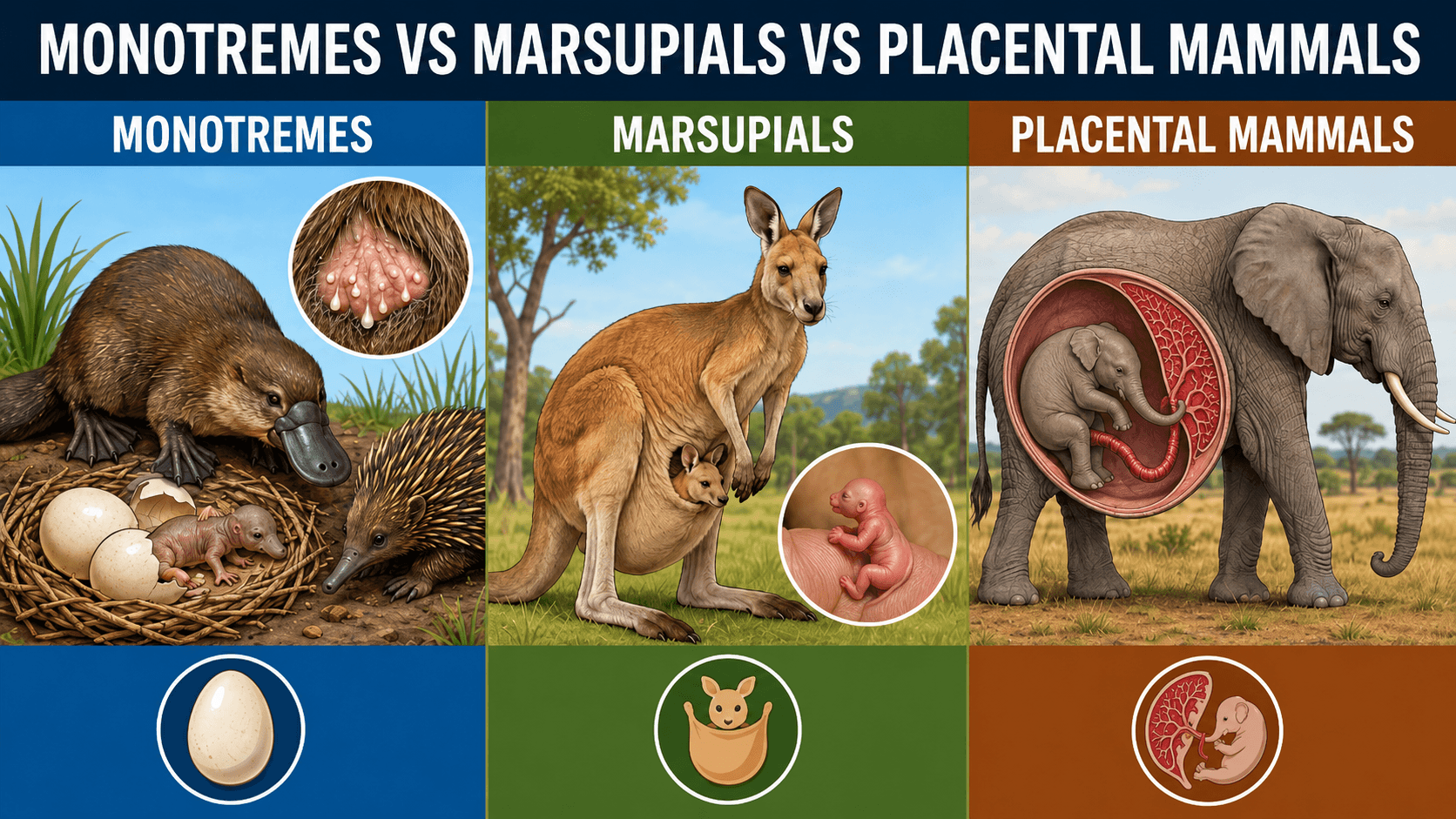
Monotremes, marsupials, and placental mammals are the three major living branches of mammals, but they differ most clearly in how their young develop. Monotremes lay eggs. Marsupials give birth to very immature young that continue much of their development while nursing. Placental mammals usually support longer development inside the uterus through a highly developed placenta.
Those differences are important, but they do not divide mammals into “less mammalian” and “more mammalian” forms. All three groups have the defining biology of mammals, including hair at some life stage and mammary glands that produce milk. Their reproductive patterns are different solutions to the same challenge: protecting, nourishing, and developing offspring.
The comparison becomes most useful when it focuses on development rather than familiar stereotypes. Not every marsupial has a large pouch, not every placental mammal gives birth to a well-developed newborn, and egg-laying monotremes are not reptiles. The sections below compare what actually happens before birth or hatching, during lactation, and through early growth.
Quick Difference
One-Sentence Definition of Each Lineage
Monotremes are living mammals that lay eggs and feed their hatchlings with milk. Marsupials are live-bearing mammals whose young are typically born at an early developmental stage and complete extensive growth while attached to a teat. Placental mammals are live-bearing mammals whose embryos usually spend more time developing in the uterus with support from a specialized placenta.
The broad pattern is easy to remember as eggs, early birth, and longer internal development. Still, each group contains variation. A reproductive label describes a lineage and its general developmental strategy, not a single timetable that every species follows.
Side-by-Side Comparison Table
| Feature | Monotremes | Marsupials | Placental Mammals |
|---|---|---|---|
| Birth or hatching | Young hatch from leathery-shelled eggs | Young are born alive at a very early developmental stage | Young are born alive after generally longer internal development |
| Embryonic nourishment | Egg yolk, followed by milk after hatching | Short uterine support, then prolonged lactation | Extensive exchange through a specialized placenta during pregnancy |
| Milk delivery | Milk reaches the skin through mammary openings rather than nipples | Young attach to teats, often within a pouch or protected skin area | Young nurse from nipples or teats after birth |
| Typical newborn condition | Small and highly dependent hatchlings | Extremely immature newborns with strong forelimb and mouth development | Ranges from helpless newborns to young able to stand or swim soon after birth |
| Familiar examples | Platypus and echidnas | Kangaroos, opossums, koalas, wombats, bandicoots | Humans, bats, rodents, whales, cats, elephants |
What All Three Groups Share as Mammals
Hair, Milk, and Mammalian Anatomy
Reproductive differences do not erase the body features inherited from a common mammalian ancestry. Mammals have hair or fur at least during part of life, produce milk through mammary glands, and possess three small middle-ear bones. They also have a lower jaw built primarily from a single dentary bone. The Animal Diversity Web overview of Mammalia summarizes these shared traits and the broad developmental differences among the three groups.
Some shared features are easy to miss. A whale may appear hairless, yet small amounts of hair occur during development or in limited areas. An echidna is covered with spines as well as hair, but those spines are modified hairs. A platypus lays eggs, yet it has fur, mammary glands, and the distinctive ear and jaw anatomy of a mammal.
Why Reproductive Differences Do Not Change Mammal Identity
Mammal identity is based on ancestry and a suite of inherited traits, not on live birth alone. Live birth also evolved in other vertebrates, including some reptiles and fishes, so giving birth does not automatically make an animal a mammal. In the same way, laying an egg does not move a monotreme outside Mammalia.
The three lineages are branches on an evolutionary tree rather than steps on a ladder. Monotremes separated early from the branch leading to marsupials and placentals. Marsupials and placentals are more closely related to one another and together form Theria, the live-bearing mammal branch. Each lineage has continued evolving for a very long time.
Monotremes: Egg-Laying Mammals

Eggs, Incubation, and Hatching
Monotremes are the only living mammals that lay eggs. After fertilization and a period of development inside the female, the embryo is enclosed in a small egg with a flexible, leathery shell. The egg is then incubated outside the uterus. A platypus shelters its eggs in a nesting burrow, while an echidna carries its egg in a temporary abdominal pouch.
The young hatch in a highly dependent condition. They are not miniature adults ready to forage. Their early survival depends on warmth, shelter, and milk supplied by the mother. This combination of egg laying and prolonged nursing shows why focusing on eggs alone gives an incomplete picture of monotreme reproduction.
Milk Production Without Nipples
Female monotremes make true mammalian milk, but they do not have nipples. Mammary ducts open onto specialized areas of skin, and milk collects around mammary hairs or skin grooves where the young can lap it. A detailed Smithsonian review of mammary gland evolution in mammals describes how milk is released at the base of hairs in platypuses and echidnas.
This delivery system is unusual among living mammals, but the milk performs the familiar mammalian job of nourishing growing young. Lactation continues after hatching while organs, muscles, insulation, and feeding abilities develop. The mother therefore shifts investment from producing and incubating an egg to supplying milk over an extended period.
Living Examples and Geographic Range
There are five widely recognized living monotreme species: one platypus, one short-beaked echidna, and three long-beaked echidnas. The University of California Museum of Paleontology introduction to monotremes identifies the platypus and four echidna species as the surviving members of this branch.
Living monotremes are native to Australia and New Guinea and nearby islands. Platypuses are semiaquatic freshwater animals, while echidnas are land-dwelling diggers and foragers. Their different bodies and habitats are a reminder that a shared reproductive pattern does not force every member of a lineage into the same ecological role.
Marsupials: Short Gestation and Extended Development

Birth at an Early Developmental Stage
Marsupials give birth to live young, but pregnancy is usually brief compared with the long period of development that follows. A newborn marsupial is extremely small and immature. Its forelimbs, mouth, and related structures are developed enough to help it reach and attach to a teat, while many other organs and body systems remain at an early stage.
Once attached, the newborn continues growing while receiving milk whose composition can change as development proceeds. In many species, the teat enlarges inside the mouth and helps maintain attachment during the most vulnerable stage. The mother’s major energetic commitment is therefore shifted toward lactation rather than concentrated in a long pregnancy.
Pouches, Teats, and Variation Among Species
A pouch is useful but not universal. Some marsupials have deep, permanent pouches. Others have shallow folds that become more prominent during reproduction, and some have no enclosing pouch at all. The young may remain attached to exposed teats or be protected in a nest. The Animal Diversity Web account of marsupial mammals emphasizes that pouch structure and reproductive anatomy vary across the group.
Pouch openings also face different directions. A forward-opening pouch can help retain a climbing or hopping young animal, while a backward-opening pouch may reduce the amount of soil entering when the mother digs. These patterns are not simple rules, but they show how reproductive structures can interact with movement and habitat.
Representative Examples Beyond Kangaroos
Kangaroos and koalas are familiar Australian marsupials, but the lineage is much broader. It includes wombats, wallabies, possums, gliders, quolls, Tasmanian devils, bandicoots, bilbies, numbats, and marsupial moles. The Americas are home to opossums, shrew opossums, and the monito del monte.
These animals occupy forests, deserts, grasslands, underground tunnels, and urban edges. Their diets include leaves, fruit, insects, meat, nectar, fungi, and mixed foods. The reproductive pattern is shared, but body size, locomotion, social behavior, and parental routines differ widely. Marsupial should never be treated as a synonym for kangaroo-like animal.
Placental Mammals: Longer Internal Development
What the Placenta Does
The placenta is a temporary organ formed from tissues associated with the embryo and the mother’s uterus. It supports exchange of oxygen, nutrients, and waste products while also taking part in hormonal and immune regulation. A Nature Reviews Genetics overview of placental development describes the placenta as essential for gas, nutrient, and waste exchange during mammalian development.
Maternal and fetal blood do not simply mix in a common pool. Materials cross specialized tissues at the maternal-fetal interface. The exact structure of that interface differs among placental species. This variation matters because it affects how deeply fetal tissues contact the uterine lining, how exchange occurs, and how pregnancy is regulated.
Gestation and Developmental Variation at Birth
Placental mammals generally retain embryos in the uterus longer than marsupials do, but “longer” is relative. Small rodents may have short pregnancies and produce blind, hairless young. Hoofed mammals often have longer pregnancies and newborns that can stand relatively soon. Humans, rabbits, bats, seals, and elephants each follow different schedules.
Biologists often describe newborns as altricial or precocial. Altricial young are comparatively helpless and need intensive care, while precocial young are more mobile and developed at birth. These terms mark ends of a spectrum. A placental mammal can have extensive prenatal development and still produce young that depend heavily on warmth, milk, protection, or teaching.
Diversity of Placental Mammals
Placental mammals contain by far the largest share of living mammal diversity. They include rodents, bats, primates, rabbits, carnivorans, whales, dolphins, elephants, armadillos, sloths, horses, deer, cattle, moles, shrews, and many other groups. Humans are also placental mammals.
Their ecological range is equally broad. Placental mammals fly, swim, dig, climb, run, glide, and live from polar seas to deserts and cities. This diversity should not be credited to the placenta alone. Feeding anatomy, sensory systems, body size, movement, climate history, competition, and many other factors also shaped the expansion of different groups.
Reproduction and Development Compared
Fertilization and Pregnancy
All three lineages reproduce through internal fertilization. The major contrast appears after fertilization. A monotreme embryo develops partly inside the reproductive tract and then inside an external egg. A marsupial embryo has a relatively short uterine period before birth. A placental embryo typically remains in the uterus for a larger portion of development.
These are general patterns, not exact formulas. Delayed implantation, embryonic diapause, litter size, seasonality, and maternal condition can alter timing. Even closely related species may differ. Comparing one kangaroo with one mouse or one elephant cannot establish a rule for every marsupial or placental mammal.
Placenta Type and Nutrient Exchange
The phrase “placental mammal” can create the mistaken impression that marsupials have no placenta. In fact, marsupial embryos commonly form a short-lived placenta, often involving the yolk sac. Bandicoots develop a more extensive chorioallantoic placenta later in gestation. The difference is therefore not placenta versus no placenta, but the form, duration, and developmental role of placental contact.
Placental mammals also do not share one identical placenta. Horses, dogs, rodents, primates, and other groups differ in tissue arrangement and maternal-fetal contact. Broad comparisons are useful, but placenta structure must be checked at the species or group level before making a detailed claim.
Birth Condition, Lactation, and Postnatal Growth
Monotreme hatchlings, newborn marsupials, and many newborn placental mammals all require substantial care. What differs is where development occurs and how maternal resources are delivered. Monotremes rely first on egg contents and then milk. Marsupials move rapidly from short pregnancy to prolonged teat attachment. Placentals usually transfer more resources before birth, followed by lactation.
Milk remains the unifying feature. It provides energy, water, nutrients, and protective compounds, although its composition changes among species and across stages of nursing. A newborn’s level of independence also depends on more than reproductive lineage. Nesting, body temperature control, predator pressure, litter size, and the mother’s feeding ecology all influence early life.
Anatomy, Ecology, and Evolutionary Trade-Offs
Why No Lineage Is Simply More Advanced
Words such as primitive and advanced can distort evolutionary relationships when they are used as rankings. Monotremes retain egg laying, but living platypuses and echidnas have highly specialized sensory systems, feeding structures, and behaviors. Marsupials have short gestation, yet their lactation and newborn development are complex. Placentals have prolonged pregnancy, but that does not make every placental species more successful than every marsupial.
Evolution modifies inherited biology under local conditions. A trait can be effective in one setting and costly in another. The survival of all three lineages shows that each strategy can work when paired with suitable anatomy, behavior, and habitat.
How Reproductive Strategy Interacts With Body Size and Ecology
Body size changes the costs of carrying young, producing milk, building nests, and avoiding predators. A burrowing echidna can protect an egg and hatchling in a sheltered space. A kangaroo can support an extremely small newborn on a teat while remaining mobile. A whale can sustain a fetus internally and later nurse a calf in water.
Ecology also shapes timing. Seasonal food peaks may favor births or hatching when mothers can produce enough milk. Predation may favor concealed nests, mobile newborns, or rapid growth. Cold environments increase the value of insulation and maternal warmth. Reproduction cannot be separated from where an animal lives and how it obtains energy.
Limits of Broad Comparisons
The three-way comparison works best at a high level. It becomes less reliable when used to predict exact gestation, litter size, intelligence, lifespan, or parental behavior. Some placental mammals produce many helpless young, while others produce one mobile newborn. Some marsupials have pouches and others do not. Monotreme species differ in habitat and nesting behavior.
Researchers also distinguish crown groups from broader fossil lineages. Eutheria includes placentals and extinct relatives closer to them than to marsupials, while Metatheria includes marsupials and their extinct relatives. Fossil discoveries continue to refine the timing and anatomy of these branches. A Nature study on the early eutherian and metatherian split illustrates how new fossils can change interpretations of mammal history.
Common Classification Mistakes
A Pouch Does Not Define Every Marsupial
The word marsupial comes from a term associated with a pouch, which makes the shortcut understandable. Still, a permanent enclosed pouch is not required. The more reliable clues are ancestry and reproductive anatomy, including the early birth of highly immature young and their prolonged dependence on teats.
A pouch is also not proof by itself. Some non-marsupial animals carry young in folds, pockets, or specialized skin structures. Classification depends on the full biological pattern, not one visible container.
Placental Does Not Mean Every Species Has the Same Placenta
Placental mammals share prolonged uterine development supported by a chorioallantoic placenta, but placentas vary in shape, tissue layers, attachment, invasiveness, and hormonal function. Human placentation should not be treated as the universal model for dogs, horses, elephants, bats, or rodents.
The name also should not be used to deny placental structures in marsupials. The distinction is evolutionary and developmental. It is not a simple claim that one group possesses an organ and another completely lacks it.
Monotremes Are Not Reptiles
Egg laying is an ancestral vertebrate reproductive condition, but it does not determine modern classification. Monotremes have the mammalian jaw and middle ear, produce milk, grow hair, and belong within the mammal family tree. Their eggs are one retained feature within an otherwise distinctly mammalian body.
Calling a platypus “part reptile” may sound playful, but it gives the wrong biological message. Animals are not mixtures of modern groups simply because they share an old trait. Similar features can persist from common ancestry or evolve independently.
How to Tell Which Lineage a Mammal Belongs To
Reproductive Evidence
Direct reproductive evidence is the clearest starting point. Egg laying identifies a living mammal as a monotreme. A very immature live-born young that attaches to a teat and completes major development after birth points toward a marsupial. Longer uterine development through a specialized placenta points toward a placental mammal.
Observation must still be careful. Many wild mammals reproduce in hidden nests, burrows, dens, tree cavities, or water. A person may see an adult without ever seeing an egg, pouch, newborn, or placenta.
Taxonomic Evidence
Reliable classification uses anatomy, genetics, fossils, and evolutionary relationships. Field guides, museum databases, and taxonomic references can identify the order, family, genus, and species. Once the species is known, its lineage is usually straightforward.
Scientific names are especially useful when common names create confusion. “Possum” can refer to different marsupials in Australia and the Americas. A name that sounds familiar may also be applied to an unrelated animal in another region.
Why Appearance Alone Can Fail
Convergent evolution can make unrelated mammals look or behave similarly because they face similar environmental challenges. A marsupial mole and a placental mole both have digging adaptations, but they belong to different lineages. Gliding marsupials and placental flying squirrels independently evolved skin membranes for moving between trees.
Body form therefore gives clues about lifestyle more readily than ancestry. Teeth, feet, fur, and movement can suggest diet or habitat, but they may not reveal whether an animal is marsupial or placental without additional evidence.
Shared Biology Beyond Reproductive Strategy
Defining Traits and Lactation
The most useful connection among the groups is lactation. Eggs, short pregnancy, and prolonged pregnancy all lead to a stage in which the mother supplies milk. That shared dependence helps explain why mammary glands are more informative for identifying mammals than live birth.
Hair, hearing anatomy, jaw structure, endothermy, breathing with lungs, and parental investment add broader context. Reproduction is only one part of mammal biology, even though it provides the clearest difference among these three lineages.
Pregnancy, Birth, Milk, and Parental Care Across Species
Within every lineage, mothers balance energy, safety, movement, and timing. Producing an egg, supporting a pregnancy, or making milk requires resources. The young must be protected from temperature extremes, hunger, predators, and accidents while their bodies mature.
Parental care varies after that basic requirement. Some young remain with a mother for a long period and learn complex behaviors. Others become independent sooner. Fathers or other group members contribute in some species, but not in others. Those patterns should be studied at the species level rather than predicted from monotreme, marsupial, or placental identity alone.
FAQ
Are Marsupials Born Alive?
Yes. Marsupials are live-bearing mammals. Their newborns are usually much less developed than the newborns people picture when thinking about many placental mammals. After birth, the young attach to a teat and continue extensive growth while nursing. A pouch may protect them, but not every marsupial has a deep or permanent pouch.
Do Monotremes Produce Milk?
Yes. Milk production is one reason monotremes are unmistakably mammals. Female platypuses and echidnas lack nipples, so milk is released through openings onto specialized skin areas. Hatchlings take up the milk from the skin and surrounding hairs while they remain protected in a burrow or temporary pouch.
Are Humans Placental Mammals?
Yes. Humans belong to the placental mammal lineage. Human embryos and fetuses develop in the uterus with support from a placenta, and infants receive milk after birth. Human pregnancy is one version of placental reproduction, not the standard pattern for every other placental species.
Which Lineage Contains the Most Living Species?
Placental mammals contain by far the most living species. Rodents and bats alone account for a large share of mammal diversity, and placentals also include primates, carnivorans, whales, hoofed mammals, elephants, and many smaller groups. Marsupials are less species-rich, and monotremes have only a handful of living species.
Final Thoughts
The clearest difference among monotremes, marsupials, and placental mammals is where early development happens. Monotremes lay eggs and nurse hatchlings. Marsupials give birth early and shift much of development into an extended nursing period. Placental mammals usually support longer development in the uterus through a specialized placenta. Yet milk, hair, mammalian anatomy, and shared ancestry unite all three. Understanding both the differences and the common ground gives a more accurate picture than treating one reproductive pattern as the normal or superior form of mammal life.

Ethan Walker is the founder and research editor of Animal Fact Central. He creates and reviews educational animal facts content using trusted wildlife, pet care, and science-based sources. His work focuses on making animal behavior, adaptations, habitats, and species facts clear, accurate, and engaging for everyday readers.
Read More Details About Ethan Walker: https://animalfactcentral.com/ethan-walker/