
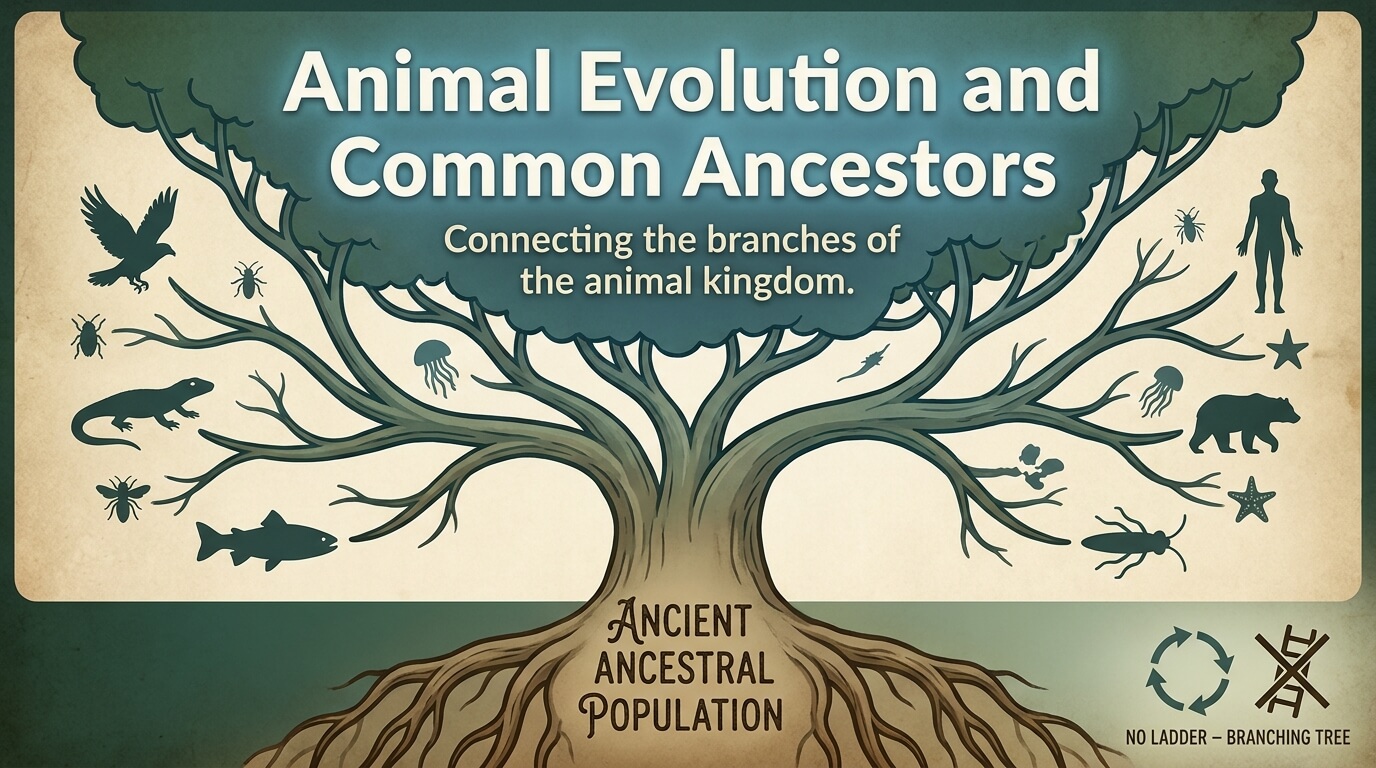
Animal evolution and common ancestors explain why a whale’s flipper, a bat’s wing, a lizard’s foreleg, and a human arm can be built from the same basic arrangement of bones. Living animals did not appear as separate, finished designs. Their lineages inherited traits from earlier populations, changed across generations, split into new branches, and sometimes disappeared. The result is not a ladder from “simple” to “advanced,” but an immense family tree with many surviving twigs and many extinct ones.
Evolution is the change in inherited characteristics of populations across generations. Common ancestry is the idea that different lineages descend from ancestral populations they share. Together, these principles explain both unity and diversity: animals can have deeply similar genes and body structures while living in radically different habitats and solving very different survival problems. The University of California Museum of Paleontology’s introduction to evolution presents this history as branching descent, with all organisms connected by ancestry.
Quick Answer
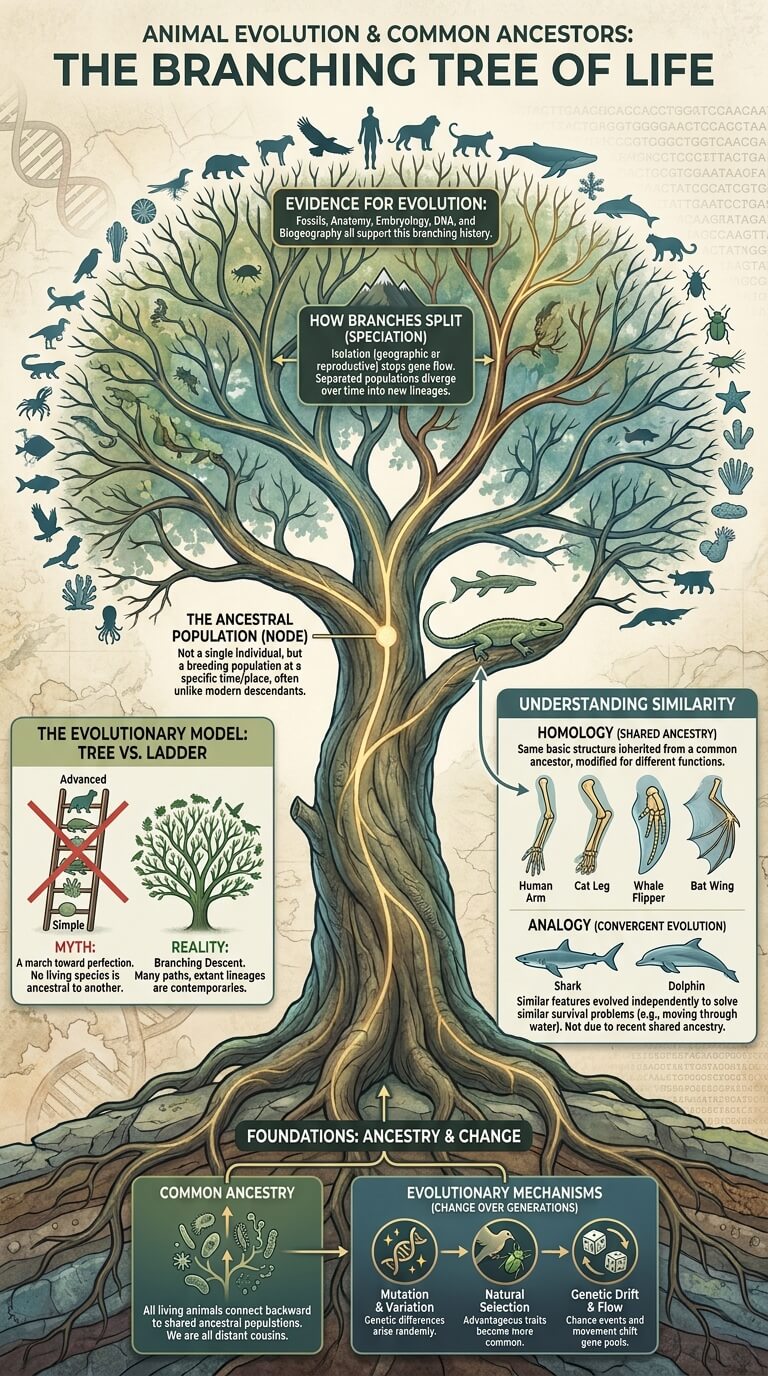
All Living Animals Are Connected Through Branching Ancestry
Every living animal belongs to a lineage that extends backward through earlier populations. Follow two lineages far enough into the past and they meet at a shared ancestral population. A dog and a wolf share a relatively recent ancestor. A dog and a sea star also share ancestry, but their meeting point lies much deeper in evolutionary history. It also explains why modern methods for classifying animals prioritize shared ancestry over superficial resemblance.
The branches do not imply that one modern animal turned into another modern animal. Dogs did not descend from living wolves, and humans did not descend from living chimpanzees. Modern relatives are better compared with cousins who inherited features from shared ancestors and then followed separate evolutionary paths.
Evolution Produces Diversity Through Population Change Across Generations
Individuals grow, learn, and adjust during their lifetimes, but populations evolve. Inherited variation already exists among individuals, and new variation can arise through mutation and genetic reshuffling. If some variants affect survival or reproduction, their frequencies may change over many generations. Chance, movement between populations, mate choice, and environmental change can also alter the genetic makeup of a lineage.
Small changes can accumulate. Given enough time, isolation, and divergence, populations may become distinct lineages. Evolution therefore includes both changes within populations and the branching processes that produce new species.
Classification Attempts to Reflect Those Relationships
Modern biological classification aims to group animals in ways that match their evolutionary history. A clade is an ancestor together with all of its descendants. Mammals form a clade, as do birds, insects, and many other named groups. Scientists test these groupings with anatomy, development, fossils, DNA, and other evidence. This branching history is the foundation of modern animal kingdom classification.
What a Common Ancestor Is
An Ancestral Population, Not Necessarily a Modern-Looking Species
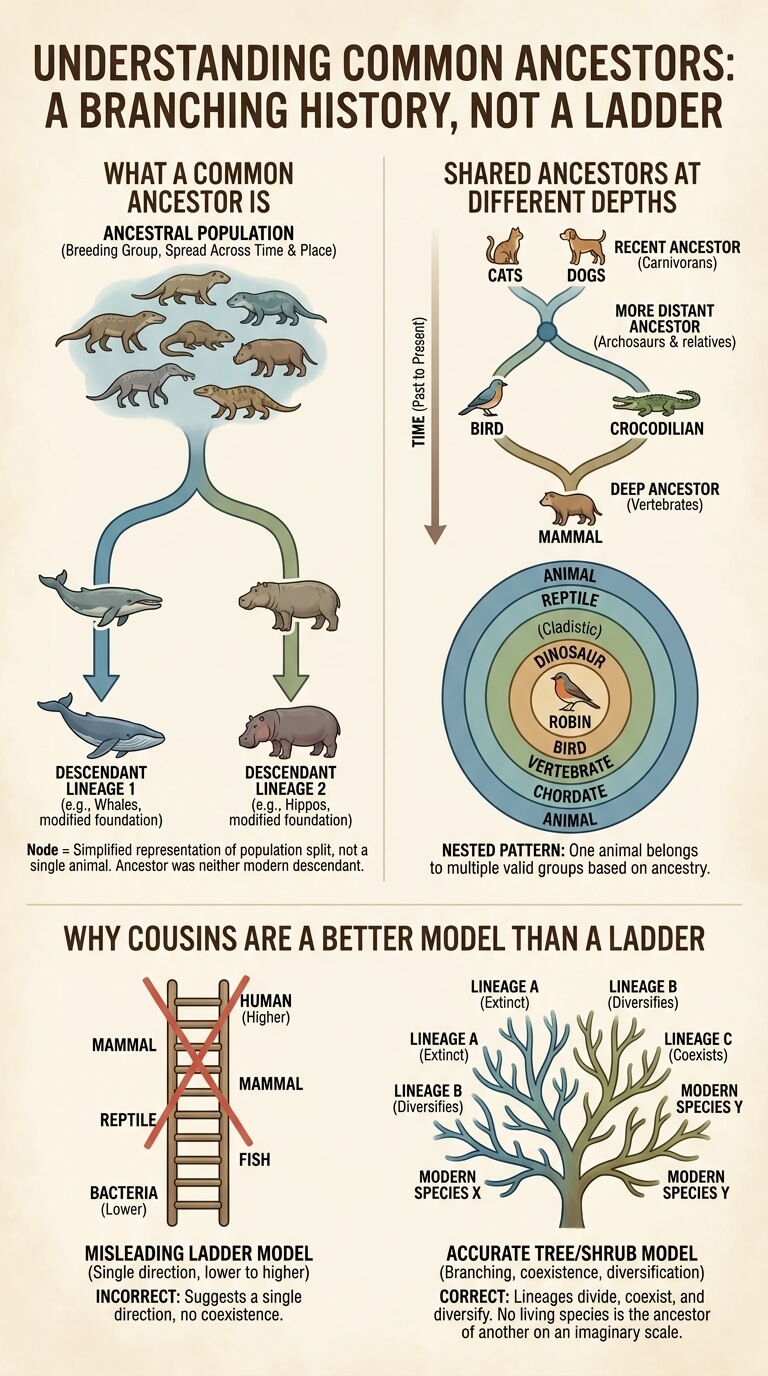
A common ancestor is often pictured as a single animal perched at a fork in a diagram. In reality, the ancestor was usually a breeding population spread across a place and time. The node on a tree is a simplified representation of that population and the split that produced descendant lineages.
That population may not have looked exactly like either descendant. The shared ancestor of whales and hippos was neither a modern whale nor a modern hippo. Descendant lineages inherited parts of an older biological foundation and modified them in different ways.
Shared Ancestors at Different Depths of Time
Relatedness depends on how recently two lineages share ancestry. Cats and dogs are both carnivorans, but each shares more recent ancestry with members of its own family. Birds and crocodilians share a more recent ancestor with each other than either shares with mammals. All three eventually connect farther back within the vertebrate tree.
This nested pattern explains why an animal can belong to several valid groups at once. A robin is a bird, a dinosaur in the evolutionary sense, a reptile within a broad cladistic framework, a vertebrate, a chordate, and an animal. Each label marks a different branch nested inside larger branches.
Why Cousins Are a Better Model Than a Ladder
A ladder suggests a single direction, with organisms arranged from lower to higher. Evolutionary history is better represented by a branching tree or spreading shrub. Lineages divide, coexist, diversify, and become extinct. No living species is the ancestor of every species placed above it on an imaginary scale.
How Animal Lineages Change
Mutation and Genetic Variation
Mutation changes DNA. Many mutations have little effect, some are harmful, and a smaller number can be useful in a particular setting. Sexual reproduction also shuffles existing genetic variants into new combinations, creating differences among offspring.
Natural Selection
Natural selection occurs when individuals with certain inherited traits leave more surviving offspring under particular conditions. Over generations, variants associated with that reproductive advantage may become more common. Selection can refine camouflage, feeding structures, disease resistance, sensory systems, and many other features.
Genetic Drift and Population Size
Genetic drift is change caused by chance rather than consistent advantage. Random events can affect which individuals reproduce and which genetic variants reach the next generation. Drift is often especially influential in small populations, where the loss or success of a few individuals represents a larger share of the gene pool.
Gene Flow and Isolation
Gene flow occurs when animals move between populations and reproduce, carrying genetic variants with them. It can keep populations similar by mixing their genes. Migration corridors, seasonal movement, and dispersal by juveniles can all maintain this connection.
Barriers reduce gene flow. A new river, mountain uplift, fragmented habitat, ocean channel, or difference in breeding time may separate populations. Once exchange declines, mutation, drift, and selection can push the populations along different paths.
Sexual Selection and Coevolution
Sexual selection favors traits that improve access to mates, even when those traits carry costs. Bright plumage, antlers, songs, dances, and contests can evolve when they influence mate choice or competition. The outcome depends on the mating system and the signals animals can perceive.
Coevolution occurs when interacting lineages influence one another’s evolution. Predators and prey may shape each other’s speed, defenses, senses, and tactics. Parasites and hosts may cycle through new ways to infect and resist. Flowers and pollinators can develop close structural and behavioral matches, although neither side is consciously directing the process.
From Populations to New Lineages
Geographic Separation
When a physical barrier divides a population, the separated groups may stop exchanging genes. Different climates, foods, predators, and random events then influence each group. If the separation lasts long enough, reproductive barriers may evolve.
Ecological Specialization
Populations can diverge while exploiting different resources in the same broad region. Some insects specialize on different host plants. Fish in one lake may feed at different depths or breed in different microhabitats. Selection can favor distinct feeding structures, colors, schedules, or behaviors in each ecological setting.
Reproductive Isolation
Reproductive isolation means that gene exchange between populations is limited. Barriers can act before mating, as with different courtship signals, breeding seasons, or habitat preferences. Others act after mating, when hybrids have reduced survival or fertility.
Isolation is often gradual rather than instant. Some recognized animal species occasionally hybridize, especially where their ranges meet. The key question is whether the lineages remain largely distinct over time, not whether every individual is completely unable to mate across the boundary.
Adaptive Radiation and Extinction
An adaptive radiation occurs when one ancestral lineage diversifies into multiple forms associated with different ecological roles. Island birds, lake fishes, and some mammal groups show how available habitats and foods can encourage rapid branching.
Extinction removes branches. It may eliminate a single specialized lineage or reshape entire ecosystems during mass extinction events. Surviving groups can later expand into newly open roles, so the pattern of animal diversity reflects both the creation and pruning of branches.
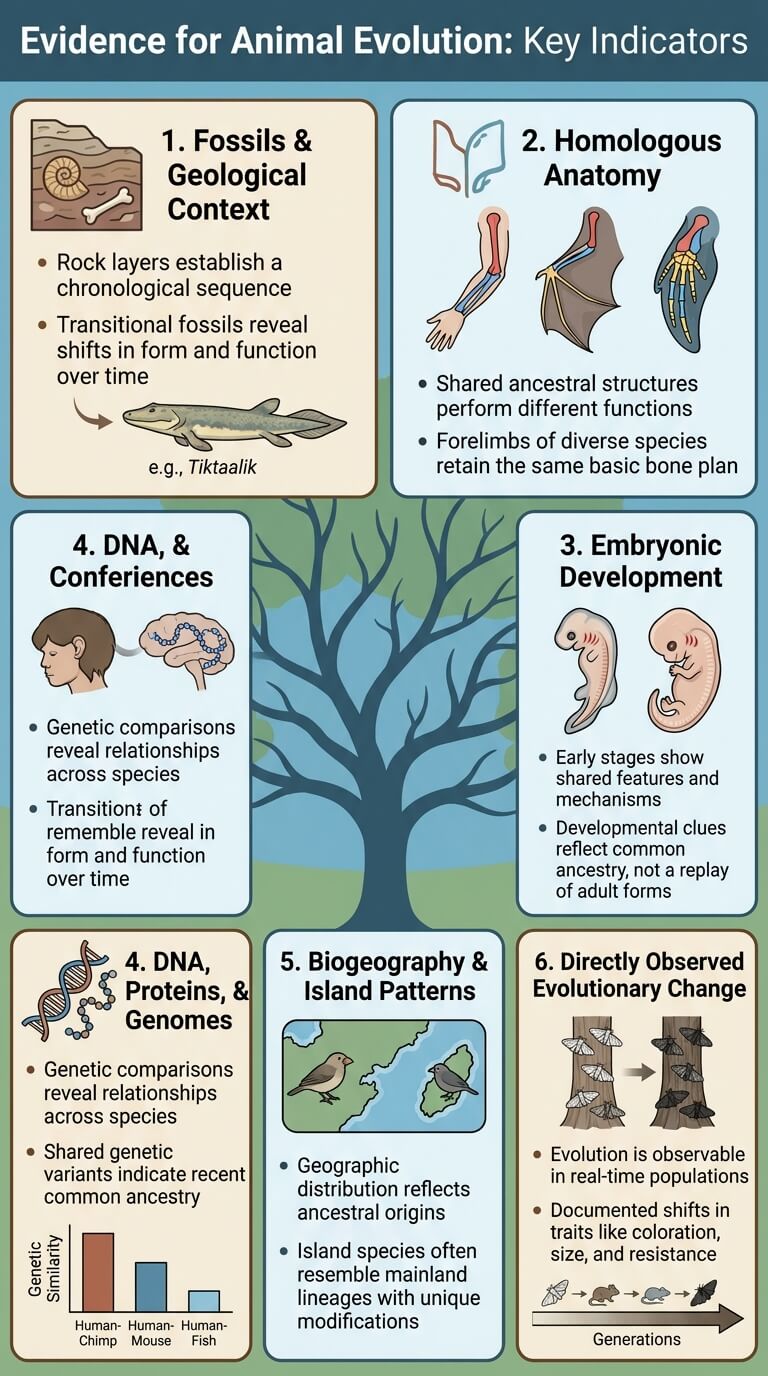
Evidence for Animal Evolution
Fossils and Geological Context
Fossils record organisms, traces, and environments from the past. Their positions in rock layers establish a sequence, while radiometric dating can provide age estimates for suitable materials and surrounding formations. Transitional fossils often combine inherited features with newer modifications, helping researchers trace changes in locomotion, feeding, and body form.
The fossil record is incomplete because preservation requires unusual conditions. Even so, museum collections document extensive change and extinction across deep time. The Smithsonian National Museum of Natural History’s fossil overview shows how ancient remains are used to reconstruct both organisms and the environments in which they lived.
Homologous Anatomy
Homologous structures are inherited from a shared ancestor, even when they perform different functions. The forelimbs of bats, whales, cats, birds, and humans contain corresponding bones arranged around the same basic plan. Evolution changed proportions, joints, muscles, and surfaces while retaining that deeper architecture.
Embryonic Development
Development can preserve clues to ancestry because related animals often use corresponding genes and tissues to build their bodies. Vertebrate embryos, for example, share early developmental features that are modified into different adult structures.
Embryos do not replay a simple ladder of adult evolutionary stages. Development is a branching, regulated process of its own. Useful comparisons focus on homologous structures and developmental mechanisms, not on the outdated claim that an embryo literally passes through adult fish, reptile, and mammal forms.
DNA, Proteins, and Genomes
DNA provides thousands of characters that can be compared across species. Closely related animals tend to share more recently inherited genetic variants, although mutation rates, natural selection, duplicated genes, and incomplete lineage sorting can complicate the pattern.
Genomic studies can confirm relationships suggested by anatomy or overturn them. They are especially valuable when animals look alike because of convergence, when fossils are scarce, or when physical differences are subtle.
Biogeography and Island Patterns
Biogeography studies where organisms live and how those distributions formed. Island animals often resemble lineages from the nearest mainland while showing distinctive modifications. Groups separated by ancient continental movements may retain patterns that match geological history.
Directly Observed Evolutionary Change
Evolution is observable whenever inherited traits change in populations across generations. Researchers have documented shifts in coloration, body size, breeding timing, resistance, feeding structures, and behavior in wild and experimental populations.
How to Read a Phylogenetic Tree
Branches, Nodes, Tips, and the Root
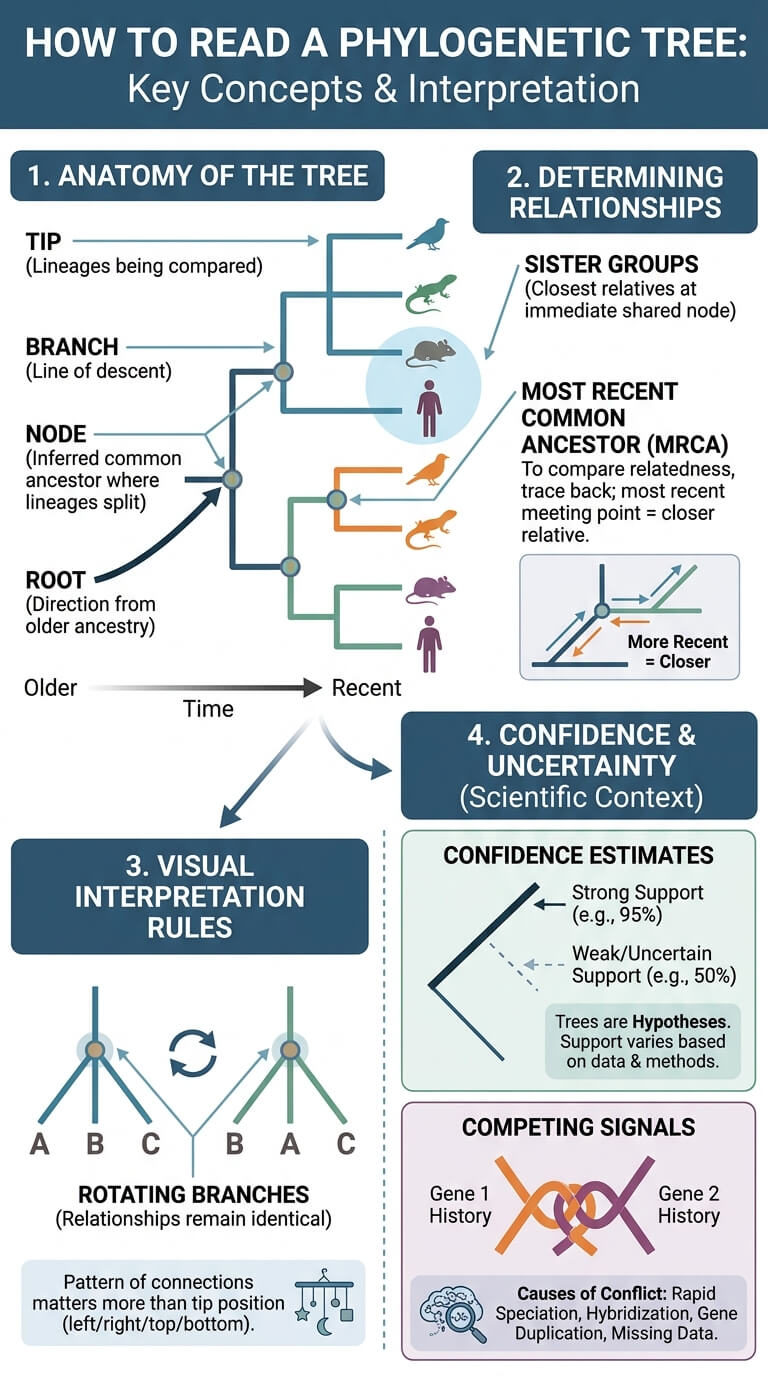
A phylogenetic tree is a hypothesis about relationships. Tips represent the lineages being compared. Branches represent lines of descent, and nodes mark inferred common ancestors where lineages split. A rooted tree also indicates the direction from older ancestry toward descendant groups.
The Understanding Evolution guide to phylogenies emphasizes that the pattern of connections matters more than whether a tip appears on the left, right, top, or bottom.
Sister Groups and Most Recent Common Ancestors
Sister groups are two lineages or clades that meet at an immediate shared node. They are each other’s closest relatives among the groups shown. To compare relatedness, trace branches backward until they meet. The pair whose meeting point is most recent is more closely related.
Rotating Branches Without Changing Relationships
Branches can rotate around a node like a mobile hanging from the ceiling. The tips move to new positions, but the descendants connected to that node remain the same. This means two trees can look different while representing identical relationships.
Confidence, Uncertainty, and Competing Trees
Researchers estimate confidence in branches using statistical methods and by comparing signals from many characters or genes. Some nodes are strongly supported, while others remain uncertain. A branch with weak support should not be presented as settled merely because it appears in a clean diagram.
Different genes can suggest different histories. Rapid speciation, hybridization, gene duplication, missing data, and analytical bias may create conflict. A review of phylogenomic disagreement in the National Library of Medicine archive explains why genome-scale data can reveal several competing evolutionary signals rather than one perfectly uniform tree.
Homology Versus Analogy
Similarity Inherited From a Common Ancestor
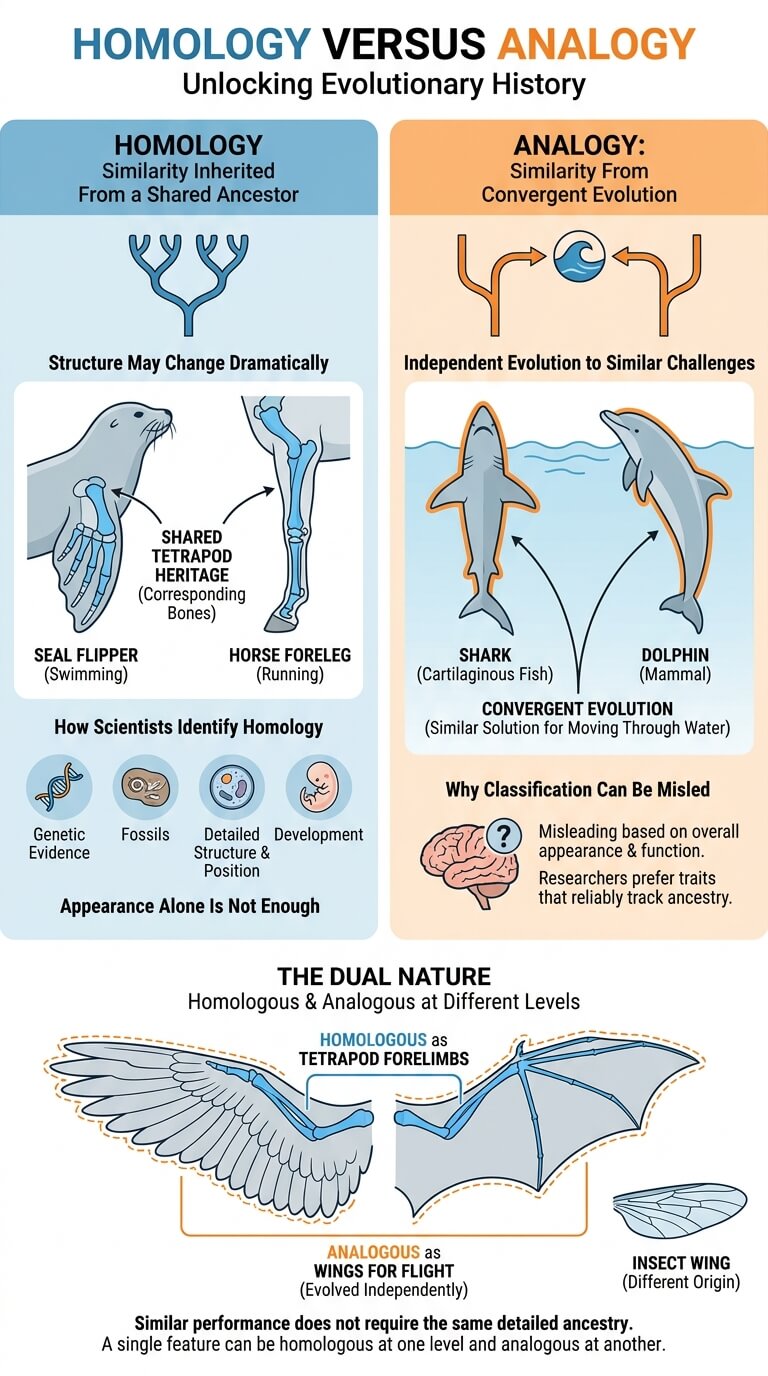
Homology describes similarity inherited from a shared ancestor. The structure may change dramatically after lineages split. A seal’s flipper and a horse’s foreleg perform different jobs, yet their corresponding bones reveal their shared tetrapod heritage.
Scientists identify homology by combining position, detailed structure, development, fossils, and genetic evidence. Overall appearance alone is not enough.
Convergent Evolution and Similar Solutions
Analogy describes similarity that evolved independently because different lineages faced similar challenges. This process is called convergent evolution. Sharks and dolphins both have streamlined bodies suited to moving through water, but one is a cartilaginous fish and the other is a mammal. Similar temperature strategies can arise independently, as shown by the diversity of warm-blooded and cold-blooded animals.
Convergence can be powerful enough to mislead classification. The UC Berkeley explanation of homologies and analogies shows why researchers prefer traits that reliably track ancestry rather than features produced repeatedly by similar environments.
Wings, Streamlined Bodies, and Camera-Like Eyes
Bird and bat forelimbs are homologous as tetrapod limbs, but their wings as flight surfaces evolved independently. Insect wings have a different origin again. These examples show that a single feature can be homologous at one anatomical level and analogous at another.
Streamlining evolved in sharks, extinct marine reptiles, dolphins, and other swimmers. Complex image-forming eyes also evolved along separate paths in vertebrates and cephalopods. Similar performance does not require the same detailed ancestry.
Major Branching Patterns in Animal Evolution
Early-Diverging Animal Lineages
Living animals include sponges, comb jellies, cnidarians, bilaterians, and other lineages that diverged near the base of the animal tree. The exact order of some earliest splits remains debated because ancient divergences are difficult to reconstruct and different data sets can favor different arrangements.
Bilateral Animals and Body-Plan Diversification
Most familiar animal groups belong to Bilateria, a broad lineage whose members ancestrally had left and right sides, front and rear ends, and three primary embryonic tissue layers. Bilateral organization supported directional movement and the concentration of sensory structures toward the front in many descendant groups.
Bilaterians diversified into an enormous range of body plans, including worms, mollusks, arthropods, echinoderms, and chordates. Some descendants later modified or obscured bilateral symmetry, as adult sea stars demonstrate.
Protostomes and Deuterostomes at a High Level
Bilaterians include two large branches commonly called protostomes and deuterostomes. Protostomes include arthropods, mollusks, annelids, nematodes, and many smaller groups. Deuterostomes include echinoderms, hemichordates, and chordates.
The names arose from developmental patterns, but textbook rules about the fate of a single embryonic opening do not describe every member neatly. Modern recognition of these branches relies on many lines of evidence, especially molecular data, rather than one developmental trait.
Vertebrates Within the Chordate Branch
Vertebrates are one branch within Chordata, not a separate summit of animal evolution. Chordates ancestrally share features such as a notochord, a dorsal hollow nerve cord, pharyngeal structures, and a tail extending beyond the anus at some stage of development.
Within vertebrates, fishes, amphibians, reptiles, birds, and mammals represent nested branches rather than five equal boxes separated from evolutionary history. Tetrapods arose within a fish lineage, birds arose within theropod dinosaurs, and mammals belong to the synapsid branch. The contrast between vertebrates and invertebrates illustrates the difference between one named lineage and a broad exclusion-based label.
How Evolution Shapes Modern Classification
Clades and Shared Derived Traits
A shared derived trait is a feature that evolved in a common ancestor and was inherited by its descendants. Such traits help identify clades. Feathers support the bird lineage, while mammary glands and hair are important inherited features of mammals.
Why DNA Can Rearrange Older Classifications
Older classifications often emphasized visible similarity. DNA can reveal that similar-looking animals are not close relatives or that very different animals share recent ancestry. Whales, for example, are deeply nested among even-toed hoofed mammals despite their aquatic bodies.
Genetic evidence does not make anatomy obsolete. The strongest conclusions integrate molecular data with fossils, development, anatomy, behavior, and geography. Disagreement prompts researchers to test assumptions, improve sampling, and examine whether convergence or rapid divergence distorted the signal.
Why Familiar Common-Name Groups May Not Be Natural Clades
Everyday labels are useful, but they do not always include an ancestor and all descendants. “Fish,” in a traditional sense, often excludes tetrapods even though tetrapods evolved within a fish lineage. “Reptiles” becomes incomplete if birds are excluded from the dinosaur branch. The relationships among mammals, birds, reptiles, amphibians, and fish become clearer when their branches are traced through common ancestors.
Difficult Cases and Scientific Uncertainty
Incomplete Fossil Records
Most organisms never fossilize. Soft bodies decay, many habitats destroy remains, and accessible rock exposures represent only part of Earth’s history. A gap therefore does not prove that no intermediate populations existed.
Rapid Radiations and Short Internal Branches
When several lineages split within a short interval, there may be little time for distinctive genetic changes to accumulate between splits. The resulting internal branches are short and difficult to resolve, especially after hundreds of millions of years of later mutation.
Adding more genes can help, but it may also uncover genuine conflict among genes. Better sampling of species and improved analytical models are often as important as simply collecting a larger amount of data.
Hybridization and Gene-Tree Conflict
Separate lineages can sometimes exchange genes through hybridization. A particular gene may then have a history that crosses the main pattern of species branching. Incomplete lineage sorting can also preserve old genetic variants through several rapid splits, causing genes to support different relationships.
Scientists therefore distinguish a gene tree from a species tree. The first traces the history of a DNA region; the second estimates the branching history of populations and species. They often agree, but they are not guaranteed to match at every point.
Convergence That Misleads Classification
Animals exposed to similar pressures may evolve similar body shapes, defenses, or feeding tools. Without detailed comparison, these analogies can be mistaken for inherited homologies. Molecular evidence has helped separate many cases of resemblance from true close relationship.
Common Myths and Misunderstandings
Evolution Is Not a March Toward Perfection
Evolution has no predetermined finish line. Selection favors traits that improve reproduction in current conditions, while drift can spread neutral or even mildly harmful variants. A useful trait in one habitat may become a liability after the environment changes.
Organisms are also constrained by ancestry. Evolution modifies existing structures, which can produce compromises rather than perfect engineering.
Humans Did Not Evolve From Living Monkeys
Humans are primates and share ancestors with monkeys and apes, but no living monkey species is the starting point of the human lineage. Both humans and modern monkeys descend from earlier populations and have continued evolving independently.
The Smithsonian Human Origins Program’s frequently asked questions explains that human evolution was branching rather than a straight line and that humans are not descended from any primate living today.
Individuals Do Not Evolve During Their Lifetimes
An individual can acclimate, learn, gain muscle, lose weight, or change behavior. These changes may be important, but they are not population evolution unless inherited differences change in frequency across generations.
Living Fossils Have Continued to Evolve
The phrase “living fossil” is sometimes applied to organisms that resemble ancient relatives in certain visible traits. It does not mean their genomes, physiology, ecology, or behavior stopped changing.
Every living lineage has experienced the same passage of time since its common ancestors with other groups. Apparent structural stability can itself reflect continued selection, changing environments, extinction of related branches, and traits that remain effective.
Why Evolution Matters for Understanding Animal Diversity
Evolutionary Evidence Guides Animal Classification
Classification becomes more informative when it reflects descent. A name then does more than organize a list. It helps predict inherited anatomy, development, physiology, and sometimes behavior. Knowing that whales are mammals immediately suggests lungs, milk production, and ancestry among land-dwelling tetrapods.
Evolutionary trees also reveal when a familiar comparison is too broad. Vertebrates are one relatively small branch within animals, while the animals commonly called invertebrates span many deep branches with very different body plans.
Species Boundaries Emerge From Diverging Populations
Species are not produced by a single universal switch. Boundaries develop as populations accumulate genetic, ecological, behavioral, and reproductive differences. Some lineages become sharply separated, while others retain occasional gene flow.
This history explains why scientists use several species concepts and why difficult cases require multiple kinds of evidence. The uncertainty reflects real biological complexity, not a failure of evolutionary theory.
Body Plans Reflect Different Branches and Shared Foundations
An insect exoskeleton, a mollusk’s muscular foot, an echinoderm water vascular system, and a vertebrate internal skeleton represent different inherited body-plan histories. Yet these lineages also share deeper cellular and genetic foundations because they all belong to the animal tree. The major invertebrate groups preserve very different body plans that arose along separate branches of animal history.
FAQ
What Does an Animal Common Ancestor Look Like?
It depends on which animals are being compared. The common ancestor of two closely related species may have resembled both in many details. The ancestor shared by distant groups may have had a much simpler or unfamiliar body plan. Scientists reconstruct likely features from fossils, homologous anatomy, development, DNA, and the distribution of traits across descendant branches. The ancestor should not be assumed to look exactly like one living descendant.
Does Evolution Always Make Animals More Complex?
No. Evolution can increase complexity, reduce it, or leave a general structure relatively stable. Parasites may lose organs they no longer need. Cave animals can lose functional eyes or pigmentation. Other lineages add specialized tissues or behaviors. The direction depends on inherited variation, ecological conditions, and reproductive consequences, not on a universal drive toward complexity.
Did Humans Evolve From Monkeys?
Humans did not evolve from any monkey species alive today. Humans, monkeys, and other primates share ancestral populations at different depths in the primate tree. After those lineages split, each continued changing. Saying that humans and monkeys share ancestors is comparable to saying cousins share grandparents; one cousin did not transform into the other.
Why Do Phylogenetic Trees Change When New Evidence Appears?
A phylogenetic tree is a tested explanation of relationships, not an unchangeable picture. New fossils, newly sampled species, larger genomic data sets, or improved analytical methods can reveal a better-supported branching pattern. Changes are especially likely around rapid ancient radiations, hybridizing lineages, and groups shaped by strong convergence. Stable branches may remain unchanged while uncertain nodes are revised.
Final Thoughts
Animal evolution and common ancestors provide a framework for understanding why animals share deep biological foundations yet display extraordinary diversity. Populations inherit variation, change through selection and chance, exchange or lose genes, split into new lineages, and sometimes go extinct. Fossils, anatomy, development, DNA, and biogeography allow scientists to reconstruct that branching history.
The most useful mental model is a tree, not a ladder. Modern animals are surviving relatives positioned on different branches, not steps toward a superior form. Reading those branches carefully makes classification more meaningful, clarifies how species arise, and shows how every animal’s distinctive features are modifications of a much older history.

Ethan Walker is the founder and research editor of Animal Fact Central. He creates and reviews educational animal facts content using trusted wildlife, pet care, and science-based sources. His work focuses on making animal behavior, adaptations, habitats, and species facts clear, accurate, and engaging for everyday readers.
Read More Details About Ethan Walker: https://animalfactcentral.com/ethan-walker/