
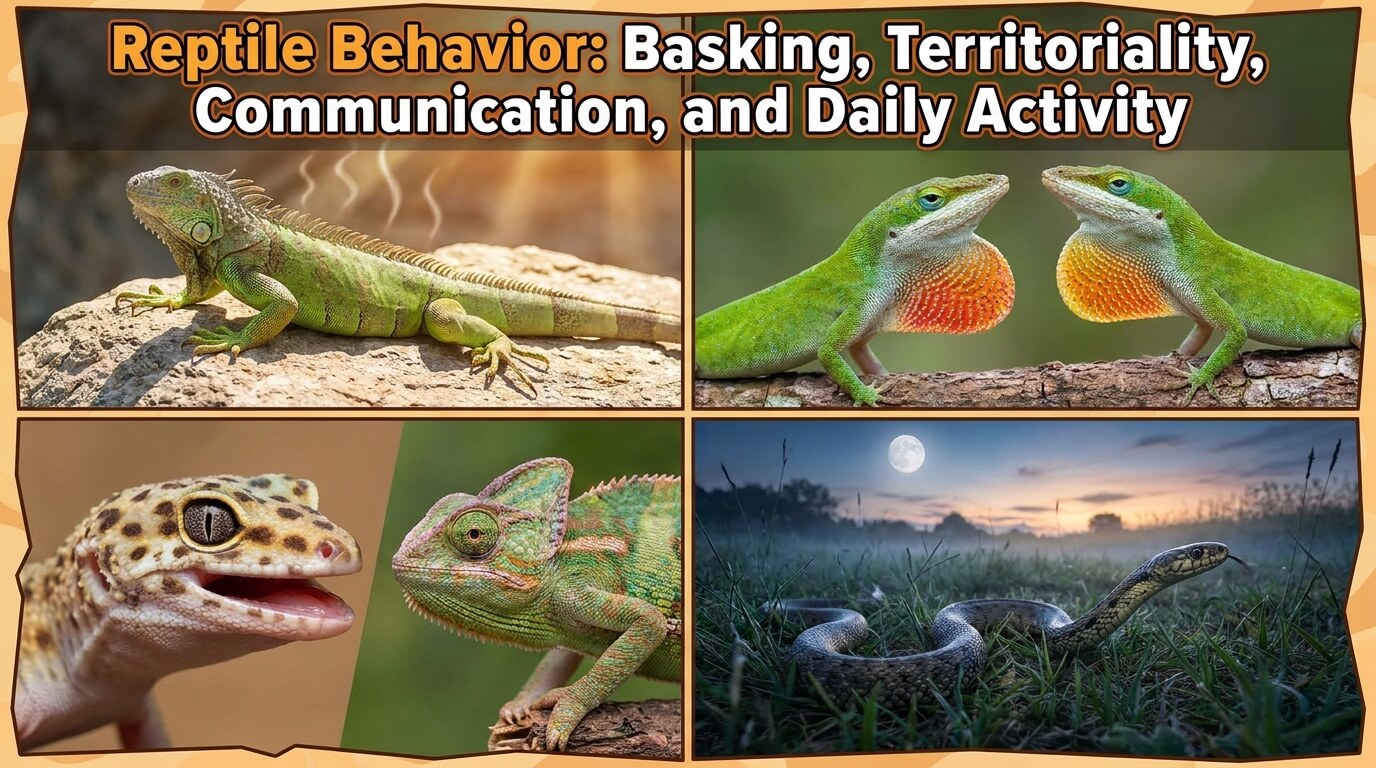
Reptile behavior is far more varied than the familiar image of a lizard sitting motionless on a rock or a snake waiting alone in the grass. Living reptiles adjust when and where they are active, communicate through color, posture, chemicals, sound, and touch, defend or share space in different ways, and change their routines with temperature, rainfall, breeding season, food availability, and predator risk.
There is no single reptile lifestyle. A territorial anole, a nocturnal gecko, a social skink, a nesting alligator, a sea turtle moving through ocean habitat, and a snake using chemical trails can all solve very different behavioral problems. Looking across these examples helps explain why broad labels such as “solitary,” “silent,” or “simple” usually hide more than they reveal.
Quick Answer: Reptile Behavior Is More Diverse Than the Stereotype
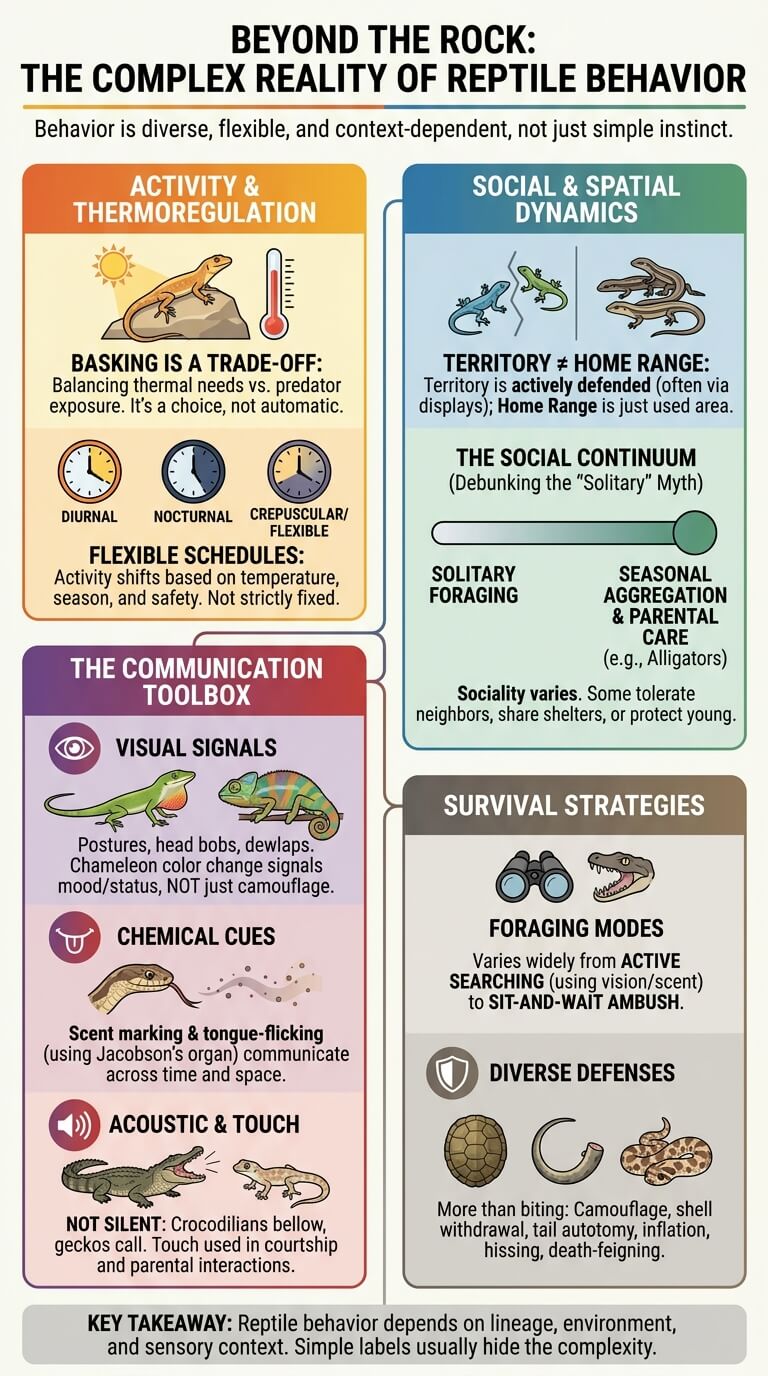
Behavior varies by lineage, habitat, season, age, and context
A reptile’s behavior reflects both its ancestry and the environment in which it lives. Desert species may shift activity to cooler hours, arboreal lizards may rely heavily on visual displays, many squamates use chemical information, and crocodilians can communicate acoustically in ways that are obvious even to human observers. Young animals may also behave differently from adults because they face different predators, food sources, and social pressures.
Even closely related species can differ. Some lizards defend feeding or display sites while others tolerate neighbors. Some snakes spend much of the year dispersed but gather seasonally at shelters or reproductive sites. Some turtles are difficult to observe socially yet still respond to other individuals at feeding, nesting, or basking locations.
Why simple instinct-only descriptions are misleading
Calling reptile behavior “just instinct” is not a useful explanation. Innate responses matter, as they do in other animals, but reptiles also alter behavior with experience and context. Research on lizards includes learning, individual variation, social displays, space use, and stable grouping. That does not mean every reptile has complex social relationships or human-like emotions. It means behavior should be described from evidence rather than from an old assumption that reptiles are behaviorally uniform.
A better question is what information an animal is responding to. Light level, temperature, scent, visual signals, vibration, the presence of a rival, a potential mate, a predator, or a familiar refuge can all change what a reptile does next.
Daily Activity Patterns
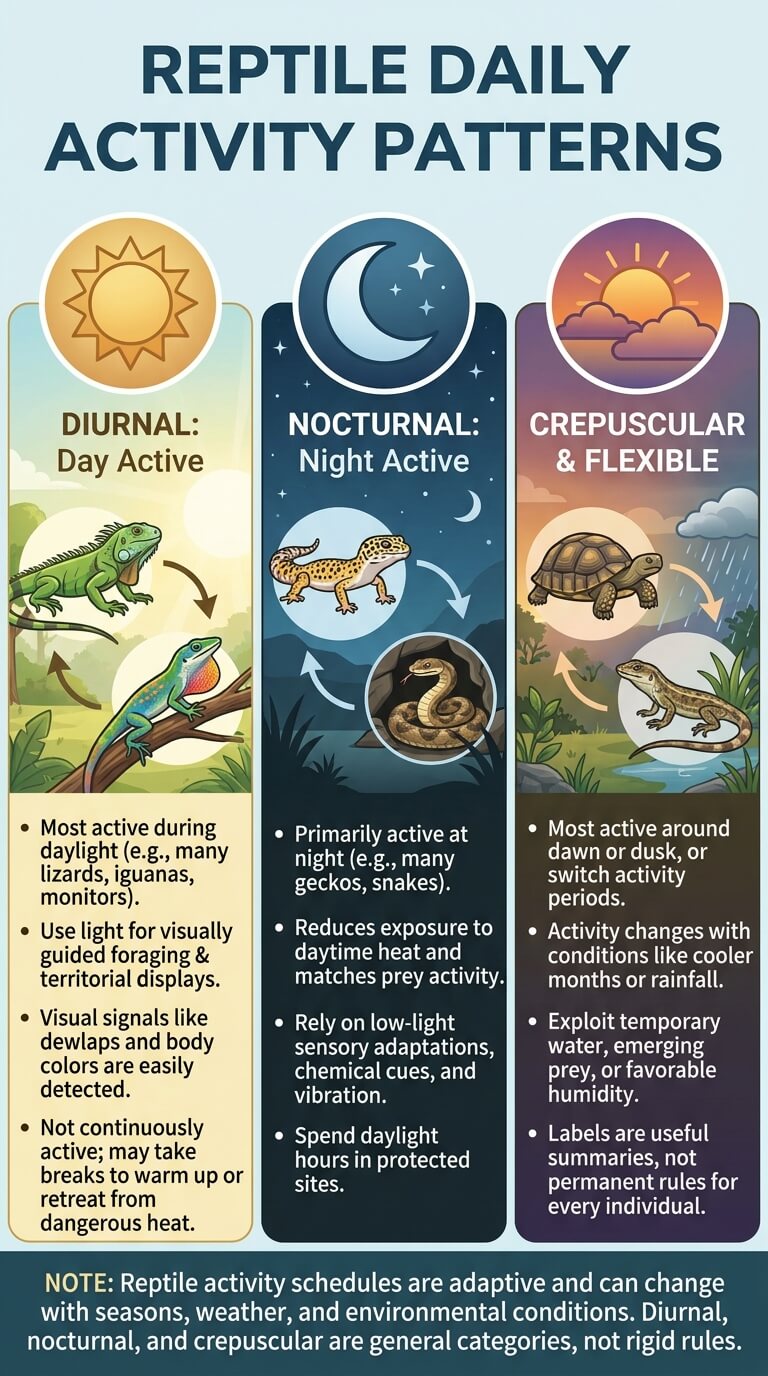
Diurnal reptiles
Diurnal reptiles are most active during daylight. Many anoles, iguanas, monitors, and other lizards use daylight for visually guided foraging, territorial displays, and movement between feeding sites and refuges. Daylight can also make visual signals such as dewlaps, body colors, and postures easier for other individuals to detect.
Being diurnal does not mean being continuously active from sunrise to sunset. A lizard may emerge, warm up, forage, retreat during dangerous heat, and become active again later. The schedule can change across seasons and weather conditions.
Nocturnal reptiles
Many geckos, snakes, and other reptiles are primarily active at night. Nocturnal activity can reduce exposure to daytime heat, match the activity of prey, or take advantage of low-light sensory adaptations. Some nocturnal reptiles spend daylight hours inside crevices, burrows, vegetation, or other protected sites and emerge after temperatures and light levels change.
Night activity is not simply “day behavior in darkness.” The sensory demands differ. Chemical cues, vibration, low-light vision, and familiar routes or shelters may become especially important depending on the species.
Crepuscular and flexible activity schedules
Some reptiles are most active around dawn or dusk, while others switch activity periods as conditions change. A species may behave more diurnally during cooler months and avoid midday activity during hotter periods. Rainfall can also trigger movement in species that exploit temporary water, emerging prey, or favorable humidity.
For this reason, labels such as diurnal, nocturnal, and crepuscular are useful summaries, not permanent rules for every individual on every day.
Basking as Behavior
Choosing exposed sites, postures, and timing
Basking is a behavioral decision about where to place the body and when to remain exposed. A reptile may choose a rock, branch, log, shoreline, road surface, or patch of sunlight that changes its heat gain. Body orientation and posture can change how much solar radiation reaches the animal, while retreating to shade or cover changes the thermal situation again.
That choice has costs as well as benefits. An exposed basking site may improve access to warmth but also make an animal more visible to predators or competitors. Reptiles therefore balance temperature, safety, access to refuge, and disturbance rather than simply “trying to get hot.”
Basking is only one part of temperature management
Visible sun basking is not universal. Nocturnal species, burrow users, forest reptiles, and aquatic reptiles may regulate temperature through shelter choice, timing, warm surfaces, water depth, or movement among microhabitats. The physiology behind ectothermy, digestion, seasonal inactivity, and thermal limits is a separate subject from the behavioral question of where an animal chooses to be.
Territoriality and Home Ranges

Defended spaces versus overlapping ranges
A home range is the area an animal regularly uses, while a territory is an area it actively defends against certain others. The two ideas are not interchangeable. A reptile may move through a broad home range yet defend only a display perch, shelter, nesting area, or feeding patch. Another species may have overlapping ranges with little obvious territorial defense.
Spatial behavior can also differ by sex, season, age, and population density. Males and females may use space differently during the breeding season, and juveniles may occupy different refuges from adults.
Displays, chasing, scent, and boundary cues
Territorial disputes do not always begin with physical fighting. Visual displays can advertise ownership or motivation before contact occurs. Tree lizards, for example, use signals including body coloration, dewlaps, and push-up-like movements in social interactions. The Animal Diversity Web profile for tree lizards describes visual and chemical signaling in this context.
Other reptiles rely more heavily on scent, repeated patrols, direct chases, or combinations of signals. A display can reduce the need for immediate physical contact by giving rivals information about presence, identity, or willingness to escalate.
Why not all reptiles are territorial
Territoriality depends on whether a resource is worth defending and whether defense is practical. Widely scattered prey, seasonal movement, large aquatic areas, or low population density may make permanent defense less useful. Some reptiles therefore show temporary aggression around mates or shelters without maintaining a year-round territory.
Visual Communication

Head bobbing, push-ups, body postures, and dewlaps
Lizards are especially well known for visual displays. Anoles can extend colorful throat fans called dewlaps, while various lizards use head bobs, push-ups, lateral body presentations, tail positions, mouth opening, or changes in body height. These movements can signal during courtship or rivalry, but their meaning depends on species and situation.
The same motion should not be assigned one universal translation. A head bob that functions in territorial advertisement in one species may appear in a different sequence or context in another. Researchers interpret such displays by studying who signals, who receives the signal, what happens before and after it, and whether the pattern is repeated.
Color signaling and chameleon misconceptions
Chameleon color change is a good example of why behavior needs context. Color can contribute to camouflage in some situations, but it can also signal stress, social status, aggression, or reproductive condition. The Smithsonian’s Meller’s chameleon profile specifically notes that color change can function in communication and is not simply a background-matching trick.
Different chameleon species use color differently, and even one individual can change appearance for more than one reason. “Chameleons change color to match anything they sit on” is therefore a misleading summary.
Species and context matter
Visual signals work only when receivers can detect them. Habitat lighting, distance, vegetation, body orientation, and the visual system of the species all matter. Bright structures that are highly visible in open sunlight may function differently in shaded forest. This is one reason reptile communication is best studied as a combination of anatomy, senses, habitat, and behavior.
Chemical Communication
Scent marking and chemical trails
Chemical information can communicate identity, reproductive condition, territory use, or the recent presence of another animal. Some lizards deposit secretions from specialized glands, while snakes and many other squamates investigate chemical traces left on surfaces or in the air.
Chemical signals are especially useful when the sender and receiver are not present at the same moment. A scent mark can remain after an animal has moved away, allowing communication to occur across time as well as space.
Tongue-flicking as information gathering in many squamates
Tongue-flicking helps many snakes and lizards collect chemical particles and deliver them to the vomeronasal, or Jacobson’s, organ. The tongue is therefore part of a sampling system, not a substitute nose. Reptiles can use this information while tracking prey, investigating mates, exploring shelters, or assessing other members of their species.
The importance of tongue-flicking varies across reptiles. It should not be described as the universal way that every reptile “smells,” because turtles, crocodilians, tuatara, and different squamate lineages use sensory systems in different proportions.
Vocal and Acoustic Communication
Crocodilian calls
Crocodilians are not silent ambush machines. Adults can bellow, growl, and use other acoustic signals, while young animals produce calls associated with hatching and contact. The National Park Service alligator sound recording provides a direct example of the low-frequency growling and groaning sounds produced by an American alligator.
Sound is useful in water and dense wetland vegetation where visual contact may be limited. Crocodilian communication also includes posture, touch, water movement, and chemical cues, so vocalization is one part of a larger signaling system.
Gecko and other reptile vocalizations
Geckos provide another clear counterexample to the idea that non-avian reptiles are uniformly quiet. Tokay geckos produce multiple call types, and researchers have examined how their larynx and associated muscles generate sound. A 2024 Journal of Experimental Biology study of tokay gecko vocalization documented distinct alarm-call forms and the mechanics involved in producing them.
Not every gecko is equally vocal, and vocal behavior is less prominent in many other reptiles. The important point is diversity: sound production occurs in several reptile lineages and can serve courtship, alarm, contact, or territorial functions depending on species.
Why reptiles should not be described as uniformly silent
Human hearing also biases what we notice. A reptile may communicate with low-amplitude sounds, substrate vibrations, chemical cues, or visual gestures that people overlook. Absence of an obvious call does not mean absence of communication.
Touch and Close-Range Communication
Courtship and social contact
Close-range interactions can involve nudging, body contact, biting that is ritualized rather than predatory, alignment of bodies, or tactile investigation. These actions are especially relevant during courtship, mating, contests, or group living. The same physical contact can have very different meanings depending on who is interacting and what other signals accompany it.
Tactile communication is harder for people to observe than a bright dewlap or loud bellow, so it can be underappreciated in casual descriptions of reptile behavior.
Parent-offspring interactions in selected lineages
Parental behavior is not universal among reptiles, but selected lineages show striking examples. American alligator hatchlings call from the nest, and females can respond by opening the nest and moving young toward water. The National Park Service account of alligator nesting behavior describes hatchling vocalizations and the mother’s response.
Other reptiles may guard eggs, remain with young for a period, or show little post-laying association. These differences are part of reptile reproductive diversity rather than evidence that one strategy is “better parenting.”
Social Tolerance and Aggregation
Reptiles that are often solitary
Many reptiles do spend much of their active lives alone. Solitary foraging can make sense when food is dispersed, when shelters are limited, or when adults compete strongly with one another. A snake that hunts alone or a territorial lizard that excludes rivals can accurately be described as largely solitary in that context.
What should be avoided is turning that pattern into a definition of reptiles as a whole.
Seasonal aggregations, basking groups, communal sites, and repeated associations
Reptiles may gather because suitable refuges, nest sites, basking sites, water, or winter shelters are concentrated in a small area. Some associations are temporary. Others involve repeated tolerance or family structure. A broad comparative study of squamates found documented social grouping across multiple lizard and snake lineages, including long-lasting parent-offspring associations in some species. The open-access study of social grouping in squamate reptiles shows why sociality cannot be dismissed as absent from reptiles.
Aggregation alone does not prove friendship, cooperation, or a stable social group. Several animals may simply need the same limited refuge. Researchers distinguish these possibilities by tracking repeated associations, kinship, tolerance, shared space, and behavior over time.
Why universal solitude claims fail
“Solitary” is a description of a social pattern, not a measure of intelligence or emotional capacity. A species can forage alone yet communicate during breeding, aggregate seasonally, recognize familiar individuals, or tolerate offspring. Social behavior exists on a continuum rather than as a yes-or-no category.
Foraging Behavior at Overview Depth
Active searching versus ambush
Reptiles find food in different ways. Some actively search through leaf litter, burrows, vegetation, shorelines, or water. Others remain still and wait for prey to move within striking range. Many species combine strategies depending on prey type, season, habitat, and hunger.
Foraging mode affects movement, sensory use, exposure to predators, and energy expenditure. An active-searching monitor lizard faces different behavioral trade-offs from a sit-and-wait ambush predator, even if both may eat animal prey.
Sensory cues and habitat use shape foraging
Vision, chemical cues, vibration, hearing, touch, and in a few snake lineages thermal sensing can all guide feeding behavior. Habitat determines which cues are reliable. A visual hunter on an open branch has a different information environment from a fossorial snake moving through soil or a crocodilian hunting in turbid water.
The important behavioral point is that feeding is not a single reflex. Reptiles decide when to search, when to remain still, which microhabitats to inspect, and when to abandon an unsuccessful patch.
Defensive Behavior
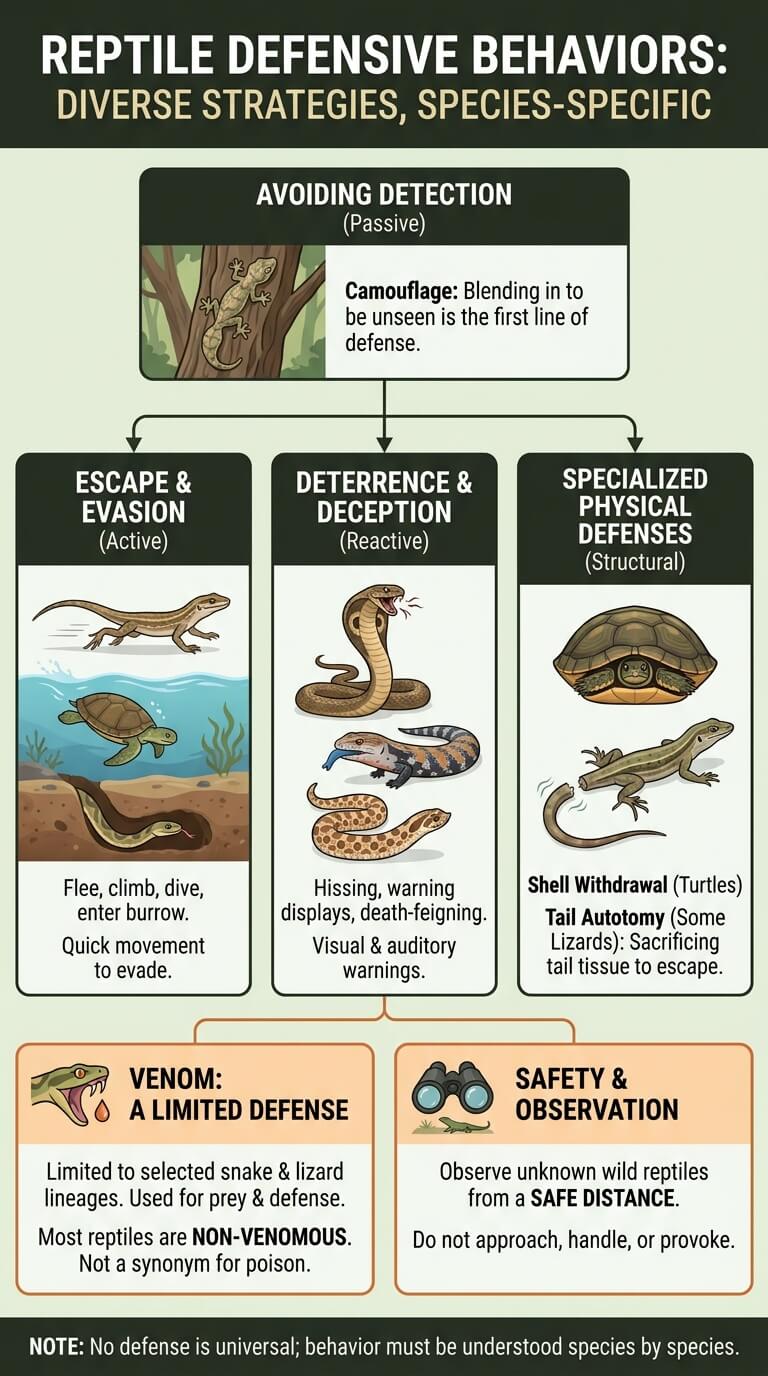
Camouflage, escape, shell withdrawal, tail autotomy, inflation, hissing, musk, displays, and death-feigning
Reptiles use many ways to reduce the chance of being captured. Avoiding detection can be the first defense. If discovered, an animal may freeze, flee, climb, dive, enter a burrow, withdraw into a shell, flatten or inflate the body, hiss, release strong-smelling secretions, display bright warning colors, or feign death. Some lizards can shed part of the tail through autotomy, sacrificing tissue while escaping a predator.
No defense is universal. A turtle cannot use lizard-style tail autotomy, and not every lizard can shed its tail. Defensive behavior must be understood species by species.
Venom is limited to selected reptile lineages
Venom can function in prey capture and defense in selected snakes and lizards, but it should not dominate an overview of reptile behavior. Most reptiles are not venomous, and venom is not a synonym for poison. An unknown wild reptile should be observed from a safe distance rather than approached, handled, or provoked to produce a defensive display.
Seasonal Behavior
Breeding seasons, dormancy, and repeated movements
Reptile routines often change through the year. Seasonal temperature, rainfall, day length, food availability, and reproductive condition can alter activity. Some animals move toward breeding or nesting areas. Others reduce surface activity during cold, drought, or extreme heat and spend longer periods in protected refuges.
Terms such as brumation are sometimes used for cold-season inactivity in reptiles, but species do not enter one identical state. A turtle overwintering underwater, a snake using a communal den, and a lizard sheltering in a burrow may differ greatly in physiology and behavior.
Environmental cues influence timing
Behavioral timing is often shaped by several cues at once. A warm afternoon after a cool period may change basking and movement. Rain can alter prey availability and humidity. Seasonal daylight can coincide with reproductive changes. Because these cues interact, behavior observed in one month may not represent the species all year.
Common Myths and Mistakes
Myth: Reptiles are universally solitary
Many are often solitary, but others aggregate seasonally, share refuges, remain near offspring, form repeated associations, or live in stable groups. The correct description depends on species and context.
Myth: Reptiles are emotionless as an established fact
Science can describe behavior, physiology, learning, stress responses, preferences, and social interactions. It is much harder to map human emotion words directly onto another animal’s subjective experience. Saying that reptiles definitely experience human-style love or jealousy would overreach the evidence, but declaring them “emotionless” is also stronger than the evidence supports.
Myth: Crocodilians are only solitary ambush predators
Ambush feeding is important in crocodilians, but it is not their entire behavioral repertoire. Courtship, bellowing, nest defense, hatchling calls, parental responses, and juvenile groups show that crocodilian behavior includes communication and social interaction as well as predation.
Myth: Chameleons change color mainly to match every background
Background matching can contribute to camouflage in some contexts, but chameleon color change also relates to signaling, stress, reproductive interactions, physiological state, and temperature. The function varies among species and situations.
How Temperature, Senses, Food, and Habitat Shape Behavior
Temperature changes when activity is practical
Because living non-avian reptiles are ectothermic, environmental heat strongly affects when many behaviors are possible or efficient. A reptile may shift between sun and shade, delay foraging, retreat underground, or change its daily schedule. Behavior is therefore one of the main ways reptiles interact with their thermal environment.
Senses determine which signals animals can use
Communication works through sensory systems. Visual displays matter only if another animal can see them, chemical marks require chemoreception, calls require sound detection, and tactile signals require close contact. Differences in sensory biology help explain why one lineage relies on bright visual displays while another relies more heavily on scent or vibration.
Reproduction, feeding, and habitat provide the context
Territoriality may intensify when mates or nesting sites are concentrated. Foraging can alter movement and exposure. Refuge availability can create temporary groups. Habitat structure changes visibility, shelter, and signal transmission. Reptile behavior makes the most sense when these ecological pressures are considered together rather than as isolated “fun facts.”
FAQ
Are reptiles social animals?
Some are, but the answer depends on what “social” means and which species is being discussed. Many reptiles spend much of their time alone, while others form temporary aggregations, tolerate relatives, remain with offspring, share shelters, or maintain repeated social associations. Reptiles range from strongly solitary species to species with surprisingly persistent group structure.
Why do lizards bob their heads?
Head bobbing is a visual signal in many lizards. It can appear during territorial encounters, courtship, recognition, or other social situations. The exact meaning depends on species, the sequence of movements, body posture, coloration, distance between animals, and what happens before and after the display.
Do crocodilians communicate with sounds?
Yes. Crocodilians can produce bellows, growls, grunts, and other sounds. Young crocodilians also vocalize, including around hatching, and adults may respond to those calls. Acoustic signaling is one part of a broader communication system that can also include visual displays, touch, water movement, and chemical information.
Why do some reptiles bask together?
A shared basking site can simply be a good thermal resource, especially when safe sunny surfaces are limited. In some species, individuals tolerate one another at these locations; in others, access may be contested. Seeing several reptiles bask together does not by itself prove a stable social relationship, but repeated associations can be biologically meaningful in some species.
Final Thoughts
Reptile behavior is best understood as a flexible set of responses to temperature, habitat, predators, food, reproduction, sensory information, and other reptiles. Basking, territorial displays, chemical trails, gecko calls, crocodilian bellows, seasonal aggregations, defensive postures, and changing daily schedules all show that living reptiles do much more than sit still and react automatically.
The useful takeaway is not that every reptile is highly social or behaviorally complex in the same way. It is that the group contains many different behavioral strategies. Watching those strategies in context gives a much more accurate picture than the old stereotypes of reptiles as universally solitary, silent, aggressive, or simple.

Ethan Walker is the founder and research editor of Animal Fact Central. He creates and reviews educational animal facts content using trusted wildlife, pet care, and science-based sources. His work focuses on making animal behavior, adaptations, habitats, and species facts clear, accurate, and engaging for everyday readers.
Read More Details About Ethan Walker: https://animalfactcentral.com/ethan-walker/