
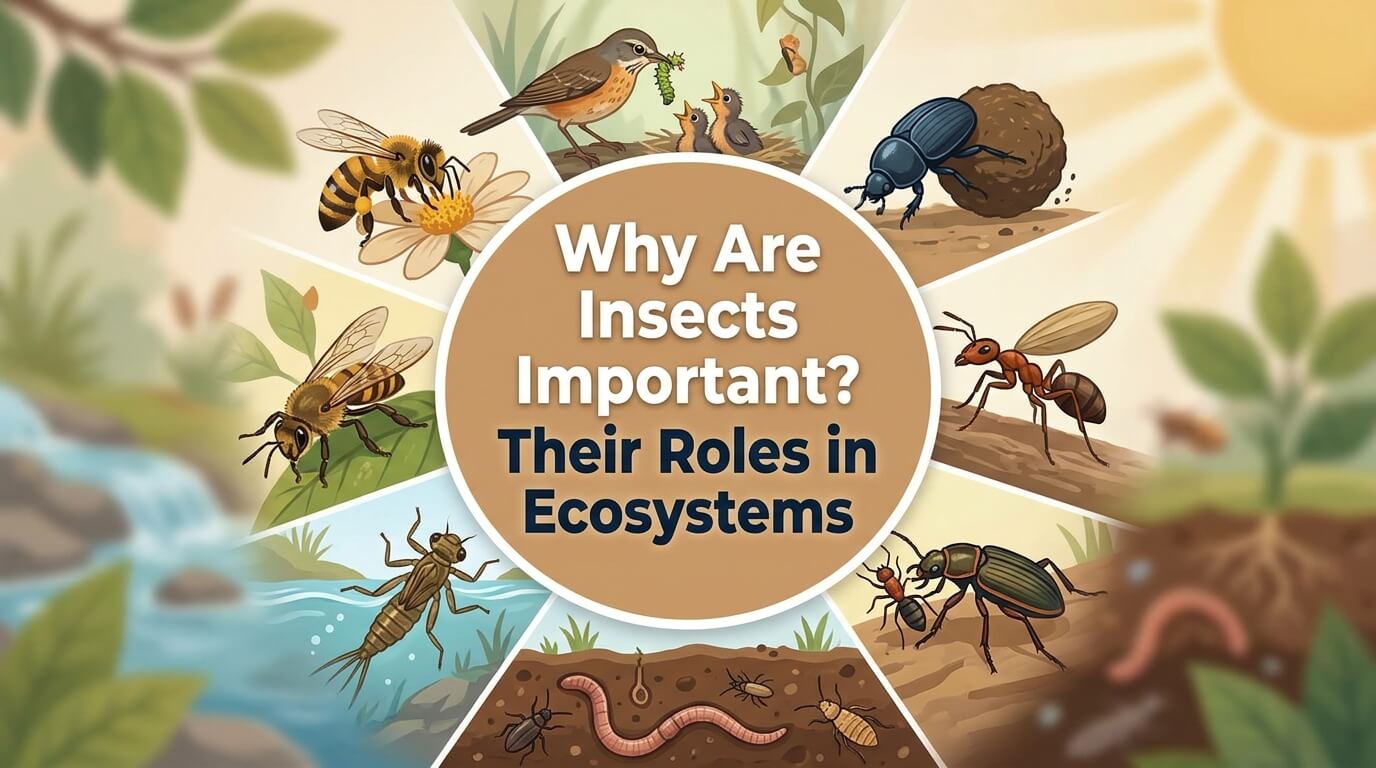
Why are insects important? Because they do far more than pollinate flowers. Across forests, grasslands, deserts, farms, wetlands, streams, and cities, insects move energy through food webs, eat living plants, hunt other animals, develop as parasitoids, process dung and carrion, help break down dead wood and plant material, move nutrients between habitats, and provide food for many other animals. The importance of any one role varies by species and ecosystem, but together these interactions make insects deeply woven into ecological processes.
It is also useful to separate ecological importance from human labels. An insect described as a pest, vector, or nuisance can still be prey for another species or participate in decomposition and nutrient movement. Likewise, an insect called beneficial is not automatically helpful in every place or at every population size. Ecology is about relationships and effects, not a simple list of good and bad insects.
Quick Answer
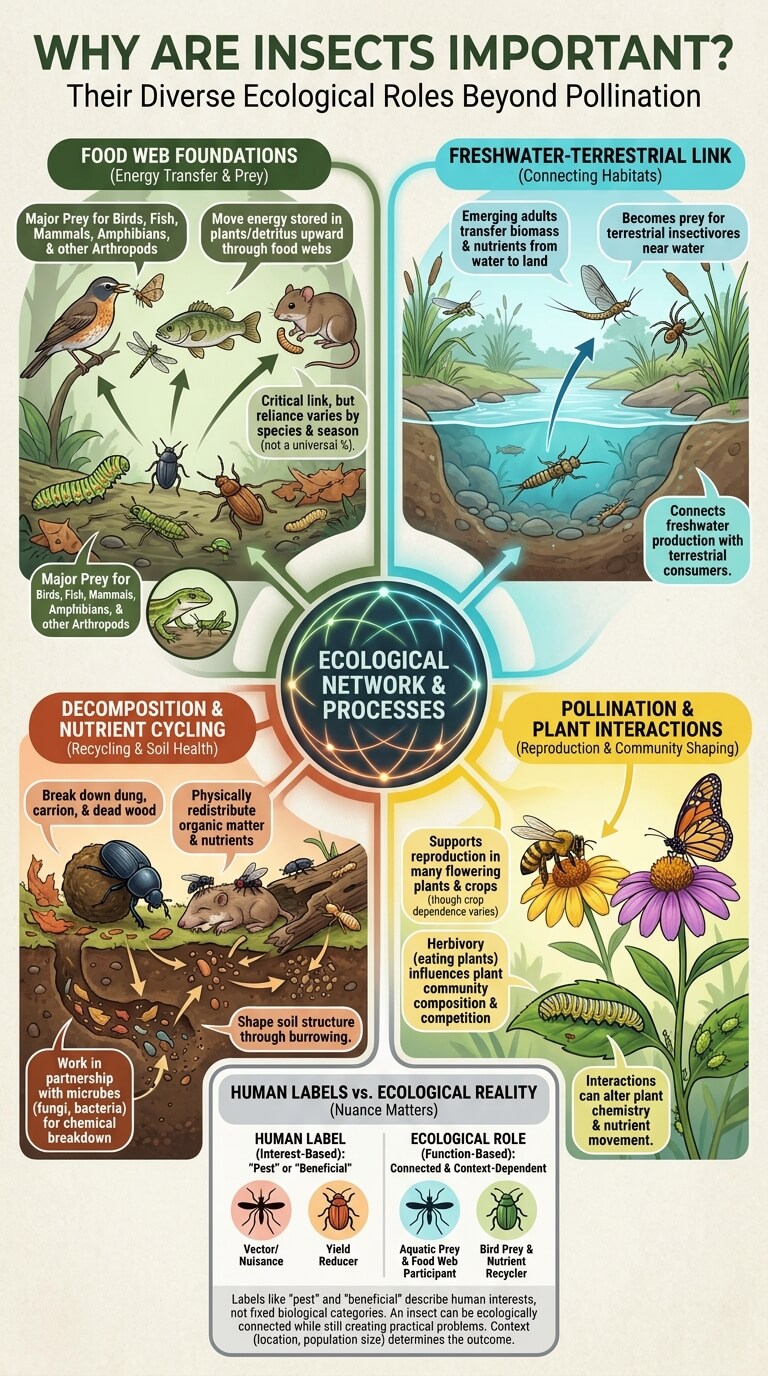
Insects Matter Because They Occupy Many Ecological Roles at Once
An ecosystem works through countless exchanges of food, nutrients, shelter, and biological interactions. Insects participate at many points in that network. A caterpillar may consume leaves and then become food for a bird. A dung beetle may move animal waste into soil. A caddisfly larva may process material in a stream and later emerge as a winged adult that is eaten by a spider or bat near the bank. A parasitoid wasp may develop in a herbivorous insect, linking plant consumption to another trophic level.
This is why asking whether insects are important has a broader answer than asking whether a particular insect is useful to people. Insects can function as herbivores, predators, prey, pollinators, scavengers, decomposer-associated consumers, seed movers, fungal feeders, and hosts or parasites. The Smithsonian’s National Museum of Natural History summarizes this breadth by noting that insects can pollinate flowers, feed other animals, and help process waste.
Why “Beneficial” and “Pest” Are Incomplete Ecological Labels
Words such as beneficial and pest describe human interests. A crop-feeding insect may reduce a farmer’s yield, yet that same species may be prey for birds, spiders, or parasitoids. A mosquito near people can matter as a vector in some disease systems, while mosquitoes also occupy aquatic and terrestrial food webs. A predatory insect may be helpful in one agricultural setting but may also consume non-target prey.
None of this means human harms should be ignored. It means ecological roles and human consequences are different questions. An insect can be ecologically connected and still create serious agricultural, veterinary, or public-health problems. Conversely, calling an insect helpful does not mean its population should be increased without considering local conditions.
Insects in Food Webs
Insects as Prey for Birds, Fish, Amphibians, Reptiles, Mammals, and Other Arthropods
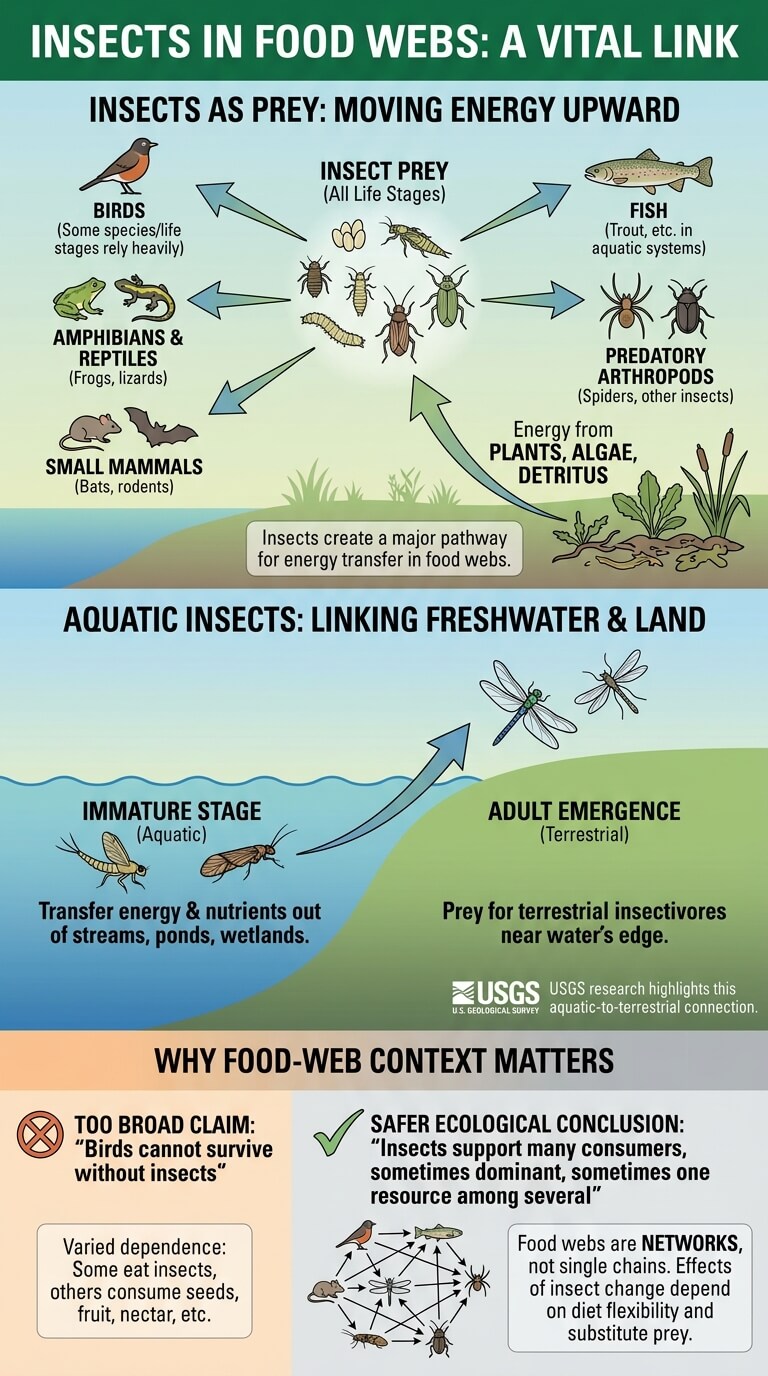
Many insects are consumers, but they are also consumed. Depending on habitat and life stage, insect eggs, larvae, nymphs, pupae, and adults can be eaten by fish, birds, frogs and salamanders, lizards, small mammals, bats, spiders, predatory insects, and other animals. This creates a major pathway by which energy stored in plants, algae, detritus, or smaller prey moves upward through food webs.
The strength of that dependence varies. Some predators specialize heavily on particular insect prey, while others switch among insects and non-insect foods. A trout in one stream may rely strongly on aquatic insects at certain times of year, while a generalist bird may change its diet as prey availability changes. It is therefore better to describe insects as important components of many food webs than to apply one universal dependency percentage to all birds, fish, or other insect-eating animals.
Aquatic Insects Can Link Freshwater and Land
Many mayflies, stoneflies, caddisflies, midges, mosquitoes, dragonflies, and other insects spend an immature stage in freshwater and later emerge into the air or onto land. That life-cycle transition can move energy and nutrients out of streams, rivers, ponds, and wetlands. The U.S. Geological Survey describes emerging aquatic insects as an important connection between freshwater production and terrestrial consumers near the water’s edge.
USGS research on aquatic-to-terrestrial food-web connections explains that emerging insects can transfer energy and nutrients from water to land, where they become prey for terrestrial insectivores. The exact magnitude depends on the water body, insect community, season, surrounding habitat, and predator community.
Why Food-Web Claims Need Local Context
Statements such as “birds cannot survive without insects” are too broad. Some bird species and life stages rely heavily on insects, while others consume seeds, fruit, fish, nectar, vertebrate prey, or mixtures of foods. Similar variation occurs among fish, amphibians, reptiles, and mammals. The safer ecological conclusion is that insects support many consumers, sometimes as dominant prey and sometimes as one resource among several.
This context also matters when insect abundance changes. A drop in one prey group may trigger diet switching, reduced growth, altered breeding success, or little detectable effect, depending on the consumer and whether substitute prey are available. Food webs are networks, not single chains.
Pollination Is One Major Role
Insect Pollination Supports Reproduction in Many Flowering Plants
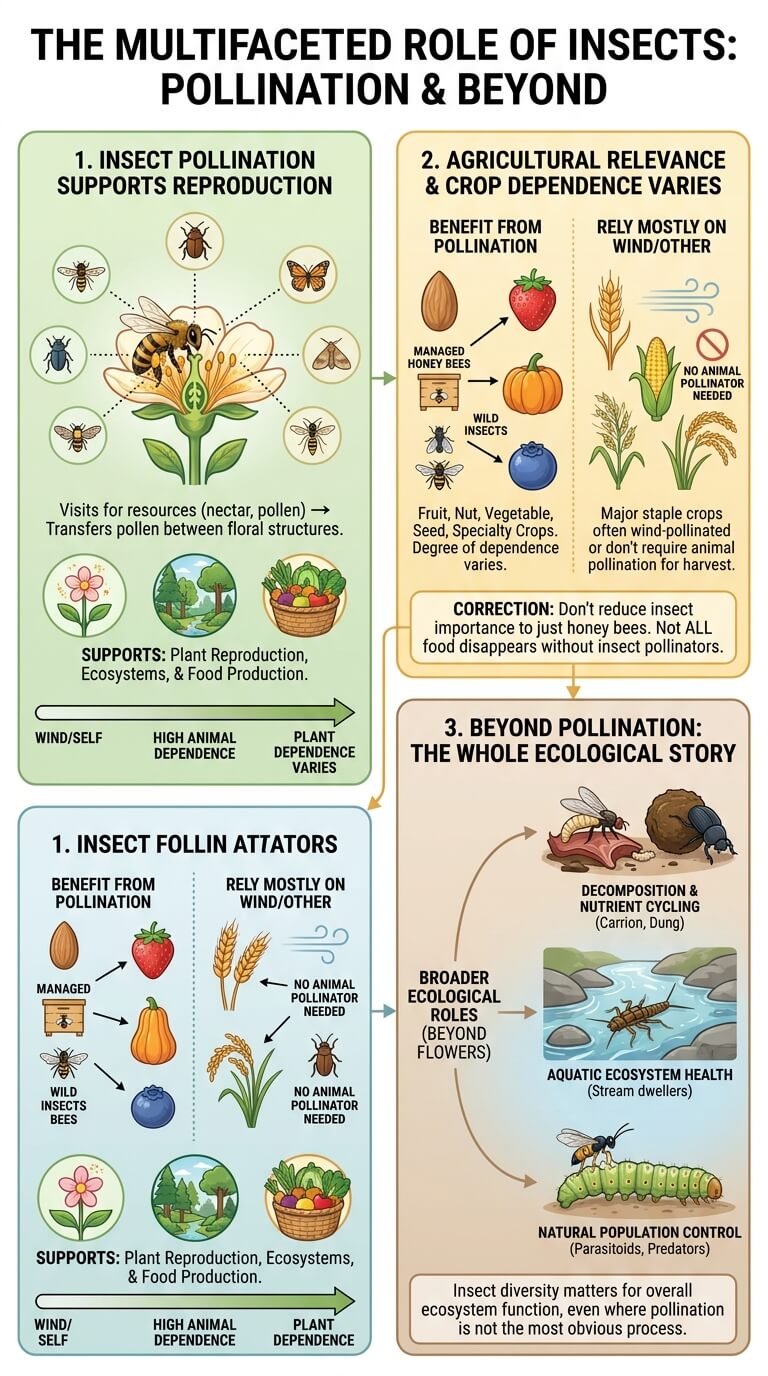
When an insect visits flowers for nectar, pollen, oils, scents, or other resources, pollen can be transferred between floral structures. Bees are famous pollinators, but flies, beetles, butterflies, moths, wasps, and other insects can also carry pollen. The ecological importance of insect pollination varies among plant species because plants differ in how much they depend on animals, wind, self-pollination, or combinations of mechanisms.
The USDA Climate Hubs overview of pollinators emphasizes that animal and insect pollinators support plant reproduction, ecosystems, and food production. Rather than treating one crop percentage as a universal measure of insect value, it is more accurate to ask which plants are being pollinated, by which animals, and how much their reproduction changes when pollinator visitation changes.
Agricultural Relevance Is Real but Crop Dependence Varies
Many fruit, nut, vegetable, seed, and specialty crops benefit from animal pollination, while other major crops rely mostly on wind or do not require animal pollinators for the harvested product. Even among pollinator-dependent crops, the degree of dependence can vary. Managed honey bees can be important in agriculture, but wild bees, flies, beetles, moths, and other insects may also contribute in particular crops and landscapes.
This distinction prevents two opposite mistakes. One is to reduce insect importance to honey bees. The other is to imply that all human food disappears if insect pollinators decline. Pollination is a major ecological and agricultural function, but it is only one part of what insects do.
Pollination Is Important, but It Is Not the Whole Story
A flower-visiting bee is performing a very visible ecological role, yet an inconspicuous fly larva in carrion, a beetle tunneling through dung, a stonefly nymph in a stream, or a tiny parasitoid wasp can be just as informative about the breadth of insect ecology. Looking beyond flowers helps explain why insect diversity matters even in ecosystems where pollination is not the most obvious process.
Herbivory and Plant Communities
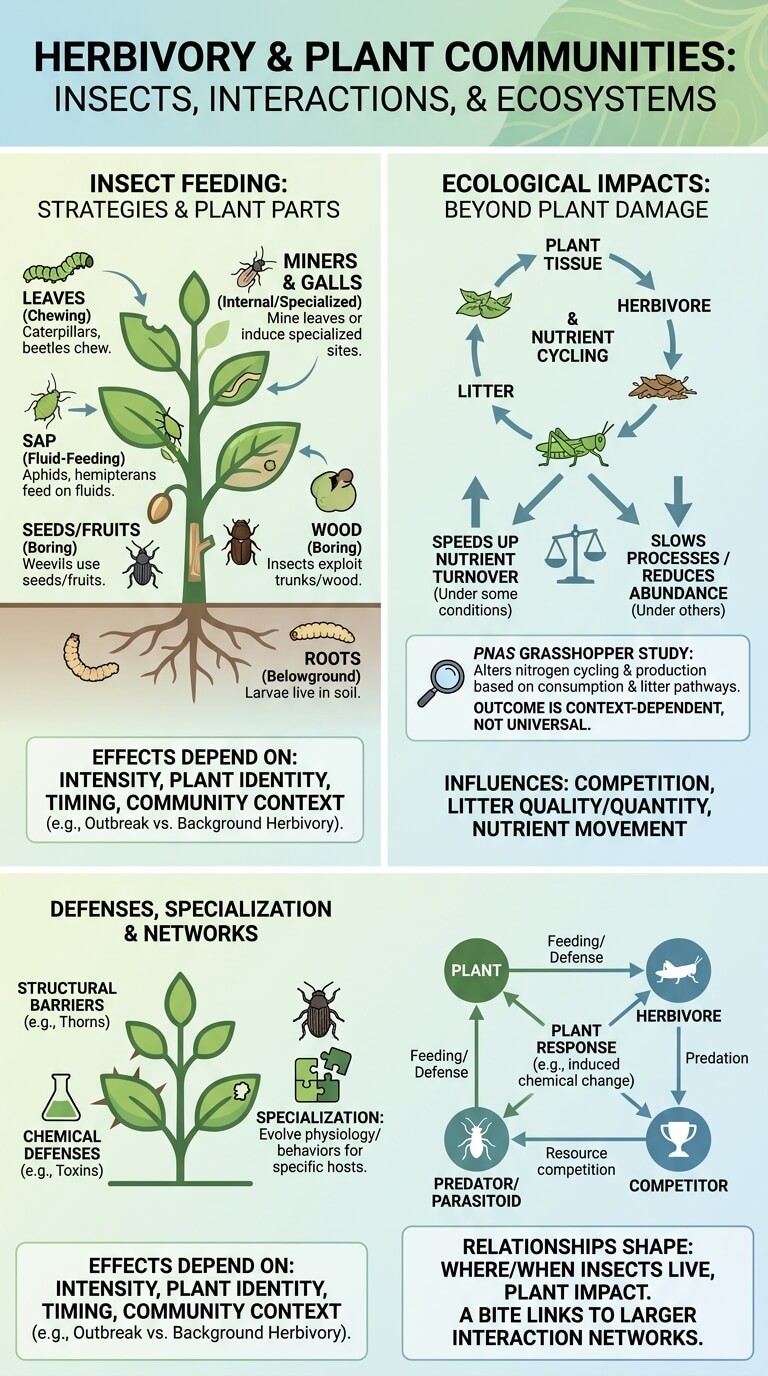
Insects Eat Leaves, Sap, Seeds, Roots, Wood, and Other Plant Tissues
Plant-feeding insects use almost every part of a plant. Caterpillars and beetles may chew leaves. Aphids and other hemipterans can feed on plant fluids. Weevils may use seeds or fruits. Root-feeding larvae live belowground. Bark and wood-associated insects exploit stems, trunks, or dead woody material. Some insects mine inside leaves, while others induce galls that create specialized feeding sites.
These feeding activities can reduce plant growth or reproduction, but ecological effects depend on intensity, plant identity, timing, and the surrounding community. Low or background herbivory is not the same as a severe outbreak. Likewise, the consequences of feeding on a dominant grass can differ from feeding on a rare tree seedling.
Herbivory Is More Than Plant Damage
By removing plant tissue selectively, insects can influence competition among plant species, the quantity and chemistry of litter, and the movement of nutrients through an ecosystem. In a long-term grassland experiment, researchers found that grasshopper herbivory could alter nitrogen cycling and plant production, but the direction and magnitude depended on how feeding changed consumption and litter pathways.
The PNAS study of grasshopper herbivory and nutrient cycling is a useful reminder that herbivory does not have one universal effect. Under some conditions it can speed nutrient turnover, while under others consumption can reduce plant abundance or slow processes. Ecological outcomes depend on context.
Plant Defenses and Insect Specialization Shape Each Other
Plants are not passive food. They can use structural barriers and defensive chemistry, while insects may evolve behaviors or physiology that allow them to use particular hosts. Some herbivores feed on many plant families; others are tightly associated with a narrow set of hosts. These relationships influence where insects can live, when they are active, and which plants they affect most strongly.
Herbivory can also change plant chemistry or trigger defenses that alter later feeding. In turn, those plant responses may influence predators, parasitoids, and competitors of the herbivore. A bite taken from a leaf can therefore become part of a larger interaction network.
Predators and Parasitoids
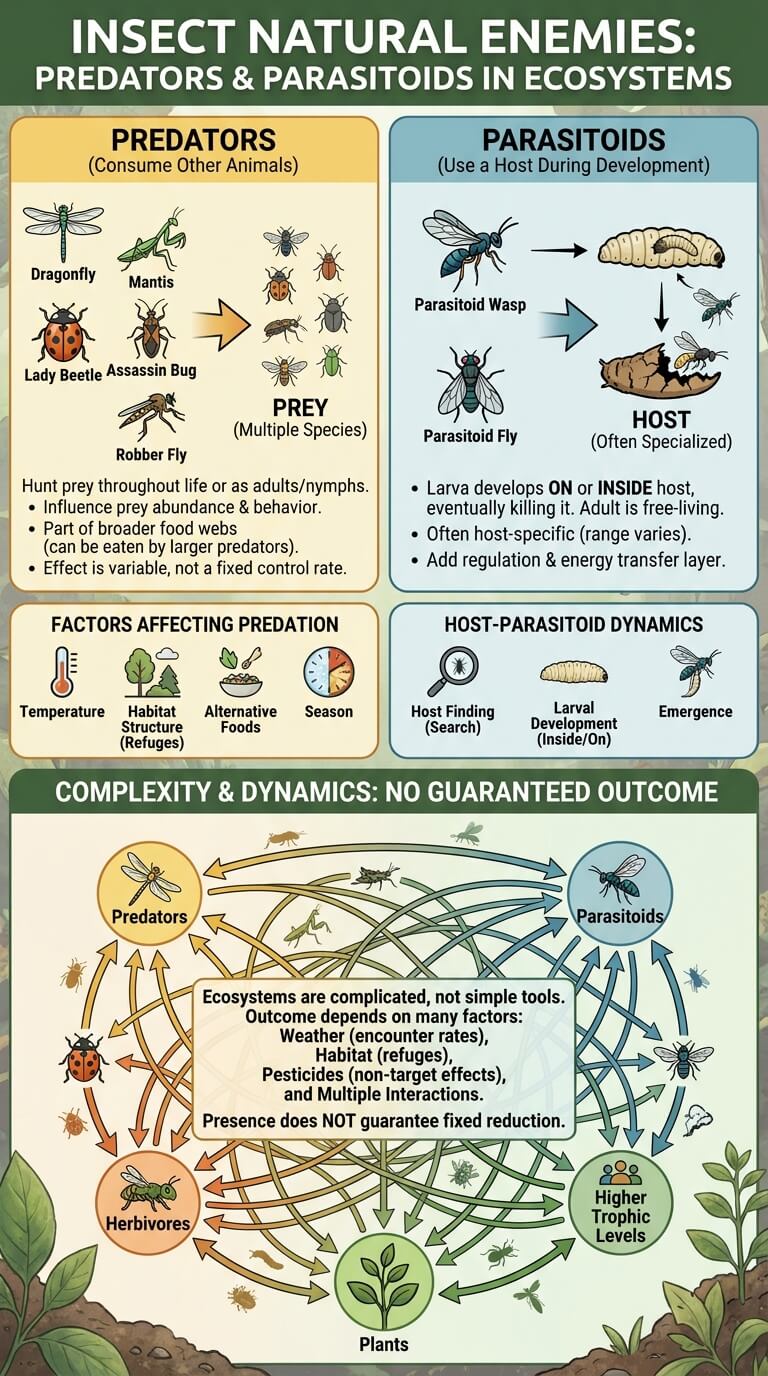
Predatory Insects Consume Other Animals
Dragonfly nymphs and adults, mantises, predatory beetles, lacewing larvae, assassin bugs, robber flies, and many other insects hunt animal prey. Predators can influence prey abundance and behavior, and they may themselves be eaten by larger predators. Their effects are therefore part of food-web dynamics rather than a simple one-way service.
Predatory insects are often discussed because some consume species considered agricultural pests. That can be valuable, but it should not be translated into a universal control rate. Predator abundance, prey choice, temperature, habitat structure, season, and alternative foods all affect what happens in a real ecosystem.
Parasitoids Use a Host During Development
Parasitoids differ from ordinary predators. A parasitoid larva typically develops on or inside a host and eventually kills that host, while the adult is free-living. Many parasitoids are wasps, and some are flies. They can be highly specialized, although host range varies among species.
The University of Minnesota Extension’s explanation of parasitoid wasp biology describes how adults search for suitable hosts and how the developing young use those hosts. In natural communities, these relationships add another layer of regulation and energy transfer between herbivores, predators, plants, and higher trophic levels.
Natural Enemies Do Not Produce One Guaranteed Outcome
It is tempting to describe lady beetles, mantises, or parasitoid wasps as automatic pest-control tools, but ecosystems are more complicated. A predator can eat multiple prey species. A parasitoid may track one host closely. Weather can change encounter rates. Habitat can provide refuges. Pesticides can affect both target and non-target insects. The presence of a natural enemy does not guarantee a fixed reduction in another population.
Decomposition and Recycling
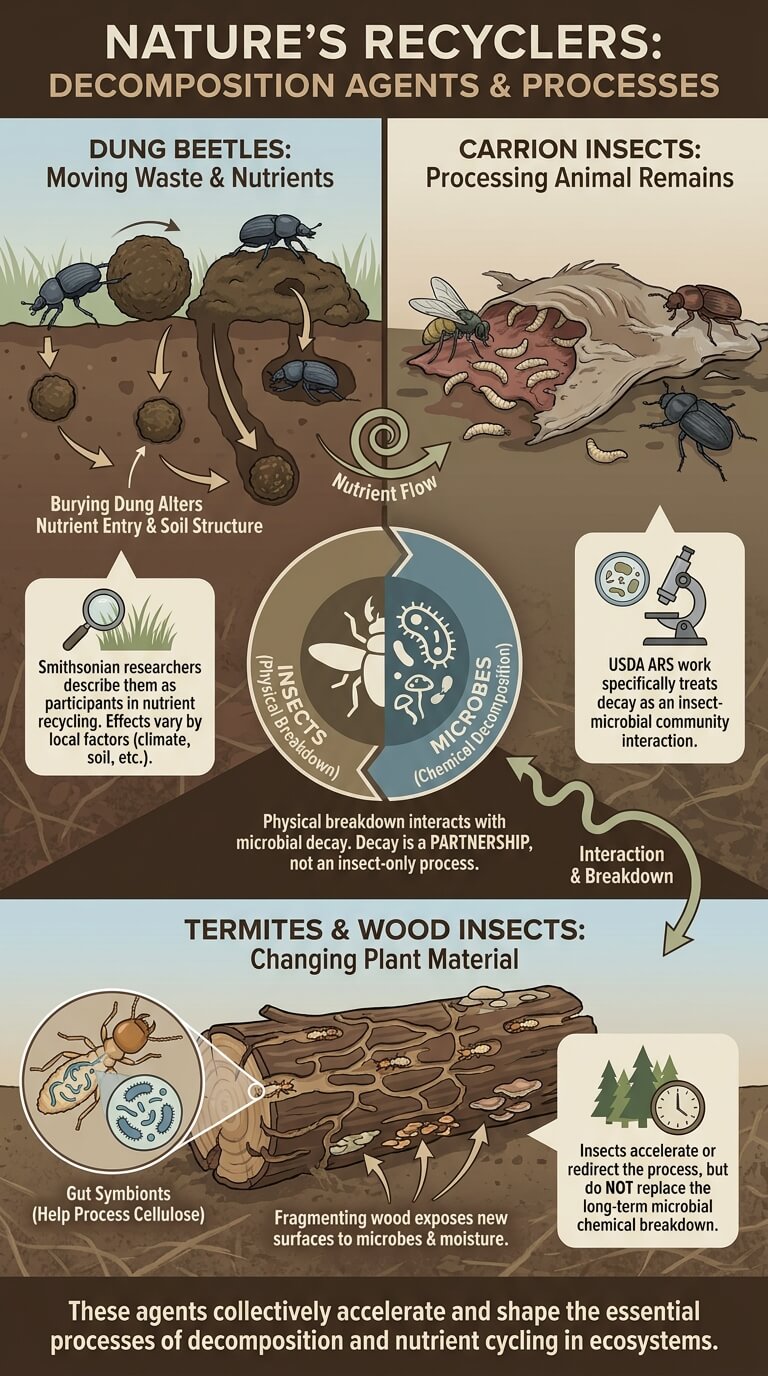
Dung Beetles Move Waste Into New Places
Many dung beetles feed on animal feces and use dung in reproduction. Depending on the species, beetles may tunnel below a dung pat, roll portions away, or live within the material. By moving and burying dung, they alter where organic matter and nutrients enter the soil and can change soil structure around those deposits.
Smithsonian researchers studying Great Plains grasslands describe dung beetles and other invertebrates as participants in nutrient recycling. Their work on invertebrates and nutrient cycling highlights how dung processing, herbivory, and belowground interactions can affect nutrient movement. The size of those effects varies with beetle community, soil, grazing system, climate, and other local factors.
Carrion Beetles and Fly Larvae Help Process Animal Remains
Dead animals create concentrated, short-lived nutrient patches. Blow flies and other carrion-associated flies can arrive quickly, while carrion beetles and many other organisms join at different stages. Their feeding and movement physically break down tissues, redistribute material, and create conditions that interact with microbial decomposition.
That partnership matters because decomposition is not an insect-only process. Bacteria, fungi, vertebrate scavengers, other invertebrates, soil conditions, moisture, and temperature all contribute. USDA Agricultural Research Service work on microbial interactions during carrion decomposition specifically treats decay as an interaction between insects and microbial communities rather than crediting either group alone.
Termites and Wood-Associated Insects Change Dead Plant Material
Termites, wood-boring beetles, bark-associated insects, and other invertebrates can fragment, tunnel through, consume, or redistribute dead plant material. Their activity changes the physical structure of wood and exposes new surfaces to microbes and moisture. In termites, gut symbionts help process cellulose-rich foods, so wood breakdown is partly a partnership between the insect and its microbial community.
In forests, decomposition of wood is a long process involving fungi, bacteria, insects, other animals, moisture, and temperature. Insects can accelerate or redirect parts of that process, but they do not replace the microbial communities responsible for much of the chemical breakdown of complex plant material.
Soil, Nutrient Cycling, and Physical Habitat Change
Burrowing and Feeding Can Move Organic Matter Through Soil
Insects that dig, tunnel, bury food, build nests, or move dung can physically rearrange soil and organic matter. Ants, termites, dung beetles, ground-nesting bees, burrowing wasps, and many larvae create spaces that may alter aeration, water movement, root access, or the distribution of nutrients. The effect is highly dependent on soil type, species, abundance, and climate.
This kind of physical modification is sometimes called ecosystem engineering when an organism changes habitat structure in a way that affects other organisms. The term can be useful for insects such as termites or dung beetles in well-documented systems, but it should not be applied automatically to every insect that touches soil.
Nutrients Move Through Bodies, Waste, and Dead Material
An insect can move nutrients simply by eating in one place and excreting, dying, or being eaten somewhere else. Herbivorous insects transfer plant-derived nutrients into animal tissue. Predators transfer those nutrients again. Dung and carcasses return nutrients to decomposer pathways. Aquatic insects can transport material from water to land during emergence.
These pathways show why nutrient cycling is not a single job performed by a single group. Insects are participants in cycles that also involve plants, microbes, vertebrates, water, soil chemistry, and physical disturbance.
Seeds, Fungi, and Other Plant-Microbe Interactions
Insects Can Consume, Move, or Occasionally Disperse Seeds
Seed-eating insects can reduce the number of seeds available for germination, which may influence plant recruitment. Other insect interactions can move seeds. Ant-mediated seed dispersal is a well-known example in some plant communities, while dung beetles can relocate seeds that are already contained in mammal dung. Whether movement helps or harms germination depends on seed species, burial depth, destination, and other conditions.
Fungi Can Be Food, Partners, or Habitat Components
Many insects feed on fungi, while some maintain close associations with particular fungi. Certain ants and termites cultivate fungal food in nests, and some wood-boring beetles transport fungal partners to plant tissues where the fungi help condition or provide food. Other insects simply graze fungal spores or fruiting bodies.
These relationships show that insect ecology often spans more than plant-animal interactions. Fungi and microbes can shape insect nutrition, habitat quality, digestion, disease, and decomposition, while insects can move fungal material between locations.
Movement Does Not Make an Insect “Good” or “Bad”
An insect can move pollen, spores, microbes, seeds, pathogens, or bits of organic matter. The consequences can be positive for one organism and negative for another. A beetle that carries fungal spores may help a symbiotic fungus spread, while a different beetle-fungus association can damage trees. The ecological action is transport; the human judgment depends on what is being moved and where.
Insects in Freshwater Ecosystems
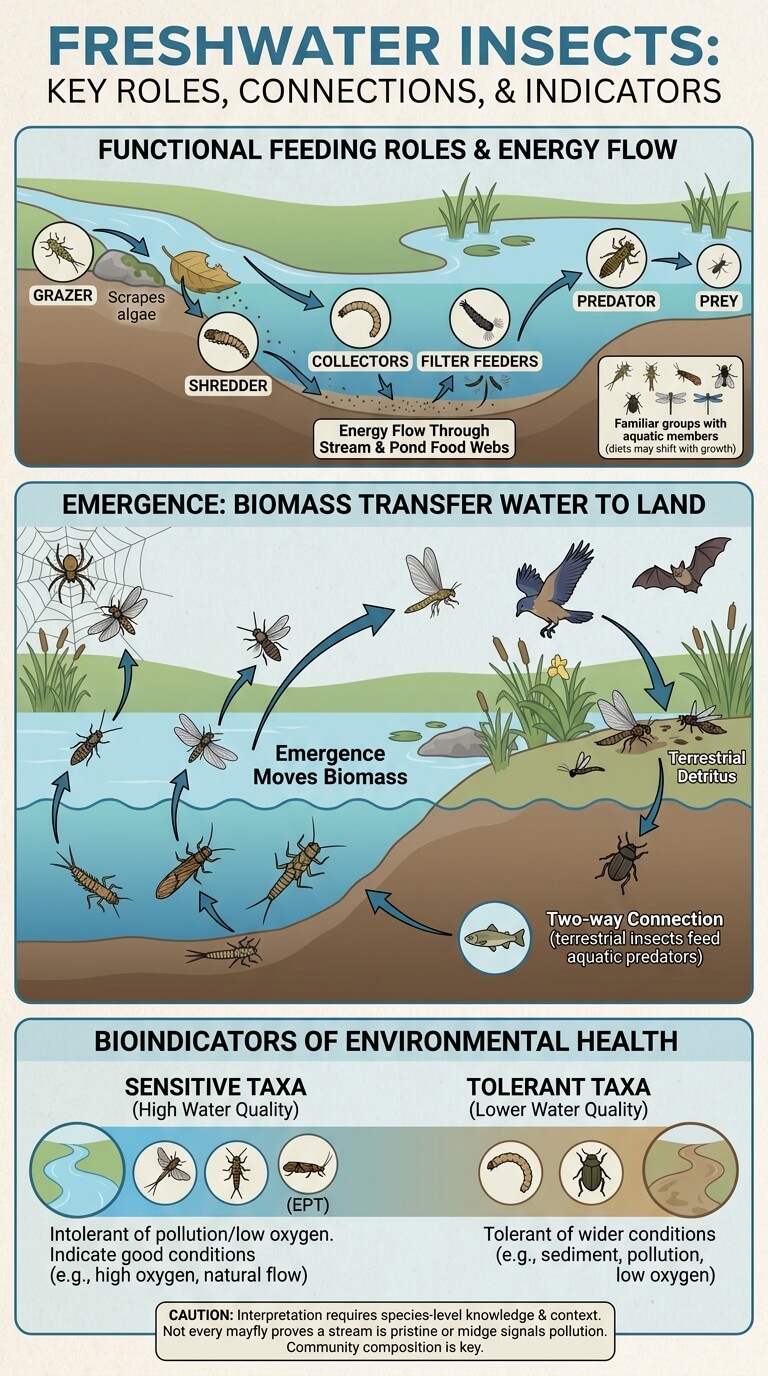
Grazers, Shredders, Collectors, Filter Feeders, Predators, and Prey
Freshwater insects occupy many feeding roles. Some scrape algae from surfaces. Some shred leaves and other coarse plant material. Some gather fine particles. Others filter suspended material from water, prey on smaller animals, or switch diets as they grow. These functional roles help move energy through stream and pond food webs.
Mayflies, stoneflies, caddisflies, true flies, beetles, dragonflies, and damselflies are among the familiar insect groups with aquatic members. Not every member of these orders is aquatic in the same way, and many species leave the water as adults.
Emergence Moves Biomass From Water to Land
When aquatic immatures transform into winged adults and leave the water, they carry biomass into riparian and terrestrial habitats. Spiders, birds, bats, and other predators can capture those adults. Some emerging insects die without being eaten and enter terrestrial detrital pathways. The result is a two-way connection because terrestrial insects can also fall into water and feed fish and other aquatic predators.
Aquatic Insects Can Reflect Environmental Conditions
Because different aquatic insect groups vary in tolerance to temperature, oxygen conditions, pollution, sediment, flow, and habitat change, community composition can provide useful information about freshwater environments. That does not mean every mayfly proves a stream is pristine or every midge signals pollution. Interpretation requires species-level or group-level knowledge, standardized sampling, and environmental context.
Human Labels Versus Ecological Roles
Helpful, Harmful, Pest, Vector, and Beneficial Depend on Context
A mosquito can be an important vector in one public-health context, a larval consumer in a wetland, and prey for another animal. A crop herbivore can be economically damaging while still participating in nutrient cycling and food webs. A parasitoid wasp can suppress an agricultural pest but also be part of a much broader host-parasitoid community.
This is why ecological descriptions should not erase human consequences, and human consequences should not erase ecology. Both can be true at the same time. The useful question is usually more specific: What does this species do in this place, at this life stage, at this abundance, and in relation to which other organisms?
Ecological Importance Does Not Mean Maximizing Every Insect Population Near People
Recognizing that insects are ecologically important does not require tolerating unsafe conditions around homes, hospitals, livestock facilities, or food systems. Mosquito vectors, termites in structures, stinging insects near high-traffic areas, and invasive agricultural pests can require management. Ecological literacy helps management become more targeted by distinguishing a real conflict from the assumption that every insect is a threat.
Common Ecology Myths
Are Insects Important Only Because of Pollination?
No. Pollination is highly visible and important, but insects also function as prey, herbivores, predators, parasitoids, dung processors, carrion consumers, wood-associated decomposer partners, freshwater consumers, seed movers, and participants in nutrient cycling. In many habitats, some of those roles can be more locally important than pollination.
Are All Insects Beneficial?
No. “Beneficial” is usually a human-use label, not a biological category for all insects. Some species damage crops, spread pathogens, infest stored products, harm forests, or conflict with people in other ways. The same species may still have ecological relationships with predators, parasites, plants, or decomposers. Ecological connection does not cancel practical harm.
Do Insects Decompose Dead Material by Themselves?
No. Insects can consume, fragment, bury, tunnel through, and redistribute dung, carrion, wood, and litter, but microbes are essential decomposers in most systems. Fungi and bacteria carry out much of the biochemical breakdown that releases compounds from dead material. Vertebrate scavengers and other invertebrates may also participate.
Ecological Roles Change With Food, Habitat, and Population Size
Diet Determines What Material Enters an Insect’s Food Web
Herbivores move plant material into animal food webs. Predators move nutrients from prey into their own bodies. Dung feeders and carrion feeders tap short-lived resources. Nectar and pollen feeders interact with flowers. These feeding choices explain why diet is inseparable from ecological function, even though the question of exactly what insects eat deserves its own detailed treatment.
Habitat Determines Which Interactions Are Possible
A desert beetle, a forest caterpillar, an urban ant, and a caddisfly larva experience very different physical conditions and food webs. Habitat determines which plants, prey, predators, microbes, and environmental challenges are present. The same broad role, such as herbivory or predation, can therefore look different across forests, grasslands, wetlands, streams, and cities.
Pollination Is Best Understood as One Specialized Interaction
Pollination deserves detailed treatment because it involves plant reproduction, floral biology, animal behavior, and agriculture. Within the broader ecological picture, however, it is one interaction among many. Keeping that perspective prevents bees and butterflies from standing in for all insects.
Population Change Can Alter Ecological Effects
If an insect population declines, increases, shifts its seasonal timing, or moves into a new range, its ecological effects can change too. But those effects are not predictable from insect abundance alone. Researchers need to know which taxon changed, where, during what period, and which food-web or ecosystem process is being measured. That is why evidence about insect population trends requires careful interpretation rather than a single global storyline.
FAQ
What Would Happen if Insect Numbers Declined in an Ecosystem?
The outcome would depend on which insects declined and what they were doing. A drop in a dominant aquatic prey species could reduce food available to fish or riparian predators. Loss of a specialist pollinator could reduce reproduction in a plant that depends on it. Fewer dung processors could change how quickly waste is buried and nutrients move into soil. Other species might partly compensate, or they might not. Ecologists therefore look at community composition and function, not insect numbers alone.
Which Animals Depend on Insects for Food?
Many fish, amphibians, reptiles, birds, mammals, spiders, and other arthropods eat insects. Dependence varies greatly by species, season, habitat, and life stage. Some consumers specialize strongly on insects, while others include insects in a broader diet. It is usually more accurate to identify the particular predator and ecosystem than to apply one percentage across entire animal groups.
How Do Insects Help Decomposition?
Insects can chew, fragment, tunnel through, bury, and consume dead organic material. Dung beetles move feces into soil, carrion flies and beetles process animal remains, and termites and wood-associated insects alter dead plant material. Their activity changes access for microbes and redistributes nutrients, but bacteria and fungi remain essential partners in decomposition.
Are Mosquitoes Ecologically Important?
Mosquitoes participate in ecosystems as aquatic larvae and terrestrial adults, and they can be prey for other animals. Some adults visit flowers and obtain plant sugars, while females of many species also take blood meals. At the same time, certain mosquito species can transmit pathogens that cause serious human or animal disease. Ecological participation does not make that health risk unimportant, and health questions should be handled separately with current public-health guidance.
Final Thoughts
Why are insects important? Their importance comes from the enormous variety of roles they perform, not from one headline service. Insects move energy through food webs, shape plant communities, pollinate flowers, hunt prey, develop as parasitoids, process dung and carrion, interact with fungi and microbes, influence soils, and connect freshwater with land. Those roles differ among species and places, which is exactly why simple labels such as pest, beneficial, or pollinator never tell the whole story. Understanding insects ecologically means looking at what each population is doing, what it interacts with, and how those interactions fit into the larger system.

Ethan Walker is the founder and research editor of Animal Fact Central. He creates and reviews educational animal facts content using trusted wildlife, pet care, and science-based sources. His work focuses on making animal behavior, adaptations, habitats, and species facts clear, accurate, and engaging for everyday readers.
Read More Details About Ethan Walker: https://animalfactcentral.com/ethan-walker/