

Arachnids are a diverse branch of arthropods that includes spiders, scorpions, ticks, mites, harvestmen, pseudoscorpions, solifuges, tailless whip spiders, vinegaroons, and several smaller groups. They share a chelicerate ancestry and several body-plan themes, but they do not all look, feed, move, reproduce, or defend themselves in the same way. Thinking of an arachnid as simply an eight-legged spider misses much of what makes this group interesting.
For general readers, the most useful way to understand arachnids is to start with their shared features and then pay attention to the exceptions. Most familiar adult arachnids have four pairs of walking legs, lack true antennae, and possess chelicerae and pedipalps near the mouth. Yet tick and many mite larvae can have six legs, body regions may be strongly fused, eye number varies widely, and many arachnids do not use venom at all.
Quick Overview of Arachnids
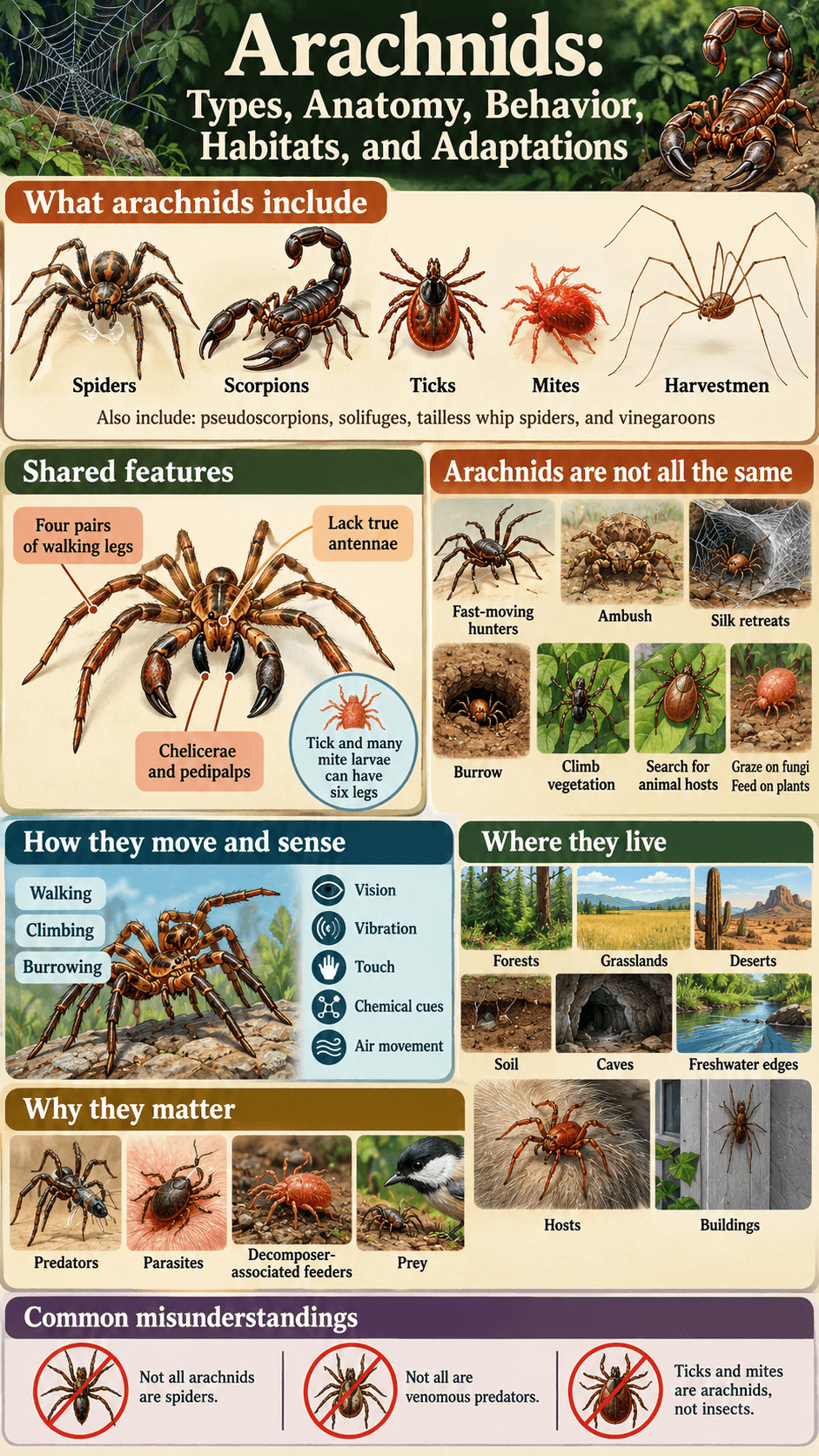
Arachnida is conventionally treated as a class within the arthropod subphylum Chelicerata. In practical terms, that places arachnids in the same broad chelicerate branch as horseshoe crabs, while separating them from insects and crustaceans. The American Arachnological Society’s overview of arachnid orders shows how many distinct lineages sit under the familiar arachnid label.
The group is far more varied than its popular image suggests. Some arachnids are fast-moving hunters. Others wait in ambush, live in silk retreats, burrow, climb vegetation, search for animal hosts, graze on fungi, feed on plants, consume decaying material, or live in soil and freshwater. This range of lifestyles explains why a single spider-like template cannot describe Arachnida accurately.
What Arachnida Includes
Arachnids within Arthropoda and Chelicerata
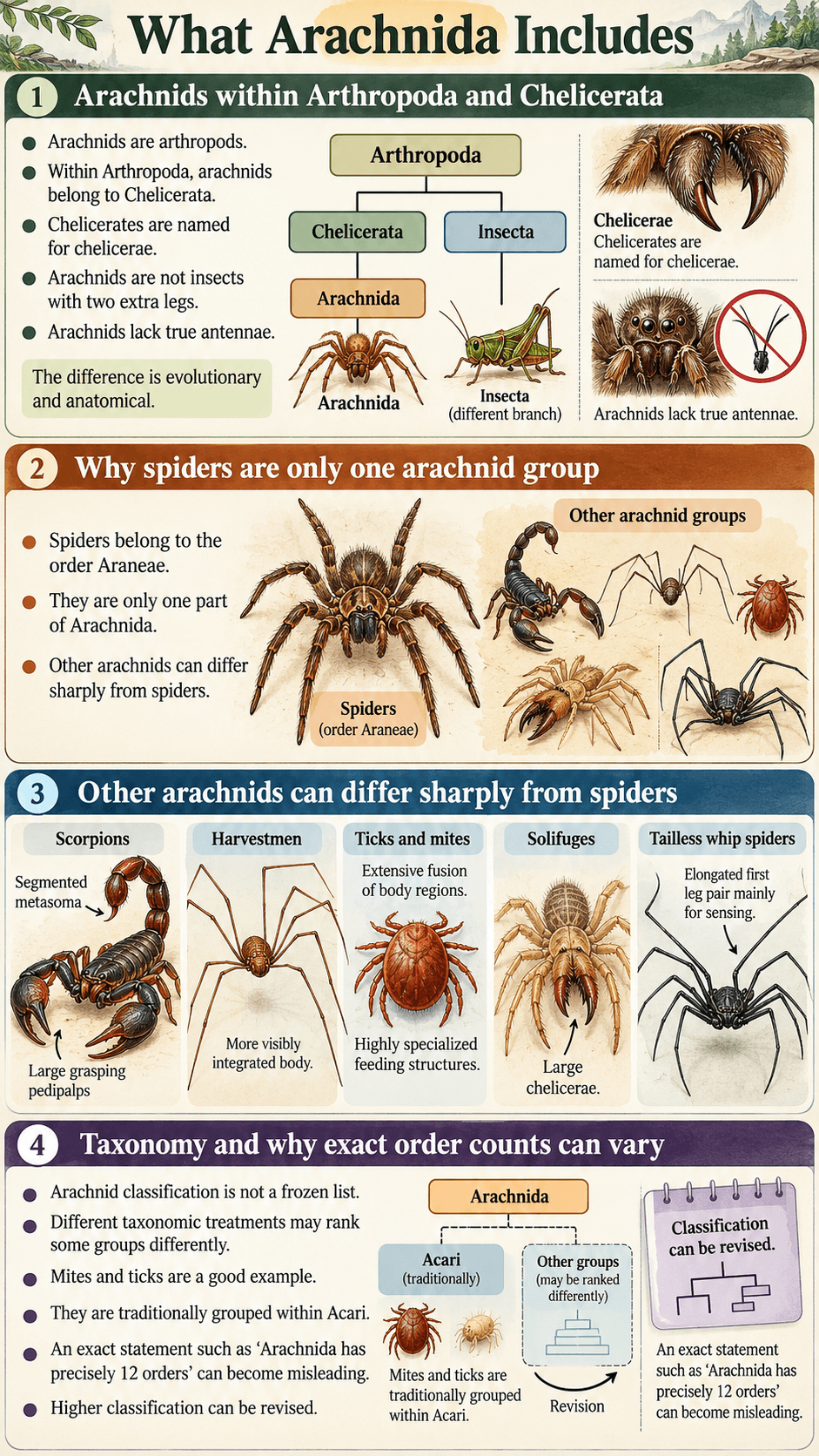
Arachnids are arthropods, so they share the broad arthropod features of jointed appendages, a segmented evolutionary body plan, and an external cuticle that supports and protects the body. Within Arthropoda, arachnids belong to Chelicerata. Chelicerates are named for chelicerae, the first pair of appendages associated with feeding.
That position matters because arachnids are not insects with two extra legs. Insects belong to a different major arthropod branch. Arachnids also lack the true antennae that are so familiar in insects. The difference is evolutionary and anatomical, not simply a matter of counting legs.
Why spiders are only one arachnid group
Spiders belong to the order Araneae, and they are exceptionally diverse, but they are only one part of Arachnida. The continuously updated World Spider Catalog tracks currently accepted spider taxonomy, illustrating both the size of Araneae and the way scientific names and classifications continue to change as new work is published.
Other arachnids can differ sharply from spiders. Scorpions have large grasping pedipalps and a segmented metasoma ending in a venom-delivery structure. Harvestmen often have a more visibly integrated body than spiders. Ticks and mites can have extensive fusion of body regions and highly specialized feeding structures. Solifuges have large chelicerae, while tailless whip spiders use an elongated first leg pair mainly for sensing rather than ordinary walking.
Taxonomy and why exact order counts can vary
Arachnid classification is not a frozen list. Different taxonomic treatments may rank some groups differently, and genetic studies continue to test relationships among chelicerate lineages. Mites and ticks are a good example. They are traditionally grouped within Acari, but acarologists use complex higher-level classifications, and the relationships among major mite and tick lineages have been debated.
For that reason, an exact statement such as “Arachnida has precisely 12 orders” can become misleading when presented without the taxonomic treatment behind it. It is more useful to recognize the major named groups and understand that higher classification can be revised.
Major Arachnid Groups at a Glance

Spiders and scorpions
Spiders are best known for silk and, in many lineages, venom associated with the chelicerae. They include active hunters, ambush predators, and web-associated hunters. Silk can be used for prey capture, shelters, egg sacs, safety lines, dispersal, and other functions, depending on the species. The major arachnid groups show how widely the same chelicerate foundation can be modified across different lineages.
Scorpions are also predators, but their body plan is very different. Their pedipalps form prominent pincers, and the rear of the body includes a narrow metasoma that ends in the telson, which bears the sting. Venom is delivered from this rear structure rather than from the chelicerae. Scorpions occur well beyond deserts, including forests, grasslands, caves, and other habitats.
Ticks, mites, and harvestmen
Ticks are specialized blood-feeding arachnids, but they should not be used as a model for mites as a whole. Mites occupy an enormous variety of ecological roles. They may be predators, plant feeders, fungus feeders, detritus-associated feeders, parasites, or inhabitants of soil, litter, freshwater, plants, and animal bodies. The American Arachnological Society’s Acari overview emphasizes both their diversity and the changing nature of their higher classification.
Harvestmen, order Opiliones, are often confused with spiders because some have very long legs. They are not spiders. Their visible body regions are typically more broadly joined than the narrow-waisted form seen in many spiders, and their feeding can include predation, scavenging, and other foods depending on the species.
Pseudoscorpions, solifuges, whip spiders, vinegaroons, and smaller groups
Pseudoscorpions resemble tiny scorpions at first glance because of their pincer-like pedipalps, but they lack the scorpion’s long metasoma and sting. Solifuges, often called camel spiders or wind scorpions, are neither true spiders nor scorpions. Their large chelicerae are conspicuous, but large mouthparts do not by themselves imply venom.
Tailless whip spiders, order Amblypygi, have raptorial pedipalps and a very long first pair of legs rich in sensory structures. The American Arachnological Society’s Amblypygi profile describes these first legs as antenniform, meaning antenna-like in function, not true antennae. Vinegaroons, or whip scorpions, are another distinct lineage. They can use a defensive spray containing acids rather than a scorpion-like venomous sting.
Smaller groups such as schizomids, ricinuleids, and palpigrades add still more variation. They are less familiar to the public, but they help show why Arachnida cannot be reduced to spiders, scorpions, and ticks.
Shared Body-Plan Themes and Important Exceptions

Chelicerae and pedipalps
Chelicerae are the first pair of appendages near the mouth, but their form and function differ among lineages. In spiders, they commonly support fang structures associated with venom delivery. In scorpions, the chelicerae are small feeding appendages, while the venom system is in the telson. In ticks, chelicerae contribute to a specialized mouthpart complex used during attachment and feeding. Solifuges use large, mechanically powerful chelicerae.
Pedipalps are equally variable. Scorpion pedipalps form the large pincers that grasp prey. Spider pedipalps can assist with sensing and manipulation, and adult males use specialized structures on them during sperm transfer. In tailless whip spiders, the pedipalps are strongly modified for capturing prey.
Walking legs, body regions, and lack of antennae
The typical post-larval arachnid plan includes four pairs of walking legs. That is a useful clue, but it is not a complete definition. Some appendages are strongly specialized. Amblypygids, for example, use the first pair mainly as sensory organs, while the remaining three pairs do most of the walking.
Body organization also varies. Spiders commonly show a prosoma and opisthosoma connected by a narrow pedicel. Scorpions divide the posterior body differently, producing the distinctive metasoma. Ticks and mites often show extensive fusion, and harvestmen can appear to have a single compact body. Using the spider shape as a universal arachnid diagram creates more confusion than clarity.
Why eight legs is not a complete definition
Arachnid identity depends on ancestry and the complete body plan, not a quick leg count. Tick larvae and many mite larvae have three pairs of legs before later stages develop a fourth pair. Individual arachnids may also lose a leg through injury or, in some groups, controlled shedding. A field observer can therefore encounter a true arachnid with fewer than eight visible legs. Those shared features are easiest to understand by looking at the defining arachnid traits together rather than relying on leg count alone.
Eye number is another unreliable shortcut. Many spiders have multiple simple eyes, but the number and arrangement vary. Some cave-adapted arachnids have reduced eyes or none. Ticks, mites, harvestmen, scorpions, and other groups each have their own patterns.
How Arachnids Move and Sense Their World

Walking, climbing, burrowing, and specialized movement
Most arachnids move using jointed legs driven by muscles, but the details vary. Spiders are notable because hemolymph pressure helps extend certain leg joints, working with muscular control rather than replacing muscles altogether. Other arachnids should not be described as if they use the same hydraulic system in the same way.
Movement is closely tied to habitat. Some species climb bark or vegetation, some run over open ground, and others remain inside burrows or crevices. Selected spiders jump, while small spiders and spiderlings can disperse through ballooning, in which silk helps them become airborne under suitable atmospheric conditions. Ticks often climb vegetation and wait in positions that increase their chance of contacting a passing host rather than jumping or flying onto one. The same anatomical diversity also shapes how arachnids move across ground, vegetation, burrows, silk, hosts, and other surfaces.
Vision, vibration, touch, chemical cues, and air movement
Arachnids gather information through combinations of senses rather than one standard system. Some hunting spiders have excellent vision, while many web-building spiders rely heavily on vibration. Mechanosensory hairs can detect touch and air movement. Chemical cues may help with prey, mate, habitat, or host detection. Different lineages also rely on very different arachnid senses to detect prey, hosts, mates, obstacles, and environmental conditions.
Scorpions possess pectines, comb-like sensory appendages on the underside of the body that help sample the substrate. Ticks have Haller’s organ on the first pair of legs, a sensory structure involved in detecting environmental and host-related cues. Amblypygids sweep their long antenniform legs through their surroundings. These examples show how different arachnids solve similar sensory problems with very different anatomy.
What Arachnids Eat
Predators and scavengers
Predation is common among arachnids, especially spiders, scorpions, pseudoscorpions, and solifuges. Prey can include insects and other arthropods, and larger species may sometimes take small vertebrates. The details vary widely, so spectacular feeding events should not be treated as the normal diet of an entire group.
Harvestmen broaden the picture because many species combine predation with scavenging or other food sources. Even among predators, capture methods differ. Some grasp prey with pedipalps, some use venom, some depend on silk, and others rely heavily on speed or large chelicerae. That ecological diversity becomes especially obvious when comparing what arachnids eat across predators, parasites, scavengers, plant feeders, and fungivores.
Blood feeders, parasites, herbivores, fungivores, and detritivores
Ticks are obligate blood feeders during their active feeding stages, but mites show much greater dietary diversity. Depending on the lineage, mites may feed on plants, fungi, decomposing organic material, other small animals, or host tissues and fluids. Some are parasites and others are free-living.
This diversity matters because the stereotype of the arachnid as a venomous hunter leaves out a huge part of arachnid ecology. An organism living in leaf litter and grazing on fungi faces very different survival problems from a spider waiting for prey or a tick searching for a host.
Behavior, Reproduction, and Development
Hunting, shelter, courtship, and social interactions
Arachnid behavior includes ambush hunting, active pursuit, web-based prey capture, burrow use, retreat building, mate searching, courtship, grooming, and seasonal shifts in activity. Many species live mostly solitary lives, but that does not mean social behavior is absent. Some spiders form aggregations or social groups, and parental associations occur in several lineages.
Courtship can involve vibration, touch, chemicals, visual displays, or combinations of cues. Scorpion courtship often includes a coordinated promenade connected with spermatophore placement. In spiders, courtship can be especially important for species in which close approach carries a risk of being mistaken for prey.
Eggs, live birth, juvenile development, and parental care
Reproductive strategies vary substantially. Spiders generally lay eggs, often enclosed in silk egg sacs. Some guard or carry egg sacs, and some remain with young for a period after hatching. Scorpions are different: they give birth to live young, and newborns commonly climb onto the mother’s back during an early stage of development.
Ticks hatch as six-legged larvae and later develop into eight-legged nymphs and adults, although life-cycle details vary among major acarid lineages. Mite development is even more diverse. These differences are another reason not to use a single spider life cycle as the template for all arachnids.
Defense and Survival Adaptations
Venom, pincers, silk, armor, camouflage, chemicals, and escape
Arachnid defense is much broader than venom. Some spiders and scorpions can use venom defensively, but other strategies include grasping pedipalps, tough body surfaces, hiding, burrowing, rapid escape, stillness, camouflage, threat displays, silk retreats, irritating hairs in selected tarantulas, and defensive chemicals. Survival also depends on how arachnids defend themselves through combinations of escape, camouflage, silk, armor, chemicals, pincers, and venom.
Vinegaroons demonstrate the chemical route especially clearly. Instead of a scorpion-like sting, they can spray a defensive mixture containing acetic acid and other compounds. Some harvestmen release defensive chemicals, and some arachnids can lose a leg during escape. The ability to regrow a lost leg depends on lineage and developmental stage, so regeneration should not be treated as automatic.
Human danger is also a poor way to organize arachnid biology. Venom may be highly effective against natural prey while having limited clinical importance to people. Risk depends on the species, amount delivered, circumstances, and the exposed person. Unknown wild arachnids are best observed without handling or provoking them.
Where Arachnids Live
Forests, deserts, soil, caves, freshwater edges, hosts, and buildings
Arachnids are especially diverse in terrestrial environments. They live in forests, grasslands, deserts, scrub, mountains, leaf litter, soil, rotting wood, bark, caves, rock crevices, burrows, vegetation, and buildings. Some live directly on animal hosts or plants. Scorpions are often associated with deserts in popular culture, but many species live in forests, savannas, caves, and humid regions as well. Much of this variation makes more sense when viewed alongside where arachnids live and the environmental conditions each lineage faces.
Mites occupy some of the smallest and most varied microhabitats in the group. They can live in soil pores, litter, moss, on plants, in stored organic material, in freshwater, and in association with animals. Their small size opens ecological spaces that are unavailable to larger arachnids.
Why not all arachnids are strictly terrestrial
Although the arachnid story is mostly terrestrial, there are important water-associated exceptions. Aquatic mites are diverse in freshwater, and some spiders live closely around streams, ponds, wetlands, or other aquatic environments. A small number of arachnid lineages occupy intertidal or other unusual habitats.
Horseshoe crabs should not be used as a simple example of a marine arachnid. They are chelicerates, but modern phylogenetic work has challenged older assumptions about the exact relationship between horseshoe crabs and conventional Arachnida. For a general overview, it is safest to keep horseshoe crabs in the broader chelicerate context and acknowledge that the evolutionary relationship is still discussed.
Why Arachnids Matter in Ecosystems
Predators, parasites, decomposer-associated feeders, and prey
Arachnids participate in food webs in many directions. Spiders, scorpions, pseudoscorpions, and predatory mites consume other animals. Ticks and parasitic mites interact with hosts. Fungivorous and detritus-associated mites participate in soil and litter systems. Arachnids are also eaten by birds, reptiles, amphibians, mammals, insects, and other arthropods.
It is tempting to describe spiders only as useful pest controllers, but ecological importance is broader than human convenience. Predation can influence prey numbers and behavior, yet the strength of those effects varies among habitats. Similarly, ticks and parasitic mites are not ecologically “useless” simply because some species cause problems for people or animals. They are parts of host-parasite relationships and food webs. Their diversity also explains why the ecological roles of arachnids extend far beyond simple predator-prey relationships.
Arachnid Conservation in Brief
Habitat threats, data gaps, and uneven assessment coverage
Arachnid conservation is difficult to summarize with one global percentage because knowledge is uneven. Many species have small ranges, specialized habitats, or limited monitoring, and many have not been assessed for extinction risk. The IUCN Red List summary statistics explicitly note that only a small fraction of the world’s described species have been evaluated, so global threat estimates must be interpreted with caution.
Threats can include habitat loss, fragmentation, altered fire regimes, pesticides, pollution, mining, cave disturbance, climate change, drought, groundwater change, invasive species, and collection for trade, but not every threat applies to every arachnid. Narrow-range cave species, island endemics, and highly specialized habitat users can be especially vulnerable to local disturbance.
Conservation status must therefore be checked species by species and assessment by assessment. “Data Deficient” does not mean a species is safe, and it does not mean the species is threatened. It means available information was insufficient for a more specific extinction-risk category under that assessment.
Common Arachnid Myths and Misunderstandings
All arachnids are spiders
Spiders are arachnids, but Arachnida also includes scorpions, ticks, mites, harvestmen, pseudoscorpions, solifuges, whip spiders, vinegaroons, and other lineages. A harvestman is not a spider. A camel spider is a solifuge, not a true spider. A vinegaroon is not a true scorpion.
All arachnids are venomous predators
Many arachnids are predators, and venom is important in some lineages, but the statement fails across the group. Ticks are blood feeders. Mites include plant feeders, fungivores, detritus-associated feeders, predators, and parasites. Harvestmen may scavenge or eat a mixed diet. Several arachnid groups lack spider-like venom systems.
All arachnids have eight eyes and exactly eight legs at every life stage
Eight walking legs are typical of many post-larval arachnids, but tick and many mite larvae begin with six. Eye number is even less uniform. Some spiders have eight eyes, but others have fewer, and some cave species are eyeless. Other arachnid orders have different eye arrangements.
Ticks and mites are insects
Ticks and mites are arachnids, not insects. Their classification within traditional Acari is complex, and higher-level relationships remain an active area of research, but they belong on the arachnid side of the arthropod family tree. Treating them as insects obscures major differences in ancestry and anatomy.
Questions That Clarify Arachnid Biology
What makes an animal an arachnid?
No single visible feature works in every case. The best definition combines chelicerate ancestry with a set of anatomical traits such as chelicerae, pedipalps, a typical four-pair post-larval walking-leg plan, and the absence of true antennae, while allowing for developmental and lineage-specific exceptions.
How do the major arachnid groups differ anatomically?
Comparing body regions, chelicerae, pedipalps, walking legs, eyes, mouthparts, and respiratory structures reveals how much variation sits inside Arachnida. Spider anatomy is familiar, but it should be treated as one version of the arachnid body plan rather than the universal model.
Why do senses, feeding, reproduction, habitats, and ecology vary so much?
Arachnids have diversified into very different ways of life. A web-building spider, a desert scorpion, a soil mite, a blood-feeding tick, and a cave harvestman experience different physical and ecological pressures. Their sensory systems, feeding tools, reproductive strategies, movement, and defenses reflect those different circumstances.
FAQ
Are arachnids insects?
No. Arachnids and insects are both arthropods, but they belong to different major evolutionary branches. Arachnids are chelicerates, while insects are hexapods within Pancrustacea. Arachnids lack true antennae, and most post-larval forms have four pairs of walking legs rather than the three pairs typical of adult insects.
Are all arachnids spiders?
No. Spiders make up the order Araneae. Other arachnids include scorpions, ticks, mites, harvestmen, pseudoscorpions, solifuges, tailless whip spiders, vinegaroons, and several smaller groups. Their anatomy and ecology can differ substantially from spiders.
Do all arachnids have eight legs?
Eight walking legs are typical of many juvenile and adult arachnids, but the rule has exceptions. Tick larvae and many mite larvae have six legs. Some appendages can be strongly specialized for sensing, and individual animals may lose legs through injury or autotomy. Leg count alone is not enough to classify an animal.
Are ticks and mites arachnids?
Yes. Ticks and mites are arachnids traditionally grouped within Acari, although their higher-level classification is complex and has been revised repeatedly. Ticks are specialized blood feeders, while mites occupy a much wider range of feeding roles and habitats.
Are all arachnids dangerous to people?
No. Human risk varies greatly across species and situations. Some spiders and scorpions have medically important venom, and some ticks can transmit pathogens, but that does not make Arachnida as a whole dangerous. Many arachnids have little direct interaction with people. Unknown wild arachnids are still best left unhandled.
Final Thoughts
Arachnids are best understood as a diverse chelicerate lineage, not as a collection of spider-like pests. Spiders are important members of the group, but mites, ticks, scorpions, harvestmen, pseudoscorpions, solifuges, whip spiders, vinegaroons, and smaller lineages reveal a much broader range of anatomy and lifestyles. Their shared body-plan themes are useful, yet the exceptions are just as important. Keeping both in view makes it easier to understand how arachnids move, sense, feed, reproduce, defend themselves, occupy habitats, and contribute to ecosystems without relying on myths or fear-based shortcuts.

Ethan Walker is the founder and research editor of Animal Fact Central. He creates and reviews educational animal facts content using trusted wildlife, pet care, and science-based sources. His work focuses on making animal behavior, adaptations, habitats, and species facts clear, accurate, and engaging for everyday readers.
Read More Details About Ethan Walker: https://animalfactcentral.com/ethan-walker/