
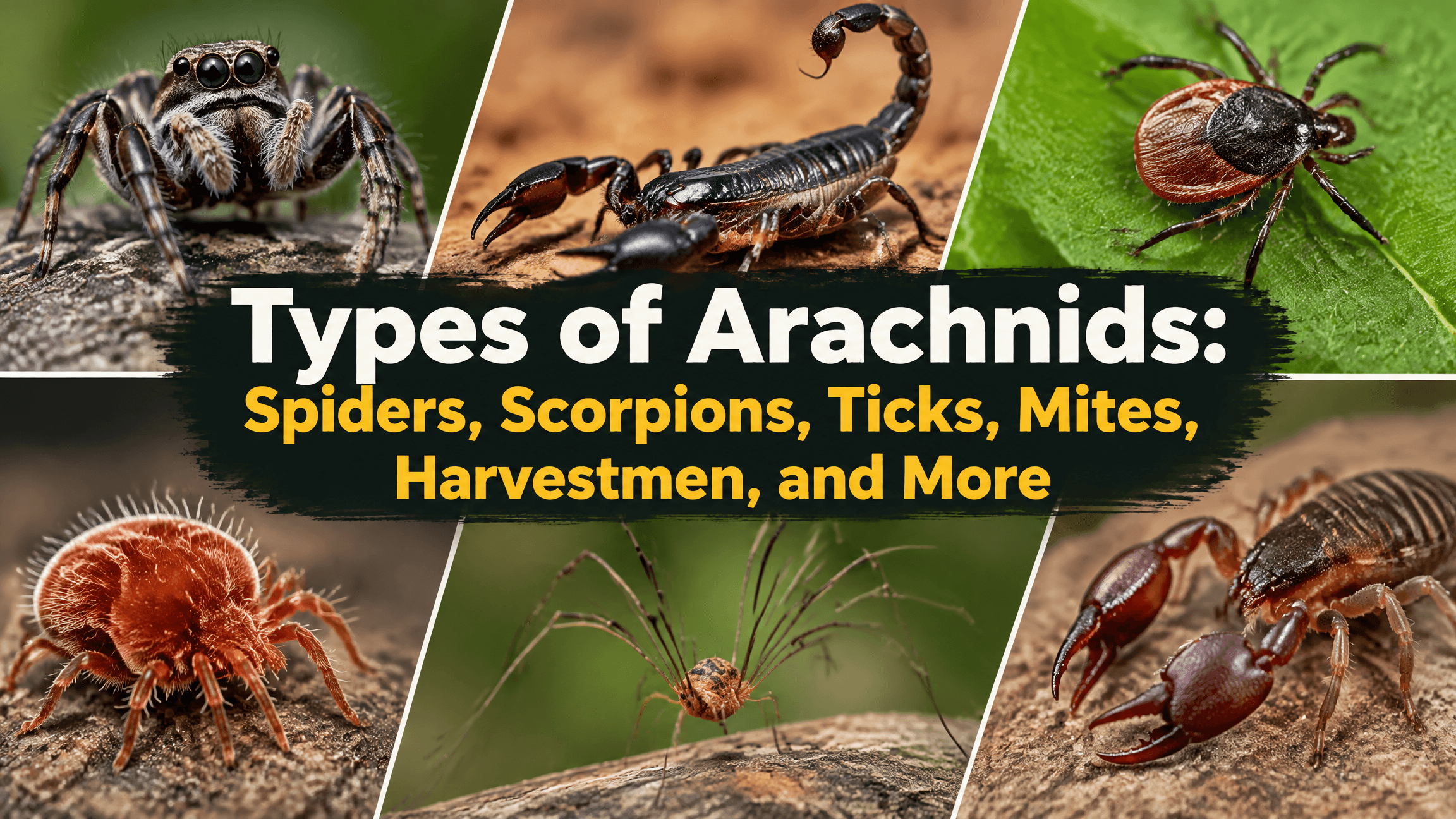
Arachnids include much more than spiders. The class Arachnida, in the conventional framework used here, contains familiar groups such as spiders, scorpions, harvestmen, ticks, and mites, along with less familiar lineages such as pseudoscorpions, solifuges, tailless whip spiders, vinegaroons, schizomids, ricinuleids, and palpigrades. These animals share chelicerate ancestry, but their bodies, diets, habitats, defenses, and life histories can look remarkably different.
That diversity is why a simple phrase such as “eight-legged animals” is not enough to explain the types of arachnids. Some arachnid larvae have six legs, some adults use one pair of legs mainly for sensing, some are active predators, some feed on blood, some eat fungi or decaying material, and some live in soil or water. A useful classification should show both the family resemblance and the differences.
Quick Answer
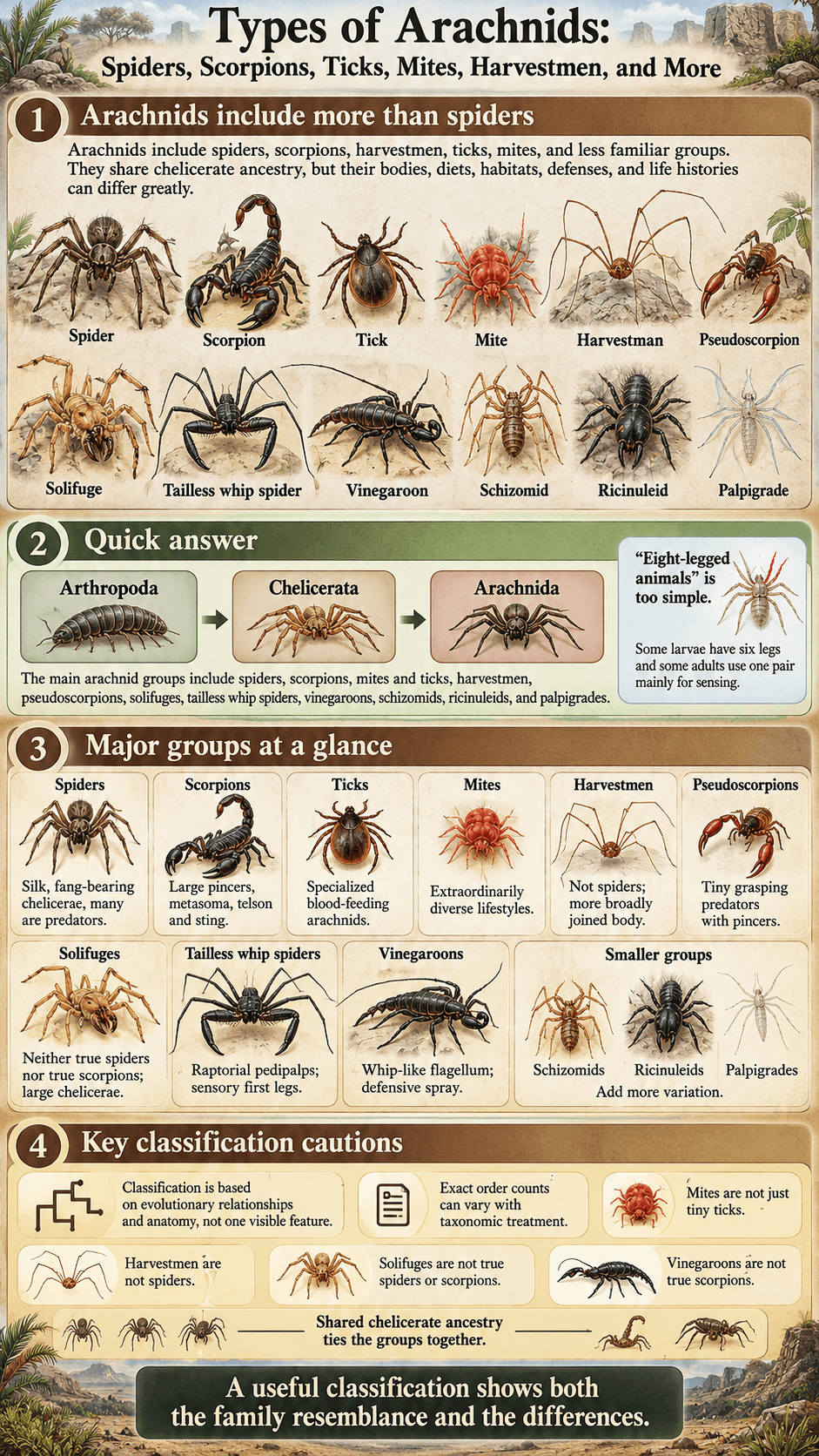
The main arachnid groups include spiders, scorpions, mites and ticks, harvestmen, pseudoscorpions, solifuges, tailless whip spiders, vinegaroons, schizomids, ricinuleids, and palpigrades. The American Arachnological Society’s overview of arachnid orders lists these major living groups while also noting that the exact number and rank of arachnid orders can vary with taxonomic treatment.
Spiders are the most familiar arachnids for many people, but they are only one lineage. Mites are extraordinarily diverse, ticks are specialized blood-feeding arachnids, harvestmen are not spiders, solifuges are not true spiders or scorpions, and vinegaroons are not true scorpions. Learning the groups side by side gives a much more accurate picture of Arachnida.
How Arachnid Classification Works
Arachnida within Chelicerata
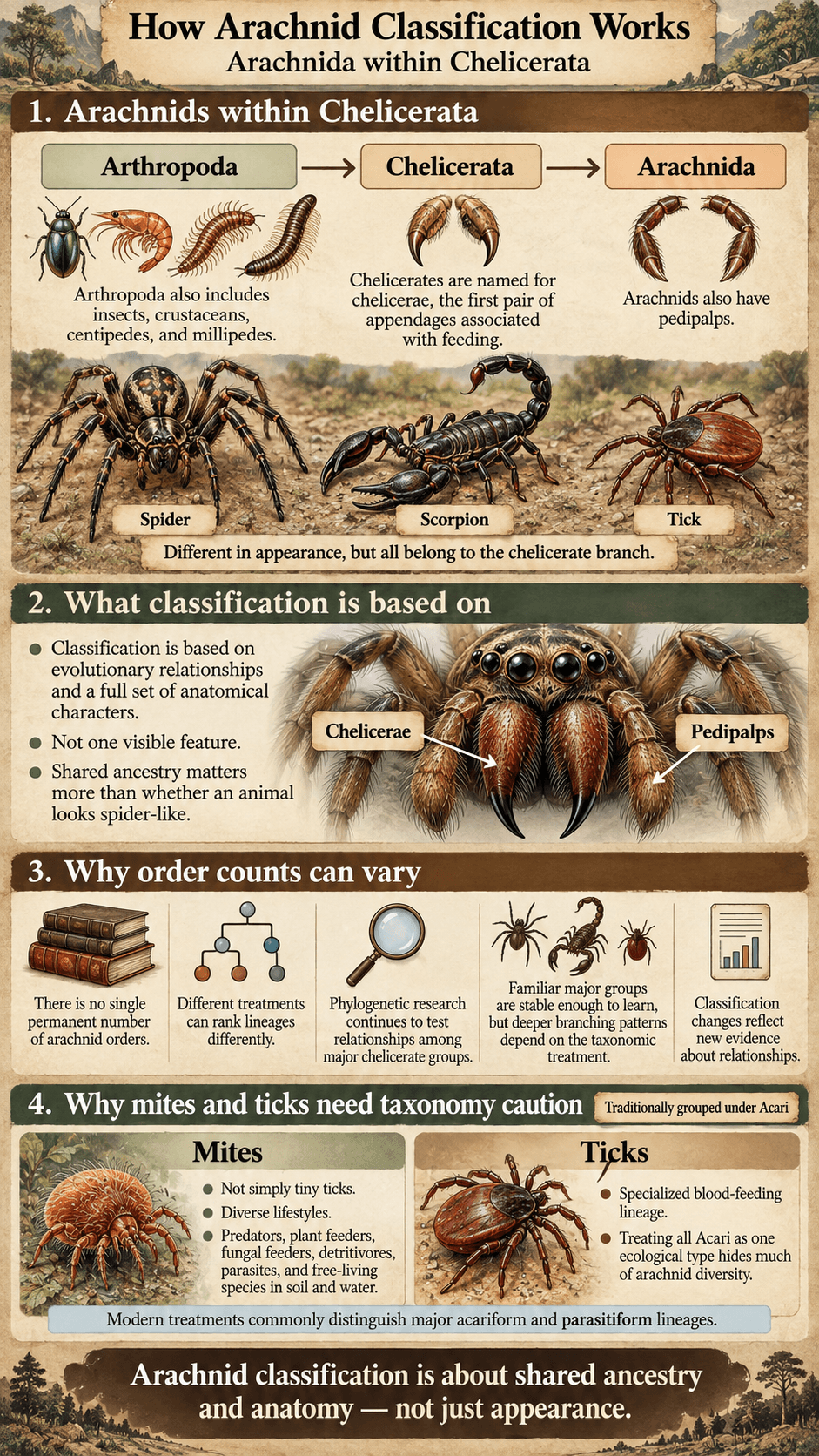
Arachnids belong to Arthropoda, the animal phylum that also includes insects, crustaceans, centipedes, and millipedes. Within Arthropoda, arachnids are chelicerates. Chelicerates are named for chelicerae, the first pair of appendages associated with feeding. Arachnids also have pedipalps, which can be small sensory structures, grasping pincers, or other specialized appendages depending on the group.
Classification is based on evolutionary relationships and a full set of anatomical characters, not on one visible feature. A spider, a scorpion, and a tick may look very different, but all are part of the chelicerate branch of arthropod evolution. That shared ancestry matters more than whether the animal looks “spider-like” to a casual observer.
Why exact order counts can vary by source and treatment
It is tempting to ask for one permanent number of arachnid orders, but modern taxonomy does not fit neatly into that kind of statement. Different treatments can rank certain lineages differently, and phylogenetic research continues to test relationships among the major chelicerate groups. Even a respected arachnology reference may present a range rather than one timeless number.
For readers, the practical lesson is simple: the familiar major groups are stable enough to learn, but exact order counts and deeper branching patterns should be tied to a current taxonomic treatment. Classification changes are not evidence that scientists “do not know what an arachnid is.” They reflect new evidence about how the lineages are related.
Why mites and ticks need taxonomy caution
Mites and ticks are traditionally grouped under Acari, but their higher-level classification is complex. The American Arachnological Society’s Acari overview explains that modern treatments commonly distinguish major acariform and parasitiform lineages and that both rank and relationships have been revised repeatedly.
This matters because “mites” are not simply tiny ticks. Ticks are a specialized blood-feeding lineage, while mites include predators, plant feeders, fungal feeders, detritivores, parasites, and free-living species in soil and water. Treating all Acari as one ecological type hides much of arachnid diversity.
Spiders: Araneae
Recognizable body form and broad feeding pattern
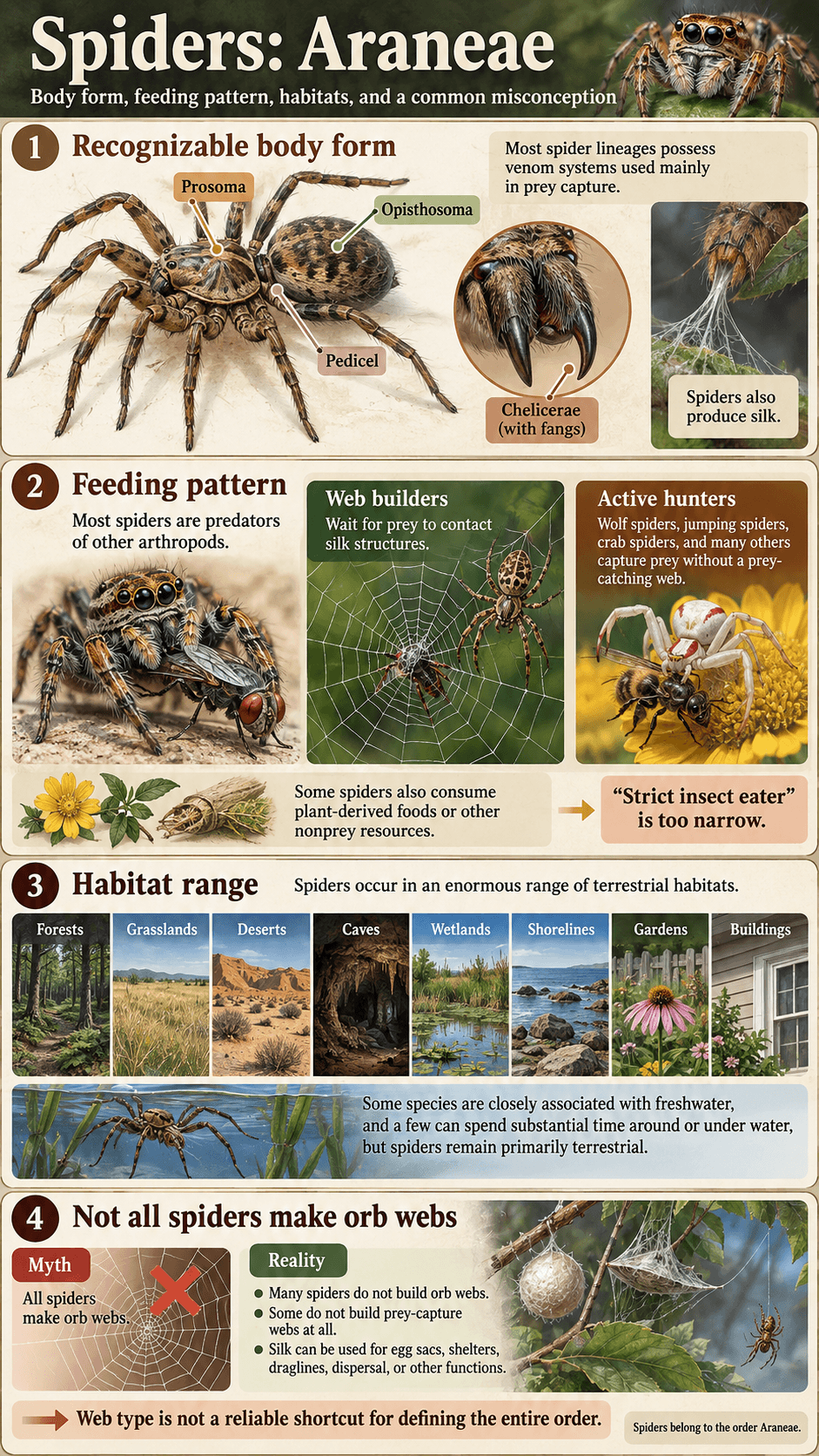
Spiders belong to the order Araneae. A typical spider has a prosoma at the front and an opisthosoma behind it, joined by a narrow connection called the pedicel. Spider chelicerae bear fang structures, and most spider lineages possess venom systems used mainly in prey capture. Spiders also produce silk, although different species use silk in very different ways. Despite their differences, the traits that distinguish arachnids still reflect a shared chelicerate foundation.
Most spiders are predators of other arthropods, but the details vary greatly. Web builders may wait for prey to contact silk structures, while wolf spiders, jumping spiders, crab spiders, and many other hunters capture prey without using a prey-catching web. Some spiders also consume plant-derived foods or other nonprey resources, so “strict insect eater” is too narrow a description.
The current World Spider Catalog is the specialist reference for accepted spider taxonomy and is updated as new taxonomic work appears. That is especially useful because spider family and species totals change over time.
Habitat range and one major misconception
Spiders occur in an enormous range of terrestrial habitats, including forests, grasslands, deserts, caves, wetlands, shorelines, gardens, and buildings. Some species are closely associated with freshwater, and a few can spend substantial time around or under water, but spiders remain primarily a terrestrial radiation.
A common misconception is that a spider is defined by making an orb web. Many spiders do not build orb webs, and some do not build prey-capture webs at all. Silk can instead be used for egg sacs, shelters, draglines, dispersal, or other functions. Web type is therefore not a reliable shortcut for defining the entire order.
Scorpions: Scorpiones
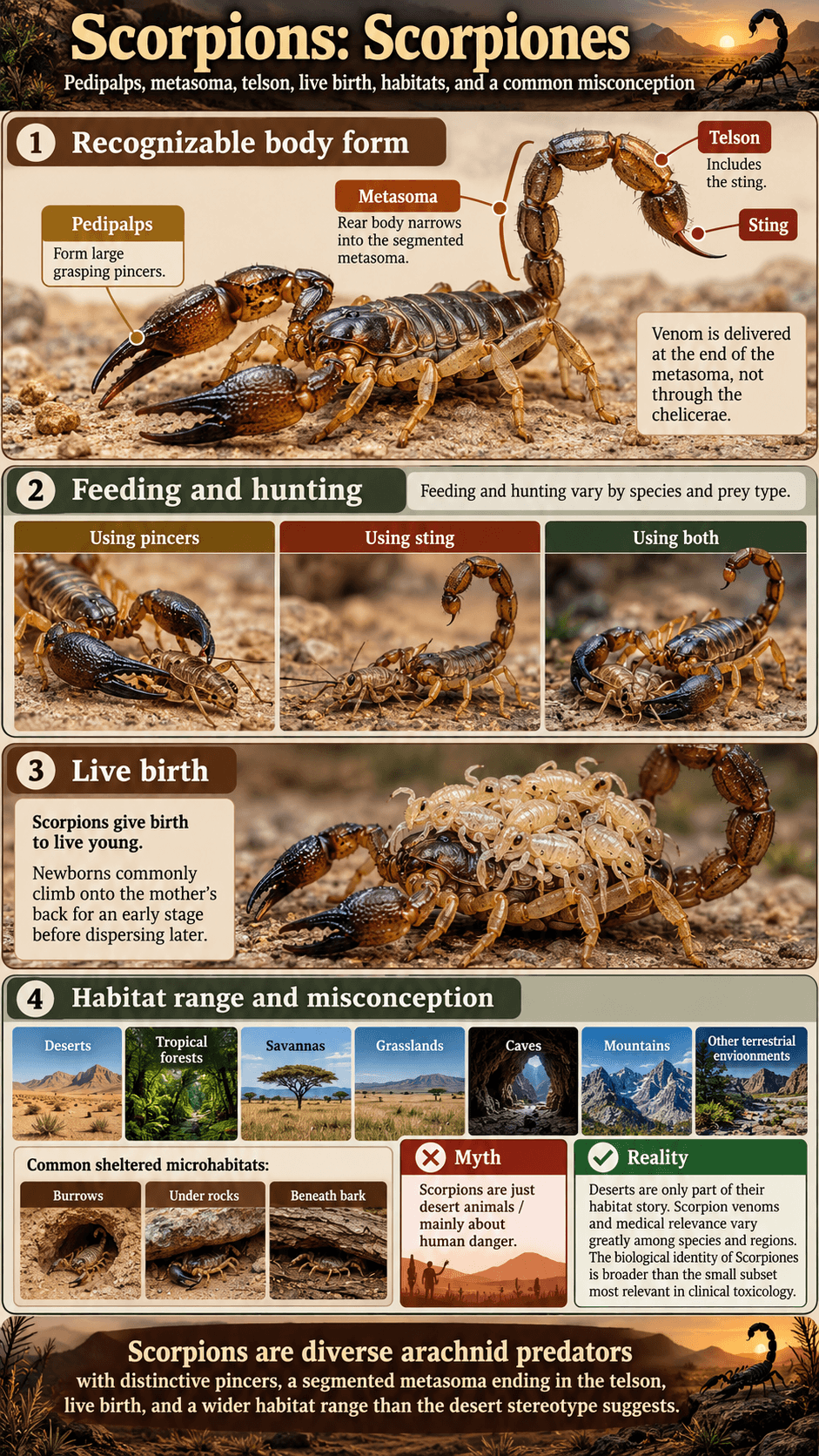
Pedipalps, metasoma, telson, and live birth at a glance
Scorpions are easy to recognize because their pedipalps form large grasping pincers and the rear of the body narrows into the segmented metasoma, often called the tail. At its end is the telson, which includes the sting. This is important anatomically because scorpion venom is delivered at the end of the metasoma, not through the chelicerae.
Scorpions are predators, but their feeding and hunting behavior varies by species and prey type. They may use the pincers, the sting, or both. Scorpions are also notable among arachnids because they give birth to live young. The newborns commonly climb onto the mother’s back for an early stage of development before dispersing later.
Habitat range and misconception about universal danger
Scorpions are often treated as desert animals, yet deserts are only part of their habitat story. Scorpions also occur in tropical forests, savannas, grasslands, caves, mountains, and other terrestrial environments. Many species spend daylight hours in burrows, under rocks, beneath bark, or in other sheltered microhabitats. Their differences extend to arachnid habitats, from soil and forests to caves, freshwater, plants, hosts, and buildings.
Another misconception is that scorpions as a group should be understood mainly through human danger. Scorpion venoms and medical relevance vary greatly among species and regions. The biological identity of Scorpiones is much broader than the small subset of species that matter most in clinical toxicology.
Mites and Ticks in Traditional Acari Context
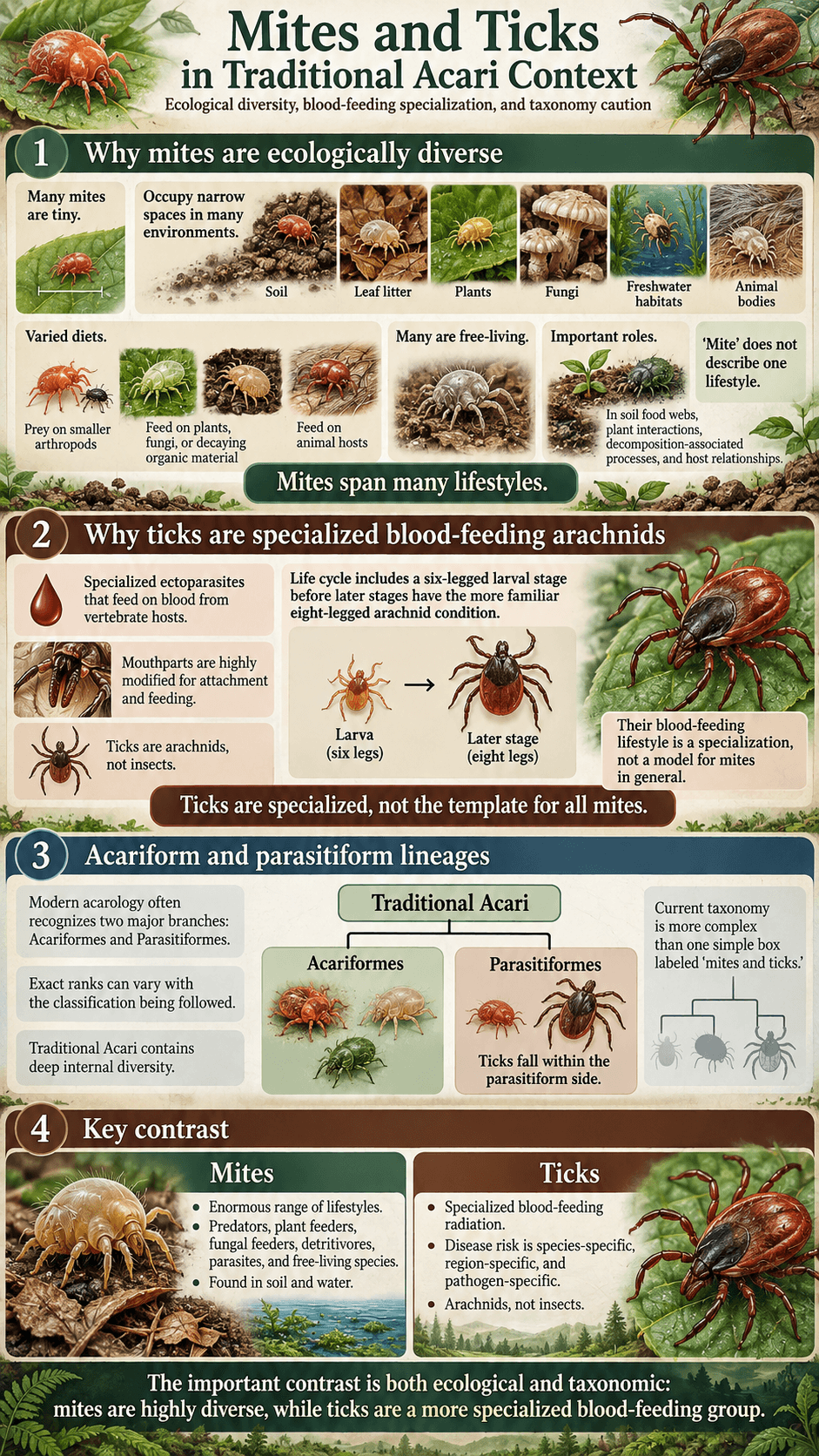
Why mites are ecologically diverse
Mites are among the clearest reasons not to picture all arachnids as medium-sized predators. Many mites are tiny, and their small bodies let them occupy narrow spaces in soil, leaf litter, plants, fungi, animal bodies, freshwater habitats, and other microenvironments. Their diets are equally varied.
Some mites prey on smaller arthropods. Others feed on plants, fungi, decaying organic material, or animal hosts. Many are free-living. This breadth means that the word “mite” does not describe one lifestyle any more than the word “bird” describes one diet.
Mites can be important participants in soil food webs, plant interactions, decomposition-associated processes, and host relationships. A few medically or agriculturally important species receive disproportionate attention, but they should not be used as the model for the entire group.
Why ticks are specialized blood-feeding arachnids
Ticks are specialized ectoparasites that feed on blood from vertebrate hosts. Their mouthparts are highly modified for attachment and feeding, and their life cycles include a six-legged larval stage before later stages have the more familiar eight-legged arachnid condition.
Ticks matter to human and veterinary health because some species can transmit pathogens, but disease risk is species-specific, region-specific, and pathogen-specific. For classification purposes, the key point is biological: ticks are arachnids, not insects, and their blood-feeding lifestyle is a specialization rather than a model for mites in general.
Acariform and parasitiform lineages without turning this into acarology
Modern acarology often recognizes two major branches commonly called Acariformes and Parasitiformes. The exact ranks assigned to these branches can vary with the classification being followed. Ticks fall within the parasitiform side of this broader mite-and-tick diversity.
For a general reader, it is enough to understand that traditional Acari contains deep internal diversity and that current taxonomy is more complicated than one simple box labeled “mites and ticks.” The important contrast is ecological as well as taxonomic: mites span an enormous range of lifestyles, while ticks are a more specialized blood-feeding radiation.
Harvestmen: Opiliones
Body integration, feeding variety, and why they are not spiders
Harvestmen belong to Opiliones. Many have long legs, but leg length varies, and the body usually appears more broadly joined than the obvious two-part silhouette of a typical spider. The American Arachnological Society’s harvestman overview emphasizes that Opiliones are a distinct arachnid order rather than a kind of spider.
Harvestmen also have a wider range of feeding habits than the common “spider-like predator” image suggests. Depending on the species, they may prey on small animals, scavenge, or consume plant and fungal material. They do not have spider-style venom-delivery fangs, and they do not make spider webs.
The daddy longlegs naming problem
“Daddy longlegs” is an unreliable biological name because different people use it for different animals. In many parts of North America it refers to harvestmen. Elsewhere, or in other contexts, the same phrase can refer to cellar spiders, which are true spiders, or crane flies, which are insects.
That naming overlap is one reason the famous “daddy longlegs are the most venomous spiders” story is so confused. A harvestman is not a spider and does not have the spider-type venom apparatus described by the myth. If the name refers to a cellar spider, then the animal is a spider, but the sensational venom claim still does not become true simply because the common name is shared.
Pseudoscorpions: Pseudoscorpiones
Tiny grasping predators with prominent pedipalps
Pseudoscorpions look like miniature scorpions at first glance because their pedipalps end in conspicuous pincers. They are usually small predators that feed on tiny arthropods such as mites, springtails, and small insect prey. Many live in leaf litter, beneath bark, under stones, or in other sheltered terrestrial microhabitats.
Some pseudoscorpions can hitch rides on insects in a behavior called phoresy. This is transport rather than parasitism: the pseudoscorpion uses the larger animal as a vehicle to reach another habitat. Many also produce silk for small chambers used in molting, brooding, or shelter.
Why they are not miniature scorpions
Pseudoscorpions lack the long scorpion metasoma and terminal stinger. Their pincer-like pedipalps evolved within their own lineage and should not be read as proof that they are simply juvenile or tiny scorpions. Some pseudoscorpion groups have venom associated with the pedipalpal pincers, but this is biologically different from the scorpion telson system.
This is a good example of why arachnid classification cannot rely on resemblance alone. Different lineages can evolve similar-looking grasping structures while remaining distinct branches with different body plans and life histories.
Solifuges: Solifugae
Large chelicerae and active terrestrial life
Solifuges are often called camel spiders, sun spiders, or wind scorpions, but they are neither true spiders nor true scorpions. They are active terrestrial hunters with very large, mechanically powerful chelicerae. Their pedipalps are prominent and can make the animal look as though it has an extra pair of legs when seen quickly.
Many solifuges occur in dry or seasonally dry regions, although their ecology varies by species. They often hunt actively rather than waiting in a web. Their large jaws are visually dramatic, which has helped make them frequent subjects of exaggerated stories.
Camel spider myths to avoid
Viral stories have portrayed camel spiders as enormous, extremely venomous animals that chase people to attack, consume human flesh, or attack camels in grotesque ways. Those claims distort the biology of Solifugae. Most solifuges do not have the kind of venom system associated with spiders or scorpions, and their behavior should not be interpreted through internet folklore.
An animal moving toward a person’s shadow or shelter is not evidence of a deliberate plan to attack a human. In hot open habitats, movement around shade can create misleading impressions about “chasing.” The safer interpretation is behavioral context, not intention.
Tailless Whip Spiders: Amblypygi
Raptorial pedipalps and sensory first legs
Tailless whip spiders belong to Amblypygi. Their bodies are flattened, their pedipalps are enlarged and raptorial for capturing prey, and their first pair of legs is extremely long and thin. Those first legs function mainly as sensory appendages rather than ordinary walking legs.
The American Arachnological Society’s Amblypygi profile describes these elongated first legs as antenniform because they probe the surroundings and carry many sensory receptors. The rear three pairs are the main walking legs.
Why they are not true spiders
The common name “tailless whip spider” is descriptive, not a statement that the animal belongs to Araneae. Amblypygids have no spider silk system and no spider fang-and-venom arrangement. Their flat bodies, raptorial pedipalps, and sensory first legs form a distinctive combination.
They are most diverse in warm regions and often shelter in crevices, caves, tree surfaces, or rocky habitats. Their unusual appearance can seem intimidating, but classification becomes much easier once the sensory legs and grasping pedipalps are recognized as amblypygid traits.
Vinegaroons and Whip Scorpions
Thelyphonida or Uropygi terminology by source
Vinegaroons, also called whip scorpions, are usually placed in Thelyphonida in modern reader-facing treatments, although Uropygi has also been used in the taxonomic literature and in broader historical classifications. They have robust raptorial pedipalps, a long whip-like flagellum, and sensory first legs.
Like tailless whip spiders, they are not true scorpions. The shared “whip scorpion” wording refers to appearance, not membership in Scorpiones. They are their own arachnid lineage.
Defensive spray versus scorpion venom
Vinegaroons are especially well known for defensive chemical sprays that can contain acetic acid and other compounds. The spray is not the same thing as scorpion venom, and the flagellum is not a scorpion sting.
The nickname “vinegaroon” comes from the vinegar-like odor associated with acetic acid, but that should not be simplified into the claim that the animal sprays ordinary household vinegar. Its defense is a biological chemical mixture produced by specialized glands.
Schizomids, Ricinuleids, Palpigrades, and Other Smaller Groups
What makes these lineages distinctive
Schizomids are small arachnids sometimes called short-tailed whip scorpions. Many have sensory first legs and a short terminal flagellum. They are generally small, secretive animals associated with warm, humid microhabitats, although the group includes ecological variation.
Ricinuleids are sometimes called hooded tick-spiders because a movable plate called the cucullus covers the chelicerae. The name sounds like a mixture of better-known animals, but ricinuleids are a distinct lineage. They are small and often associated with leaf litter, caves, and tropical or subtropical habitats.
Palpigrades, or micro whip scorpions, are tiny, delicate arachnids that often live in moist soil, under stones, or in caves. They lack eyes, and their first legs are used heavily in sensing. Their size and hidden habitats help explain why most people never encounter them.
Why obscure names should not overwhelm the reader
Learning every order name at once is less useful than recognizing the larger pattern. Arachnida contains multiple experiments in body shape, feeding, sensing, and survival. Some lineages are large and familiar, while others are tiny, cryptic, or restricted to specialized habitats.
The smaller groups matter because they prevent a spider-centered view of arachnids. They show that pincers, sensory legs, flagella, fused body regions, reduced eyes, and unusual life histories have evolved in many combinations across the class.
Horseshoe Crabs and the Arachnid Relationship Debate
Chelicerates, not true crabs
Horseshoe crabs are chelicerate arthropods, not crustacean crabs. Their common name reflects superficial resemblance rather than close relationship to true crabs. Traditionally, living horseshoe crabs have often been treated outside Arachnida as a separate chelicerate lineage.
That traditional arrangement has been challenged by some molecular studies. A large phylogenomic analysis published in Molecular Biology and Evolution recovered horseshoe crabs nested among arachnid lineages, while other analyses and morphological frameworks have supported different arrangements. The phylogenomic study of chelicerate relationships illustrates why this question remains an active research problem rather than a settled classroom fact.
Why they should not be presented as a routine arachnid type without qualification
For a general classification guide, the clearest approach is to keep horseshoe crabs in the wider chelicerate discussion and explain the debate. Listing them beside spiders, scorpions, and harvestmen as an ordinary, uncontested arachnid type would hide the uncertainty.
This is also a useful reminder that biological classification is a scientific model of evolutionary relationships. When new genomic and morphological evidence points in different directions, the responsible answer is to describe the uncertainty rather than force a simple label.
Major Arachnid Groups Compared
Body form, feeding tendency, habitat, and one misconception for each
| Group | Recognizable feature | Typical ecological pattern | Common misconception |
|---|---|---|---|
| Spiders | Fang-bearing chelicerae, silk-producing systems, distinct prosoma and opisthosoma | Mostly predators in terrestrial habitats | All spiders build orb webs |
| Scorpions | Large pincers and a segmented metasoma ending in a sting | Predators in deserts, forests, grasslands, caves, and other habitats | All scorpions are highly dangerous to humans |
| Mites | Often tiny with highly varied body forms | Predators, herbivores, fungivores, detritivores, parasites, and more | All mites are parasites |
| Ticks | Specialized mouthparts and blood-feeding life history | Ectoparasites of vertebrates | Ticks are insects |
| Harvestmen | Broadly joined body regions in many familiar species | Predation, scavenging, omnivory, and other diets | They are spiders |
| Pseudoscorpions | Small body with grasping pedipalps and no scorpion tail | Predators in litter, bark, soil, caves, and sheltered sites | They are baby scorpions |
| Solifuges | Very large chelicerae and prominent pedipalps | Active terrestrial hunting | Camel spiders are true spiders or extremely venomous |
| Amblypygids | Flattened body, raptorial pedipalps, sensory first legs | Nocturnal predation in warm, sheltered habitats | Tailless whip spiders are true spiders |
| Vinegaroons | Raptorial pedipalps, whip-like flagellum, chemical defense | Nocturnal predation and shelter use | They are true scorpions that spray venom |
Common Mistakes and Myths
Every arachnid is a spider
Spiders are only one arachnid lineage. Scorpions, harvestmen, mites, ticks, pseudoscorpions, solifuges, amblypygids, vinegaroons, and several smaller groups have their own evolutionary histories and distinctive body plans.
A better rule is to think of “arachnid” as the broad category and “spider” as one member of it, much as a particular bird order belongs to the larger class Aves without representing all birds.
Every arachnid is a venomous predator
This stereotype fails in several ways. Many mites are not predators at all. Ticks are blood-feeding parasites. Harvestmen may scavenge or eat plant and fungal material. Some arachnids use venom, some use chemical sprays, some use pincers or camouflage, and some rely mainly on escape and shelter.
Even among venom-using groups, venom does not automatically mean major human danger. Venom evolves in ecological contexts such as prey capture and defense, and medical significance depends on the species and circumstances.
Camel spiders are spiders and vinegaroons are scorpions
Common names often describe appearance rather than formal classification. Camel spiders are solifuges, not Araneae. Vinegaroons are thelyphonids, not Scorpiones. Tailless whip spiders belong to Amblypygi, not the spider order.
Once those examples are familiar, arachnid diversity becomes easier to interpret. A common name can be a useful clue, but it should never be treated as a taxonomic diagnosis.
What Group Differences Reveal About Arachnid Biology
What makes an arachnid
Looking across the groups shows why arachnids cannot be defined by eight legs alone. Most post-larval arachnids have four pairs of walking legs, but tick and many mite larvae begin with six. Amblypygids use the first leg pair mainly as sensory appendages. What unites the groups is their chelicerate ancestry and the organization of structures such as chelicerae and pedipalps, not a single field mark.
Comparative anatomy and senses
Different arachnid groups modify the same basic appendage sets in strikingly different ways. Scorpion pedipalps become large pincers. Spider pedipalps remain smaller and take on sensory, manipulatory, and reproductive roles. Amblypygid first legs become long sensory feelers. Tick mouthparts are specialized for attachment to hosts.
Sensory biology varies just as widely. Some spiders rely strongly on vision, some on vibration. Scorpions use sensory structures including pectines. Ticks detect environmental and host-related cues with specialized organs on the first legs. These differences help explain how arachnids occupy such different ecological roles.
Feeding, reproduction, habitat, and ecology
The group comparison also explains why broad statements about arachnid diet or reproduction need caution. Spiders and scorpions are mainly predators, ticks are blood feeders, mites span many dietary categories, and harvestmen can be flexible feeders. Spiders usually lay eggs in silk sacs, while scorpions give birth to live young. The groups also differ sharply in feeding strategy, which is why arachnid diets range far beyond predation alone.
Habitats range from deserts and tropical forests to leaf litter, caves, freshwater, animal hosts, and buildings. Arachnids can be predators, parasites, decomposer-associated feeders, herbivores, scavengers, and prey. Their ecological diversity is a major reason the class cannot be understood through spiders alone.
FAQ
How many types of arachnids are there?
There are multiple major living arachnid lineages, including spiders, scorpions, harvestmen, mites and ticks, pseudoscorpions, solifuges, tailless whip spiders, vinegaroons, schizomids, ricinuleids, and palpigrades. The exact number of formal orders should not be treated as a permanent single value because taxonomic ranks and relationships can vary with the classification being followed.
Are ticks and mites arachnids?
Yes. Ticks and mites are arachnids traditionally grouped in Acari. Their higher-level classification is complicated, and modern treatments commonly distinguish major acariform and parasitiform lineages. Ticks are specialized blood-feeding ectoparasites, while mites include a much wider range of free-living and host-associated lifestyles.
Are harvestmen spiders?
No. Harvestmen belong to Opiliones, while true spiders belong to Araneae. Harvestmen often have a more broadly joined body outline than spiders and lack the spider-style venom-delivery fangs and silk systems. The shared nickname “daddy longlegs” can cause confusion because it is also used for cellar spiders and crane flies.
Are camel spiders true spiders?
No. Camel spiders are solifuges in the order Solifugae. They are arachnids, but not members of Araneae. Their large chelicerae and fast terrestrial hunting have inspired many exaggerated stories, including misleading claims about extreme venom and deliberate attacks on people.
Are horseshoe crabs arachnids?
Horseshoe crabs are definitely chelicerates, but their exact relationship to the traditional Arachnida has been debated in modern phylogenetic research. Some molecular analyses place them within a broader arachnid radiation, while other analyses and traditional treatments place them outside Arachnida as a separate chelicerate lineage. For general readers, it is most accurate to present that relationship as an active scientific question rather than an uncontested label.
Final Thoughts
The types of arachnids extend far beyond spiders. Scorpions use grasping pedipalps and a terminal sting, ticks specialize in blood feeding, mites occupy an extraordinary range of ecological roles, harvestmen follow their own distinct body plan, and smaller lineages such as pseudoscorpions, solifuges, amblypygids, vinegaroons, schizomids, ricinuleids, and palpigrades reveal even more variation.
The most useful way to understand Arachnida is to compare the groups without forcing them into one stereotype. Shared chelicerate ancestry ties them together, while differences in anatomy, senses, feeding, reproduction, habitat, and defense show how many evolutionary paths arachnids have taken. That broader view makes spiders easier to understand too, because they become one remarkable lineage among many rather than the definition of the entire class.

Ethan Walker is the founder and research editor of Animal Fact Central. He creates and reviews educational animal facts content using trusted wildlife, pet care, and science-based sources. His work focuses on making animal behavior, adaptations, habitats, and species facts clear, accurate, and engaging for everyday readers.
Read More Details About Ethan Walker: https://animalfactcentral.com/ethan-walker/