
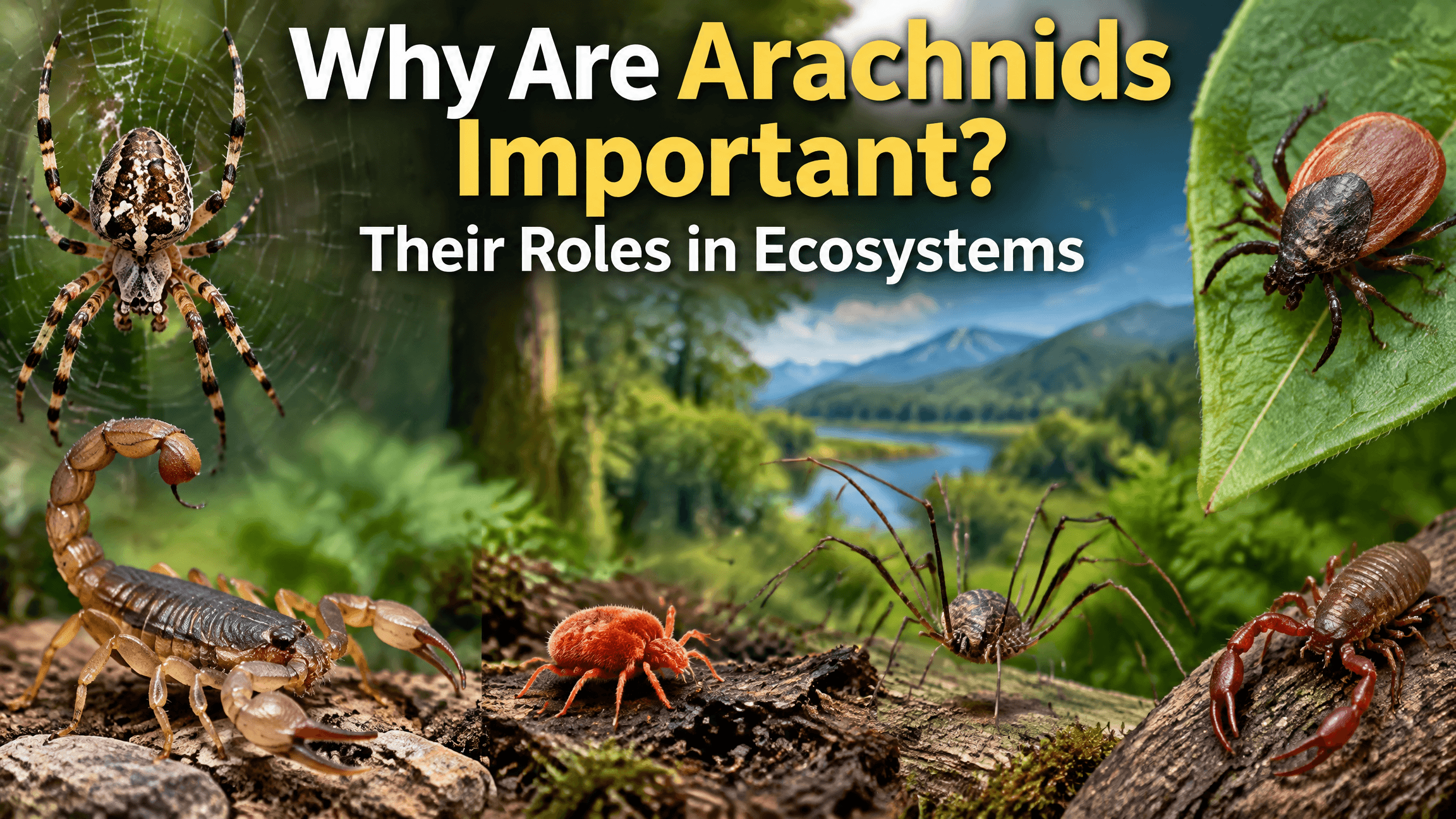
Arachnids are important because they occupy many different positions in food webs. Spiders and scorpions are predators, ticks and some mites are parasites, plant-feeding mites consume living vegetation, other mites graze fungi or feed in decomposer systems, harvestmen can act as predators, scavengers, or omnivores, and pseudoscorpions hunt tiny arthropods in soil, litter, and bark. Arachnids are also eaten by birds, reptiles, amphibians, fish, insects, and other arachnids.
That ecological variety matters more than any simple claim that arachnids are “good” or “bad.” A spider consuming insects, a mite grazing fungus, and a tick feeding on a vertebrate host are all part of ecological networks that move energy, nutrients, and biological interactions through an ecosystem. Their importance comes from the connections they make, not from whether humans find a particular species useful or inconvenient.
Quick Answer
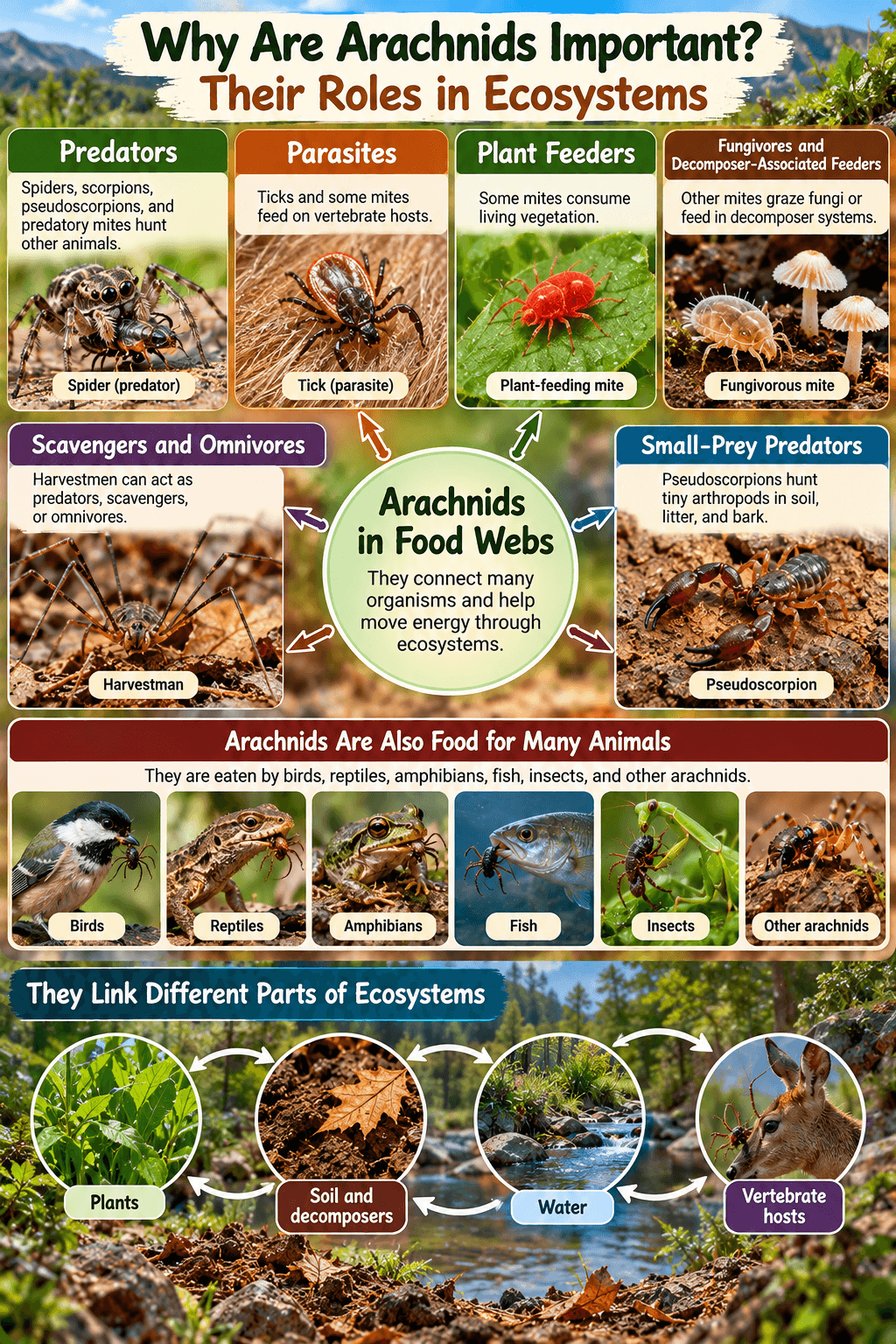
Arachnids contribute to ecosystems as predators, parasites, herbivores, fungivores, scavengers, decomposer-associated feeders, and prey. They influence interactions among insects, fungi, plants, soil organisms, vertebrate hosts, and other predators. Soil mites are particularly important because different species occupy several trophic levels and can affect decomposition, fungal communities, and nutrient transformations. These food-web connections reflect the broader ecological diversity of arachnids rather than one universal ecosystem function.
Spiders are major terrestrial arthropod predators, but their effects vary among ecosystems and prey communities. Scorpions can be both predators and prey. Ticks participate in host-parasite relationships and are themselves consumed by other animals. Harvestmen and pseudoscorpions add additional links through scavenging, omnivory, and small-prey predation. Protecting these ecological relationships is one reason arachnid conservation must consider both species and the habitats that support them.
Arachnids Occupy Many Positions in Food Webs

Predators
Predation is one of the best-known arachnid roles. Spiders capture insects and other arthropods, scorpions consume a wide variety of small animals, pseudoscorpions hunt minute prey such as mites and springtails, and predatory mites attack nematodes, insect eggs, other mites, and small arthropods.
Predators transfer energy from prey populations into larger food-web pathways. They can also change prey behavior even when no prey is killed. An insect that avoids a spider’s web site, for example, may feed, mate, or move differently simply because a predator is present.
These effects are highly context dependent. Predator abundance, prey diversity, habitat complexity, season, alternative food, and other predators all influence the outcome. Ecological importance is therefore better described as participation in trophic interactions than as a guaranteed ability to “control” a particular prey population.
Parasites and host-associated arachnids
Ticks are specialized blood-feeding parasites of vertebrates, and many mites also form parasitic or host-associated relationships. These interactions move energy directly from hosts to arachnids and can affect host behavior, condition, immunity, and population interactions.
Parasites are part of food webs rather than organisms existing outside them. They can be eaten by predators, removed during host grooming, or interact with other parasites and microorganisms on the same host. A review of parasites as prey in food webs emphasizes that parasites can contribute to energy transfer and food-web structure in addition to their direct effects on hosts. Many of these ecological roles begin with the extraordinary range of arachnid diets.
Disease transmission can be medically important in some tick systems, but it is not an ecological “purpose.” From an ecosystem perspective, a tick is a consumer linked to hosts, predators, microbes, climate, vegetation, and off-host habitats.
Herbivores, fungivores, scavengers, and decomposer-associated feeders
Arachnids also include consumers that do not fit the predator-parasite stereotype. Plant-feeding mites remove material from living plants. Fungivorous mites graze fungal hyphae and spores. Harvestmen can consume fungi, fruit, carrion, detritus, and live prey. Some mites and harvestmen use a mixture of foods depending on what is available.
These feeding modes connect arachnids with plant production, decomposition, microbial growth, and dead organic matter. They also create pathways through which carbon and nutrients move between living and decomposing parts of an ecosystem.
Spiders as Generalist Predators
Predation in terrestrial food webs
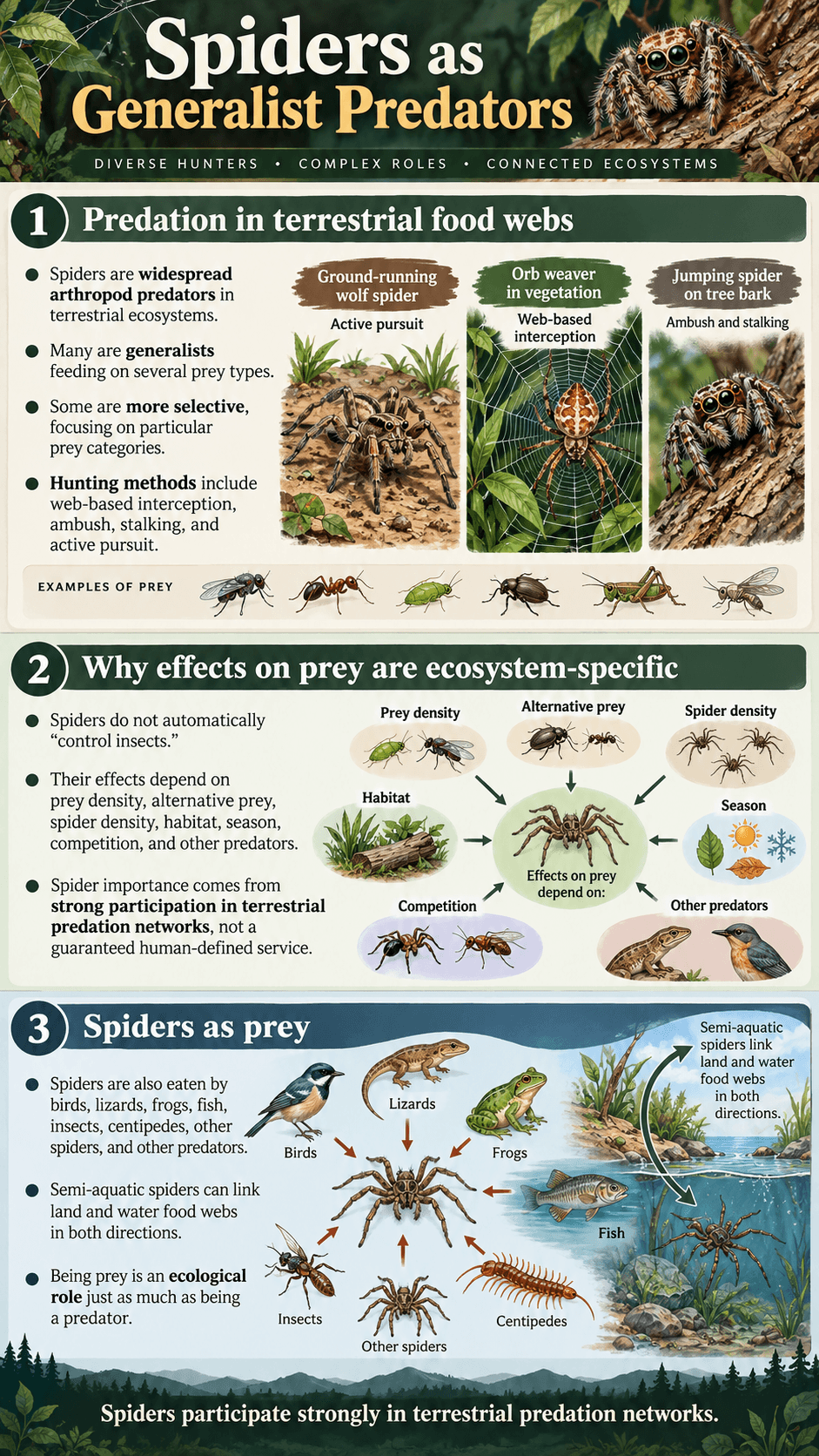
Spiders are among the most widespread arthropod predators in terrestrial ecosystems. Many species are generalists that feed on several prey types rather than specializing on one animal. Others are much more selective and may focus heavily on ants, termites, moths, other spiders, or particular prey categories.
A review of spider ecology and behavior describes spiders as versatile generalist predators found across terrestrial environments. Their hunting methods range from web-based interception and ambush to stalking and active pursuit.
Because spiders differ in size, hunting strategy, activity period, habitat layer, and prey preference, they divide predatory roles among many ecological niches. A ground-running wolf spider does not interact with exactly the same prey community as an orb weaver in vegetation or a jumping spider hunting on tree bark.
Why spider effects on prey are ecosystem-specific
It is tempting to summarize spider ecology by saying spiders “control insects.” The reality is more complicated. Spiders consume many insects, but whether they substantially reduce a particular prey population depends on prey density, alternative prey, spider density, habitat, season, competition, and the presence of other predators.
A review of spiders in biological control notes that generalist predators can suppress some pest populations but can also consume non-pest prey or interact with other natural enemies. The effect is therefore conditional rather than automatic.
This is why ecological explanations should avoid promising that more spiders always produce fewer pests. Spiders are important because they participate strongly in terrestrial predation networks, not because every spider population performs the same human-defined service.
Spiders as prey
Spiders are not only consumers. They are eaten by birds, lizards, frogs, fish, insects, centipedes, other spiders, and several other predators. This makes spider biomass available to animals at higher trophic levels.
Semi-aquatic spiders can connect land and water food webs in both directions. They consume aquatic insects and small aquatic animals, yet they can also be eaten by fish, amphibians, birds, and other predators. A review of semi-aquatic spiders in freshwater food webs describes multiple links across the aquatic-terrestrial boundary.
Being prey is an ecological role just as much as being a predator. Arachnids can transfer energy upward to vertebrates and larger invertebrates that depend on small animal prey.
Mites Are Central to Arachnid Ecology

Soil mites occupy several trophic levels
Mites are among the most ecologically diverse arachnids, and soil mites alone occupy several feeding roles. Some graze fungi, some consume dead organic material or microorganisms, some prey on small animals, and others shift diets among habitats or life stages.
Stable-isotope research on oribatid mites has revealed much more trophic diversity than the old idea that they are simply litter feeders. A 2023 review of oribatid mite trophic ecology identified fungal feeders, primary decomposers, predators or scavengers, lichen feeders, moss feeders, and other dietary categories, with substantial variation among species and sites.
This diversity means soil mites cannot be assigned one ecological job. Different species may connect fungi to predators, fragment organic matter, consume microbial biomass, or feed at higher trophic levels.
Fungal grazing
Fungi are major decomposers in many soils and forest floors. Mites that graze fungal hyphae or spores can influence which fungi grow, how fungal biomass is distributed, and how microbes interact with dead plant material.
Grazing does not always simply reduce fungal abundance. Partial grazing can stimulate regrowth, alter competition among fungi, or disperse spores. The outcome depends on mite species, fungal species, litter chemistry, moisture, and grazing intensity.
These interactions place mites in a feedback system with decomposers. Fungi process organic matter, mites consume fungal tissue, and predators can then consume the mites. Energy moves from dead plant material through microbes into small animals and onward through the soil food web.
Decomposition and nutrient transformations
Microarthropods can influence decomposition by fragmenting litter, feeding on microbes, redistributing fungal spores, and changing microbial activity. Their effects are often indirect rather than equivalent to the chemical breakdown carried out by bacteria and fungi.
An experiment with the oribatid mite Scheloribates moestus found that the mite altered litter chemistry, nitrogen availability, and decomposition-related processes. The study of oribatid mites and nutrient cycling demonstrates that even one mite species can influence chemical transformations during decomposition.
It would still be inaccurate to say “mites decompose leaves” as though every mite performs the same function. Soil decomposition is produced by interacting fungi, bacteria, animals, chemistry, climate, and plant material. Mites participate in that network rather than replacing microbial decomposers.
Plant-Associated Mites
Plant feeding
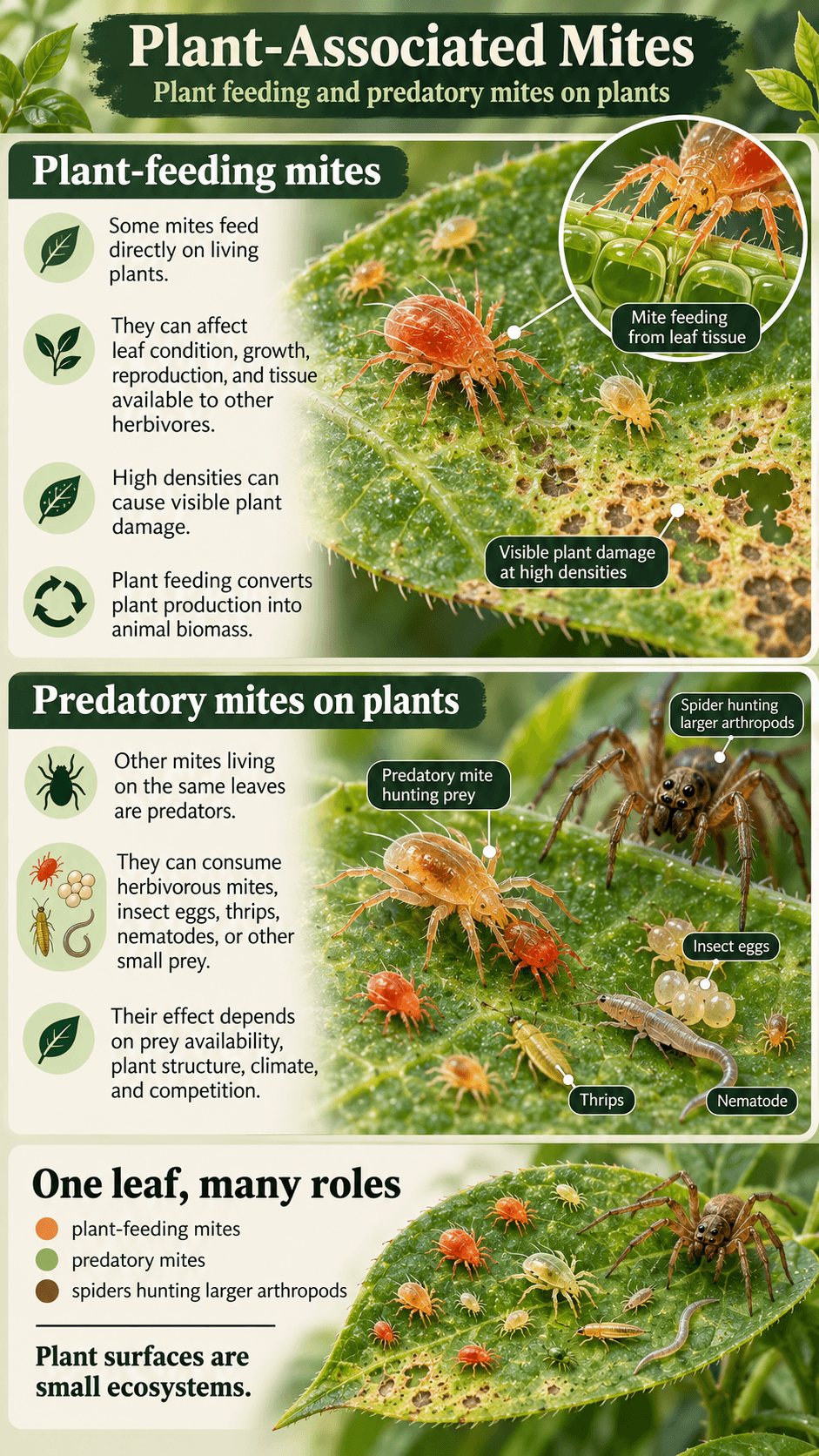
Some mites feed directly on living plants. By piercing cells or removing plant fluids, they can affect leaf condition, growth, reproduction, and the amount of tissue available to other herbivores. High densities of certain species can cause visible plant damage, while other plant-feeding mites remain part of natural herbivore communities at lower densities.
Herbivory is an ecological interaction even when humans dislike its effects on crops or ornamental plants. A plant-feeding mite converts plant production into animal biomass, which can then support predators and parasitoids higher in the food web.
Predatory mites on plants
Other mites living on the same leaves are predators. They can consume herbivorous mites, insect eggs, thrips, nematodes, or other small prey. Their effect depends on prey availability, plant structure, climate, and competition.
This means a single leaf can host arachnids in several trophic roles at once: plant-feeding mites, predatory mites, and spiders that hunt larger arthropods. Plant surfaces are small ecosystems rather than simple feeding sites.
Scorpions as Predators and Prey
Middle and upper positions in local food webs
Scorpions are predators of insects, spiders, other arachnids, and additional small animals, but calling every scorpion a top predator would be inaccurate. Their trophic position varies with body size, habitat, prey community, and which larger predators share the ecosystem.
Some scorpions can be important nocturnal predators in arid and tropical systems. Others occupy forest litter, caves, grasslands, or humid habitats and interact with very different food webs.
Scorpions are also food
Birds, mammals, reptiles, amphibians, centipedes, spiders, and other predators can consume scorpions. Juveniles are especially vulnerable because of their small size, but adults can also be prey.
This two-way role is ecologically important. Scorpions transfer energy from smaller prey into their own biomass, then become a resource for animals capable of overcoming their pincers, sting, armor, or defensive behavior.
Harvestmen as Omnivores, Scavengers, and Prey
Flexible feeding creates multiple links
Harvestmen are especially interesting because many can eat solid food and use a wider range of resources than fluid-feeding spiders. Depending on species, they may consume live invertebrates, carrion, fungi, fruit, plant tissue, or detritus.
A 2025 Journal of Arachnology study describes harvestmen as generally considered omnivorous and uses stable isotopes and fecal evidence to investigate trophic position. The broader literature indicates substantial diet variation among lineages and habitats.
That flexibility means harvestmen can connect several parts of a food web. One individual may function as a predator during one feeding event and a scavenger during another.
Harvestmen support predators too
Harvestmen themselves are eaten by spiders, insects, amphibians, reptiles, birds, fish, and mammals. A Journal of Arachnology research on harvestman diet and predators documented both varied feeding and a broad set of natural enemies.
The combination of omnivory and vulnerability to many predators makes harvestmen connectors between detrital, fungal, invertebrate, and vertebrate pathways.
Pseudoscorpions and Other Small Predatory Arachnids
Tiny predators in litter, bark, soil, and crevices
Pseudoscorpions are small predators that consume mites, springtails, flies, beetles, and other minute arthropods. They live in leaf litter, bark, stones, caves, nests, and other terrestrial microhabitats.
The American Arachnological Society profile of pseudoscorpions describes the group as predatory and widespread across terrestrial environments. Their small size places them inside food-web layers that are largely invisible without close sampling.
These predators should not be promoted as guaranteed household pest-control agents. Their ecological importance comes from participation in microarthropod communities, not from a promise to eliminate organisms people dislike.
Small predators can still matter
Food webs are built from many small interactions. A pseudoscorpion consuming a mite, a predatory mite feeding on a nematode, or a tiny spider eating a springtail may seem minor individually, but repeated interactions across thousands of animals can shape local energy flow and community structure.
Ecological effects depend on abundance and context. Tiny body size does not mean an organism is ecologically irrelevant.
Ticks as Parasites and Food-Web Participants
Host-parasite relationships
Ticks obtain blood from vertebrate hosts and therefore occupy a parasitic trophic role. Their populations are linked to host abundance, host behavior, climate, vegetation, and the survival of off-host life stages. The ecological effect of a species also depends strongly on arachnid habitats and the community surrounding it.
Ticks can affect hosts through blood loss, irritation, immune responses, and pathogen transmission in some systems. Yet parasite-host interactions also need to be understood within broader ecological communities rather than only as medical events.
Different ticks use different host ranges, and host specialization can change by region or life stage. This variability makes tick ecology a network problem involving many potential hosts rather than a simple one-parasite, one-host relationship.
Ticks can also be eaten
Ticks are prey for ants, beetles, spiders, birds, and other animals, although predation rates and population effects vary among habitats. Engorged ticks can be particularly vulnerable because they are larger and less mobile.
Being consumed returns parasite biomass to the wider food web. This reinforces the point that parasites are not ecological dead ends. They are both consumers and potential food for other organisms.
Arachnids Connect Soil, Plants, Water, and Vertebrates
Soil-to-surface connections
Soil mites, pseudoscorpions, small spiders, and harvestmen feed within litter and soil communities, while larger predators feed on them from above. Organic matter entering soil from plants can pass through fungi and microbes to mites, then to predators.
These pathways connect decomposition with aboveground food webs. A bird eating a spider or harvestman may ultimately receive energy that entered the system through plant litter and microbial processing.
Plant-to-predator connections
Plant-feeding mites convert living plant tissue into animal biomass. Predatory mites, spiders, insects, and other consumers can then feed on those herbivores. This creates short but important chains linking primary production to predators.
Again, the effect is not always simple suppression. Predators may switch prey, herbivores may move to safer parts of the plant, and plant chemistry can affect both herbivores and their enemies.
Aquatic-terrestrial links
Water-associated spiders and mites can connect aquatic and terrestrial communities. Aquatic insect larvae develop in water, emerge as adults, and become food for riparian spiders. Some spiders also capture aquatic prey directly, while fish and amphibians may consume spiders at the shoreline.
These cross-boundary interactions move nutrients and biomass between streams, ponds, wetlands, and surrounding land.
Nutrient Cycling and Decomposition
Mites as microarthropod participants
Nutrient cycling describes the movement and transformation of elements such as carbon, nitrogen, phosphorus, and calcium through living organisms, dead material, soil, water, and the atmosphere. Arachnids contribute mainly by feeding, excreting, dying, being eaten, and interacting with microbes and organic matter.
Soil mites are especially relevant because many feed directly on fungi, microbial films, or detritus-associated resources. Grazing can change microbial biomass and activity, while fragmentation can increase the surface area available to decomposers.
Some oribatid mites also move fungal spores and other microbes through soil and litter. These actions can change where decomposer organisms establish and how litter is processed.
Why arachnids are not the sole drivers of decomposition
Fungi and bacteria perform much of the chemical decomposition of dead organic matter. Earthworms, insects, millipedes, nematodes, protists, and other organisms also participate. Arachnids are one component of a much larger decomposer network.
Their importance lies in modifying interactions within that network. By grazing fungi, consuming smaller decomposers, fragmenting material, and becoming prey, arachnids help redistribute energy and nutrients without functioning as a single master control on decomposition.
Why “Good Bugs That Kill Pests” Is Too Narrow
Ecological importance is not the same as human usefulness
Calling spiders “good” because they eat pests can be an effective way to reduce fear, but it also narrows ecology to human convenience. A spider eating a native moth, a mite feeding on a plant, or a tick parasitizing a deer may be just as ecologically real as a predator consuming an agricultural pest.
Nature is not organized around categories such as beneficial and harmful. Those labels describe human interests. Food webs instead describe who consumes whom, how energy moves, and how organisms influence one another.
Effects vary among ecosystems
A predator that reduces one prey population in a crop field may have little effect on the same prey in a forest. A mite that contributes strongly to decomposition in one litter type may have a smaller effect where different fungi, climate, or soil chemistry dominate.
Ecological claims therefore need scale and context. Arachnids are important because they participate repeatedly in many interactions, not because every species produces the same measurable outcome everywhere.
Common Myths About Arachnid Ecology
All arachnids are predators
No. Arachnids include blood-feeding parasites, plant-feeding mites, fungivores, scavengers, omnivores, and decomposer-associated feeders in addition to predators.
Spiders always control insect populations
Spiders consume large numbers of arthropods and can influence prey populations and behavior, but the strength of those effects varies with habitat, prey density, alternative prey, spider community composition, and other predators. There is no guaranteed universal control effect.
Mites are mostly pests
No. Mites occupy many ecological roles, including fungal feeding, decomposition-associated feeding, predation, herbivory, parasitism, scavenging, and aquatic feeding. Many never interact directly with people.
Ticks are ecologically useless
Ticks are parasites, and some transmit pathogens, but that does not place them outside ecology. They consume host resources, interact with host immunity and behavior, support predators, and participate in complex communities of microbes, vertebrates, vegetation, and climate-driven processes.
How Arachnid Roles Change with Habitat and Community
Forest, grassland, desert, soil, and freshwater differences
A forest-floor mite interacts with fungi and litter in ways that differ from a plant-feeding mite on a crop leaf. A riparian spider links aquatic insects with shoreline predators, while a desert scorpion participates in a nocturnal terrestrial food web. Habitat changes the available food, predators, competitors, moisture, temperature, and shelter.
The same broad feeding role can therefore produce different ecological effects in different environments.
Species identity matters
Even closely related arachnids can occupy different trophic positions. Some spiders specialize on certain prey while others are generalists. Some mites are fungal feeders while close relatives are predators. Some harvestmen rely heavily on animal prey while others consume more fungi or plant material.
Ecology becomes more accurate when claims are tied to species, guilds, and habitats instead of treating an entire arachnid order as one functional unit.
FAQ
Why are spiders important in ecosystems?
Spiders are widespread terrestrial predators that consume many kinds of arthropods and sometimes other small animals. They can influence prey abundance and behavior and are themselves food for birds, reptiles, amphibians, fish, insects, and other predators. Their effects vary among ecosystems and should not be reduced to a universal pest-control claim.
Why are mites important?
Mites occupy many ecological roles. Soil mites can graze fungi, consume organic material, prey on smaller animals, and participate in decomposition-related nutrient cycling. Plant-feeding mites connect plants to predators, parasitic mites interact with hosts, and aquatic mites occupy freshwater food webs.
Do arachnids help decomposition?
Some do, especially soil mites and other detritus-associated arachnids. Their main effects often come from fragmenting material, feeding on fungi and microbes, moving spores, and changing microbial activity. Fungi and bacteria remain major chemical decomposers, so arachnids are participants in a larger decomposition network.
Are scorpions important to food webs?
Yes. Scorpions consume insects, spiders, other arachnids, and additional small animals, and they are also eaten by birds, mammals, reptiles, amphibians, centipedes, and other predators. Their exact trophic importance depends on species and habitat.
Do ticks have an ecological role?
Ticks are blood-feeding parasites linked to vertebrate hosts, predators, microbes, climate, and vegetation. They can affect hosts and are also consumed by other animals. Describing those relationships does not imply that disease transmission is an ecological purpose; it simply places ticks within broader food webs and host-parasite networks.
Final Thoughts
Arachnids matter because they connect many parts of ecosystems. Spiders, scorpions, pseudoscorpions, and predatory mites consume other animals. Ticks and parasitic mites draw resources from hosts. Plant-feeding mites interact with vegetation. Fungivorous and detritus-associated mites connect microbes and dead organic matter with soil food webs. Harvestmen can shift among predation, scavenging, fungi, plants, and detritus. All of these arachnids can also become food for other organisms.
The most useful ecological view is therefore not “arachnids are good because they kill pests.” It is that arachnids occupy many trophic positions and move energy through food webs above ground, below ground, on plants, on hosts, and at the edges of freshwater systems. Their diversity makes them important not through one universal service, but through thousands of species-specific interactions that help build functioning ecological communities.

Ethan Walker is the founder and research editor of Animal Fact Central. He creates and reviews educational animal facts content using trusted wildlife, pet care, and science-based sources. His work focuses on making animal behavior, adaptations, habitats, and species facts clear, accurate, and engaging for everyday readers.
Read More Details About Ethan Walker: https://animalfactcentral.com/ethan-walker/