
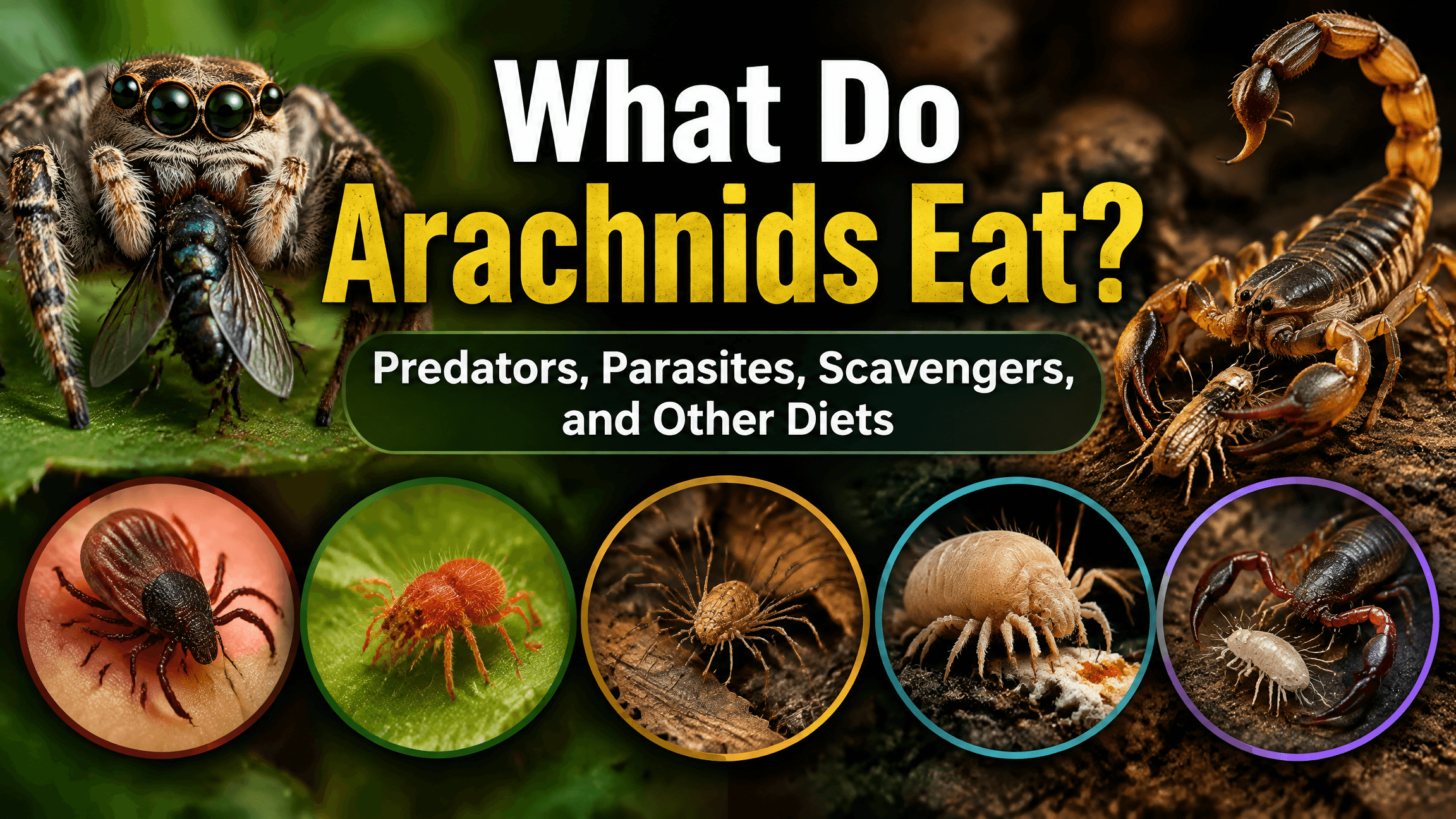
Arachnids do not all eat the same kind of food. Spiders and scorpions are mostly predators, ticks are specialized blood feeders, many mites eat plants or fungi, other mites prey on tiny animals, and harvestmen can combine predation, scavenging, fungi, plant material, and other foods. Some arachnids are parasites, some are detritus-associated feeders, and a few lineages use diets that do not fit the familiar image of a venomous hunter.
That variety matters because “arachnid diet” is often reduced to what spiders eat. Spiders are important examples, but they are only one part of Arachnida. Looking across the group reveals feeding strategies shaped by body size, mouthparts, habitat, prey availability, host relationships, and the ability to process solid or liquid food.
Quick Answer
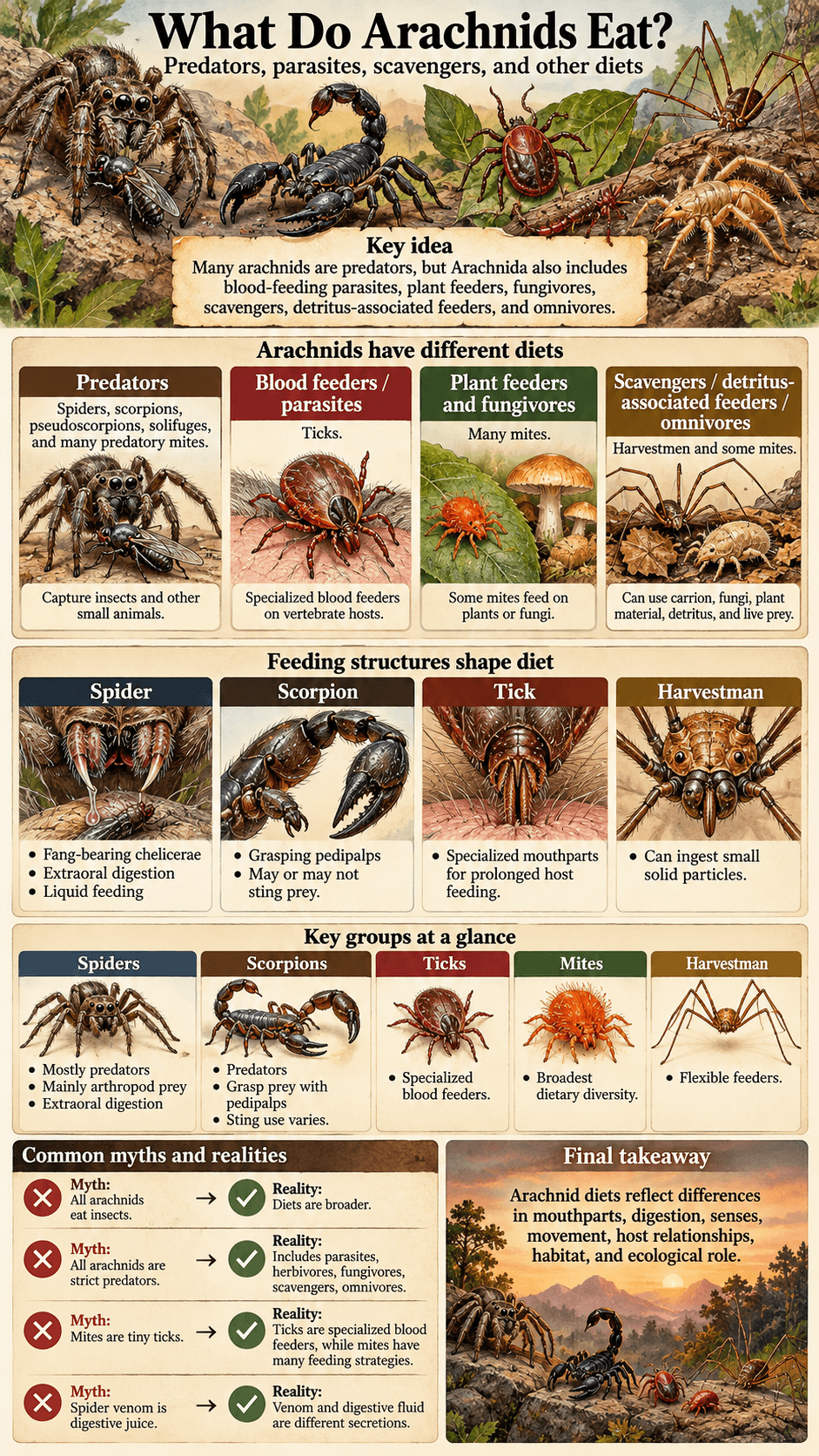
Many arachnids are predators of insects and other small animals, but the group also includes blood-feeding parasites, plant feeders, fungivores, scavengers, detritus-associated feeders, and omnivores. Spiders generally rely on liquid feeding after extraoral digestion. Scorpions grasp prey with their pedipalps and may or may not sting it. Ticks take blood meals from vertebrate hosts. Mites show some of the broadest dietary diversity in Arachnida, while harvestmen are unusually flexible because many can ingest solid food particles. This dietary variety is part of the much broader ecological diversity found across arachnids.
No single menu defines an arachnid. Diet has diversified along with anatomy and habitat, so the best answer depends on which arachnid group is being discussed.
Arachnid Diets Are More Diverse Than the Predator Stereotype
Predation
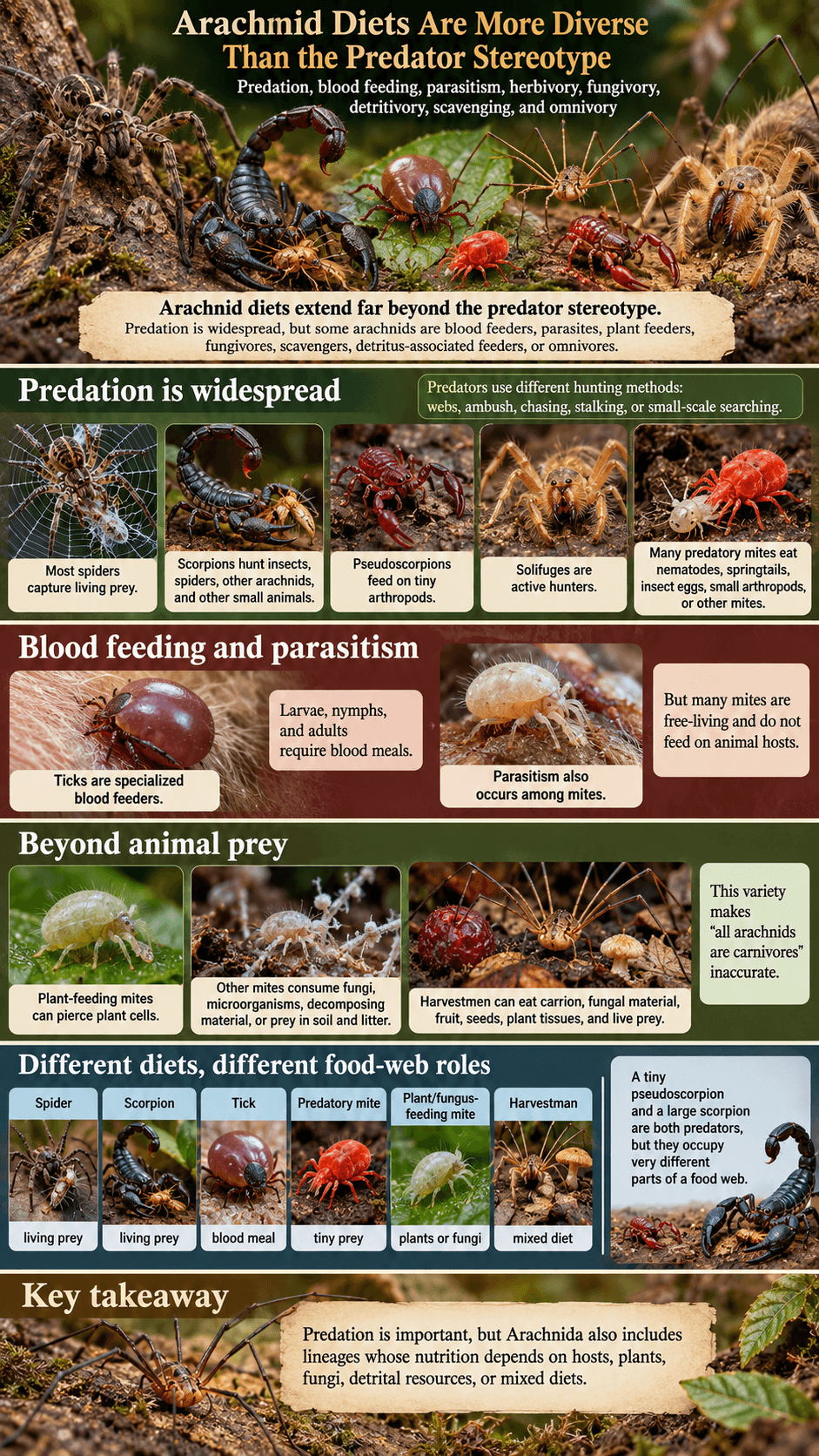
Predation is widespread among arachnids. Most spiders capture living prey, often insects or other arthropods. Scorpions hunt insects, spiders, other arachnids, and additional small animals. Pseudoscorpions feed on tiny arthropods, and solifuges are active hunters. Many predatory mites consume nematodes, springtails, insect eggs, small arthropods, or other mites. Comparing the major arachnid groups makes it clear why no single diet can represent the class.
Predation does not require one standard hunting method. A spider may intercept prey in a web, ambush from vegetation, chase across the ground, or stalk visually. A scorpion can seize prey with its pedipalps. A predatory mite searches at a much smaller spatial scale through soil, leaves, or other microhabitats.
Even among predators, prey size and prey type vary with the predator’s own body size and feeding structures. A tiny pseudoscorpion and a large scorpion are both predators, but they occupy very different parts of a food web.
Blood feeding and parasitism
Ticks are the clearest example of specialized blood feeding among arachnids. Their active life stages attach to vertebrate hosts and take blood meals needed for development, survival, and reproduction. The CDC overview of tick life cycles notes that larvae, nymphs, and adults require blood meals, although the number and identity of hosts vary among tick species.
Parasitism also occurs among mites. Some mites feed on animals, while others live on or within hosts in more specialized relationships. Host association does not define mites as a whole, however. Many mites are completely free-living and never feed on animal hosts.
Herbivory, fungivory, detritivory, scavenging, and omnivory
Arachnid diets extend well beyond animal tissue. Plant-feeding mites can pierce plant cells and remove their contents. Other mites consume fungi, microorganisms, decomposing material, or prey associated with soil and litter. Harvestmen can eat carrion, fungal material, fruit, seeds, plant tissues, and live prey depending on the species and opportunity.
A Journal of Arachnology review documented harvestmen and spiders feeding on fungi, fruits, and seeds. Harvestmen showed especially broad solid-food feeding, whereas plant-derived foods recorded for spiders more often involved liquids such as nectar, sap, or other accessible fluids.
This variety makes “all arachnids are carnivores” inaccurate. Predation is important, but Arachnida also includes lineages whose nutrition depends on hosts, plants, fungi, detrital resources, or mixed diets.
How Arachnid Feeding Structures Shape Diet
Chelicerae, pedipalps, mouthpart complexes, and extraoral digestion
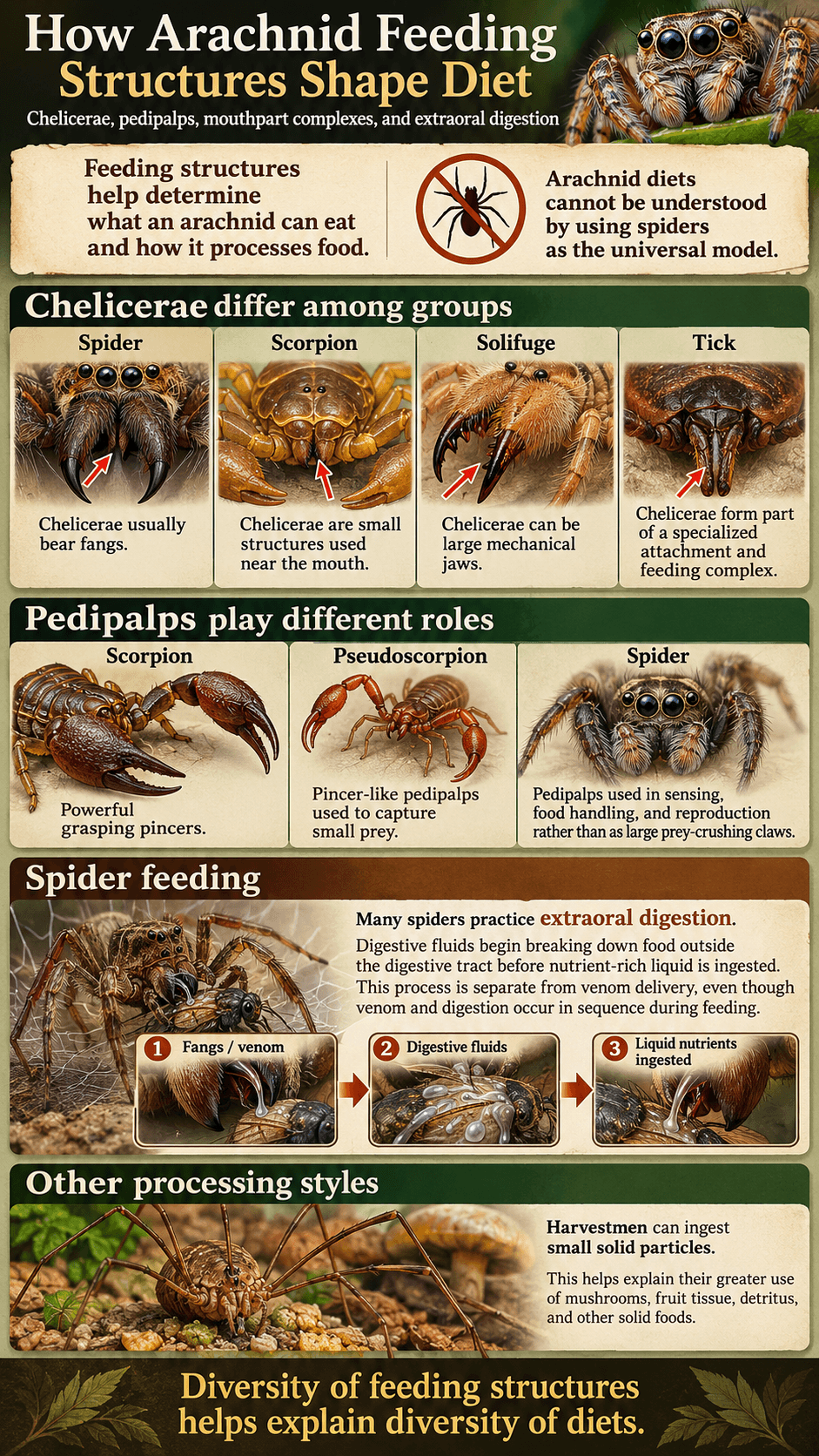
Feeding structures help determine what an arachnid can eat and how it processes food. Chelicerae are the first pair of feeding appendages in chelicerates, but they differ greatly among groups. Spider chelicerae usually bear fangs, scorpion chelicerae are small structures used near the mouth, solifuge chelicerae can be large mechanical jaws, and tick chelicerae form part of a specialized attachment and feeding complex. What each group can eat is closely connected to arachnid anatomy, especially the form of the chelicerae, pedipalps, and mouthparts.
Pedipalps also play different roles. Scorpion pedipalps form powerful grasping pincers. Pseudoscorpions use pincer-like pedipalps to capture small prey. Spiders generally use pedipalps in sensing, food handling, and reproduction rather than as large prey-crushing claws.
Many spiders practice extraoral digestion, meaning digestive fluids begin breaking down food outside the digestive tract before nutrient-rich liquid is ingested. Research on spider digestive fluids and extraoral digestion shows that digestive secretions contain enzymes specialized for breaking down prey tissues. This process is separate from venom delivery even though venom and digestion occur in sequence during feeding.
Other arachnids process food differently. Harvestmen can ingest small solid particles, which helps explain their greater use of mushrooms, fruit tissue, detritus, and other solid foods. The diversity of feeding structures is one reason arachnid diets cannot be understood by using spiders as the universal model.
Spiders as Predators with Important Exceptions
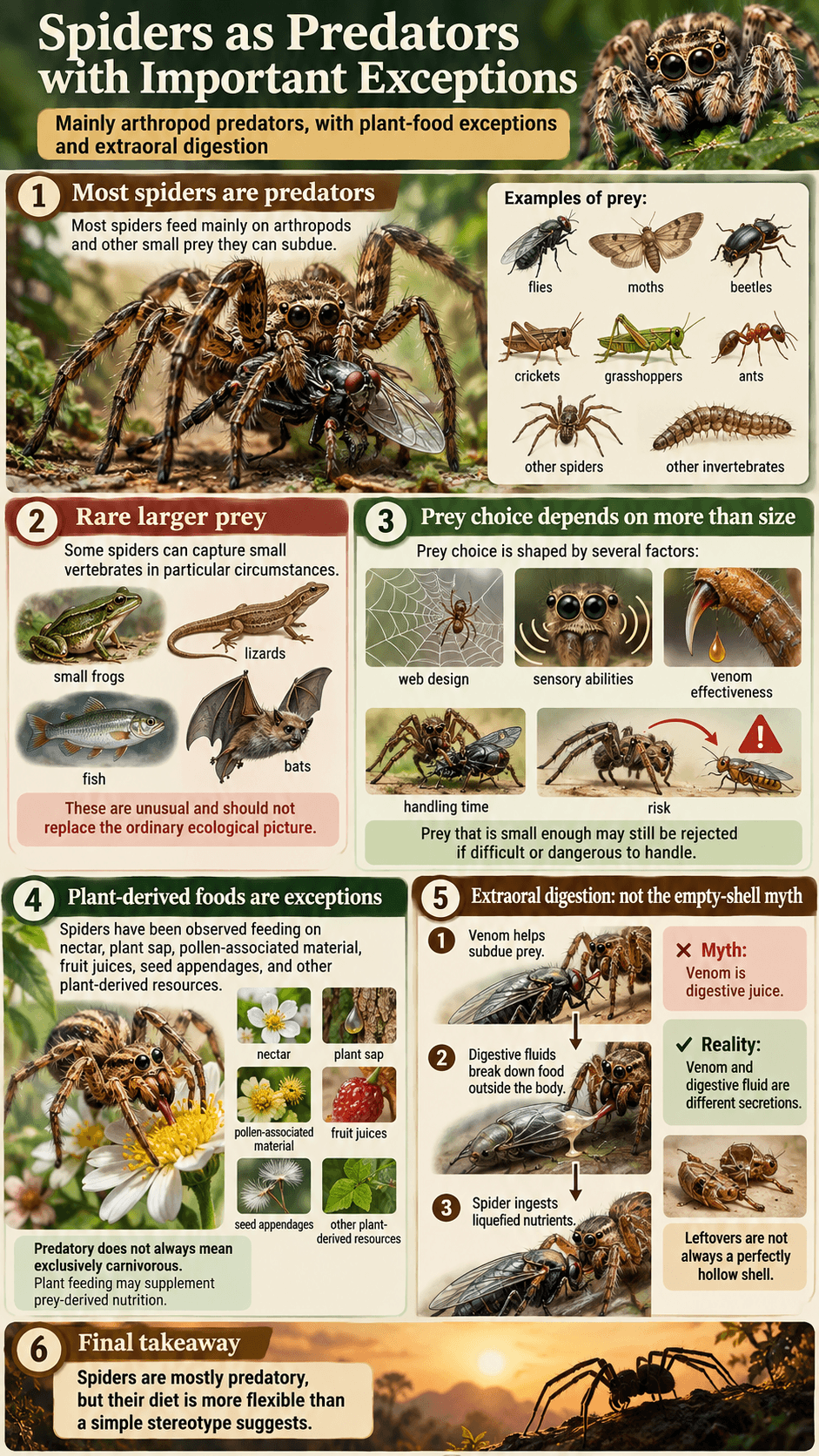
Arthropod prey and selected vertebrate prey
Most spiders are predators, and arthropods form much of the prey recorded for the group. Flies, moths, beetles, crickets, grasshoppers, ants, other spiders, and many additional invertebrates can become prey depending on the spider’s size, hunting method, and habitat.
Some spiders also capture small vertebrates such as tiny frogs, lizards, fish, bats, or other animals in particular circumstances. Those observations are biologically real but can become overrepresented in viral media because they are unusual and visually dramatic. They should not replace the ordinary ecological picture of spiders feeding mainly on arthropods and other small prey they can subdue.
Spider prey choice is also constrained by web design, sensory abilities, venom effectiveness, handling time, and risk. A prey item that is technically small enough to attack may still be rejected if it is difficult to restrain or dangerous to handle.
Plant-derived foods and other dietary exceptions
Predatory does not always mean exclusively carnivorous. Spiders have been observed feeding on nectar, plant sap, pollen-associated material, fruit juices, seed appendages, and other plant-derived resources. One famous salticid, Bagheera kiplingi, obtains an unusually large portion of its nutrition from plant resources, although it is not a model for spiders in general.
Plant feeding may supplement prey-derived nutrition by providing sugars, moisture, or other nutrients. Its importance varies among species and environments. A spider sipping nectar is still a member of a predominantly predatory lineage, and the occasional use of plant food does not turn most spiders into herbivores.
Extraoral digestion without the empty-shell myth
Spiders are often described as injecting digestive juice into prey and sucking out everything until only an empty shell remains. That image is too simple. Different spiders process prey in different ways, and digestive fluid may be applied externally, worked through damaged tissues, or repeatedly taken up and reapplied during feeding.
Venom and digestive fluid also serve different functions. Venom mainly helps immobilize or subdue prey and begins physiological effects after delivery through the fangs. Digestive secretions contain enzymes that break food into material the spider can ingest. Calling venom “digestive juice” merges two distinct secretions.
After feeding, substantial indigestible material can remain, especially hard cuticle. But the leftover prey is not always a perfectly hollow exoskeleton. How much remains and what it looks like depends on prey type and the spider’s feeding mechanics.
Scorpion Feeding
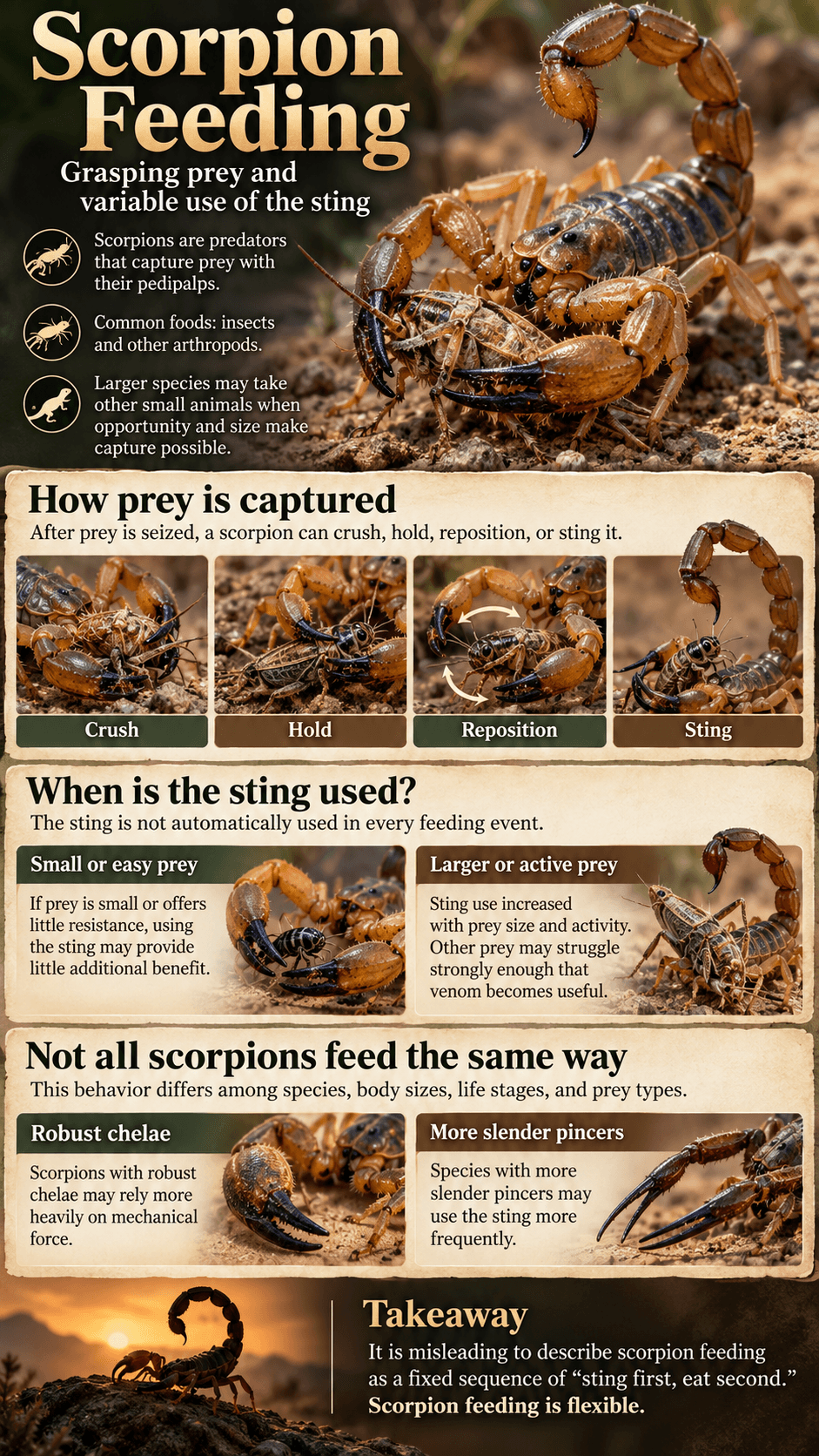
Grasping prey and variable use of the sting
Scorpions are predators that capture prey with their pedipalps. Insects and other arthropods are common foods, and larger species may take other small animals when opportunity and size make capture possible. Once prey is seized, the scorpion can crush, hold, reposition, or sting it.
The sting is not automatically used in every feeding event. Experiments on Hadrurus spadix found that sting use increased with prey size and activity. The Journal of Arachnology study of selective scorpion sting use supports the idea that scorpions can reserve venom for prey that is harder to overpower mechanically.
Why scorpions do not always sting prey first
A scorpion’s pincers can already provide substantial control over prey. If the prey is small or offers little resistance, using the sting may provide little additional benefit. Other prey may struggle strongly enough that venom becomes useful.
This behavior differs among species, body sizes, life stages, and prey types. Scorpions with robust chelae may rely more heavily on mechanical force than species with more slender pincers. It is therefore misleading to describe scorpion feeding as a fixed sequence of “sting first, eat second.”
Ticks as Specialized Blood Feeders
Ectoparasitism and host feeding
Ticks are ectoparasites, meaning they feed from the outside of a host’s body. After locating a suitable attachment site, a tick cuts into the skin and inserts specialized mouthparts. Hard ticks can remain attached for extended feeding periods, while some soft ticks feed much more rapidly.
Blood supplies proteins, lipids, water, and other nutrients required by the tick. The feeding event is central to development: active stages must obtain a blood meal before progressing through the life cycle or, in adults, supporting reproduction.
Life-stage and host variation
Different tick species use different host patterns. Some remain on one host through multiple stages, while others use two, three, or multiple hosts. Larvae, nymphs, and adults can also differ in the host species they most often encounter.
Ticks can feed on mammals, birds, reptiles, and amphibians. Host use is not identical across all ticks, and a species may have broad preferences or be much more specialized. That variation is why “ticks feed on humans” is an incomplete biological description. Humans are only one possible host for certain species and life stages.
Why this section is biology, not disease guidance
Tick feeding has major medical and veterinary importance because pathogens can be transmitted during blood feeding, but disease transmission is not the subject needed to understand arachnid diet. From a feeding-ecology perspective, the defining point is that ticks are highly specialized blood-feeding arachnids with life cycles built around finding vertebrate hosts.
Keeping that distinction clear also prevents the rest of Acari from being interpreted through a medical lens. Ticks are one branch of a much larger and more ecologically varied mite-and-tick radiation.
Mite Feeding Diversity
Predatory mites
Many mites are predators. Soil-dwelling predatory mites can feed on nematodes, springtails, insect eggs, small arthropods, and other mites. An USDA Agricultural Research Service summary of soil predatory mites describes a broad prey range that includes free-living nematodes, springtails, and insect eggs.
Predatory mites operate at a scale that is easy to overlook. In soil, litter, bark, nests, and plant surfaces, they can be important consumers of organisms that are themselves tiny. Their prey base is therefore very different from the insects commonly associated with spider or scorpion predation.
Plant-feeding and fungivorous mites
Other mites feed directly on plants. Spider mites and flat mites can pierce plant cells and remove their contents, producing visible injury when populations become high. A USDA summary of plant-feeding flat mites describes Tenuipalpidae as plant feeders that include economically important species on crops, fruit trees, and ornamentals.
Fungivory is also widespread in mite ecology. Some mites graze fungal spores, hyphae, or other fungal resources, and their relationships with fungi can be complex. In bark-beetle systems, for example, mites may consume fungi, transport spores, compete with fungi, or influence interactions among insects and microbes.
Detritivorous, parasitic, and other host-associated mites
Many soil and litter mites feed in decomposer-associated systems. They may consume decaying organic material directly, graze on microorganisms growing on that material, or prey on other decomposer organisms. Calling every one of these species a strict “detritivore” can oversimplify what is often a mixed microbial and organic diet.
Parasitic and host-associated mites add another set of feeding strategies. Some take fluids or tissues from animals, others live with insects or vertebrates in more specialized ways, and still others use hosts mainly for transport rather than food. The word “mite” therefore describes a taxonomic grouping, not one ecological role.
Harvestmen as Flexible Feeders
Predation, scavenging, omnivory, plant and fungal material
Harvestmen are unusually flexible feeders among familiar arachnids because many can ingest solid particles rather than relying entirely on liquid food. They may prey on small invertebrates, scavenge dead animals, consume fungi, eat fruit or other plant tissues, and use detrital material.
A 2025 Journal of Arachnology study described harvestmen as generally considered omnivorous and noted records of invertebrates, small vertebrates, plant tissue, fungi, and detritus in the broader group. The actual balance differs among species, and quantitative diet data remain limited for many harvestmen.
This flexibility helps explain why harvestmen do not fit the stereotype of an arachnid waiting to inject venom into prey. They lack spider-style venom fangs, and many forage by encountering a wide range of edible material in litter, vegetation, bark, or damp ground.
Pseudoscorpions, Solifuges, and Other Predatory Arachnids
Small-prey hunting and chewing mechanics in context
Pseudoscorpions are small predators that can capture mites, springtails, tiny insects, larvae, and other small arthropods with their pincer-like pedipalps. Their scale matters: what looks like a minute animal to a person can still be a substantial predator within bark crevices, litter, nests, or soil pores.
Solifuges are also predators. Their large chelicerae allow them to seize and mechanically process prey. In contrast to spiders, they do not depend on the same fang-and-liquid-feeding system, and the large jaws contribute directly to breaking food apart.
Tailless whip spiders and vinegaroons are additional examples of arachnid predators with strongly modified pedipalps. Their hunting methods differ, but they reinforce a larger point: predatory arachnids do not all capture or process food the way spiders do.
Why giant-prey viral stories mislead
Large or unusual predation events are disproportionately likely to be photographed and shared. A solifuge eating an unusually large prey item or a spider capturing a vertebrate can become more visible online than thousands of ordinary feeding events involving insects and other arthropods.
These observations can be valuable natural-history records, but they should not be turned into the default diet of an entire group. The most representative diet is determined by repeated observations, gut-content evidence, stable isotopes, field studies, and other systematic methods rather than by the most dramatic photograph.
Feeding Myths and Mistakes
All arachnids eat insects
Many arachnids do eat insects, but insects are only one food category. Ticks feed on vertebrate blood. Some mites feed on plants, fungi, detritus-associated resources, or hosts. Harvestmen may consume fruit, fungi, carrion, and other material. Predatory arachnids can also eat non-insect arthropods.
All arachnids are strict predators
Predation is widespread but not universal. Arachnida includes parasites, blood feeders, herbivores, fungivores, scavengers, omnivores, and decomposer-associated feeders. Even within predominantly predatory spiders, supplemental plant feeding has been documented.
Mites are tiny ticks
Ticks and mites are related within the broader acarological diversity, but a tick is not simply a large mite with the same lifestyle. Ticks are specialized blood feeders. Mites span far more feeding strategies, including predation, plant feeding, fungal feeding, parasitism, and decomposition-associated diets.
Spider venom is digestive juice
Venom and digestive fluid are different secretions. Venom is delivered through spider fangs and primarily helps subdue prey. Digestive fluid contains enzymes that break down food during extraoral digestion. Some molecular components can overlap, but that does not make the two fluids biologically interchangeable.
How Feeding Links Anatomy, Behavior, and Ecology
Feeding anatomy
Diet is constrained by structures. A spider’s fang-bearing chelicerae and narrow mouth favor liquid feeding. A scorpion can restrain prey with pedipalps and process it with smaller chelicerae. A tick has mouthparts specialized for prolonged host attachment. A harvestman can take solid particles. Mite mouthparts vary with plant feeding, predation, parasitism, and other diets.
These differences are why one feeding mechanism cannot be used to explain Arachnida. Shared chelicerate ancestry provides the basic appendages, but each lineage modifies them for different nutritional problems.
Hunting behavior and senses
Finding food depends on information. Web spiders monitor vibration, visual hunters track prey with their eyes, scorpions detect substrate disturbances, ticks respond to host-related environmental cues, and tiny mites navigate chemical and physical gradients at close range. Finding and obtaining food also depends on arachnid behavior, including ambush, active pursuit, host seeking, and scavenging.
Feeding behavior begins before contact with food. Sensory systems determine what an arachnid notices, movement brings it into position, and capture or attachment structures determine what happens next.
Ecosystem roles and host relationships
Diet places arachnids into many positions in food webs. Predatory spiders, scorpions, pseudoscorpions, and mites consume other animals. Ticks and parasitic mites draw resources from hosts. Plant-feeding mites interact directly with vegetation. Fungivorous and decomposer-associated mites connect with microbial and litter systems. Harvestmen can move among several trophic roles.
Those roles should not be judged only by whether humans consider a species helpful or harmful. Feeding ecology describes how energy and nutrients move through ecosystems, including relationships that may be inconvenient, medically relevant, or economically important to people. These feeding differences place arachnids in many food-web roles and help explain their ecological importance.
FAQ
Do all arachnids eat insects?
No. Insects are common prey for many spiders, scorpions, pseudoscorpions, and other predators, but arachnid diets are much broader. Ticks feed on blood, plant-feeding mites consume plant cells, fungivorous mites and harvestmen use fungal resources, and harvestmen may also scavenge or eat plant material.
Do spiders drink their prey?
Spiders are primarily liquid feeders, but “drinking prey” is an oversimplification. They use extraoral digestion to break down prey tissues and then ingest liquefied nutrients. Depending on the spider and prey, digestive fluid can be applied and re-ingested in complex ways rather than simply sucking an untouched liquid interior from a hollow shell.
What do mites eat?
There is no single mite diet. Some mites prey on nematodes, insects, springtails, or other mites. Others feed on plants, fungi, decaying material, microorganisms, or animal hosts. Mite feeding diversity is one of the strongest reasons not to describe all arachnids as predators.
What do ticks eat?
Ticks are specialized blood feeders. Larvae, nymphs, and adults obtain blood meals from vertebrate hosts, with host patterns varying by tick species and life stage. Mammals, birds, reptiles, and amphibians can all serve as hosts for different ticks.
Do harvestmen eat plants?
Some do. Harvestmen are often omnivorous and can consume plant tissues, fruits, seeds or seed appendages, fungi, detritus, carrion, and live invertebrate prey. The exact diet varies among species and habitats, so plant feeding is part of their broader dietary flexibility rather than a universal rule.
Final Thoughts
What arachnids eat depends on which arachnid you mean. Predation dominates in spiders, scorpions, pseudoscorpions, solifuges, and many mites, but it is only part of the picture. Ticks specialize in blood feeding. Mites span predation, herbivory, fungivory, parasitism, and decomposer-associated feeding. Harvestmen can combine animal prey, carrion, fungi, plant material, and detritus.
That feeding diversity is more informative than the stereotype of arachnids as venomous insect hunters. Their diets reflect differences in mouthparts, digestion, senses, movement, host relationships, habitat, and ecological role. Seeing those differences makes Arachnida easier to understand as a diverse animal group rather than a collection of spider-like predators.

Ethan Walker is the founder and research editor of Animal Fact Central. He creates and reviews educational animal facts content using trusted wildlife, pet care, and science-based sources. His work focuses on making animal behavior, adaptations, habitats, and species facts clear, accurate, and engaging for everyday readers.
Read More Details About Ethan Walker: https://animalfactcentral.com/ethan-walker/