
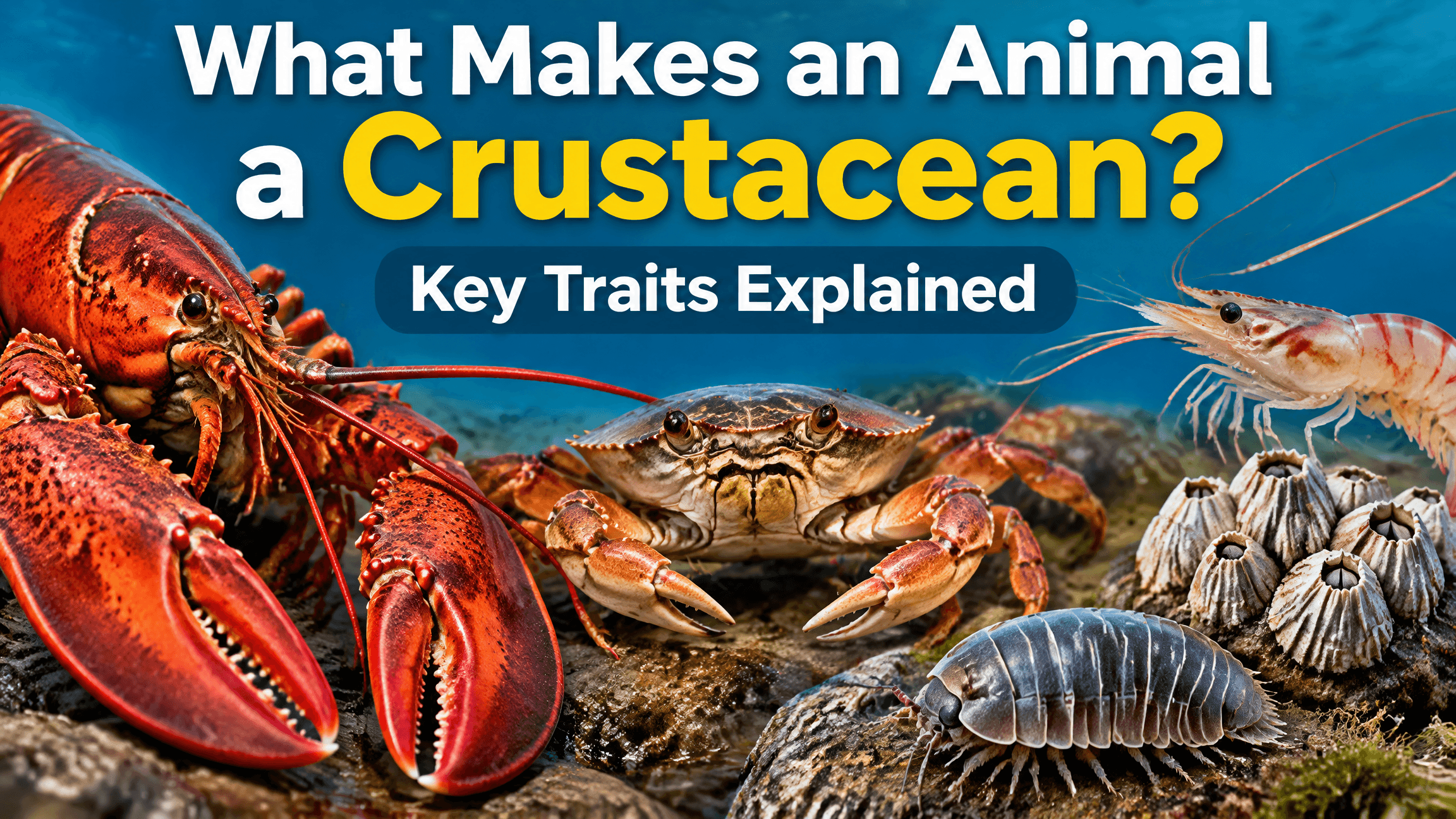
A crustacean is an arthropod that belongs to the broad evolutionary radiation that includes familiar animals such as crabs, lobsters, shrimp, crayfish, barnacles, copepods, krill, and isopods. The useful part of that definition is not a single visible feature. Crustaceans are recognized by a combination of body-plan traits, including a segmented arthropod body, jointed appendages, a cuticle that is replaced during molts, a characteristic set of head appendages, and an evolutionary history within Pancrustacea.
That combination matters because crustaceans can look radically different from one another. A lobster has obvious walking legs and large claws. A copepod may be only a few millimeters long and swim with tiny appendages. An adult barnacle is fixed to a surface and barely resembles a mobile shrimp. A pill bug lives on land. All are conventionally called crustaceans, yet none of the popular shortcuts such as “hard shell,” “ten legs,” or “lives in water” works as a complete definition.
Quick Answer

What is a crustacean in practical terms? It is a member of the arthropod lineage traditionally called Crustacea, recognized by a shared evolutionary body plan rather than one universal outward feature. The traditional framework emphasizes two pairs of antennal appendages, mandibulate mouthparts, specialized segmental limbs, and an ancestral pattern in which many appendages are biramous, meaning they have two main branches. Those features have been modified so extensively that they may be reduced, fused, specialized, or hard to recognize in some adults. For the wider picture beyond the defining traits, the broader crustacean overview places them alongside the group’s diversity, habitats, and adaptations.
The current World Register of Marine Species treatment of Crustacea adds an important modern qualification. WoRMS retains Crustacea as an accepted and useful assemblage of non-hexapod pancrustaceans, while noting that Hexapoda emerges from within the broader pancrustacean radiation. In other words, the familiar word “crustacean” remains useful, but the evolutionary tree is more complicated than an old textbook split between crustaceans and insects.
Start with Arthropoda, Not a Single Crustacean Feature

Segmentation, jointed appendages, cuticle, and molting as arthropod context
Before asking what makes a crustacean different from other animals, it helps to place crustaceans inside Arthropoda. Arthropods are built from repeated body segments and jointed appendages. Their body surface is covered by an external cuticle produced by the underlying epidermis. Because that covering cannot simply stretch forever as the animal grows, arthropods periodically replace it through molting.
Crustaceans inherit that basic framework. A crab leg, a lobster antenna, a copepod swimming limb, and a barnacle feeding appendage may serve very different jobs, but they are all examples of the arthropod pattern of segmental appendages being modified for specialized functions. This is why identifying a crustacean begins with the whole body plan rather than with one dramatic structure such as a claw.
The cuticle also varies greatly. In some crabs and lobsters it is heavily mineralized and feels shell-like. In many small or lightly built crustaceans it is thinner and more flexible. Calling every crustacean a “hard-shelled animal” therefore confuses one common form of the crustacean cuticle with the deeper traits shared across the group.
Why the broader arthropod definition is only the starting point
Segmentation, jointed limbs, a cuticle, and molting do not identify a crustacean by themselves because insects, spiders, centipedes, millipedes, and other arthropods share the same broad framework. Those features tell you that you are dealing with an arthropod. The next step is to look at the arrangement and evolutionary identity of the head appendages and the way the rest of the limbs have been modified.
This distinction prevents a common problem in animal classification: turning a broad arthropod feature into a crustacean-only feature. Molting is important to crustacean biology, for example, but it is not exclusive to crustaceans. Likewise, a segmented body is essential context, but segmentation also appears in many other arthropods.
The Traditional Crustacean Body-Plan Framework
Two pairs of antennae
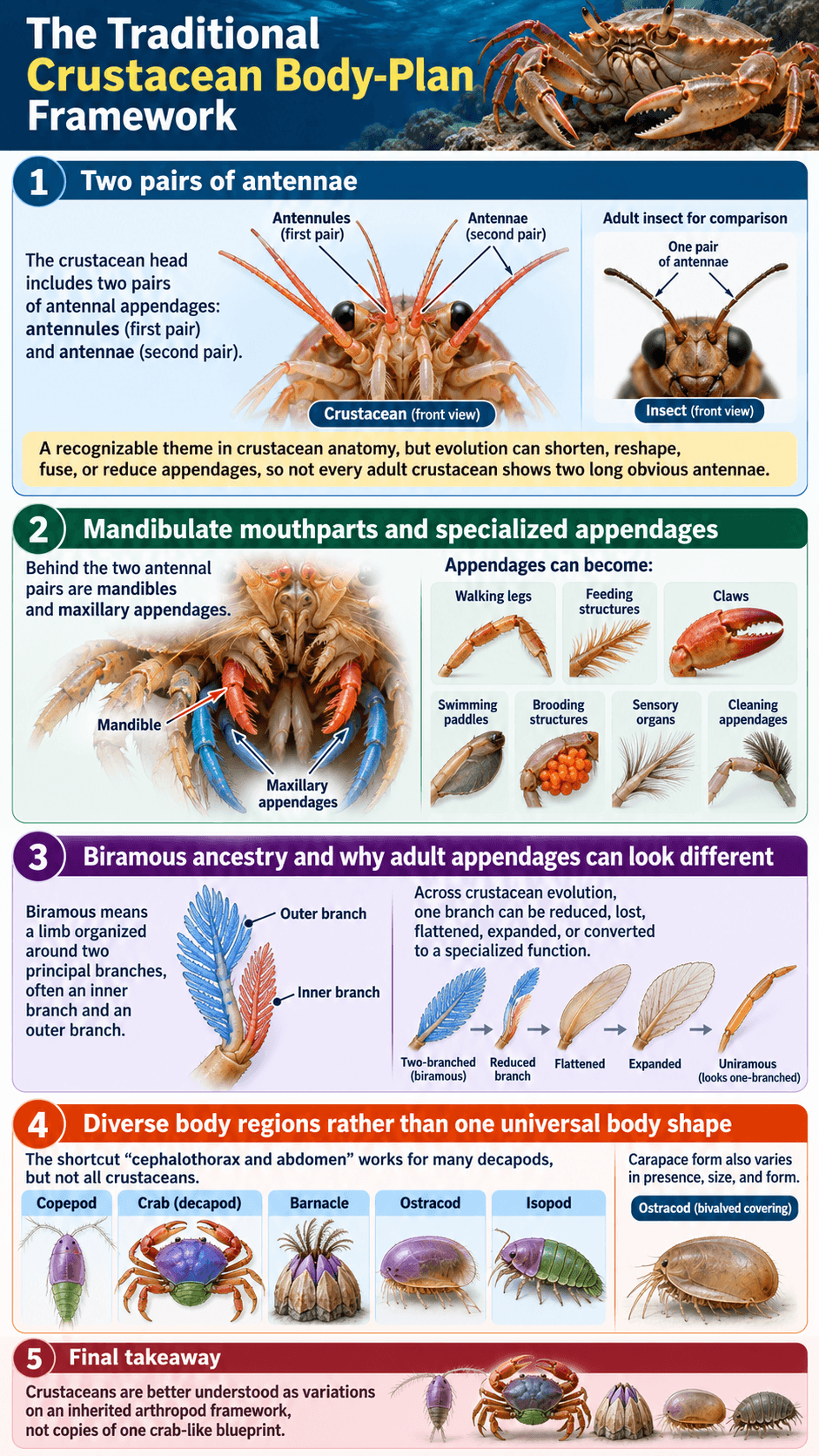
The traditional crustacean head includes two pairs of antennal appendages. The first pair is usually called the antennules, and the second pair is called the antennae. This arrangement is one of the most recognizable themes in crustacean anatomy, especially when compared with adult insects, which have one obvious pair of antennae.
A modern comparative treatment of pancrustacean body plans describes the head framework as including two antennal pairs followed by mandibles and two pairs of maxillae. The Oxford Academic review of pancrustacean body plans also emphasizes how much disparity exists around that basic pattern. That is important because evolution can shorten, reshape, fuse, or reduce appendages. A field mark that is easy to see on a shrimp may be much less obvious on a highly modified parasitic or sessile crustacean.
The safest wording is therefore that two antennal pairs are part of the characteristic or ancestral crustacean head plan, not that every adult crustacean must display two long, obvious antennae that look the same.
Mandibulate mouthparts and specialized appendages
Behind the two antennal pairs, the classic crustacean head plan includes mandibles, which are paired mouthparts used in processing food, followed by maxillary appendages. The exact shape and role of these structures vary. A predatory crustacean, a suspension feeder, and a tiny planktonic grazer do not use identical feeding equipment.
That variation illustrates a broader crustacean theme: appendages are highly evolvable. Limbs that arise from repeated body segments can be transformed into walking legs, feeding structures, claws, swimming paddles, brooding structures, sensory organs, or cleaning appendages. Crustacean identity comes partly from this shared segment-and-appendage organization, even when the final adult shapes seem unrelated.
Biramous ancestry and why adult appendages can look different
Many descriptions of crustaceans mention biramous appendages. “Biramous” means that a limb is organized around two principal branches, commonly described as an inner branch and an outer branch. This is an important crustacean body-plan concept, but it should not be treated as a rule that every visible adult limb must look clearly forked.
Across crustacean evolution, one branch can be reduced, lost, flattened, expanded, or converted to a specialized function. Some adult limbs are effectively uniramous in appearance, while others retain a more obvious two-branched organization. The evolutionary pattern matters more than expecting every crab leg or barnacle appendage to match a simple textbook drawing.
Diverse body regions rather than one universal body shape
Another shortcut says that crustaceans have a cephalothorax and abdomen. That description works reasonably well for many decapods, but it cannot serve as a universal definition. Crustacean lineages divide and fuse body segments in different ways, a process zoologists call tagmosis. The visible body regions of a copepod, crab, barnacle, ostracod, and isopod are not organized in one identical pattern.
Even a carapace, the shield-like covering that is especially familiar in crabs and shrimp, varies in presence, size, and form. An ostracod may have a strongly enclosing bivalved covering, while other crustaceans lack a comparable structure. The whole group is better understood as variations on an inherited arthropod framework than as copies of one crab-like blueprint.
Why Hard Shells, Ten Legs, and Claws Are Not Definitions
Thin and flexible cuticles
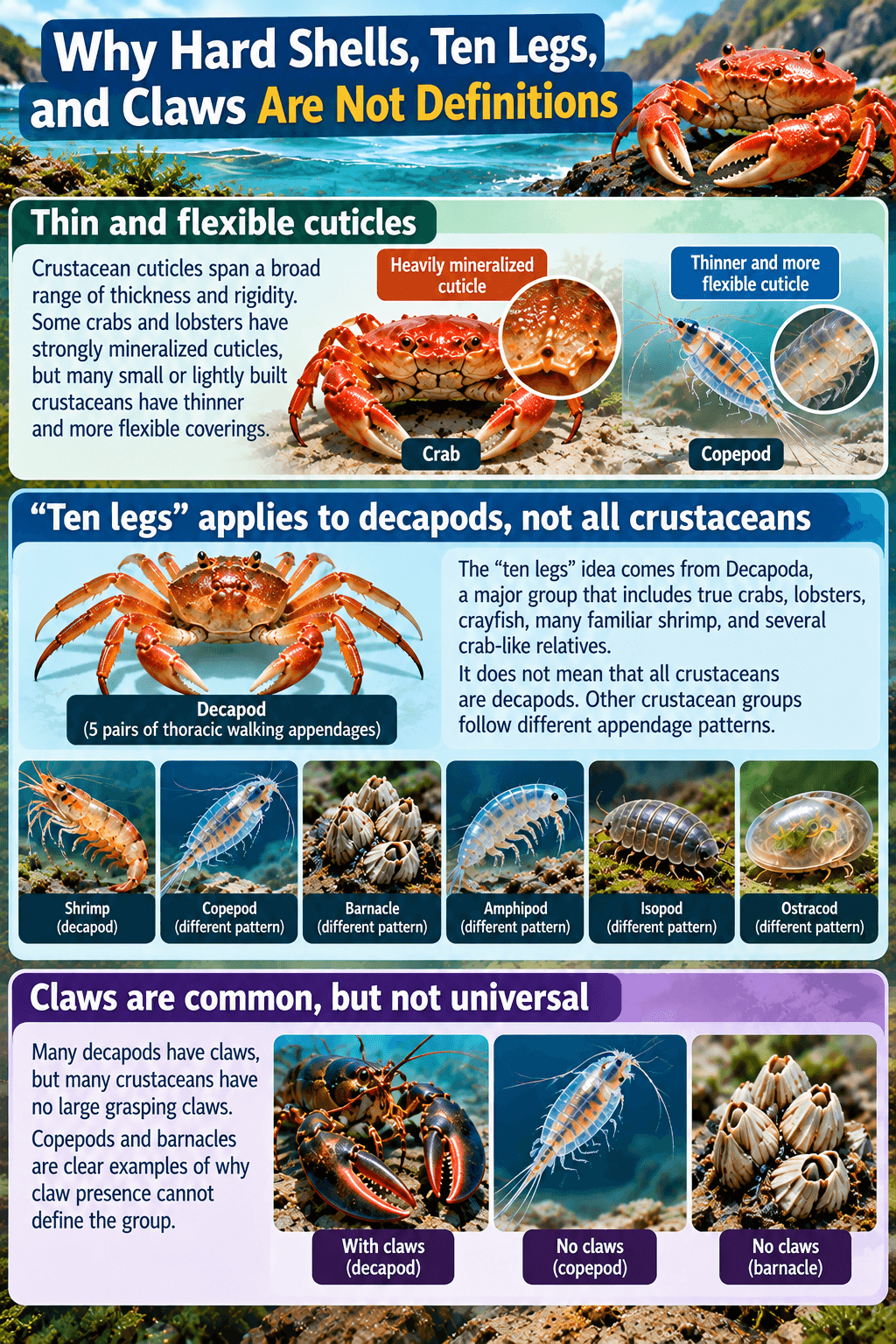
Crabs and lobsters make the phrase “hard shell” feel intuitive because their cuticles can be strongly mineralized. But crustacean cuticles span a broad range of thickness and rigidity. Tiny planktonic forms, larval stages, and many non-decapod groups do not present the heavy armor people associate with a lobster.
The more accurate statement is that crustaceans, like other arthropods, possess an external cuticle and molt it as they grow. Mineralization is an important crustacean specialization in many lineages, not a universal test that separates crustaceans from everything else.
Decapods versus crustaceans broadly
The “ten legs” idea comes from Decapoda, the major crustacean group that includes true crabs, lobsters, crayfish, many familiar shrimp, and several crab-like relatives. The name refers to the characteristic five pairs of thoracic walking appendages in that body plan. It does not mean that all crustaceans are decapods.
Copepods, barnacles, amphipods, isopods, branchiopods, ostracods, and other crustaceans follow different appendage patterns. Even within a single lineage, some appendages may be reduced or repurposed so strongly that counting visible “legs” is a poor way to identify the broader group.
Lineages without claws
Claws are another familiar feature that can mislead. Many decapods possess chelae, the pincer-like structures people recognize as claws, but many crustaceans have no large grasping claws at all. Copepods and barnacles are obvious examples of why claw presence cannot define the group.
Claws are best understood as one possible modification of crustacean appendages. They can be important for feeding, defense, courtship, competition, or handling objects in species that have them, but they are not a required badge of crustacean identity.
Aquatic Ancestry Without an Aquatic-Only Rule
Gills and aquatic respiratory structures in many groups
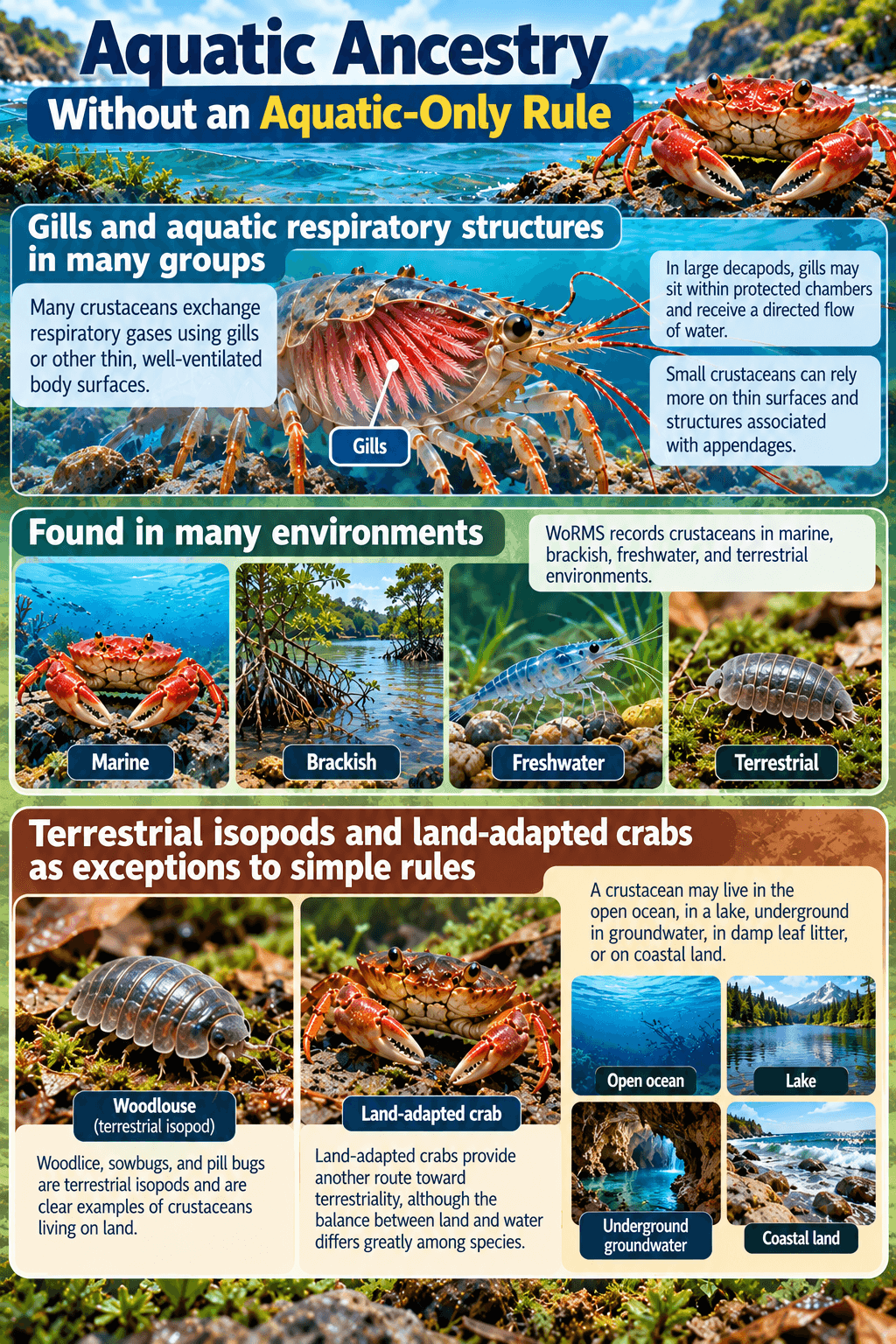
Crustacean diversity is especially rich in marine and freshwater environments, and many familiar species exchange respiratory gases using gills or other thin, well-ventilated body surfaces. In large decapods, gills may sit within protected chambers and receive a directed flow of water. Small crustaceans can rely more heavily on thin surfaces and structures associated with appendages.
This aquatic background is biologically important, but “lives in water” is not a definition. WoRMS records representatives of Crustacea in marine, brackish, freshwater, and terrestrial environments. The group’s evolutionary history is strongly tied to aquatic life, yet several lineages have moved onto land to different degrees.
Terrestrial isopods and land-adapted crabs as exceptions to simple rules
Woodlice, sowbugs, and pill bugs are terrestrial isopods, and they are among the clearest examples of crustaceans living on land. They did not become miniature insects. Their respiratory and water-balance systems remain shaped by crustacean ancestry, which is one reason many species favor humid microhabitats.
Research on terrestrial isopods shows that land life involves specialized pleopodal respiratory surfaces, water-conserving features, and different degrees of tolerance for dry conditions. The Oxford review of terrestrial crustacean environments describes these adaptations as responses to the challenges of desiccation and aerial respiration. Land-adapted crabs provide another route toward terrestriality, although the balance between land and water differs greatly among species. Those exceptions make more sense when viewed across the full range of crustacean habitats.
These cases show why habitat cannot define the group. A crustacean may live in the open ocean, in a lake, underground in groundwater, in damp leaf litter, or on coastal land. What unites those animals is ancestry and body-plan history, not a requirement to remain submerged.
What the Two Antennal Pairs Can Do
Antennules and first-pair functions
Antennules are the first antennal appendages. In many crustaceans they carry sensory structures that detect chemicals, touch, water movement, or vibration. In some groups they also participate in balance and orientation. The exact sensory equipment differs with habitat and lifestyle, so it is more accurate to think of antennules as versatile sensory platforms than as simple “noses.”
A detailed comparative review of crustacean antennules and antennae documents the extensive structural variation in these appendages. That diversity makes sense when comparing a bottom-walking lobster, a planktonic copepod, and a burrowing or parasitic crustacean. Each faces different problems in finding food, mates, shelter, or orientation cues.
Second antennae and sensory, locomotor, or feeding roles
The second antennal pair can also serve more than one function. In many crustaceans it is strongly sensory, but in some lineages it contributes to swimming, handling particles, or other tasks. Branchiopods and some small planktonic crustaceans can use enlarged antennae in locomotion, while other groups use the appendages primarily to sample the environment.
This functional variety is another reason not to define crustaceans by what an antenna “does.” The important point is the paired appendage identity and its place in the head plan. Evolution can then reshape the appendage for a particular way of life.
Crustacea and Pancrustacea: The Modern Phylogenetic Nuance
Hexapods within the broader pancrustacean radiation
Traditional zoology often pictured crustaceans and insects as two separate neighboring branches of the arthropod tree. Modern molecular and phylogenomic research has changed that picture. Hexapods, the lineage that includes insects and their close relatives, are nested within the broader pancrustacean radiation rather than sitting entirely outside it.
A large 2023 phylogenomic study of Pancrustacea recovered Pancrustacea as the clade containing non-hexapod crustacean lineages and Hexapoda, while also showing that relationships among several major branches remain sensitive to taxon sampling and analytical choices. The practical lesson is not that classification has become useless. It is that evolutionary history does not line up perfectly with the traditional everyday boundary around the word “crustacean.”
WoRMS handles this by continuing to use Crustacea for the conventional non-hexapod pancrustaceans while openly noting that this assemblage is paraphyletic. “Paraphyletic” means a named group includes a common ancestor and some, but not all, descendants. This is a technical complication worth knowing, but it does not require readers to call butterflies or beetles crustaceans in ordinary conversation.
Why insects are not modern shrimp or crabs
Saying that hexapods are nested within Pancrustacea does not mean a modern insect descended from a modern shrimp, crab, or lobster. Living lineages are cousins on an evolutionary tree, not steps in a ladder. Their shared ancestry lies deeper in time, and each lineage has followed its own evolutionary history since diverging from ancestral populations.
Likewise, similarities between insect and crustacean appendages do not turn one living animal into another. Phylogeny is about common ancestry and branching relationships. A modern dragonfly is no more a transformed modern shrimp than a human is a transformed modern chimpanzee.
Testing the Definition Across Very Different Animals
Lobster and crab
Lobsters and crabs fit the popular picture of crustaceans because their crustacean features are easy to see. They have jointed appendages, two antennal pairs, mandibulate mouthparts, a molting cuticle, and strongly specialized limbs. Many also have heavily mineralized exoskeletons and large claws, which makes them memorable but can create the false impression that those two features define the entire group.
These animals are useful examples precisely because they show both the framework and its specializations. Their body plans are highly modified for walking, handling food, defense, and other tasks. A crustacean definition should explain why they belong without turning their decapod anatomy into a rule for every other lineage.
Copepod and barnacle
Copepods test the definition in the opposite direction. Many are tiny, lightly built, and very unlike crabs. They can be planktonic, bottom-associated, symbiotic, or parasitic. The Smithsonian overview of copepods emphasizes the enormous ecological variety within this crustacean group, including marine and freshwater forms and many different lifestyles.
Barnacles push the contrast even further. Familiar adult barnacles are sessile, meaning attached in one place, and their calcareous plates can make them look superficially like mollusks. Their developmental history and anatomy reveal their crustacean identity. The point is not that a barnacle looks like a crab. It is that both inherit different versions of the same deeper pancrustacean framework.
Woodlouse and ostracod
A woodlouse demonstrates that a fully terrestrial lifestyle does not erase crustacean ancestry. Woodlice are isopods, related to aquatic isopods but adapted to life on land. Smithsonian work on terrestrial isopods, including surveys of North American woodlice, treats them plainly as terrestrial isopod crustaceans.
Ostracods show a different kind of disguise. Much of the body can be enclosed within a two-valved, shell-like carapace, giving the animal an appearance that can be mistaken for a tiny bivalve mollusk. Yet the appendages and arthropod body inside that covering place ostracods among crustaceans. External resemblance alone is therefore a poor substitute for anatomy and evolutionary relationships.
Common Mistakes
Defining crustaceans by ten legs
Ten walking legs describe the classic decapod pattern, not Crustacea as a whole. If the ten-leg rule were used as a definition, copepods, barnacles, amphipods, isopods, branchiopods, ostracods, and many other crustaceans would be incorrectly excluded.
A better question is whether the animal fits the crustacean arrangement of head appendages and the broader pancrustacean body-plan history. Leg count can help identify some groups after that, but it cannot define all crustaceans.
Assuming all have carapaces or identical gills
A carapace is prominent in many crustaceans, but its form and presence vary. It may cover part of the body, enclose much of the body, be reduced, or be absent in a familiar carapace-like form. It is also not the same thing as the entire exoskeleton.
Respiration varies as well. Many aquatic crustaceans use gills, but gills differ in position and structure, and small forms may exchange gases across other thin surfaces. Terrestrial isopods and land-adapted crabs show additional modifications for using oxygen from air while still managing moisture. “Has gills” is therefore too crude to function as a universal identification test.
Treating one visible trait as a taxonomic test
The most persistent mistake is expecting taxonomy to work like a checklist with one decisive feature. Real evolutionary groups are recognized through combinations of anatomy, development, genetics, and shared ancestry. Some traits are highly informative, but each can be modified in specialized lineages.
This is especially true in a group as morphologically diverse as crustaceans. A barnacle can lose the mobile adult form people expect. A woodlouse can move onto land. An ostracod can acquire a bivalved covering. A parasitic crustacean can reduce structures that are obvious in free-living relatives. The more specialized the animal, the less reliable a one-feature definition becomes.
Why Definition and Detailed Anatomy Are Different Questions
Major groups add context to the basic traits
Once the definition is clear, the next useful step is learning how major crustacean groups modify the basic framework. Decapods, copepods, barnacles, branchiopods, isopods, amphipods, ostracods, remipedes, and other lineages differ in body regions, appendage use, development, and habitat. Their differences explain why no simple crab-shaped model can represent the entire group.
Classification helps organize that diversity, but the definition should remain broader than any one subgroup. A lobster is a crustacean because it fits the shared evolutionary framework, not because all crustaceans must look like lobsters.
Detailed anatomy explains how the shared framework is modified
A full anatomy comparison goes beyond the definition. It asks how specific appendages, gills, eyes, body regions, circulatory structures, and digestive systems differ among lineages. That deeper comparison is valuable because it shows evolution working through modification of inherited structures.
For the definition itself, the main lesson is simpler: crustaceans are identified through a suite of inherited traits plus evolutionary relationships. The more you compare very different crustaceans, the clearer it becomes that exceptions are not failures of the definition. They are evidence of how flexible the underlying body plan has been.
FAQ
Do all crustaceans have two pairs of antennae?
Two pairs of antennal appendages, antennules and antennae, are a characteristic part of the traditional crustacean head plan. In many crustaceans both pairs are obvious. In highly modified lineages, especially some parasites or strongly specialized adults, appendages can be reduced or altered enough that the pattern is not easy to recognize from a casual look.
So the trait is best understood as part of crustacean body-plan ancestry, not as a requirement that every adult animal display four long antenna-like structures of similar shape.
Do all crustaceans have gills?
No single gill design applies to every crustacean. Many aquatic crustaceans use gills or other thin respiratory surfaces, but the location and structure vary among lineages. Very small forms may rely substantially on gas exchange across body surfaces, while terrestrial isopods and land-adapted crabs have respiratory modifications suited to life in air.
Gills are therefore important in crustacean biology, especially because of the group’s aquatic history, but “has gills” is not a complete definition.
Are pill bugs crustaceans?
Yes. Pill bugs are terrestrial isopods, a crustacean lineage. They are not insects, even though people often find them in the same leaf litter, soil, and garden habitats where insects occur. Their segmented bodies and jointed appendages are arthropod features, while their deeper anatomy and ancestry place them with isopod crustaceans.
Not every woodlouse can roll into a tight ball, so “pill bug” is also not a label for all terrestrial isopods. The important point is that the common garden animals known as pill bugs and sowbugs belong to a crustacean lineage that successfully colonized land.
Are insects crustaceans?
In ordinary zoological and educational usage, insects are called hexapods, not crustaceans. The evolutionary complication is that modern phylogenetic research places Hexapoda within Pancrustacea. That means the traditional Crustacea, when it is restricted to the non-hexapod animals commonly called crustaceans, does not include every descendant of their deeper common ancestor.
This is why many zoologists use Pancrustacea for the monophyletic group that includes both hexapods and the lineages conventionally called crustaceans. It does not mean a beetle should be called a crab or that modern insects descended from modern shrimp.
Final Thoughts
The best answer to “what is a crustacean?” is a combination rather than a shortcut. Crustaceans are arthropods whose traditional body plan includes two antennal pairs, mandibulate mouthparts, specialized segmental appendages, and an inherited pattern in which biramous limbs are important, all modified through a long and diverse evolutionary history. Some have hard, mineralized exoskeletons, ten walking legs, claws, obvious gills, or aquatic lifestyles, but none of those traits alone defines the whole group.
That broader view explains why a lobster, copepod, barnacle, woodlouse, and ostracod can all be crustaceans despite looking so different. It also makes sense of the modern Pancrustacea picture: familiar crustacean terminology remains useful, while evolutionary evidence shows that hexapods are nested within the same deeper radiation. Understanding both the shared framework and the exceptions is what turns a simple label into a biologically accurate definition.

Ethan Walker is the founder and research editor of Animal Fact Central. He creates and reviews educational animal facts content using trusted wildlife, pet care, and science-based sources. His work focuses on making animal behavior, adaptations, habitats, and species facts clear, accurate, and engaging for everyday readers.
Read More Details About Ethan Walker: https://animalfactcentral.com/ethan-walker/
1 thought on “What Makes an Animal a Crustacean? Key Traits Explained”