

A snail, a clam, an octopus, a chiton, and a tusk shell can look so different that it is hard to imagine them in the same animal group. What makes an animal a mollusk is not one obvious feature such as a shell, a crawling foot, or a radula. Mollusks belong to the phylum Mollusca because they share evolutionary ancestry and a deeply related body-plan framework that has been modified in very different ways across the group.
That framework usually includes a mantle associated with the visceral organs, a muscular foot or structures derived from the ancestral foot, and a soft-bodied organization built around a set of recurring anatomical themes. Many mollusks also make shells, and many have a radula for feeding, but neither feature is universal. The best way to recognize Mollusca is therefore to look at the whole biological pattern rather than demand one visible trait in every species.
Quick Answer
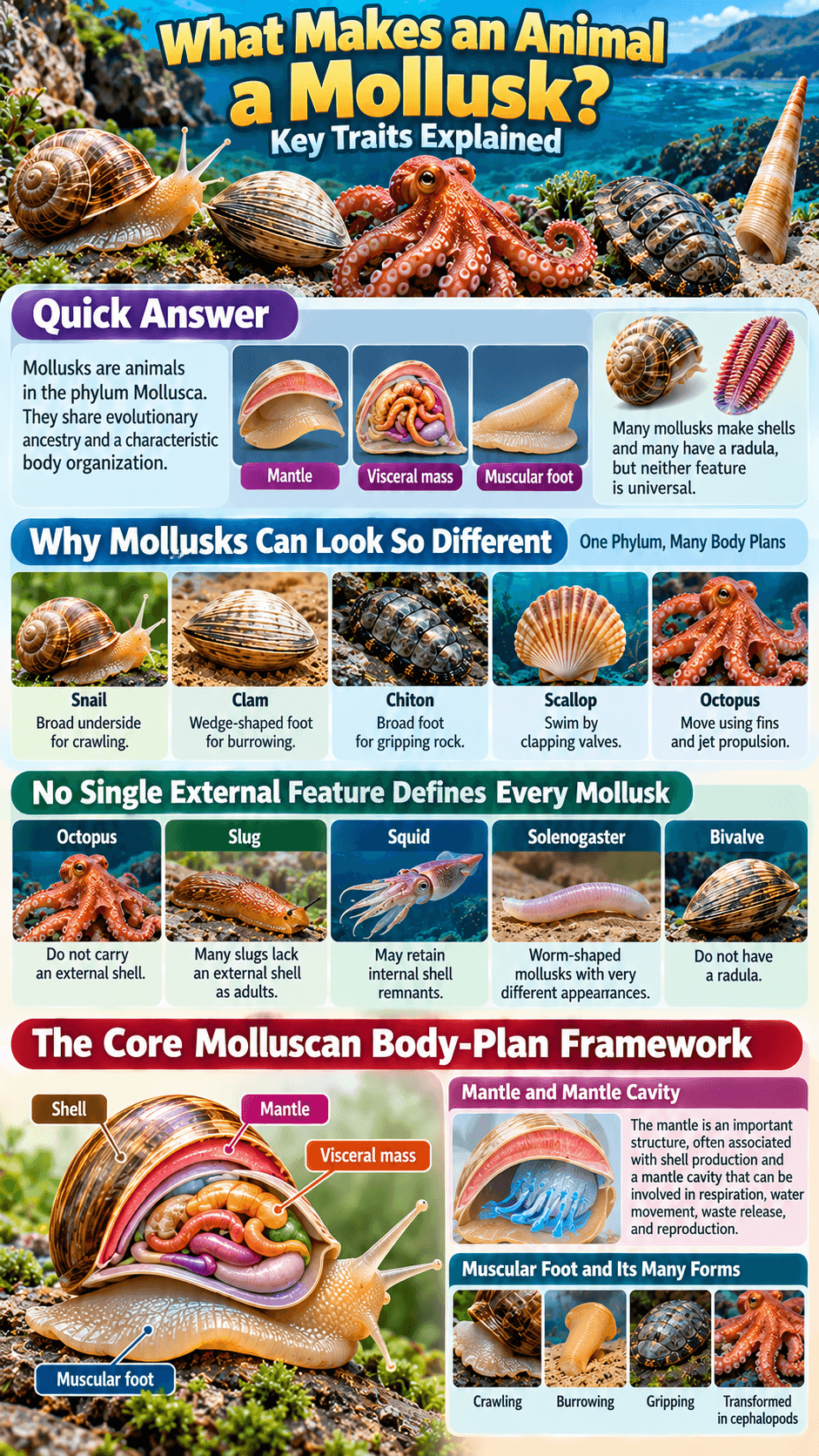
Mollusks are animals in the phylum Mollusca. Their shared identity is based on common ancestry and a characteristic body organization that typically includes a mantle, a visceral mass containing many internal organs, and a muscular foot that may be heavily modified. A mantle cavity is also important in many groups, often housing or interacting with respiratory, excretory, reproductive, or water-flow structures.
Shells and radulas are useful clues, but they cannot define the phylum by themselves. Slugs, nudibranchs, many squid, and octopuses may lack an obvious external shell, while bivalves such as clams and mussels lack a radula. The Smithsonian overview of the mollusk body plan highlights the mantle and muscular foot as central themes while also showing how movement and shell form vary among groups.
Why Mollusks Can Look So Different
One Phylum, Many Body Plans
Evolution can preserve an underlying developmental framework while changing what its parts look like and what they do. Mollusks are a strong example. A typical snail has a broad underside used for crawling, a clam may use a wedge-shaped foot for burrowing, a chiton has a broad adhesive foot for gripping rock, and a cephalopod has an extremely transformed head-foot region associated with arms, tentacles, and a funnel.
The result is a phylum whose members can crawl on land, burrow through sediment, cement themselves to hard surfaces, cling to wave-swept rocks, swim by clapping shell valves, or move through water using fins and jet propulsion. Their outward differences are not evidence that they are unrelated. They show how strongly a shared anatomical starting point can be reshaped.
Modern taxonomy treats Mollusca as a major animal lineage containing marine, freshwater, and terrestrial species. MolluscaBase maintains an actively updated taxonomic account across living and fossil mollusks, which is useful because classification details and accepted names can change as research advances.
Why No Single External Feature Defines Every Mollusk
A simple definition such as “soft-bodied animal with a shell” works for some familiar mollusks but fails immediately when tested across the phylum. Octopuses do not carry an external shell. Many slugs and nudibranchs lack one as adults. Some squid retain internal shell remnants rather than an external protective shell. Solenogasters and caudofoveates are worm-shaped mollusks with very different external appearances from a snail or clam.
The same problem appears if the foot is used as the sole test. A chiton’s broad foot is easy to recognize, but the corresponding evolutionary region in a cephalopod is so altered that it no longer resembles a single crawling sole. Radulas also fail as a universal marker because bivalves do not have them. The most reliable definition therefore comes from ancestry plus a combination of anatomical relationships.
The Core Molluscan Body-Plan Framework
Mantle and Mantle Cavity
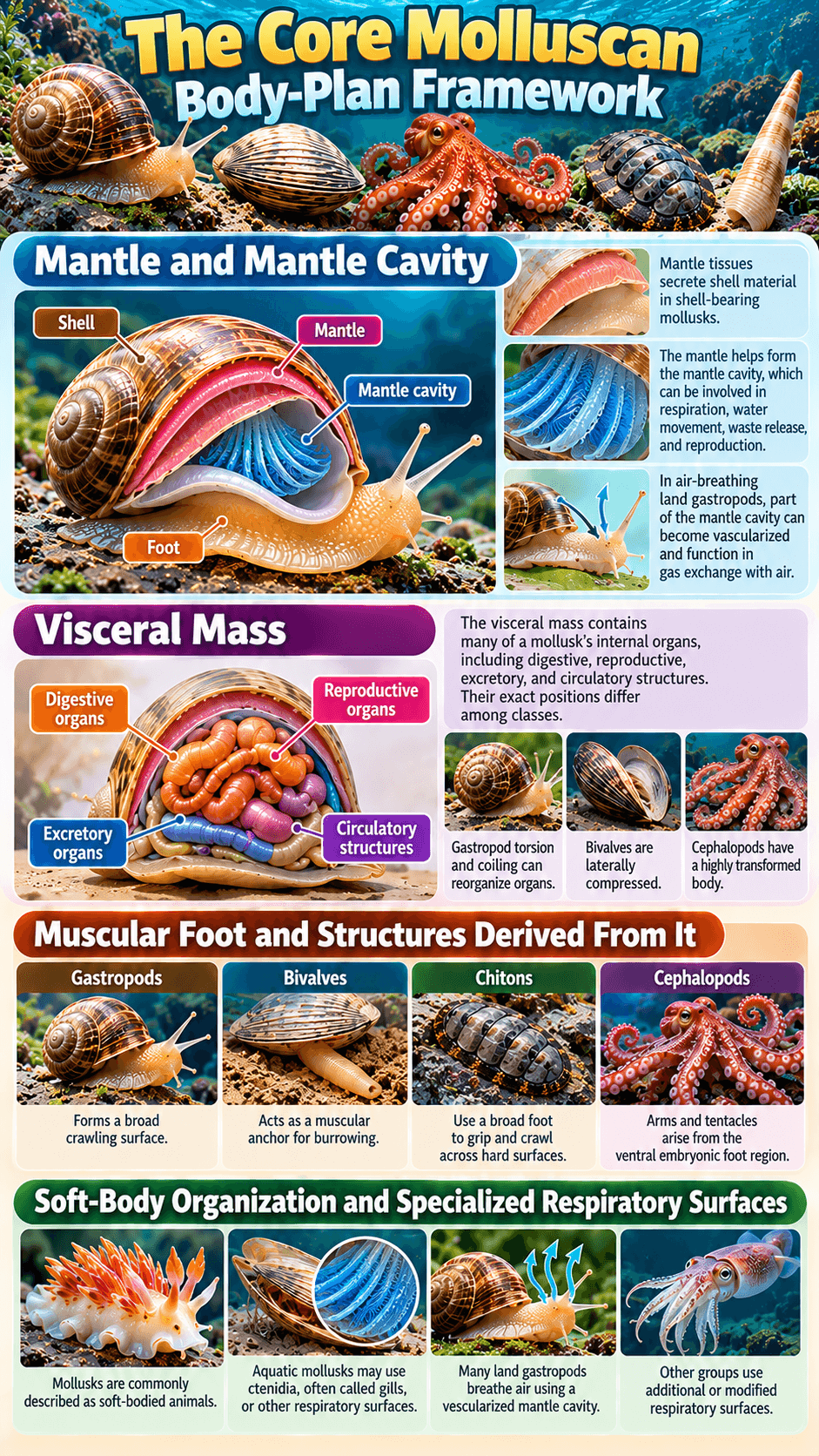
The mantle is one of the most important structures for understanding mollusks. It is a body-wall tissue associated with the dorsal or outer side of the visceral region, although its exact shape and position vary greatly among classes. In shell-bearing mollusks, mantle tissues secrete shell material. That function is important, but it is not the mantle’s only role.
The mantle also helps form the mantle cavity, a space that can be involved in respiration, water movement, waste release, reproduction, and other functions depending on the lineage. In many aquatic mollusks, gills or related respiratory surfaces are associated with this region. In air-breathing land gastropods, part of the mantle cavity can become vascularized and function in gas exchange with air.
This broad functional range is why it is misleading to describe the mantle as nothing more than a shell-making organ. The Smithsonian’s cowrie anatomy material, for example, identifies the mantle as shell-secreting tissue while also showing it as part of a larger living body rather than an isolated shell factory.
Visceral Mass
The visceral mass is the region that contains many of a mollusk’s internal organs. Digestive, reproductive, excretory, and circulatory structures are arranged in or around this region, but their exact positions differ among classes. It is a useful concept for comparing body plans, not a promise that every mollusk has the same compact lump of organs in the same shape.
Gastropod torsion and coiling can reorganize the relationship between organs and body openings. Bivalves are laterally compressed inside paired shell valves. Cephalopods have a highly transformed body in which the mantle encloses a large cavity used for ventilation and locomotion. These differences show why a generalized diagram can be helpful for learning the basic plan but cannot stand in for the anatomy of every living class.
Muscular Foot and Structures Derived From It
The muscular foot is another recurring molluscan theme. In many gastropods it forms a broad crawling surface. In burrowing bivalves it can act as a muscular anchor that extends into sediment and helps pull the body forward. Chitons use a broad foot to grip and crawl across hard surfaces. Scaphopods use a specialized foot in sediment.
Cephalopods show the most dramatic transformation. Their body plan does not display a single flat foot under the body. Developmental and evolutionary work indicates that cephalopod arms and tentacles arose from the ventral embryonic foot region, making them evolutionary novelties built from a structure with deep molluscan roots. A peer-reviewed study of cephalopod limb development describes this relationship while emphasizing that cephalopod appendages are not simply unchanged copies of the feet seen in other mollusks.
Soft-Body Organization and Specialized Respiratory Surfaces
Mollusks are commonly described as soft-bodied animals, and that description is broadly useful. Their bodies are not organized around a jointed external skeleton like an arthropod’s. Muscles, connective tissues, fluid-filled spaces, and shells or other hard parts can all contribute to support. Some groups have robust shells, plates, spicules, internal shell remnants, or other structures that make “soft-bodied” less visually obvious than the phrase suggests.
Respiration is similarly diverse. Aquatic mollusks may use ctenidia, often called gills, or other surfaces associated with the mantle cavity. Many land gastropods breathe air using a vascularized mantle cavity. Other groups use additional or modified respiratory surfaces. The shared pattern is not one identical respiratory organ, but a body plan in which mantle-associated spaces and surfaces have been repeatedly adapted to different environments.
Traits That Are Common but Not Universal
Shells and Shell-Secreting Mantle Ancestry
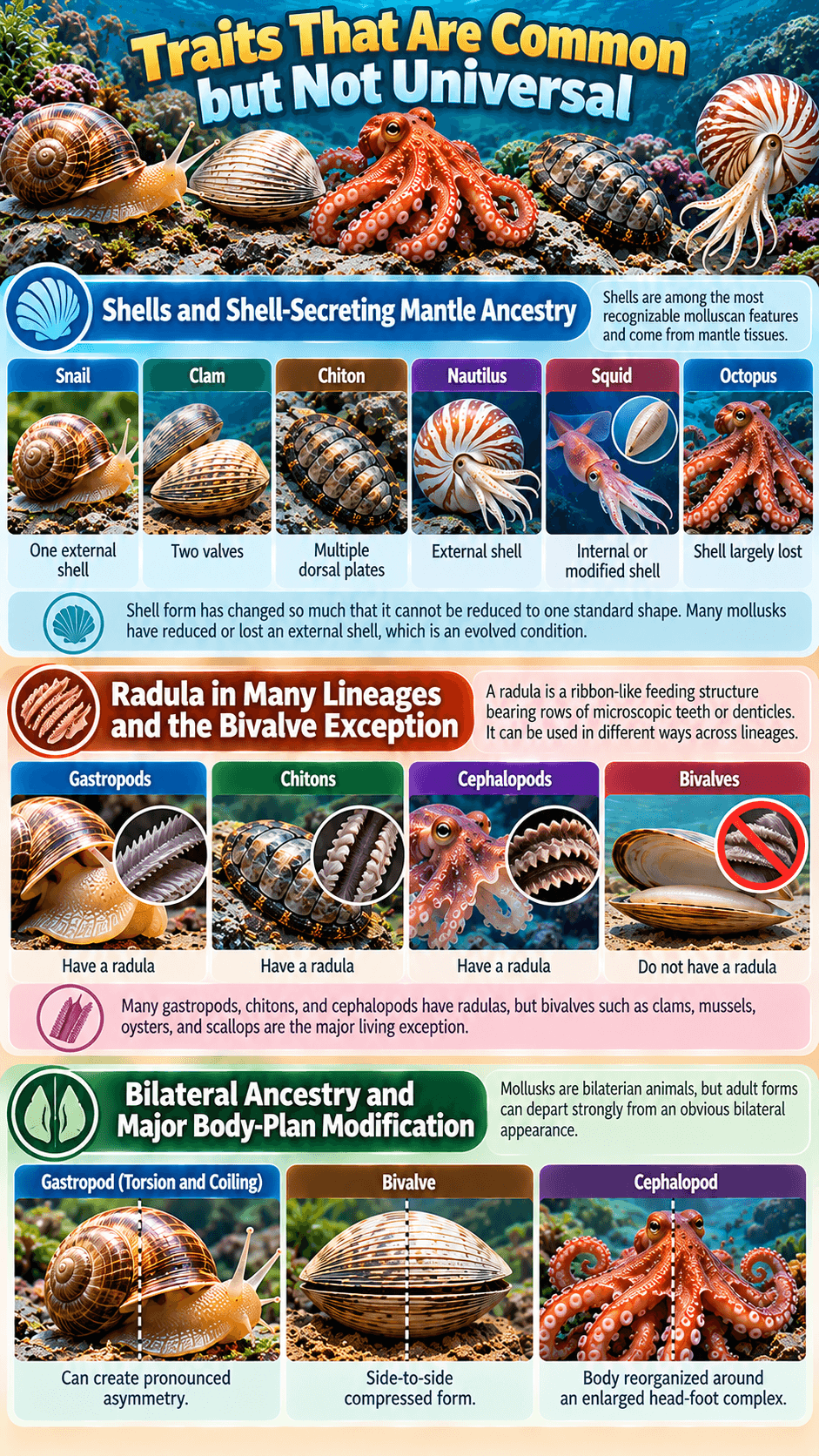
Shells are among the most recognizable molluscan features. A snail shell, a clam’s paired valves, a chiton’s series of shell plates, and a nautilus shell all come from molluscan shell-secreting systems associated with mantle tissues. Yet shell form has changed so much that it cannot be reduced to one standard shape.
Some mollusks have one external shell, some have two valves, and chitons have multiple dorsal plates. In many squid and cuttlefish, the shell is internal or strongly modified. In octopuses it is largely lost. Numerous gastropod lineages have independently reduced or lost an external shell. These patterns matter because they show that shell loss is an evolved condition, not evidence that an animal stopped being a mollusk.
Radula in Many Lineages and the Bivalve Exception
A radula is a ribbon-like feeding structure bearing rows of microscopic teeth or denticles. It can scrape surfaces, rasp plant or algal material, help process animal prey, or become highly specialized for different diets. Radula shape varies greatly, so describing it as a “tongue with teeth” is only a rough analogy.
Many gastropods, chitons, and cephalopods have radulas, but bivalves are the major living exception. Clams, mussels, oysters, scallops, and other bivalves do not have a radula. Many obtain food by suspension feeding with cilia, mucus, gills, and related structures, although feeding ecology within Bivalvia is more diverse than a single filter-feeding stereotype.
Because an entire major molluscan class lacks a radula, the structure is an important comparative trait but a poor yes-or-no test for membership in Mollusca.
Bilateral Ancestry and Major Body-Plan Modification
Mollusks are bilaterian animals, meaning their evolutionary ancestry is tied to a left-right body organization. Adult forms can depart strongly from an obvious bilateral appearance. Gastropod torsion and shell coiling can create pronounced asymmetry. Bivalves emphasize a side-to-side compressed form. Cephalopods reorganize the body around an enlarged head-foot complex and mantle.
These transformations are a reminder that ancestry and development matter more than a superficial silhouette. Two animals can look very different as adults yet still retain comparable tissues, developmental regions, organ relationships, and genetic patterns that reveal common descent.
How the Molluscan Foot Changes Across Groups
Crawling Foot in Many Gastropods
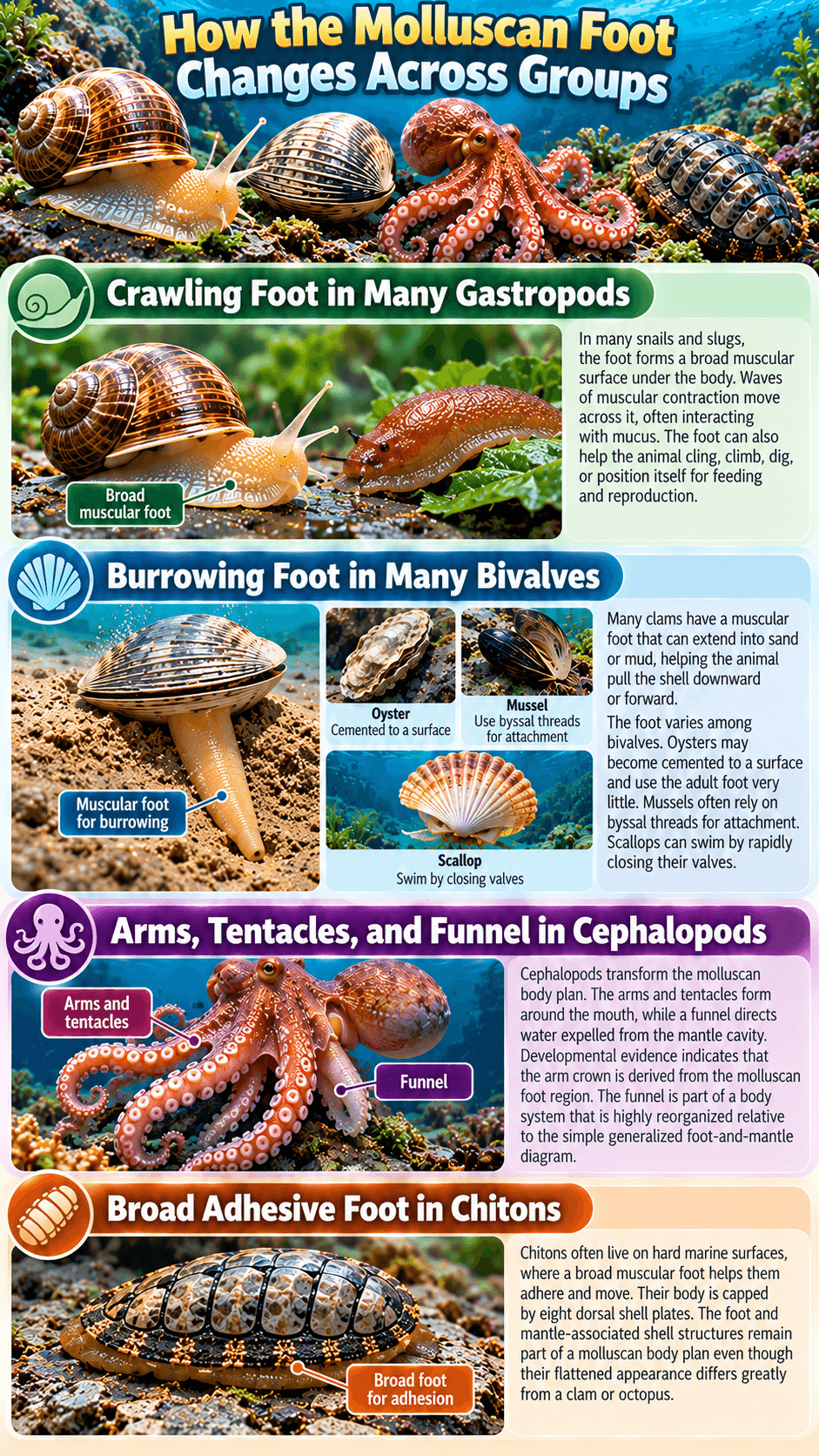
In many snails and slugs, the foot forms a broad muscular surface under the body. Waves of muscular contraction move across it, often interacting with mucus that affects adhesion and friction. The foot can also help the animal cling, climb, dig, or position itself for feeding and reproduction.
This familiar crawling form is useful for understanding the ancestral idea of a molluscan foot, but it should not be treated as the standard that every class must visibly match.
Burrowing Foot in Many Bivalves
Many clams have a muscular foot that can extend into sand or mud. By pushing into the sediment, anchoring, and contracting muscles, the animal can pull the shell downward or forward. The shape is often more wedge-like than the flat sole of a snail.
Even within bivalves, the foot varies. Oysters may become cemented to a surface and use the adult foot very little. Mussels often rely heavily on byssal threads for attachment. Scallops can swim by rapidly closing their valves. This variation makes “mollusks move with a crawling foot” far too narrow.
Arms, Tentacles, and Funnel in Cephalopods
Cephalopods transform the molluscan body plan so extensively that their relationship to a snail can be difficult to see. The arms and tentacles form around the mouth, while a funnel directs water expelled from the mantle cavity. The Smithsonian Ocean cephalopod overview describes the mantle, funnel, and arm arrangement that characterize this group.
Developmental evidence indicates that the arm crown is derived from the molluscan foot region. The funnel also participates in a body system that is highly reorganized relative to the simple generalized foot-and-mantle diagram used to introduce Mollusca. This is why cephalopods are best understood as highly modified mollusks, not as exceptions that somehow sit outside the basic plan.
Broad Adhesive Foot in Chitons
Chitons often live on hard marine surfaces, where a broad muscular foot helps them adhere and move. Their body is capped by eight dorsal shell plates, but those plates are not body segments like those of an arthropod. The foot and mantle-associated shell structures remain part of a molluscan body plan even though the animal’s flattened appearance differs greatly from a clam or octopus.
Chitons therefore provide a useful middle ground for understanding variation. Their foot is easy to recognize, while their shell is divided into multiple plates rather than a single coil or paired valves.
Why Shells Alone Cannot Define Mollusks
Shell-Less and Reduced-Shell Mollusks
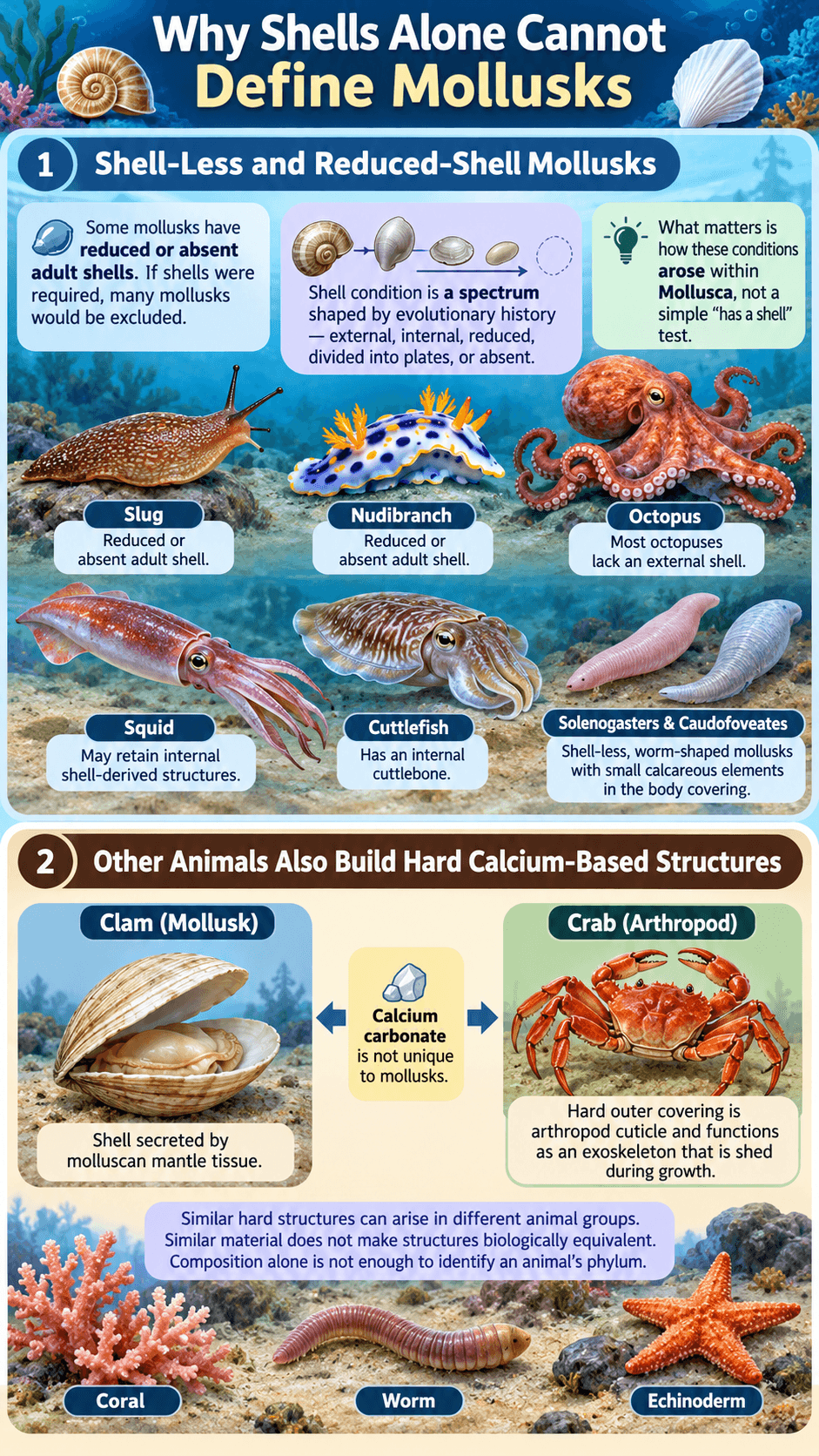
If shells were required for membership in Mollusca, many undisputed mollusks would be excluded. Slugs and nudibranchs include forms with reduced or absent adult shells. Most octopuses lack an external shell. Squid may retain internal structures derived from the shell, and cuttlefish have an internal cuttlebone. Solenogasters and caudofoveates are shell-less, worm-shaped mollusks with small calcareous elements in the body covering rather than a conventional shell.
Shell condition is therefore a spectrum shaped by evolutionary history. A shell can be external, internal, reduced, divided into plates, or absent as an obvious adult structure. What matters is how those conditions arose within Mollusca, not whether the animal passes a visual “has a shell” test.
Other Animals Also Build Hard Calcium-Based Structures
Calcium carbonate is not unique to mollusks. Corals, some worms, crustaceans, echinoderms, and other animals can build hard mineralized structures. Even when two structures contain similar minerals, they may arise from different tissues and have different evolutionary histories.
A clam shell is secreted by molluscan mantle tissue. A crab’s hard outer covering is arthropod cuticle that functions as an exoskeleton and must be shed during growth. Similar material does not make the structures biologically equivalent. Composition is therefore not enough to identify an animal’s phylum.
Why the Radula Cannot Define All Mollusks
What a Radula Is
The radula is one of the most distinctive feeding innovations found in many mollusks. It is a flexible band that carries repeated rows of tiny teeth. Muscles and supporting tissues move it during feeding. Depending on the species, those teeth may scrape algae, cut plant tissue, drill or rasp hard prey surfaces, or help move pieces of animal prey.
The structure can differ dramatically in tooth number, shape, arrangement, and wear pattern. That diversity means a radula is better understood as a family of related feeding structures than as one identical organ copied across every mollusk.
Why Bivalves Are the Major Living Exception
Bivalves have no radula. Their evolutionary history produced a different feeding apparatus, with the mouth and gill region organized for feeding strategies that commonly involve suspended particles. In many species, water flow, cilia, mucus, and gill surfaces help capture and transport food toward the mouth.
The absence of a radula in bivalves is decisive evidence against defining mollusks as “animals with a radula.” A trait can be characteristic of a large portion of a phylum while still being lost or absent in a major lineage.
Mollusks vs Arthropods: A Short Boundary Check
Mantle-Based Body Plan vs Jointed Appendages and Ecdysis
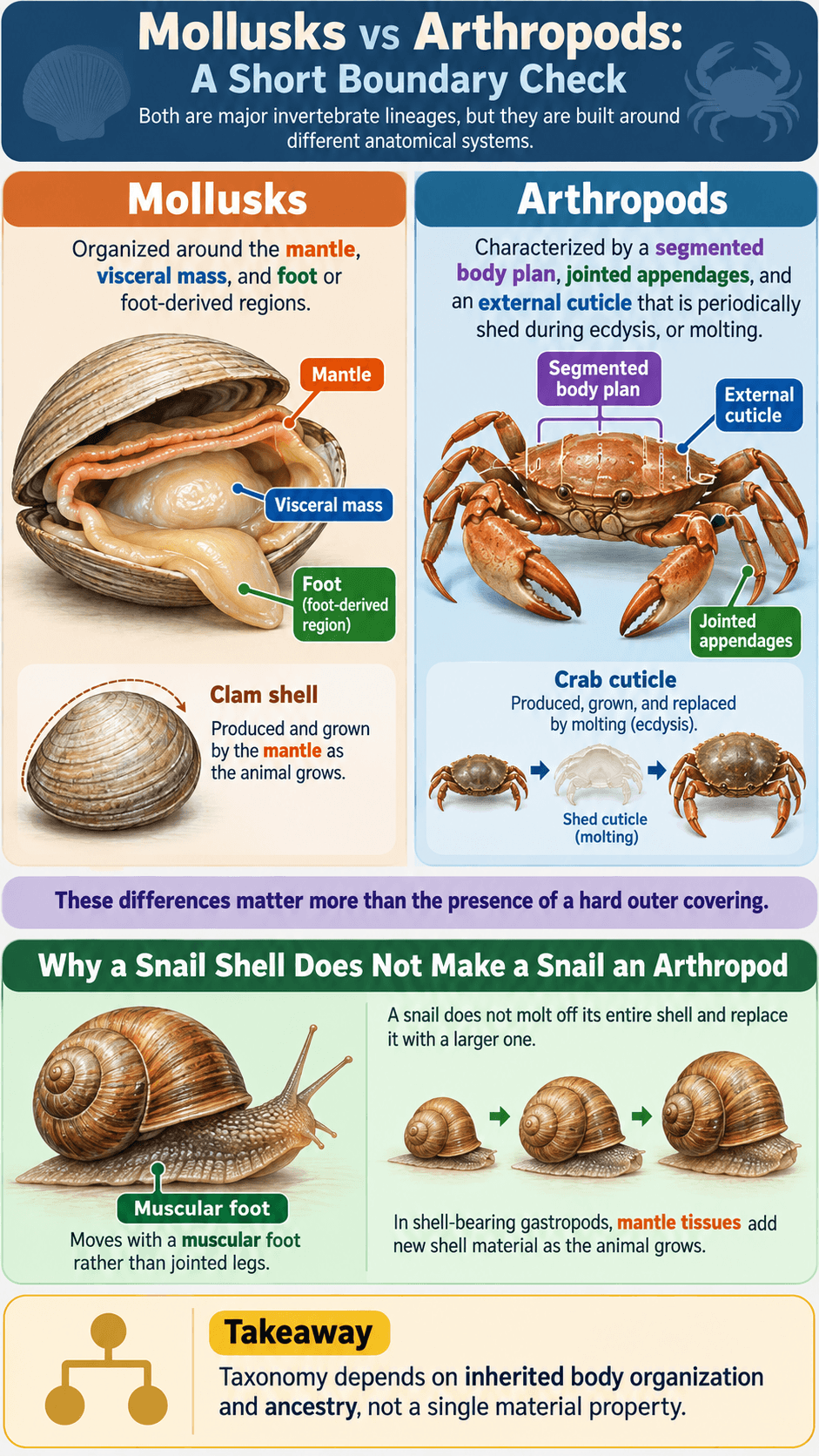
Mollusks and arthropods are both major invertebrate lineages, but they are built around different anatomical systems. Mollusks are organized around structures such as the mantle, visceral mass, and foot or foot-derived regions. Arthropods are characterized by a segmented body plan, jointed appendages, and an external cuticle that is periodically shed during ecdysis, or molting.
These differences matter more than the presence of a hard outer covering. A crab and a clam can both feel hard to the touch, but the crab’s cuticle and the clam’s shell are produced, grown, and replaced in different ways.
Why a Snail Shell Does Not Make a Snail an Arthropod
A snail does not molt off its entire shell and replace it with a larger one. In shell-bearing gastropods, mantle tissues add new shell material as the animal grows. A snail’s locomotor system is also based on a muscular foot rather than jointed legs.
So the presence of a hard outer shell is not evidence for an arthropod relationship. Taxonomy depends on inherited body organization and ancestry, not a single material property.
Common Definition Mistakes
“Soft-Bodied Animals With Shells”
This phrase is useful as a first classroom image, but it is too restrictive as a definition. Many mollusks have no obvious external shell, while many non-mollusks also produce shells, tubes, tests, plates, or other hard coverings. A better description is that mollusks are soft-bodied animals with a characteristic mantle-centered body organization, in which shell production is common but not universal.
“Animals With a Muscular Foot”
The muscular foot is a major molluscan theme, but the word “foot” can mislead readers into expecting the same flat structure under every animal. The ancestral region has been reshaped for crawling, burrowing, gripping, swimming-related structures, and other functions. In cephalopods, its evolutionary derivatives are reorganized around the head and locomotor system.
“Animals With a Radula”
Radulas are widespread and important, but bivalves lack them. Any definition that excludes clams, oysters, mussels, and scallops cannot be a definition of Mollusca. The radula is best used as one comparative clue among several.
What These Traits Help Explain
Major Living Mollusk Classes
Once the shared framework is clear, the major living classes make more sense. Gastropods emphasize a head-foot and often a shell that may be coiled, cap-shaped, reduced, internal, or absent. Bivalves have paired valves and no radula. Cephalopods transform the foot region into a complex head-foot system. Chitons combine a broad foot with eight dorsal shell plates. Tusk shells, monoplacophorans, solenogasters, and caudofoveates show still more ways to modify the same deep ancestry.
The value of classifying these animals together is not that they look alike. It is that their differences can be interpreted as transformations of a related biological plan.
Comparative Mollusk Anatomy
The mantle, foot, visceral region, gills or other respiratory surfaces, feeding apparatus, nervous system, and shell can each be compared across classes. Those comparisons reveal both homology, meaning structures related by common ancestry, and evolutionary innovation, meaning new forms built through modification of inherited tissues and developmental systems.
This comparative approach is especially useful for avoiding overgeneralizations. The anatomy of a snail is not a universal diagram for Mollusca, just as an octopus is not a universal model for cephalopods or mollusks as a whole.
How Mollusk Shells Are Formed
Knowing that the mantle is central to shell production also explains why shell biology is more than a question of mineral chemistry. Shell-bearing mollusks control the deposition of mineral and organic materials through living tissues. Growth happens as material is added in species-specific patterns, and shell structure can differ substantially among lineages.
That also clarifies why shell reduction and shell loss are evolutionary changes to a living anatomical system, not simply the absence of a generic external skeleton.
FAQ
Do all mollusks have shells?
No. Many familiar mollusks have shells, but an external shell is not universal. Slugs, nudibranchs, octopuses, and several other molluscan lineages have reduced, internal, highly modified, or absent adult shells. Shell condition has changed repeatedly during mollusk evolution.
Do all mollusks have a foot?
Mollusks share an evolutionary body-plan region commonly described as the foot, but it does not look like one flat crawling organ in every class. Gastropods may use a broad crawling foot, many bivalves use a specialized foot for burrowing, chitons have an adhesive foot, and cephalopods have dramatically transformed foot-derived structures associated with the arm crown and head-foot complex.
Do all mollusks have a radula?
No. A radula is present in many mollusks and can be highly specialized for different foods, but bivalves lack one. Clams, oysters, mussels, and scallops are therefore a major reminder that the radula is a common molluscan trait rather than a universal defining feature.
Final Thoughts
What makes an animal a mollusk is a shared evolutionary history expressed through a flexible body-plan framework, not one outward feature. The mantle, visceral mass, and muscular foot or its evolutionary derivatives provide the strongest recurring anatomical themes, while shells and radulas are important but non-universal traits. Looking at the whole pattern explains how a clam, snail, chiton, tusk shell, and octopus can belong to the same phylum even when their adult bodies seem almost unrelated at first glance.

Ethan Walker is the founder and research editor of Animal Fact Central. He creates and reviews educational animal facts content using trusted wildlife, pet care, and science-based sources. His work focuses on making animal behavior, adaptations, habitats, and species facts clear, accurate, and engaging for everyday readers.
Read More Details About Ethan Walker: https://animalfactcentral.com/ethan-walker/