
Arachnid conservation is difficult to summarize with one number because the group is vast, unevenly studied, and incompletely assessed. Spiders receive far more attention than many mites, harvestmen, pseudoscorpions, whip spiders, and other smaller lineages, yet even spider monitoring is patchy across regions and habitats. Many species are known from few records, tiny ranges, isolated caves, islands, mountain systems, springs, or other specialized microhabitats.
The central conservation issue is therefore not only which arachnids are threatened. It is also how much remains unknown. Habitat loss, fragmentation, climate change, cave disturbance, pollution, pesticides, groundwater change, invasive species, and collection for trade can all matter, but they do not affect every species equally. Conservation has to be built around the biology, range, habitat, and evidence available for each lineage.
Quick Answer
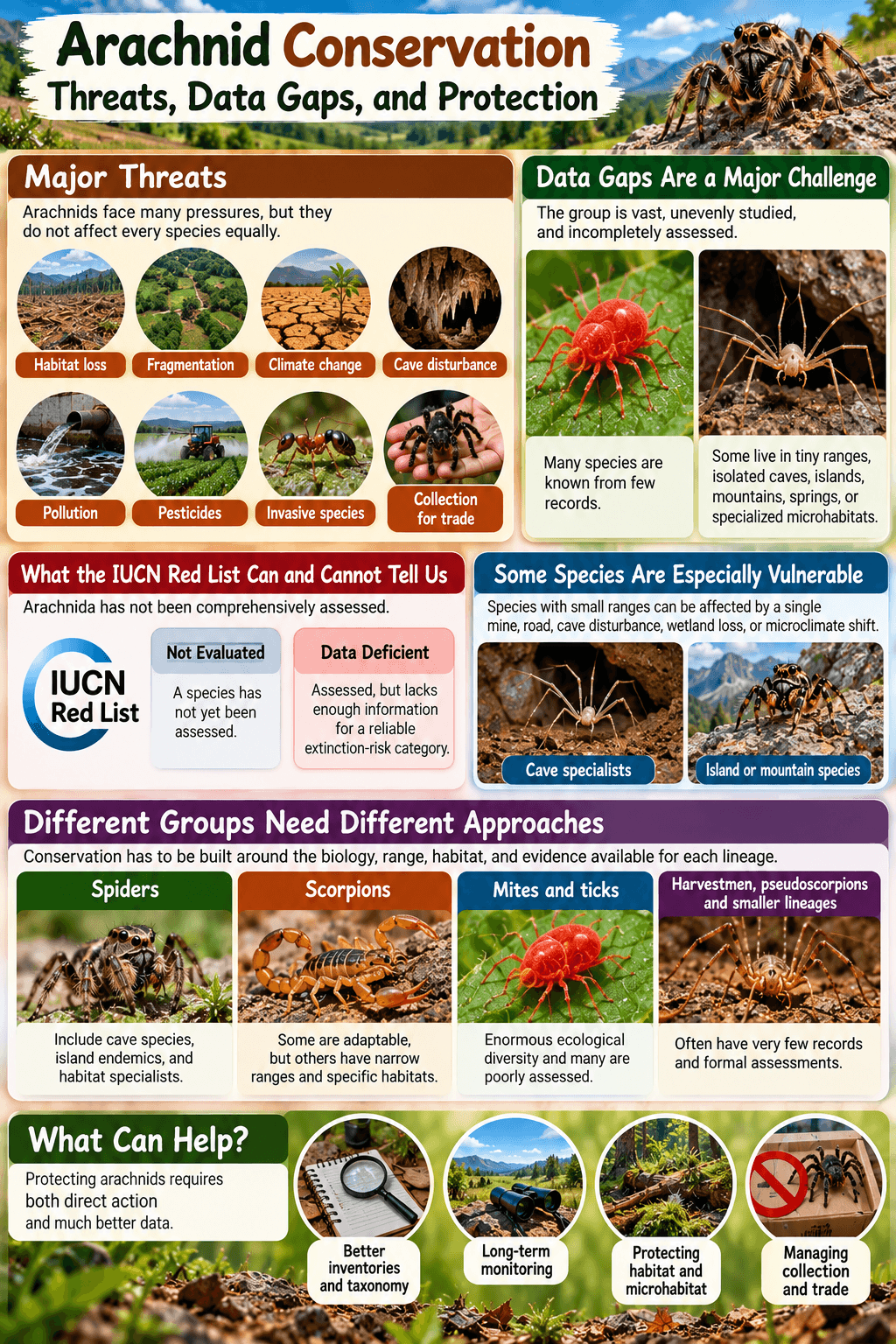
Arachnids face many of the same broad pressures affecting other animals, including habitat destruction, land-use change, pollution, altered fire regimes, climate change, drought, invasive species, and overcollection. Specialized species with small ranges can be especially vulnerable because a single mine, road, cave disturbance, wetland loss, or microclimate shift may affect a large share of their known habitat. Conservation priorities make more sense when viewed against the wider diversity of arachnids and their different biological requirements.
At the same time, major data gaps make global conclusions difficult. The IUCN Red List has not comprehensively assessed Arachnida as a whole. Many arachnid species remain Not Evaluated, while Data Deficient species have been assessed but lack enough information for a reliable extinction-risk category. Protecting arachnids therefore requires both direct conservation action and much better taxonomic, distribution, population, and ecological data. Those species are also components of wider food webs, which is why the ecological roles of arachnids should remain part of conservation thinking.
Why Data Gaps Are Central to Arachnid Conservation
Many species are known from few records
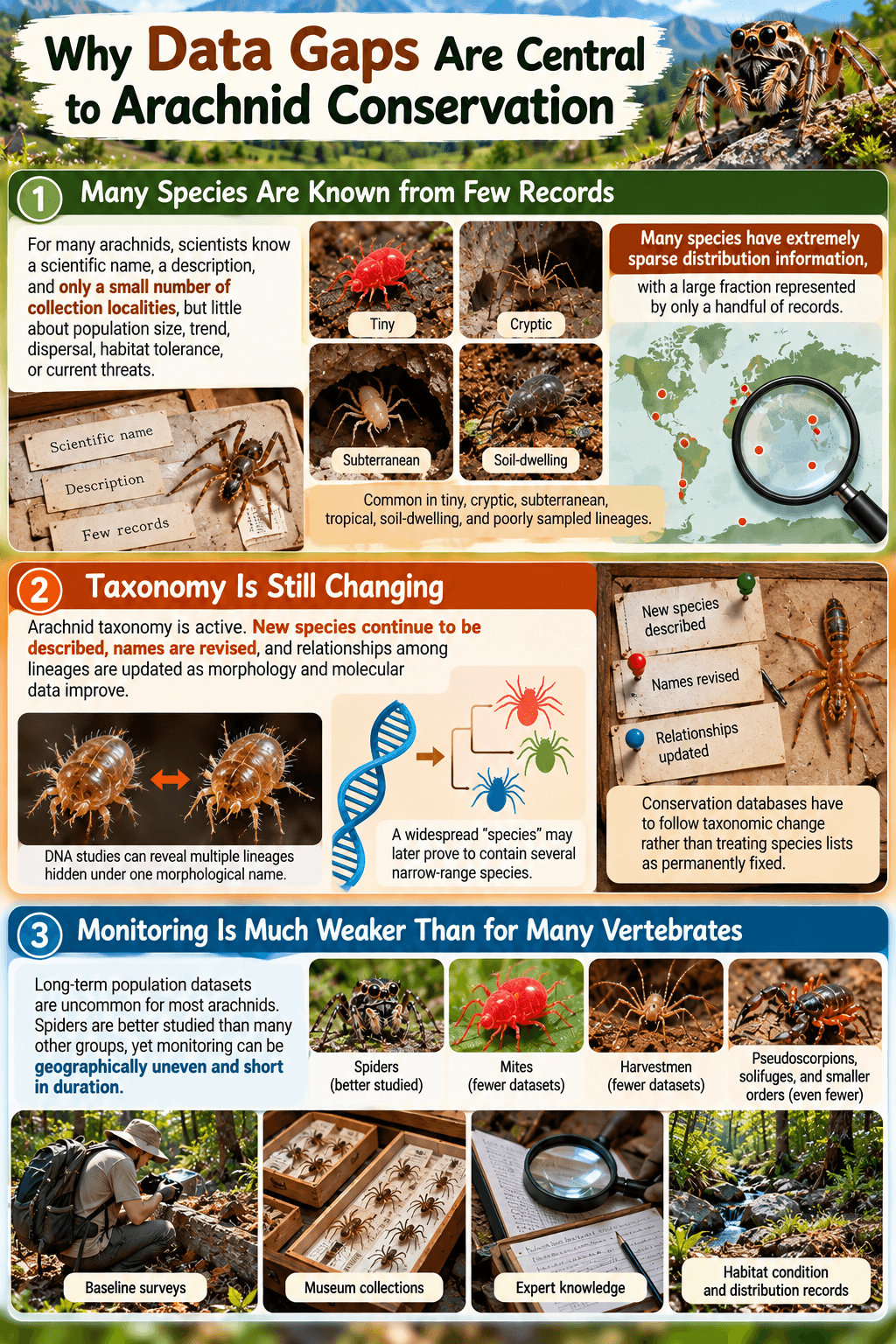
For many arachnids, scientists know a scientific name, a description, and perhaps a small number of collection localities, but little about population size, trend, generation length, dispersal, habitat tolerance, or current threats. This is especially common in tiny, cryptic, subterranean, tropical, soil-dwelling, and poorly sampled lineages.
A global analysis of occurrence records used in spider conservation profiles found that many species had extremely sparse distribution information, with a large fraction represented by only a handful of records. Sparse records make it difficult to distinguish a genuinely narrow range from a species that simply has not been surveyed well.
Knowledge gaps also vary geographically. Regions with active arachnologists, museums, and long-term monitoring can have much stronger datasets than equally diverse regions with fewer surveys. That imbalance can make some species look better known simply because scientists have looked more often.
Taxonomy is still changing
Arachnid taxonomy is active. New species continue to be described, names are revised, and relationships among lineages are updated as morphology and molecular data improve. Mites are particularly challenging because many species are tiny and cryptic, and DNA studies sometimes reveal multiple lineages hidden under one morphological name.
This matters for conservation because a widespread “species” may later prove to contain several narrow-range species, each with a much smaller distribution. The reverse can also happen when separate names are synonymized. Conservation databases therefore have to follow taxonomic change rather than treating species lists as permanently fixed.
Monitoring is much weaker than for many vertebrates
Long-term population datasets are uncommon for most arachnids. Spiders are better studied than many other groups, yet even spider monitoring can be geographically uneven and short in duration. Mites, harvestmen, pseudoscorpions, solifuges, and smaller orders often have even fewer standardized population datasets.
Without repeated monitoring, a species can decline while the evidence remains too weak to quantify the trend. That is one reason arachnid conservation depends heavily on baseline surveys, museum collections, expert knowledge, habitat condition, and carefully interpreted distribution records.
What the IUCN Red List Can and Cannot Tell Us
Arachnida has not been comprehensively assessed
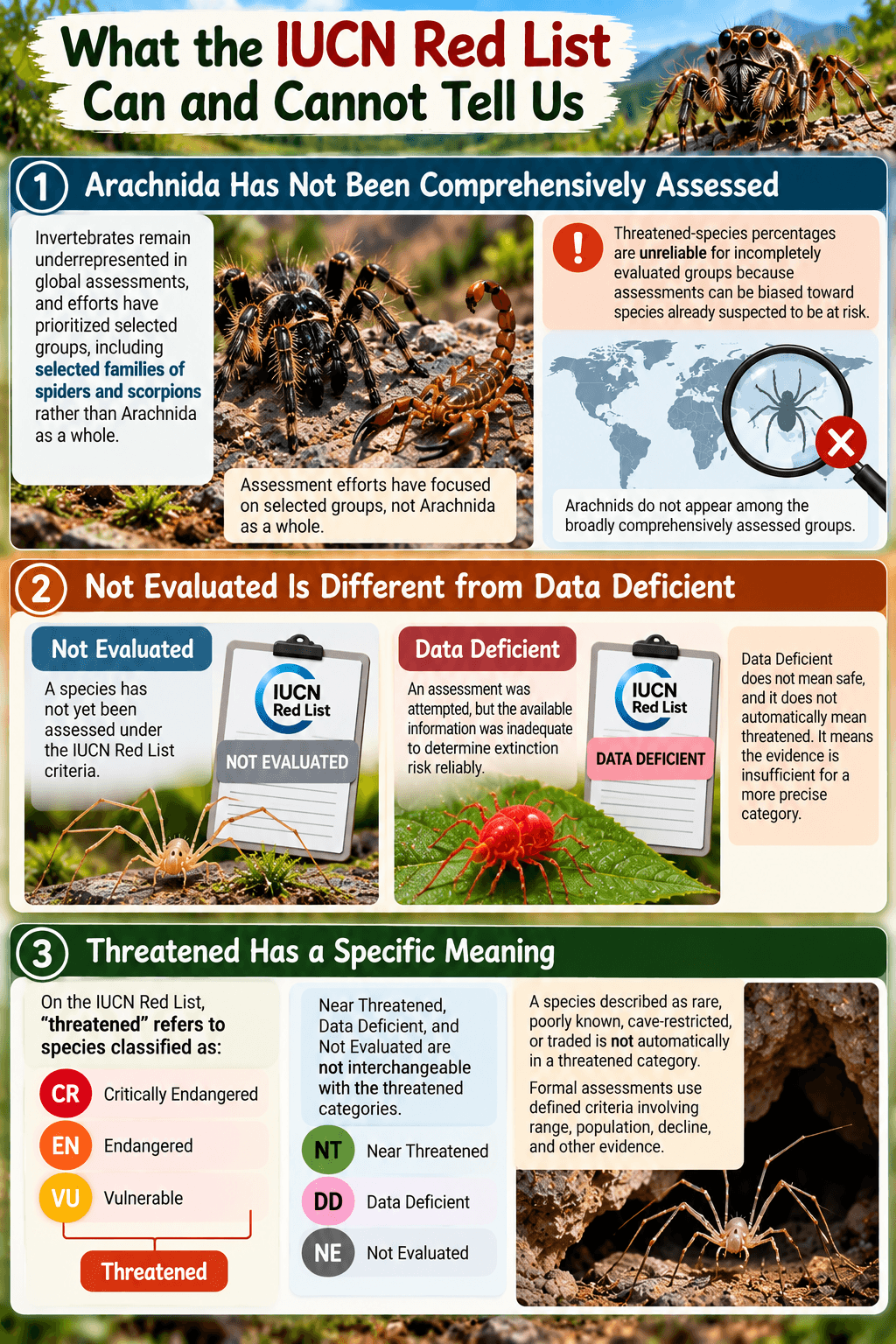
The current IUCN Barometer of Life explains that invertebrates remain underrepresented in global assessments and that assessment efforts have prioritized selected groups, including selected families of spiders and scorpions rather than Arachnida as a whole.
The IUCN Red List 2026-1 summary statistics warn that threatened-species percentages are unreliable for incompletely evaluated groups because assessment efforts can be biased toward species already suspected to be at risk. Arachnids do not appear among the broadly comprehensively assessed groups used for IUCN’s global percentage-threatened comparisons.
For that reason, it would be misleading to divide the number of assessed threatened arachnids by an estimated total number of arachnid species and present the result as a global threat percentage. The denominator, assessment coverage, and sampling process do not support that calculation.
Not Evaluated is different from Data Deficient
Not Evaluated means a species has not yet been assessed under the IUCN Red List criteria. Data Deficient means an assessment was attempted, but the available information was inadequate to determine extinction risk reliably.
The IUCN definition of Data Deficient specifically states that inadequate information about distribution or population status prevents a direct or indirect assessment of extinction risk. Data Deficient therefore does not mean safe, and it does not automatically mean threatened. It means the evidence is insufficient for a more precise category.
Threatened has a specific meaning
On the IUCN Red List, the term threatened refers to species classified as Vulnerable, Endangered, or Critically Endangered. Near Threatened, Data Deficient, and Not Evaluated are not interchangeable with those categories.
This distinction is especially important for arachnids because readers may encounter species described as rare, poorly known, cave-restricted, or traded. None of those facts alone establishes an IUCN threat category. Formal assessments use defined criteria involving range, population, decline, and other evidence.
Habitat Loss and Fragmentation
Forests, grasslands, wetlands, and soil microhabitats
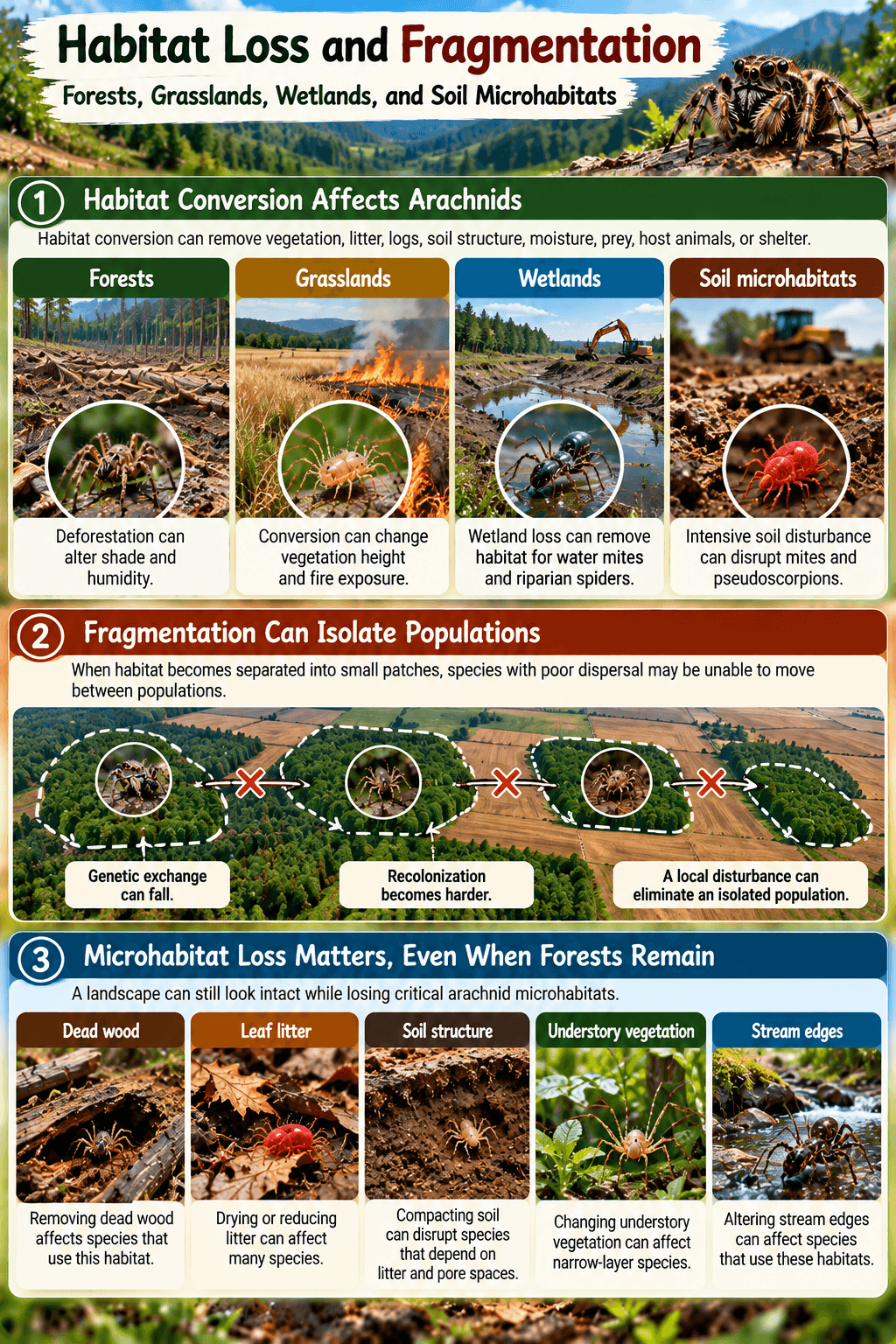
Habitat conversion can affect arachnids directly by removing vegetation, litter, logs, soil structure, moisture, prey, host animals, or shelter. Deforestation can alter shade and humidity. Grassland conversion can change vegetation height and fire exposure. Wetland loss can remove habitat for water mites and riparian spiders. Intensive soil disturbance can disrupt mites and pseudoscorpions that depend on litter and pore spaces. Many conservation risks are ultimately tied to where arachnids live and the microhabitats required by specialized species.
Fragmentation can be especially serious for species with poor dispersal. If suitable habitat becomes separated into small patches, individuals may be unable to move between populations. Genetic exchange can fall, recolonization becomes harder, and a local disturbance can eliminate an isolated population permanently.
Microhabitat loss can matter even when a landscape still looks intact
A forest can remain standing while losing critical arachnid microhabitats. Removing dead wood, drying litter, compacting soil, changing understory vegetation, or altering stream edges can affect species that use only a narrow layer of the environment.
This is why arachnid conservation often requires finer-scale habitat thinking than simply protecting a large green area on a map. Rotting logs, moss, cave humidity, spring flow, bark structure, leaf litter depth, and host communities can all be biologically important.
Cave and Narrow-Range Arachnids
Small ranges increase vulnerability
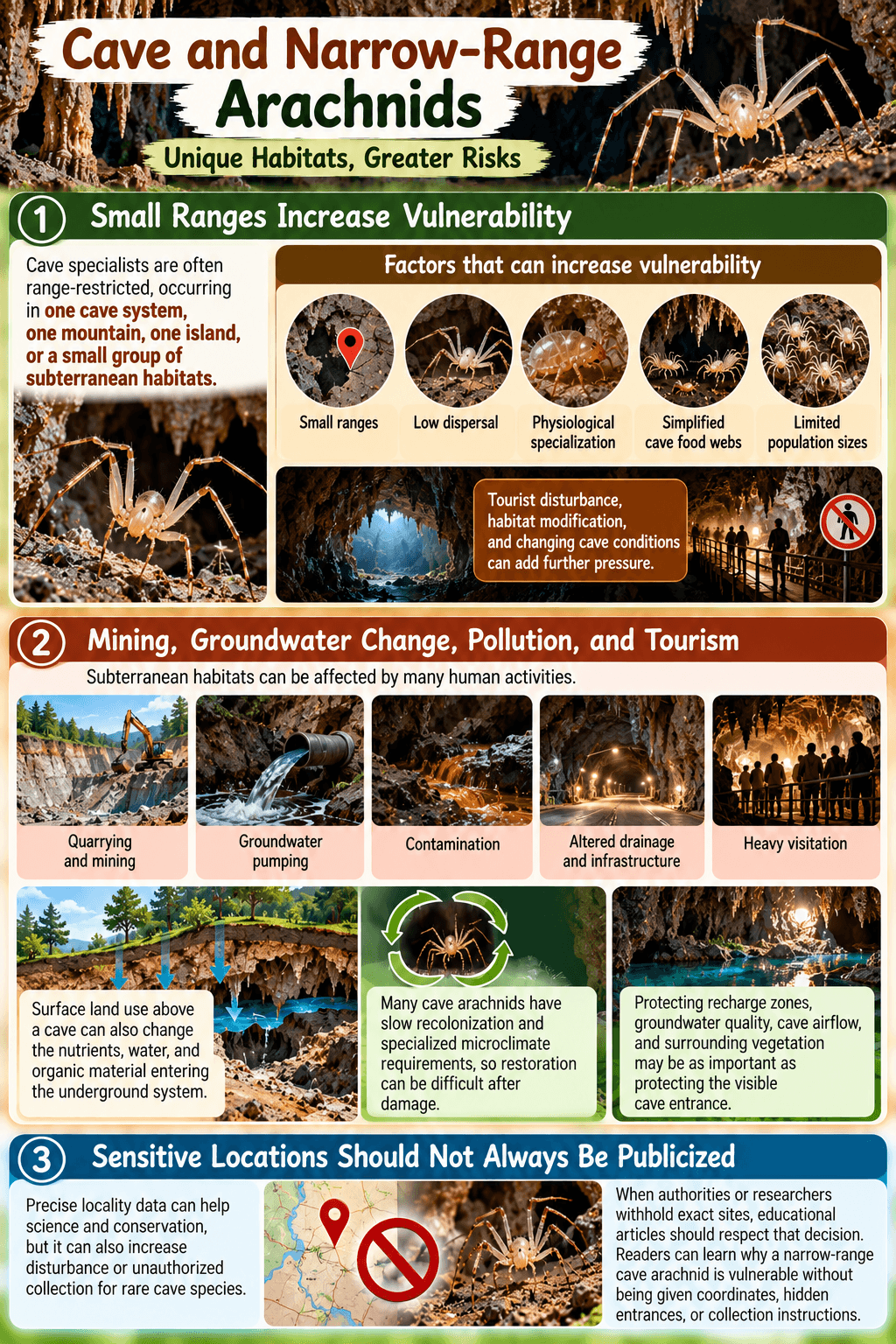
Cave specialists are among the clearest examples of range-restricted arachnids. A species may occur in one cave system, one mountain, one island, or a small group of subterranean habitats. Low dispersal makes movement to new habitat difficult if conditions deteriorate.
A review of spiders in caves and their conservation identifies small ranges, low dispersal, physiological specialization, simplified cave food webs, and limited population sizes as factors that can increase vulnerability. Tourist disturbance, habitat modification, and changing cave conditions can add further pressure.
Mining, groundwater change, pollution, and tourism
Subterranean habitats can be affected by quarrying and mining, groundwater pumping, contamination, altered drainage, infrastructure, and heavy visitation. Surface land use above a cave may also change the nutrients, water, and organic material entering the underground system.
Because many cave animals have slow recolonization and specialized microclimate requirements, restoration can be difficult after major damage. Protecting recharge zones, groundwater quality, cave airflow, and surrounding vegetation may be as important as protecting the visible cave entrance.
Sensitive locations should not always be publicized
Precise locality data can help science and conservation, but public disclosure can also increase disturbance or unauthorized collection for rare cave species. When conservation authorities or researchers intentionally withhold exact sites, educational articles should respect that decision.
Readers can learn why a narrow-range cave arachnid is vulnerable without being given coordinates, hidden entrances, or collection instructions.
Climate Change and Microclimate
Temperature and moisture shifts
Many arachnids experience their environment at a microclimate scale. A few degrees of warming or a change in humidity can alter water balance, activity, development, prey availability, and reproductive success even when the broader habitat category remains the same.
Cave specialists can be particularly sensitive because subterranean environments are often thermally stable. Alpine species can lose suitable cool habitat as climate zones move upslope. Soil and litter species may be affected when drought dries the upper layers they occupy.
Conservation profiles of narrow-range cave spiders have identified climate-driven changes in subterranean microclimate as an important concern, especially for species with limited dispersal and narrow thermal tolerance.
Drought and altered fire regimes
Drought can reduce humidity in litter, soil, vegetation, springs, and caves. Fire can remove vegetation, litter, woody debris, and shade, while repeated or unusually intense fires may change habitat structure for years.
Some arachnids recover well after fire, while others depend on unburned refuges or slow-forming microhabitats. The effect depends on fire frequency, intensity, season, landscape history, and the species involved. It is not accurate to treat fire as universally harmful or harmless.
Agriculture, Pesticides, and Pollution
Direct and indirect effects of pesticides
Pesticides can affect non-target arachnids directly through toxicity and indirectly by reducing prey, altering plant communities, or changing soil and litter food webs. Different compounds, exposure routes, application methods, and species sensitivities produce very different outcomes.
Predatory mites and spiders are often studied in agricultural systems because of their interactions with crop pests, but conservation concerns extend beyond crop fields. Chemical movement into field margins, wetlands, soil, and waterways can affect species that were not the intended target.
Soil and water contamination
Heavy metals, nutrient pollution, hydrocarbons, mine drainage, sewage, and other contaminants can alter arachnid habitats. Water mites and cave arachnids can be especially exposed to pollutants moving through streams, springs, or groundwater.
Pollution can also change microbial and fungal communities that support soil mites and detritus-associated food webs. The impact may therefore occur through several trophic levels rather than only through direct poisoning.
Trade and Collection
Popular spiders and scorpions can enter international trade
Large, visually striking arachnids such as tarantulas and scorpions are collected and traded internationally. The scale and source of trade vary among taxa, and captive breeding can reduce pressure for some species, while wild collection can still be important for others.
A global study of arachnids in wildlife trade found more than a thousand spider, scorpion, and whip-scorpion species represented in trade sources and highlighted major gaps in distribution, population, and conservation-status data. The authors cautioned that limited monitoring makes the effect of wild collection difficult to evaluate for many species.
CITES listings cover selected arachnids, not the whole group
The official CITES Appendices list selected tarantula lineages and selected Pandinus scorpions rather than Arachnida as a whole. CITES regulates international trade in listed taxa; it does not provide a complete extinction-risk assessment for every arachnid species.
A CITES listing is not the same as an IUCN Red List category. CITES focuses on whether international trade needs regulation so that it does not threaten wild populations, while IUCN categories assess extinction risk using a different system. A species can be CITES-listed without being in an IUCN threatened category, and an IUCN-threatened species may not be CITES-listed.
Trade regulation works best when taxonomy, identification, origin, population status, and legal supply chains are clear. Those are precisely the areas where many arachnids still have substantial data gaps.
Spiders, Scorpions, Mites, and Ticks Need Different Conservation Approaches
Spiders
Spider conservation includes narrow-range cave species, island endemics, alpine specialists, wetland species, forest specialists, and traded tarantulas. Threats differ accordingly. A cave spider may be affected most by microclimate and tourism, while a grassland spider may respond to land conversion or fire management. The major arachnid groups differ enough in ecology and life history that conservation needs cannot be assumed to be identical.
Spiders are relatively well studied compared with many arachnids, but that does not mean their conservation status is comprehensively known. Large geographic and ecological knowledge gaps remain.
Scorpions
Scorpion conservation often receives less attention than toxinology or human-health research. Some adaptable species can thrive in modified environments, but that should not be generalized to all scorpions. Forest specialists, cave species, mountain endemics, and narrow-range desert taxa may have very different vulnerabilities.
Collection for trade can matter for selected species, especially when populations are localized or reproduction is slow, but trade pressure should be documented rather than assumed for every scorpion.
Mites and ticks
Mites and ticks represent enormous ecological diversity. Some are parasites, but many mites are free-living predators, fungal feeders, plant associates, freshwater species, soil animals, cave specialists, or inhabitants of highly specific host microhabitats.
Small size and difficult identification make many mite species especially poorly assessed. Cryptic diversity can hide multiple species under a single name, making range size and conservation status harder to estimate.
Tick conservation requires careful framing. Some tick species are medically important vectors, but the broader evolutionary diversity of ticks and mites cannot be reduced to human disease. Conservation decisions remain species- and ecosystem-specific rather than a blanket argument for increasing medically important vector populations in human environments.
Harvestmen, pseudoscorpions, and smaller lineages
Harvestmen and pseudoscorpions include cave species, litter specialists, mountain endemics, and other narrow-range forms. Smaller arachnid orders can have even fewer experts, records, and formal assessments.
For these groups, basic taxonomy and distribution mapping are often conservation actions in their own right. A species cannot be effectively protected if researchers do not know where it occurs or whether several populations assigned the same name are actually separate species.
What Effective Arachnid Conservation Looks Like
Better inventories and taxonomy
Field surveys, museum collections, DNA data, taxonomic revision, and accessible occurrence databases help establish which species exist and where they live. Standardized methods also allow different studies to be compared over time.
New surveys should prioritize undersampled habitats and regions rather than repeatedly collecting only common species from well-known sites.
Long-term monitoring
Repeated sampling is needed to distinguish natural fluctuations from sustained decline. Monitoring can track occupancy, abundance, habitat quality, microclimate, host availability, and other factors relevant to the species.
Long-term datasets are especially valuable for detecting gradual effects of climate change, land-use change, altered fire regimes, or groundwater shifts that may not be obvious from a single survey.
Protecting habitat and microhabitat
Protected areas can help, but management has to preserve the features arachnids actually use. Forest conservation may need to retain litter and dead wood. Cave conservation may require protecting groundwater and surface vegetation. Wetland protection can maintain springs and riparian edges. Grassland management may need appropriate disturbance and fire regimes.
Microhabitat protection is often inexpensive compared with rebuilding a damaged ecosystem, but it requires knowing which small-scale features matter.
Managing collection and trade where evidence supports it
Trade monitoring, legal collection limits, captive breeding, origin documentation, and enforcement can reduce pressure where collection is demonstrated or plausibly severe. Regulation should be targeted at taxa and populations for which evidence indicates a conservation concern.
Because online trade changes quickly, monitoring cannot rely only on historical export records. Updated taxonomy and species identification are also necessary so newly described or renamed species are not hidden under vague trade names.
Common Conservation Myths
Arachnids are too abundant to need conservation
No. Some species are abundant and widespread, while others are known from one cave, island, mountain, spring, or small habitat patch. Abundance in one familiar species says nothing about the status of a narrow-range relative.
If a species is not on the IUCN Red List, it is safe
No. A species absent from the Red List may simply be Not Evaluated. Lack of an assessment is not evidence of low extinction risk.
Data Deficient means endangered
No. Data Deficient means the available information is insufficient to determine extinction risk reliably. Some Data Deficient species may later prove threatened, while others may prove secure once better data become available.
CITES-listed means IUCN threatened
No. CITES and the IUCN Red List answer different questions. CITES regulates international trade in listed taxa, while IUCN evaluates extinction risk. The two systems can overlap, but one status does not automatically imply the other.
Only charismatic spiders matter
No. Mites, ticks, harvestmen, pseudoscorpions, scorpions, whip spiders, solifuges, and smaller arachnid lineages represent large amounts of evolutionary and ecological diversity. Conservation based only on the most visible species would miss much of Arachnida.
How to Read Arachnid Conservation Claims Carefully
Check the population and time period
A claim of decline should identify which species or population was measured, where the data came from, and over what period. A regional decline cannot automatically be converted into a global trend.
Check whether a number refers to described, assessed, or threatened species
These categories are different. The number of described species comes from taxonomy. The number assessed comes from conservation programs. The number in threatened categories comes from risk evaluations. Mixing them produces misleading percentages.
Check whether a threat is demonstrated or only plausible
Habitat loss, climate change, pesticides, mining, and trade can all threaten arachnids, but evidence strength varies. Good conservation writing distinguishes documented population impacts from plausible concerns that still need study.
FAQ
Are arachnids endangered?
Some arachnid species are threatened, while many others are not formally assessed or remain poorly known. Arachnida as a whole has not been comprehensively assessed by the IUCN Red List, so there is no defensible single global percentage describing how many arachnid species are threatened.
Why are cave arachnids vulnerable?
Cave species can have very small ranges, low dispersal, specialized microclimate requirements, and limited population sizes. Mining, groundwater change, pollution, tourism, altered surface vegetation, and climate-driven temperature or humidity shifts can therefore affect a large share of a species’ habitat at once.
Does Data Deficient mean a species is safe?
No. Data Deficient means the available evidence is inadequate to assign a reliable extinction-risk category. It does not mean safe, and it does not automatically mean threatened.
Does CITES protect all tarantulas and scorpions?
No. CITES lists selected arachnid taxa rather than all tarantulas, scorpions, or arachnids. The exact appendices and accepted names can change, so current CITES records should be checked for a particular species.
How can arachnid conservation improve?
Priorities include better taxonomy, wider field surveys, accessible occurrence records, long-term monitoring, protection of specialized habitats and microhabitats, careful management of collection and trade where needed, and repeated reassessment as new information becomes available.
Final Thoughts
Arachnid conservation is as much a knowledge problem as a threat problem. Habitat loss, fragmentation, climate change, pollution, altered fire, groundwater change, pesticides, invasive species, and trade can affect arachnids, but their importance varies among species. Narrow-range cave, island, alpine, spring, forest, or habitat-specialist species can face very different pressures from widespread generalists.
The strongest conservation approach is therefore evidence-based and taxon-specific. It distinguishes Not Evaluated from Data Deficient, avoids calculating global threat percentages from incomplete samples, protects critical microhabitats, improves monitoring, and updates trade or habitat protections when new data justify them. For Arachnida, filling the gaps in taxonomy, distribution, population trends, and ecology is not separate from conservation. It is one of the main ways conservation becomes possible.

Ethan Walker is the founder and research editor of Animal Fact Central. He creates and reviews educational animal facts content using trusted wildlife, pet care, and science-based sources. His work focuses on making animal behavior, adaptations, habitats, and species facts clear, accurate, and engaging for everyday readers.
Read More Details About Ethan Walker: https://animalfactcentral.com/ethan-walker/