
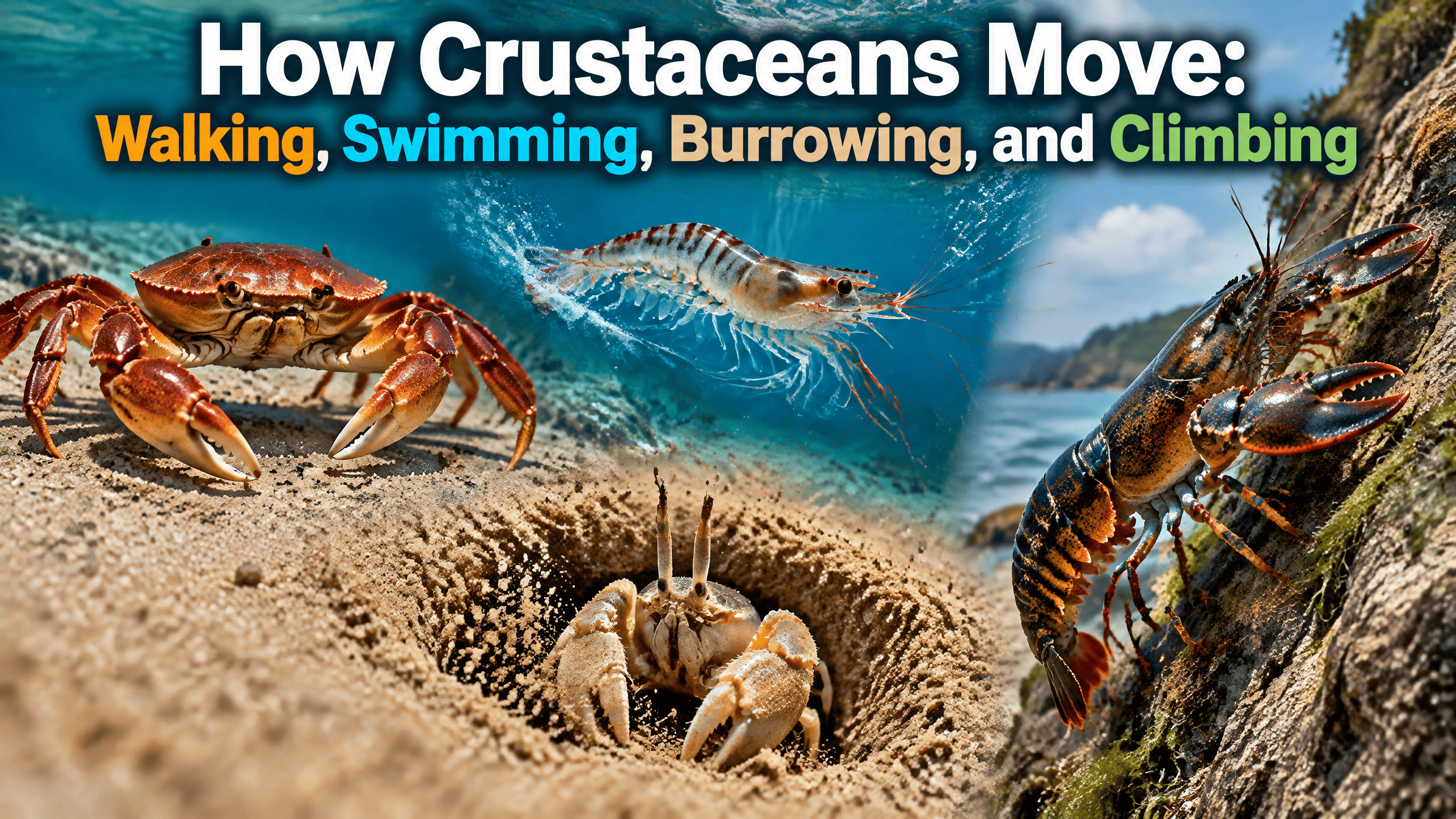
Crustaceans move in far more ways than the familiar sideways walk of a crab. Depending on the lineage and habitat, they may walk across the bottom, crawl through leaf litter, swim with rhythmic strokes, launch a rapid tail-flip escape, burrow into sediment, climb exposed surfaces, drift while actively adjusting position in the water, or spend adult life attached to one spot after a mobile larval stage.
That variety makes crustacean locomotion a useful example of how a shared arthropod body plan can be reshaped for very different jobs. The same broad theme of jointed appendages appears in crabs, shrimp, lobsters, crayfish, copepods, amphipods, isopods, barnacles, and mantis shrimps, but those animals do not move in one standard crustacean way. Their movement depends on body shape, appendage design, muscle control, sensory feedback, and the physical demands of water, sediment, rock, vegetation, or land.
Quick Answer
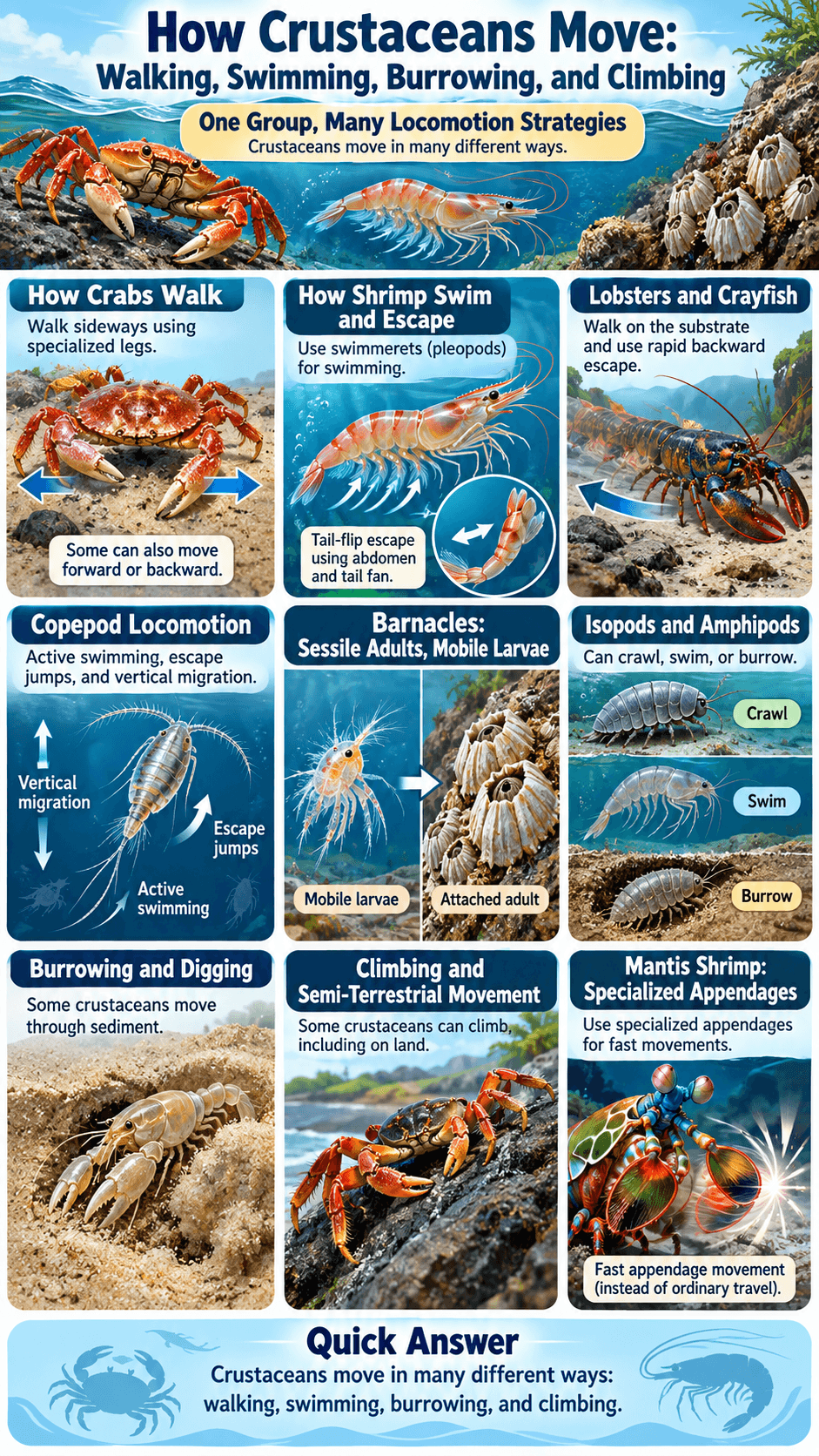
Crustaceans move by coordinating specialized appendages and, in some groups, movements of the abdomen and tail region. Many decapods walk on jointed thoracic legs. Shrimp can swim with pleopods, often called swimmerets, and can use rapid abdominal flexion for escape. Lobsters and crayfish commonly walk along the substrate but can use tail-flips to retreat quickly. Copepods actively swim and perform fast escape movements even though many are planktonic. Isopods and amphipods may crawl, swim, burrow, or walk on land. Familiar adult barnacles are sessile, but their larvae are mobile before settlement. For the broader picture of the group behind these movement strategies, see the crustacean overview.
Research on crustacean motor control also shows why broad rules can be misleading. A review of decapod locomotion describes different neural and mechanical patterns for sideways walking in crabs and forward or backward walking in lobsters and crayfish, with sensory feedback helping coordinate multiple legs. The Oxford Handbook review of crustacean locomotion provides a useful overview of this diversity.
One Group, Many Locomotion Strategies
Walking, crawling, swimming, burrowing, and climbing
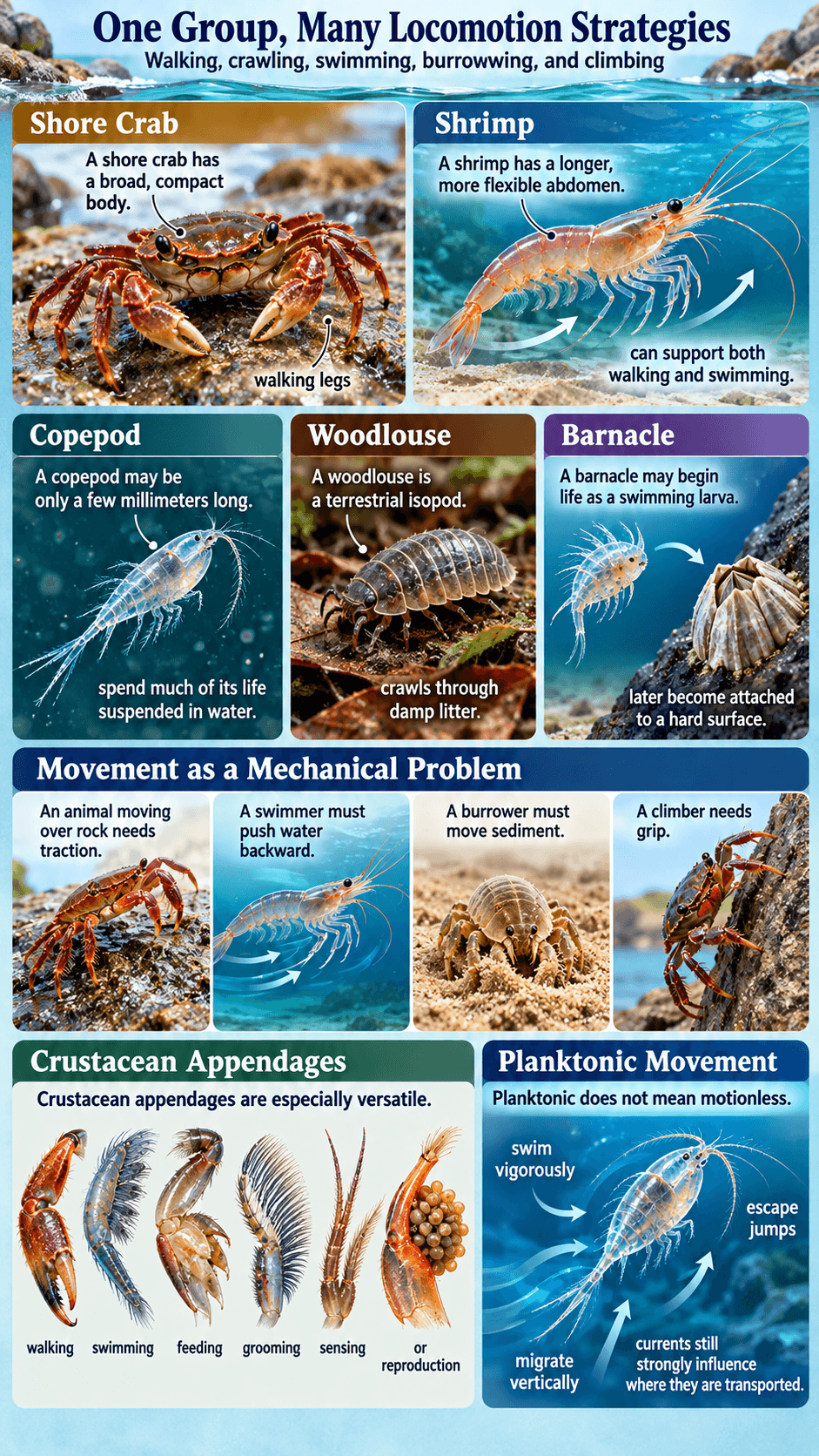
The word crustacean covers animals with dramatically different proportions and lifestyles. A shore crab has a broad, compact body with laterally arranged walking legs. A shrimp has a longer, more flexible abdomen and appendages that can support both walking and swimming. A copepod may be only a few millimeters long and spend much of its life suspended in water. A woodlouse is a terrestrial isopod that crawls through damp litter. A barnacle may begin life as a swimming larva and later become attached to a hard surface.
These differences matter because locomotion is a mechanical problem. An animal moving over rock needs traction and stable leg placement. A swimmer must push water backward to move itself forward, or rapidly flex the body to accelerate away from danger. A burrower must move sediment while maintaining enough purchase to avoid simply slipping in place. A climber needs grip, joint control, and a body position that keeps it attached to the surface.
Crustacean appendages are especially versatile because serially related limbs can be modified for different tasks. Some are used primarily for walking, others for swimming, feeding, grooming, sensing, or reproduction. Movement therefore emerges from combinations of body regions and appendages rather than from one universal type of “crustacean leg.”
Planktonic movement versus large-scale currents
Planktonic does not mean motionless. A planktonic animal may swim vigorously, change orientation, respond to light or chemical cues, make escape jumps, or migrate vertically through the water column. The defining limitation is that plankton generally cannot maintain position against large-scale water movement in the same way a strong nektonic swimmer can.
Copepods make this distinction easy to see. Many species actively swim and can react rapidly to disturbances, but their small size means currents still strongly influence where they are transported. The Smithsonian National Museum of Natural History describes copepods as extremely diverse aquatic crustaceans occupying habitats from fresh water to the deep ocean, with free-living, symbiotic, and parasitic forms. Smithsonian’s copepod research overview is a reminder that “copepod” does not describe one locomotor lifestyle.
How Crabs Walk
Why sideways walking is common in many true crabs
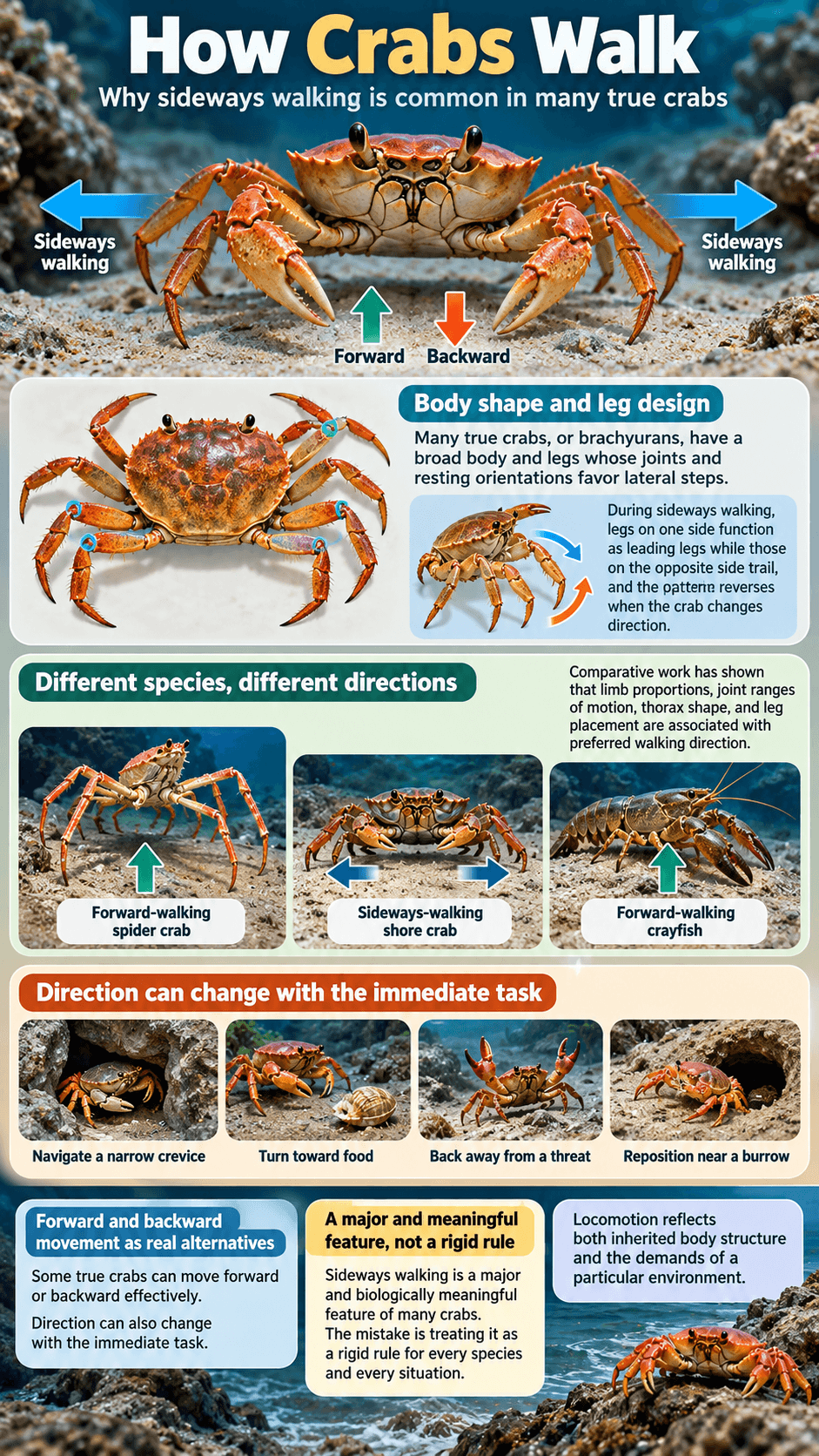
Sideways movement is strongly associated with true crabs, or brachyurans, because many species have a broad body and legs whose joints and resting orientations favor lateral steps. During sideways walking, legs on one side function as leading legs while those on the opposite side trail, and the pattern reverses when the crab changes direction.
This arrangement can make lateral locomotion mechanically convenient for a compact crab body, but it should not be turned into a rule that every crab can only move sideways. Comparative work has shown that limb proportions, joint ranges of motion, thorax shape, and leg placement are associated with preferred walking direction. One study comparing a forward-walking spider crab, a sideways-walking shore crab, and a forward-walking crayfish found that joint range and limb proportions reflected each animal’s preferred direction. The comparative study of forward and sideways walking shows that crab locomotion is more flexible than the stereotype suggests.
Forward and backward movement as real alternatives
Some true crabs can move forward or backward effectively, and recent comparative research indicates that forward-moving forms have evolved within Brachyura as well. Direction can also change with the immediate task. A crab navigating a narrow crevice, turning toward food, backing away from a threat, or repositioning near a burrow may not use the same gait it would use when crossing open ground.
The useful takeaway is not that sideways walking is a myth. It is a major and biologically meaningful feature of many crabs. The mistake is treating it as a rigid rule for every species and every situation. Locomotion reflects both inherited body structure and the demands of a particular environment.
How Shrimp Swim and Escape
Walking appendages and swimmerets
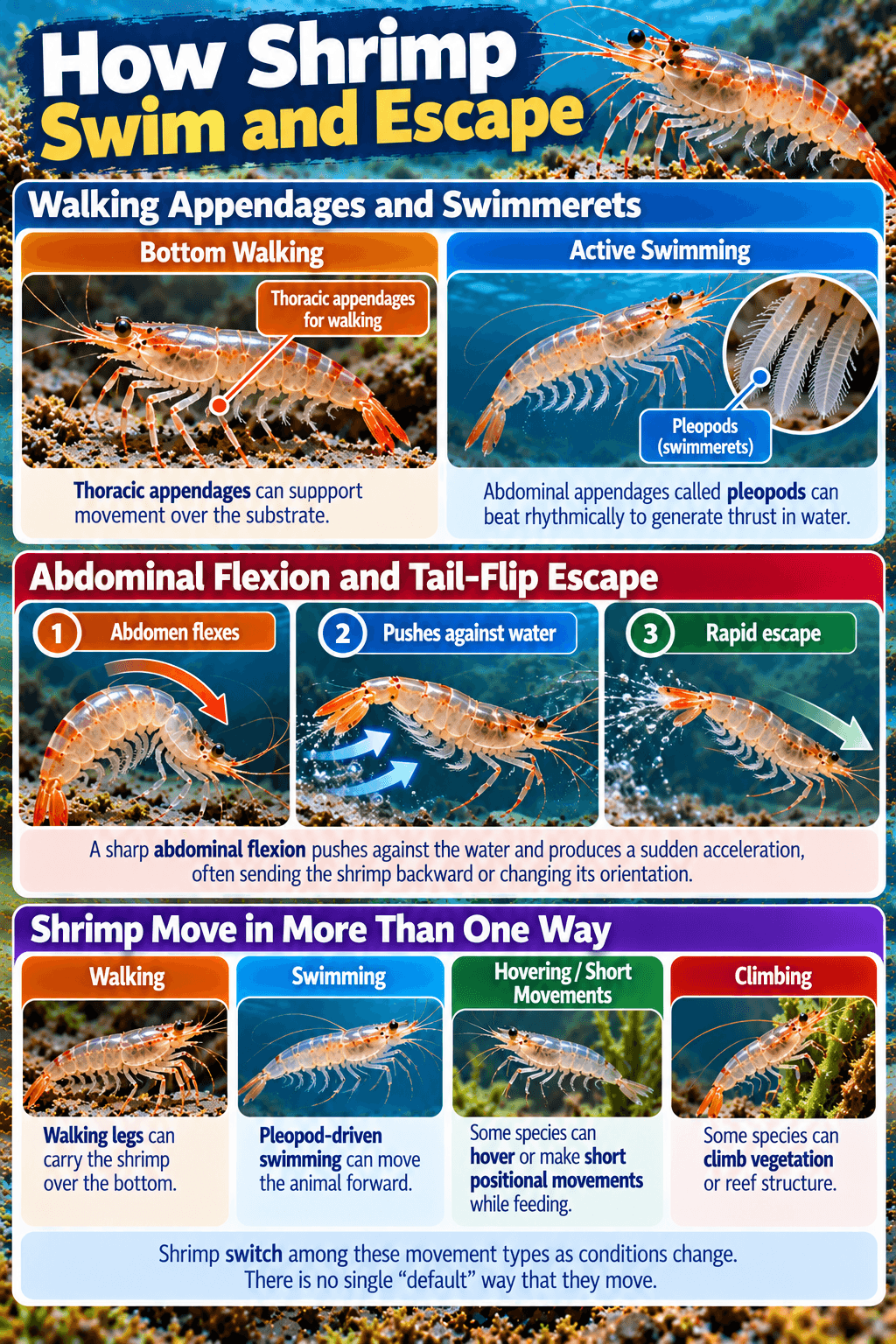
Many shrimp can combine bottom walking with active swimming. Thoracic appendages can support movement over the substrate, while abdominal appendages called pleopods can beat rhythmically to generate thrust in water. The exact balance between walking and swimming varies among species and situations.
Routine swimming can be very different from emergency escape. In sustained movement, repeated pleopod strokes may propel a shrimp while allowing controlled orientation. In laboratory work on whiteleg shrimp, researchers distinguished walking, swimming, and tail-flipping as separate locomotor modes and found that the energetic demands differed among them. The Journal of Crustacean Biology study of shrimp locomotion documents these distinct movement modes without implying that one represents all shrimp behavior.
Abdominal flexion and tail-flip escape
When rapid escape matters, many elongate decapods can flex the abdomen sharply. This movement pushes against the surrounding water and produces a sudden acceleration that often sends the animal backward or changes its orientation. The broad tail fan in many species helps interact with the water during the maneuver.
Tail-flipping is best understood as an escape response rather than the normal direction of all locomotion. A shrimp may spend long periods walking, hovering, or swimming in a controlled way, then use a much more powerful abdominal flexion when startled. The distinction is important because viral descriptions often make it sound as if shrimp simply “swim backward” as their default behavior.
Why shrimp are not always moving tail-first
Shrimp can travel in more than one direction because different appendages and body movements serve different tasks. Pleopod-driven swimming can move the animal forward, while the abdomen can generate rapid escape motions. Walking legs can carry the animal over the bottom. Some species also hover, climb vegetation or reef structure, or make short positional movements while feeding.
There is no need to choose one of these as the “real” shrimp locomotion. The animal switches among them as conditions change. A slow foraging movement, a migration, a current adjustment, and a predator escape have different mechanical demands, so a flexible locomotor repertoire is useful.
Lobsters and Crayfish
Substrate walking
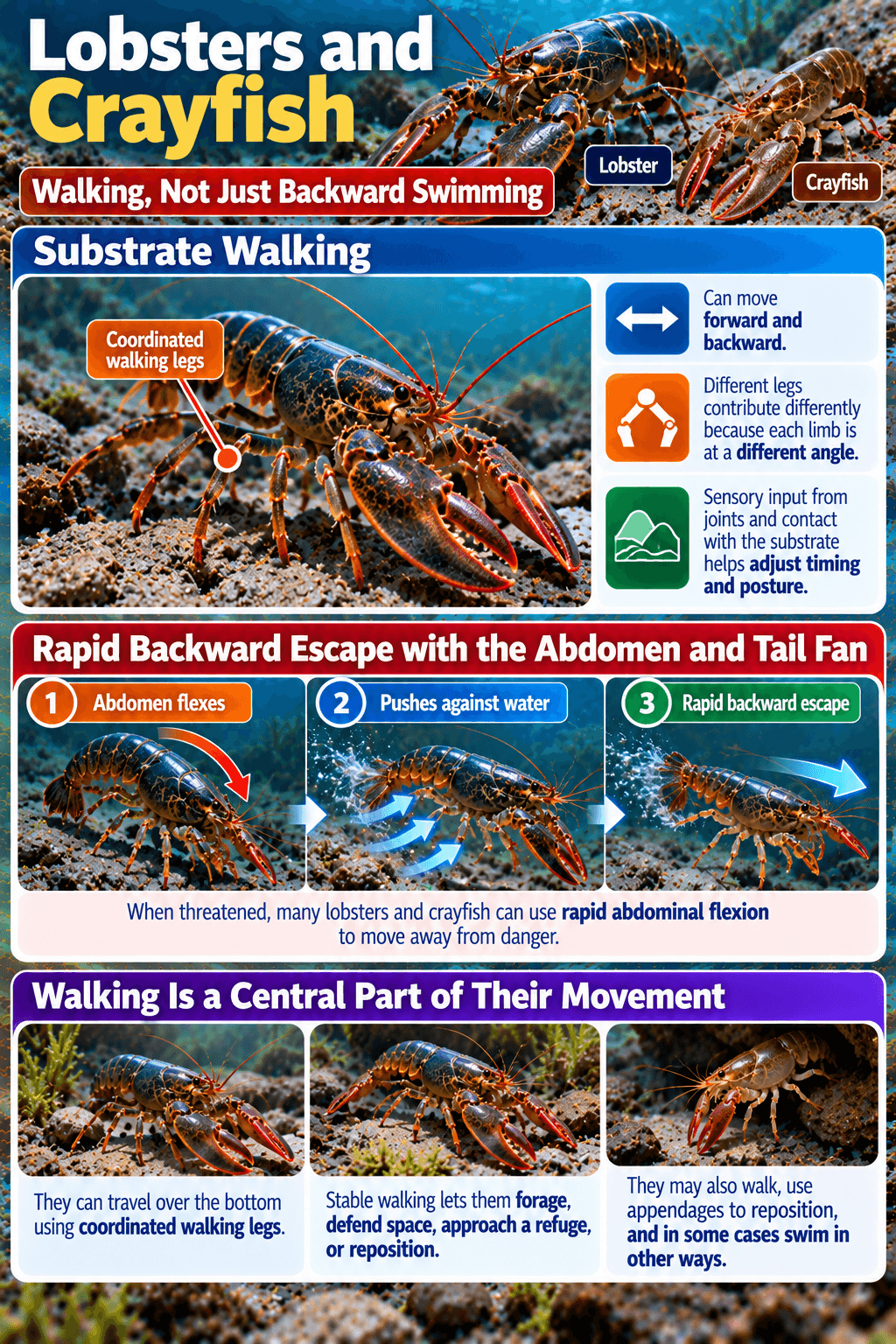
Lobsters and crayfish are often pictured as animals that shoot backward through the water, but walking is a central part of their normal movement. They can travel over the bottom using coordinated walking legs, including forward and backward movement. Different legs contribute differently because each limb is positioned at a different angle relative to the body.
Leg coordination is not simply a fixed marching pattern. Sensory input from joints and contact with the substrate helps adjust timing and posture. That feedback matters when an animal crosses uneven rock, sediment, vegetation, or the entrance of a shelter. Stable walking lets the animal forage, defend space, approach a refuge, or reposition without spending the energy required for repeated escape responses.
Rapid backward escape with the abdomen and tail fan
When threatened, many lobsters and crayfish can use rapid abdominal flexion to move away from danger. In crayfish, the tail-flip escape has become an important model for studying animal biomechanics and neural control. A 2024 study of virile crayfish examined how the animal interacts with the substrate during the response and emphasized that this behavior involves rapid abdominal flexion rather than ordinary walking. The recent crayfish tail-flip study gives a modern biomechanical look at this escape system.
That does not mean lobsters and crayfish spend their lives swimming backward. The tail-flip is a specialized high-speed option. During ordinary activity they may walk, use appendages to reposition, and in some cases swim in other ways. The striking backward escape is memorable precisely because it is different from slower routine locomotion.
Copepod Locomotion
Continuous swimming and orientation
Copepods show how small crustaceans can be active swimmers without behaving like fish. Many free-living forms use repeated movements of cephalic and swimming appendages to maintain position, move through the water, feed, or change orientation. Because they operate at small scales, the physical properties of water affect them differently than they affect a lobster or crab.
A copepod’s movement can look jerky, smooth, or intermittent depending on species and behavior. Feeding currents, cruising, hovering, sinking, and reorientation can involve different movement patterns. Some copepods live near the bottom or on surfaces rather than spending all their time in open water, so even within Copepoda there is no single locomotor template.
Escape jumps
Many planktonic copepods can perform rapid escape jumps when they detect a hydrodynamic disturbance or another cue associated with danger. The jump moves the animal over a distance that is large relative to its body size, which can be enough to disrupt a predator’s attack path.
This is one reason it is misleading to describe plankton as passive specks. The surrounding current determines large-scale transport, but at the scale of a predator encounter a copepod can make an active, behaviorally meaningful movement. Small does not mean mechanically helpless.
Vertical migration without redefining plankton
Some planktonic crustaceans shift depth over daily or seasonal cycles. Vertical migration can change exposure to predators, food, light, temperature, or other environmental conditions. The animal may actively swim upward or downward while still remaining part of plankton because it cannot overcome major horizontal currents over long distances.
Keeping these scales separate prevents a common misunderstanding. “Planktonic” describes ecological transport in relation to water movement. It does not mean an organism lacks muscles, appendages, sensory systems, or the ability to swim.
Barnacles: Sessile Adults, Mobile Larvae
Settlement and attached adult life
Familiar acorn and stalked barnacles provide one of the sharpest locomotor contrasts among crustaceans. After settlement, the adult is attached to a surface and does not walk around like a crab. Its appendages are used mainly for functions such as feeding rather than transporting the whole animal from place to place.
For many species, the settlement decision is therefore a major transition. The cyprid stage can explore surfaces before attaching. Once a typical sessile barnacle has committed to a site and metamorphosed, relocation is generally no longer an option. Smithsonian research on barnacle dispersal notes that adults are committed to their settlement site while larvae can travel in the plankton before attachment. Smithsonian’s barnacle dispersal explanation captures this life-stage contrast clearly.
Why barnacles do move during their life cycle
Saying that barnacles “never move” ignores their larval biology. Nauplius larvae are free-swimming, and the later cyprid stage can swim and investigate potential settlement surfaces. Movement during these stages helps connect otherwise fixed adult populations across space.
The barnacle example also shows why locomotion should sometimes be considered across an entire life cycle. An adult’s movement capacity may be extremely limited even though an earlier developmental stage is mobile enough to disperse, search, and settle.
Isopods and Amphipods
Crawling and terrestrial walking
Isopods include marine, freshwater, and terrestrial forms. Woodlice and pill bugs are terrestrial isopods that walk through soil surfaces, leaf litter, beneath bark, and other humid microhabitats. Their relatively low body profile and multiple walking legs suit movement through tight spaces, but species differ in shape and behavior.
Marine isopods can move across the seafloor, live on hosts, swim, or occupy other specialized settings. It would therefore be inaccurate to use a pill bug as the movement model for all isopods. The order includes far more ecological and locomotor diversity than its familiar terrestrial members suggest.
Swimming and burrowing
Amphipods likewise include swimmers, crawlers, burrowers, and species that move among algae, sediment, groundwater, beaches, or other habitats. Their laterally compressed appearance is common in many familiar forms, but body design and movement vary widely.
For small crustaceans living among grains of sediment or plant surfaces, the most useful movement may not be long-distance swimming. Short bursts, gripping, crawling, flexing the body, or pushing through narrow gaps can matter more. The environment determines which kind of locomotion is effective.
Burrowing and Digging Crustaceans
Substrate use and locomotor trade-offs
Burrowing is a form of locomotion in which the animal must move both itself and the surrounding material. Crabs, shrimp, amphipods, and other crustaceans include species that dig or occupy burrows. Some excavate sediment with claws or walking appendages, while others use combinations of pushing, kicking, flexing, and carrying.
A burrow can provide shelter from predators, currents, temperature extremes, or drying, but moving through sediment creates resistance. A body suited for rapid open-water swimming is not automatically ideal for digging. Burrowing species often rely on appendage positions, body shapes, and behavioral sequences that give them leverage against the substrate.
Digging can also reshape the immediate environment. Sediment moved to the surface, tunnels that alter water flow, or repeated excavation around a burrow entrance can affect nearby conditions. Those ecological consequences vary greatly among species, so they should not be generalized to every burrowing crustacean.
Climbing and Semi-Terrestrial Movement
Shore and land-adapted examples
Crustaceans that spend time on exposed shores or land face a different locomotor problem. They must support their weight without the buoyancy of water, maintain traction on irregular surfaces, and often manage a greater risk of water loss. Terrestrial isopods walk through litter and soil surfaces, while some crabs climb rocks, roots, vegetation, or other structures.
Climbing requires more than strong legs. Foot contact, joint angles, surface texture, body orientation, and behavior all influence whether an animal can keep its grip. The ability to climb in one species should not be extended to every land crab or isopod, and terrestrial movement does not mean freedom from moisture requirements.
Semi-terrestrial lifestyles also show how locomotion and respiration can interact. An animal moving farther from water must still maintain the respiratory surfaces and water balance appropriate for its lineage. Movement opens access to food and shelter, but it comes with physiological constraints.
Specialized Rapid Movements
Mantis-shrimp strikes are appendage specialization, not ordinary travel
Mantis shrimps are crustaceans with highly specialized raptorial appendages used in feeding and interactions with other animals. Their rapid strikes are an example of appendage movement powered by elastic energy storage and release. The striking limb is not simply a walking leg moving unusually fast. It is a specialized mechanical system with springs, linkages, and latching components.
This distinction matters because a strike is not the same category of movement as whole-body locomotion. Mantis shrimps also crawl and swim. The raptorial strike shows how crustacean appendages can become specialized for a fast task, but it should not dominate a general explanation of how crustaceans travel through their environments.
Popular accounts often attach dramatic speed, force, or “strongest” labels to mantis-shrimp strikes. Those numbers depend on species, appendage type, measurement method, and behavioral context. The biologically useful point is simpler: elastic structures allow certain stomatopods to store energy and release it rapidly during a strike.
Common Movement Myths
All crabs do not only walk sideways
Many true crabs are strongly adapted for lateral walking, and sideways motion is an important feature of brachyuran locomotion. But some crabs favor forward movement, and many can move in more than one direction. Body shape and joint geometry influence preference without turning that preference into an absolute rule.
Plankton is not immobile
Copepods and other planktonic crustaceans can swim, jump, orient, and migrate vertically. They are called plankton because currents dominate their large-scale transport, not because they lack active movement. Confusing those two scales erases much of the behavior that matters during feeding and predator avoidance.
Barnacles are not motionless for their entire lives
Sessile adult barnacles are attached to a surface, but their larvae are mobile. Nauplii swim in the plankton, and cyprids search for places to settle. The adult stage and larval stages solve locomotion in very different ways.
How Anatomy and Habitat Shape Movement
Appendage anatomy and movement
Crustacean locomotion makes more sense when appendages are viewed as a flexible toolkit rather than identical legs repeated along the body. Thoracic legs can support walking, pleopods can propel swimming, claws may help dig or grip, and sensory structures help coordinate movement with the surroundings. Coordination of those movements depends on information supplied by crustacean sensory systems.
The same broad arthropod principle of segmented, jointed appendages can therefore produce very different outcomes. A broad crab body favors one set of gait mechanics, a long shrimp abdomen supports another escape system, and tiny planktonic crustaceans operate in a fluid environment where small-scale hydrodynamics strongly shape movement.
Habitat structure and locomotor strategy
Rocky shores, muddy bottoms, open water, leaf litter, caves, reefs, vegetation, and burrows impose different movement challenges. Locomotion is useful only when it works in the animal’s actual surroundings. Fast swimming may matter little to a crustacean that spends most of its time inside sediment, while strong gripping may be crucial on wave-exposed rock. Which movement strategy works best depends strongly on the structure of crustacean habitats.
That is why there is no single ranking of the “best” crustacean movement. Each strategy involves trade-offs. Stable walking, efficient swimming, rapid escape, digging, climbing, and settlement solve different problems.
FAQ
Why do many crabs walk sideways?
Many true crabs have a broad body and leg joints whose orientation makes lateral stepping mechanically effective. Their leading and trailing legs can coordinate efficiently during sideways walking. However, crab species differ, and some favor forward movement or can readily switch direction. Sideways walking is a common specialization, not a universal restriction.
Do lobsters swim backward?
They can, especially during rapid escape. Lobsters can flex the abdomen and tail region to produce powerful backward movement. But they also spend substantial time walking on the substrate and can reposition in other ways. Backward swimming should be understood as one locomotor mode rather than the only way a lobster moves.
Can copepods swim against currents?
Copepods can swim actively, adjust position, make escape jumps, and move vertically. At the same time, most planktonic copepods are too small to overcome large-scale currents over long distances. They can control movement at short spatial and behavioral scales while currents still determine much of their broader transport.
Can barnacles move?
Typical adult barnacles are sessile after settlement, so they do not walk from place to place. Their larvae are mobile, however. Nauplius larvae swim in the plankton, and cyprids can explore surfaces before attaching and metamorphosing. Barnacle mobility therefore depends strongly on life stage.
Final Thoughts
Understanding how crustaceans move means looking beyond the sideways crab stereotype. Crustacean locomotion includes walking, crawling, controlled swimming, tail-flip escape, jumping, burrowing, climbing, vertical migration, and life cycles that shift from mobile larvae to attached adults. Those movements are shaped by appendage anatomy, body form, sensory control, and the physical demands of each habitat.
The most useful pattern is diversity rather than a single rule. Crabs, shrimp, lobsters, crayfish, copepods, barnacles, isopods, amphipods, and mantis shrimps share crustacean ancestry, yet they solve movement in very different ways. That flexibility is one reason crustaceans can occupy environments ranging from open water and deep sediments to rocky shores, fresh water, caves, and damp land habitats.

Ethan Walker is the founder and research editor of Animal Fact Central. He creates and reviews educational animal facts content using trusted wildlife, pet care, and science-based sources. His work focuses on making animal behavior, adaptations, habitats, and species facts clear, accurate, and engaging for everyday readers.
Read More Details About Ethan Walker: https://animalfactcentral.com/ethan-walker/