
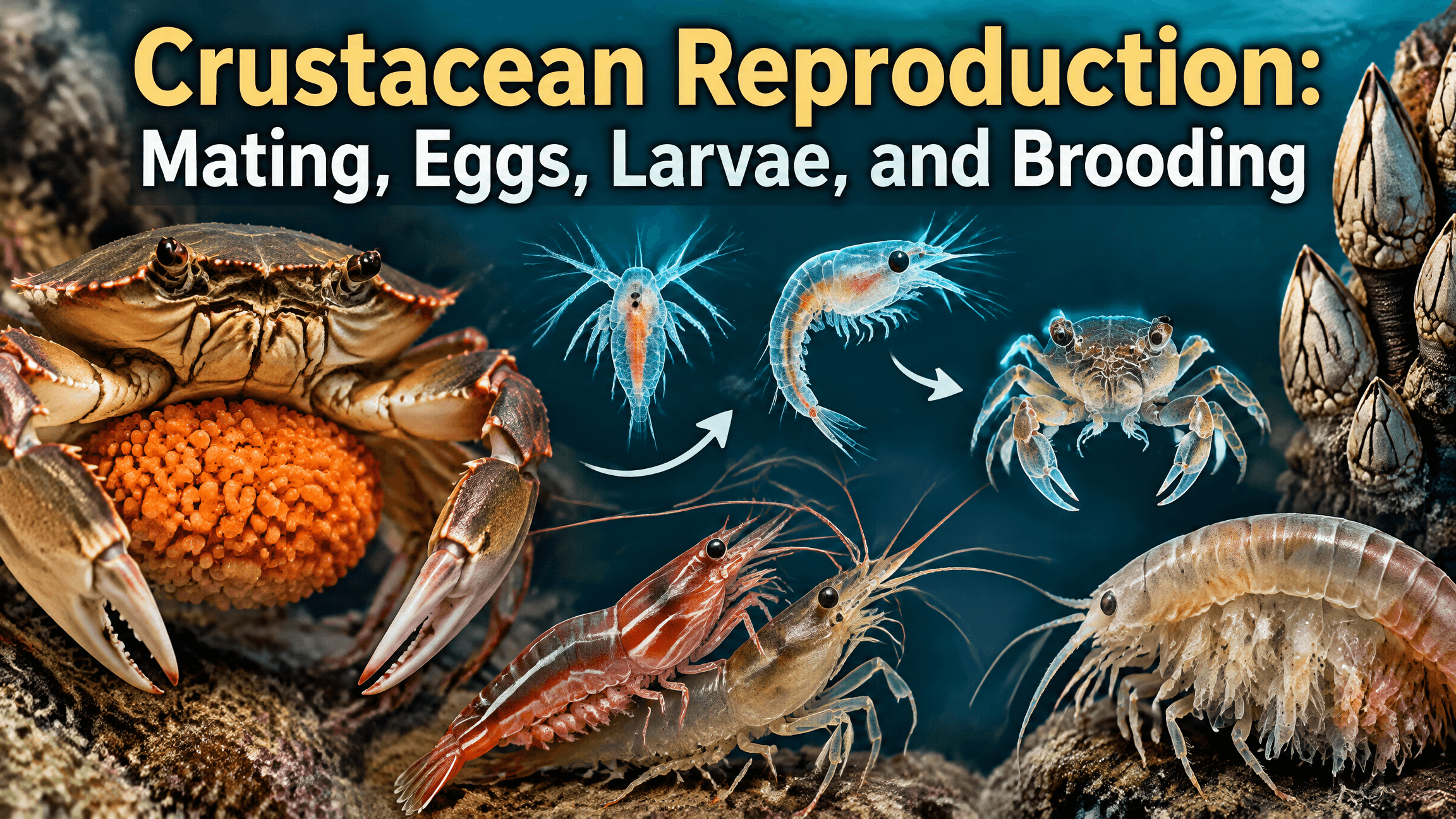
Crustacean reproduction is far more varied than the familiar image of a female crab carrying eggs beneath her abdomen. Crabs, shrimp, lobsters, copepods, barnacles, isopods, amphipods, branchiopods, and other crustaceans can differ greatly in how they find mates, transfer sperm, fertilize eggs, brood embryos, and develop from young stages into adults.
The most important idea is that there is no single crustacean life cycle. Some species release free-swimming larvae. Others keep development inside the egg or a brood pouch until the young resemble miniature versions of the adult. Some groups commonly reproduce sexually, while certain branchiopods can alternate between asexual and sexual reproduction. Even familiar larval terms such as nauplius, zoea, and megalopa belong to particular developmental patterns and should not be arranged into one universal sequence.
Quick Answer
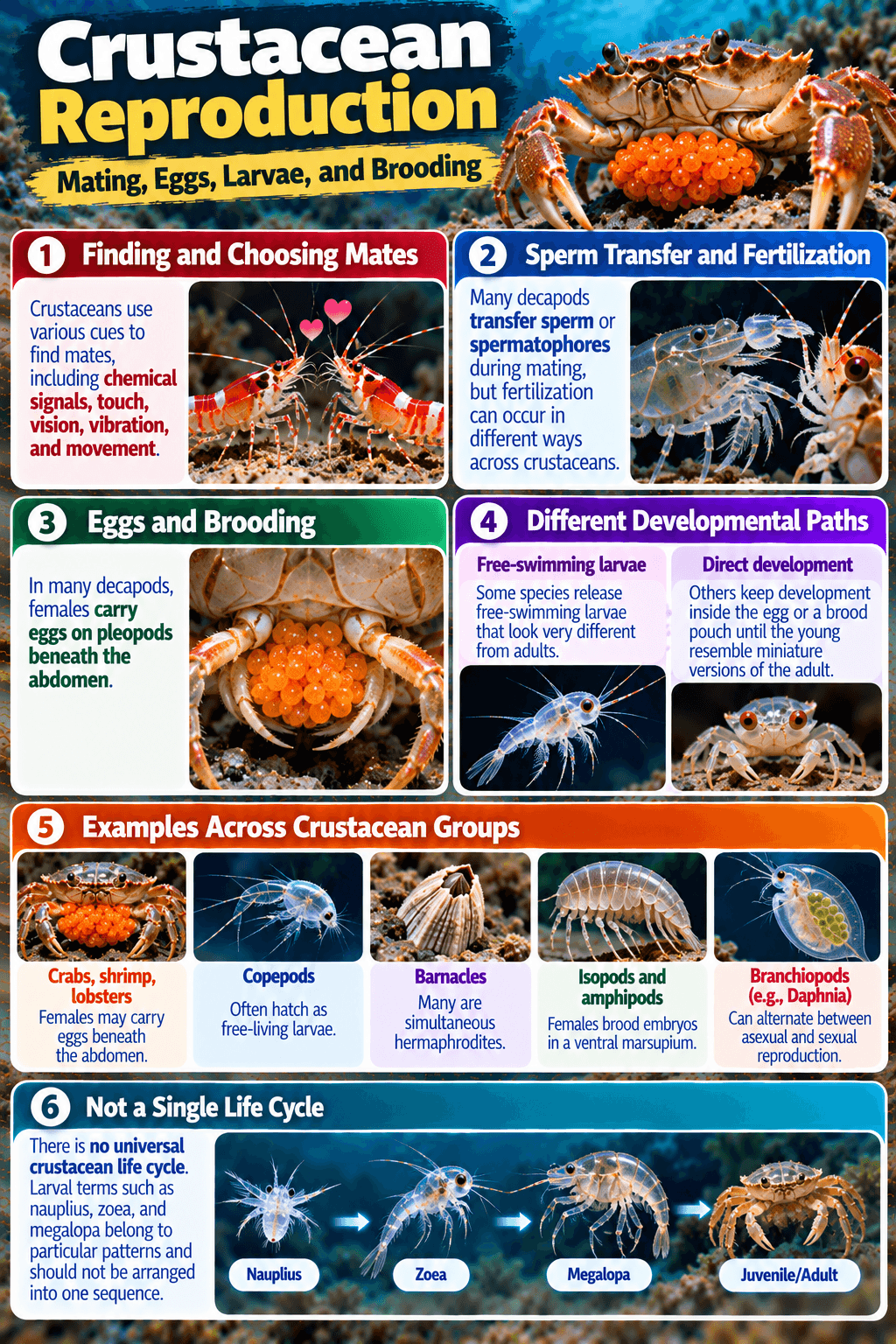
Most crustacean reproduction involves eggs, but the path from mating to juvenile life differs widely among lineages. Many decapods transfer sperm or spermatophores during mating, and females may later carry fertilized eggs on pleopods beneath the abdomen. Numerous crustaceans hatch as free-living larvae, while others complete much of development inside eggs or specialized brood chambers. Peracarids such as isopods and amphipods are especially notable because females brood embryos in a ventral marsupium, and most release young that are already juvenile-like rather than producing a typical free-swimming larva. For the wider biological context around these life cycles, see the crustacean overview.
A broad treatment of crustacean development therefore has to compare several developmental routes rather than teach one formula. Oxford Academic’s review of crustacean larval development describes major patterns across groups including Decapoda, Copepoda, Thecostraca, and Branchiopoda, with nauplius, zoea, copepodite, cypris, and other stages appearing in different combinations.
Why There Is No Universal Crustacean Life Cycle
Sexual reproduction is common, but the details differ
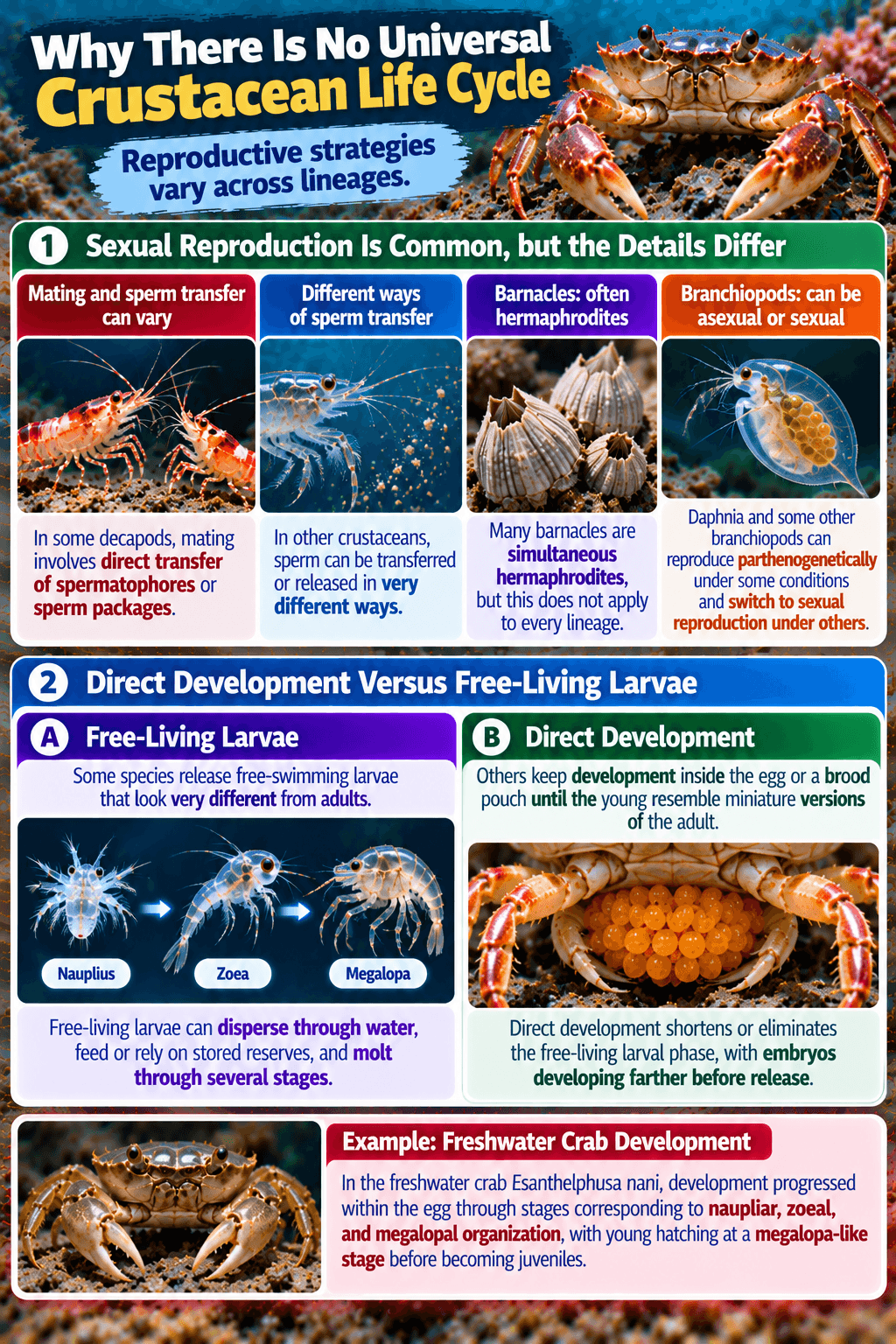
Sexual reproduction is widespread among crustaceans, yet even closely related species may differ in courtship, sperm transfer, sperm storage, fertilization timing, egg brooding, and larval development. In some decapods, mating involves direct transfer of spermatophores or sperm packages to the female. In other crustaceans, sperm can be transferred or released in very different ways.
The diversity becomes even clearer when barnacles, branchiopods, and parasitic crustaceans are included. Many barnacles are simultaneous hermaphrodites, meaning an individual has both male and female reproductive function, but that description does not apply to every barnacle lineage or every mating system. Daphnia and some other branchiopods can reproduce parthenogenetically under some conditions and switch to sexual reproduction under others. These patterns make it risky to summarize Crustacea with a single reproductive diagram.
Direct development versus free-living larvae
One of the biggest differences among crustaceans is whether young enter the environment as larvae or remain protected through more of development. Free-living larvae can disperse through water, feed or rely on stored reserves, molt through several stages, and often look very different from adults. Direct development shortens or eliminates that free-living larval phase, with embryos developing farther before release.
Freshwater crabs provide a useful example of how strongly development can shift. A study of the freshwater crab Esanthelphusa nani found that development progressed within the egg through stages corresponding to naupliar, zoeal, and megalopal organization, with young hatching at a megalopa-like stage before becoming juveniles. The Journal of Crustacean Biology study of freshwater crab development shows why a visible free-swimming zoea cannot be assumed for every crab.
Finding and Choosing Mates
Courtship and chemical cues
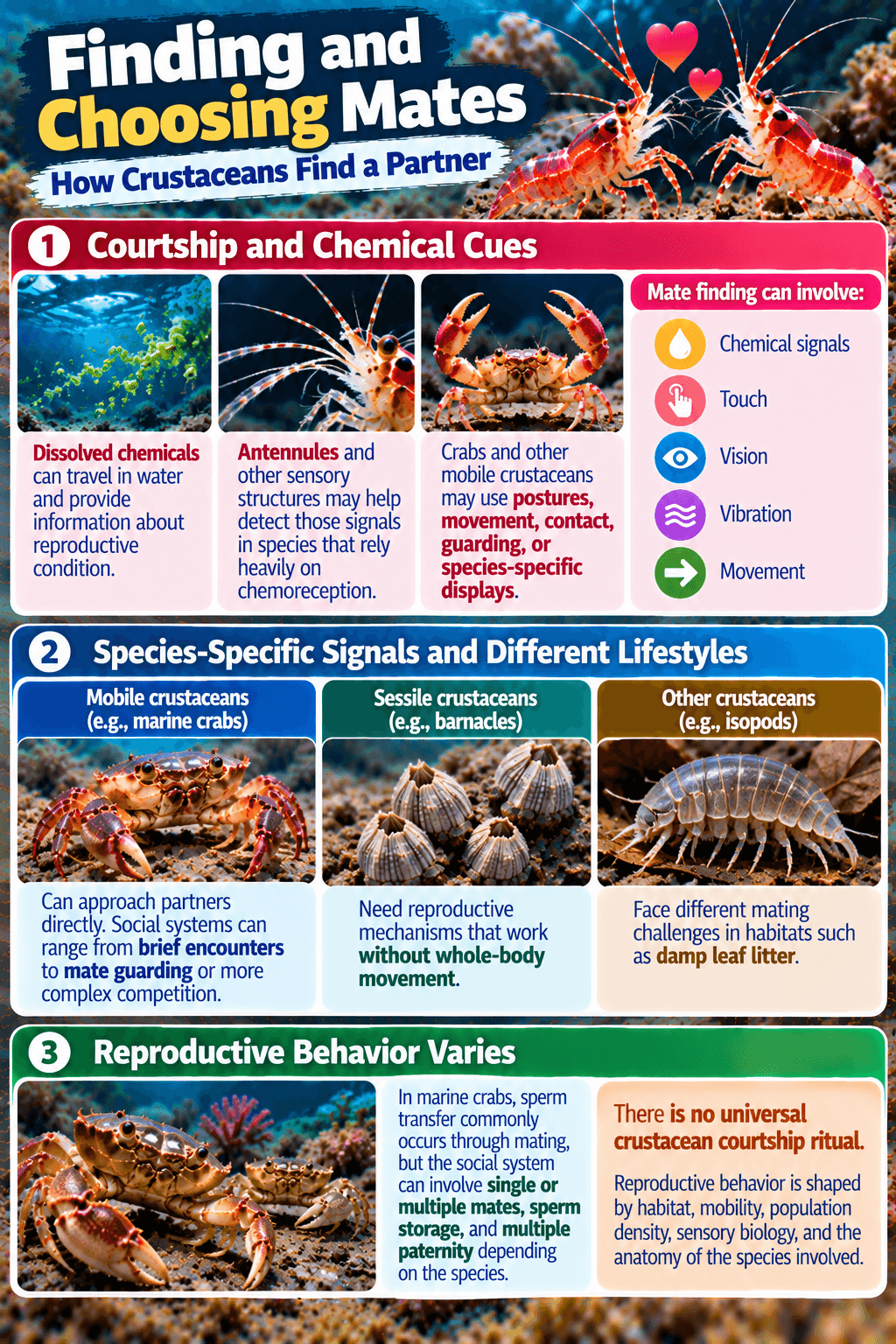
Mate finding can involve chemical signals, touch, vision, vibration, movement, or combinations of these cues. In water, dissolved chemicals can travel beyond the animal’s body and provide information about reproductive condition. Antennules and other sensory structures may help detect those signals in species that rely heavily on chemoreception.
Crabs and other mobile crustaceans may also use postures, movement, contact, guarding, or species-specific displays. The useful general rule is not that crustaceans use one universal pheromone or courtship ritual. Reproductive behavior is shaped by habitat, mobility, population density, sensory biology, and the anatomy of the species involved.
Species-specific social and sensory signals
A mate-searching animal on an open seafloor faces a different problem from a barnacle fixed to rock or an isopod living in damp leaf litter. Mobile crustaceans can sometimes approach partners directly, while sessile forms need reproductive mechanisms that work without whole-body movement.
In marine crabs, sperm transfer commonly occurs through mating, but the social system can range from brief encounters to mate guarding or more complex competition. The Smithsonian Tropical Research Institute notes that decapod mating systems can involve single or multiple mates, sperm storage, and multiple paternity depending on the species. Smithsonian research on marine crab mating systems highlights how much variation exists even within crabs.
Sperm Transfer and Fertilization
Internal and external contexts
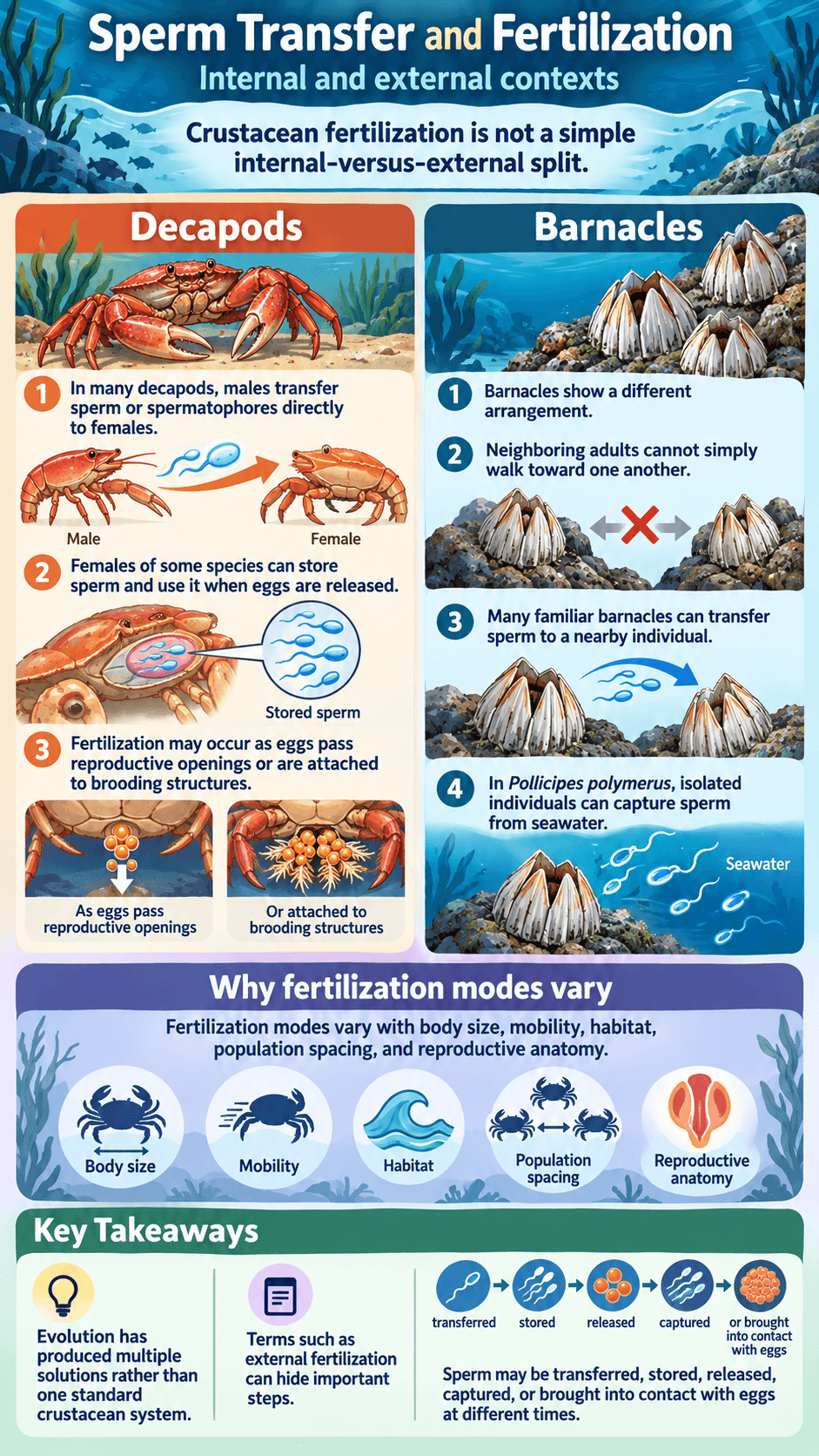
Crustacean fertilization cannot be reduced to a simple internal-versus-external split. In many decapods, males transfer sperm or spermatophores directly to females. Females of some species can store sperm and use it when eggs are released. Fertilization may occur as eggs pass reproductive openings or are attached to brooding structures.
Other crustaceans use different arrangements. Sessile barnacles are a striking example because neighboring adults cannot simply walk toward one another. Many familiar barnacles can transfer sperm to a nearby individual, while at least some species have additional options. In the gooseneck barnacle Pollicipes polymerus, researchers documented fertilization of isolated individuals by sperm captured from seawater rather than by self-fertilization.
Why fertilization modes vary
Body size, mobility, habitat, population spacing, and reproductive anatomy all influence how fertilization can work. A mobile crab living in a dense coastal population has different opportunities from a permanently attached barnacle or a tiny planktonic crustacean. Evolution has produced multiple solutions rather than one standard crustacean system.
That diversity also means common wording such as “external fertilization” can hide important steps. Sperm may be transferred, stored, released, captured, or brought into contact with eggs at different times. A useful explanation should name the actual mechanism for the species or lineage whenever the details matter.
Eggs and Brooding
Eggs carried under the abdomen or on pleopods
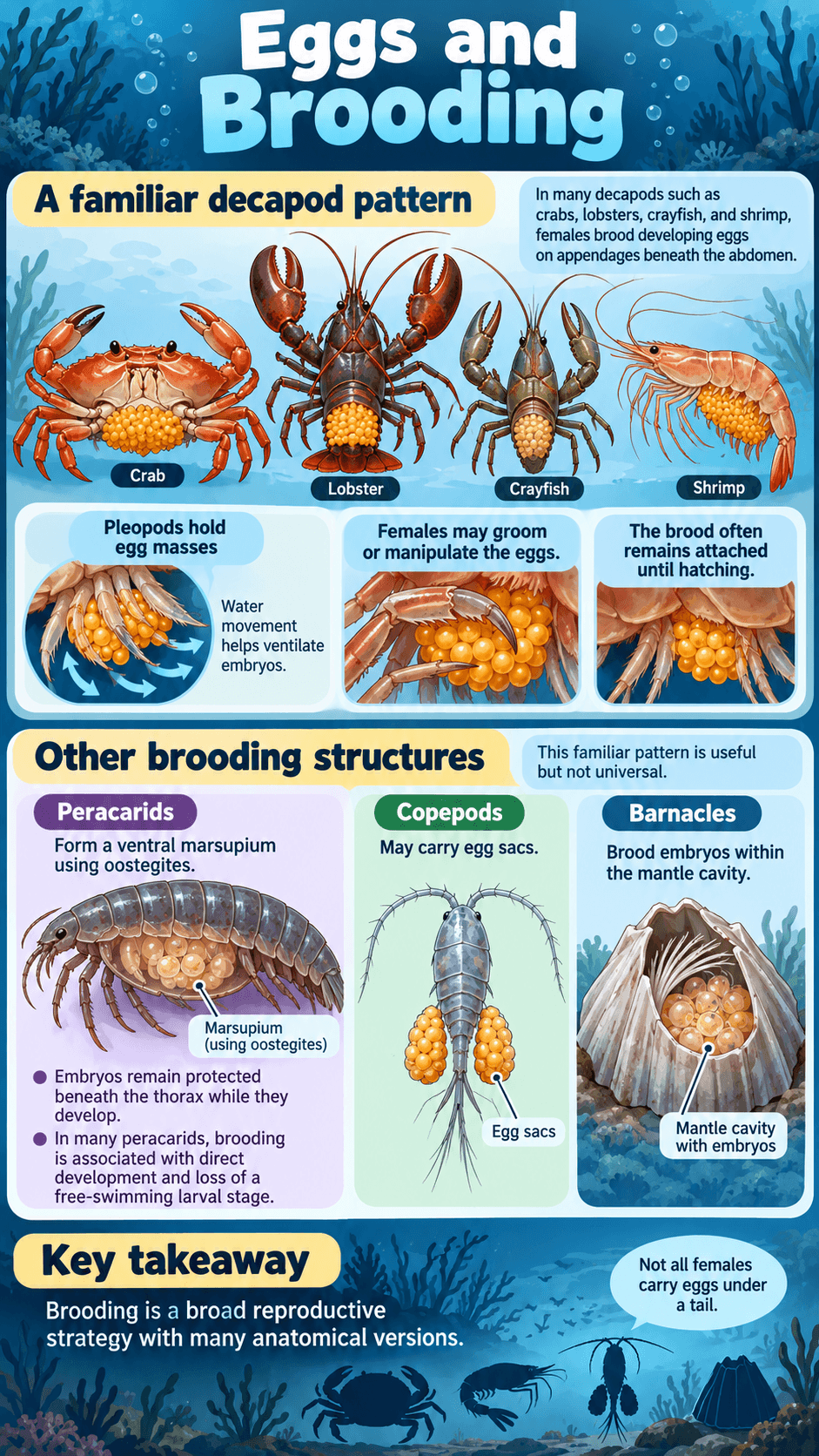
In many decapods, especially familiar crabs, lobsters, crayfish, and shrimp, females brood developing eggs on appendages beneath the abdomen. Pleopods can hold egg masses where water movement helps ventilate the embryos. Females may groom or manipulate the egg mass, and the brood often remains attached until hatching.
This familiar pattern is useful but not universal. The position, duration, attachment method, and degree of parental care differ among decapods. An image of a berried lobster or crab therefore illustrates one important brooding strategy rather than the definition of crustacean reproduction.
Brood chambers and other specialized structures
Other crustaceans brood embryos in chambers or pouches. Peracarids are especially important because breeding females typically form a ventral marsupium using specialized plates called oostegites. The embryos remain protected beneath the thorax while they develop. In many peracarids, this brooding is associated with direct development and the loss of a free-swimming larval stage.
A 2026 phylogenomic study of Peracarida supports the group as a major crustacean lineage characterized by extensive brood care and describes an evolutionary transition toward direct development in most lineages. The recent Molecular Biology and Evolution study of peracarid development also emphasizes that some exceptions and intermediate patterns occur, so even marsupial crustaceans should not be forced into one developmental template.
Why not all females carry eggs under a tail
The idea that female crustaceans always carry eggs under a tail comes mainly from familiar decapods. Copepods may carry egg sacs in some groups, barnacles brood embryos within the mantle cavity in many species, peracarids use a marsupium, and other crustaceans have still different arrangements.
The body plan determines where brood structures can form and how embryos receive protection and water exchange. Brooding is therefore best understood as a broad reproductive strategy with many anatomical versions.
Nauplius Larvae
A major crustacean larval form
The nauplius is one of the most important larval concepts in crustacean biology. A classic nauplius has three principal pairs of appendages associated with the first antennae, second antennae, and mandibles. In free-living forms, these appendages can contribute to swimming, feeding, or both, depending on the group and stage.
Naupliar development appears across widely separated crustacean lineages, but the nauplius does not look or behave identically in all of them. Copepod nauplii, barnacle nauplii, and branchiopod nauplii can differ considerably in ecology and later development.
Why not every crustacean hatches as a free-swimming nauplius
A crucial distinction is whether the naupliar organization appears as a free-living larva or during development inside the egg. Some crustaceans pass through nauplius-like embryonic stages without releasing a swimming nauplius into the environment. Other lineages have modified or reduced visible larval stages.
This is why “crustaceans hatch as nauplii” is too broad. Naupliar development is biologically important, but hatching stage varies. Readers should separate a developmental stage recognized in embryology from a free-swimming larva that can be observed in plankton.
Decapod Development
Zoea and megalopa in many crab life cycles
Many marine true crabs release zoeae that live in the plankton before passing through later stages. Zoeae typically look very different from adult crabs, with body proportions and swimming structures suited to a pelagic life. After one or more zoeal stages, many crabs enter a megalopa stage that combines larval features with a body becoming more crab-like.
The megalopa eventually molts into a juvenile crab. This zoea-to-megalopa pattern is a useful model for many brachyuran crabs, but the number and form of stages vary. Environmental conditions and species biology can also affect development.
Shrimp and lobster developmental differences
Shrimp and lobsters do not simply copy the crab sequence. Different decapod groups use different larval terminology and pass through distinct morphological stages. Some shrimp hatch as nauplii or nauplius-like larvae, while others hatch at more advanced stages. Lobster development varies among major lineages as well.
Common names make this even harder because “shrimp” and “lobster” include several evolutionary lineages. A life cycle described for one commercial species should not be treated as the standard for every animal with the same common-name label.
Why crab development is not universal
Even among crabs, direct or abbreviated development can occur. Freshwater and terrestrial environments can favor developmental strategies that reduce dependence on long planktonic larval phases, although the details differ among species. Some freshwater crabs keep development within the egg to a much later stage before hatching.
The broader lesson is that larval names describe particular developmental forms, not mandatory steps in a crustacean checklist. A crab, barnacle, copepod, isopod, and Daphnia can all be crustaceans without sharing the same sequence of free-living stages.
Isopods and Other Peracarids
Marsupium as a crustacean brood pouch
Peracarids include isopods, amphipods, mysids, tanaids, cumaceans, and several smaller lineages. A defining reproductive feature of the group is extensive brooding associated with a marsupium. In many species, oostegites project inward from thoracic appendages and form a chamber beneath the female where embryos develop.
The word marsupium simply means brood pouch in this context. It has no special evolutionary connection to the pouch of marsupial mammals. Similar words are used because both structures hold developing young, not because crustaceans and kangaroos inherited a pouch from a common recent ancestor.
Manca-like juveniles and direct-development patterns
Many peracarids release young that resemble small adults but may lack the final pair of thoracic walking appendages. This juvenile form is often called a manca in groups such as isopods. Development continues through later molts after the young leave the pouch.
There are exceptions and lineage-specific details, especially among parasitic isopods and some other peracarids. The safest generalization is that direct or near-direct development with brood care is a major peracarid pattern, not that every member follows an identical manca sequence.
Barnacle Reproduction
Hermaphroditism in many species
Many familiar barnacles are simultaneous hermaphrodites, which is useful for animals that remain attached after settlement because each neighboring individual can potentially function in male and female roles. However, hermaphroditism does not mean that self-fertilization is always the main strategy. Cross-fertilization is common in many studied barnacles.
One especially informative case is Pollicipes polymerus. Genetic analysis showed that isolated individuals could receive sperm from the water rather than simply fertilizing themselves. Smithsonian’s report on waterborne sperm capture in gooseneck barnacles illustrates why fixed adult life has not produced only one mating solution.
Reproductive diversity beyond the stereotype
Barnacles include more reproductive diversity than the textbook image of two neighboring hermaphrodites mating. Some lineages have separate sexes, dwarf males, parasitic life histories, or other specialized systems. Larval development is also important because barnacle nauplii and cyprids are mobile even though familiar adults are sessile.
The most useful fact is therefore not a sensational claim about barnacle anatomy. It is that sessile adult life creates unusual reproductive constraints, and barnacle evolution has produced several ways to move sperm, brood embryos, and disperse young.
Branchiopods and Parthenogenesis
Daphnia-like cyclical strategies where supported
Daphnia are famous for cyclical parthenogenesis. Under suitable conditions, females in many populations can produce daughters asexually, allowing rapid population growth without mating. At other times, environmental and biological conditions are associated with the production of males and sexual females, leading to sexually produced resting eggs that can persist through unfavorable periods.
The switch is not governed by one simple trigger everywhere. Population density, food conditions, temperature, photoperiod, genotype, predators, parasites, and other ecological factors can influence reproductive investment depending on species and population. A field study of Daphnia dentifera found strong seasonal and population-level variation in sexual reproduction, including some populations that remained entirely asexual during the study period. University of Minnesota research on Daphnia sexual reproduction demonstrates why the phrase “Daphnia reproduce by cloning” is incomplete.
Why not all water fleas reproduce the same way
Daphnia species and populations differ. Some lineages show cyclical parthenogenesis, while others can be obligately parthenogenetic. Even within cyclical systems, the timing and strength of sexual reproduction can vary among populations and environmental settings.
Other branchiopods, including fairy shrimp and brine shrimp, have their own reproductive strategies. Some produce resistant or dormant stages, but those adaptations should not be generalized across all branchiopods. Reproduction is shaped by lineage, habitat permanence, salinity, temperature, and local ecological conditions.
Molting and Reproduction
Where molt timing can matter
Reproduction and molting can interact strongly in some crustaceans. Mating may occur near a female molt in certain crabs, lobsters, or shrimp, while other species mate at different times. Molting can also affect body size, reproductive maturity, and the timing of brooding or spawning.
These relationships should be explained species by species. It is not accurate to say that every female crustacean must molt immediately before mating or that reproduction always stops during a particular molt stage. The connection can be tight in one lineage and much looser in another.
Why ecdysis and shell hardening are separate topics
Ecdysis is the shedding event in the molt cycle. New cuticle formation, expansion, mineral handling, and hardening are part of growth physiology, not reproduction itself. They matter here only when reproductive timing depends on the molt cycle.
Keeping these processes separate makes the biology clearer. A reproductive article should explain when mating, fertilization, egg production, and brooding occur. A molting explanation should focus on how the old cuticle is replaced and how the new one develops.
Common Reproduction Myths
Egg to nauplius to zoea to megalopa is not a universal sequence
This sequence combines stages from different developmental patterns. Nauplius is widespread as a crustacean developmental concept, but it may occur inside the egg rather than as a free-living larva. Zoea and megalopa are especially associated with particular decapod developmental patterns, including many crabs. Peracarids commonly use direct development in a brood pouch instead.
A better approach is to identify the lineage first, then describe its actual developmental stages. Doing so avoids turning one familiar crab life cycle into a false model for copepods, barnacles, isopods, branchiopods, and other crustaceans.
All barnacles are not identical hermaphrodites
Hermaphroditism is common in many familiar barnacles, but reproductive systems across barnacles are more diverse. Cross-fertilization, waterborne sperm capture in at least some species, separate sexes, and specialized male forms all show that there is no single barnacle mating system.
Crustacean marsupia are not related to marsupial mammal pouches
A crustacean marsupium is a brood chamber, usually associated with specialized thoracic plates in peracarids. A kangaroo pouch is a mammalian structure with a completely different evolutionary origin and anatomy. The shared word describes a similar broad function, carrying developing young, not a close biological relationship.
How Reproduction Interacts With Senses, Molting, and Habitat
Sensory cues in mating
Reproductive behavior depends on an animal finding and recognizing suitable partners. Chemical cues, antennal contact, vision, vibration, and movement can all contribute in different crustaceans. Sensory biology therefore influences how far a signal can travel, when courtship begins, and whether an animal can identify reproductive condition.
The exact signal should not be guessed from one species. A chemical cue demonstrated in a lobster cannot automatically be assigned to every crab or copepod. Reproductive signals work within each animal’s sensory and ecological setting.
Molting and habitat conditions during development
Embryos and larvae also experience the habitat differently from adults. Planktonic larvae may encounter currents, predators, changing salinity, and different food than bottom-dwelling adults. Brooded embryos are sheltered by the female but may still depend on oxygen exchange, temperature, and water quality. Direct-developing freshwater or terrestrial crustaceans can reduce reliance on an open-water larval phase. Larval dispersal, brooding, and direct development can also be shaped by crustacean habitats.
These developmental differences influence dispersal. A species releasing tiny swimming larvae may spread offspring through currents, while a species releasing advanced juveniles may keep young closer to parental habitat. Neither strategy is automatically better. Each has costs and benefits tied to the environment.
FAQ
Do all crustaceans lay eggs?
Egg production is extremely widespread among crustaceans, including both sexually reproducing and many parthenogenetic forms, but the eggs are handled in very different ways. Some are attached beneath the abdomen, some are held in sacs or brood chambers, and some remain protected within a marsupium during development. It is therefore safer to describe the specific reproductive system than to imagine every crustacean releasing visible eggs into the environment.
What is a nauplius?
A nauplius is an important early crustacean developmental form characterized by a basic set of three main appendage pairs associated with the antennules, antennae, and mandibles. In some crustaceans it is a free-swimming larva. In others, comparable naupliar development occurs inside the egg, so the animal hatches at a later stage.
Do all crabs have a megalopa stage?
No. A megalopa is an important post-zoeal stage in the development of many crabs, especially marine brachyurans, but crab development varies. Some species have abbreviated or direct development, and certain freshwater crabs can complete stages corresponding to zoeal and megalopal organization within the egg before hatching. The life cycle must be checked at the species or lineage level.
What is a crustacean marsupium?
A crustacean marsupium is a brood pouch used especially by peracarids such as isopods and amphipods. In many species it forms beneath the female’s thorax from plates called oostegites. Embryos develop within this protected chamber and are often released as juvenile-like young rather than as free-swimming larvae.
Final Thoughts
Crustacean reproduction is best understood as a set of different solutions to the same basic challenges: finding a mate or producing offspring without one, transferring genetic material, protecting embryos, and getting young through early development. Crabs carrying eggs beneath the abdomen represent only one version of that story.
Across Crustacea, naupliar development, zoeae, megalopae, direct development, marsupial brooding, barnacle hermaphroditism, waterborne sperm capture, and Daphnia parthenogenesis show how flexible reproductive biology can be. The safest way to understand any crustacean life cycle is to start with the lineage and species rather than forcing every animal into one sequence of egg, larva, and adult.

Ethan Walker is the founder and research editor of Animal Fact Central. He creates and reviews educational animal facts content using trusted wildlife, pet care, and science-based sources. His work focuses on making animal behavior, adaptations, habitats, and species facts clear, accurate, and engaging for everyday readers.
Read More Details About Ethan Walker: https://animalfactcentral.com/ethan-walker/