
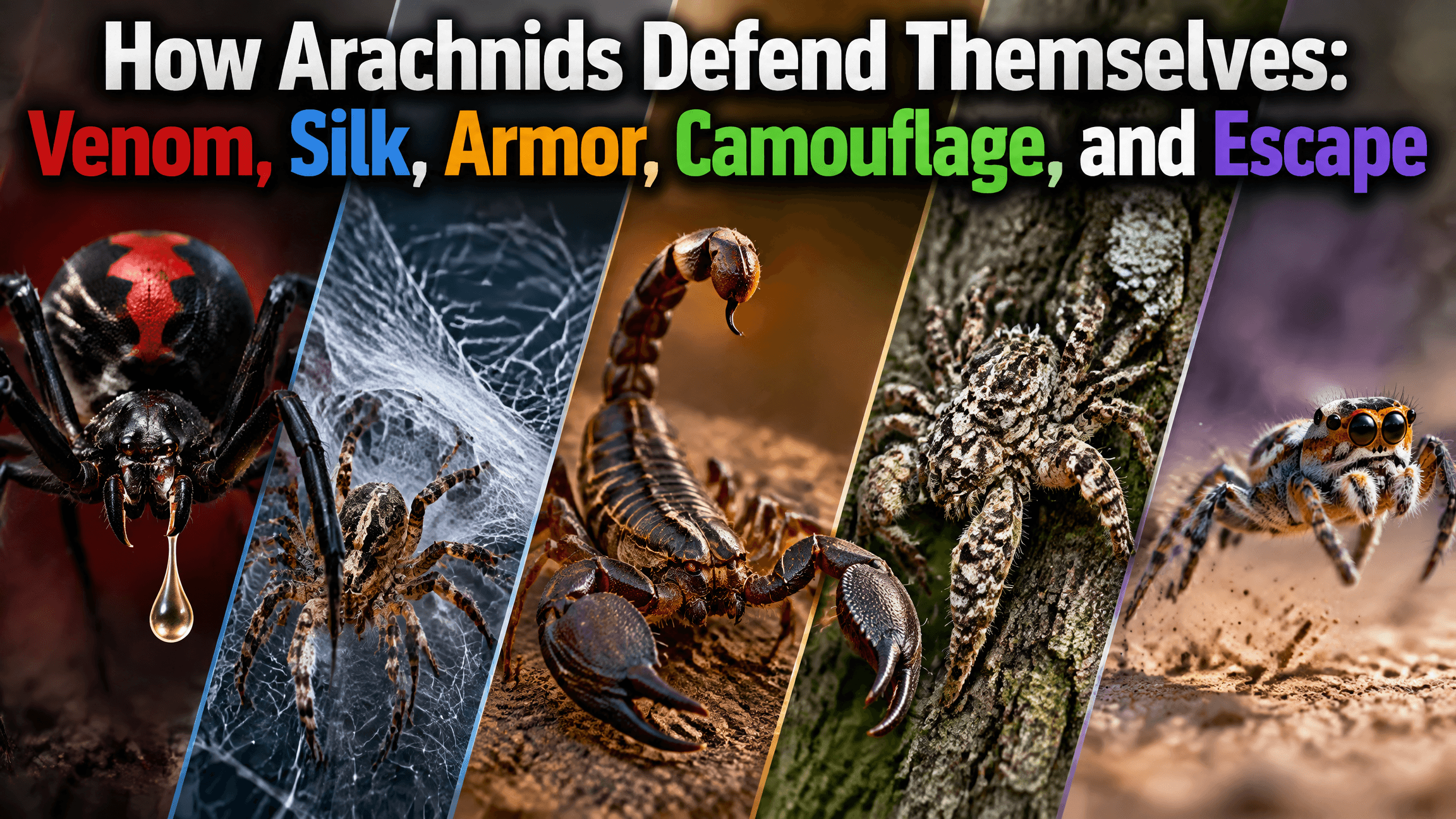
Arachnids defend themselves in many ways, and venom is only one part of the story. Spiders may hide, run, drop away, use silk retreats, display threat postures, or bite when pressed. Scorpions combine pincers, a stinger, armor, posture, and shelter use. Harvestmen may freeze, release defensive chemicals, shed a leg, vibrate, group together, or feign death. Vinegaroons spray defensive chemicals, while some New World tarantulas use specialized urticating setae.
The best defense is often avoiding a fight altogether. Camouflage, stillness, burrowing, body flattening, retreats, and rapid escape can prevent physical contact before venom, pincers, sprays, or other weapons are needed. Different arachnid groups use different combinations, so there is no single “arachnid defense system.”
Quick Answer
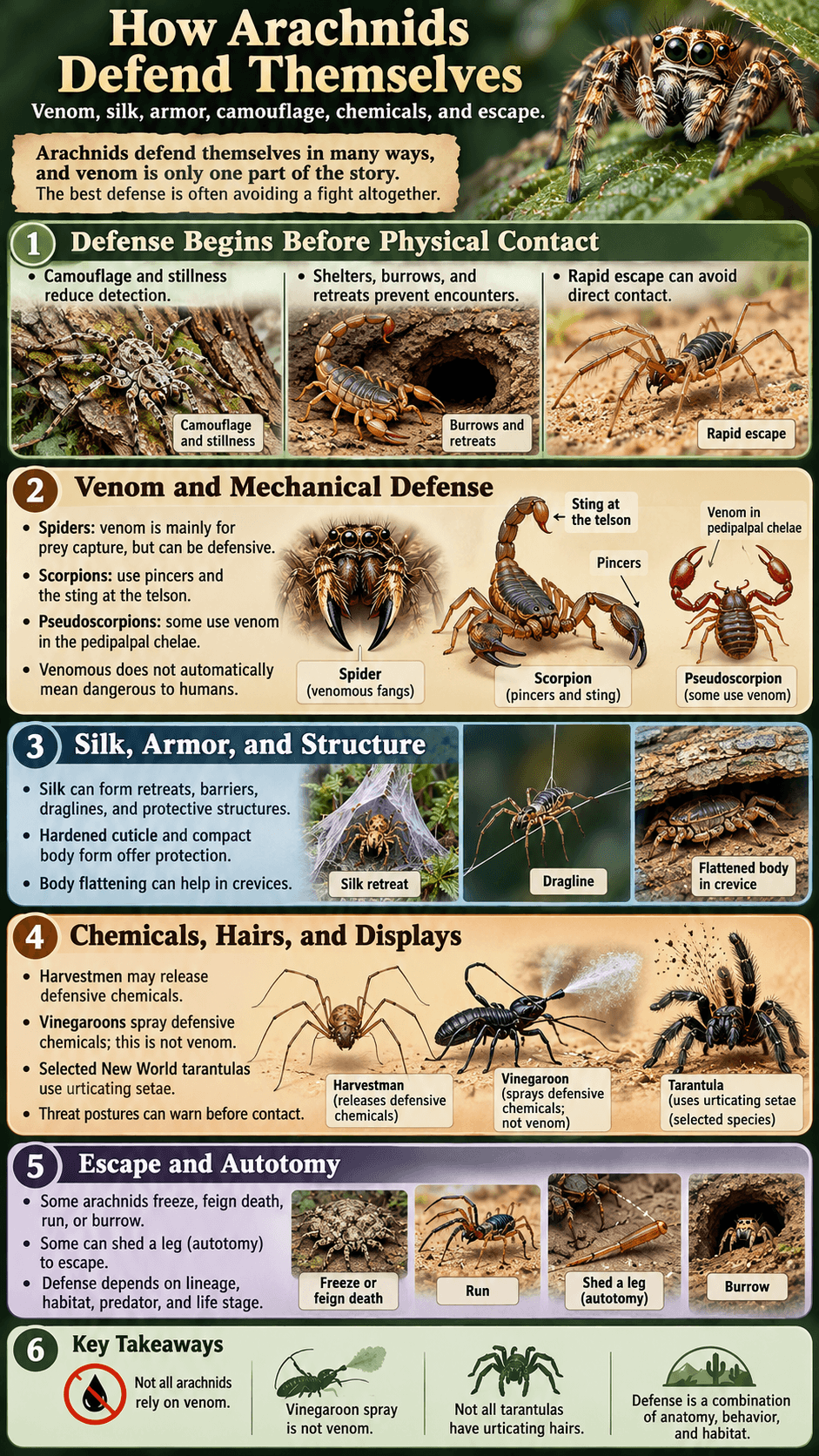
Arachnids defend themselves through chemical, mechanical, structural, and behavioral strategies. These include venom, pincers, hardened cuticle, silk retreats, camouflage, threat displays, defensive sprays, spines or specialized setae, autotomy, rapid running, burrowing, freezing, and death-feigning. The mix depends on the lineage, body size, predator, habitat, and life stage. The diversity of these defenses reflects the wider range of body plans and lifestyles found across arachnids.
Venom is important in spiders and scorpions, but it should not dominate the picture. Many arachnids rely first on hiding, escape, armor, or mechanical defense. Even in venomous groups, venom evolved largely in ecological contexts such as prey capture and defense, and human medical relevance varies greatly among species.
Defense Begins Before Physical Contact
Camouflage, stillness, and avoiding detection
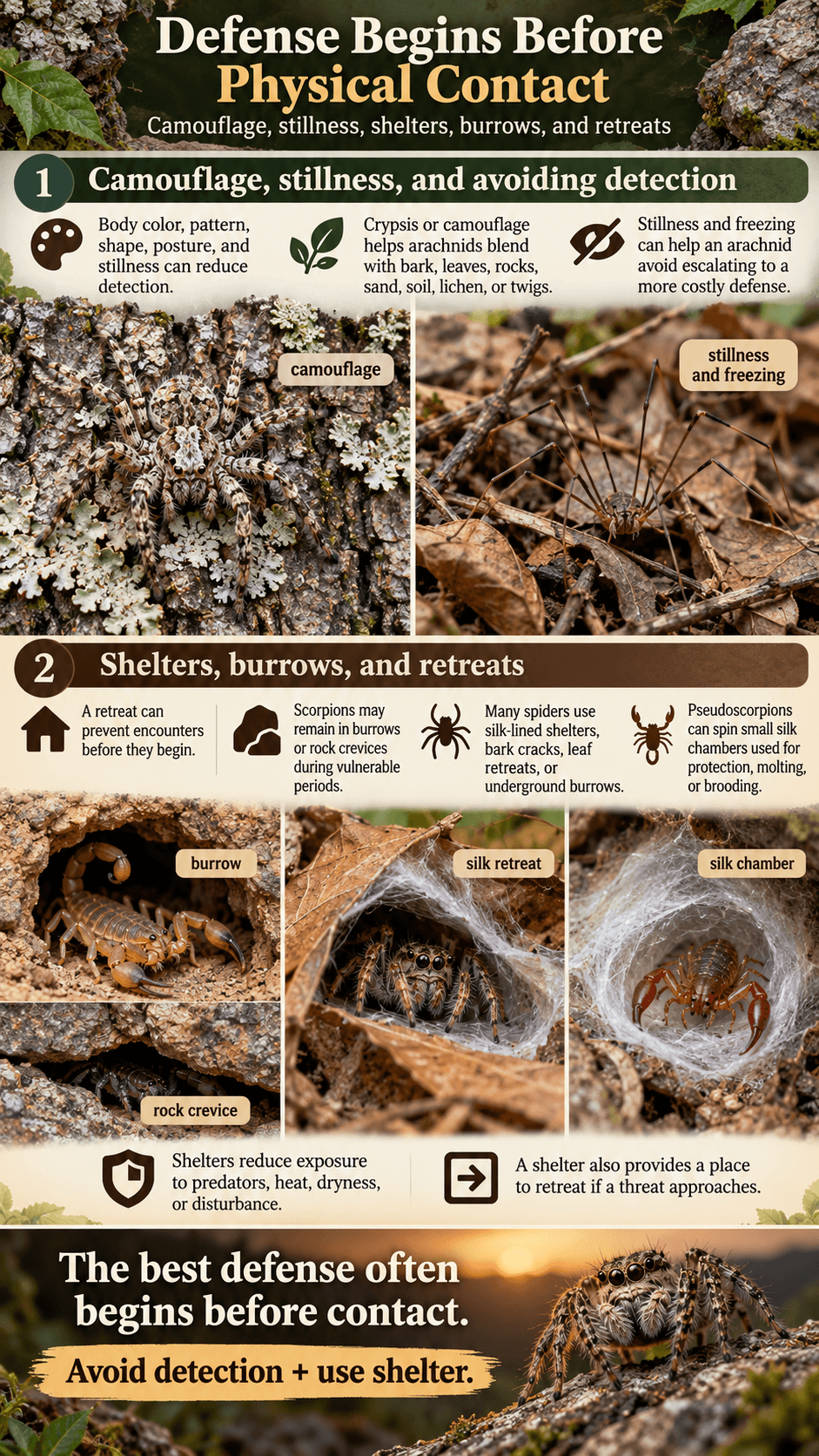
Many arachnids reduce risk by being difficult to notice. Body color, pattern, shape, posture, and stillness can make an animal blend with bark, leaves, rocks, sand, soil, lichen, or other surfaces. This is usually called crypsis or camouflage.
Camouflage should not be described as an arachnid consciously deciding to “become invisible.” Natural selection favors body forms and behaviors that reduce detection in particular environments. A spider that resembles bark or a harvestman that remains motionless among twigs can be harder for a predator to detect without making a deliberate visual plan.
Stillness can be especially effective against predators that respond strongly to movement. Freezing also gives the arachnid time to assess whether the threat passes without escalating to a more costly defense.
Shelters, burrows, and retreats
A retreat can prevent encounters before they begin. Scorpions may remain in burrows or rock crevices during vulnerable periods. Many spiders use silk-lined shelters, bark cracks, leaf retreats, or underground burrows. Pseudoscorpions can spin small silk chambers used for protection, molting, or brooding. Running, dropping, burrowing, and autotomy also connect defensive behavior with arachnid movement.
The American Arachnological Society overview of pseudoscorpions notes that many pseudoscorpions spin dome-shaped silk chambers that can serve as protective retreats. This is a useful reminder that silk is not exclusively a spider material, even though spiders have developed silk use most extensively.
A shelter reduces exposure to predators, heat, dryness, or physical disturbance. It also gives an arachnid a place to retreat if a threat approaches. Before physical defenses are used, arachnid behavior often determines whether the animal freezes, hides, displays, retreats, or escapes.
Venom as Defense

Spider venom is mainly a prey-capture system with defensive roles
Most spiders use venom primarily to subdue prey. Defensive biting can occur when a spider is trapped, pressed, restrained, or otherwise unable to escape, but that does not make humans or other large vertebrates normal prey.
Modern research on spider venom emphasizes that predation has been a major evolutionary function, while defensive roles vary among lineages. A recent comparative study of spider venom evolution found evidence that some venom components can become specialized for defense, showing that venom function itself can evolve in different ecological directions.
Venomous also does not mean medically dangerous. The effects of a bite depend on species, venom composition, dose, delivery, victim, and circumstances. Many spider venoms are highly effective against natural prey yet have limited effects on humans.
Scorpion venom and the telson
Scorpions inject venom with the sting at the end of the telson, which is located at the tip of the metasoma. Their large front pincers are pedipalps, not venom fangs. Those pincers can restrain prey or contribute to defense without using the sting.
The American Arachnological Society’s scorpion profile describes the characteristic combination of grasping pedipalps and a terminal venomous sting. It also emphasizes that medical significance varies greatly across scorpion species.
Defensively, a scorpion may raise the metasoma and orient the sting toward a threat. The posture itself can discourage contact before venom is used.
Pseudoscorpion venom is a different system
Some pseudoscorpion lineages possess venom glands in the fingers of the pedipalpal chelae. This means the venom-delivery system is located in the pincer-like pedipalps rather than in a tail or spider-like fangs.
These tiny arachnids use the system mainly in capturing small arthropod prey. Their venom apparatus is biologically interesting, but it should not be interpreted as evidence that pseudoscorpions are a meaningful danger to people.
Pincers, Armor, and Mechanical Defense
Scorpion pincers
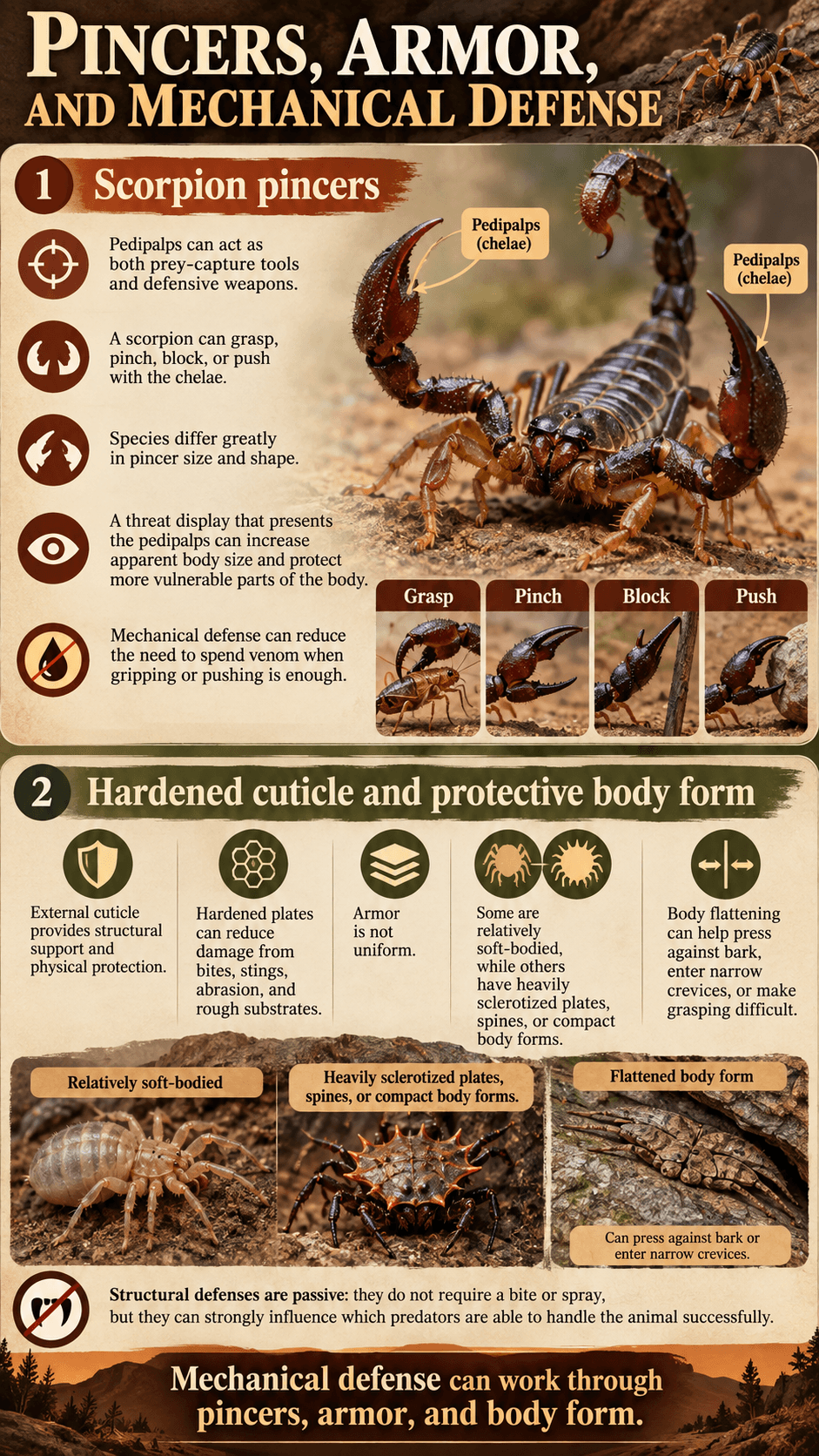
Scorpion pedipalps can act as both prey-capture tools and defensive weapons. A scorpion can grasp, pinch, block, or push with the chelae. Species differ greatly in pincer size and shape, and mechanical force can play a larger or smaller role depending on the lineage.
A threat display that presents the pedipalps can increase apparent body size and protect more vulnerable parts of the body. Mechanical defense can also reduce the need to spend venom in situations where gripping or pushing is enough.
Hardened cuticle and protective body form
Arachnids have an external cuticle that provides structural support and physical protection. In many groups, hardened plates can reduce damage from bites, stings, abrasion, and contact with rough substrates.
Armor is not uniform. Some arachnids are relatively soft-bodied, while others have heavily sclerotized plates, spines, or compact body forms. Body flattening can also be defensive by allowing an animal to press against bark, enter narrow crevices, or make grasping difficult.
Structural defenses are passive in the sense that they do not require a bite or spray, but they can strongly influence which predators are able to handle the animal successfully.
Silk as a Defensive Tool
Retreats and barriers
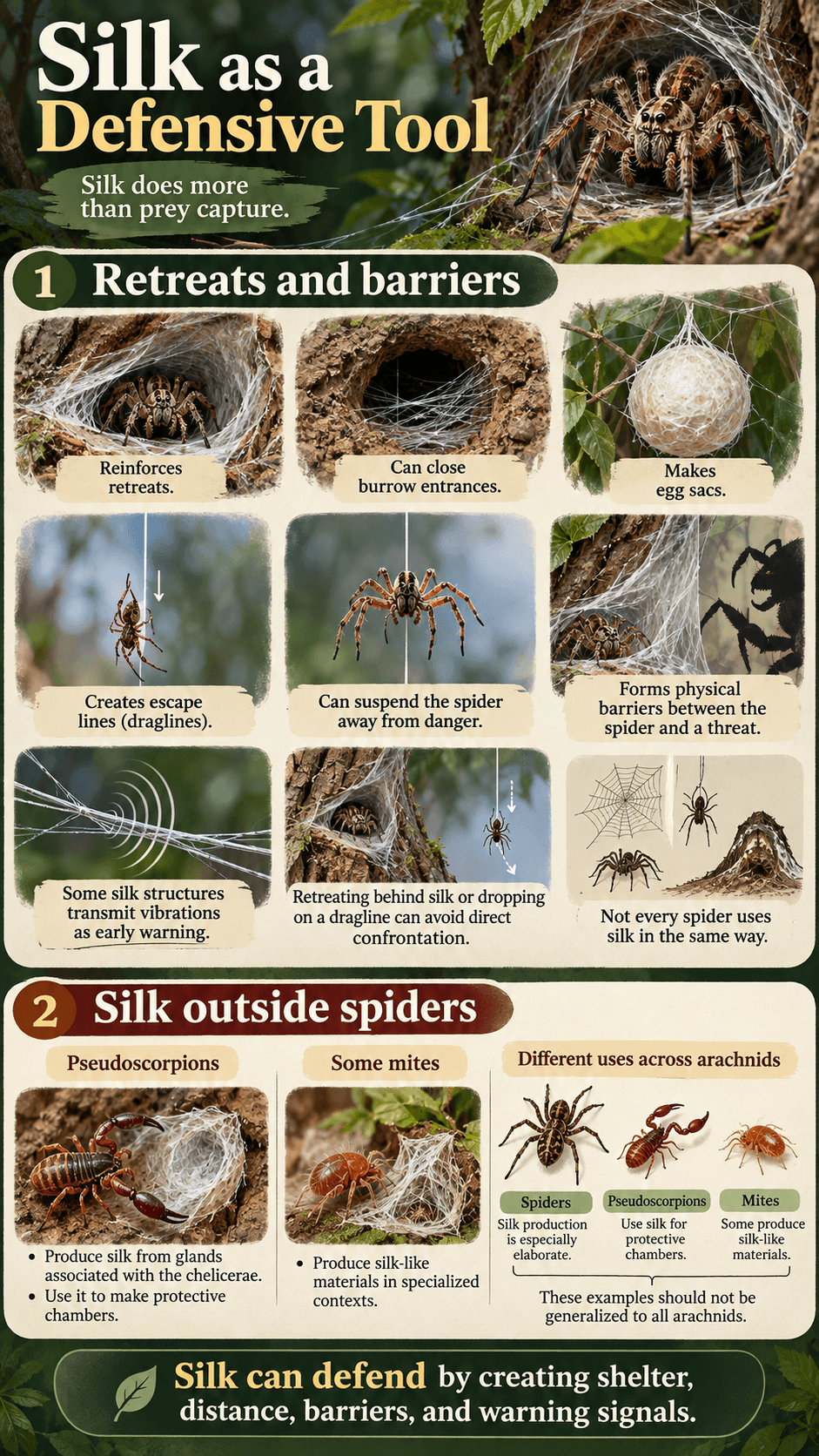
Spiders use silk for much more than prey capture. Silk can reinforce retreats, close burrow entrances, make egg sacs, create escape lines, suspend the animal away from danger, or build physical barriers between the spider and a threat.
A spider that retreats behind silk or drops on a dragline can avoid direct confrontation. Some silk structures also transmit vibrations, providing early warning that something is approaching.
The defensive value depends on species and structure. Not every spider uses silk in the same way, and not every silk structure functions primarily as defense.
Silk outside spiders
Pseudoscorpions produce silk from glands associated with the chelicerae and use it to make protective chambers. Some mites also produce silk-like materials in specialized contexts, including structures associated with feeding or habitat use.
These examples should not be generalized to all arachnids. Silk production is especially elaborate in spiders, but Arachnida contains several independent or differently organized uses of secreted fibers and shelter-building materials.
Camouflage, Crypsis, and Threat Displays
Color and body shape
Coloration can help an arachnid match leaves, bark, flowers, rock, soil, or sand. Body shape can reinforce that effect. Some spiders have flattened bodies that lie close to bark, while others resemble twigs, leaf fragments, or textured surfaces.
Cryptic coloration works only in relation to the visual environment and the observer. A pattern that hides an animal from one predator may be much less effective against another predator with different vision or sensory abilities.
Threat postures
When hiding fails, some arachnids make themselves look more difficult to attack. A spider may raise the front legs or expose chelicerae. A scorpion can elevate the metasoma and spread the pedipalps. Tarantulas may adopt conspicuous postures that display fangs or body size.
A threat display does not mean an attack is inevitable. It is often a warning stage that can prevent contact. For the arachnid, avoiding injury is usually safer than entering a physical struggle with a much larger animal.
Sound and stridulation in selected groups
Some arachnids produce sounds or vibrations by rubbing body structures together, a process called stridulation. In certain spiders, scorpions, harvestmen, and other groups, these signals may be used in defense, courtship, or communication depending on the species.
Stridulation should be treated as a lineage-specific defense rather than a general arachnid trait. Many species do not produce defensive sounds at all.
Defensive Chemicals Beyond Venom
Vinegaroon spray
Vinegaroons, also called whip scorpions, are famous for spraying defensive chemicals from glands near the rear of the body. The spray can contain acetic acid along with other compounds, producing the sharp vinegar-like odor that inspired the common name.
A Smithsonian arachnid reference describes the defensive acid spray of whip scorpions as a glandular chemical defense rather than venom. The mixture can include compounds that alter how the secretion spreads across a surface.
Calling the spray “venom” is incorrect because it is not injected through fangs or a stinger. Calling it ordinary household vinegar is also misleading. The secretion is a biological chemical mixture produced by specialized glands.
Harvestman defensive secretions
Harvestmen have paired defensive glands that can release chemicals when threatened. The chemistry differs among groups, and the secretion may deter predators through odor, taste, irritation, or other effects.
A 2024 Journal of Arachnology review of harvestman defenses summarizes chemical defenses alongside coloration, autotomy, aggregation, freezing, bobbing, vibration, and sound production. The authors also stress that no single defense occurs in every harvestman species.
This diversity makes harvestmen a strong example of arachnid defense without venom. They can rely on chemistry, behavior, body form, and escape rather than a spider-style fang system.
Urticating Setae in Selected Tarantulas
What urticating setae are
Urticating setae are specialized hairs that can irritate predators or other intruders when they contact sensitive tissues. They occur in selected tarantula lineages, especially among New World theraphosids.
A detailed review of tarantula urticating setae describes several structural types and confirms their importance as a defense against vertebrate and invertebrate threats. Their morphology also has taxonomic value.
Why not all tarantulas have them
Urticating setae are not a universal tarantula feature. They are characteristic of particular New World lineages, while Old World tarantulas generally rely on other combinations of threat display, speed, biting, shelter use, or defensive posture.
This difference is important because the word “tarantula” covers a large family with substantial behavioral and anatomical diversity. One famous defense should not be assigned to the entire family.
Autotomy, Escape, and Sacrificing a Leg
Leg autotomy
Autotomy is the controlled loss of a body part, usually a leg, when it is seized or severely threatened. Some harvestmen and spiders can shed a leg, allowing the body to escape while the predator remains occupied with the detached appendage.
In harvestmen, leg autotomy is part of a broader defensive repertoire. The 2024 harvestman review describes it alongside chemical defenses, freezing, aggregation, vibration, coloration, and other anti-predator behaviors.
Losing a leg has costs. Locomotion, sensory performance, courtship, feeding, or escape can be affected. Regeneration also depends on lineage and developmental stage. Juveniles with molts remaining may regenerate some lost tissue in certain groups, while adults often cannot replace a missing leg fully.
Rapid running and sudden retreat
Escape can be more effective than fighting. Solifuges are fast terrestrial runners, many spiders can sprint into cover, mites disappear into tiny spaces, and scorpions may retreat quickly into burrows or crevices.
Running ability interacts with habitat. A long-legged animal on open ground uses a different escape strategy from a flattened arachnid living beneath bark or a tiny mite moving through soil pores.
Burrowing and hiding
Burrows give arachnids a physical refuge from predators and environmental extremes. A burrow entrance can also be defended or closed, and the narrow space may prevent larger predators from following.
Animals that live under stones, within leaf litter, or beneath bark gain similar protection from inaccessible spaces. These habitats reduce the need for active confrontation.
Freezing, Death-Feigning, and Body Movement
Thanatosis and immobility
Thanatosis, often called death-feigning, occurs when an animal becomes motionless in response to threat. Some harvestmen and other arachnids use this behavior. A predator that depends on movement to identify or stimulate prey may lose interest.
Freezing can occur without full death-feigning. Remaining still against a matching background combines behavior with camouflage and may prevent escalation.
Bobbing and vibration
Some harvestmen bob the body or vibrate when disturbed. These movements may confuse predators, make targeting more difficult, or interact with other defenses such as aggregation or chemical secretion.
The defensive value depends on the predator and context. A behavior that deters one predator may have little effect on another. Defense is therefore an interaction between the arachnid’s traits and the sensory abilities of the attacking animal.
Group-Specific Defense Examples
Spiders
Spiders can combine venom, silk, camouflage, retreats, threat displays, rapid escape, dropping behavior, autotomy, body flattening, spines, and in selected tarantulas urticating setae. Which defense is used first depends on species and circumstances.
Many spiders avoid confrontation when possible. Venom is valuable for prey capture and can also serve defensive roles, but biting is only one option in a much broader defensive sequence.
Scorpions
Scorpions combine large pedipalpal pincers, a venomous sting, armored body surfaces, burrows, nocturnal activity, camouflage, and threat postures. The balance between pincers and sting varies by species and context.
Defensive behavior should not be interpreted through a “deadly scorpion” stereotype. Most encounters in nature do not involve humans as prey, and medical relevance is a separate species-specific question.
Harvestmen
Harvestmen may use freezing, grouping, chemical secretions, leg autotomy, bobbing, vibration, sound production, coloration, spines, or death-feigning. Their diversity is useful because it shows that powerful venom is not required for a successful arachnid defense system.
Vinegaroons, pseudoscorpions, and solifuges
Vinegaroons rely strongly on chemical spray, armored body form, pedipalps, and retreat behavior. Pseudoscorpions can use pincers, venom in some groups, silk chambers, and small body size to avoid threats. Solifuges often rely on speed, powerful chelicerae, and shelter use.
Solifuges should not be described as universally venomous “camel spiders.” Their defensive reputation has been distorted by viral stories that exaggerate speed, aggression, and danger.
Common Defense Myths
All arachnids rely on venom
No. Venom is important in spiders, scorpions, and some pseudoscorpions, but many arachnids rely mainly on camouflage, armor, chemical secretions, pincers, silk retreats, autotomy, hiding, or escape. Ticks and mites also include lineages whose defenses do not fit the venom-centered model.
Venomous means dangerous to humans
No. Venom is an ecological tool, and effectiveness depends on the target. A venom highly effective against an insect may have limited effects on a human, while a small subset of arachnids can cause medically significant envenomation. Human risk requires species-specific and clinical context.
Daddy longlegs are extremely venomous but cannot bite
The name “daddy longlegs” is ambiguous. It can refer to harvestmen, cellar spiders, or crane flies depending on region. Harvestmen are arachnids but not spiders, and they lack the spider-type venom-delivery fang system involved in the famous myth.
Cellar spiders are true spiders, so treating every animal called daddy longlegs as one biological group creates confusion before the venom claim is even evaluated.
Vinegaroons spray venom
Vinegaroons release defensive chemicals from glands near the rear of the body. The secretion can contain acetic acid and other compounds, but it is not venom because it is not injected through a specialized venom-delivery apparatus.
All tarantulas have urticating hairs
No. Specialized urticating setae are associated mainly with selected New World tarantula lineages. Old World tarantulas generally lack the same abdominal urticating-hair system and rely on other defensive strategies.
How Defense Fits Anatomy, Behavior, and Habitat
Anatomy determines available defenses
A scorpion has a stinger and large pincer-like pedipalps. A spider has cheliceral fangs and silk systems. A vinegaroon has defensive glands capable of spraying chemicals. A harvestman may possess chemical glands and legs that can be autotomized. Each lineage begins with a different anatomical toolkit. Many defensive tools arise directly from arachnid anatomy, including chelicerae, pedipalps, cuticle, silk-producing structures, and specialized setae.
Evolution modifies that toolkit into different defensive strategies. The result is not a ladder from “weak” to “strong” defense but a set of solutions suited to different predators and environments.
Behavior determines when a defense is used
Possessing venom or pincers does not mean an arachnid uses them immediately. An animal may first freeze, retreat, display, hide, run, or seek shelter. Escalation usually depends on how close and persistent the threat becomes.
This sequence matters because physical defense carries risks. Biting or grappling can lead to injury, venom is biologically costly to produce, and remaining exposed increases danger.
Habitat changes the value of each strategy
Camouflage works best against a matching visual background. Burrowing is valuable where suitable soil or crevices exist. Rapid running helps on open ground. Flattening helps under bark or in narrow cracks. Silk retreats are useful where a spider can anchor fibers securely. The effectiveness of camouflage, burrows, retreats, and escape routes depends strongly on where arachnids live.
Defense is therefore inseparable from habitat. The same behavior or structure may be highly effective in one environment and much less useful in another.
FAQ
Do all arachnids have venom?
No. Many spiders and all scorpions have venom systems, and some pseudoscorpions possess venom in the pedipalpal chelae. Other arachnids rely on different defenses, including chemical sprays, secretions, armor, camouflage, escape, autotomy, or hiding.
Why do spiders use silk for defense?
Silk can form retreats, barriers, draglines, and protective structures. It can also transmit warning vibrations. These uses let a spider avoid direct contact with a predator, but silk functions vary greatly among spider species and should not be reduced to one defensive purpose.
How do harvestmen defend themselves?
Depending on species, harvestmen can freeze, release defensive chemicals, shed a leg, group together, bob, vibrate, make sounds, use camouflage, display spines, run, or feign death. No single combination occurs in every harvestman.
Do vinegaroons spray vinegar?
They spray a defensive glandular secretion that can contain acetic acid along with other compounds. The odor resembles vinegar, which inspired the name, but the secretion is a biological mixture rather than ordinary household vinegar.
Can arachnids regrow lost legs?
Some arachnids can regenerate lost leg tissue if they have future molts remaining, but ability varies by lineage, age, and developmental stage. Adults of many species cannot fully replace a lost leg. Autotomy is therefore an escape strategy with real costs rather than a consequence-free defense.
Final Thoughts
Arachnid defense is much broader than venom. These animals survive by combining chemical weapons, pincers, hardened body surfaces, silk retreats, camouflage, threat displays, defensive sprays, specialized setae, autotomy, freezing, burrowing, and rapid escape. The most effective defense is often the one that prevents physical contact entirely.
Spiders and scorpions provide familiar venom examples, but harvestmen, vinegaroons, pseudoscorpions, solifuges, tarantulas, mites, and other arachnids reveal a much wider defensive landscape. Looking across these groups shows that survival depends not on one “most powerful” weapon, but on anatomy, behavior, habitat, and the ability to choose among several defensive options as a threat develops.

Ethan Walker is the founder and research editor of Animal Fact Central. He creates and reviews educational animal facts content using trusted wildlife, pet care, and science-based sources. His work focuses on making animal behavior, adaptations, habitats, and species facts clear, accurate, and engaging for everyday readers.
Read More Details About Ethan Walker: https://animalfactcentral.com/ethan-walker/