
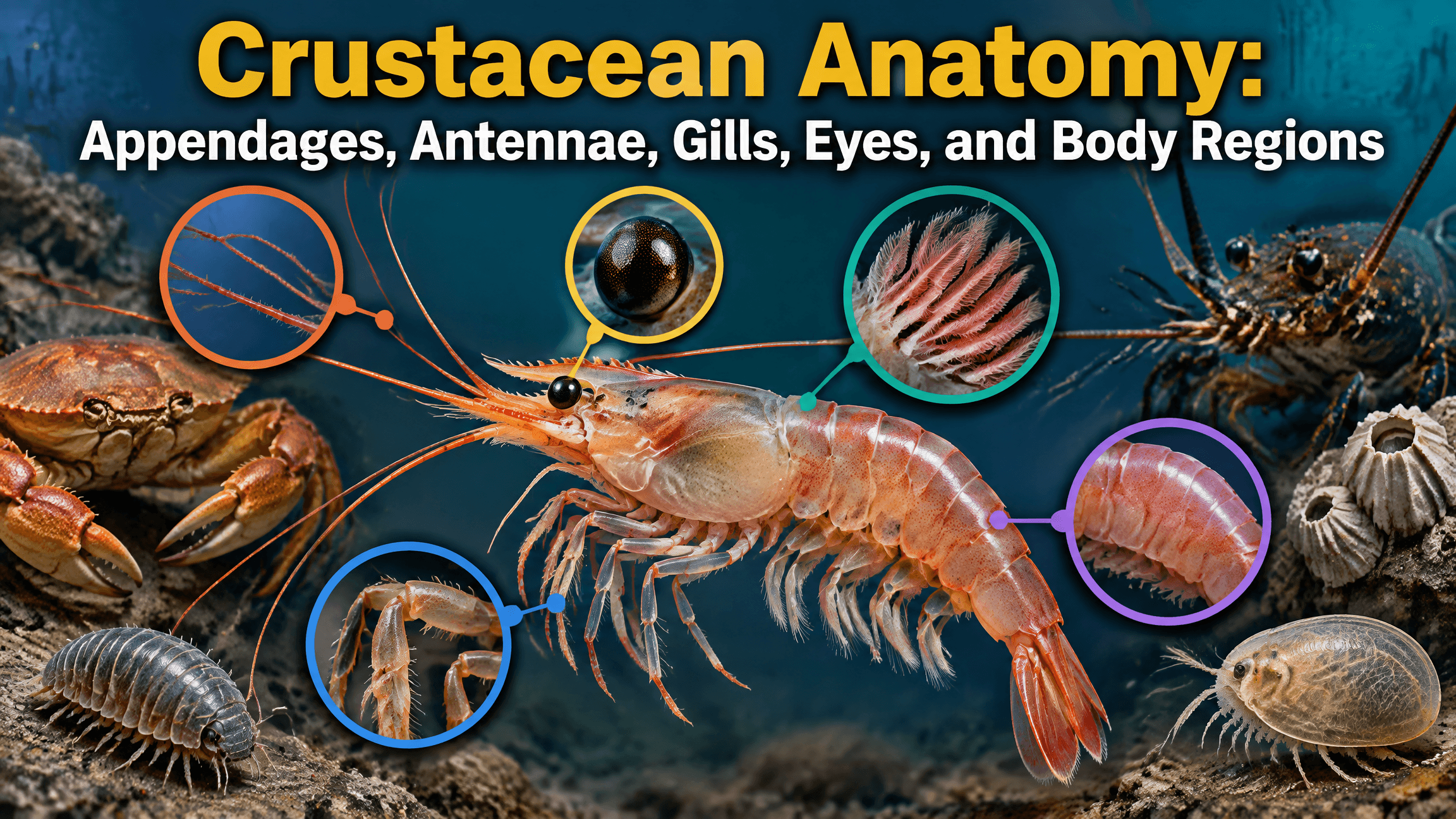
Crustacean anatomy is built on a segmented arthropod framework, but there is no single body diagram that fits every crustacean. A crab, shrimp, copepod, barnacle, isopod, and ostracod can all share deep structural themes while looking radically different on the outside. Their segments may be grouped into different body regions, their appendages may be modified for walking, swimming, feeding, brooding, or sensing, and structures such as a carapace, stalked eyes, or claws may be prominent in one lineage and reduced or absent in another.
The most useful way to understand crustacean body parts is therefore comparative. Instead of treating the familiar crab as the default, it helps to ask how each lineage modifies the same broad toolkit of segments, jointed limbs, sensory appendages, respiratory surfaces, and internal organ systems. That approach explains both the similarities that link crustaceans together and the exceptions that make their anatomy so diverse.
Quick Anatomy Overview
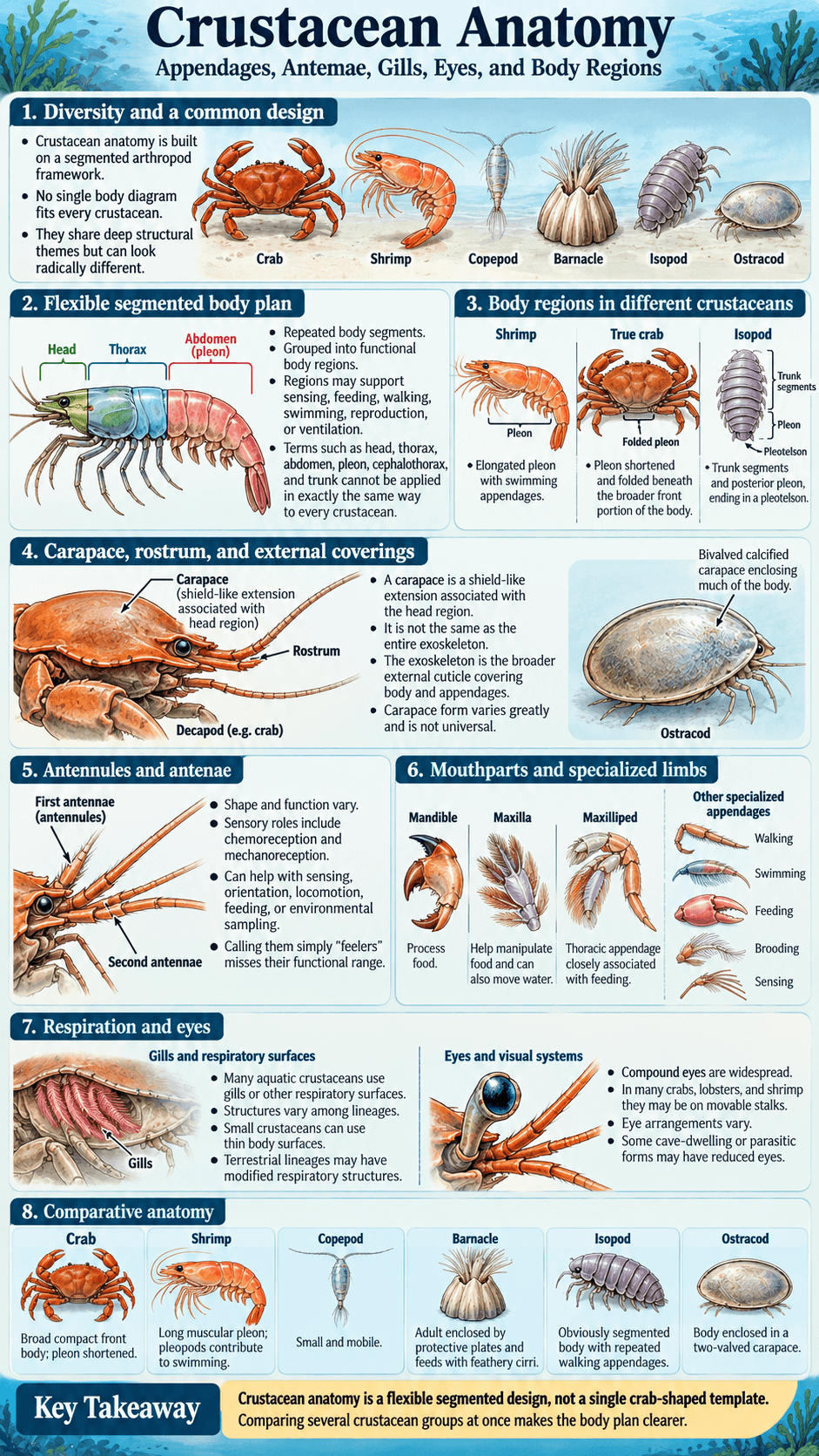
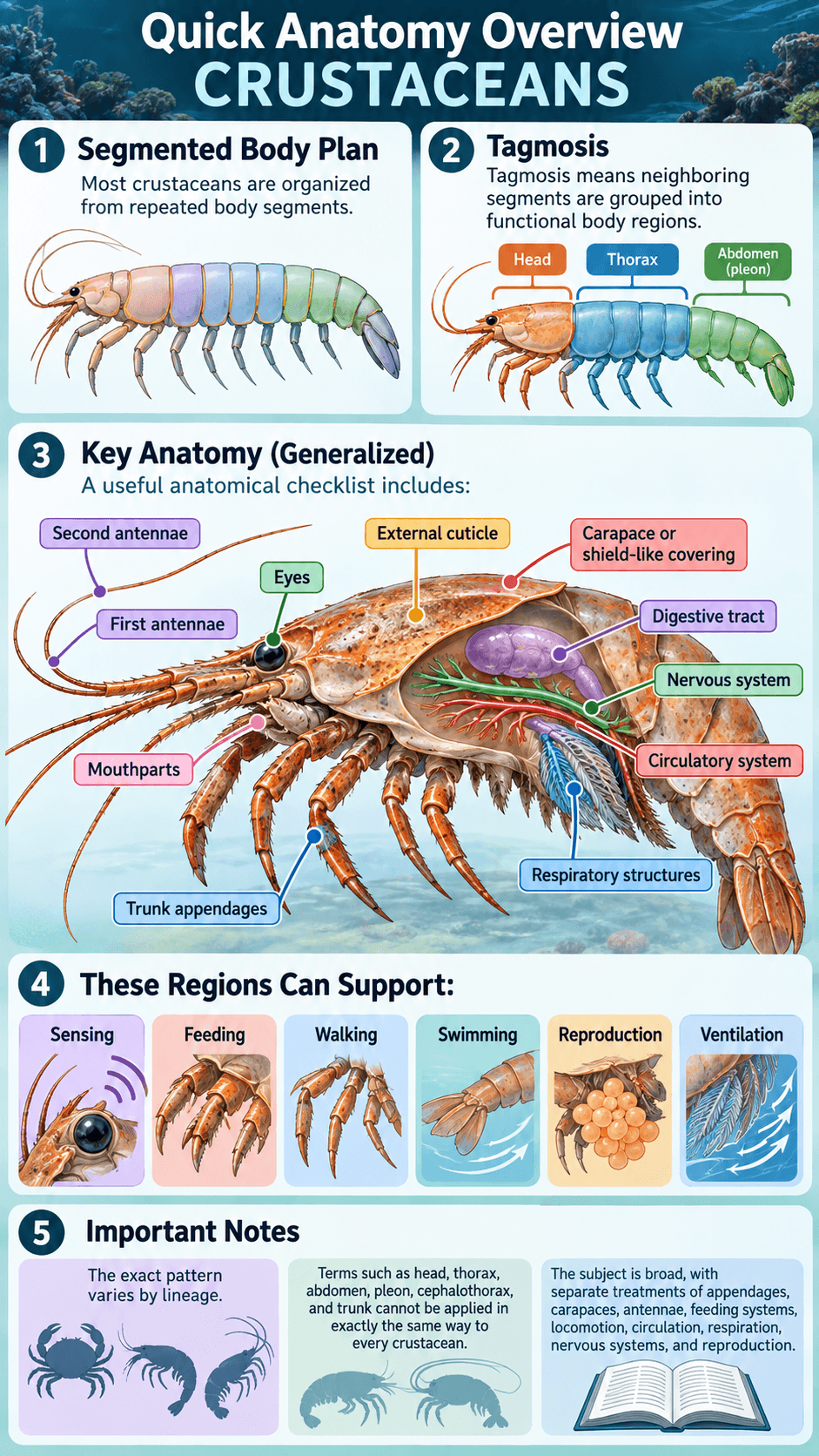
Most crustaceans are organized from repeated body segments that have become specialized through a process called tagmosis, meaning that neighboring segments are grouped into functional body regions. Those regions can support different jobs such as sensing, feeding, walking, swimming, reproduction, or ventilation. The exact pattern varies by lineage, which is why terms such as head, thorax, abdomen, pleon, cephalothorax, and trunk cannot be applied in exactly the same way to every crustacean. For the broader context around these structures, see the overview of crustacean diversity and adaptations.
A useful anatomical checklist includes the first and second antennae, mouthparts, trunk appendages, external cuticle, any carapace or shield-like covering, respiratory structures, eyes, digestive tract, nervous system, and circulatory system. The multi-volume Smithsonian catalog of The Natural History of the Crustacea reflects how broad this subject is, with separate treatments of appendages, carapaces, antennae, feeding systems, locomotion, circulation, respiration, nervous systems, and reproduction.
A Flexible Segmented Body Plan
Segmentation and tagmosis
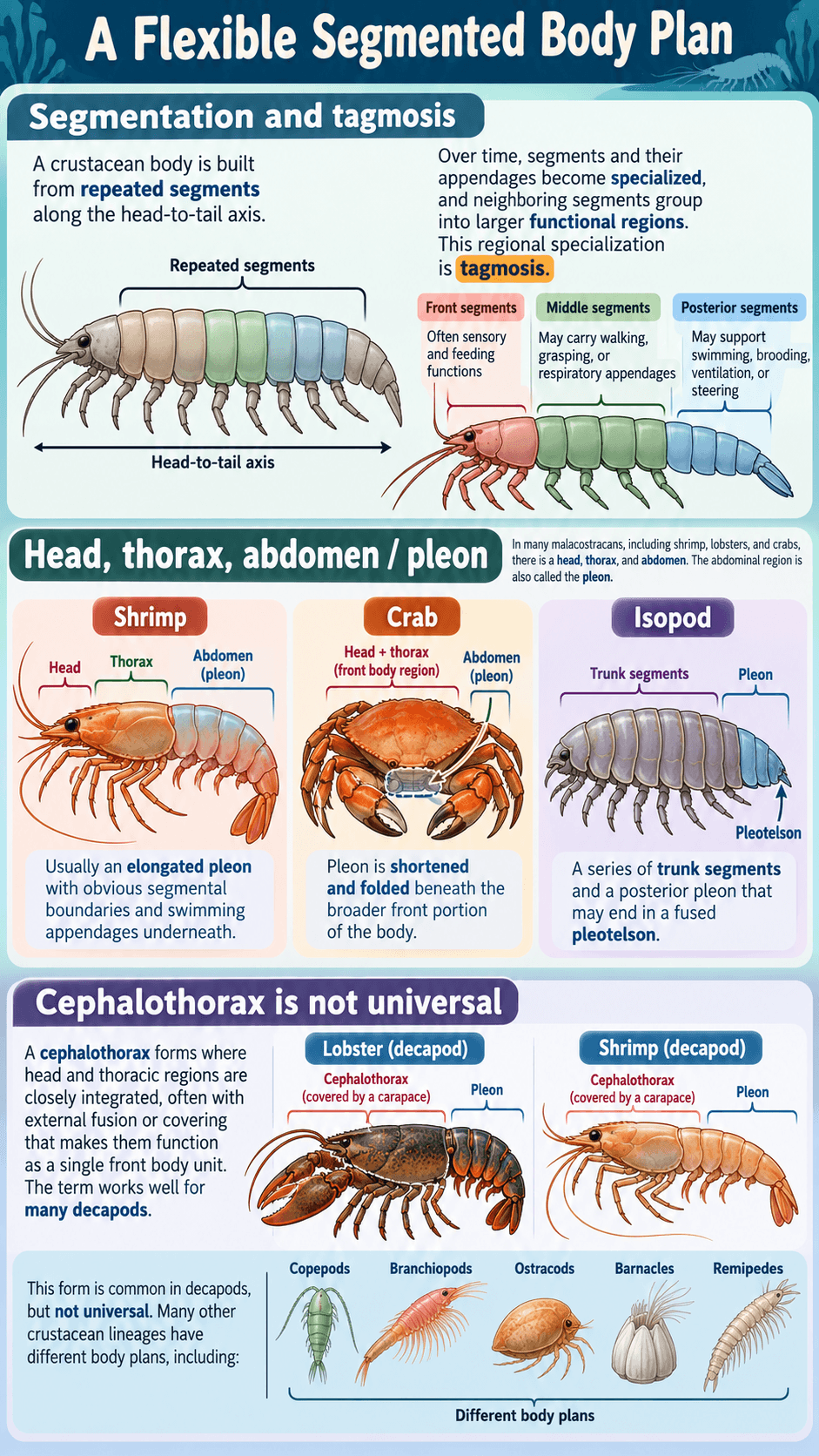
Segmentation means that the body is built from repeated units arranged along the head-to-tail axis. In crustaceans, those units are rarely identical in adults. Over evolutionary time, segments and their appendages became specialized, while neighboring segments were grouped into larger functional regions. This regional specialization is tagmosis.
Tagmosis helps explain why crustaceans can perform so many different tasks with structures that began as serially repeated parts. Front segments are often dominated by sensory and feeding functions. Middle segments may carry walking, grasping, or respiratory appendages. Posterior segments may support swimming, brooding, ventilation, or steering. Which segments do which jobs depends heavily on the lineage.
Head, thorax, abdomen or pleon where applicable
In many malacostracans, including familiar shrimp, lobsters, and crabs, readers often encounter a head, thorax, and abdomen. In this context, the abdominal region is also called the pleon. Yet even within Malacostraca, the apparent proportions and functions of these regions can be very different.
A shrimp usually shows an elongated pleon with obvious segmental boundaries and swimming appendages underneath. In a true crab, the pleon is shortened and folded beneath the broader front portion of the body. Isopods have a different profile again, with a series of trunk segments and a posterior pleon that may end in a fused pleotelson. These differences affect how the animal moves and where particular appendages are positioned.
Cephalothorax and why it is not universal
A cephalothorax forms where head and thoracic regions are closely integrated, often with external fusion or covering that makes them function as a single front body unit. The term works well for many decapods. In a lobster or shrimp, for example, a carapace covers much of the cephalothoracic region, while the pleon extends behind it.
Crabs show an especially compact version because the broad front body region dominates the animal’s appearance. That familiar form can make it tempting to describe every crustacean as a cephalothorax plus abdomen, but this would erase major anatomical differences among copepods, branchiopods, ostracods, barnacles, remipedes, and other lineages.
Carapace, Rostrum, and External Coverings
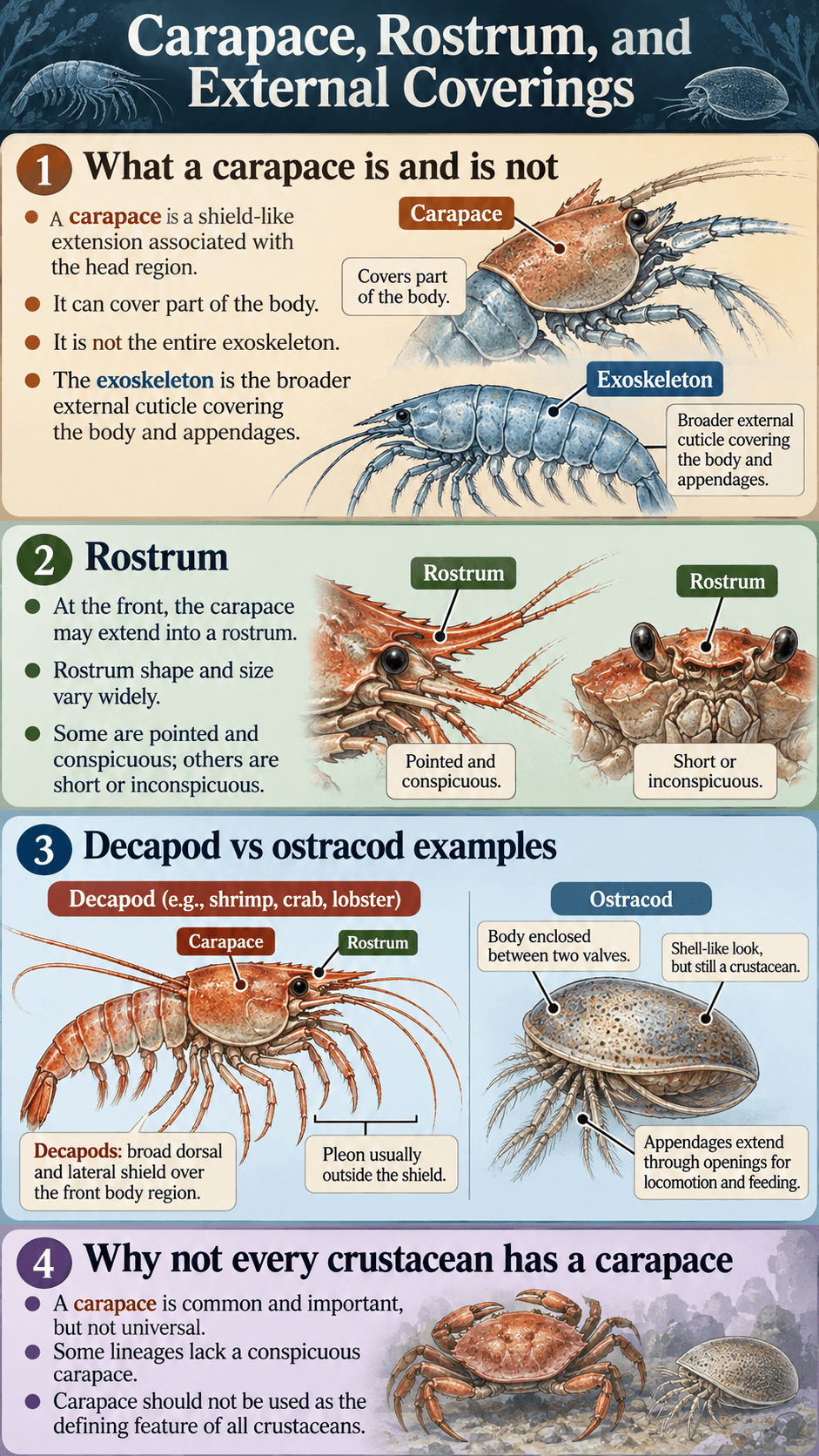
What a carapace is and is not
A carapace is a shield-like extension associated with the head region that can cover part of the body. It is not simply another name for the entire exoskeleton. The Oxford review of the crustacean carapace emphasizes that carapace form varies greatly among crustacean groups and that the structure can differ in extent, development, and function.
In many decapods, the carapace covers the fused head and thoracic area and may create lateral spaces associated with the gills. At the front, it may extend into a rostrum, a projecting structure whose shape and size vary widely. Some rostra are pointed and conspicuous, while others are short or inconspicuous.
The exoskeleton, by contrast, is the broader external cuticle covering the arthropod body and appendages. A carapace is one regional specialization of that covering. Using the terms precisely prevents a common mistake in which every hard outer surface on a crustacean is called its carapace.
Decapod versus ostracod examples
Decapods and ostracods show how dramatically a carapace can differ. In a shrimp, crab, or lobster, the carapace forms a broad dorsal and lateral shield over the front body region while leaving appendages and, in most cases, the pleon outside that shield. Its shape contributes strongly to the animal’s recognizable outline.
An ostracod looks very different. Much of its body is enclosed between two valves, giving the animal a seed-like or miniature bivalve appearance. A Smithsonian description of an ostracod notes that its body can be enclosed by a bivalved calcified carapace while appendages extend through openings for locomotion and feeding. Despite the shell-like look, an ostracod is still a crustacean, not a mollusk.
Why not every crustacean has a carapace
A carapace is common and important, but it is not universal. Some crustacean lineages lack a conspicuous carapace, and others have coverings that are reduced, differently shaped, or fused in ways that do not resemble the familiar decapod shield. This variation is one reason a carapace should not be used as the defining feature of all crustaceans.
Antennules and Antennae

Two pairs with different functions
A traditional crustacean body-plan feature is the presence of two pairs of antennal appendages: the first antennae, usually called antennules, and the second antennae. Their shape and function vary considerably. The Oxford review of crustacean antennules and antennae describes major differences among taxa and notes sensory roles that include chemoreception and mechanoreception.
Antennules are often important sensory structures. They may carry dense arrays of setae and specialized sensilla that respond to chemicals or movement in the surrounding water or air. In some groups they also interact with balance-related structures. The second antennae can also be sensory, but in certain crustaceans they are enlarged or modified for swimming, feeding, or other functions.
Calling both pairs simply feelers misses this functional range. They are jointed appendages that can collect chemical information, detect touch and fluid motion, help orient the animal, or contribute directly to locomotion and feeding.
Sensory, locomotor, and feeding roles across lineages
In many decapods, long antennae project well beyond the head and are useful for tactile and environmental sensing. Antennules are usually shorter but carry important sensory structures. In copepods, the first antennae can be extremely prominent and may help with swimming, orientation, and detecting hydrodynamic signals.
Some ostracods use their antennae as major locomotor appendages. In other crustaceans, antennal appendages may help manipulate food or generate currents. Development can change their role as well, so the function of an appendage in a larva may differ from its function in the adult.
Mouthparts and Feeding Appendages
Mandibles and maxillae
Crustacean mouthparts are built from appendages associated with head segments. Mandibles generally serve as major food-processing structures, while maxillae help manipulate food and can also participate in water movement or other functions. Their exact shape reflects what an animal eats and how it handles food.
A predatory crustacean may have robust structures for grasping and processing animal tissue. A suspension feeder may rely more heavily on setose appendages that capture particles from water. A grazer, detritivore, scavenger, or parasite can show a different combination again. Feeding anatomy therefore makes the most sense when connected to the animal’s actual diet rather than described as a fixed set of miniature jaws.
Maxillipeds and lineage-specific modifications
Maxillipeds are thoracic appendages that have become closely associated with feeding. They are especially familiar in malacostracans, but their number, size, and function differ among groups. In decapods, maxillipeds help manipulate food near the mouth, and their shape can vary according to feeding mode.
Walking, Swimming, and Specialized Limbs
Pereopods and walking legs
Pereopods are thoracic appendages used in locomotion and other tasks in many malacostracans. In familiar decapods, five pairs of thoracic walking appendages form the basis of the name Decapoda. Yet even within a decapod, not every member of those pairs has to function as a simple walking leg.
Some pereopods are slender and adapted for walking over sediment or rock. Others are flattened for swimming, enlarged for burrowing, equipped with claws, or modified to handle food. Isopods and amphipods show their own limb specializations, shaped by whether they crawl, cling, burrow, swim, or live on hosts.
The evolution of crustacean limbs is unusually flexible. An Oxford review of crustacean appendage evolution highlights repeated modification of limbs into functional units for locomotion, feeding, reproduction, and other specialized tasks.
Chelae and why claws are not universal
A chela is a pincer formed when terminal parts of an appendage oppose one another. The large claws of many crabs and lobsters are familiar examples, but claws are not a universal crustacean feature. Many copepods, branchiopods, ostracods, and other crustaceans do not have the oversized pincers people associate with crabs.
So a claw is best understood as one possible specialization of a limb, not as a defining crustacean body part.
Pleopods, swimmerets, uropods, and telson
Pleopods are appendages associated with the pleon in many malacostracans. In shrimp and related animals, they often contribute to swimming and are commonly called swimmerets. In other species they may also help carry eggs, ventilate broods, or perform reproductive functions.
Uropods are posterior appendages near the end of the body in many malacostracans. Together with the telson, which is a terminal body structure rather than a paired appendage, they can form a tail fan. Shrimp, lobsters, and crayfish can use the posterior body and tail fan in rapid escape movements, although the detailed mechanics belong to locomotion rather than basic anatomy.
Brooding, cleaning, sensory, and feeding appendages
Crustacean limbs can do much more than move the body. Some support or ventilate eggs. Some clean the body surface or other appendages. Some carry dense sensory setae. Others create feeding currents, filter suspended particles, anchor the animal to a surface, or help transfer sperm.
Barnacles provide a striking example. Familiar suspension-feeding barnacles extend modified thoracic appendages called cirri into the water to capture food, even though the adult animal itself is fixed to the substrate. The limbs are still recognizably part of the crustacean appendage system, but their function has shifted from walking to feeding. Mouthparts and specialized limbs become especially clear when compared with crustacean feeding strategies.
Biramous Appendages as a Body-Plan Concept
Ancestral pattern versus modified adult limbs
A biramous appendage has two branches arising from a common base, typically described as an inner branch and an outer branch. Biramous organization is an important concept in crustacean morphology and evolutionary history, but it should not be treated as a rule that every adult limb must visibly display two equal branches.
Branches may be reduced, enlarged, fused, lost, or specialized. An appendage that looks single-branched in an adult may still be understood in relation to a deeper crustacean limb pattern. Conversely, strongly modified feeding or sensory structures may make the underlying organization difficult to recognize without developmental or comparative anatomical evidence.
Gills and Respiratory Structures in Anatomical Context
Why location and form vary
Many aquatic crustaceans use gills or other thin respiratory surfaces for gas exchange, but the structures are not located or shaped identically across the group. In numerous decapods, gills are associated with the thoracic region and lie within protected spaces beneath the carapace. Water must move across these surfaces so oxygen and carbon dioxide can diffuse between the environment and the animal’s internal transport system.
Other crustaceans use different arrangements. Respiratory surfaces can be associated with appendages or broad areas of the body, and terrestrial isopods have modifications of pleonal appendages that support life in air while retaining a strong dependence on moisture. A full explanation of ventilation and terrestrial breathing requires more physiology than an anatomy overview, but the structural point is simple: there is no one crustacean gill blueprint.
The relationship between respiratory surfaces and circulation is close. An Oxford review describes crustaceans as having an open vascular system in which hemolymph leaves vessels and moves through body spaces, while respiratory exchange depends on both ventilating external surfaces and transporting gases internally.
Eyes and Visual Systems
Compound and stalked eyes where present
Compound eyes are widespread among crustaceans, especially in many malacostracans. They are built from repeated visual units rather than a single lens. In crabs, lobsters, shrimp, and some other groups, the compound eyes may be carried on movable stalks, giving the animal a wide field of view and allowing eye position to change independently of the body.
Yet stalked compound eyes are not universal. Copepods, branchiopods, ostracods, barnacles, and other lineages can have very different visual arrangements. Some species combine lateral eyes with median or naupliar eyes. Others have simplified systems suited to their habitat and behavior.
A review of pancrustacean visual evolution documents extensive diversity in eye types and also notes that major lineages include taxa that have lost or reduced particular eyes, showing why crustacean eye anatomy cannot be reduced to one compound-eye model.
Reduced eyes and alternative visual arrangements
Crustaceans living in caves, deep subterranean water, inside hosts, or other low-light environments may have reduced eyes or lack prominent external eyes. Reduction does not necessarily mean that every light-sensing ability disappears, and the degree of change varies by lineage and species.
Internal Anatomy at Overview Depth
Nervous system
Crustaceans have a nervous system organized around a brain in the head region and longitudinal nerve pathways with segmental ganglia, which are concentrations of nerve cells associated with particular parts of the body. The exact degree of fusion and concentration varies among lineages and body plans.
Open circulation and hemolymph
Crustaceans generally have an open circulatory system, more precisely described by some researchers as an open vascular system. A heart pumps hemolymph through arteries, after which the fluid moves through spaces and sinuses around organs before returning toward the heart. Hemolymph performs transport functions analogous in broad terms to those of blood, but it does not remain inside a fully closed network of fine vessels as in vertebrates.
Digestive system overview
The digestive tract runs through the body and is regionally specialized for receiving, processing, digesting, and absorbing food. In many crustaceans, the foregut includes structures that help process food mechanically, while digestive glands contribute enzymes and nutrient absorption. The details differ with diet and lineage.
Comparing Very Different Crustacean Bodies
Crab versus shrimp
A true crab and a shrimp illustrate how much a shared decapod framework can be rearranged. A crab has a broad, compact front body, with the pleon shortened and folded beneath the body. Walking legs dominate locomotion on the substrate, and the first pair may be enlarged into claws.
A shrimp keeps a long, muscular pleon extending behind the cephalothorax. Pleopods contribute to swimming, and the posterior body can flex rapidly. Both animals possess decapod features, but their proportions, limb use, and overall silhouette are very different.
Copepod versus barnacle
A copepod is often small and mobile, with prominent antennal appendages and a body suited to swimming, crawling, or host-associated life depending on the species. Many free-living forms have a compact anterior region and a narrower posterior region, with appendages arranged for feeding and movement.
An adult barnacle is almost the opposite in appearance. Many familiar species are fixed to a surface, enclosed by protective plates, and feed with feathery cirri. Larval stages are mobile before settlement, but the adult anatomy is reorganized around attachment and suspension feeding.
Isopod versus ostracod
An isopod typically shows an obviously segmented body with repeated walking appendages. Terrestrial woodlice make the pattern easy to see because the trunk plates and legs remain exposed. Marine and freshwater isopods vary widely, but many retain this recognizable segmented profile.
An ostracod encloses much of its body inside a two-valved carapace, so the segmentation and appendages are far less obvious from the outside. Limbs protrude when the animal swims, crawls, feeds, or senses its surroundings.
Common Anatomy Mistakes
Treating a crab as the universal diagram
Crabs are convenient teaching examples because their major limbs and front body region are easy to see, but a crab-centered diagram can create false rules. Not every crustacean has a broad cephalothorax, five obvious pairs of walking legs, large claws, eye stalks, or a shortened abdomen.
A better mental model uses several examples at once: a shrimp for an elongated decapod body, a copepod for a small planktonic form, a barnacle for extreme adult modification, an isopod for exposed trunk segmentation, and an ostracod for a body enclosed by a bivalved carapace.
Calling the whole exoskeleton a carapace
The exoskeleton is the overall external cuticle of the arthropod body and appendages. A carapace is a particular shield-like part that can cover the head region and varying amounts of the trunk. The two terms overlap anatomically but are not interchangeable.
This distinction becomes especially important when comparing groups. A crab has a prominent carapace over the front body, but its walking legs and ventral surfaces are also covered by exoskeleton. An ostracod has an enclosing carapace with a very different shape. A crustacean without a conspicuous carapace still has an arthropod cuticle.
Assuming every limb is visibly biramous
Biramous organization is important for understanding crustacean limb evolution, but adult appendages can be extensively remodeled. One branch may be reduced or lost. Parts can fuse, flatten, elongate, or acquire dense setae. Some structures become so specialized that their two-branched ancestry is not obvious by inspection.
It is therefore misleading to tell readers that every crustacean leg should visibly split into two equal branches. Biramous anatomy is best used as a comparative and evolutionary concept.
How Anatomy Shapes Molting, Movement, Feeding, Senses, and Breathing
Molting and cuticle replacement
Because the cuticle forms the external framework around the body and appendages, growth requires periodic replacement through molting. Anatomy determines what must be shed and rebuilt, but the physiology of mineral recovery, new-cuticle formation, expansion, and hardening is a separate process. Because the cuticle is replaced during growth, this anatomy connects directly to the crustacean molt cycle.
The important anatomical connection is that the external skeleton covers far more than the main body. Jointed limbs, mouthparts, sensory structures, and many fine projections are all part of the surface that must be renewed. That helps explain why a molt is a whole-body event rather than simply removing a shell from the back.
Movement, senses, feeding, and breathing as functions of anatomy
Body structure sets the physical possibilities for behavior. Flattened swimming appendages, strong walking legs, tail fans, digging limbs, and attachment structures support different forms of movement. Antennules, antennae, setae, and eyes determine what kinds of environmental information can be detected. Mouthparts and feeding limbs shape how food is captured and processed. These appendage differences also help explain the many forms of crustacean locomotion.
Respiratory anatomy is equally connected to lifestyle. Protected gills, appendage-associated surfaces, and terrestrial respiratory modifications allow different lineages to exchange gases in water or moist air. The same segmented body plan therefore serves as the platform for locomotion, feeding, sensing, respiration, and reproduction.
FAQ
How many body regions do crustaceans have?
There is no single number that applies to every crustacean. Many familiar malacostracans can be described using head, thorax, and pleon, while some have an obvious cephalothorax formed by integration of the head and thoracic region. Other lineages organize their segments differently. It is more accurate to describe the body regions of a particular group than to impose one fixed count on all crustaceans.
Do all crustaceans have eye stalks?
No. Stalked eyes are common in many decapods, including numerous crabs, shrimp, and lobsters, but crustacean visual systems are highly diverse. Some species have unstalked eyes, median or naupliar eyes, reduced eyes, or little obvious external visual anatomy. Cave-dwelling and parasitic forms can show especially strong reductions.
Do all crustaceans have claws?
No. Claws are specialized appendages found in some groups, especially many decapods, but large pincers are not a defining feature of Crustacea. Copepods, many branchiopods, barnacles, ostracods, and numerous other crustaceans lack the prominent chelae associated with crabs and lobsters.
What is the difference between a carapace and an exoskeleton?
The exoskeleton is the broader external cuticle covering the body and appendages. A carapace is a specific shield-like extension associated with the head region that can cover part of the trunk. A crustacean may have an exoskeleton without having a conspicuous carapace, and the shape of a carapace can differ greatly among lineages.
Final Thoughts
Crustacean anatomy is best understood as a flexible segmented design rather than a single crab-shaped template. Shared themes include specialized body segments, paired appendages, two antennal pairs in the conventional crustacean framework, external cuticle, and organ systems adapted to an arthropod body. From that foundation, different lineages have produced broad crab bodies, streamlined shrimp, tiny copepods, attached barnacles, many-legged isopods, and shell-like ostracods.
The most important takeaway is that familiar structures such as carapaces, claws, eye stalks, gills, and swimmerets are lineage-specific expressions of a much broader anatomical toolkit. Comparing several crustacean groups at once makes the body plan clearer and prevents the common mistake of treating one familiar animal as the definition of them all.

Ethan Walker is the founder and research editor of Animal Fact Central. He creates and reviews educational animal facts content using trusted wildlife, pet care, and science-based sources. His work focuses on making animal behavior, adaptations, habitats, and species facts clear, accurate, and engaging for everyday readers.
Read More Details About Ethan Walker: https://animalfactcentral.com/ethan-walker/
1 thought on “Crustacean Anatomy: Appendages, Antennae, Gills, Eyes, and Body Regions”