
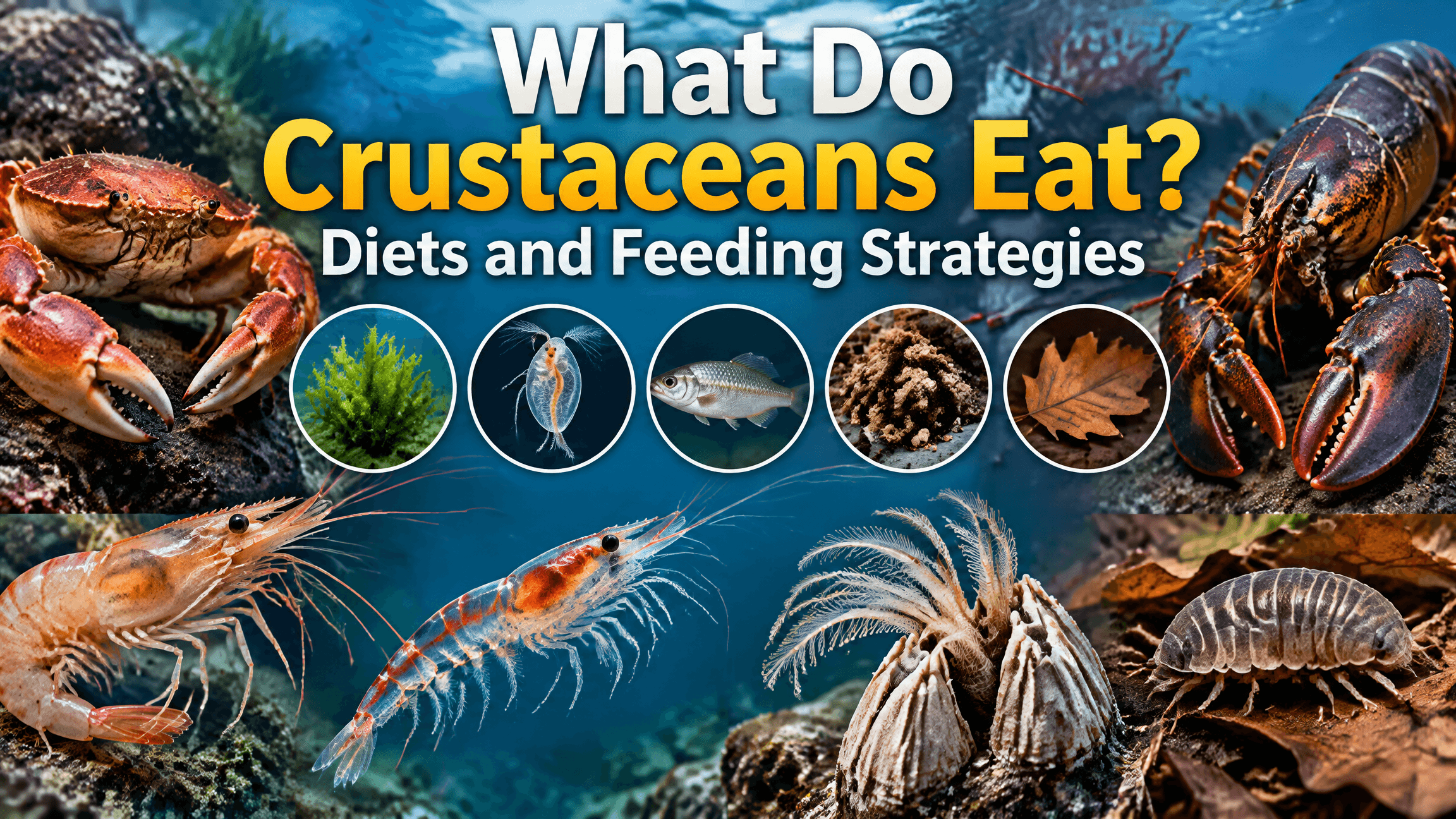
Crustaceans do not share one diet. Some hunt live prey, some graze algae, some collect organic particles from sediment, some filter food from the water, some feed on decaying plant material, and some live as parasites on or inside other animals. Even closely related crustaceans can eat very different foods because their appendages, mouthparts, habitat, body size, and life stage shape what they can capture and digest.
That diversity is easy to miss if crustaceans are reduced to familiar crabs, shrimp, and lobsters. Copepods include herbivores, omnivores, and predators. Barnacles often suspension-feed with feathery cirri, yet parasitic barnacles follow a completely different strategy. Terrestrial isopods commonly process leaf litter and other decaying material. Krill can graze phytoplankton but may also consume animal prey and detrital material. The useful answer to “what do crustaceans eat?” is therefore not a single food list, but a set of feeding strategies.
Quick Answer

Crustaceans may eat algae, phytoplankton, zooplankton, worms, mollusks, other crustaceans, carrion, detritus, decaying leaves, microorganisms, suspended particles, and host tissues or fluids, depending on the species. Many are omnivorous or opportunistic, while others are specialized grazers, predators, suspension feeders, detritivores, or parasites. For the broader biology behind this dietary diversity, see the crustacean overview.
Free-living copepods make the diversity especially clear. A modern overview of copepod feeding describes predatory, omnivorous, and mostly herbivorous forms, with sensory systems and appendages matched to different food types. Oxford Academic’s overview of copepod feeding modes shows why no single feeding label fits even one major crustacean group.
Crustaceans Do Not Have One Diet
Predation and omnivory
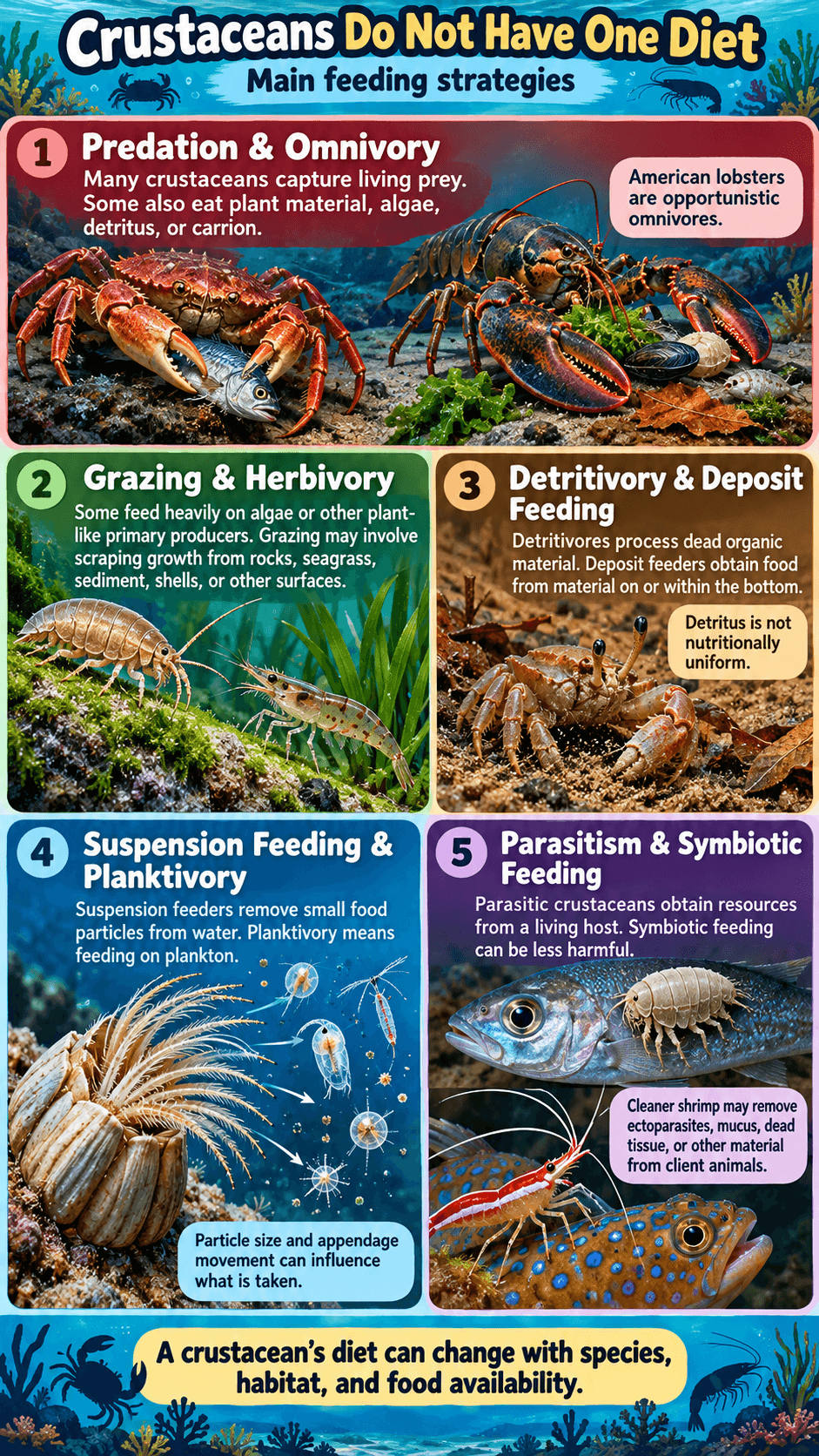
Many crustaceans capture living prey. Predatory crabs may seize mollusks, worms, smaller crustaceans, or other accessible animals. Some shrimp stalk or grab small prey. Lobsters and crayfish can hunt animals they encounter while also eating plant material and carrion. Predatory copepods may capture other zooplankton, including smaller copepods.
Omnivory is equally important. An omnivorous crustacean can switch among animal prey, algae, detritus, and other resources as availability changes. That flexibility can be useful in habitats where food varies with season, tide, depth, temperature, or local productivity. It also means a short stomach-content sample does not necessarily describe the full diet of a species across its range.
American lobsters provide a familiar example. NOAA Fisheries describes adults as opportunistic omnivores that consume animals such as crabs, mollusks, worms, sea urchins, sea stars, and fish, along with macroalgae. NOAA Fisheries’ American lobster profile is a useful correction to the old stereotype that lobsters mainly wait for dead animals.
Grazing and herbivory
Some crustaceans feed heavily on algae or other plant-like primary producers. Grazing may involve scraping growth from rocks, seagrass, sediment, shells, or other surfaces. Planktonic grazers can consume phytoplankton suspended in the water. In freshwater systems, small branchiopods and copepods can also process microscopic producers, although the balance between algae and other foods varies by species.
Herbivory does not always mean eating large pieces of living plants. A crustacean may graze thin films of algae and microbes, select individual phytoplankton cells, or feed on partly decomposed plant tissues. The boundary between herbivory and detritivory can therefore become less obvious in habitats where decomposers and biofilms transform plant material before it is eaten.
Detritivory and deposit feeding
Detritus is dead organic material, often mixed with microbes and fine mineral particles. Detritivorous crustaceans help process this material in aquatic sediments, leaf litter, mangroves, streams, shorelines, and soils. They may shred larger pieces, ingest fine particles, or selectively consume microbe-rich material.
Deposit feeders obtain food from material on or within the bottom. They may swallow sediment and extract usable organic particles, or pick individual food items from the surface. These strategies are especially common where food arrives as sinking particles rather than as large prey.
Detritus is not nutritionally uniform. Freshly fallen leaves, heavily decomposed litter, fecal material, microbial films, and sediment-associated organic matter can differ strongly in digestibility and nutrient content. A crustacean that is called a detritivore may therefore show clear preferences rather than eating every dead material it encounters.
Suspension feeding and planktivory
Suspension feeders remove small food particles from water. Their feeding structures may create currents, sweep through moving water, or intercept particles already carried past the animal. Barnacle cirri are a classic example, but crustacean suspension feeding also occurs in other groups.
Planktivory simply means feeding on plankton. The prey may include phytoplankton, protozoans, eggs, larvae, or small zooplankton. Some crustaceans combine suspension feeding with selective capture, so the process is not always a passive sieve. Particle size, flow, sensory cues, and appendage movement can influence what is actually taken.
Parasitism and symbiotic feeding
Parasitic crustaceans obtain resources from a living host. Parasitic copepods, isopods, branchiurans, and rhizocephalan barnacles include species with very different attachment sites and feeding mechanisms. Some live on external surfaces, some occupy gills or body cavities, and others are highly modified internal parasites.
Symbiotic feeding relationships can also be less harmful. Cleaner shrimp, for example, may remove ectoparasites, mucus, dead tissue, or other material from client animals, depending on the species and interaction. Describing this as kindness is misleading. The behavior persists because the shrimp gains food and the partner may gain a cleaning benefit under appropriate conditions.
How Crustacean Appendages Help Them Feed
Mouthparts and grasping appendages
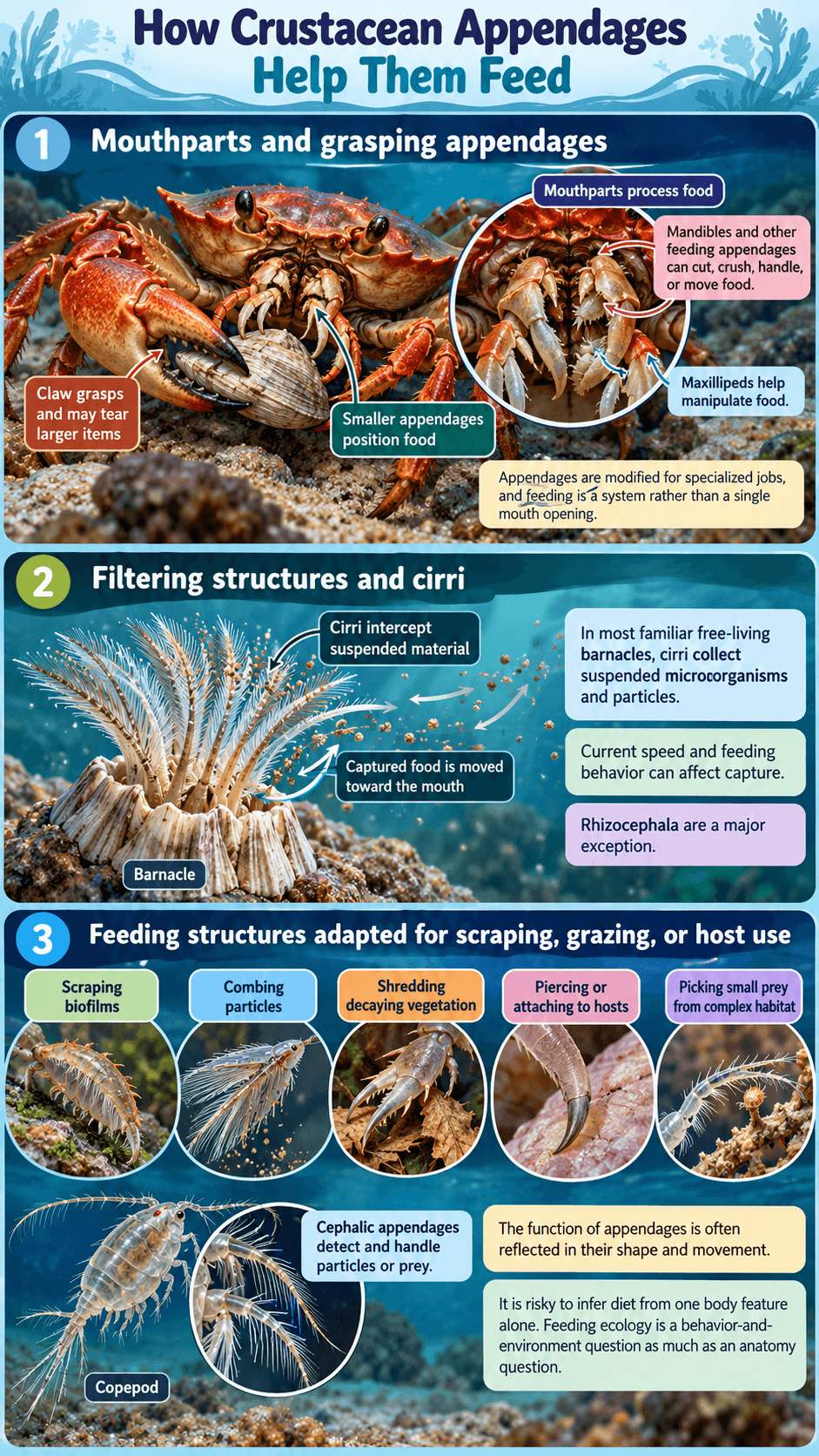
Crustaceans inherit a segmented arthropod body plan in which appendages can be modified for specialized jobs. Around the mouth, mandibles and other feeding appendages can cut, crush, handle, or move food. In many decapods, maxillipeds help manipulate food near the mouth, while claws or other thoracic appendages may capture and tear larger items. The mouthparts and appendages used to capture and process food are compared in crustacean anatomy.
The result is a feeding system rather than a single mouth opening doing all the work. A crab may use a claw to grasp food, smaller appendages to position it, and mouthparts to process it. A copepod can use cephalic appendages to detect and handle particles or prey. The exact structures and motions differ widely, so one shrimp or crab diagram should not be treated as a universal crustacean feeding plan.
Filtering structures and cirri
Many familiar barnacles feed by extending feathery thoracic appendages called cirri into the surrounding water. These structures intercept suspended material and move captured food toward the mouth. Current speed and feeding behavior can affect how effectively different particles are captured.
Queensland Museum describes barnacles as specialized crustaceans whose familiar free-living forms mostly use cirri to collect suspended microorganisms and particles. It also notes the major exception of Rhizocephala, parasitic barnacles that live in association with crustacean hosts. Queensland Museum’s barnacle overview illustrates how dramatically feeding structures can change within barnacles.
Feeding structures adapted for scraping, grazing, or host use
Crustacean appendages may also be suited to scraping biofilms, combing particles from surfaces, shredding decaying vegetation, piercing or attaching to hosts, or picking small prey from complex habitat. Function is often reflected in the shape and movement of the appendage, but it is risky to infer diet from one body feature alone.
Diet studies therefore combine anatomy with observations, stomach contents, stable isotopes, molecular methods, or other evidence. A strong claw might suggest an ability to crush food, but it does not prove that the animal eats only hard-shelled prey. Feeding ecology is a behavior-and-environment question as much as an anatomy question.
What Crabs Eat
Predators, scavengers, grazers, omnivores, and deposit feeders
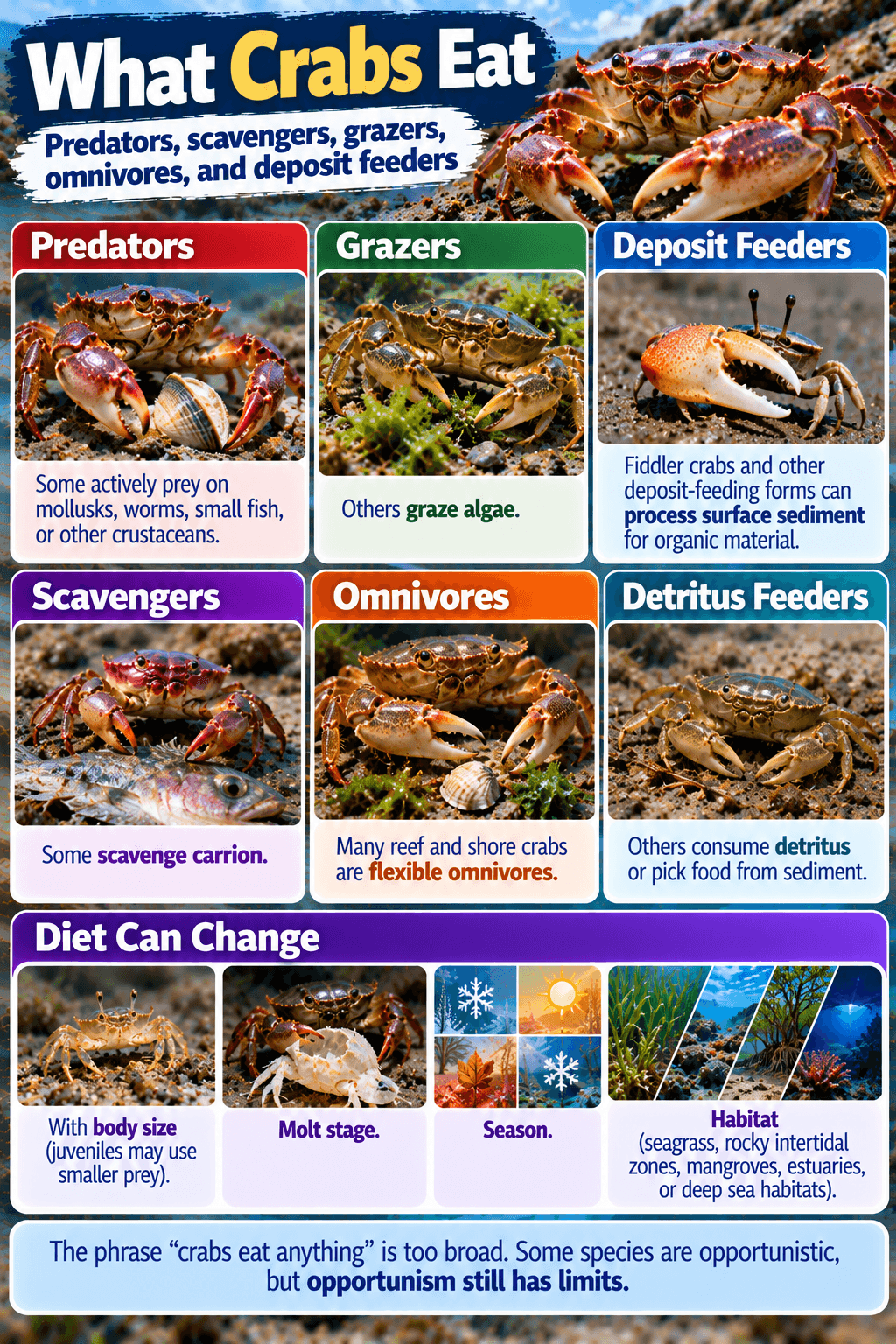
Crabs occupy many feeding guilds. Some actively prey on mollusks, worms, small fish, or other crustaceans. Others graze algae, sift or pick food from sediment, consume detritus, scavenge carrion, or combine several strategies. Fiddler crabs and other deposit-feeding forms can process surface sediment for organic material, while many reef and shore crabs are more flexible omnivores.
Even within a single species, diet can change with body size, habitat, molt stage, season, or what food is locally available. Juveniles may use smaller prey or softer foods than adults. Crabs living in seagrass, rocky intertidal zones, mangroves, estuaries, or deep sea habitats encounter very different feeding opportunities.
The phrase “crabs eat anything” is therefore too broad. Some species are opportunistic, but opportunism still has limits set by mouthparts, handling ability, digestive physiology, habitat, and behavior. A crab cannot automatically use every object that contains calories.
What Shrimp Eat
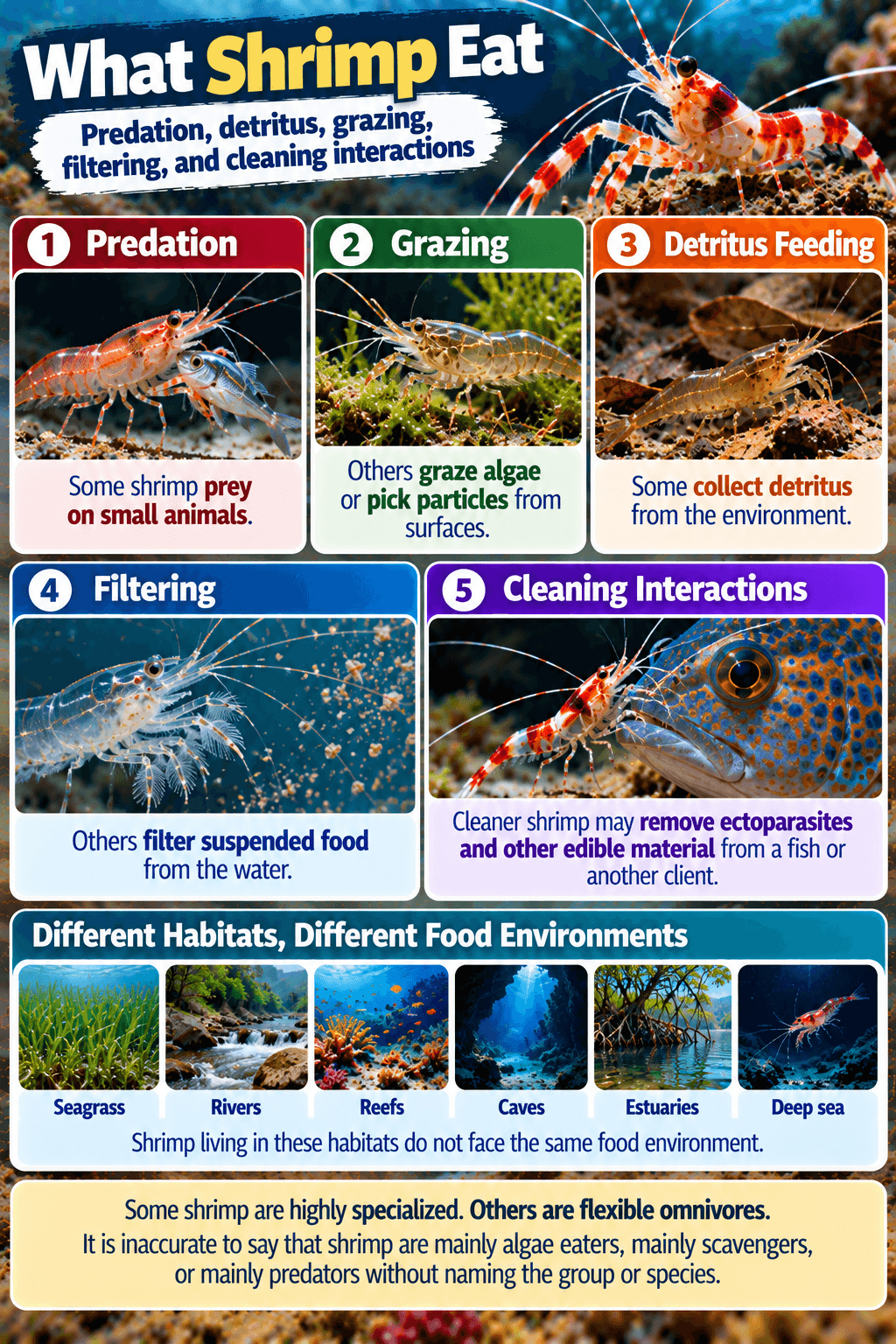
Predation, detritus, grazing, filtering, and cleaning interactions
Shrimp is a common-name category that covers many lineages and feeding styles. Some shrimp prey on small animals. Others graze, collect detritus, filter suspended food, or pick particles from surfaces. Species living in seagrass, rivers, reefs, caves, estuaries, and the deep sea do not face the same food environment.
Cleaner shrimp are useful examples of feeding through animal interactions. A cleaner may remove ectoparasites and other edible material from a fish or another client. The behavior can benefit both participants, but the shrimp is still feeding. It does not need a human-like motive for the interaction to function as a mutualistic or context-dependent relationship.
Some shrimp are highly specialized. Others are flexible omnivores. That range makes it inaccurate to say that shrimp are mainly algae eaters, mainly scavengers, or mainly predators without naming the group or species.
Lobsters and Crayfish
Opportunistic omnivory, predation, and scavenging
Lobsters and crayfish are often described as scavengers because they readily use carrion and because baited traps make scavenging behavior easy to observe. In nature, however, many species also attack living prey and eat plant or algal material. The balance varies among species and habitats.
American lobster is a good case study because direct field and fisheries observations have overturned the idea that it lives mainly on carrion. Its diet can include live benthic animals as well as macroalgae. Crayfish likewise include opportunistic omnivores that feed on aquatic plants, invertebrates, detritus, carrion, and other available resources.
“Crayfish eat everything” is still an overstatement. Food choice is constrained by size, habitat, local abundance, life stage, and the animal’s ability to find and handle a food item. A broad diet is not the same as a limitless diet.
Copepods
Phytoplankton grazing
Copepods deserve major attention because they are not simply tiny fish food. Many free-living copepods graze phytoplankton and can influence how primary production moves through aquatic food webs. Their feeding appendages may generate currents or manipulate particles at a scale where individual cells and microscopic prey matter.
Species can be selective about particle size or food type, and feeding may change when the plankton community changes. A copepod that consumes phytoplankton during one bloom may also take protozoans or other prey under different conditions. Labeling all copepods as filter feeders hides this flexibility.
Predatory and omnivorous forms
Predatory copepods can capture other zooplankton, including small crustaceans. Their sensory systems help detect water movement and chemical information associated with prey. A Journal of Crustacean Biology study of predatory copepod feeding documented Tortanus copepods capturing other small planktonic crustaceans. Some species are strongly carnivorous, while others mix animal prey with plant or microbial foods.
Omnivory can connect different parts of the planktonic food web. A copepod that eats both phytoplankton and protozoans, for example, is not simply occupying one fixed step in a food chain. Its diet changes the pathways by which carbon and nutrients reach larger consumers.
Detrital and parasitic strategies
Other copepods live near the bottom, use detrital material, or live in symbiotic and parasitic relationships. Parasitic copepods occur on a wide range of marine and freshwater hosts, and their feeding structures may be highly modified compared with free-swimming planktonic relatives.
This diversity is why statements such as “copepods eat algae” or “copepods filter-feed” should be treated as examples, not definitions. Copepoda contains multiple feeding ecologies, and even closely related species may occupy different trophic roles.
Krill
Phytoplankton, animal prey, and detrital particles
Krill are famous as prey for whales, penguins, seals, fish, and seabirds, but they have their own varied feeding ecology. Antarctic krill often graze phytoplankton and sea-ice algae, yet they can also use other foods, including animal prey and detrital material, depending on season and habitat.
The Australian Antarctic Program notes that phytoplankton is a primary food source for Antarctic krill and that winter diets can include sea-ice algae, seafloor detritus, and other animals. The Australian Antarctic Program’s krill profile is useful because it presents krill as flexible consumers rather than as passive links between phytoplankton and whales.
Krill should therefore not be described merely as “whale food,” and Antarctic krill should not be used as the diet model for every krill species. Euphausiids occupy different ocean regions and experience different food conditions.
Barnacles
Suspension feeding with cirri
Many familiar acorn and stalked barnacles collect suspended food using cirri. By extending and retracting these feathery appendages, a barnacle can intercept particles, plankton, and small organisms carried by water. Feeding can be adjusted to flow conditions rather than functioning as a completely passive filter.
This method fits an attached adult because the animal cannot chase prey across the seafloor. Instead, it uses water movement and repeated cirral motions to bring food within reach. The same basic lifestyle can still vary among species depending on current, particle availability, body size, and habitat.
Parasitic and highly modified exceptions
Not all barnacle lineages feed this way. Rhizocephalan barnacles are parasites of other crustaceans, especially decapods. Adults can be so modified that they no longer resemble the familiar shell-plated barnacle body. Their feeding relationship depends on extracting resources from a host rather than sweeping suspended particles with ordinary cirri.
This is a strong reminder that common examples should not be turned into universal rules. “Barnacles are suspension feeders” works for many recognizable barnacles, but it does not describe every lineage within the broader group.
Terrestrial Isopods
Litter, decaying plant material, and associated microorganisms
Woodlice, sowbugs, and pill bugs are terrestrial isopod crustaceans. Many are detritivores that feed heavily on dead or decaying plant material. As litter decomposes, fungi, bacteria, and other microorganisms change its chemistry and nutritional value, so isopods often consume a mixture of plant tissue and the microbial community associated with it. What food is available also changes across the wide range of crustacean habitats.
Penn State Extension describes terrestrial isopods as detritivores that break down rotting material and notes that they primarily feed on dead plant material, while some can also feed on living plants under certain conditions. Penn State’s terrestrial isopod overview supports the broader point that their diets are centered on decomposition but are not restricted to one food item.
It is therefore too narrow to say that woodlice eat only dead leaves. Bark, fungi, biofilms, decaying vegetation, and other organic materials may contribute depending on species and setting.
Parasitic Crustaceans
Copepods, isopods, branchiurans, and rhizocephalans
Parasitism has evolved in several crustacean groups. Parasitic copepods may attach to fish, invertebrates, or other hosts. Some isopods feed externally or occupy gill chambers and body cavities. Branchiurans include fish parasites, while rhizocephalan barnacles develop highly modified internal systems associated with crustacean hosts.
These feeding strategies are different enough that “parasitic crustacean” is an ecological label rather than a single anatomical design. One species may pierce host tissues, another may feed at a surface, and another may develop a root-like internal system that absorbs resources from within its host.
Why common names such as sea lice require caution
Common names can hide taxonomic differences. “Sea lice” is used for certain parasitic copepods associated with fish, but similar informal wording may be applied inconsistently. The safest approach is to identify the taxonomic group or species before making claims about feeding or host effects.
This matters because a parasite’s diet, life cycle, host range, and ecological impact cannot be inferred reliably from a vague common name. Parasitic crustaceans should be discussed at the appropriate species or lineage level whenever the details matter.
Common Diet Myths
Crustaceans are not simply scavengers
Scavenging is common and ecologically important, but it is only one crustacean feeding strategy. Predation, grazing, suspension feeding, detritivory, deposit feeding, omnivory, and parasitism are all widespread enough that “crustaceans are scavengers” gives readers the wrong picture of the group.
Lobsters do not eat only carrion
Lobsters can scavenge, but at least some well-studied species actively consume living prey and other foods. American lobster, for example, is an opportunistic omnivore. Scavenging should be described as part of its feeding ecology, not as the complete diet.
Cleaner shrimp interactions are not acts of kindness
A cleaner shrimp may remove edible material from another animal while the client receives a potential benefit. That can produce a mutually beneficial interaction without requiring human-like intention. Framing the behavior as kindness replaces ecology with anthropomorphism and obscures the feeding incentive that helps sustain the interaction.
Krill are more than whale food
Krill are prey for many predators, but they are also consumers with their own feeding decisions and seasonal challenges. Their grazing and omnivorous feeding help move energy among phytoplankton, microbial or zooplankton prey, detrital pathways, and larger animals.
How Feeding Structures Shape Ecological Roles
Feeding appendages connect anatomy with diet
Crustacean feeding becomes easier to understand when diet and anatomy are considered together. Claws can grasp or crush, mouthparts can process food, setose appendages can collect small particles, and cirri can sweep suspended material. These structures affect what an animal can capture efficiently, but behavior and habitat still determine which foods are actually available.
A structure can also serve more than one function. An appendage used in feeding may also help with grooming, sensing, locomotion, or defense. Evolutionary modification of repeated arthropod appendages is one reason crustaceans can occupy so many feeding niches without sharing one standardized feeding apparatus.
Diet helps determine a crustacean’s place in a food web
A grazing copepod can transfer primary production to larger consumers. A predatory crab may control smaller invertebrates. A detritivorous isopod can fragment decaying plant material. A suspension-feeding barnacle links water-column particles with attached shore communities. A parasitic copepod transfers resources directly from a host.
These roles are not isolated labels. Many crustaceans switch foods as they grow or as conditions change, so their ecological role can shift over a lifetime or across seasons. That flexibility is one reason crustacean food webs are better pictured as networks than as simple chains.
FAQ
Are crustaceans carnivores or herbivores?
They can be either, and many are omnivores. Crustaceans include predators, algal grazers, detritivores, suspension feeders, scavengers, parasites, and species that combine several strategies. The correct answer depends on the species and often on its age, habitat, or season.
Do crabs eat anything they find?
No. Some crabs are highly opportunistic, but food still has to be detectable, accessible, manageable, and digestible. Different crabs specialize to different degrees in predation, grazing, deposit feeding, scavenging, or mixed diets. A broad diet does not mean that every object is usable food.
Are all copepods filter feeders?
No. Copepods include phytoplankton grazers, omnivores, predators, detrital feeders, symbionts, and parasites. Some capture suspended particles, but the group is far too diverse to define by filter feeding alone.
What do barnacles eat?
Many familiar free-living barnacles suspension-feed on particles and small plankton captured with cirri. However, barnacle diversity includes major exceptions, especially parasitic rhizocephalans that obtain resources from crustacean hosts rather than feeding with the familiar cirral system.
Final Thoughts
So, what do crustaceans eat? The answer ranges from microscopic algae and suspended particles to live prey, carrion, decaying leaves, detritus, microorganisms, and host-derived resources. The important pattern is diversity. Crabs, shrimp, lobsters, crayfish, copepods, krill, barnacles, isopods, and parasitic lineages solve the feeding problem in different ways.
Understanding those diets also explains why crustaceans matter in so many ecosystems. Their feeding strategies move energy through plankton, seafloors, rivers, wetlands, rocky shores, forest litter, and host-parasite systems. Rather than asking for one universal crustacean diet, it is more accurate to ask which crustacean, which habitat, and which feeding strategy are involved.

Ethan Walker is the founder and research editor of Animal Fact Central. He creates and reviews educational animal facts content using trusted wildlife, pet care, and science-based sources. His work focuses on making animal behavior, adaptations, habitats, and species facts clear, accurate, and engaging for everyday readers.
Read More Details About Ethan Walker: https://animalfactcentral.com/ethan-walker/
1 thought on “What Do Crustaceans Eat? Diets and Feeding Strategies”