
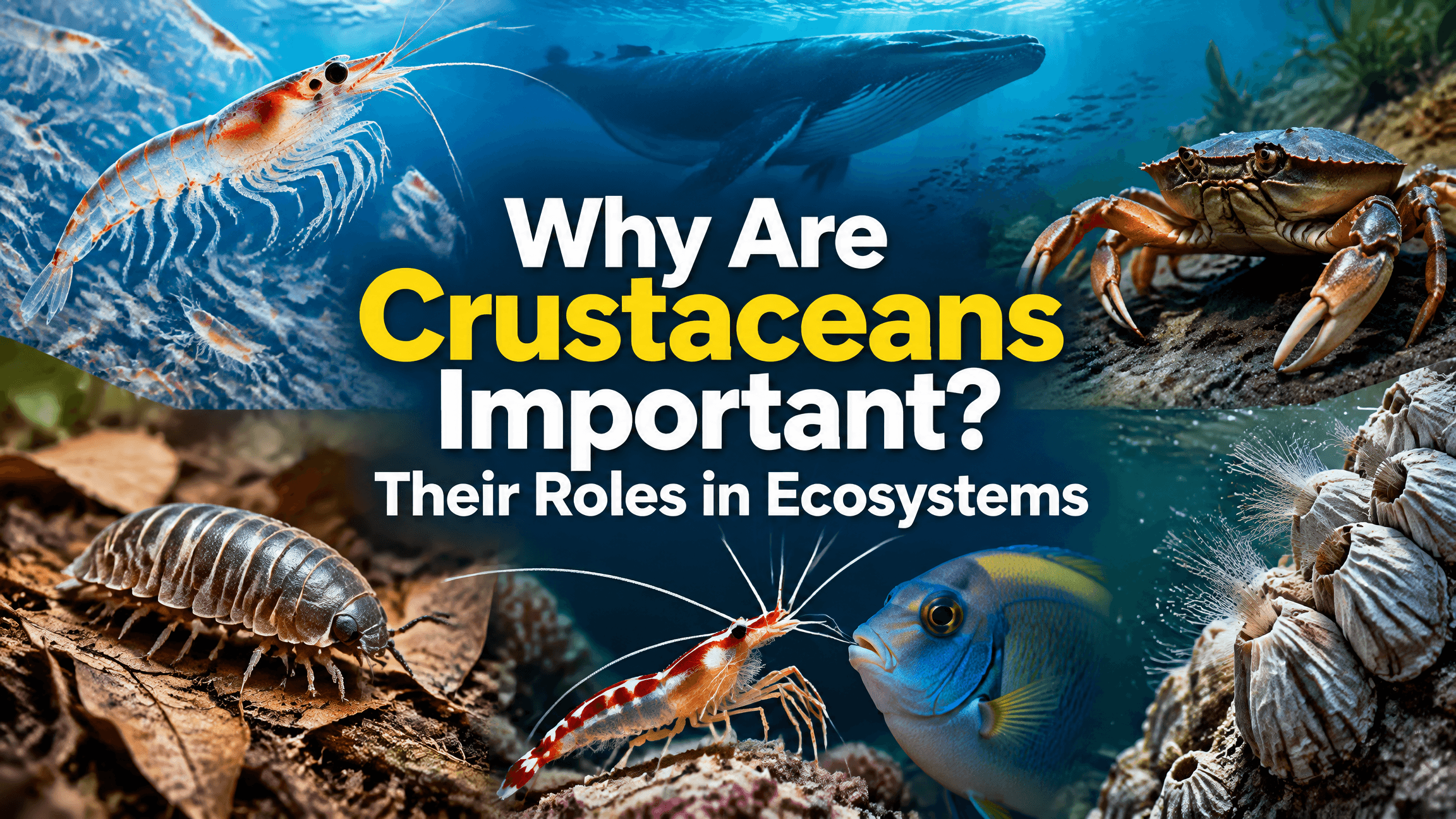
Crustaceans matter because they move energy, nutrients, and organic material through ecosystems in many different ways. Some graze on microscopic algae, some hunt other animals, some break down dead material, some filter particles from water, some disturb and rework sediment, and many become food for fish, birds, marine mammals, reptiles, and other invertebrates. Their ecological importance comes from this diversity, not from one universal role.
A copepod drifting through the ocean, a krill swarm in polar water, a crab digging in an estuary, a woodlouse feeding in leaf litter, and a cleaner shrimp interacting with reef fish can all influence ecosystems in very different ways. Understanding those roles helps explain why crustaceans are more than familiar seafood species. They are woven into food webs from forest floors and freshwater ponds to estuaries, coral reefs, the open ocean, and the deep sea.
Quick Answer

Crustaceans are important because they participate in many ecological processes at once. They can transfer energy from algae and microorganisms to larger predators, recycle organic matter, graze on plants and biofilms, filter suspended particles, disturb sediment, support symbiotic relationships, and serve as prey across multiple trophic levels. For the broader biological context behind these ecosystem roles, see the crustacean overview.
The importance of a particular crustacean depends on the ecosystem and species involved. Copepods can be major links between microscopic producers and larger consumers. Krill can become concentrated prey for whales, seals, penguins, fish, and seabirds in certain marine systems. Terrestrial isopods help fragment and process plant litter. Burrowing crabs can alter sediment structure. Cleaner shrimp can participate in specialized interactions with reef fishes. These are different ecological jobs, not different versions of the same one.
Crustaceans Help Move Energy Through Food Webs
Small crustaceans can connect microscopic producers to larger animals
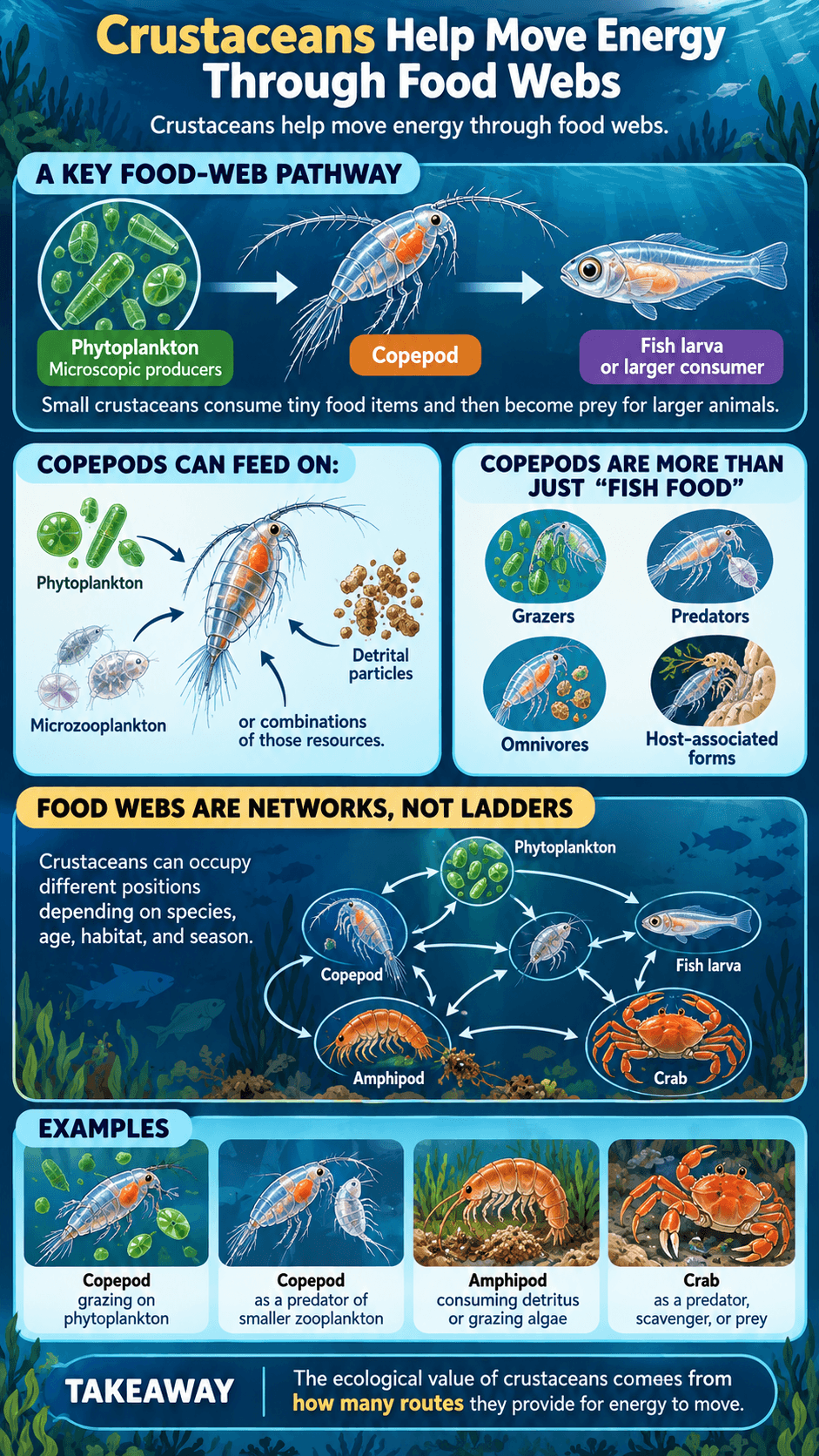
Many aquatic food webs depend heavily on small crustaceans because these animals can consume tiny food items and then become prey for larger animals. Copepods are a clear example. Many free-living copepods feed on phytoplankton, microzooplankton, detrital particles, or combinations of those resources. Fish larvae and other predators can then consume the copepods, transferring that energy farther through the food web.
The Smithsonian National Museum of Natural History describes copepods as exceptionally diverse aquatic crustaceans and notes that they can link microscopic algal cells with juvenile fish and even much larger consumers. Smithsonian’s copepod research overview also emphasizes that copepods include free-living, symbiotic, and parasitic forms, so their ecological roles extend far beyond one simple feeding relationship.
This is why calling copepods merely “fish food” misses most of the story. Some are grazers, others predators, others omnivores, and some live in association with hosts. Their importance lies in how frequently they connect microbial, planktonic, benthic, and higher-consumer processes in water.
Food webs are networks, not ladders
It is tempting to describe one abundant crustacean as “the base of the food chain,” but real food webs are more complicated. Producers, microbes, grazers, predators, parasites, detritivores, and scavengers interact in networks with many alternative pathways. Crustaceans may occupy different positions in those networks depending on species, age, habitat, and season.
A copepod can graze on phytoplankton and later be eaten by a larval fish. Another copepod may prey on smaller zooplankton. An amphipod may consume detritus in one habitat and graze algae in another. A crab may function as predator, scavenger, herbivore, deposit feeder, or prey. The ecological value of crustaceans therefore comes partly from how many routes they provide for energy to move.
Copepods Are Major Players in Aquatic Ecosystems
Grazing, predation, and nutrient transfer
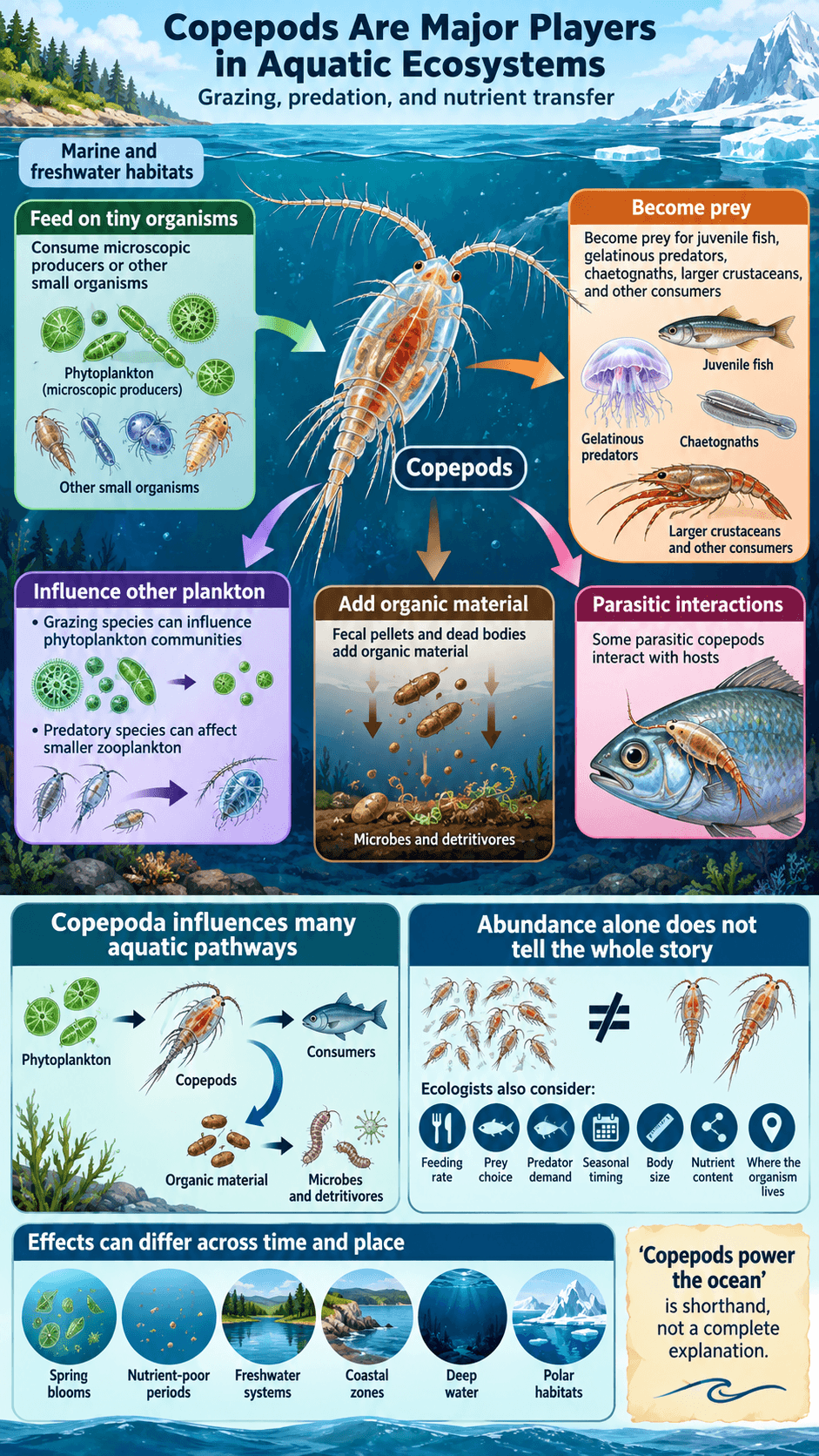
Copepods occur in marine and freshwater habitats around the world. In planktonic systems, many species consume microscopic producers or other small organisms and package that energy into bodies large enough for juvenile fish, gelatinous predators, chaetognaths, larger crustaceans, and other consumers to eat.
Because copepods are diverse, their ecological effects vary. Grazing species can influence phytoplankton communities. Predatory species can affect smaller zooplankton. Their fecal pellets and dead bodies contribute organic material that may sink or be consumed by microbes and detritivores. Parasitic copepods interact with hosts in entirely different ways.
The useful point is not that every copepod performs every role. It is that Copepoda contains enough ecological diversity and abundance to influence many aquatic pathways simultaneously.
Why abundance alone does not tell the whole story
A species can be numerous without being equally important in every process, and a less abundant species can still have a strong local effect. Ecologists therefore look at more than head counts. They consider feeding rate, prey choice, predator demand, seasonal timing, body size, nutrient content, and where an organism lives in the water column or on the bottom.
For copepods, this means their effect can change between spring blooms, nutrient-poor periods, freshwater systems, coastal zones, deep water, and polar habitats. Any simple statement that “copepods power the ocean” should be treated as shorthand rather than a complete ecological explanation.
Krill Can Concentrate Energy for Large Predators
Why krill are so important in some marine systems
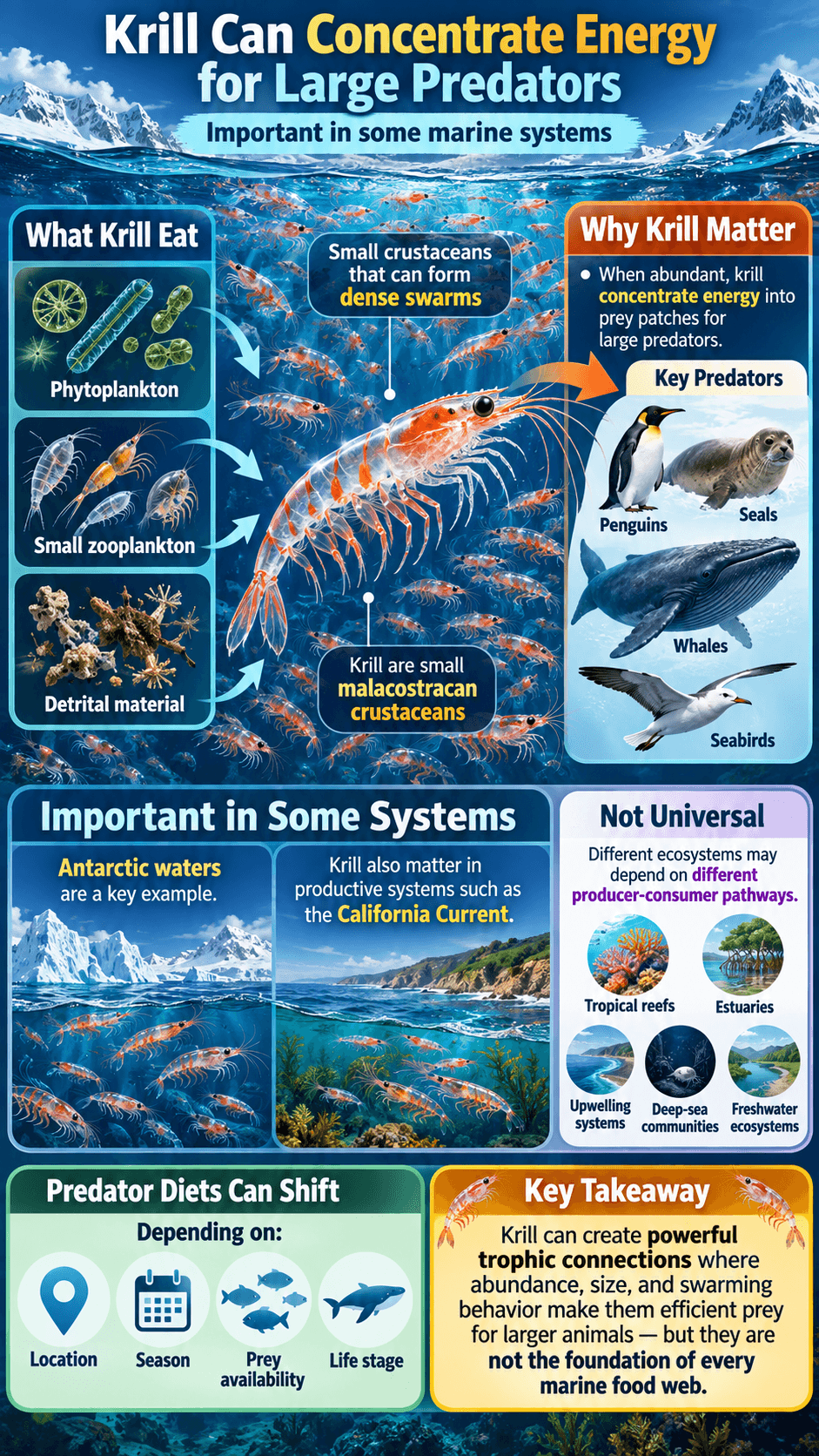
Krill are small malacostracan crustaceans that can occur in dense aggregations. They feed on resources such as phytoplankton and, depending on species and conditions, can also consume small zooplankton and detrital material. When krill become abundant, they can concentrate energy into prey patches that are valuable to large predators.
NOAA Fisheries notes that Antarctic krill are a significant food source for penguins, seals, whales, and seabirds and that krill research is closely tied to understanding predator demand and climate variability. NOAA Fisheries’ Antarctic krill research program highlights this predator-prey relationship without implying that every marine ecosystem depends on krill in the same way.
Krill are important, but not universally dominant
The strongest krill examples come from ecosystems where particular euphausiid species become abundant and are heavily used by predators. Antarctic waters are especially well known, but krill also matter in productive systems such as the California Current.
That does not justify saying krill are the universal foundation of ocean food webs. Tropical reefs, coastal estuaries, upwelling systems, deep-sea communities, and freshwater ecosystems may depend on very different combinations of producers and consumers. Even in krill-rich systems, predator diets can shift with location, season, prey availability, and life stage.
The more accurate lesson is that krill can create powerful trophic connections where their abundance, size, and swarming behavior make them efficient prey for larger animals.
Crustaceans Recycle Dead Organic Material
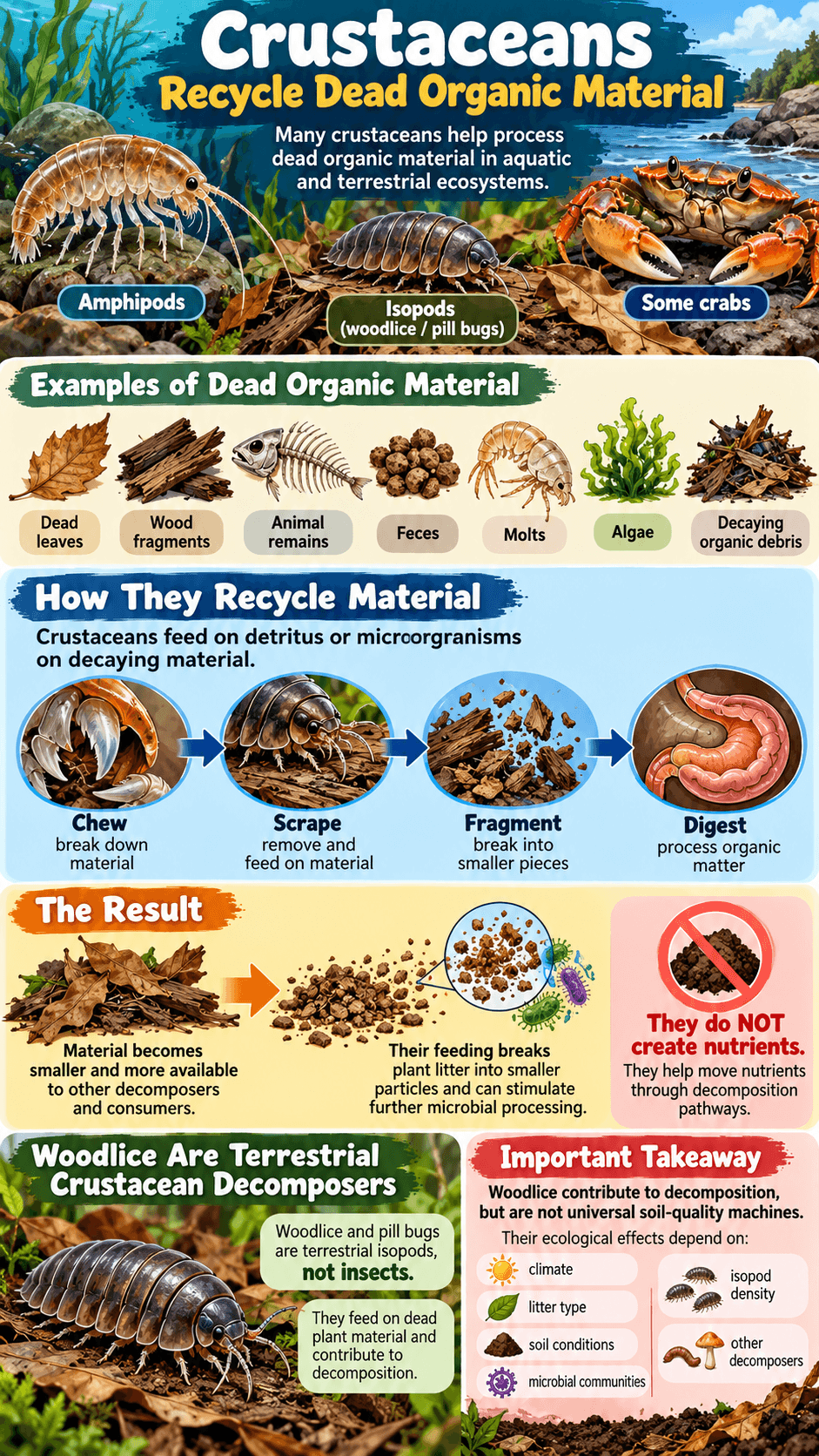
Detritivores turn litter and debris into smaller, reusable material
Dead leaves, wood fragments, animal remains, feces, molts, algae, and other organic material do not disappear on their own. They are processed by fungi, bacteria, and detritivorous animals. Many crustaceans participate in this recycling network.
Amphipods, isopods, some crabs, and other crustaceans can feed on detritus or on microorganisms growing on decaying material. By chewing, scraping, fragmenting, and digesting organic matter, they change its physical form and make it available to other decomposers and consumers.
This does not mean crustaceans “create nutrients.” Instead, their feeding can help move nutrients through decomposition pathways that release or redistribute elements already present in organic matter.
Woodlice are terrestrial crustacean decomposers
Woodlice and pill bugs are terrestrial isopods, not insects. Many feed heavily on decaying plant litter and the microbial community associated with it. Their feeding breaks plant material into smaller particles and can stimulate further microbial processing.
A review indexed by PubMed describes terrestrial isopods as important participants in decomposition through the mechanical and chemical breakdown of plant litter and through effects on microbial activity. The review of nutrition in terrestrial isopods also explains how their feeding ecology contributes to nutrient recycling in terrestrial environments.
It is still better to avoid saying every woodlouse “improves soil.” Ecological effects depend on climate, litter type, soil conditions, microbial communities, isopod density, and other decomposers. Woodlice are contributors to decomposition, not universal soil-quality machines.
Burrowing Crustaceans Can Reshape Sediments
What bioturbation means
Bioturbation is the movement and mixing of sediment by living organisms. Crustaceans contribute to it when they dig burrows, feed in sediment, transport particles, ventilate tunnels, or repeatedly move between the surface and deeper layers.
This physical activity can alter oxygen penetration, particle distribution, microbial conditions, and the location of organic matter. It can also influence how water moves through sediment and how other organisms use the habitat.
The University of Texas Marine Science Institute describes burrowing animals, including crustaceans such as fiddler crabs, as organisms that can move sediments and alter benthic conditions. The institute’s explanation of bioturbation illustrates how repeated digging can affect ecological processes well beyond the animal’s body.
Not every burrowing crab is automatically an ecosystem engineer
The term ecosystem engineer is useful when an organism physically changes habitat in ways that alter resources or conditions for other species. Some burrowing crabs clearly fit that description in particular systems. But the label should not be applied automatically to every crab that makes a hole.
The size, density, persistence, and structure of burrows matter. So do sediment type, tidal conditions, plant cover, and the presence of other burrowers. One species may strongly alter mudflat drainage or marsh sediment, while another may produce only localized effects.
For readers, the important idea is that locomotion and feeding can have physical ecosystem consequences. A crab is not just using sediment. It may also be rearranging it.
Suspension Feeders and Deposit Feeders Process Particles
Filtering suspended material from water
Many familiar barnacles use feathery thoracic appendages called cirri to capture suspended food particles from water. Some other crustaceans also suspension-feed. This feeding strategy transfers small plankton and suspended organic particles into animal biomass and waste products that enter other ecological pathways.
Suspension feeding can be especially important where currents continually deliver food. Because attached barnacles cannot chase prey, their feeding structures and position in flowing water become central to how they obtain energy.
Not all barnacle lineages feed this way. Highly modified parasitic thecostracans are major exceptions, which is another reason to avoid treating the familiar acorn barnacle as a model for every barnacle relative.
Deposit feeding links sediment organic matter to animals
Deposit feeders consume organic material associated with mud, sand, or detritus. Crustaceans that use this strategy may ingest sediment and select or digest the organic fraction, or they may pick particles from the surface.
The Smithsonian Environmental Research Center notes that benthic communities contain both suspension feeders that process particles from the water column and deposit feeders that consume organic matter on or in sediment. Smithsonian’s overview of benthic invertebrate communities shows how these feeding modes connect animals with sediment and water-column processes.
Crustaceans Are Prey for Many Other Animals
Fish, birds, mammals, and invertebrates depend on crustacean prey
Crustaceans are eaten by a remarkably wide range of predators. Fish consume copepods, amphipods, shrimp, krill, crabs, and other crustaceans. Seabirds take krill and larger crustaceans. Whales and seals can rely heavily on krill in some regions. Shorebirds eat small crustaceans in tidal habitats. Octopuses and other invertebrate predators feed on crabs, shrimp, and related animals.
This prey role can matter at several scales. Tiny copepods may support larval fish. Medium-sized amphipods and mysids can support juvenile and adult fish. Large crabs or lobsters may become prey for fish, octopuses, marine mammals, or seabirds. The crustacean body-size spectrum therefore creates feeding opportunities for predators of very different sizes.
Prey value depends on timing and place
Predators do not need crustaceans in the same way everywhere. A seabird colony may rely strongly on one seasonal prey pulse, while the same prey species is less important elsewhere. A fish may eat copepods when young and switch to larger prey as it grows. A whale may track dense krill patches but use other prey in a different region. The strength of these roles changes with the conditions and resources available across crustacean habitats.
This variation is why broad claims about dependence should be tied to a particular ecosystem, predator, and season whenever possible.
Cleaning Symbioses Add Another Ecological Role
Cleaner shrimp and client fishes
Some shrimp participate in cleaning interactions in which fish visit a cleaner and allow it to remove ectoparasites, mucus, dead tissue, or other material. These interactions can involve signaling and repeated use of cleaning stations.
A major review of cleaner fishes and shrimp identified dozens of shrimp species associated with cleaning behavior while also warning that the label “cleaner shrimp” has sometimes been applied too broadly. The James Cook University review of cleaning symbioses stresses that cleaning behavior should be demonstrated rather than assumed from a species name or aquarium reputation.
This caution matters. Some shrimp are dedicated cleaners, some may clean opportunistically, and others may be called cleaners without strong field evidence. Cleaning is therefore a specialized ecological role within Crustacea, not a general shrimp behavior.
Symbiosis can influence animal behavior as well as feeding
Cleaning interactions are interesting because they connect feeding ecology with communication and movement. Client fish may approach particular sites, adopt postures that signal willingness to be cleaned, and repeatedly visit successful cleaning stations. The shrimp receives food while the fish may lose parasites or damaged tissue.
The ecological consequences can extend beyond one feeding event, but their strength depends on species and community context. It is safer to describe cleaning as one type of interaction within reef communities than to claim cleaner shrimp universally “keep reefs healthy.”
Crustaceans Also Function as Predators, Grazers, and Parasites
Predatory crustaceans can influence prey communities
Many crustaceans actively hunt. Predatory crabs can take mollusks, worms, other crustaceans, and small vertebrates. Some copepods prey on other zooplankton. Mantis shrimps are specialized predators. Amphipods and isopods include predatory species as well.
Predation can influence which prey survive, where they forage, and how they use habitat. The ecological strength of that effect depends on predator abundance, prey availability, and the presence of competing predators.
Grazers can affect algae and biofilms
Crustacean grazers consume algae, microbes, and biofilms from surfaces or from the water column. Copepod grazing on phytoplankton is one example. Amphipods, isopods, shrimp, and crabs can graze algae or plant material in other settings.
Grazing can redirect primary production into animal biomass, influence the abundance of particular algae, and create food for predators. But again, the direction and size of the effect depend on species and environment.
Parasitic crustaceans are part of ecosystem networks too
Parasitism is also widespread within Crustacea. Copepods, isopods, branchiurans, rhizocephalan barnacles, and other groups include parasites of fish and invertebrates.
Parasites are often discussed only as harmful organisms, but ecologically they participate in food webs, host population dynamics, energy transfer, and species interactions. Their presence can alter host behavior, growth, reproduction, or vulnerability to predators. These effects vary strongly among parasite-host systems, so broad generalizations should be avoided.
Why Crustacean Diversity Matters for Ecosystem Function
Different body plans create different ecological jobs
Crustaceans occupy so many ecological roles partly because their appendages and body plans are highly modifiable. The same broad arthropod framework can produce a swimming copepod, a burrowing crab, a suspension-feeding barnacle, a terrestrial detritivorous isopod, or a predatory stomatopod.
Those body differences change what food an animal can capture, where it can live, how it moves, and what other organisms can eat it. Ecological diversity therefore grows from anatomical and behavioral diversity.
Microscopic and inconspicuous species can matter as much as familiar ones
Crabs, shrimp, and lobsters are the crustaceans most people recognize, but many major ecosystem processes involve smaller animals. Copepods, amphipods, ostracods, branchiopods, and tiny isopods can be abundant in plankton, sediments, freshwater, groundwater, or litter.
Ignoring those small species would distort the picture. A crustacean does not need to be large, commercially valuable, or visually dramatic to influence food webs or decomposition.
Human Importance Is Real but Different From Ecological Importance
Crustaceans support fisheries, aquaculture, tourism, scientific research, and food economies. Those human values are significant, but they are not the same question as ecological importance. Understanding these ecosystem roles also helps explain why crustacean conservation is species- and habitat-specific.
A lobster population can have market value and ecological value at the same time. Krill can be harvested while also serving as prey for wildlife. Shrimp fisheries can matter economically while shrimp themselves function as predators, scavengers, grazers, or prey within ecosystems.
Keeping those ideas separate helps prevent the article from reducing crustaceans to resources for people. Their ecosystem roles exist whether or not humans harvest them.
Common Misunderstandings About Crustacean Ecology
Crustaceans are not just scavengers
Scavenging is common in some groups, but crustaceans also include grazers, predators, suspension feeders, deposit feeders, parasites, detritivores, and omnivores. No single feeding strategy represents the whole group.
Krill are not the foundation of every ocean food web
Krill can be extremely important in particular marine systems, especially where they form dense aggregations used by large predators. Other ecosystems rely more heavily on copepods, fish larvae, gelatinous plankton, benthic prey, or other pathways.
Every burrowing crab is not automatically an ecosystem engineer
Burrowing can alter sediments, but the term ecosystem engineer should be reserved for cases where physical modification meaningfully changes habitat or resource conditions for other organisms.
Every woodlouse does not automatically improve soil
Terrestrial isopods contribute to litter processing and nutrient recycling, but ecosystem outcomes depend on litter, climate, microbial communities, density, and interactions with other decomposers.
FAQ
Why are copepods important?
Copepods are important because many species connect microscopic food resources with larger consumers. They can graze phytoplankton, eat other zooplankton, become prey for fish and larger invertebrates, contribute organic particles, and participate in symbiotic or parasitic relationships. Their role varies widely among species and habitats.
Why are krill important to whales and penguins?
In some marine ecosystems, krill form dense, energy-rich aggregations that large predators can exploit efficiently. Antarctic krill are especially important prey for several whales, seals, penguins, fish, and seabirds. That importance is strongest in systems where krill are abundant and available at the right time and place.
How do pill bugs help ecosystems?
Pill bugs are terrestrial isopod crustaceans that often feed on decaying plant material. By fragmenting litter and interacting with microbes during digestion and decomposition, they contribute to the recycling of organic matter and nutrients. Their effect varies with habitat and environmental conditions.
Do crabs help the environment?
Some crabs have strong ecological effects as predators, grazers, scavengers, prey, or burrowers. Burrowing species can mix sediment and alter local physical conditions, while other crabs may influence prey or vegetation. The effect depends on the species and ecosystem, so there is no single ecological role shared by all crabs.
Final Thoughts
Crustaceans are important because they occupy many positions in ecological networks. They transfer energy from microscopic producers to predators, recycle dead organic matter, graze algae, filter particles, rework sediment, support specialized symbioses, act as parasites and predators, and provide food for animals ranging from larval fish to whales.
The strongest lesson is that ecological importance is context-dependent. Copepods, krill, woodlice, crabs, shrimp, barnacles, amphipods, isopods, and other crustaceans do not perform the same job, and no single species represents the group. Their collective importance comes from the enormous range of ways they interact with food, habitat, nutrients, predators, prey, hosts, and the physical environment.

Ethan Walker is the founder and research editor of Animal Fact Central. He creates and reviews educational animal facts content using trusted wildlife, pet care, and science-based sources. His work focuses on making animal behavior, adaptations, habitats, and species facts clear, accurate, and engaging for everyday readers.
Read More Details About Ethan Walker: https://animalfactcentral.com/ethan-walker/