
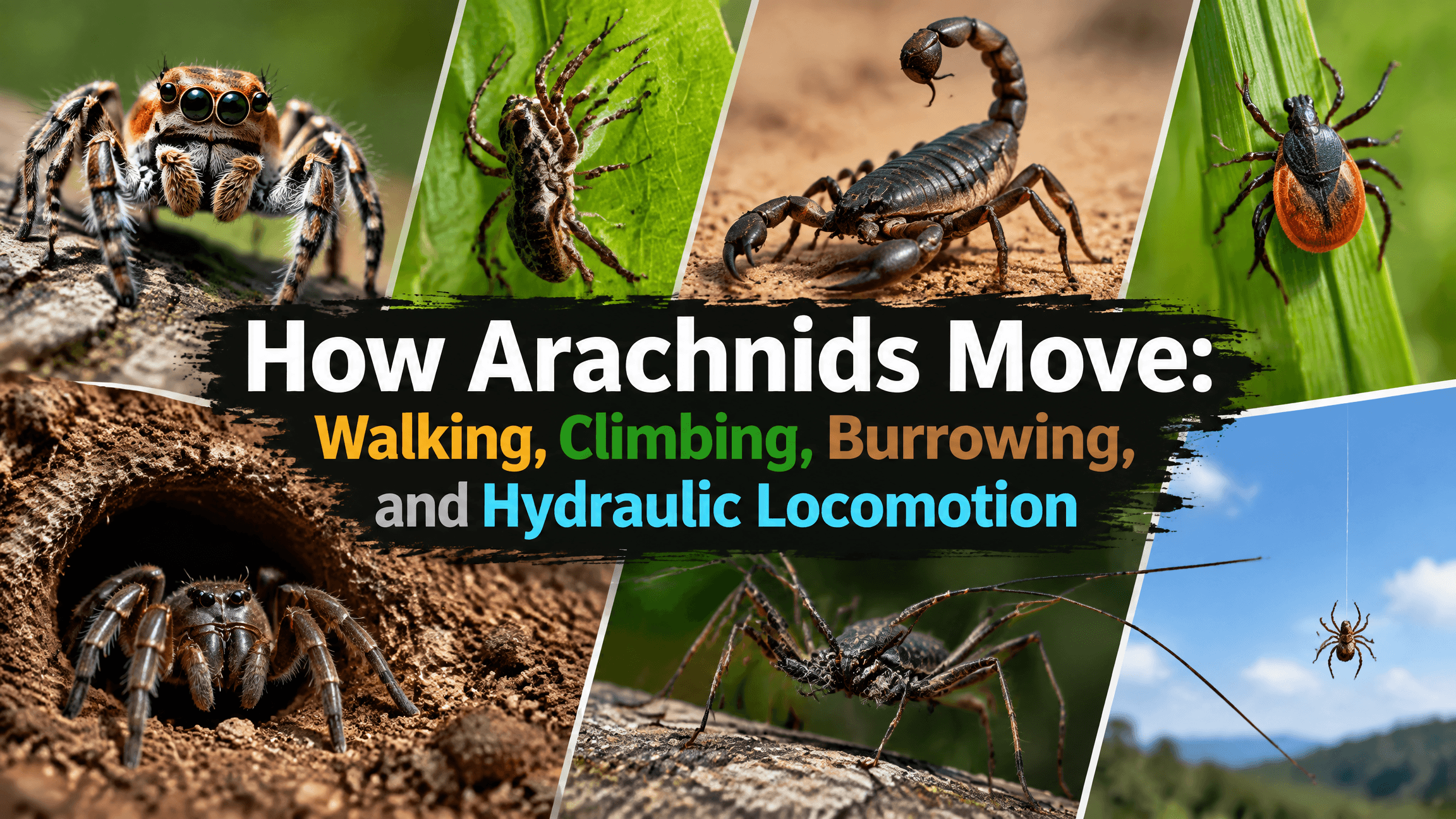
Arachnids move in far more ways than the familiar eight-legged walk. Spiders run, climb, jump, burrow, and sometimes travel through the air on silk. Scorpions cross loose soil and shelter in burrows. Harvestmen step across uneven ground on long legs. Ticks climb vegetation and wait for passing hosts. Mites can crawl through soil, plants, animal surfaces, and even aquatic habitats. Tailless whip spiders use only three leg pairs as their main walking legs because the first pair has become highly specialized for sensing.
There is also no single “arachnid locomotion system.” The famous hydraulic mechanism of spider legs is real, but it is a spider specialization and even spiders combine hydraulic pressure with muscular forces. Other arachnid groups rely on their own combinations of muscles, joints, claws, sensory structures, body posture, and substrate contact. Understanding how arachnids move means looking at both the shared jointed-limb framework and the many ways each lineage has modified it.
Quick Answer
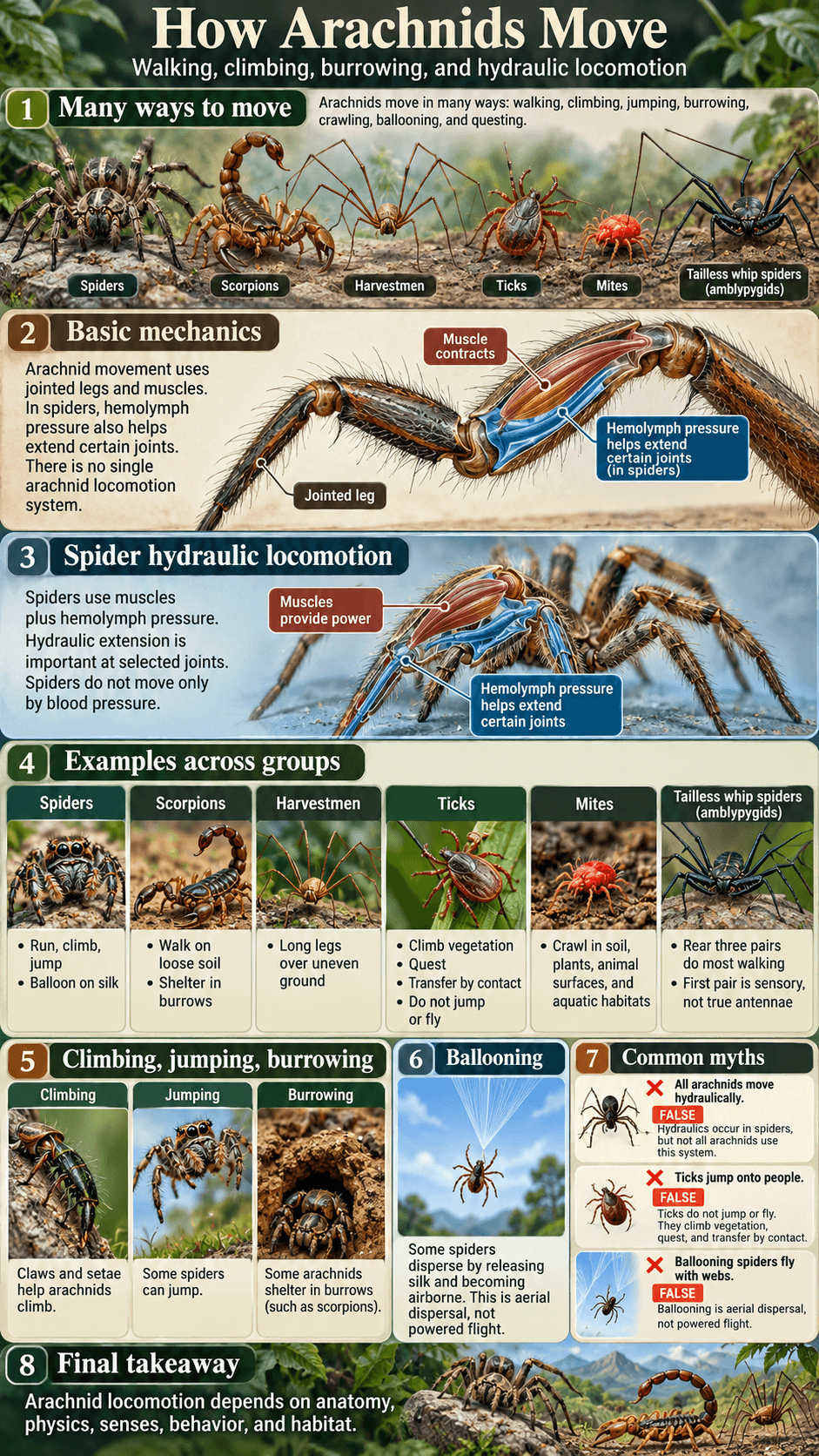
Most arachnids move by coordinating several pairs of jointed legs, but the details vary greatly among groups. Spiders use muscles plus hemolymph pressure to extend certain leg joints. Scorpions and harvestmen use different musculoskeletal mechanics. Some spiders climb using claws and microscopic adhesive hairs, some jump, some burrow, and some disperse by ballooning on silk. Ticks generally crawl rather than jump or fly, and many species climb vegetation before entering a questing posture and transferring to a passing host. These movement strategies are another example of how widely arachnid biology has diversified across different lineages.
The main lesson is that movement reflects anatomy, habitat, and behavior. A fast-running solifuge, a web-bound spider, a soil mite, and a host-seeking tick face very different mechanical problems even though they are all arachnids.
The Basic Mechanics of Arachnid Locomotion
Jointed appendages, muscles, and hemolymph
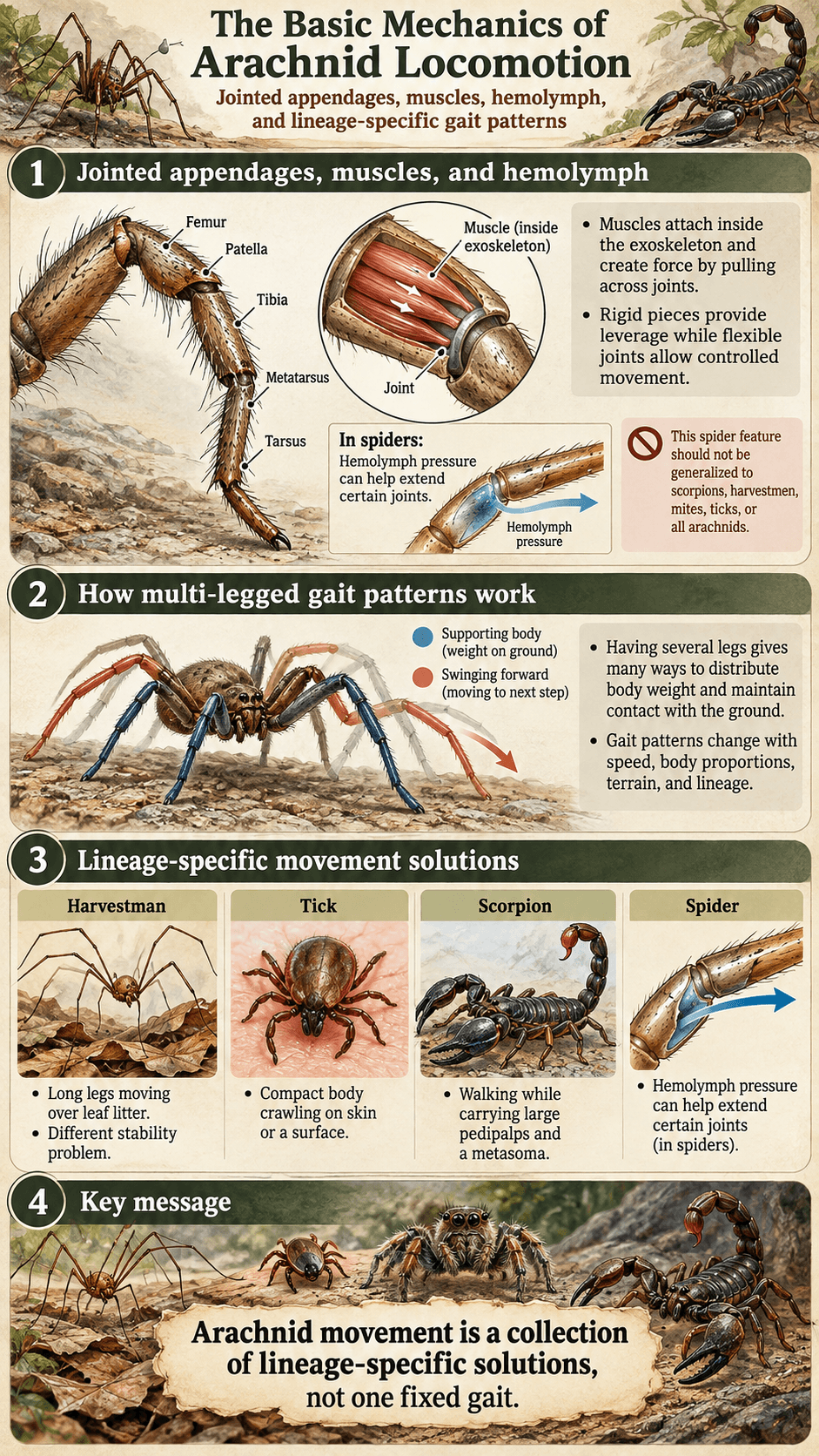
Arachnid legs are divided into articulated segments connected by joints. Muscles attach inside the exoskeleton and create force by pulling across those joints. The exact segment names and joint mechanics vary among arachnid groups, but the principle is similar to other arthropods: rigid pieces provide leverage while flexible joints allow controlled movement.
Hemolymph, the circulating fluid of arthropods, also matters mechanically in spiders. Pressure changes can help extend certain joints that lack direct extensor muscles. That feature has made spider locomotion famous, but it should not be generalized to scorpions, harvestmen, mites, ticks, or all other arachnids.
Why multi-legged gait patterns vary by lineage
Having several legs gives an arachnid many possible ways to distribute body weight and maintain contact with the ground. At any moment, some legs support the body while others swing forward. The exact pattern changes with speed, body proportions, terrain, and lineage.
A long-legged harvestman moving over leaf litter does not face the same stability problem as a compact tick crawling on skin or a scorpion carrying a large pair of pedipalps and a metasoma. Arachnid movement is therefore better understood as a collection of lineage-specific solutions than as one fixed gait.
Walking and Running
Spiders, scorpions, harvestmen, solifuges, and mites
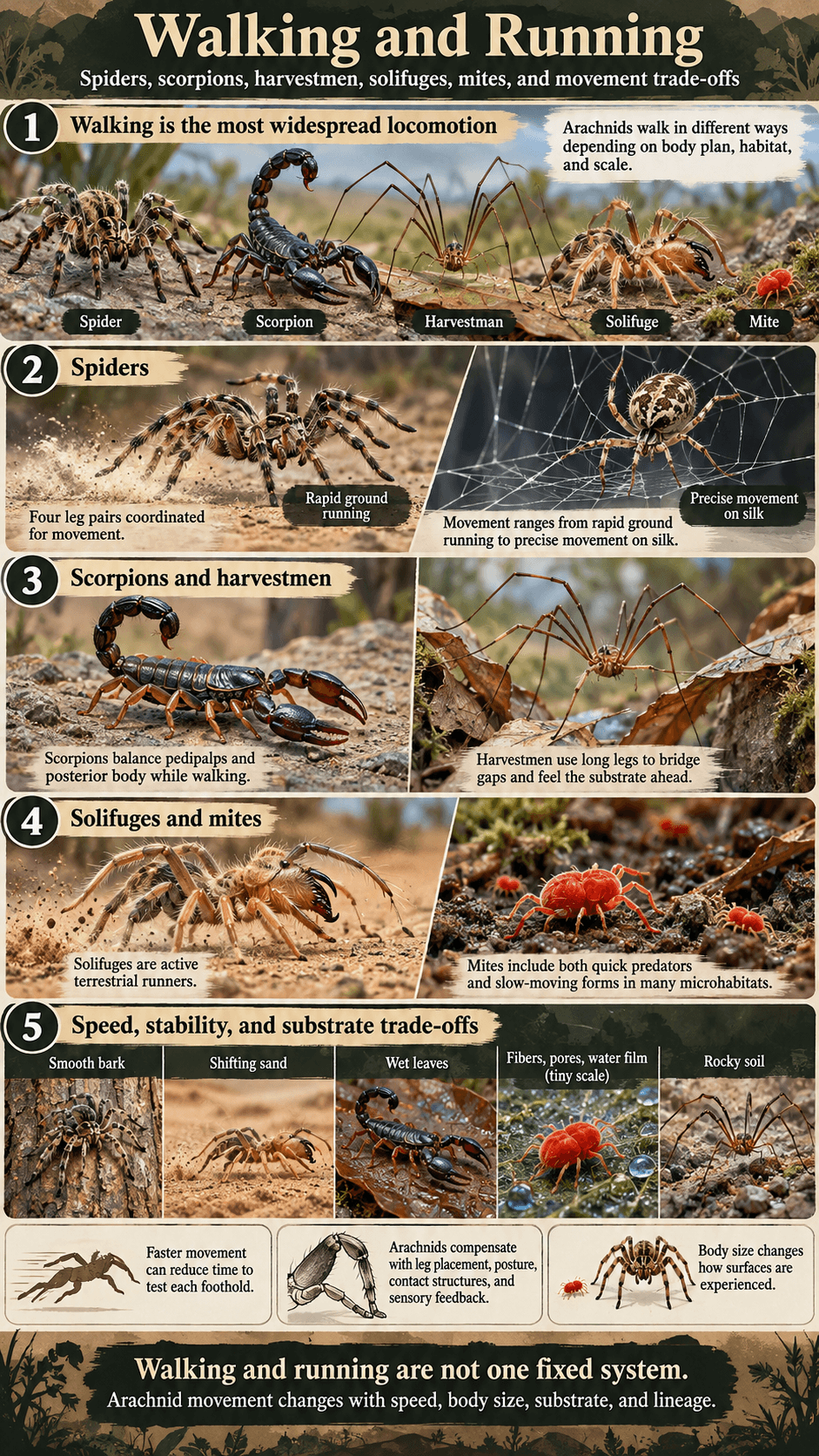
Walking is the most widespread form of arachnid locomotion. Spiders coordinate four leg pairs, but different species range from slow web-associated movement to rapid ground running. Wolf spiders and many other active hunters can cross open ground quickly, while web builders often move with great precision across silk structures where a misplaced step could alter tension or vibration.
Scorpions usually walk with the body held above the substrate, balancing the mass of the pedipalps and posterior body while navigating soil, rock, bark, or litter. Harvestmen often use long legs to bridge gaps and feel the substrate ahead. Solifuges are active terrestrial runners with a body plan built around rapid movement and large chelicerae. Mites include both quick predators and slow-moving forms adapted to soil, plants, hosts, or other microhabitats.
Speed, stability, and substrate trade-offs
Moving faster can reduce the amount of time available to test each foothold. It can also increase the risk of slipping or losing stability on loose surfaces. Arachnids compensate through leg placement, posture, contact structures, and sensory feedback.
Body size matters too. Tiny mites experience surfaces as landscapes of fibers, pores, hairs, and water films. Larger spiders or scorpions interact with rocks, soil particles, bark, and vegetation at a different scale. A movement strategy that works well on smooth tree bark may perform poorly on shifting sand or wet leaves.
Spider Hydraulic Locomotion Explained Carefully

Hemolymph-pressure-assisted extension at selected joints
Spiders are unusual because several important leg joints lack the direct extensor muscles that many people would expect. Instead, increased pressure in the prosoma and legs helps extend those joints. Classic experiments established that spider leg pressure can generate extension torque, and later studies have refined how that mechanism contributes during real movement.
A Journal of Experimental Biology study of spider locomotion showed that hydraulic extension remains important but does not necessarily provide the main propulsive drive in large spiders during rapid movement. In the species studied, muscular forces at proximal joints contributed strongly to acceleration.
Why spiders still use muscles
The viral version of spider biomechanics often says that spiders “have no leg extensor muscles” and therefore move entirely by blood pressure. That wording is too broad. Some distal leg joints lack direct extensor muscles and rely strongly on hydraulic pressure, while more proximal joints have muscular control.
Flexor muscles also remain essential. They bend joints, control leg position, generate forces against the substrate, and work with the hydraulic system. A moving spider is therefore not a set of passive hydraulic tubes. It is a mechanically integrated animal using muscles, pressure, joint geometry, sensory feedback, and elastic properties together.
Why hydraulic extension is not a universal arachnid system
The presence of a striking mechanism in spiders does not make it an arachnid-wide rule. Scorpions, harvestmen, mites, ticks, pseudoscorpions, and other groups have different joint structures and locomotor mechanics. They use hemolymph as part of an open circulatory system, but that does not mean they all extend their walking legs with the spider-style hydraulic system.
That distinction matters because “arachnids move hydraulically” sounds simple but teaches the wrong biological pattern. A more accurate statement is that spiders have evolved an especially important pressure-assisted mechanism for extending certain leg joints.
Climbing
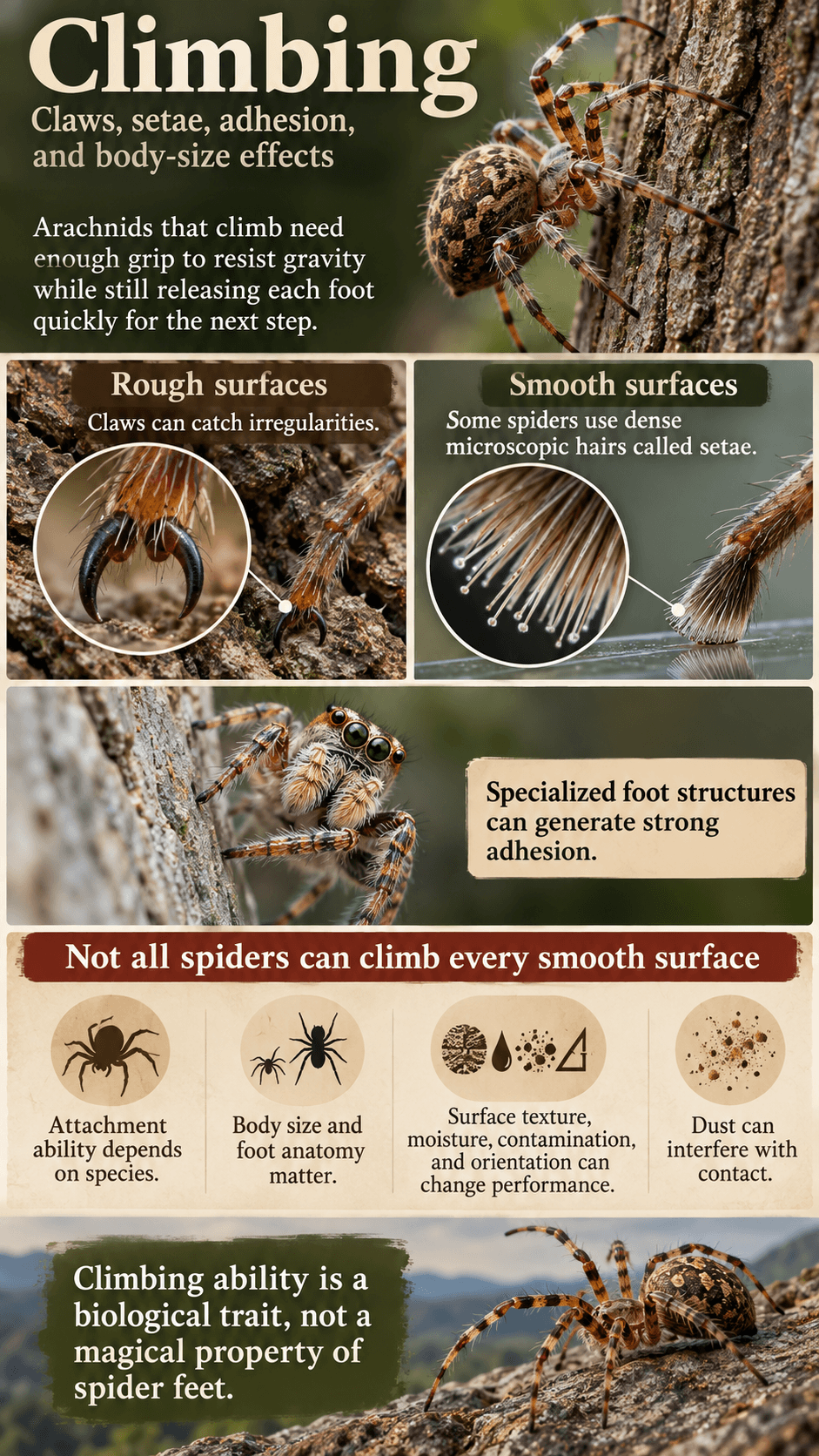
Claws, setae, adhesion, and body-size effects
Arachnids that climb must create enough grip to resist gravity while still being able to release each foot rapidly for the next step. On rough surfaces, claws can catch irregularities. On smoother surfaces, some spiders use dense fields of microscopic hairs called setae that divide contact among many tiny tips.
Experiments on the jumping spider Evarcha arcuata found that its feet use claws on rough substrates and adhesive hair structures on smooth surfaces. The Journal of Experimental Biology study on spider attachment demonstrates how specialized foot structures can generate strong adhesion without implying that every spider uses the same arrangement.
Why not all spiders can climb every smooth surface
“Spiders can climb glass” is not a universal rule. Attachment ability depends on species, body size, foot anatomy, surface texture, contamination, moisture, and orientation. A spider adapted to running across soil may have very different attachment structures from a species that regularly moves over smooth leaves.
Even species with adhesive setae face limits. Dust can interfere with contact, steep or inverted surfaces impose different loads, and very large body mass changes the forces that the feet must resist. Climbing ability is a biological trait, not a magical property of spider feet.
Jumping and Rapid Launches
Jumping spiders as a familiar example
Jumping spiders are the best-known arachnid jumpers. They can launch from one surface to another while controlling body orientation and landing position. Vision is especially important in many jumping spiders because they use it to judge prey, rivals, mates, and routes through complex vegetation.
Hydraulic extension contributes to spider leg movements, but jumping should not be reduced to a single pressure pulse. Leg posture, muscular forces, body size, takeoff angle, and species-specific mechanics all affect a jump. Different spiders also use different combinations of legs during rapid launches.
Why record-style jump-distance claims need context
Statements such as “a jumping spider can jump X times its body length” often circulate without naming a species or explaining how the measurement was made. Those numbers can vary with body size, motivation, surface, takeoff direction, and experimental method.
For a useful biological explanation, it is better to focus on what jumping accomplishes. A controlled leap can help a spider cross gaps, approach prey, evade a threat, or move efficiently through vegetation without requiring a continuous silk bridge.
Burrowing and Digging
Scorpions, trapdoor spiders, solifuges, mites, and other examples
Burrowing is common in arachnids that need shelter from temperature extremes, dry air, predators, or daytime exposure. Many scorpions excavate or occupy retreats in soil. Trapdoor spiders can construct silk-lined burrows. Some solifuges dig shelters for resting or reproduction. Soil mites move through spaces between particles and organic debris at a much smaller scale.
Digging structures differ by lineage. Spiders may use chelicerae and legs to loosen or move material, while scorpions can use legs and pedipalps in excavation. Small arachnids often exploit existing pore spaces rather than producing a conspicuous tunnel.
Temporary shelters versus permanent burrows
Not every burrowing arachnid builds a long-term home. A shallow scrape used for daytime shelter is different from a maintained burrow used repeatedly for feeding, molting, mating, or raising young. Some species modify natural crevices instead of excavating from scratch. Running, questing, burrowing, jumping, and retreat use are also part of the wider range of arachnid behavior.
That distinction matters in habitat ecology. A permanent burrow can stabilize temperature and humidity around the animal, while temporary digging may simply provide short-term protection during heat, dryness, or inactivity.
Silk-Assisted Movement and Ballooning
Spiderlings and small spiders becoming airborne
Some spiders use silk for aerial dispersal in a behavior called ballooning. A spider climbs to an exposed point, raises its abdomen, releases silk, and can become airborne when environmental forces lift or carry the silk and body. Ballooning is especially associated with small spiders and spiderlings, although larger individuals can also show aerial dispersal behavior under some conditions.
This movement can carry spiders away from crowded or unsuitable sites and help them colonize new habitat patches. The animal has no wings and does not generate powered flight. Its role is mainly to choose when to release silk and respond to conditions that make takeoff possible.
Why ballooning is not powered flight
A bird or insect in powered flight generates aerodynamic force through active wing movements. A ballooning spider does not. Its silk interacts with moving air and other physical forces, allowing the spider to become suspended and transported.
Because the spider cannot steer like a flying insect, wind and atmospheric conditions strongly influence where it goes. Silk length, body mass, posture, and local airflow also affect the mechanics. Calling this “flying with a web” may be memorable, but it hides the passive-dispersal nature of the behavior.
Wind and electric-field evidence without claiming one universal mechanism
Air movement has long been central to explanations of ballooning, but research has also shown that atmospheric electric fields can influence the behavior. Experiments published in Current Biology found that naturally relevant electric-field strengths could trigger ballooning behavior and that mechanosensory hairs responded to electric fields.
The Current Biology research on electric fields and spider ballooning supports atmospheric electricity as an additional factor, not a reason to discard aerodynamic effects. Ballooning should therefore be explained as a behavior shaped by several physical and environmental conditions rather than by one universal force.
Sensory-Leg Probing and Specialized Appendage Use
Amblypygi antenniform legs
Tailless whip spiders, or amblypygids, provide one of the clearest examples of a leg pair being repurposed away from ordinary locomotion. Their first legs are extremely long, thin, and flexible. These antenniform legs sweep and probe the surroundings and carry large numbers of sensory receptors.
The American Arachnological Society’s Amblypygi profile notes that only the rear three pairs function as the main walking legs. The sensory first pair behaves somewhat like insect antennae in function, but they are still modified legs, not true antennae.
Movement while sensing substrate and air
For an amblypygid, moving and sensing are tightly linked. The animal can advance on six main walking legs while sweeping the long first pair across surfaces and through nearby air. This lets it gather information about obstacles, prey, possible mates, and the shape of its environment.
Other arachnids also collect sensory information while moving. Spiders detect vibration through legs and hairs, scorpions monitor substrate cues, and ticks use sensory structures on the first legs while searching for hosts. Locomotion is therefore not just transport. It is also a continuous sampling process.
Host Seeking and Crawling in Ticks
Climbing vegetation and questing
Many ticks locate hosts by moving into positions where contact is likely. They may climb grass, low vegetation, or other surfaces and hold the first pair of legs out while waiting. This posture is called questing. Which movement strategy works best often depends on arachnid habitats and the surfaces the animal encounters there.
The CDC’s explanation of how ticks find hosts describes ticks detecting cues such as breath, body odors, heat, moisture, and vibrations. When a host brushes past a questing tick, the tick can climb aboard and then crawl to a suitable attachment site.
Why ticks do not fly or jump like fleas
Ticks have no wings and do not launch themselves through the air like fleas. They generally reach hosts by crawling and by transferring when a host makes contact with the vegetation or surface where the tick is waiting.
This distinction is biologically important because a tick that appears suddenly on clothing did not necessarily “jump” from a distance. It may have transferred during contact and then crawled upward before being noticed. The movement strategy is patient positioning plus climbing, not aerial pursuit.
Aquatic and Surface-Associated Movement
Selected spiders and mites in water-associated habitats
Arachnids are primarily associated with land, but some lineages move in or around water. Certain spiders can run across the water surface, dive temporarily, or use submerged retreats. Aquatic mites spend much of their lives moving through freshwater environments.
Water changes the mechanical problem. Drag is greater than in air, surface tension can support very small animals, and hydrophobic body surfaces or trapped air can influence movement. Different lineages solve those problems in different ways, so “aquatic arachnid movement” is not one mechanism.
Escape Movements
Rapid running, hiding, autotomy context, and retreat use
Speed is only one way to escape. Some arachnids sprint for cover, some drop from vegetation, some retreat into burrows or silk shelters, and some become still to avoid detection. Long-legged species may also sacrifice a leg under attack through autotomy or lose one through injury.
Autotomy can help an animal escape a predator that has seized a limb, but losing a leg has costs. Stability, speed, courtship, prey capture, or sensory performance may change afterward. Regrowth is possible in some lineages and developmental stages, especially if molts remain, but it is not guaranteed for every arachnid.
Common Movement Myths
All arachnids move hydraulically
No. Hydraulic leg extension is especially important in spiders and acts at particular joints. Even spiders combine pressure-assisted extension with muscular forces. Other arachnid lineages have different mechanical arrangements.
Ticks jump onto people
Ticks generally crawl and transfer through contact rather than jumping like fleas. Many species use questing, holding position on vegetation until a host brushes past. A tick found higher on the body may have crawled there after contact.
Ballooning spiders fly with webs
Ballooning is aerial dispersal, not powered flight. Silk interacts with airflow and can also be influenced by atmospheric electric fields. The spider does not beat wings or control its route the way a flying insect does.
How Body Design and Habitat Shape Movement
Anatomy sets the mechanical possibilities
Leg proportions, joint structure, claws, adhesive hairs, body mass, pedipalps, and sensory appendages all influence how an arachnid can move. Spider hydraulics depend on spider-specific joint mechanics. Amblypygid locomotion is shaped by the conversion of the first legs into sensory organs. Tick movement reflects a compact body built for crawling and host attachment. The mechanics of movement depend closely on arachnid anatomy, especially joint structure, leg proportions, attachment surfaces, and body form.
Comparing these structures explains why movement cannot be separated completely from anatomy. The same evolutionary appendage plan can support running, climbing, digging, probing, host seeking, or controlled jumping after different lineages reshape it.
Senses guide movement through real environments
Arachnids do not move through empty space. They respond to vibration, light, air movement, chemical cues, humidity, temperature, obstacles, prey, predators, and hosts. A movement decision that looks random to a person may be tightly linked to cues the arachnid detects through hairs, slit sensilla, specialized legs, or other receptors.
This is especially clear in ballooning and questing. A spider’s takeoff behavior depends on environmental conditions, while a tick positions itself where host contact is more likely. Movement is therefore a behavioral response to information as well as a mechanical act.
Habitat creates different movement challenges
Loose sand, smooth leaves, tree bark, caves, soil pores, silk webs, water surfaces, and animal skin impose very different demands. Arachnids that live in these environments need traction, stability, sensory feedback, and energy use suited to the substrate.
That environmental context explains why there is no single “best” arachnid movement style. A slow, stable crawler can be highly successful in a sheltered microhabitat, while a fast runner may be favored in open ground where rapid escape or active hunting matters more.
FAQ
Do spiders move using blood pressure?
Spiders use hemolymph pressure to help extend certain leg joints, so pressure-assisted movement is a real part of spider locomotion. However, spiders also use muscles, especially at proximal joints and during flexion. Describing the system as hybrid is more accurate than saying spiders move only through hydraulic pressure.
Can arachnids jump?
Some can. Jumping spiders are the best-known examples, and other spiders can make rapid leaps or launches depending on their anatomy and behavior. Jumping ability varies widely across Arachnida and should not be assumed from the number of legs alone.
Can arachnids climb glass?
Some spiders can climb very smooth surfaces using microscopic adhesive structures on their feet, but this ability is not universal. Species, body size, foot anatomy, surface condition, and orientation all influence attachment. Scorpions, mites, ticks, harvestmen, and other arachnids have their own climbing abilities and limitations.
Can spiders fly?
Spiders do not have wings and do not perform powered flight. Some spiders balloon by releasing silk that allows environmental forces to lift and transport them through the air. Ballooning can move spiders substantial distances, but the movement is fundamentally different from wing-powered flight.
Do ticks jump?
Ticks generally do not jump or fly. Many species crawl onto vegetation and use questing to wait for a passing host. They transfer when the host brushes against the surface and then crawl to a suitable place to attach.
Final Thoughts
How arachnids move depends on far more than having several jointed legs. Spiders combine muscles with pressure-assisted joint extension, some species climb with microscopic attachment structures, and others jump or use silk for aerial dispersal. Scorpions and solifuges walk or dig across terrestrial habitats, mites navigate tiny microspaces and aquatic environments, ticks use crawling and questing, and amblypygids turn their first legs into mobile sensory organs.
The most useful way to think about arachnid locomotion is as an interaction among anatomy, physics, senses, behavior, and habitat. Hydraulic movement is one remarkable spider solution, not the rule for every arachnid. Across the group, movement has diversified to match the surfaces, shelters, prey, hosts, and environmental challenges each lineage encounters.

Ethan Walker is the founder and research editor of Animal Fact Central. He creates and reviews educational animal facts content using trusted wildlife, pet care, and science-based sources. His work focuses on making animal behavior, adaptations, habitats, and species facts clear, accurate, and engaging for everyday readers.
Read More Details About Ethan Walker: https://animalfactcentral.com/ethan-walker/