
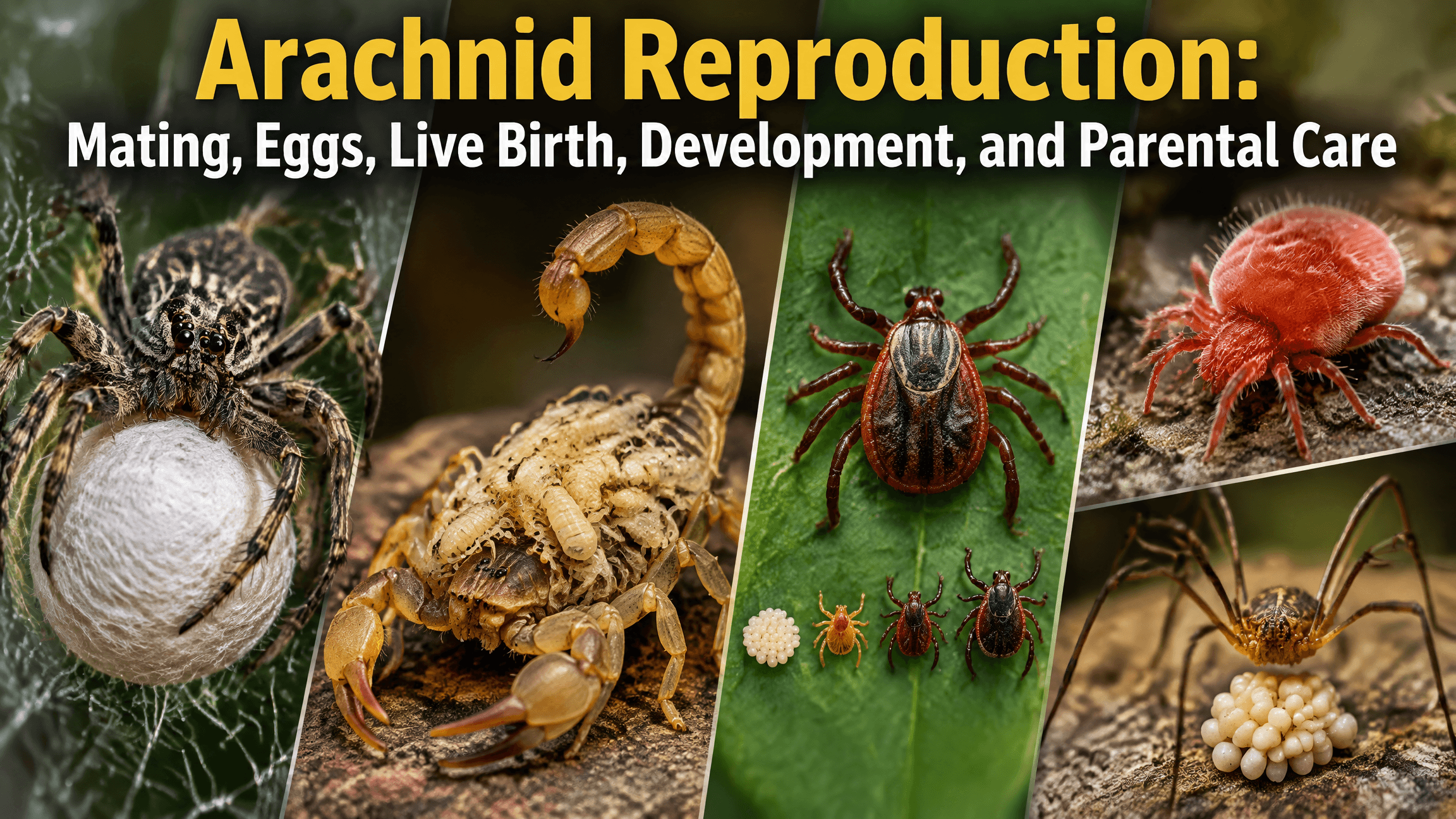
Arachnid reproduction is far more varied than the familiar image of a spider guarding an egg sac. Most spiders lay eggs, scorpions give birth to live young, ticks pass through egg, larval, nymphal, and adult stages, mites show several developmental patterns, and harvestmen include species with maternal or paternal egg care. Mating can involve direct sperm transfer, sperm-loaded pedipalps, or spermatophores placed on a surface.
These differences make reproduction one of the clearest examples of why spiders cannot stand in for all Arachnida. Courtship is only the beginning. The reproductive cycle also includes sperm transfer, fertilization, egg production or live birth, juvenile development, molting during growth, and in some species prolonged parental care.
Quick Answer
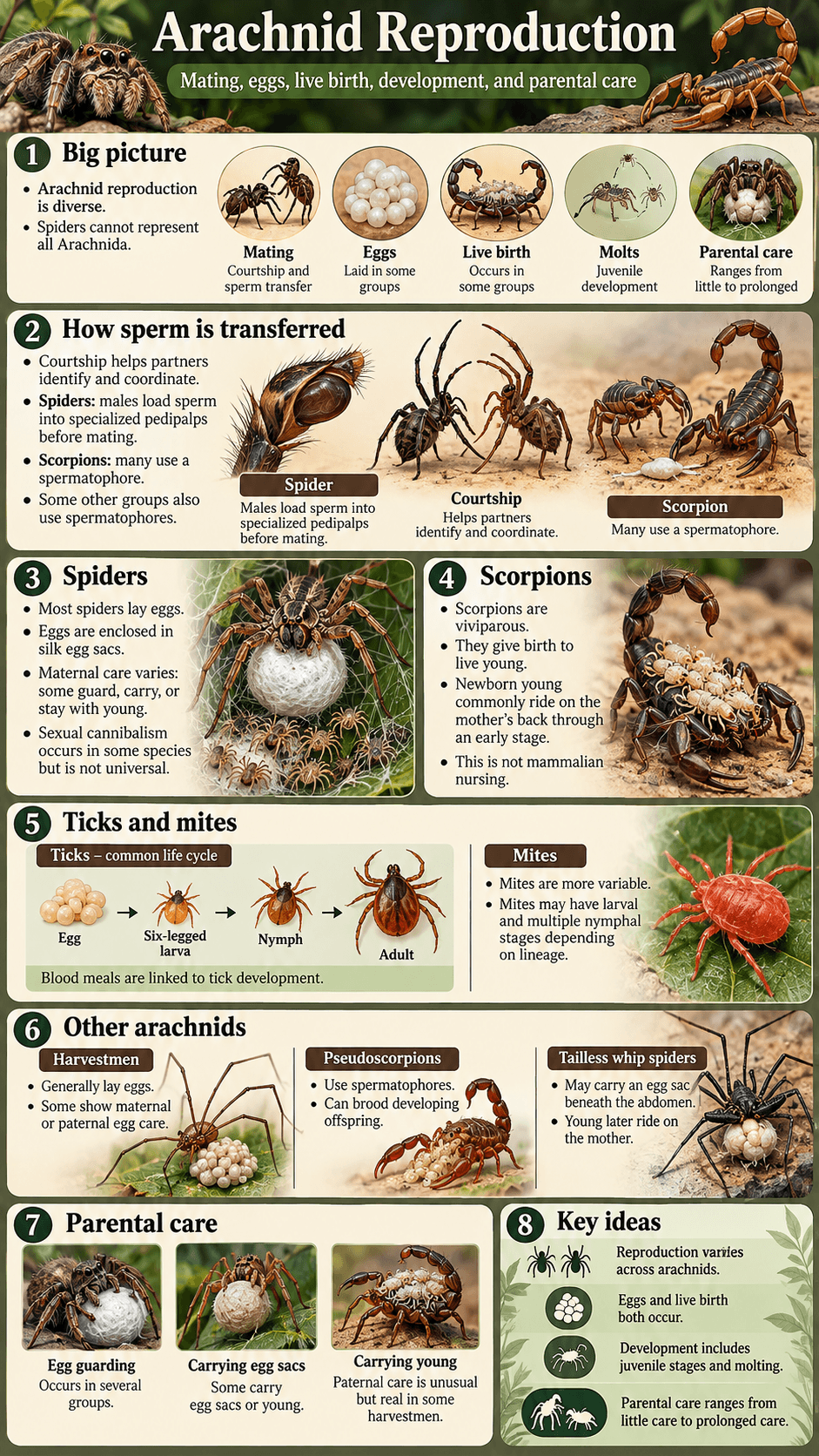
Arachnids reproduce mainly through sexual reproduction, but the mechanics differ strongly among groups. Male spiders transfer sperm with specialized pedipalps after first loading them with sperm. Many scorpions use a spermatophore during mating and later give birth to live young. Most spiders enclose eggs in silk egg sacs. Ticks usually hatch as six-legged larvae before becoming eight-legged nymphs and adults. Mites can pass through several larval and nymphal stages, with the exact sequence varying among lineages. These reproductive differences add another layer to the biological diversity of arachnids.
Parental care also varies. Some spider females guard or carry egg sacs or young, newborn scorpions commonly remain on the mother’s back until after an early molt, and some harvestmen show maternal or paternal egg guarding. None of these patterns should be treated as universal for all arachnids.
From Mate Finding to Sperm Transfer
Courtship helps partners identify and coordinate with each other
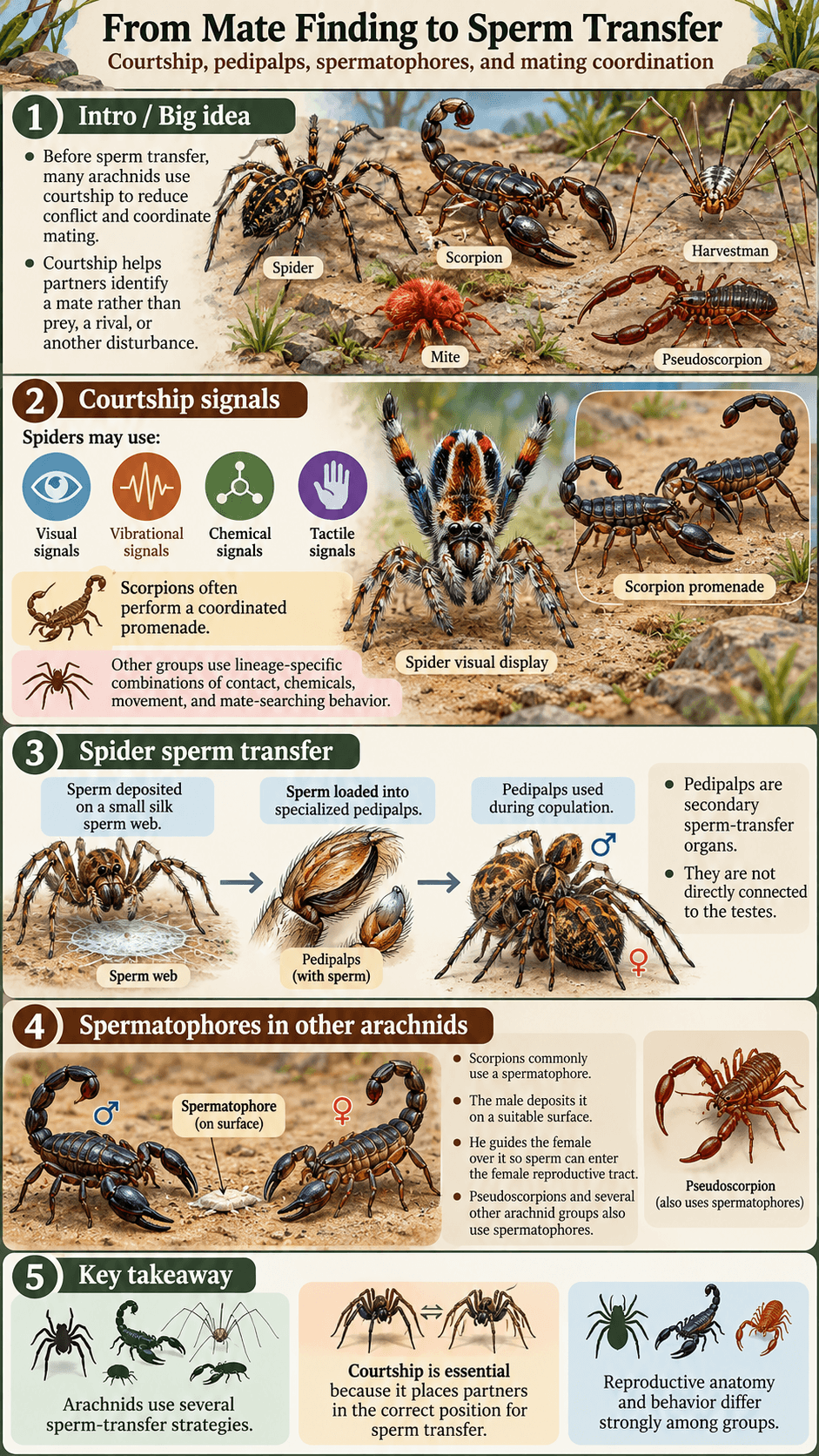
Before sperm transfer occurs, many arachnids use courtship to reduce conflict and coordinate mating. Spiders can exchange visual, vibrational, chemical, or tactile signals. Scorpions often perform a coordinated promenade. Harvestmen, mites, pseudoscorpions, and other groups use their own lineage-specific combinations of contact, chemical information, movements, and mate-searching behavior.
The details of courtship belong to behavior, but reproduction depends on its outcome. Successful courtship places the animals in the correct position for sperm transfer and can help a potential mate distinguish a reproductive partner from prey, a rival, or an unrelated disturbance. Mate searching, courtship, and parental association connect reproduction closely with arachnid behavior.
Direct transfer, spermatophores, and indirect steps
Arachnids use several sperm-transfer strategies. In spiders, the male does not transfer sperm directly from the genital opening to the female. Instead, mature males typically deposit sperm onto a small silk sperm web, draw it into specialized pedipalps, and later use those pedipalps during copulation.
A review of spider sperm transfer and competition explains that male spider pedipalps function as secondary sperm-transfer organs and are not directly connected to the testes. This unusual arrangement requires sperm induction before mating and helps explain why spider reproductive anatomy differs so strongly from that of many other animals.
Scorpions commonly use a spermatophore, a packaged sperm structure deposited on a suitable surface during courtship. The male guides the female over it so sperm can enter the female reproductive tract. Pseudoscorpions and several other arachnid groups also use spermatophores, although placement and transfer behavior differ.
Spider Reproduction
How male spiders load and use the pedipalps
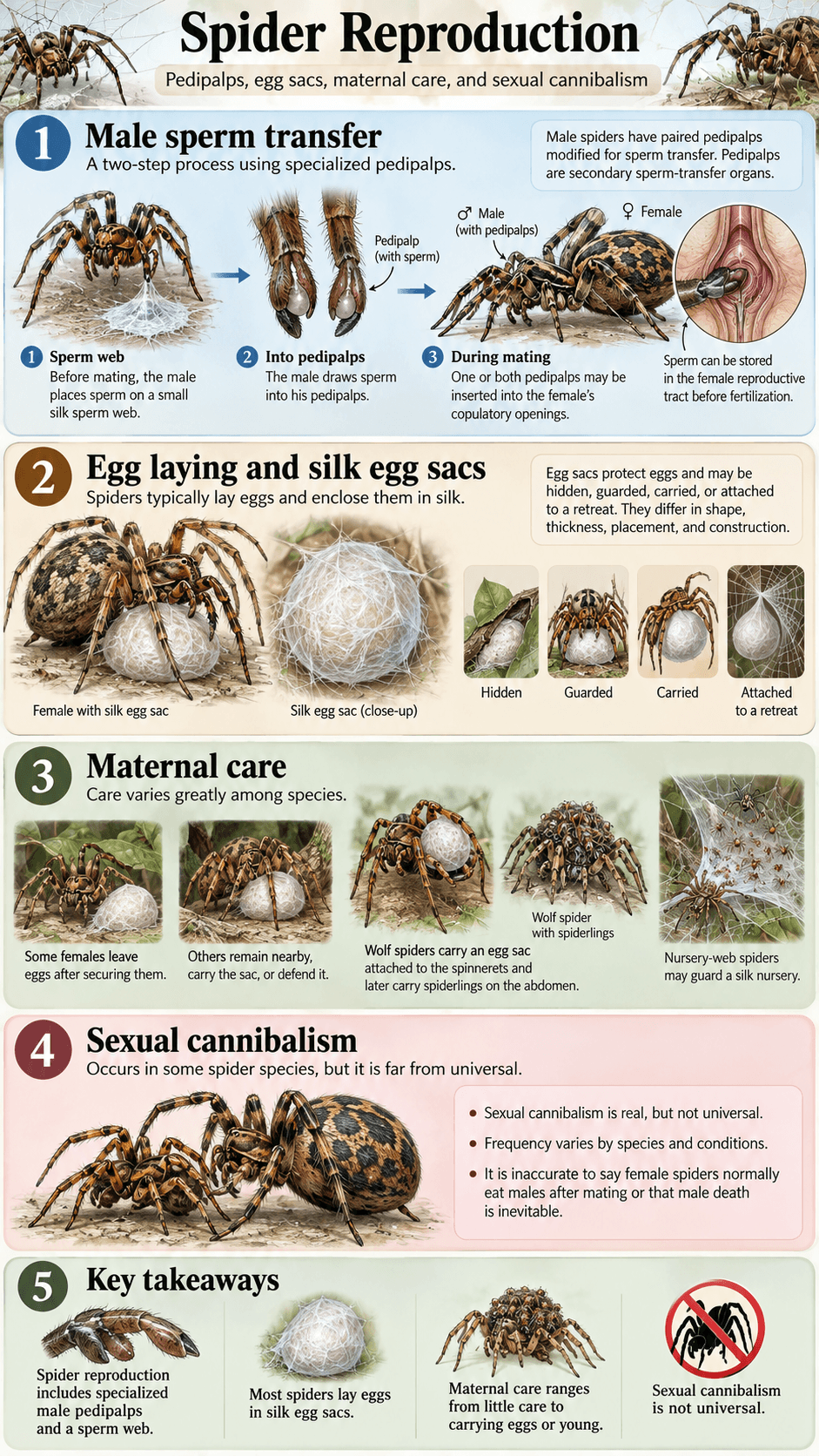
Adult male spiders have paired pedipalps modified for sperm transfer. Before mating, sperm released from the genital opening is placed on a small silk structure. The male then draws sperm into the pedipalps, where it remains until copulation.
During mating, one or both pedipalps can be inserted into the female’s copulatory openings, depending on the spider’s anatomy and mating sequence. Sperm can then be stored within the female reproductive tract before fertilization occurs as eggs pass through the reproductive system.
This two-step process separates sperm production from the appendages that deliver it. The pedipalps are therefore reproductive structures in adult males, but they originated as appendages that also have sensory and food-handling roles in spiders more generally. Several reproductive mechanisms depend on specialized arachnid anatomy, including modified pedipalps and other reproductive structures.
Egg laying and silk egg sacs
Spiders typically lay eggs and enclose them in silk. The resulting egg sac can protect eggs physically, reduce exposure to environmental stress, and provide a structure that can be hidden, guarded, carried, or attached to a retreat depending on the species.
Egg sacs differ in shape, thickness, placement, color, and construction. Some are suspended in webs, some are placed in vegetation, some are hidden in retreats, and others are carried by the female. A Journal of Arachnology study of spider egg-sac construction describes how one deinopid spider built a dense silk egg sac and concealed it with dry leaves, illustrating how egg protection can combine construction and behavior.
Silk egg sacs are widespread among spiders, but the amount of care after construction varies greatly. Some females leave the eggs after securing them. Others remain nearby, carry the sac, defend it, or continue caring for spiderlings after hatching.
Maternal care ranges from brief protection to carrying young
Wolf spiders provide one familiar example of extended maternal care. Females carry an egg sac attached to the spinnerets and later carry newly emerged spiderlings on the abdomen for a period before the young disperse. Nursery-web spiders may guard a silk nursery containing young.
Other spiders remain with egg sacs, defend them, provide prey, or interact with offspring in different ways. A few lineages show prolonged family associations. However, none of these behaviors is a universal spider pattern. Many species provide relatively limited care beyond choosing an egg-laying site and constructing the egg sac.
Sexual cannibalism is real but far from universal
Sexual cannibalism occurs in some spider species when one mating partner, usually the female, consumes the other before, during, or after mating. It has become one of the most famous spider reproductive stories, but its frequency varies greatly among species and conditions.
Some highly studied spiders show substantial cannibalism, while others rarely do. Hunger, size differences, courtship, mating history, and species-specific reproductive strategies can affect the outcome. It is therefore inaccurate to say that female spiders normally eat males after mating or that male death is an inevitable part of spider reproduction.
Scorpion Reproduction and Live Birth

Scorpions are viviparous
Unlike spiders, scorpions do not lay external egg sacs. Living scorpions are viviparous, meaning embryonic development occurs inside the female and she gives birth to live young. The details of nourishment and embryonic development differ among scorpion lineages, so viviparity should not be equated with mammalian pregnancy.
A review of scorpion life-history strategies describes scorpion reproduction as live birth followed by a distinctive post-embryonic stage in which first-instar young remain associated with the mother. Scorpions therefore provide a major exception to any claim that arachnids universally lay eggs externally.
Newborn scorpions and the mother’s back
After birth, young scorpions commonly climb onto the mother’s back. At this stage they are first-instar young, not larvae in the insect sense. They remain there through an early developmental period and usually undergo their first molt before becoming more independent.
The mother’s back provides a protected location during a vulnerable stage. Recent experimental work has also shown that maternal association can improve survival during the first molt in at least one studied scorpion species. The broader pattern of carrying newborn young is widespread in scorpions, but the exact duration and behavior vary.
Why this is not mammalian pregnancy or nursing
Scorpion live birth can look superficially familiar because embryos develop inside the female and young emerge alive. The underlying anatomy and nutrient-transfer mechanisms are arachnid systems, however, not mammalian placental pregnancy.
After birth, the young do not nurse from mammary glands. Their association with the mother’s back is maternal care and developmental protection. Using mammal-specific terms such as nursing would describe a biological process that scorpions do not possess.
Tick Reproduction and Development

Egg, six-legged larva, nymph, and adult
Most familiar hard ticks follow a four-stage sequence: egg, six-legged larva, eight-legged nymph, and adult. The six-legged larva is especially important because it is a clear reminder that arachnid identity cannot be defined only by counting eight legs at every life stage.
The CDC tick life-cycle overview describes this egg-larva-nymph-adult progression for common ticks and notes that active stages require blood meals. The host pattern and time needed to complete development vary among species.
Hard ticks and soft ticks do not have identical life cycles
Hard ticks in the family Ixodidae commonly have one nymphal stage between the larva and adult. Soft ticks in the family Argasidae can have two or more nymphal instars, and the number can vary. Some soft ticks take repeated, relatively brief blood meals and can pass through several nymphal stages before adulthood.
This difference matters because the simple four-stage diagram is useful but not universal across all ticks. It is even less appropriate as a model for mites, whose developmental sequences can be more diverse.
Blood meals connect development and reproduction
Tick development is tightly connected to feeding. Larvae and nymphs generally need a blood meal before molting to the next stage, and adult females of many species require a substantial blood meal before producing eggs. Mating can occur on or off the host depending on the tick lineage.
After egg laying, many hard-tick females die, but that life-history pattern should not be generalized to all arachnids. A spider, mite, scorpion, or harvestman follows its own reproductive schedule and may reproduce in very different ways.
Mite Reproduction and Development Are Highly Variable
Why one mite life cycle does not represent Acari
Mites occupy an enormous range of habitats and ecological roles, and their reproductive development is correspondingly diverse. Many mites hatch as six-legged larvae and later develop four pairs of legs, but the number, form, and activity of nymphal stages vary.
A study of juvenile development across mite groups notes that a fuller acariform developmental sequence can include larva, protonymph, deutonymph, tritonymph, and adult, while some groups reduce or modify that sequence. This is why statements such as “all mites have one nymph stage” are inaccurate.
Larval, nymphal, resting, and specialized stages
Some mite life cycles contain active feeding stages separated by quiescent developmental periods. In other lineages, one developmental stage may be greatly reduced or function very differently from another. Certain mites have specialized dispersal stages, while others spend most or all of their life on a host.
Even within ecologically similar mites, development can respond strongly to temperature, humidity, food, host condition, or season. A life cycle diagram should therefore identify the lineage or species it represents rather than being labeled simply as “the mite life cycle.”
Sex determination and reproductive systems also differ
Mites use several reproductive and genetic systems. Some lineages reproduce sexually with ordinary male and female development, while others have unusual mechanisms involving haploidy, paternal genome elimination, or parthenogenesis. These systems are important in acarology but are not shared by all mites.
The safest generalization is that Acari contains substantial reproductive diversity. Tick development is one specialized branch within that broader picture and should not be used to explain every mite.
Harvestmen and Other Arachnids
Egg laying and parental care in harvestmen
Harvestmen generally lay eggs, but what happens afterward varies widely. Females in many species deposit eggs in protected sites and leave them, while other species guard eggs. In some harvestmen, males perform prolonged egg guarding and can care for clutches laid by more than one female.
The Journal of Arachnology has documented independently evolved paternal care in harvestmen, including males that guard eggs in Neotropical lineages. Other harvestmen show maternal care, making Opiliones an important example of parental-care diversity within Arachnida.
Pseudoscorpions and spermatophore transfer
Pseudoscorpions reproduce sexually and many use spermatophores. In some lineages, a male deposits the spermatophore with limited direct contact, while in others courtship helps position the female for sperm uptake.
Females can brood developing embryos or young in a brood sac associated with the reproductive opening. This system differs from both spider egg sacs and scorpion live birth, showing another way arachnids protect developing offspring.
Solifuges, whip spiders, and other lineages add more variation
Solifuges generally lay eggs in protected chambers, and females in some species remain near the eggs or early young. Tailless whip spiders carry an egg sac beneath the abdomen and later allow newly emerged young to climb onto the mother’s back for a period. Vinegaroons also carry developing eggs and young in lineage-specific ways.
These examples demonstrate that parental carrying evolved in more than one arachnid lineage, but the anatomy and developmental stage being carried are not identical. Similar-looking behavior can arise through different reproductive systems.
Molting During Juvenile Growth
Why juveniles must molt to grow
Arachnids have an external cuticle, so juveniles usually grow through a series of molts. Each molt allows the animal to increase in size and enter the next developmental stage or instar. The number of molts before maturity varies among lineages and species.
In spiders and scorpions, juveniles can resemble smaller versions of adults in broad body plan but still change substantially in size, proportions, coloration, and reproductive anatomy. In ticks and many mites, named larval and nymphal stages make developmental differences especially obvious.
Why reproduction does not require a full molting tutorial
For reproductive biology, the important point is that development is divided into stages separated by molts. The detailed cellular and mechanical sequence of replacing the old cuticle is part of general arthropod molting biology rather than a separate reproductive process.
This distinction keeps attention on what changes across arachnid life histories: how many juvenile stages occur, when sexual maturity is reached, whether offspring remain with a parent, and which stages feed, disperse, or stay protected.
Parental Care Across Arachnids
Guarding eggs
Egg guarding occurs in several arachnid groups. A spider may remain beside an egg sac, a harvestman may defend exposed eggs, and other arachnids can protect broods in retreats or chambers. Guarding can reduce predation or disturbance but also costs the parent time and energy.
Parental investment therefore varies with ecology. Species whose eggs are hidden deeply or protected by durable structures may benefit from different strategies than species with exposed broods.
Carrying egg sacs or young
Carrying offspring places protection directly on the parent’s body. Wolf spiders carry egg sacs and later spiderlings. Scorpion young commonly remain on the mother’s back. Amblypygid young also spend an early period on the mother after emerging.
These examples are visually striking, but they should not be treated as one identical behavior called “carrying babies.” In one lineage the parent may carry an egg sac, while in another the young have already been born or emerged and are passing through an early instar.
Paternal care is unusual but real
Maternal care is more familiar in arachnids, but paternal care occurs in some harvestmen. Males can guard eggs against predators or fungal growth and may remain associated with a clutch for extended periods.
Because paternal care has evolved in particular lineages rather than throughout Opiliones, it is best treated as a documented reproductive strategy, not a defining harvestman behavior.
Common Reproductive Myths
All arachnids lay eggs
No. Spiders, ticks, mites, harvestmen, and many other arachnids lay eggs, but scorpions give birth to live young. Arachnid reproduction includes both oviparity and viviparity.
Every female spider eats the male
No. Sexual cannibalism occurs in some spiders, sometimes frequently, but in many species it is uncommon or absent. Whether it happens can depend on species, hunger, size, courtship, mating sequence, and other conditions.
All mites and ticks have the same developmental stages
No. Many ticks follow an egg, larva, nymph, adult pattern, but soft ticks can have multiple nymphal instars. Mites show still more variation, including reduced, repeated, quiescent, or specialized stages depending on lineage.
Baby scorpions are larvae
Newborn scorpions are first-instar young and are often described as pro-juveniles in developmental literature. Calling them larvae can confuse scorpion development with the larval systems of insects or ticks. They are born alive and typically remain on the mother during the first stage of post-embryonic development.
How Reproduction Changes Across Arachnid Life Histories
Body size, sex differences, and maturity
Sexual maturity can bring major anatomical and behavioral changes. Male spider pedipalps become fully functional sperm-transfer organs after the maturation molt. Males and females may differ in body size, coloration, appendage proportions, or movement patterns associated with mate searching.
Sexual dimorphism is not equally strong in all arachnids. In some species the sexes look similar, while in others adults differ dramatically. Reproductive anatomy is therefore often more reliable than superficial body size when identifying sex.
Egg production, live birth, and offspring number involve trade-offs
Producing many small eggs, fewer larger offspring, or live young places different demands on the parent. Protecting a brood can improve survival but also restrict movement or feeding. Carrying young can reduce mobility, and guarding eggs can keep a parent close to one location.
Arachnid reproductive strategies balance offspring number, offspring size, development time, parental investment, environmental risk, and the parent’s own survival. There is no single optimal pattern across the class.
Developmental diversity reflects ecology
Life stages can be adapted to different tasks. A tick larva finds a host before molting to a nymph. Some mite larvae and nymphs occupy different ecological roles. A newborn scorpion remains with its mother during a vulnerable first instar. Spiderlings may disperse soon after leaving an egg sac or remain with the mother longer in species with extended care. Development and reproductive timing can also be shaped by arachnid habitats and the environmental conditions surrounding juveniles and adults.
These transitions show why development is not simply a countdown to adulthood. Each stage can have its own movement, feeding, habitat, and survival challenges.
FAQ
Do all arachnids lay eggs?
No. Egg laying is widespread among spiders, ticks, mites, harvestmen, and many other arachnids, but scorpions are viviparous and give birth to live young. The embryos develop inside the female before birth.
How do spiders transfer sperm?
Male spiders typically place sperm on a small sperm web and load it into specialized pedipalps. During mating, parts of a pedipalp are inserted into the female reproductive opening and sperm is transferred. This makes the pedipalps secondary sperm-transfer organs rather than direct extensions of the testes.
Why do baby scorpions ride on their mother?
Newborn scorpions are vulnerable during the first instar and commonly remain on the mother’s back until after an early molt. The association provides protection, and experimental research in at least one species indicates that the mother’s back can also improve survival during the first molt.
Why do tick larvae have six legs?
The six-legged condition is a normal developmental stage in ticks. After feeding and molting, a larva becomes an eight-legged nymph. This is one reason eight legs cannot be used as an absolute rule for identifying every arachnid at every life stage.
Do arachnid fathers care for offspring?
In some species, yes. Paternal egg guarding is well documented in several harvestman lineages. It is much less typical than maternal care across familiar arachnids, but it shows that arachnid parenting is not exclusively female.
Final Thoughts
Arachnid reproduction spans sperm-loaded spider pedipalps, spermatophores, silk egg sacs, live birth, six-legged larvae, multiple nymphal stages, egg guarding, and offspring carried on a parent’s body. The details vary enough that no single spider or tick life cycle can represent the class.
Spiders usually lay silk-protected eggs, scorpions give birth to live young, ticks pass through distinctive larval and nymphal stages, mites show extensive developmental diversity, and harvestmen include both maternal and paternal care. Together, these reproductive strategies reveal how arachnids have evolved many different ways to transfer sperm, protect developing young, reach maturity, and move the next generation into the world.

Ethan Walker is the founder and research editor of Animal Fact Central. He creates and reviews educational animal facts content using trusted wildlife, pet care, and science-based sources. His work focuses on making animal behavior, adaptations, habitats, and species facts clear, accurate, and engaging for everyday readers.
Read More Details About Ethan Walker: https://animalfactcentral.com/ethan-walker/