
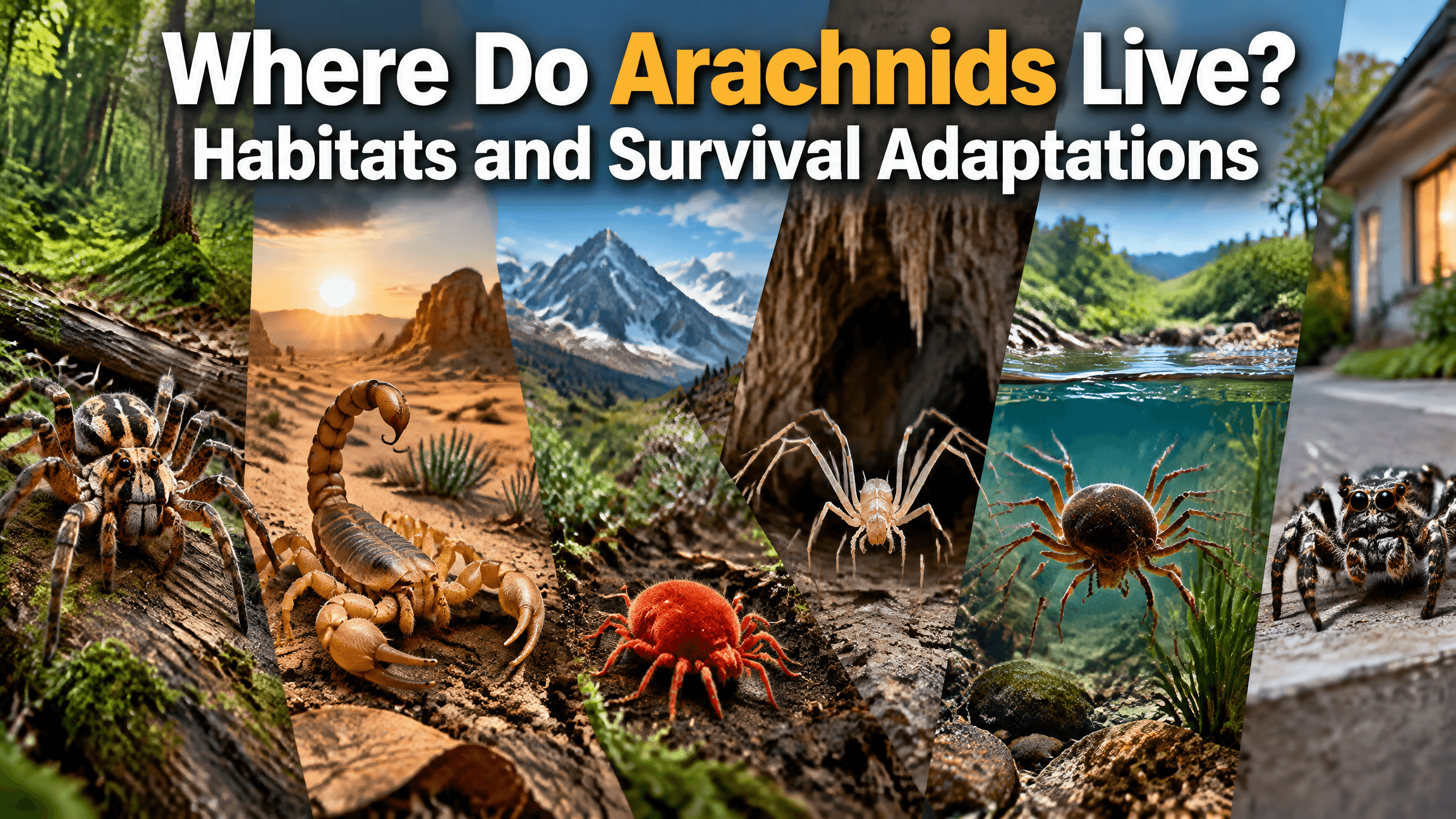
Arachnids live in an extraordinary range of habitats. Spiders, scorpions, mites, ticks, harvestmen, pseudoscorpions, whip spiders, and other arachnids occur in forests, grasslands, deserts, mountains, caves, soil, leaf litter, tree bark, freshwater, intertidal zones, animal hosts, plants, gardens, buildings, and many other microhabitats.
Most arachnids are associated with land, but “arachnids are terrestrial” is only a broad pattern, not an absolute rule. Aquatic mites are diverse, some spiders spend much of their lives in or around freshwater, and mites also occur in marine and intertidal environments. Habitat use depends on body size, moisture needs, temperature tolerance, food, shelter, host availability, activity timing, and the physical structure of the environment.
Quick Answer

Arachnids are especially diverse in terrestrial habitats, from humid forests to dry scrublands and deserts. Many live in small protected spaces such as soil pores, leaf litter, rotting wood, bark, rock crevices, burrows, or caves. Others live on plants or animal hosts. Aquatic and water-associated arachnids also exist, particularly mites and a smaller number of specialized spiders.
Survival depends on more than an exoskeleton. Arachnids manage heat, cold, water loss, flooding, darkness, food scarcity, and seasonal change through combinations of behavior, cuticle properties, body size, shelter use, respiration, activity timing, and habitat selection.
Arachnids Are Especially Diverse on Land but Not Limited to It

Terrestrial dominance with important aquatic and host-associated exceptions
The familiar arachnid is a land animal: a spider on vegetation, a scorpion under a stone, a harvestman in leaf litter, or a pseudoscorpion beneath bark. Terrestrial habitats contain enormous arachnid diversity because the ground, plants, woody debris, soil, and rock provide countless small spaces with different temperatures, moisture levels, prey communities, and shelter opportunities.
Yet mites alone break any simple “land only” rule. The American Arachnological Society overview of mites and ticks describes free-living mites from soil and water on every continent and notes that acarines occur from high mountains to deep ocean environments. Their tiny body size allows them to occupy microhabitats unavailable to larger arachnids.
Host-associated habitats add another dimension. Ticks spend critical parts of their lives on vertebrate hosts, while numerous mites live on or within animals, plants, fungi, nests, feathers, skin, or other living surfaces. Habitat is therefore not always a place such as a forest or desert. For some arachnids, another organism is part of the habitat. Different habitats also place arachnids in different ecological roles within local food webs.
Forests and Woodlands
Leaf litter, bark, canopy, rotting wood, and microclimates
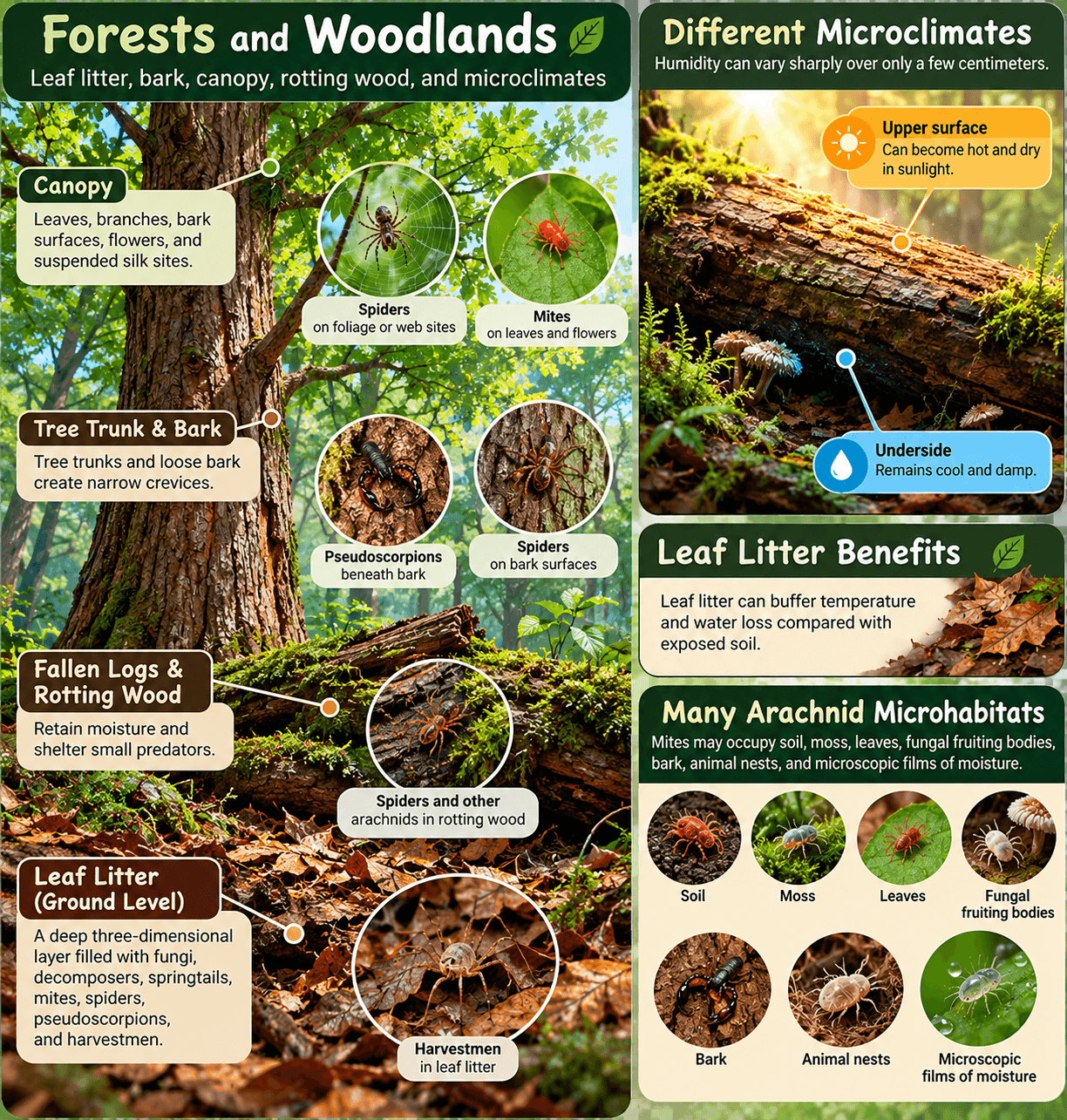
Forests contain stacked layers of arachnid habitat. The canopy provides leaves, branches, bark surfaces, flowers, and suspended silk sites. Tree trunks and loose bark create narrow crevices. Fallen logs and rotting wood retain moisture and shelter small predators. At ground level, leaf litter forms a deep three-dimensional layer filled with fungi, decomposers, springtails, mites, spiders, pseudoscorpions, and harvestmen.
Humidity can vary sharply over only a few centimeters. The upper surface of a fallen log may become hot and dry in sunlight while the underside remains cool and damp. Leaf litter can buffer temperature and water loss compared with exposed soil. These small differences make microhabitat selection especially important for tiny arachnids.
Pseudoscorpions illustrate this forest-scale diversity well. The American Arachnological Society profile of pseudoscorpions notes that they occur in leaf litter, beneath tree and log bark, under stones, in caves, and across terrestrial environments from seashores to high elevations.
Forest spiders also divide habitat vertically. Some hunt on the ground, others live in shrubs, bark, canopy foliage, or web sites between branches. Mites may occupy soil, moss, leaves, fungal fruiting bodies, bark, animal nests, and microscopic films of moisture. The forest is therefore not one arachnid habitat but thousands of overlapping ones.
Grasslands, Savannas, and Scrublands
Surface-active, burrowing, and vegetation-associated arachnids
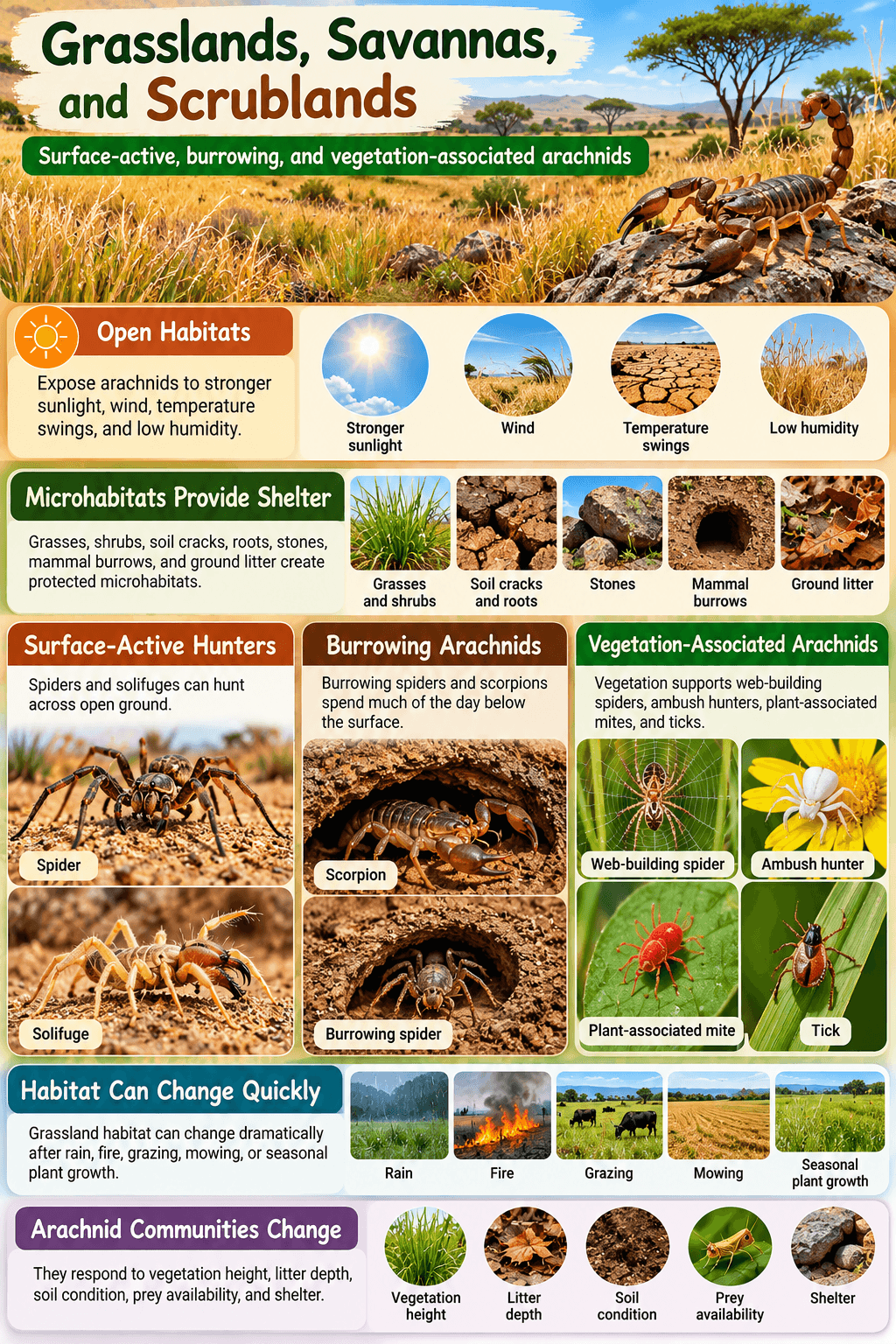
Open habitats expose arachnids to stronger sunlight, wind, temperature swings, and periods of low humidity. At the same time, grasses, shrubs, soil cracks, roots, stones, mammal burrows, and ground litter create protected microhabitats.
Surface-active spiders and solifuges can hunt across open ground, while burrowing spiders and scorpions spend much of the day below the surface. Vegetation supports web-building spiders, ambush hunters, plant-associated mites, and ticks waiting in positions where a host may make contact.
Grassland habitat can change dramatically after rain, fire, grazing, mowing, or seasonal plant growth. Arachnid communities respond to vegetation height, litter depth, soil condition, prey availability, and shelter. Species that thrive in open, dry grass may be replaced by different species only a short distance away in a shaded thicket.
Deserts and Other Dry Environments
Burrows, nocturnal activity, sheltered microhabitats, and water balance
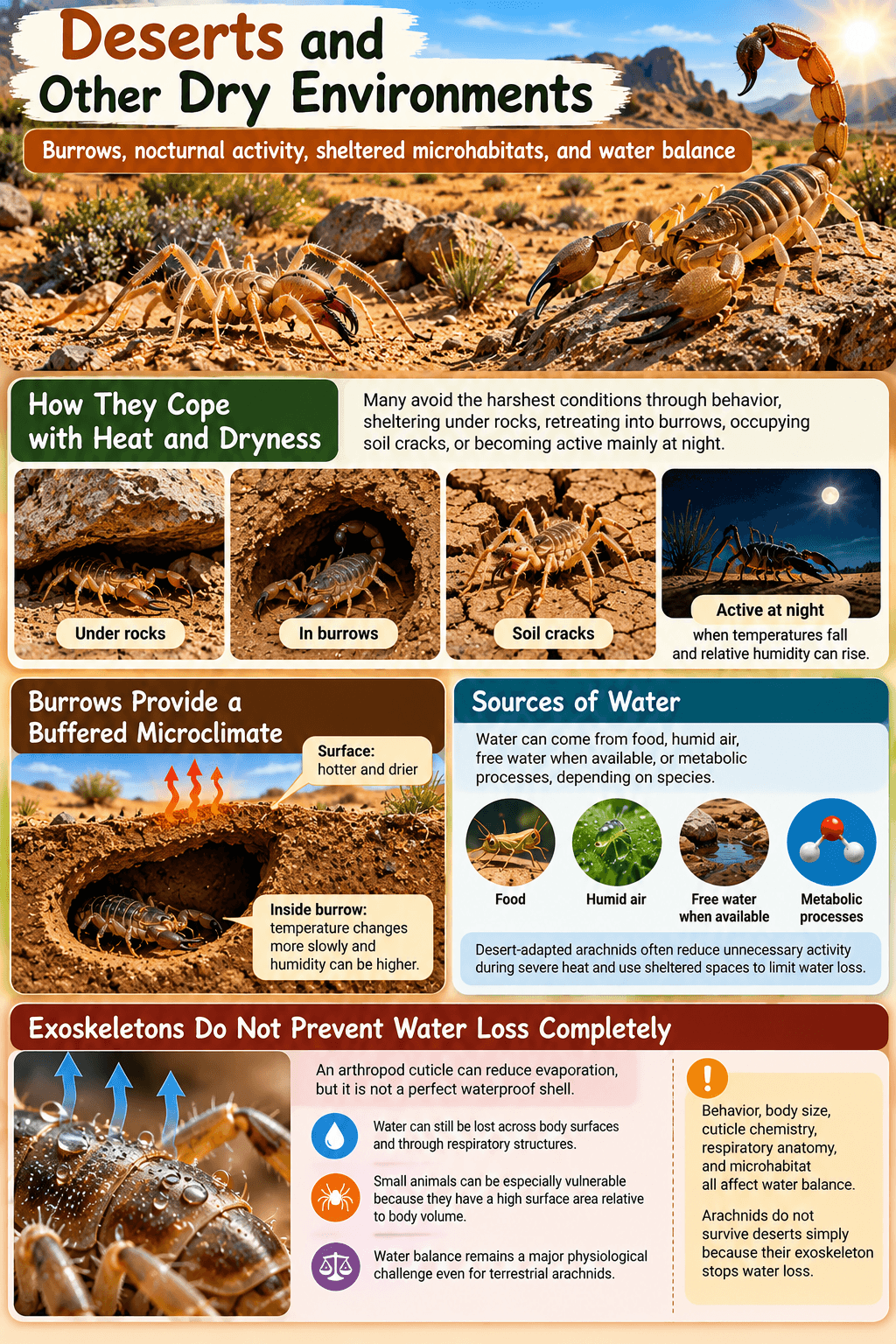
Deserts are famous for scorpions and solifuges, but the animals that live there do not simply ignore heat and dryness. Many avoid the harshest conditions through behavior. They shelter under rocks, retreat into burrows, occupy deep soil cracks, or become active mainly at night when temperatures fall and relative humidity can rise. Shelter use, activity timing, host seeking, and foraging show how closely habitat and arachnid behavior are connected.
Burrows create a buffered microclimate. Temperature changes more slowly below ground than at the exposed surface, and humidity can remain higher. A desert arachnid may therefore spend much of its life in an environment that is less extreme than the air a person experiences above the burrow. Different substrates and shelter types place different demands on how arachnids move.
Water can come from food, humid air, free water when available, or metabolic processes, depending on species. Desert-adapted arachnids often reduce unnecessary activity during severe heat and use sheltered spaces to limit water loss.
Why exoskeletons do not prevent water loss completely
An arthropod cuticle can reduce evaporation, but it is not a perfect waterproof shell. Water can still be lost across body surfaces and through respiratory structures. Small animals can be especially vulnerable because they have a high surface area relative to body volume.
A Journal of Arachnology study compared desiccation resistance in a scorpion from dry and wet tropical forests, emphasizing that water balance remains a major physiological challenge even for terrestrial arachnids. Populations living under different moisture regimes can experience different hydric pressures.
Behavior, body size, cuticle chemistry, respiratory anatomy, and microhabitat all affect water balance. The statement “arachnids survive deserts because their exoskeleton stops water loss” leaves out most of the adaptation.
Mountains, Alpine Zones, and Cold Environments
Short seasons, shelter, and narrow environmental windows
Arachnids also live at high elevations and in cold climates. Mountain environments can combine low temperatures, intense sunlight, wind, snow cover, short growing seasons, and large daily temperature changes. Suitable activity windows may be brief.
Small arachnids can exploit protected spaces beneath stones, in moss, soil, litter, and vegetation where conditions are warmer or more stable than the exposed air. Snow cover can insulate the ground and create a subnivean zone with less extreme temperatures than the surface above.
Pseudoscorpions occur at remarkably high elevations, and mites are especially successful in cold and alpine habitats. Some mites also occur in Antarctica. Cold tolerance, seasonal dormancy, rapid development during favorable periods, and protected microhabitat use can all contribute to survival, but the exact strategy varies by lineage.
Mountain populations can also become isolated on separate peaks or high-elevation habitat islands. That isolation matters biologically because specialized arachnids may have small ranges and limited opportunities to move between suitable habitats.
Soil and Leaf Litter
Mites, pseudoscorpions, harvestmen, and tiny soil-food-web arachnids
Soil and litter are among the most important arachnid habitats on Earth, yet much of their diversity is easy to miss because the animals are tiny. Mites can occur in enormous numbers in organic soil layers, feeding as predators, fungivores, plant feeders, scavengers, parasites, and decomposer-associated consumers.
Pseudoscorpions hunt small arthropods in leaf litter and beneath bark. Small spiders move through spaces among leaves and soil particles. Harvestmen forage across damp litter and woody debris. Other minute arachnids occupy moss, humus, fungal material, animal nests, and the boundary between soil and decaying vegetation.
At this scale, “habitat” can be a film of moisture around a soil particle or the underside of a single leaf. Temperature, humidity, oxygen, microbes, fungi, and prey can change across millimeters. Tiny body size makes these microgradients ecologically important.
Soil arachnids also respond strongly to disturbance. Compaction, drying, loss of litter, fire, pollution, and changes in vegetation can alter the structure of the microhabitat even when the landscape still appears superficially intact.
Caves and Rock Crevices
Eye reduction, elongated appendages, slow life histories, and narrow ranges
Caves create a distinctive habitat: permanent darkness, relatively stable temperature, limited plant production, and often patchy food supplied from the surface. Arachnid cave specialists include spiders, pseudoscorpions, harvestmen, mites, scorpions, and smaller lineages.
Permanent cave dwellers can evolve reduced eyes, pale coloration, elongated appendages, and enhanced nonvisual sensory systems. The pseudoscorpion profile from the American Arachnological Society notes cave species with long legs, eye loss, and pale body color. These features are often called troglomorphic traits.
Not every cave arachnid has every trait, and animals near cave entrances may retain normal eyes and pigmentation. Cave adaptation exists along a continuum from occasional cave visitors to species that complete their entire life cycle underground.
Cave specialists can also have small geographic ranges because suitable subterranean habitat is isolated. Slow reproduction or low dispersal may make recolonization difficult if a population is lost.
Why precise sensitive cave localities should not be disclosed
Caves can contain fragile communities concentrated in very small areas. Human traffic, pollution, altered airflow, groundwater changes, mining, and disturbance of roosts or nutrient sources can damage habitats that recover slowly.
A USGS-linked study of sensitive cave ecological areas described subterranean habitats as fragile and recommended limiting access to particularly sensitive zones. For rare cave arachnids, educational writing should focus on habitat biology rather than publishing precise hidden collection sites when conservation sources intentionally withhold them.
Freshwater, Intertidal, and Water-Associated Habitats
Aquatic mites
Water mites are among the clearest examples of truly aquatic arachnids. Their adults and nymphs occur in ponds, lakes, streams, springs, wetlands, groundwater interfaces, and other freshwater habitats. Different species occupy different current speeds, substrates, depths, vegetation, and prey communities.
The NTNU University Museum overview of water mites describes freshwater mites as occupying a wide variety of ecological niches, including very small habitats and groundwater-surface-water interfaces. Many adult water mites are predators of freshwater invertebrates.
Water-mite life cycles can also connect aquatic and aerial environments because larvae of some species parasitize aquatic insects that later fly. That relationship can help mites reach new water bodies.
Freshwater-associated spiders and other specialists
Several spiders live at the edges of ponds, rivers, marshes, and streams, where they hunt on vegetation, shorelines, or the water surface. Fishing spiders can exploit surface tension and detect vibrations generated by prey in water. The diving bell spider goes further by spending most of its life underwater in a silk-supported air chamber.
These spiders still breathe air. Their aquatic lifestyle depends on behavior, water-repellent body surfaces, silk, and access to atmospheric oxygen rather than gills.
Other arachnids occur in wetlands, riparian zones, splash zones, and intertidal habitats. Marine and coastal mites can occupy algae, sediments, rocks, and other narrow habitats exposed to changing salinity and water levels.
Why horseshoe crabs are not the default marine arachnid example
Horseshoe crabs are chelicerates, but their exact relationship to the conventional class Arachnida remains an active phylogenetic question. Some analyses place them within or near arachnid lineages, while traditional classifications place living horseshoe crabs outside Arachnida.
For a straightforward habitat explanation, aquatic mites and water-associated spiders are better examples of arachnids using aquatic environments. They avoid turning a habitat section into a debate about chelicerate classification.
Hosts, Plants, and Other Living Surfaces
Ticks and host availability
Ticks occupy both off-host and on-host habitats. Off the host, they may live in leaf litter, soil surface layers, vegetation, nests, burrows, buildings, or other sheltered sites depending on species. When seeking a blood meal, many species move into positions where contact with a suitable vertebrate is likely.
Host availability therefore becomes part of the habitat. A site with suitable humidity and vegetation may still be poor habitat if appropriate hosts are absent. Conversely, a host-rich area can support ticks only if temperature and moisture allow off-host stages to survive.
Different tick species have different tolerances for drying, different host preferences, and different activity patterns. There is no single “tick habitat” that applies everywhere.
Mites on animals and plants
Mites occupy an even wider range of living surfaces. Plant-feeding mites live on leaves, stems, buds, fruits, and other tissues. Predatory mites hunt other small organisms on plants. Feather mites occupy bird plumage, while other mites live on skin, in hair follicles, in nests, or within specialized structures on animals.
Many of these relationships are highly specific. A mite adapted to a feather microhabitat faces different temperature, moisture, attachment, and feeding conditions from a soil mite or water mite.
Living on another organism can provide food and transport, but it also creates risks. The host moves, grooms, molts, sheds tissue, changes temperature, and may mount immune or behavioral defenses.
Urban, Suburban, and Indoor Habitats
Buildings, gardens, debris, and microclimates without pest-control framing
Human-modified environments contain many arachnid microhabitats. Gardens, walls, fences, sheds, woodpiles, storm drains, basements, roof spaces, windows, planted vegetation, mulch, and outdoor lighting can create shelter or feeding opportunities.
Some house-associated spiders use corners, cracks, storage spaces, or exterior walls. Pseudoscorpions can occur in buildings where tiny prey are available. Mites may live in stored organic material, plant pots, dust, animal nests, or other highly specific microhabitats. Certain ticks can also persist around buildings when their preferred hosts and environmental conditions are present.
Urban habitat does not mean every arachnid is a pest. Many simply use artificial structures as substitutes for rock crevices, bark gaps, caves, vegetation, or sheltered ground. Their presence reflects habitat opportunity rather than a single relationship with humans.
Scorpions Are Not Only Desert Animals
Forest, grassland, cave, mountain, and humid-tropical examples
Desert scorpions are visually iconic, but Scorpiones occupies a much broader environmental range. The American Arachnological Society’s scorpion overview notes that scorpions have adapted to a wide range of environmental conditions and occur on every continent except Antarctica.
Scorpions live in tropical rainforests, dry forests, grasslands, savannas, scrublands, mountains, caves, rocky areas, and deserts. Some species live in litter or under bark in humid environments rather than exposed sand.
The dry-versus-wet forest scorpion study discussed earlier used the same species from Atlantic rainforest and Caatinga dry forest populations. That example shows that even one scorpion species can span markedly different moisture regimes.
The desert stereotype persists partly because scorpions are easy to associate with arid landscapes, but habitat should be described from species evidence rather than visual symbolism.
Habitat Adaptations Across Arachnids
Behavior, cuticle properties, respiration, body size, and activity timing
Habitat adaptation rarely depends on one feature. A desert arachnid may combine nocturnal activity, a burrow, low surface exposure, cuticular water resistance, and efficient water use. A cave arachnid may emphasize touch and chemical sensing over vision. A water mite may be small enough to move among aquatic vegetation or sediments. A tick must balance humidity needs with access to hosts.
Respiratory systems also interact with habitat. Book lungs, tracheae, spiracles, and body-surface exchange differ among arachnid groups. Respiratory openings can create routes for water loss, so gas exchange and water conservation involve trade-offs in terrestrial environments.
Body size changes the scale of habitat. A large scorpion uses burrows, stones, and landscape features, while a minute mite experiences individual soil pores, fungal surfaces, leaf hairs, or water films as major environmental structures.
Trade-offs and species-specific limits
Adaptation does not mean an animal can tolerate every condition found in its habitat. Desert species can still die from dehydration. Cave species can be vulnerable to temperature changes. Aquatic species may depend on particular oxygen levels, current speeds, hosts, or substrates. Alpine species may be active only during short favorable periods.
Species also differ within the same habitat. Two spiders on the same tree may use different heights, prey, temperatures, web sites, or times of day. Two mites in the same soil sample may occupy different moisture layers. Habitat categories such as “forest” or “desert” are only the first level of description.
Common Habitat Myths
All arachnids live on land
No. Terrestrial habitats dominate Arachnida, but aquatic mites are highly diverse, some spiders are strongly associated with freshwater, and marine or intertidal mites also occur. Host-associated arachnids can spend important parts of their lives on other animals rather than on the ground.
All scorpions are desert animals
No. Scorpions occur in rainforests, dry forests, grasslands, savannas, caves, mountains, scrublands, and deserts. Many species depend on humid or sheltered microhabitats.
Mites are mostly household parasites
No. Mites include vast numbers of free-living species in soil, freshwater, marine environments, plants, fungi, litter, moss, nests, bark, and other habitats. Parasitic and house-associated mites are only part of their diversity.
Desert arachnids never need water
No. Desert arachnids must maintain water balance like other terrestrial animals. They can obtain water from food, available moisture, or other sources and reduce losses through behavior and physiology. Burrows and nocturnal activity often protect them from the driest conditions.
How Habitat Shapes the Rest of Arachnid Biology
Movement and sensory adaptation
Habitat determines what kinds of movement and sensory information are useful. A cave arachnid navigating darkness benefits from touch and chemical cues. A spider on smooth leaves needs secure attachment. A soil mite moves through microscopic spaces. A scorpion crossing open ground must locate shelter efficiently. Habitat also changes which arachnid senses are most useful, from vision in exposed environments to touch and chemical cues in dark or confined spaces.
Movement and sensing are therefore responses to habitat structure. Legs, claws, sensory hairs, eyes, pectines, Haller’s organ, and other systems become useful only in relation to the surfaces and signals the animal encounters.
Feeding and host relationships
Food distribution also shapes habitat. Web spiders need sites where prey traffic makes interception worthwhile. Predatory mites depend on microhabitats containing appropriate prey. Plant-feeding mites remain close to suitable tissues. Ticks require both survivable off-host conditions and access to vertebrate hosts.
An arachnid’s habitat is therefore partly defined by resource access. A physically suitable shelter with no food or hosts may not support a population for long.
Conservation of specialized habitats
Habitat specialization can increase vulnerability. Cave species may occupy one subterranean system, alpine species can be isolated on mountaintops, freshwater mites may depend on springs or clean streams, and soil specialists can disappear when litter layers or moisture regimes change.
Protecting arachnid diversity often means protecting microhabitats that look insignificant at human scale: a spring, patch of litter, rotting log, cave chamber, moss layer, riparian edge, or host-associated community.
FAQ
Do arachnids live in water?
Yes. Water mites are diverse freshwater arachnids, and some mite lineages occur in intertidal or marine habitats. Several spiders live at water edges, hunt on the surface, dive temporarily, or, in the case of the diving bell spider, spend most of their lives underwater while breathing air from a silk-supported chamber.
Where do scorpions live?
Scorpions occur in deserts, dry forests, tropical rainforests, grasslands, savannas, scrublands, mountains, caves, rocky areas, and other terrestrial habitats. Many shelter under stones, bark, logs, or in burrows and crevices. Deserts are important scorpion habitats but do not represent the whole order.
Where do mites live?
Mites live almost everywhere suitable microhabitats exist. They occur in soil, litter, freshwater, marine environments, plants, fungi, animal bodies, nests, moss, bark, stored organic material, and high-elevation or polar environments. Different mite lineages use very different habitats.
Do arachnids live in caves?
Yes. Spiders, pseudoscorpions, harvestmen, mites, scorpions, and other arachnids include cave-associated species. Permanent cave specialists may show eye reduction, pale coloration, elongated appendages, or other traits associated with life in darkness, but not every cave species has every feature.
Can arachnids live in houses?
Yes. Some spiders, pseudoscorpions, mites, ticks, and other arachnids can use buildings or structures when temperature, humidity, shelter, prey, hosts, or organic material are suitable. Indoor occurrence is one habitat option for certain species, not a defining feature of Arachnida.
Final Thoughts
Arachnids live from forest canopies and leaf litter to deserts, alpine zones, caves, freshwater, intertidal habitats, animal hosts, gardens, and buildings. Their greatest diversity is terrestrial, but aquatic mites, freshwater-associated spiders, and other specialists show that the group is not confined to dry land.
The most important habitat lesson is scale. A forest, desert, or mountain is only the broad setting. For an arachnid, survival often depends on the exact microhabitat: the underside of bark, a humid soil pore, a burrow, a rock crevice, a cave chamber, a patch of vegetation, a host body, or a small freshwater spring. Arachnid habitat diversity is ultimately the story of how different lineages use those small environmental spaces to manage temperature, water, food, shelter, movement, and survival.

Ethan Walker is the founder and research editor of Animal Fact Central. He creates and reviews educational animal facts content using trusted wildlife, pet care, and science-based sources. His work focuses on making animal behavior, adaptations, habitats, and species facts clear, accurate, and engaging for everyday readers.
Read More Details About Ethan Walker: https://animalfactcentral.com/ethan-walker/