
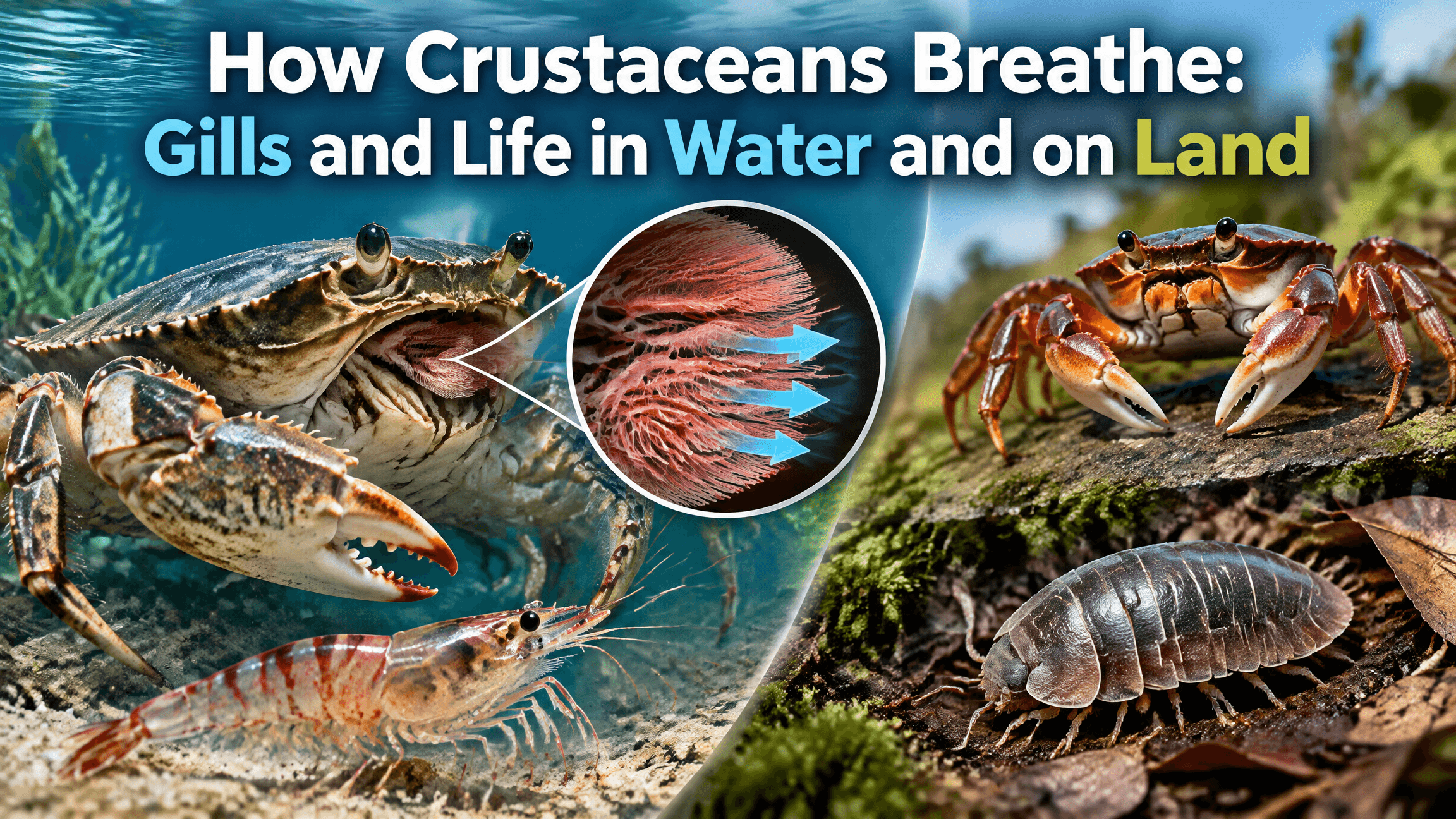
Most crustaceans exchange oxygen and carbon dioxide through gills or other thin respiratory surfaces, but there is no single breathing system that works for every crab, shrimp, copepod, barnacle, isopod, or other crustacean. Aquatic species usually depend on water flowing across gas-exchange surfaces. Terrestrial forms still need moist respiratory tissues, and some have evolved specialized structures that let them remain active in air.
That diversity matters because crustaceans range from tiny aquatic forms to large decapods and fully terrestrial woodlice. A crab’s gill chamber can be a useful example, but it is not a blueprint for the entire group. The best way to understand how crustaceans breathe is to focus on the problem every lineage must solve: moving oxygen across a thin, moist surface into the body while releasing carbon dioxide.
Quick Answer
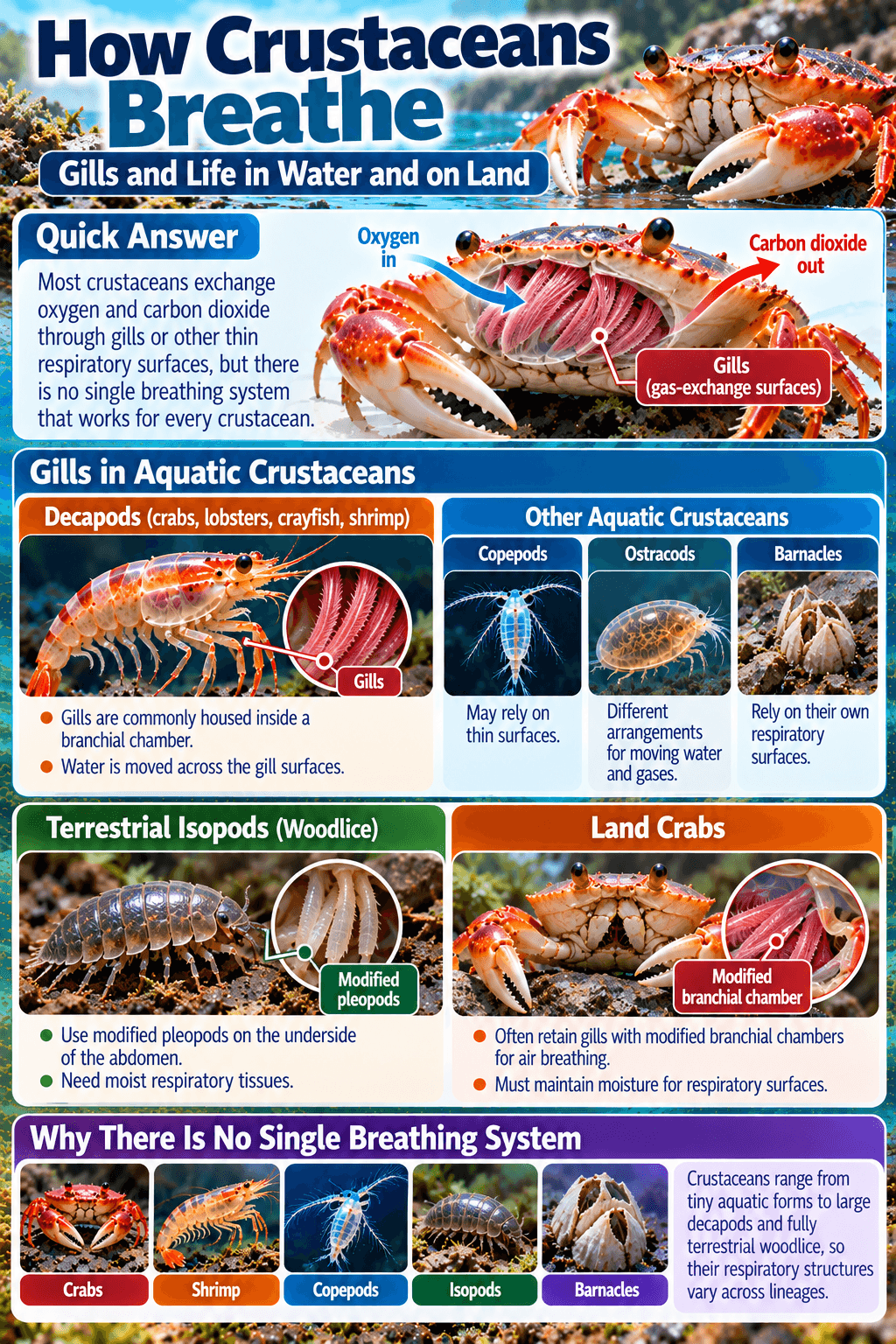
In water, many crustaceans use gills, which provide a large, thin surface where dissolved oxygen can diffuse into the hemolymph and carbon dioxide can move out. Water must usually be moved across or around those surfaces, and the details differ greatly among lineages. In decapods such as many crabs, lobsters, crayfish, and shrimp, gills are commonly housed inside a protected branchial chamber beneath the carapace. For the broader biological context behind these respiratory differences, see the crustacean overview.
Other crustaceans rely more heavily on appendage-associated surfaces or on relatively broad areas of thin body surface, especially when they are very small. On land, terrestrial isopods such as woodlice use modified pleopods on the underside of the abdomen, while some land crabs rely on a combination of retained gills and highly vascularized areas of the branchial chamber. These structures work only when water balance is controlled, which is why humidity remains so important for many terrestrial crustaceans.
What Breathing Means for a Crustacean
Gas Exchange Rather Than “Breathing Water”
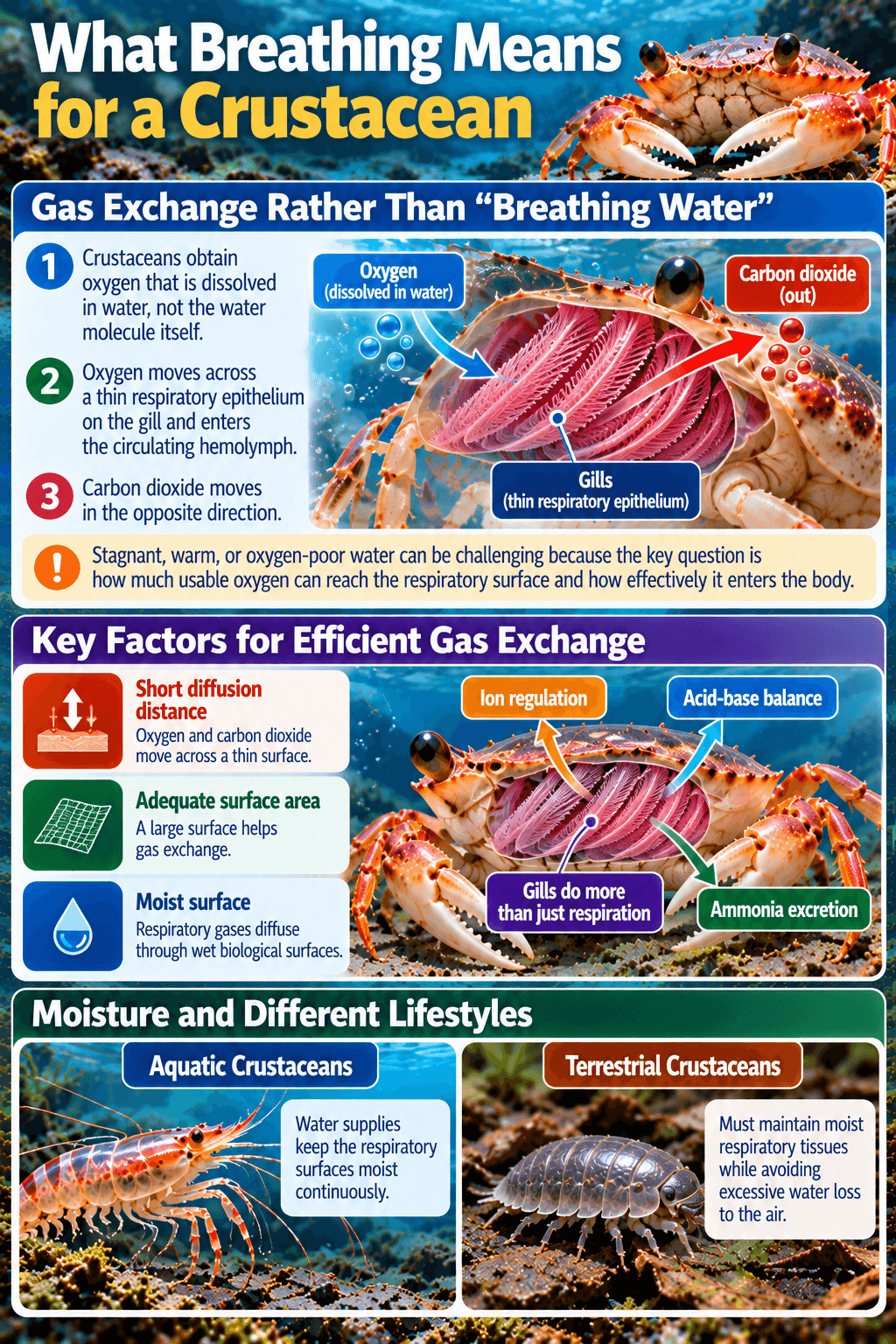
A crustacean does not use the water molecule itself as a respiratory fuel. Aquatic crustaceans obtain molecular oxygen that is dissolved in water. Oxygen moves across a respiratory epithelium, the thin tissue covering a gill or other gas-exchange surface, and then enters the circulating hemolymph. Carbon dioxide moves in the opposite direction.
This distinction helps explain why stagnant, warm, or oxygen-poor water can be challenging even though an animal is surrounded by water. The relevant question is how much usable oxygen can reach the respiratory surface and how effectively the animal can move that oxygen into its body.
Oxygen Availability, Surface Area, and Moisture
Efficient gas exchange depends on a short diffusion distance, adequate surface area, and contact with a medium that can carry respiratory gases. Crustacean gills also perform other jobs. A major review of crustacean gill physiology describes roles in ion regulation, acid-base balance, and ammonia excretion in addition to respiration, showing why a gill is more than a simple oxygen collector. A review of multiple crustacean gill functions provides a useful overview of this multifunctional physiology.
Moisture is essential because respiratory gases diffuse through wet biological surfaces. In aquatic species, water supplies that wet interface continuously. A terrestrial crustacean must maintain the same basic requirement while avoiding excessive water loss to the air. That trade-off helps shape the respiratory structures and behaviors seen in woodlice, beach-dwelling isopods, semiterrestrial crabs, and land crabs.
Gills in Aquatic Crustaceans
Decapod Gills as a Familiar Example
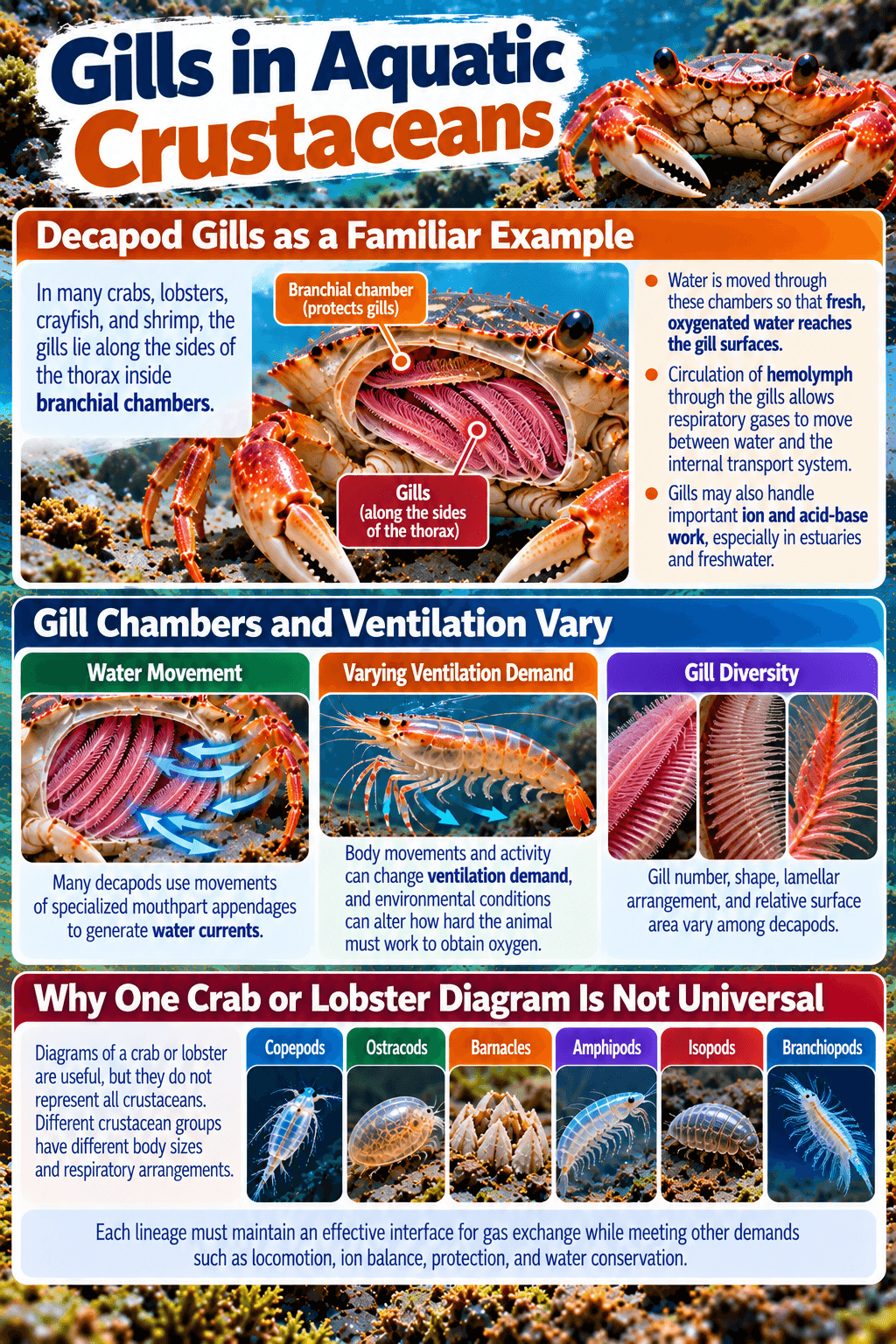
Decapods provide the best-known crustacean gill examples. In many crabs, lobsters, crayfish, and shrimp, the gills lie along the sides of the thorax inside branchial chambers. Water is moved through these chambers so that fresh, oxygenated water reaches the gill surfaces. The circulation of hemolymph through the gills allows respiratory gases to move between the surrounding water and the internal transport system.
The gills may also handle important ion and acid-base work. This is particularly significant in estuaries and freshwater, where the animal must control salt and water balance while still exchanging gases. Different parts of the gill can be more specialized for different physiological tasks, so even within one animal the entire gill set should not be treated as functionally identical.
Gill Chambers and Ventilation Vary
A branchial chamber protects delicate respiratory surfaces, but the way water moves through it varies. Many decapods use movements of specialized mouthpart appendages to generate water currents. Body movements and activity can change ventilation demand, and environmental conditions can alter how hard the animal must work to obtain oxygen.
Gill number, shape, lamellar arrangement, and relative surface area also vary among decapods. Species that remain immersed face different physical conditions from species that spend long periods exposed to air. Studies of semiterrestrial crabs show that respiratory structures can change substantially along this gradient, including reductions or modifications of gills and development of additional gas-exchange surfaces. Research on semiterrestrial crab branchial structures illustrates how strongly respiratory anatomy can vary with lifestyle.
Why One Crab or Lobster Diagram Is Not Universal
Educational diagrams often use a crab or lobster because the gills are comparatively large and easy to show. That is useful for understanding one decapod arrangement, but it can become misleading if it is presented as a universal crustacean plan. Copepods, ostracods, barnacles, amphipods, isopods, branchiopods, and other crustaceans differ enormously in body size and body organization.
Even among crabs, aquatic, amphibious, and terrestrial species may place different demands on the branchial chamber. The important general principle is not that all crustaceans possess one standard gill layout. It is that each lineage must maintain an effective interface for gas exchange while meeting other demands such as locomotion, ion balance, protection, and water conservation.
Other Aquatic Respiratory Surfaces
Appendage-Associated Structures
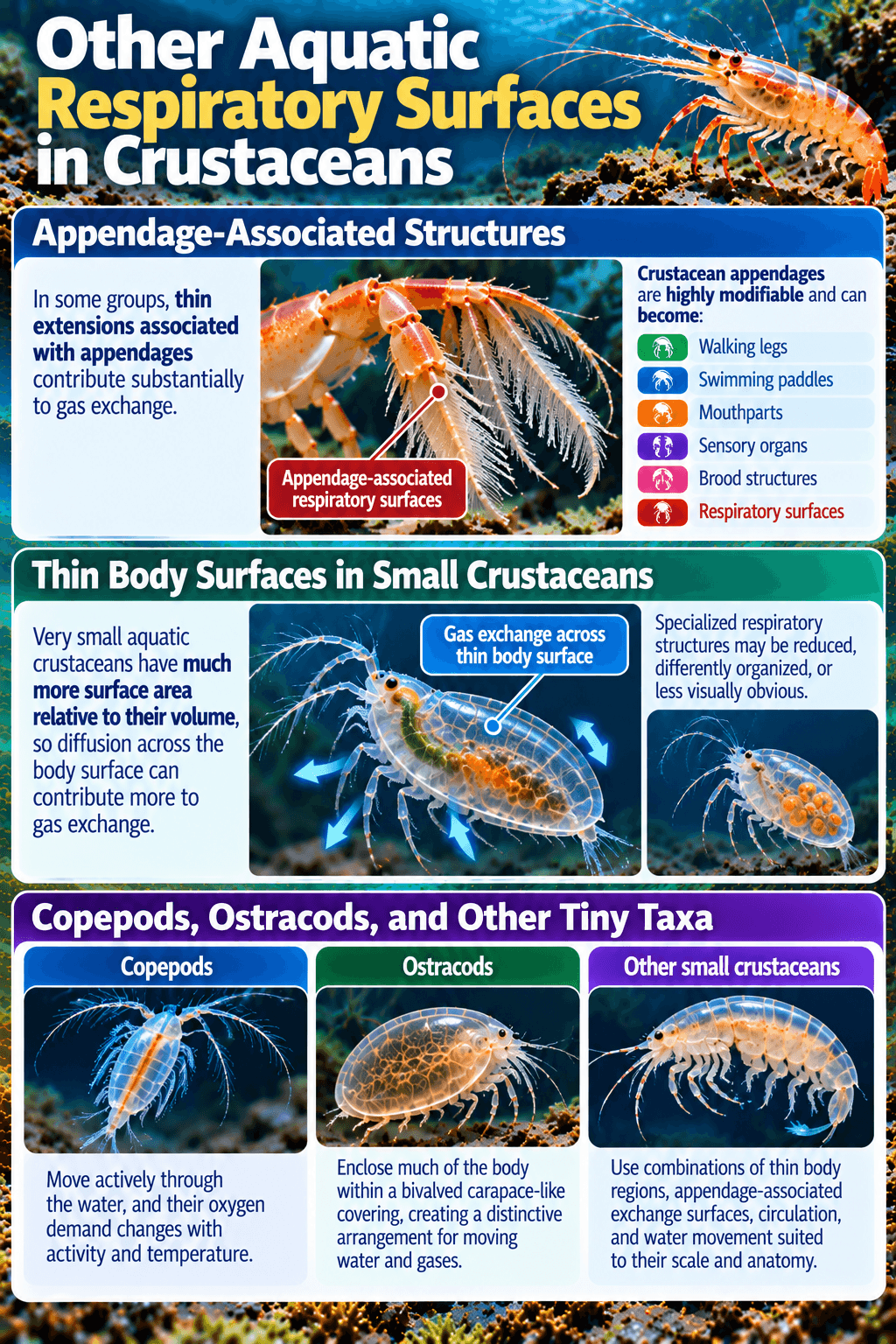
Crustacean appendages are highly modifiable. In some groups, thin extensions associated with appendages contribute substantially to gas exchange. These respiratory surfaces may be called gills in a broad functional sense, but their position and structure can differ from the internal branchial arrangement familiar from many decapods.
This fits a larger pattern in crustacean biology. Serial appendages can become walking legs, swimming paddles, mouthparts, sensory organs, brood structures, or respiratory surfaces depending on lineage and body segment. Respiration therefore cannot be separated completely from crustacean anatomy, although the important point here is functional: wherever the gas-exchange surface is located, it must remain thin enough and sufficiently ventilated or exposed for diffusion to occur.
Thin Body Surfaces in Small Crustaceans
Very small aquatic crustaceans have a different relationship between body size and surface area than large crabs or lobsters. Because a tiny animal has much more surface area relative to its volume, diffusion across the body surface can contribute more to overall gas exchange. Specialized respiratory structures may be reduced, differently organized, or less visually obvious.
This does not mean that every small crustacean simply absorbs oxygen through its entire body. Cuticle thickness, activity level, habitat, circulation, and lineage-specific anatomy all matter. It does mean that the large, conspicuous gills of a decapod should not be forced onto miniature body plans that solve the same gas-exchange problem in different ways.
Copepods, Ostracods, and Other Tiny Taxa
Copepods and ostracods are useful reminders that a large portion of crustacean diversity is small-bodied. Many copepods move actively through the water despite being planktonic or associated with the bottom, and their oxygen demand changes with activity and temperature. Ostracods enclose much of the body within a bivalved carapace-like covering, creating another distinctive arrangement for moving water and gases around the animal.
Rather than assigning one simple respiratory organ to every member of these groups, it is more accurate to say that small crustaceans use combinations of thin body regions, appendage-associated exchange surfaces, circulation, and water movement that are appropriate to their scale and anatomy. The details can differ even among close relatives.
How Terrestrial Isopods Breathe
Pleopodal Respiratory Structures
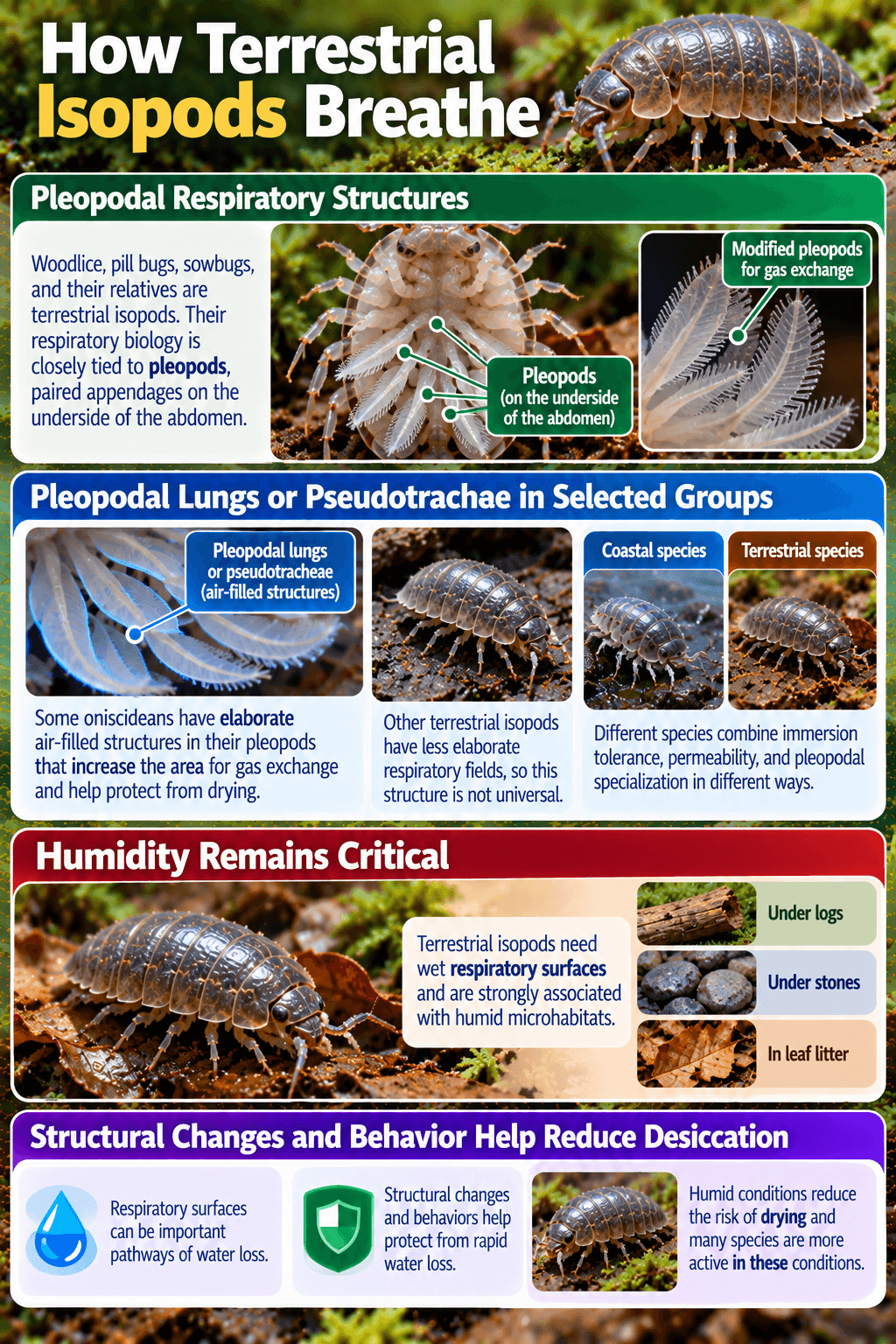
Woodlice, pill bugs, sowbugs, and their relatives are terrestrial isopods in the suborder Oniscidea. Their respiratory biology is closely tied to pleopods, paired appendages on the underside of the abdomen. These structures are descended from appendages used in aquatic ancestors and have been modified in different terrestrial lineages for gas exchange in air.
The shift onto land did not free isopods from the need for wet respiratory surfaces. Instead, terrestrial isopods combine structural changes with behaviors that reduce desiccation. Hiding under logs, stones, leaf litter, bark, or other humid cover helps protect respiratory surfaces and the rest of the body from rapid water loss.
Pleopodal Lungs or Pseudotracheae in Selected Groups
Some oniscideans have elaborate air-filled structures in their pleopods that are commonly described as pleopodal lungs or pseudotracheae. These increase the area available for aerial gas exchange while providing some protection from drying. Other terrestrial isopods have less elaborate respiratory fields, so the presence of one particular lung structure should not be treated as a defining feature of every woodlouse.
Research comparing coastal and terrestrial isopods shows substantial variation in aerial and aquatic respiratory performance as well as in pleopod structure. A study of aerial and aquatic respiration in Oniscidea found that different species combine immersion tolerance, permeability, and pleopodal specialization in different ways. That diversity is exactly what we would expect from lineages occupying habitats from wave-washed shorelines to dry land.
Why Humidity Remains Critical
Terrestrial isopods lack the highly water-resistant outer coating that helps many insects limit evaporation. Their respiratory surfaces can also be important pathways of water loss. As a result, many species are strongly associated with humid microhabitats and become more active when temperature and moisture conditions reduce the risk of drying.
A broad review of terrestrial crustaceans describes water balance as a continuing constraint even in well-established land-dwelling groups. The review of terrestrial crustacean adaptations emphasizes both respiratory specialization and the persistent problem of desiccation. This is why finding pill bugs under damp objects is not merely a preference for darkness. The microclimate supports the physiology of life on land.
How Land Crabs Handle Air Exposure
Modified Branchial Chambers and Retained Gills
Land crabs did not simply replace gills with mammal-like lungs. Many retain gills, but the branchial chamber and its lining can become heavily modified for aerial respiration. In some lineages, vascularized areas of the chamber act as lung-like surfaces, while gills may continue to contribute to gas exchange, ion balance, or other functions.
A recent review of terrestrial crab physiology explains that the shift toward land involves changes in gill surface, branchial chamber structure, and the division of labor among respiratory and ion-regulating tissues. A review of crab transitions from water to land shows why it is inaccurate to describe a land crab as simply carrying ordinary aquatic gills into the air.
Different Degrees of Terrestriality
Crabs occupy a continuum from fully aquatic to intertidal, amphibious, semiterrestrial, and strongly terrestrial lifestyles. Some leave water briefly to feed or move. Others spend most of their adult lives on land but remain tied to water for parts of their life cycle. Still others use burrows where humidity is much higher than in the open air.
Because these lifestyles differ, the phrase “land crab” does not imply one respiratory design. Some species depend heavily on gills kept moist within the branchial chamber. Others have expanded air-breathing surfaces in the chamber lining. The balance between air breathing, water breathing, salt regulation, carbon dioxide elimination, and water conservation differs among species.
Can Crustaceans Breathe Both Air and Water?
Why the Answer Is Species-Specific
Some crustaceans can exchange gases in both air and water, but that ability is not universal and should not be reduced to a yes-or-no statement for the entire group. A respiratory surface that works well in water may collapse, dry, or ventilate poorly in air. Conversely, a structure specialized for aerial respiration may not perform the same way when submerged.
Coastal and amphibious species often provide the clearest examples of flexible gas exchange. They regularly encounter changing tides, wet sediments, burrows, air exposure, and immersion. Their respiratory systems and behavior can be adapted to those transitions. A fully aquatic crustacean may tolerate only limited emersion, while a terrestrial species may still need water or saturated humidity to keep its respiratory tissues functional.
Moisture, Temperature, Activity, and Exposure Duration
Whether a crustacean can remain out of water depends on more than the name of the species. Humidity influences evaporation. Temperature affects metabolic demand and water loss. Activity increases oxygen requirements. Body size changes the relationship between surface area and water loss. The duration of exposure also matters because an animal that survives a short period in air may not be able to remain there indefinitely.
For this reason, it is unsafe and scientifically misleading to test a crab, shrimp, or other aquatic crustacean by deliberately leaving it out of water to see how long it survives. Observing the animal in its normal habitat tells us far more about its biology without creating unnecessary stress.
Low-Oxygen Environments and Tolerance
Why Tolerance Varies Across Habitats and Life Stages
Crustaceans encounter low oxygen in mud, burrows, warm ponds, tide pools, deep water, eutrophic habitats, and other environments. Their responses vary. Some reduce activity, change ventilation, move to better-oxygenated water, or tolerate short periods of low oxygen. Others are much less tolerant.
Life stage matters too. Larvae and adults may occupy different habitats and have different body sizes, activity patterns, and respiratory structures. Temperature can increase metabolic demand while also reducing how much oxygen water can hold, so a condition tolerated in cool water may be more stressful when the water warms.
It is therefore inaccurate to say that crustaceans as a whole either “cannot survive low oxygen” or “are adapted to low oxygen.” Tolerance is a property of a species, life stage, physiological condition, and environment. Broad claims erase ecologically important differences.
Common Breathing Myths
All Crustaceans Do Not Have Identical Gills
Many crustaceans have gills, but their number, shape, location, and importance differ. Some tiny forms depend substantially on other thin surfaces. Terrestrial isopods use modified pleopods. Land crabs may combine retained gills with lung-like branchial surfaces. “Crustaceans breathe with gills” is a useful first approximation, not a complete definition.
Land Crabs Do Not Have Vertebrate-Style Lungs
Calling a vascularized branchial structure a “lung” describes its air-breathing function, not an anatomical identity with a mammal lung. Crustacean air-breathing organs evolved from arthropod structures and have their own arrangement of cuticle, epithelia, hemolymph spaces, and ventilation.
Classic comparative work on terrestrial crabs documented major differences in branchial chamber form and accessory respiratory surfaces among species. Comparative research on terrestrial crab branchial chambers helps show why “a crab lung” should be understood as a functional description rather than a vertebrate analogy.
All Crabs Cannot Survive Indefinitely Out of Water
Some crabs are highly terrestrial, some are amphibious, and many are primarily aquatic. Even species that spend long periods in air must protect their respiratory surfaces from drying and maintain water and salt balance. A marine crab stranded in hot, dry air is facing a very different challenge from a land crab resting in a humid burrow.
That variation is why rules such as “crabs can breathe air” or “crabs suffocate as soon as they leave water” are both too broad. The correct answer depends on the species and environmental conditions.
How Breathing Relates to Anatomy and Life on Land
Gills, Appendages, and the Branchial Chamber
Respiration is closely connected to body structure. In decapods, the position of the gills, the shape of the branchial chamber, and the appendages that ventilate it determine how water or air reaches respiratory surfaces. In isopods, abdominal pleopods have taken on a major respiratory role. In tiny taxa, body scale changes how much exchange can occur across relatively broad surfaces.
These examples show how crustacean anatomy can be modified without requiring every lineage to evolve the same organ. The shared physiological need is gas exchange, while the structural solutions are diverse.
Terrestrial Habitats and Water-Balance Constraints
Moving onto land solves one problem and creates another. Air contains abundant oxygen and gases diffuse rapidly through it, but exposed respiratory surfaces can lose water quickly. Terrestrial crustaceans therefore combine respiratory anatomy with behavior. Burrowing, sheltering under cover, becoming active at humid times, and retaining moisture within respiratory chambers can all help keep gas exchange working. These respiratory solutions are closely tied to the environmental demands of crustacean habitats.
This link between respiration and water balance explains why terrestrial crustaceans are not simply aquatic animals that happen to walk on land. Their success depends on coordinated changes in anatomy, physiology, and behavior, and those changes have evolved in different ways in different lineages.
FAQ
Do All Crustaceans Have Gills?
No. Gills are common and important in many aquatic crustaceans, especially larger forms such as decapods, but the group is too diverse for one universal respiratory organ. Small-bodied crustaceans may rely heavily on thin body surfaces or appendage-associated structures, while terrestrial isopods use modified pleopods. Some terrestrial crabs combine retained gills with specialized air-breathing surfaces in the branchial chamber.
How Do Pill Bugs Breathe?
Pill bugs are terrestrial isopod crustaceans. They exchange gases mainly through modified pleopods on the underside of the abdomen. In some isopod groups, these pleopods contain specialized lung-like or pseudotracheal structures. Their respiratory surfaces must remain moist, which is one reason pill bugs commonly occupy humid shelters under leaves, wood, stones, and similar cover.
Can a Crab Breathe Out of Water?
Some crabs can breathe in air for substantial periods, while others are much more dependent on immersion. The outcome depends on species, humidity, temperature, activity, and the condition of the respiratory surfaces. Amphibious and terrestrial crabs have structural and physiological adaptations that help them exchange gases in air, but this should not be generalized to every crab.
Why Do Terrestrial Crustaceans Need Humid Places?
Gas exchange requires thin, moist surfaces. On land, those surfaces can lose water rapidly. High humidity reduces evaporation and helps woodlice, land crabs, and other terrestrial crustaceans maintain respiratory function and overall water balance. Species differ in their ability to resist drying, but moisture remains a major constraint for the group.
Final Thoughts
So, how do crustaceans breathe? Many aquatic crustaceans use gills, but the complete answer is much broader. Some small species rely heavily on thin or appendage-associated surfaces, terrestrial isopods breathe through modified pleopods, and land crabs can combine retained gills with specialized air-breathing regions of the branchial chamber. Across all of these forms, the same physical challenge remains: oxygen and carbon dioxide must cross a thin, moist surface while the animal maintains enough water to keep that surface working. Crustacean respiration is therefore best understood as a set of related solutions rather than one universal design.

Ethan Walker is the founder and research editor of Animal Fact Central. He creates and reviews educational animal facts content using trusted wildlife, pet care, and science-based sources. His work focuses on making animal behavior, adaptations, habitats, and species facts clear, accurate, and engaging for everyday readers.
Read More Details About Ethan Walker: https://animalfactcentral.com/ethan-walker/
1 thought on “How Crustaceans Breathe: Gills and Life in Water and on Land”