
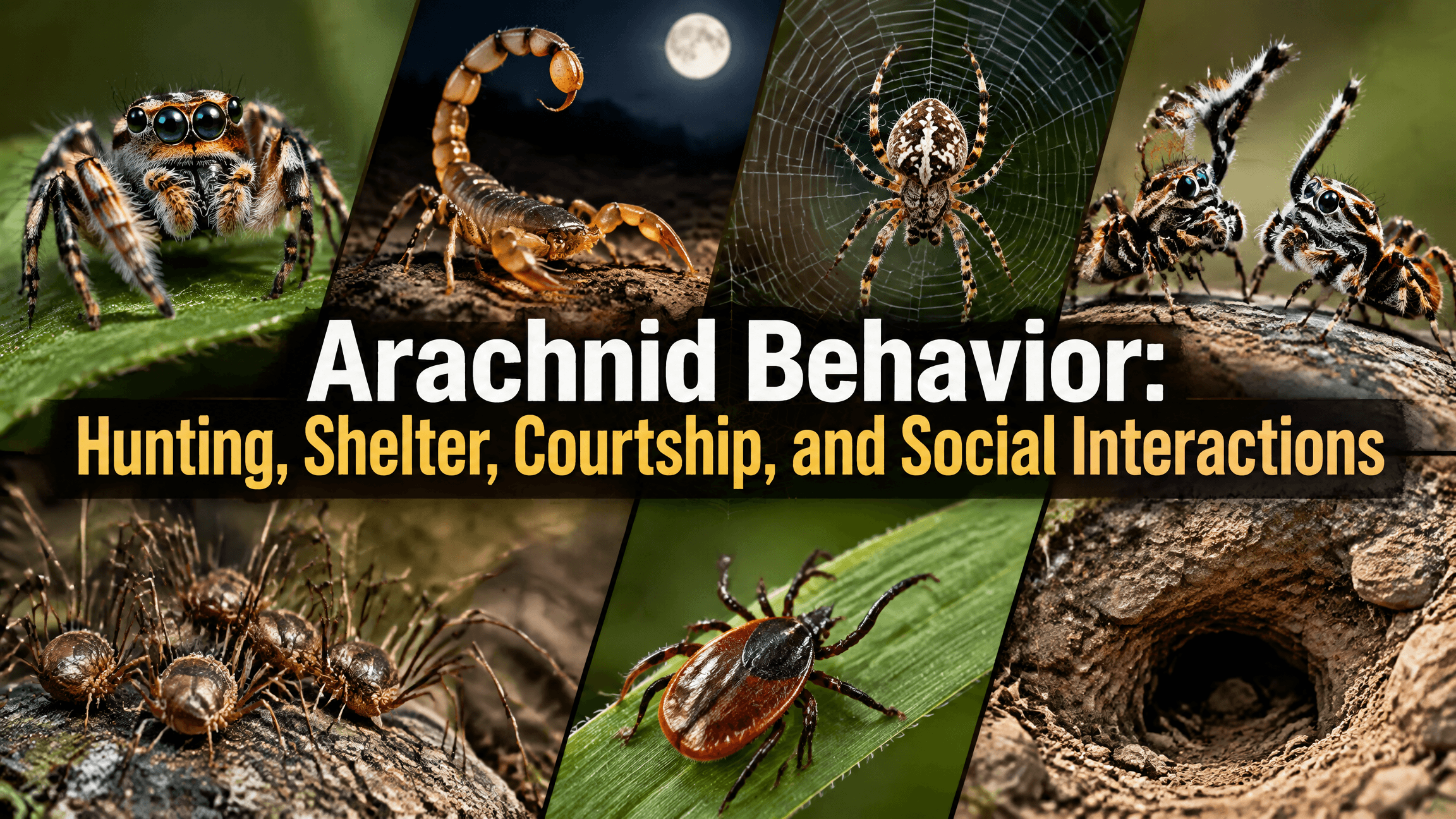
Arachnid behavior is far more varied than the familiar image of a spider waiting in a web. Some spiders stalk prey visually, others ambush from cover, scorpions leave retreats after dark to hunt, harvestmen may forage and rest in groups, ticks wait in a questing posture for passing hosts, and a small number of spider species live in cooperative societies. Courtship can involve vibration, vision, chemicals, touch, or carefully coordinated movement.
That range makes behavior one of the clearest ways to see how diverse Arachnida really is. Hunting style, shelter use, activity timing, mate searching, grooming, aggregation, and social interaction all depend on anatomy, senses, habitat, food, climate, and life stage. There is no single behavioral pattern that describes every spider, scorpion, tick, mite, harvestman, pseudoscorpion, solifuge, or whip spider.
Quick Answer

Arachnids use many behavioral strategies to find food, avoid harsh conditions, reproduce, and interact with their surroundings. Hunting can involve ambush, active pursuit, web-associated prey capture, or other specialized methods. Shelters range from burrows and silk retreats to rock crevices, bark, litter, and temporary hiding places. Courtship may combine visual, vibrational, chemical, and tactile signals. Many species spend much of their lives alone, but aggregations, prolonged family associations, communal living, and rare cooperative spider societies also occur. This behavioral range reflects the wider biological diversity found across Arachnida.
Activity is equally variable. Many arachnids are active at night, but others are diurnal, crepuscular, or change activity with temperature, moisture, season, prey, or reproductive condition. The best way to understand arachnid behavior is to ask what problem the animal is solving in its particular environment.
Arachnid Behavior Is Highly Diverse

Why one spider-centered model does not fit all arachnids
Spiders receive a great deal of behavioral research, but even spiders alone do not follow one pattern. Jumping spiders can be visually guided active hunters, orb weavers monitor silk for vibrations, wolf spiders search on foot, and trapdoor-building species may wait near a retreat entrance. A Journal of Arachnology review of jumping spider behavior describes visually mediated predation and courtship alongside chemical and mechanical sensing, showing how behavior can be strongly shaped by a lineage’s sensory equipment.
Other arachnids widen the picture further. Scorpions often combine shelter use with nighttime activity. Harvestmen can show gregarious resting, exploration, grooming, feeding interactions, or solitary behavior depending on species and context. Ticks are not active predators at all; their host-seeking behavior involves positioning, waiting, and contact. Mites occupy so many ecological roles that “mite behavior” cannot be treated as one unified system.
Activity Timing and Daily Patterns

Nocturnal, diurnal, crepuscular, and context-dependent activity
Night activity is common in many arachnids because darkness can coincide with lower temperatures, higher humidity, different prey availability, and reduced exposure to visually hunting predators. Many scorpions spend daylight hours in retreats and emerge after dark. Numerous harvestmen also become more active at night. Some spiders hunt mainly after sunset, while others, especially visually oriented hunters, are active in daylight.
Crepuscular activity, concentrated around dawn or dusk, can occur when light, temperature, or moisture conditions are favorable. Activity schedules are not fixed labels that apply to an entire order. Closely related species can differ, and the same animal may alter its behavior across seasons or life stages.
A detailed behavioral study of a Neotropical harvestman found that individuals were usually sheltered during daylight and became active after dark, while also recording feeding, exploration, resting, social interactions, reproduction, and grooming. The harvestman behavioral repertoire study is a useful reminder that even one species can divide its day among several kinds of behavior rather than simply being “nocturnal.”
Temperature, moisture, prey, and shelter effects
Arachnids are ectotherms, so environmental temperature affects how quickly muscles and physiological processes can operate. Very hot, cold, or dry conditions can reduce surface activity and favor shelter use. Small-bodied arachnids may also be especially sensitive to water loss, which makes humid microhabitats or cooler activity periods important for some species.
Food availability can change activity too. A hungry active hunter may search longer or farther, while a recently fed sit-and-wait predator may remain in a retreat. Reproductive condition can alter movement as well, especially when males leave familiar areas to search for mates.
Shelter is part of the timing system. An arachnid may remain inactive in a burrow, under bark, beneath a rock, or inside a silk retreat until environmental conditions become suitable. Activity timing is therefore not just an internal clock. It emerges from interactions among physiology, weather, habitat, hunger, predation risk, and reproduction.
Hunting Strategies

Ambush and sit-and-wait hunting
Ambush hunters reduce the need for prolonged searching. They remain still or move very little until prey enters a favorable capture zone. Some spiders wait on flowers, leaves, bark, or the ground, using camouflage or body position to remain difficult to detect. Burrow-associated spiders can remain close to an entrance and respond when prey passes nearby.
Scorpions can also use sit-and-wait tactics near retreats or along areas where prey is likely to move. Waiting saves energy but depends on choosing a useful location and detecting prey quickly when it arrives.
The trade-off is simple: ambush reduces travel costs but gives the animal less control over how often prey appears. Success depends heavily on positioning, patience, and sensory sensitivity.
Active pursuit
Active hunters search for prey rather than waiting for prey to come to them. Jumping spiders visually inspect their surroundings and can alter their approach as prey moves. Wolf spiders and solifuges may search across the ground, while predatory mites move through microscopic environments such as soil, litter, or plant surfaces.
Active pursuit requires more movement and can expose the hunter to predators or environmental stress. It also allows the animal to sample a larger area and respond flexibly to prey location. Sensory systems are especially important because the hunter must distinguish potential food from obstacles, threats, and irrelevant movement.
Many species fall between the extremes. An animal can search actively at one time and wait in ambush at another. Behavior changes with hunger, prey type, temperature, age, and habitat.
Web-associated hunting at overview depth
Some spiders use silk structures to intercept prey, transmit vibrations, or define a hunting area. A web can extend the spider’s sensory reach because struggling prey sends mechanical information through the silk. The spider then interprets the signal and decides whether to approach, attack, retreat, or ignore it.
Web-associated hunting is extremely diverse. Some structures are geometric, some are irregular, some form sheets or funnels, and some are reduced to only a few signal threads. Other spiders produce silk but do not use a prey-catching web at all.
The important behavioral point is that silk can become part of the hunting system. It changes where the spider waits, what signals it receives, and how it approaches prey, without making web building the defining behavior of every spider.
Shelter and Retreat Use
Burrows, silk retreats, crevices, litter, bark, and temporary shelters
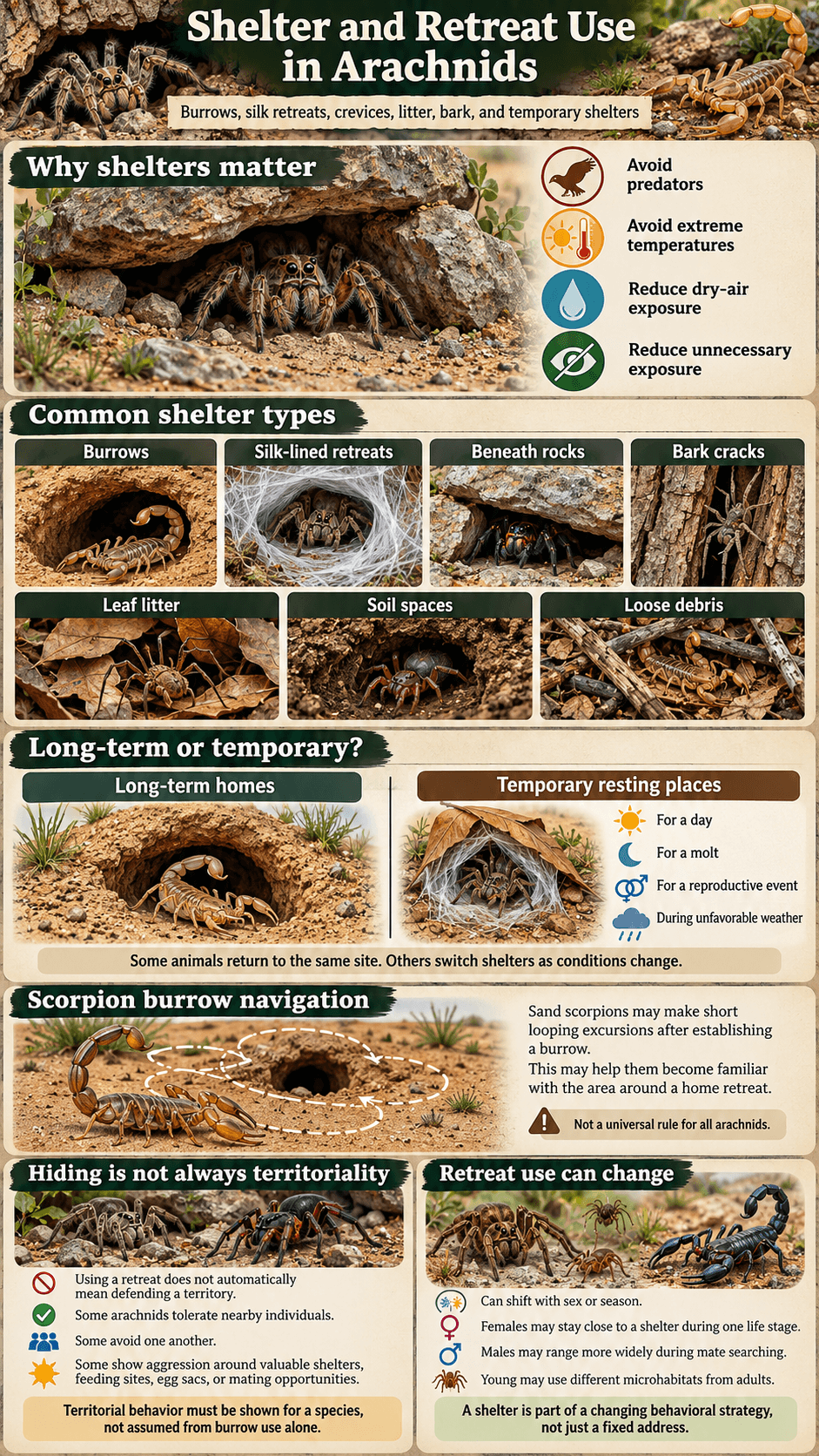
Shelters help arachnids avoid predators, extreme temperatures, dry air, and unnecessary exposure. Burrows are especially important for some scorpions and spiders. Other arachnids hide beneath rocks, inside bark cracks, among leaf litter, within soil spaces, under loose debris, or in silk-lined retreats.
Some retreats are long-term homes. Others are temporary resting places used for a day, a molt, a reproductive event, or an unfavorable weather period. An animal may return repeatedly to the same site or switch shelters as conditions change.
Research on sand scorpions found that individuals formed burrows and made short looping excursions after establishing them before ranging farther. The study of scorpion burrow navigation interpreted these movements as possible learning walks associated with becoming familiar with the area around a home retreat. That finding applies to the studied scorpions and should not be turned into a universal arachnid rule. Many of these behaviors depend directly on how arachnids move through vegetation, soil, burrows, silk, and host-associated environments.
Hiding versus territoriality
Using a retreat does not automatically mean defending a territory. Some arachnids tolerate nearby individuals, some avoid one another, and others show aggression around valuable shelters, feeding sites, egg sacs, or mating opportunities. Territorial behavior should be demonstrated for a species rather than inferred merely because an individual occupies a burrow.
Retreat use can also shift with sex or season. A female may remain close to a shelter during one life stage, while a male may range more widely during mate searching. Young animals may use different microhabitats from adults. The shelter itself is therefore part of a changing behavioral strategy rather than just a fixed address.
Mate Searching and Courtship
Visual, vibrational, chemical, and tactile signals in spiders
Spider courtship can combine several sensory channels. Visually oriented species may use leg waves, body movements, colors, or ornamental structures. Web-dwelling species can transmit patterned vibrations through silk. Chemical cues on silk or surfaces can reveal the presence and reproductive condition of a potential mate, and close-range courtship may include touch.
These signals help partners identify each other and coordinate approach. In predatory animals, courtship can also reduce the chance that a potential mate is treated like prey. Sexual cannibalism occurs in some spiders, but it is not a universal or inevitable part of spider mating.
Multimodal courtship is especially well documented in wolf and jumping spiders. The exact mix of visual, vibrational, chemical, and tactile information differs among species, so no single sequence represents Araneae as a whole.
Scorpion courtship promenade and spermatophore placement at behavior depth
Scorpion courtship often includes a characteristic promenade in which the male grasps the female’s pedipalps and guides her while searching for a suitable surface. He eventually deposits a spermatophore, a structure carrying sperm, and positions the female so sperm transfer can occur.
A review of scorpion courtship and weapon use describes the promenade and the male’s search for an appropriate spermatophore site. The details vary among species, and some courtships include additional tactile or stinging behaviors.
Behaviorally, the striking feature is coordination. Two predatory animals that usually move independently must maintain contact and respond to each other’s movements long enough for mating to proceed.
Courtship is only one part of reproduction
Courtship explains how animals locate, recognize, assess, and coordinate with potential mates. It does not by itself explain fertilization, egg production, live birth, juvenile development, or the many forms of parental care found across Arachnida. Courtship and mate searching form the behavioral side of the wider process of arachnid reproduction.
Keeping those questions separate makes courtship easier to understand. A visual display, vibrational signal, chemical cue, or scorpion promenade is a behavioral interaction occurring before or during mating, while later reproductive events follow their own biological processes.
Aggregation and Social Interactions
Many species live mostly alone, but solitude is not universal
Many familiar arachnids spend much of their adult lives alone. They may meet conspecifics mainly during courtship, competition, feeding opportunities, or temporary crowding. That pattern is common enough to shape the popular image of arachnids as solitary animals.
However, solitary is not a synonym for antisocial, and it does not describe every species. Individuals can respond to chemical traces, tolerate neighbors, form temporary aggregations, associate with offspring, or coordinate around shared structures without living in a permanent cooperative society.
Harvestmen provide good examples of aggregation. Some species rest together in groups, which may influence predator defense, moisture balance, or access to shelters depending on the species and environment. Grouping does not necessarily mean that individuals cooperate in feeding or reproduction.
Aggregations, communal behavior, subsociality, and maternal associations
Aggregation simply means individuals gather in the same place. Communal behavior goes further when animals share a structure while carrying out many activities independently. Subsocial behavior usually involves prolonged parent-offspring association or cooperation that does not reach the organization seen in the most complex animal societies.
Arachnids show examples across this spectrum. Young scorpions spend an early period on the mother’s back. Some amblypygids maintain extended mother-offspring associations. Certain spiders share retreats or web frameworks. Others cooperate in prey capture or brood care.
A review of social behavior across arachnids summarizes maternal associations in amblypygids, social tendencies in some scorpions, and the distinction between communal and cooperative spider societies. These are real exceptions to universal solitude, not evidence that most arachnids live socially.
Rare social spiders and how their groups differ from insect societies
A small number of spider species form persistent cooperative groups in which individuals can share prey capture, web maintenance, and brood care. Such societies are biologically important because spiders evolved this behavior from ancestors in a largely solitary lineage.
Social spider groups should not be described as miniature ant colonies. They generally lack the queen-worker caste systems, sterile worker classes, and division of labor that define many eusocial insect societies. The organization, genetics, dispersal, and reproductive structure of social spiders follow different patterns.
Even among group-living spiders, communal and cooperative systems differ. Some species simply tolerate neighbors in connected webs while each spider captures its own food. Others participate jointly in prey capture or care. “Social spider” therefore covers more than one degree of social interaction.
Host Seeking in Ticks
Questing and contact with hosts
Ticks are parasites rather than predators, so their host-seeking behavior follows a different logic from spider or scorpion hunting. Many species climb vegetation or move to exposed positions and wait with the first pair of legs extended. This posture is called questing.
The CDC description of tick host seeking explains that ticks can respond to breath, body odors, heat, moisture, vibrations, and other cues. When a host brushes past the waiting tick, it can climb aboard. Ticks cannot fly or jump onto a host from a distance.
Questing is waiting for contact, not a chase
Questing is behaviorally closer to strategic positioning than pursuit. The tick chooses or reaches a place where contact is more likely, responds to environmental and host-related cues, and transfers when opportunity occurs.
Species differ in how high they climb, how long they wait, which hosts they use, and how they respond to temperature or humidity. Host seeking should therefore be described by species and environment rather than by a single universal rule for all ticks.
Grooming, Cleaning, and Self-Maintenance
Why grooming can serve different functions
Arachnids use grooming to clean appendages and sensory surfaces, remove debris, and maintain structures used for movement or information gathering. The exact actions vary among groups. A spider may pass legs through the mouthparts or clean the pedipalps. Harvestmen can perform leg-threading movements. Scorpions and mites show their own self-cleaning behaviors.
Grooming can become especially important after feeding, digging, contact with sticky material, or movement through dusty substrates. Sensory hairs and chemical receptors only work well when their surfaces remain exposed to the environment.
Behavioral studies must still be interpreted at the species level. The fact that one harvestman cleans certain legs more frequently or one scorpion performs a specialized grooming sequence does not establish a universal grooming pattern for Arachnida.
Seasonal and Environmental Behavior
Temperature, humidity, breeding cycles, and seasonal activity
Behavior can change across the year as temperature, rainfall, humidity, daylight, prey abundance, and reproductive cycles change. In seasonal climates, an arachnid may be abundant and active at the surface for only part of the year while spending other periods in sheltered or less active states.
Sexes can also show different seasonal patterns. Mate-searching males may move farther during reproductive periods, while females may remain closer to retreats or young. Juveniles can occupy different microhabitats from adults and may appear at different times of year.
There is no single arachnid “season.” Desert scorpions, temperate spiders, tropical harvestmen, host-seeking ticks, cave arachnids, and soil mites respond to different environmental cycles. Seasonal behavior makes sense only in relation to the species and habitat involved.
Behavior When Arachnids Face Threats
Threat postures, escape, retreat, and stillness
When threatened, an arachnid may run, retreat into shelter, freeze, raise appendages, display weapons, drop from vegetation, hide beneath the substrate, or use other group-specific responses. Scorpions may raise the metasoma and pedipalps. Some spiders rear or expose defensive structures. Harvestmen can freeze, bob, vibrate, aggregate, or lose a leg through autotomy in certain circumstances.
The response depends on what the animal detects, how close the threat is, whether a retreat is available, and the costs of confrontation. An animal that remains motionless is not necessarily unaware of danger. Stillness itself can reduce detection by visually oriented predators.
Defense changes behavior before physical contact
Defensive behavior begins before venom, pincers, chemicals, silk, hairs, armor, or autotomy are actually used. Choosing a shelter, becoming nocturnal, freezing, dropping away, or avoiding exposed ground can reduce the chance that physical defense is needed at all. Threat responses such as freezing, retreating, displaying, or escaping are also part of how arachnids defend themselves.
This behavioral layer is important because it prevents arachnids from being understood only through weapons. The first response to danger is often avoidance or escape rather than attack.
Common Behavior Myths
Arachnids are mindless reflex machines
Arachnid nervous systems are different from vertebrate brains, but behavior can still be flexible. Jumping spiders adjust hunting and courtship sequences according to targets and sensory information. Scorpions can navigate around retreats and show repeatable patterns of exploration. Spiders, harvestmen, and other groups can modify responses with experience in species-specific contexts.
This does not mean every arachnid has the same learning abilities or human-like cognition. Evidence from one lineage should not be generalized to all Arachnida. The accurate conclusion is that arachnid behavior includes more flexibility than a simple fixed-reflex model suggests.
All arachnids are solitary
Many are largely solitary, but not all. Temporary aggregations occur in several groups, mothers and offspring can remain associated, and a small number of spider species form persistent cooperative societies. Sociality exists on a continuum rather than as a yes-or-no label.
Social spiders form ant-like colonies
Cooperative spiders can share prey capture, web maintenance, and care of young, but their societies are not organized around ant-like reproductive castes. Applying social-insect terminology without qualification can hide important differences in how spider groups form and persist.
Camel spiders chase people to attack
Solifuges, often called camel spiders, are active runners, but stories that they deliberately chase people in order to attack are misleading. In hot open environments, an animal may move toward a person’s shadow or another patch of shade. Interpreting that movement as hostile pursuit assigns human-like intent that the behavior does not demonstrate.
How Senses, Reproduction, Defense, Habitat, and Feeding Shape Behavior
Senses and movement
Behavior depends on what an arachnid can detect and how it can move. Vision guides many jumping spiders. Vibration travels through webs and ground surfaces. Scorpions sample substrates with pectines. Ticks use sensory structures on the first legs during host seeking. Amblypygids sweep long antenniform legs through the surroundings while walking on the rear three pairs.
Movement turns sensory information into action. An animal approaches, waits, retreats, courts, climbs, digs, or remains still because sensory systems continuously update what is happening nearby.
Reproduction and parental care
Courtship is behavioral, but reproduction continues long after courtship ends. Egg guarding, carrying young, remaining near offspring, or changing activity during reproductive periods can all alter how an arachnid uses space and responds to other individuals.
Parental behavior varies greatly. Some spiders guard egg sacs, wolf spiders can carry spiderlings, scorpion young spend an early period on the mother’s back, and some amblypygids maintain extended family associations. These examples should be treated as lineage-specific strategies rather than a single arachnid parenting pattern.
Defense, habitats, and feeding ecology
Habitat creates the stage on which behavior occurs. Burrows favor retreat-centered routines, webs create a vibration-rich hunting surface, leaf litter offers hidden pathways, and exposed vegetation creates opportunities for questing ticks. Feeding ecology then influences whether the animal searches, waits, stalks, attaches to a host, or returns to a shelter.
Defense shapes the same choices. An arachnid may hunt only when temperature and predation risk are favorable, remain close to a refuge, or use stillness and camouflage before resorting to physical defenses. Behavior is the point where anatomy, senses, food, reproduction, and environment meet.
FAQ
Are arachnids nocturnal?
Many arachnids are active mainly at night, including numerous scorpions, harvestmen, and spiders, but nocturnality is not universal. Some spiders are strongly diurnal, and other species are active around dawn or dusk. Activity can also shift with temperature, humidity, season, food availability, and reproductive condition.
Do arachnids live in groups?
Many arachnids spend much of their lives alone, but grouping occurs in several forms. Some harvestmen form aggregations, some arachnid mothers remain with young, communal spiders tolerate neighbors in shared structures, and a small number of spider species cooperate in prey capture or brood care. These groups are not all organized in the same way.
How do spiders court mates?
Spider courtship can use visual displays, vibrations, chemical cues, touch, or combinations of several channels. The exact sequence depends on the species. Jumping spiders often emphasize visual signaling, while many web-associated spiders use vibrations transmitted through silk. Courtship helps partners recognize and coordinate with one another before mating.
What is tick questing?
Questing is a host-seeking posture used by many ticks. A tick climbs or moves to an exposed position, holds its first pair of legs outward, and waits for a host to make contact. The tick can respond to host-related and environmental cues, but it does not fly or jump toward a person or animal.
Do arachnids learn?
Evidence from spiders, scorpions, and other studied arachnids shows that some species can modify behavior with experience, remember locations or routes, or adjust responses to different situations. The form and complexity of learning vary, and research on one group cannot be applied automatically to every arachnid. It is safest to say that learning and behavioral flexibility occur in some well-studied lineages rather than treating Arachnida as cognitively uniform.
Final Thoughts
Arachnid behavior includes far more than web building or venomous attack. These animals hunt by ambush or pursuit, use retreats and burrows, time their activity around environmental conditions, search for mates, exchange courtship signals, groom, aggregate, care for young, seek hosts, and respond flexibly to threats.
The major pattern is diversity. Many arachnids live mostly alone, but social exceptions matter. Many are nocturnal, but others are active by day. Spiders offer spectacular examples of hunting and courtship, but scorpions, ticks, harvestmen, mites, and other lineages reveal equally important behavioral strategies. Understanding those differences shows how arachnids use behavior to connect their senses, movement, habitat, feeding, reproduction, and survival.

Ethan Walker is the founder and research editor of Animal Fact Central. He creates and reviews educational animal facts content using trusted wildlife, pet care, and science-based sources. His work focuses on making animal behavior, adaptations, habitats, and species facts clear, accurate, and engaging for everyday readers.
Read More Details About Ethan Walker: https://animalfactcentral.com/ethan-walker/