

Arthropod conservation is difficult to summarize with a single number. Arthropoda includes insects, arachnids, crustaceans, myriapods, horseshoe crabs, and many smaller or less familiar lineages spread across land, freshwater, oceans, caves, soils, plants, and animal hosts. These groups are not monitored equally, and their conservation problems are not identical.
Some arthropod populations have declined sharply in particular regions, habitats, or time periods. Some species are formally threatened with extinction. Others remain common, are increasing, or have never been assessed well enough to support a reliable trend. Evidence from one insect study, one freshwater crayfish assessment, or one coastal horseshoe crab population cannot automatically describe the whole phylum.
The most useful conservation question is therefore not “What percentage of arthropods are disappearing?” It is “Which arthropods, in which places, over what period, measured in what way, and under which pressures?”
Quick Answer: Why Arthropod Conservation Requires Careful Evidence
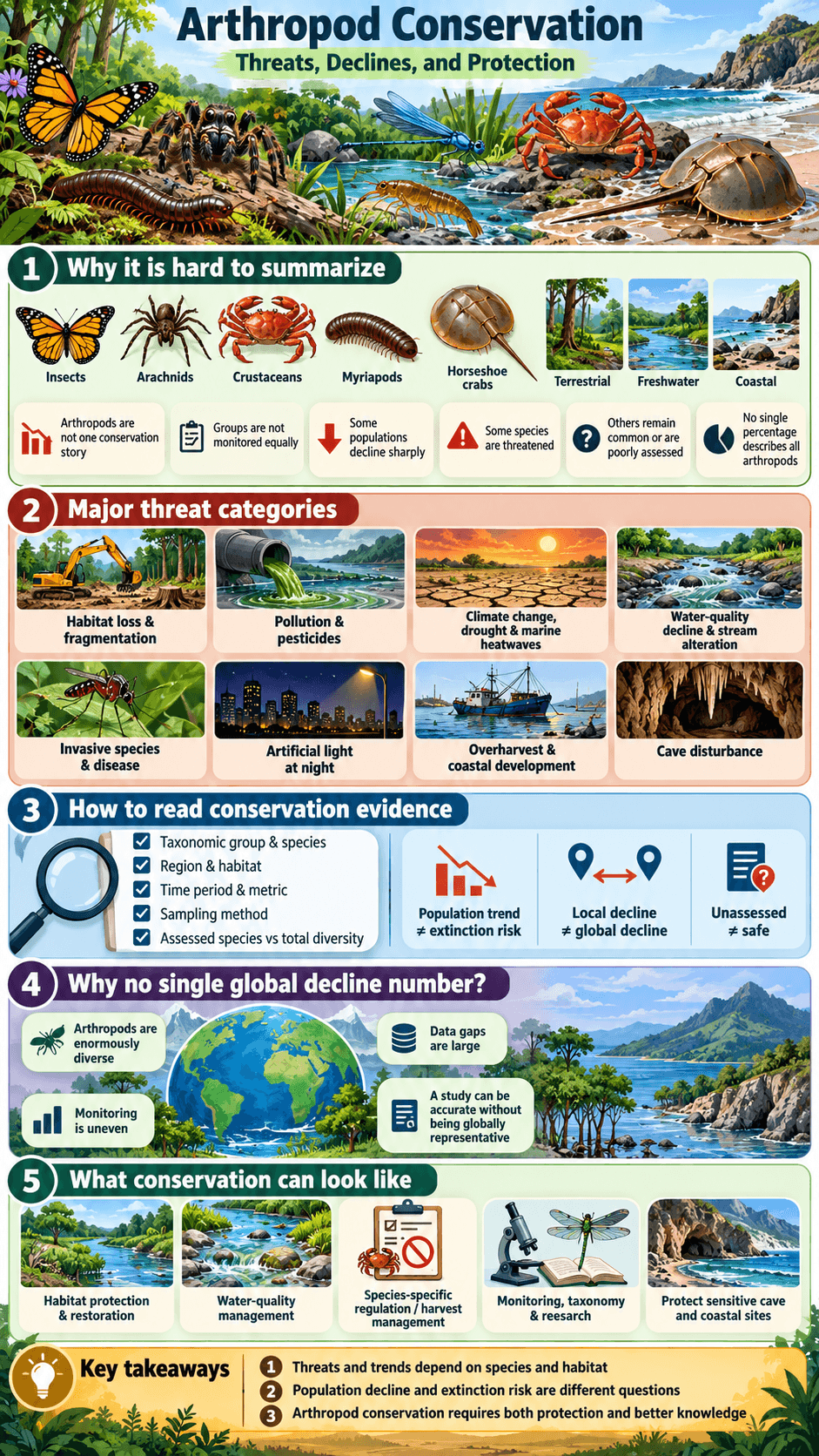
Arthropods face habitat loss and fragmentation, pollution, pesticides in relevant systems, altered freshwater flow and water quality, climate change, drought, marine heatwaves, invasive species, disease, artificial light, overharvest, collection pressure, coastal development, cave disturbance, and other pressures. The importance of each threat depends on species and habitat.
Conservation evidence is uneven. The IUCN Red List 2026 summary statistics explicitly warns that not all taxonomic groups have been completely assessed and that threatened percentages for incompletely evaluated groups can be biased.
That means a conservation overview must separate population trends from extinction-risk assessments, distinguish assessed species from total known diversity, and avoid extrapolating from well-studied groups to poorly studied ones.
Why There Is No Single Global Arthropod Decline Percentage
Arthropoda Is Enormous and Unevenly Monitored
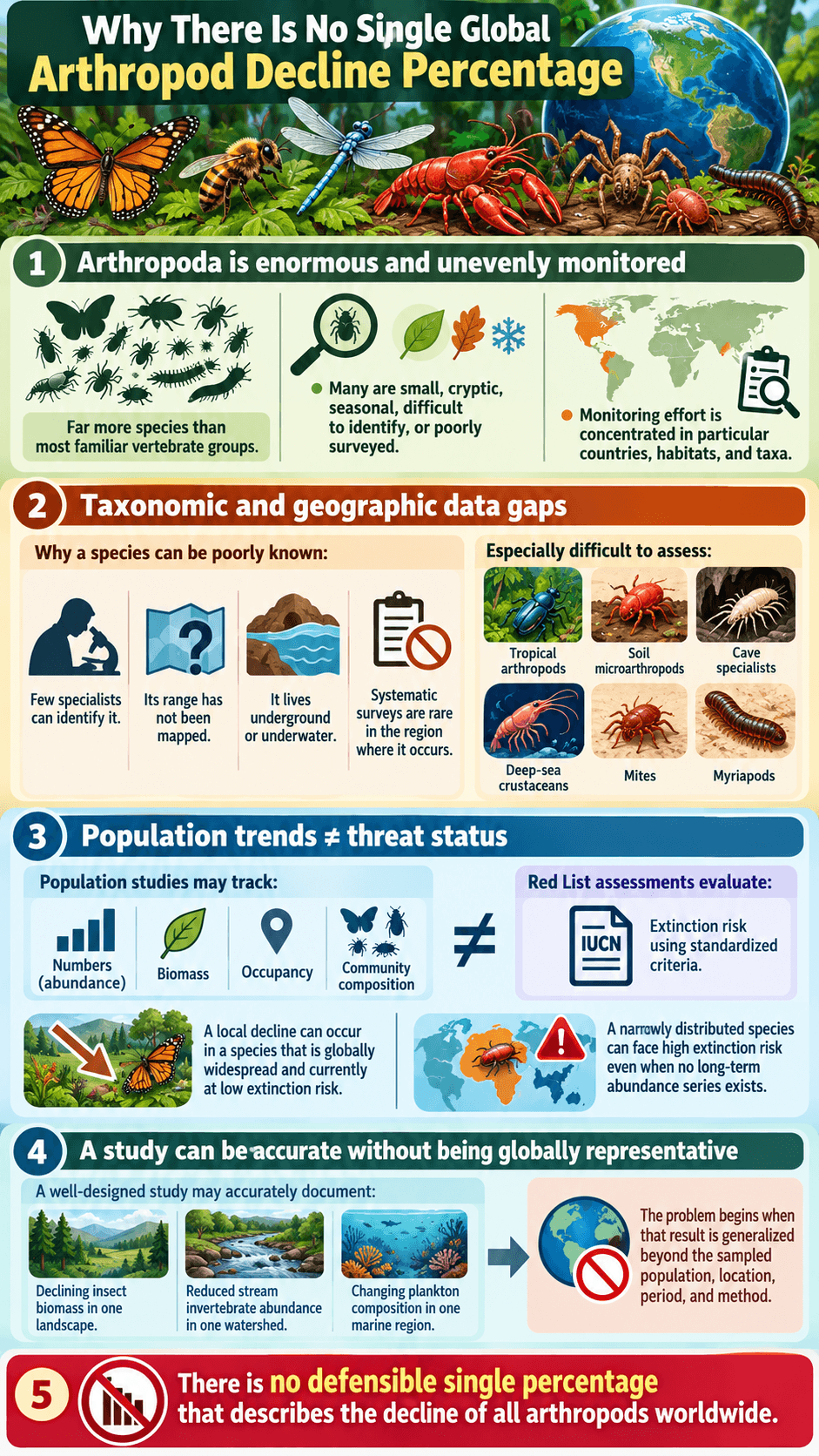
Arthropods contain far more species than most familiar vertebrate groups, and many are small, cryptic, seasonal, difficult to identify, or poorly surveyed. Monitoring effort is concentrated in particular countries, habitats, and taxa.
Well-studied butterflies, bees, dragonflies, freshwater crayfishes, commercially relevant crustaceans, and selected spiders therefore sit beside enormous numbers of arthropods with little long-term population information.
Taxonomic and Geographic Data Gaps
A species can be poorly known because few specialists can identify it, because its range has not been mapped, because it lives underground or underwater, or because systematic surveys are rare in the region where it occurs.
Tropical arthropods, soil microarthropods, cave specialists, deep-sea crustaceans, mites, and many myriapods can be especially difficult to assess comprehensively.
Population Trends Versus Species-Level Threat Status
A measured decline in abundance is not the same thing as an IUCN threatened category. Population studies may track numbers, biomass, occupancy, or community composition over a certain period. Red List assessments evaluate extinction risk using standardized criteria.
A local decline can occur in a species that is globally widespread and currently at low extinction risk. Conversely, a narrowly distributed species can face high extinction risk even when no long-term abundance series exists.
A Study Can Be Accurate Without Being Globally Representative
A well-designed study may accurately document declining insect biomass in one landscape, reduced stream invertebrate abundance in one watershed, or changing plankton composition in one marine region. The problem begins when that result is generalized beyond the sampled population, location, period, and method.
There is therefore no defensible single percentage that describes the decline of all arthropods worldwide.
How to Read Arthropod Conservation Evidence

Identify the Taxonomic Group and Species
Start by asking what organisms were actually measured. “Arthropods” may mean all individuals caught in traps, only flying insects, one family of spiders, freshwater crayfish, zooplanktonic crustaceans, or a single threatened species.
Taxonomic precision matters because different groups respond differently to land use, water chemistry, climate, disease, and habitat structure.
Check the Region and Habitat
A decline in an intensively farmed landscape does not necessarily predict a trend in tropical forest, desert soil, alpine meadow, open ocean, or cave groundwater.
Habitat context affects both exposure to threats and the ecological mechanisms behind change.
Check the Time Period and Metric
A five-year abundance trend and a fifty-year occupancy trend answer different questions. Biomass, species richness, individual counts, range size, catch per unit effort, and extinction risk are not interchangeable.
Short-term fluctuations can also be large, particularly in species affected by rainfall, temperature, tides, seasonal reproduction, or episodic food resources.
Check the Sampling Method and Study Design
Light traps, pitfall traps, sweep nets, benthic kick samples, plankton nets, visual counts, environmental DNA, fisheries surveys, and museum records detect different portions of arthropod communities.
A method can miss species that are too small, too large, inactive at the sampling time, outside the sampled habitat, or behaviorally unlikely to enter the device.
Separate Assessed Species From Total Diversity
The IUCN Barometer of Life reports that invertebrates form a relatively small share of animal assessments compared with their enormous biodiversity and that targeted assessment programs are still expanding coverage.
IUCN lists some arthropod subsets as comprehensively assessed, such as dragonflies and damselflies, freshwater crabs, lobsters, and selected freshwater crustaceans. That does not mean Arthropoda as a whole is comprehensively assessed.
Major Threat Categories
Habitat Loss and Fragmentation
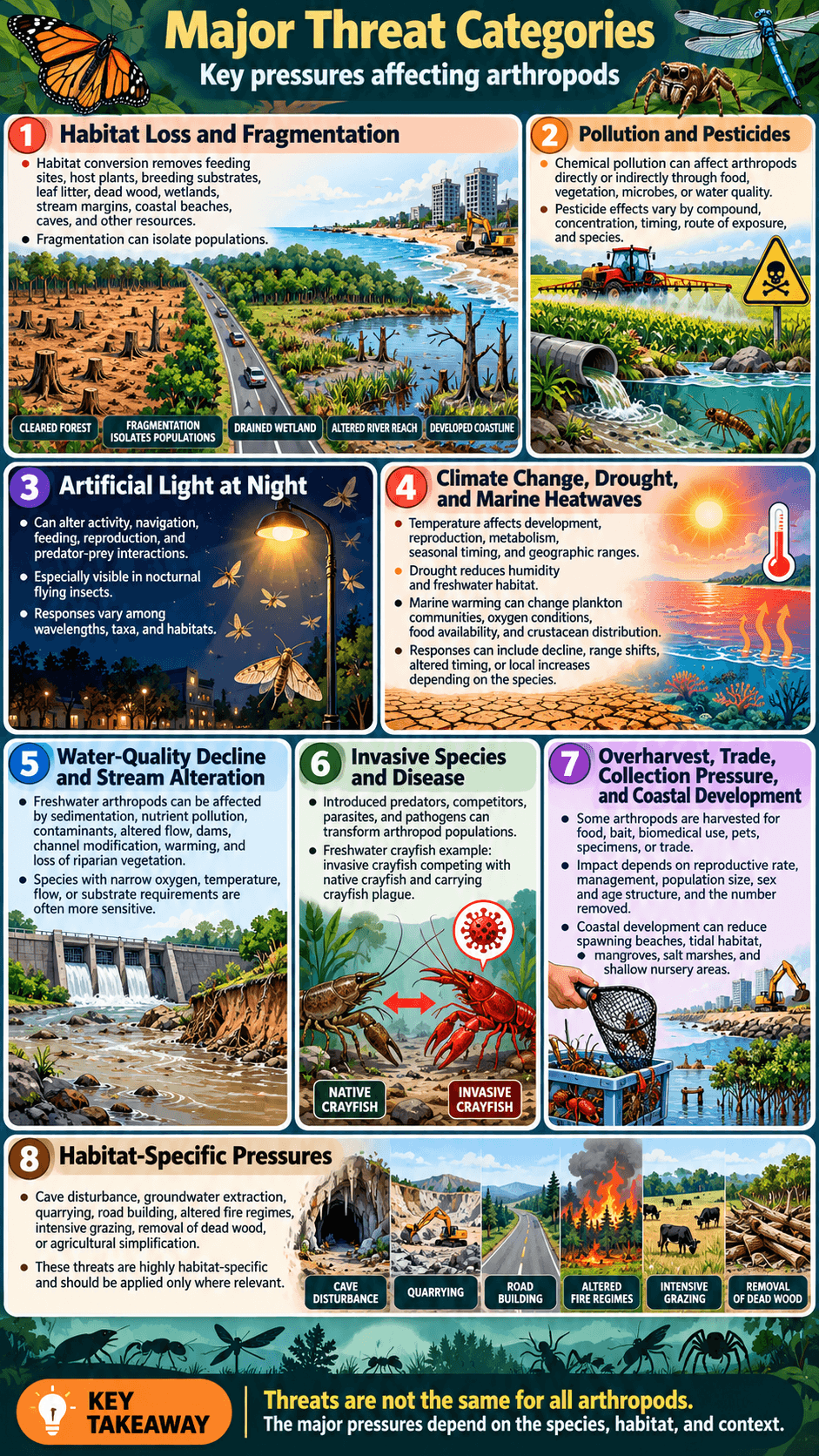
Habitat conversion can remove feeding sites, host plants, breeding substrates, leaf litter, dead wood, wetlands, stream margins, coastal beaches, caves, or other resources required by arthropods.
Fragmentation can also isolate populations. For species with poor dispersal or highly specialized habitat needs, a road, drained wetland, cleared forest patch, altered river reach, or developed coastline can separate populations that previously exchanged individuals.
Pollution and Pesticides Where Relevant
Chemical pollution can affect arthropods directly through toxicity or indirectly by changing food, vegetation, microbial communities, or water quality. Agricultural pesticides are especially relevant when exposure overlaps sensitive species, habitats, or life stages.
Effects vary by compound, concentration, timing, route of exposure, and species. “Pesticides are the cause of arthropod decline” is therefore too broad without specifying the evidence.
Artificial Light at Night
Artificial light can alter activity, navigation, feeding, reproduction, and predator-prey interactions in light-sensitive nocturnal arthropods. Flying insects are especially visible examples, but responses vary among wavelengths, taxa, and habitats.
Light pollution is not equally important for every arthropod and should be treated as one pressure among many.
Climate Change, Drought, and Marine Heatwaves
Temperature affects arthropod development, reproduction, metabolism, seasonal timing, and geographic ranges. Drought can reduce humidity and freshwater habitat, while extreme heat can push species beyond physiological limits.
In marine systems, warming and marine heatwaves can change plankton communities, oxygen conditions, food availability, and the distribution of crustaceans and other arthropods. Responses can include decline, range shifts, altered timing, or local increases depending on the species.
Water-Quality Decline and Stream Alteration
Freshwater arthropods can be affected by sedimentation, nutrient pollution, contaminants, altered flow, dams, channel modification, warming, and loss of riparian vegetation.
Species with narrow oxygen, temperature, flow, or substrate requirements are often more sensitive than broad generalists.
Invasive Species and Disease
Introduced predators, competitors, parasites, and pathogens can transform arthropod populations. Freshwater crayfish provide a strong example.
The U.S. Fish and Wildlife Service overview of invasive crayfish management describes nonindigenous crayfish competing with native crayfish and carrying crayfish plague, a pathogen capable of causing mass mortality in susceptible populations.
Overharvest, Trade, Collection Pressure, and Coastal Development
Some arthropods are harvested for food, bait, biomedical use, pets, specimens, or trade. Whether harvest threatens a population depends on reproductive rate, management, population size, sex and age structure, and the number removed.
Coastal development can also reduce spawning beaches, tidal habitat, mangroves, salt marshes, and shallow nursery areas used by marine and coastal arthropods.
Cave Disturbance, Infrastructure, Fire-Regime Change, and Agricultural Intensification
Specialized arthropods may be affected by cave visitation, groundwater extraction, quarrying, road building, altered fire regimes, intensive grazing, removal of dead wood, or agricultural simplification.
These threats are highly habitat-specific. They should be applied only where research or species assessments identify them as relevant.
Insect Conservation as One Part of the Arthropod Picture
Insect Evidence Is Important but Not Universal
Insects are the best monitored arthropods in many terrestrial systems, so they contribute a large share of public discussion about arthropod declines.
Studies of butterflies, moths, bees, beetles, dragonflies, grasshoppers, and broader insect assemblages have documented declines in some places and periods. Other studies find stable, increasing, or mixed trends.
Why Insect Trends Cannot Automatically Represent All Arthropoda
Crustaceans occupy different habitats, use different respiratory systems, and face different water-quality, fisheries, salinity, and ocean-change pressures. Cave arachnids and soil myriapods may have tiny ranges and completely different monitoring problems.
An insect trend can contribute to an arthropod-wide conservation picture, but it cannot stand in for the entire phylum.
Arachnid Conservation
Habitat Specialists and Poorly Assessed Groups
Arachnids include spiders, scorpions, mites, ticks, harvestmen, pseudoscorpions, and other lineages. Some are widespread generalists, while others are confined to caves, islands, dunes, forests, mountaintops, or narrow microhabitats.
Assessment coverage is limited compared with the known diversity of arachnids. This means the absence of a threatened listing often reflects lack of assessment rather than proof that a species is secure.
Avoiding Spider-Centric Assumptions
Spiders receive more research and public attention than many arachnids, but spider ecology cannot represent mites, scorpions, pseudoscorpions, ticks, or harvestmen.
Conservation needs can differ even among spider species because web builders, burrowers, cave specialists, dune species, and forest litter hunters use different habitats.
Freshwater Crustaceans
Restricted Ranges and Water-Quality Sensitivity
Freshwater crayfishes, crabs, shrimps, amphipods, isopods, copepods, and branchiopods can have extremely different range sizes. Some occur across large watersheds, while others are confined to one spring, cave system, drainage, lake, or short section of stream.
Narrow ranges increase vulnerability because one pollution event, drought, invasive species, or major habitat alteration can affect a large proportion of the total population.
Fragmentation, Invasive Species, and Disease
Dams, culverts, channel alteration, water extraction, and degraded water quality can isolate aquatic populations. Introduced crayfish can compete with native species and alter habitat, while crayfish plague is a major disease threat in susceptible lineages.
The severity of these pressures varies among species and regions.
Why One Crayfish Assessment Cannot Represent All Crustaceans
Freshwater crayfishes are useful conservation case studies because many have relatively restricted distributions, but crustaceans also include marine copepods, deep-sea amphipods, terrestrial isopods, shrimp, crabs, barnacles, ostracods, and many other forms.
A high threat level in one comprehensively assessed freshwater subgroup cannot be converted into a threat percentage for all crustaceans.
Marine Arthropods and Coastal Pressures
Fisheries, Coastal Development, and Ocean Change
Marine arthropods can be affected by direct harvest, bycatch, seafloor disturbance, coastal construction, pollution, hypoxia, ocean warming, acidification, and changing plankton or prey communities.
The importance of these pressures differs from species to species. A harvested lobster, planktonic copepod, intertidal amphipod, deep-sea isopod, and coastal horseshoe crab do not share one conservation pathway.
Horseshoe Crabs as a Carefully Bounded Case Study
Atlantic horseshoe crabs are harvested for bait and biomedical purposes, and their eggs are an important food resource for migrating shorebirds in Delaware Bay and other coastal areas.
The U.S. Fish and Wildlife Service Atlantic horseshoe crab account explains that increased harvest in the 1990s prompted coast-wide management, including state harvest quotas and a sanctuary near Delaware Bay, and that commercial landings have been reduced under active management.
This is a strong conservation example because it links harvest, species management, and food-web effects. It should not be generalized to every horseshoe crab population worldwide or to marine arthropods as a whole.
Cave and Groundwater Arthropods
Small Ranges and Specialized Habitats
Cave and groundwater arthropods can be restricted to very small areas and may have low dispersal ability. Some depend on stable humidity, groundwater chemistry, darkness, narrow temperature ranges, or specific food inputs.
These conditions make them vulnerable to groundwater extraction, contamination, quarrying, infrastructure, altered drainage, excessive disturbance, or changes in organic inputs.
Why Exact Rare-Species Locations May Need Protection
Highly localized cave species can be vulnerable to collecting, trampling, habitat damage, or disturbance if exact sites are widely publicized.
Conservation communication can therefore describe range size and habitat needs without revealing sensitive locality details.
Myriapods and Other Understudied Arthropods
Assessment Gaps
Millipedes, centipedes, pauropods, symphylans, many mites, and numerous smaller arthropod groups receive less conservation assessment than familiar vertebrates or flagship insects.
Data gaps can include basic taxonomy, distributions, population sizes, habitat requirements, and responses to land-use change.
Habitat-Specific Risks Without Assuming Universal Decline
A litter-dependent millipede may be vulnerable to forest clearing or drying, while a cave centipede may be vulnerable to groundwater change and a widespread urban centipede may remain common.
The correct conservation conclusion must follow the evidence for the species or habitat rather than the name of the larger group.
Understanding the IUCN Red List for Arthropods
Incomplete and Uneven Assessment Coverage
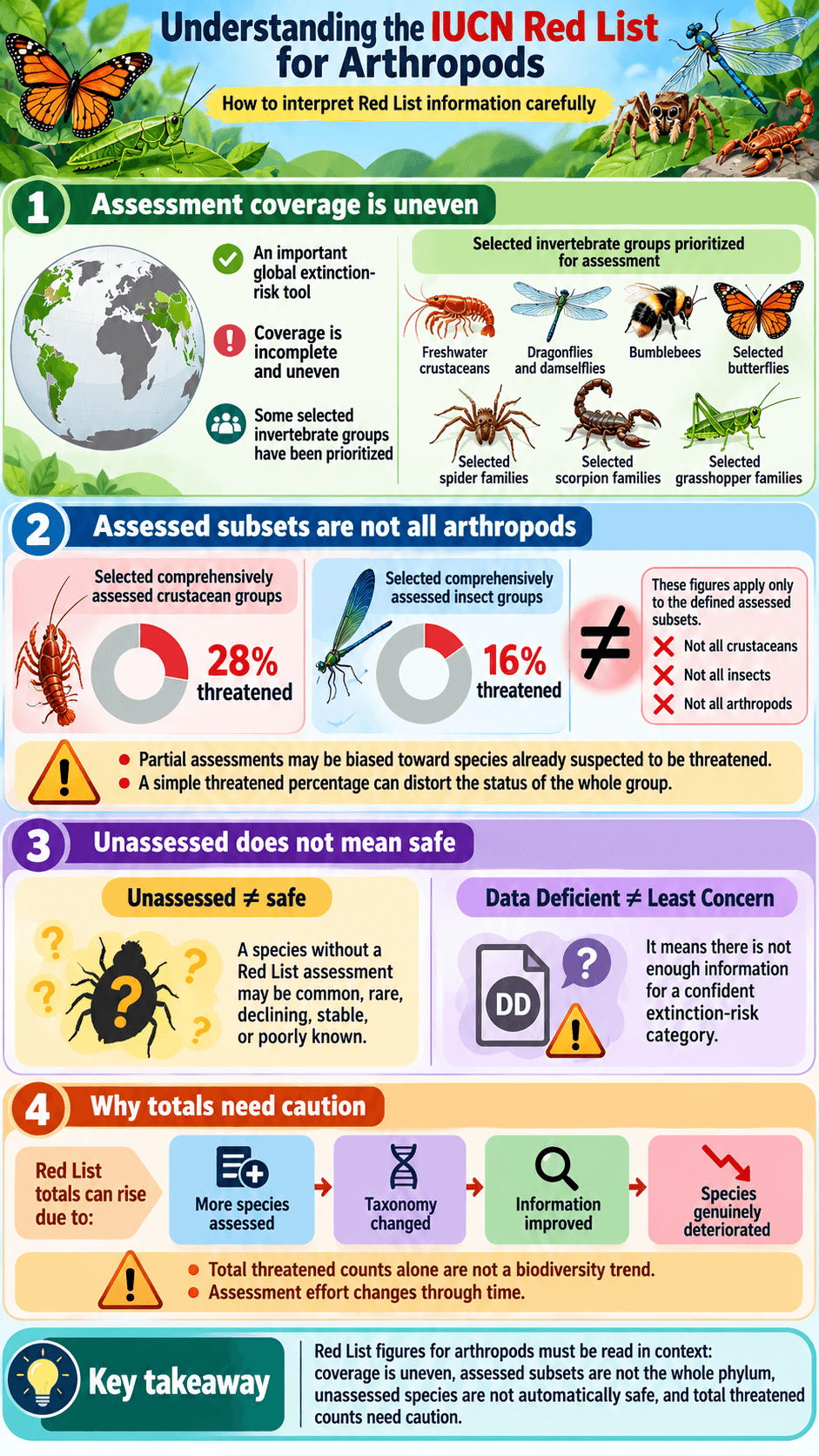
The IUCN Red List is one of the most important global tools for evaluating species extinction risk, but coverage is uneven. The 2026 Red List statistics emphasize that many groups remain incompletely assessed.
IUCN notes that assessment work has prioritized selected invertebrate groups, including freshwater crustaceans, dragonflies and damselflies, bumblebees, selected butterflies, and selected spider, scorpion, and grasshopper families.
Percentage Threatened Among Assessed Taxa Is Not Percentage Threatened Among All Arthropods
IUCN currently reports a best estimate of 28 percent threatened for selected comprehensively assessed crustacean groups and 16 percent for selected comprehensively assessed insect groups. Those figures apply to the defined assessed subsets, not to all crustaceans, all insects, or all arthropods.
For incompletely evaluated groups, IUCN warns that assessment efforts may be biased toward species already suspected to be threatened. Reporting a simple threatened percentage from those partial assessments can therefore exaggerate or otherwise distort the status of the entire group.
Unassessed Does Not Mean Safe
A species without a Red List assessment has not been demonstrated to be secure. It may be common, rare, declining, stable, or simply too poorly known.
Likewise, Data Deficient does not mean Least Concern. It means available information is insufficient for a confident extinction-risk category.
Why Changes in Red List Totals Need Caution
The number of species listed as threatened can rise because more species were assessed, taxonomy changed, information improved, or species genuinely deteriorated.
The IUCN explanation of the Red List Index specifically warns that total threatened counts across updates cannot by themselves be used as a biodiversity trend because assessment effort changes through time.
What Conservation Can Look Like
Habitat Protection and Restoration
Conservation can protect forests, wetlands, dunes, streams, caves, grasslands, coastal beaches, reefs, dead wood, leaf litter, and other habitats needed by arthropods.
Restoration is most effective when it targets the ecological requirements of the species rather than assuming any increase in vegetation or habitat area will benefit all arthropods equally.
Water-Quality and Pollution Management
Reducing harmful contaminants, sediment, nutrient loading, and other forms of water degradation can protect freshwater and coastal arthropods.
Management may also involve maintaining natural flow, riparian vegetation, groundwater conditions, and connectivity where these are important to target species.
Species-Specific Regulation or Harvest Management
Harvested arthropods may require quotas, size limits, seasonal rules, protected areas, gear restrictions, or other measures depending on the fishery or collection pressure.
Horseshoe crab management demonstrates how conservation can integrate species harvest with the needs of other wildlife that depend on the same resource.
Monitoring, Taxonomy, and Research
Conservation cannot respond effectively to species that have not been identified, mapped, or monitored. Taxonomic research and museum collections remain fundamental because they establish what species exist and how they can be distinguished.
Long-term monitoring is equally important. Consistent methods allow researchers to separate short-term fluctuation from sustained change.
Protecting Sensitive Cave and Coastal Sites
Highly localized species may benefit from restrictions on disturbance, careful infrastructure planning, groundwater protection, or protection of spawning and breeding sites.
Public conservation information should support protection without making rare populations easier to collect or disturb.
What Readers Often Misunderstand
Arthropods Are Disappearing Everywhere
Evidence does not support one universal trend across all arthropods, regions, and habitats. Serious declines are documented in some populations and groups, but other populations are stable, increasing, fluctuating, or insufficiently monitored.
Most Arthropods Are Endangered
That conclusion cannot be drawn from current assessments. Arthropod diversity is enormous, while assessment coverage remains incomplete and uneven.
One Insect Decline Statistic Describes the Whole Phylum
No. Insect studies can provide important evidence for insect populations in the places and periods studied. They cannot automatically represent arachnids, crustaceans, myriapods, horseshoe crabs, or other arthropods.
Unassessed Means Safe
No. Unassessed means that a formal assessment has not been completed. It is an information gap, not a conservation category.
How This Connects to Nearby Arthropod Topics
Ecosystem Roles Versus Conservation Need
An arthropod can be ecologically important without being threatened, and a threatened species can have an ecological role that is poorly understood.
Ecological importance and extinction risk are different questions.
Habitat Specialization Versus Vulnerability
Species restricted to one cave, spring, island, host, stream, or narrow climate zone may have fewer alternatives when conditions change. Habitat specialization can therefore increase vulnerability, although specialization alone does not prove that a species is declining.
Insect Conservation Versus Arthropoda-Wide Evidence
Insect conservation can examine pollinators, agricultural landscapes, insect monitoring, and insect-specific threats in depth. An Arthropoda-wide conservation view must add freshwater and marine crustaceans, arachnids, myriapods, cave species, coastal harvest, and assessment gaps.
FAQ
Are Arthropods Declining Worldwide?
Some arthropod populations and species are declining, sometimes severely, but there is no single global trend estimate that accurately represents all Arthropoda. Evidence must be interpreted by taxonomic group, region, habitat, time period, and metric.
Are Most Arthropods Assessed by the IUCN Red List?
No. The IUCN Red List has expanded substantially, but arthropod and other invertebrate diversity remains incompletely represented. Some selected groups are comprehensively assessed, while many others have limited coverage.
What Threatens Freshwater Arthropods?
Threats can include water pollution, altered flow, sedimentation, habitat fragmentation, invasive species, disease, drought, warming, groundwater extraction, and physical modification of streams, springs, wetlands, or caves. The importance of each pressure depends on species and location.
Why Are Cave Arthropods Often Conservation-Sensitive?
Some cave arthropods have extremely small ranges, low dispersal, specialized habitat requirements, and dependence on stable groundwater or microclimate. A localized disturbance can therefore affect a large share of the total population.
Final Thoughts
Arthropod conservation is a problem of diversity and uneven knowledge. Some insects, freshwater crustaceans, cave arachnids, coastal horseshoe crabs, and other arthropods face well-documented threats. For many other groups, basic information on distribution, abundance, and population trends is still incomplete.
The strongest conservation conclusions are specific. They identify the species or group, habitat, place, time period, metric, sampling method, and threat. They distinguish local population decline from global extinction risk and assessed subsets from the full diversity of Arthropoda. Protecting arthropods therefore requires both direct conservation action and better knowledge: habitat protection, water-quality management, sustainable harvest where relevant, careful protection of sensitive sites, taxonomy, and long-term monitoring.

Ethan Walker is the founder and research editor of Animal Fact Central. He creates and reviews educational animal facts content using trusted wildlife, pet care, and science-based sources. His work focuses on making animal behavior, adaptations, habitats, and species facts clear, accurate, and engaging for everyday readers.
Read More Details About Ethan Walker: https://animalfactcentral.com/ethan-walker/