
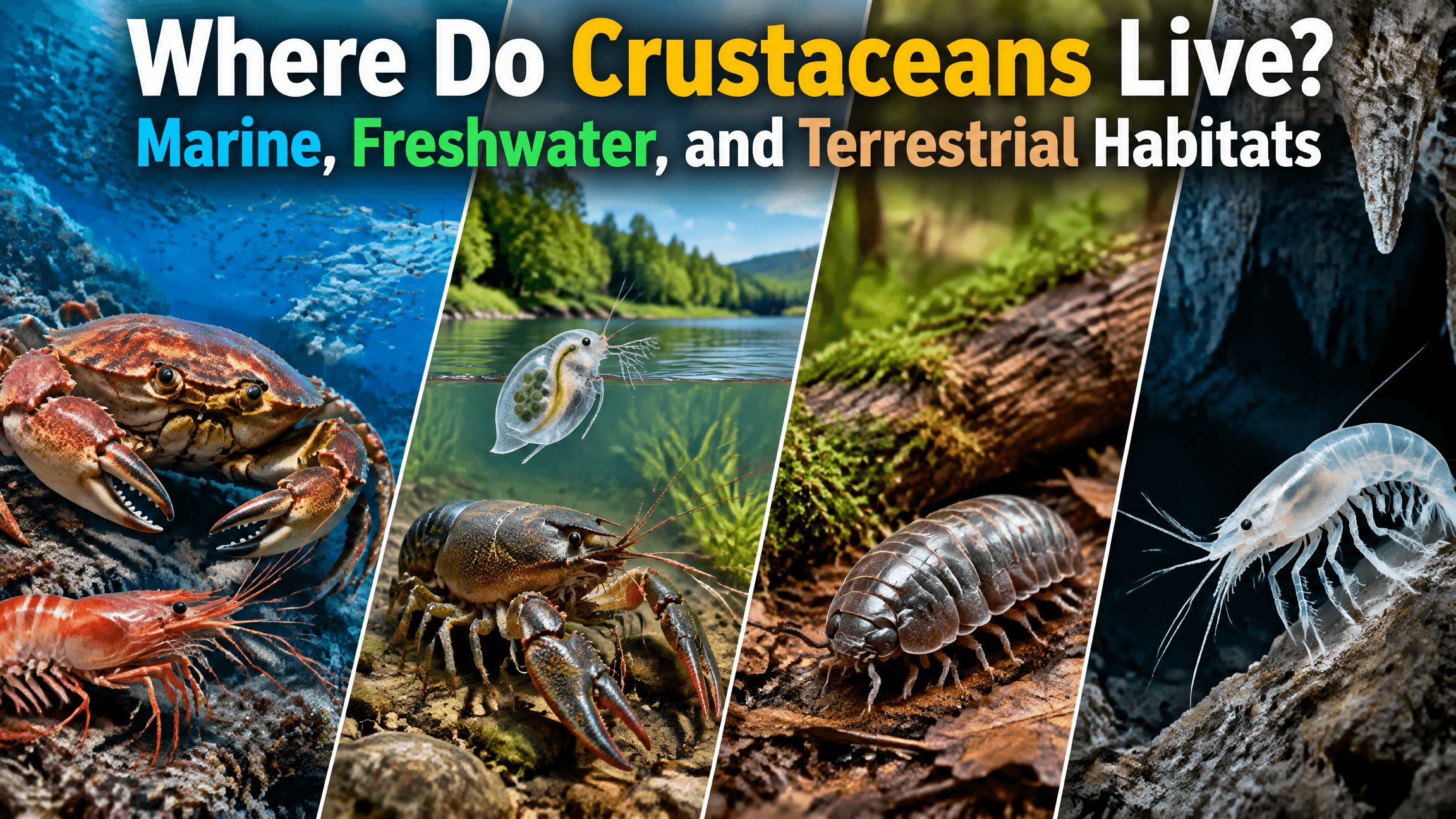
Crustaceans live in far more places than the ocean. Marine habitats contain an enormous share of crustacean diversity, but crustaceans also occur in estuaries, rivers, lakes, temporary pools, groundwater, caves, damp forests, beaches, and even on or inside other animals. Familiar crabs, shrimp, lobsters, and krill represent only part of that environmental range.
The reason crustacean habitats are so varied is that different lineages solve the same basic problems in different ways. Aquatic species must deal with salinity, oxygen, currents, depth, and temperature. Terrestrial forms must limit water loss while keeping respiratory surfaces functional. Cave species may face darkness, low food availability, unusual water chemistry, and extremely small geographic ranges. Understanding where crustaceans live therefore means looking at both the habitat and the biological constraints that come with it.
Quick Answer
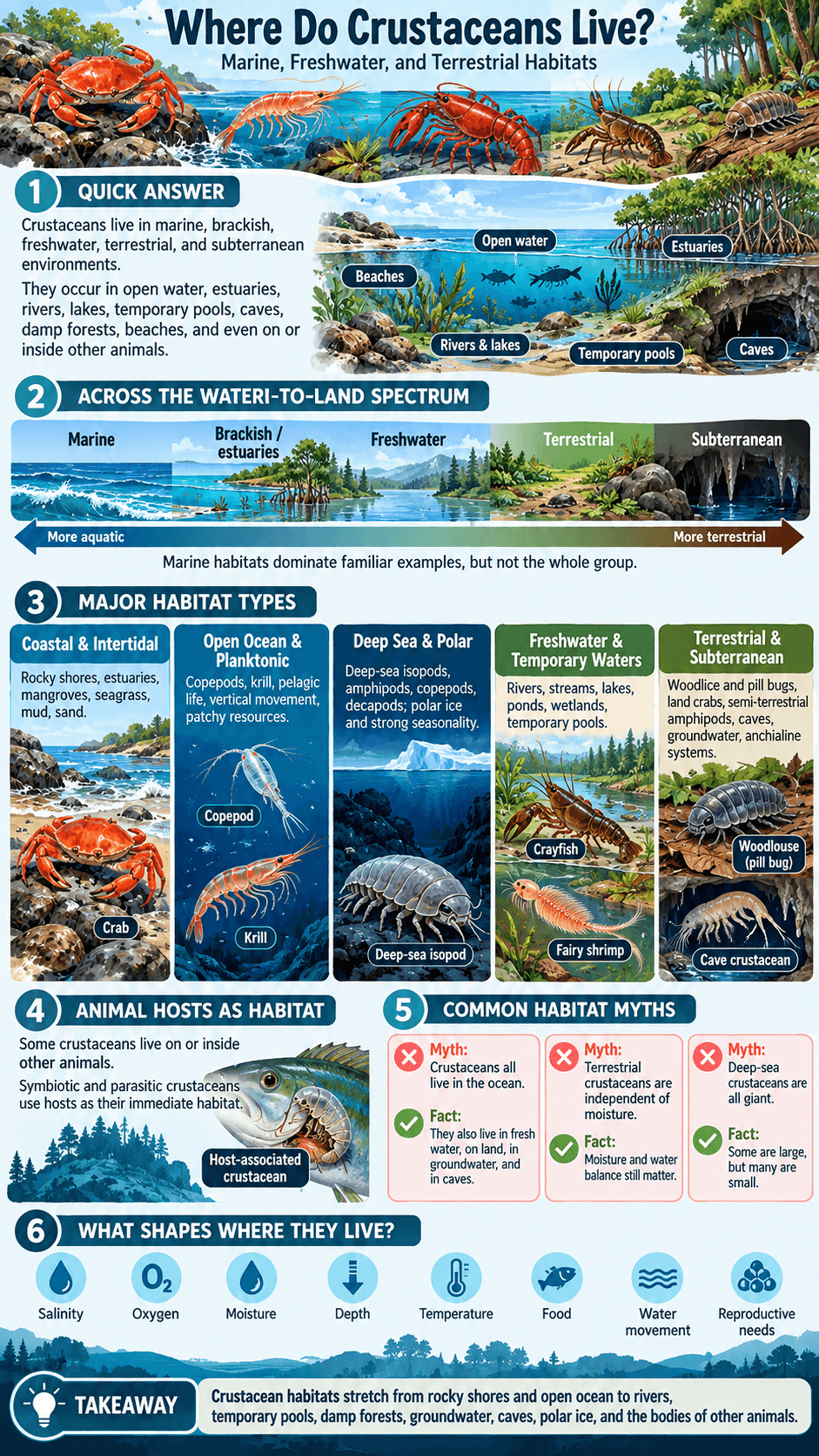
Crustaceans occupy marine, brackish, freshwater, terrestrial, and subterranean environments. The current World Register of Marine Species entry for Crustacea lists the group across marine, brackish, fresh, and terrestrial settings, a useful reminder that an ocean-only definition is incorrect. The WoRMS Crustacea record also reflects how broad the environmental range of the group has become.
Some crustaceans are strongly tied to open water, such as many krill and planktonic copepods. Others live on rocky shores, in estuaries, inside sediment, or among aquatic vegetation. Freshwater communities include crayfish, shrimp, copepods, branchiopods, ostracods, amphipods, and isopods. Terrestrial woodlice and pill bugs spend their adult lives on land, usually in humid microhabitats. Cave and groundwater crustaceans include remipedes, amphipods, isopods, copepods, shrimp, and crayfish.
Crustaceans Across the Water-to-Land Spectrum
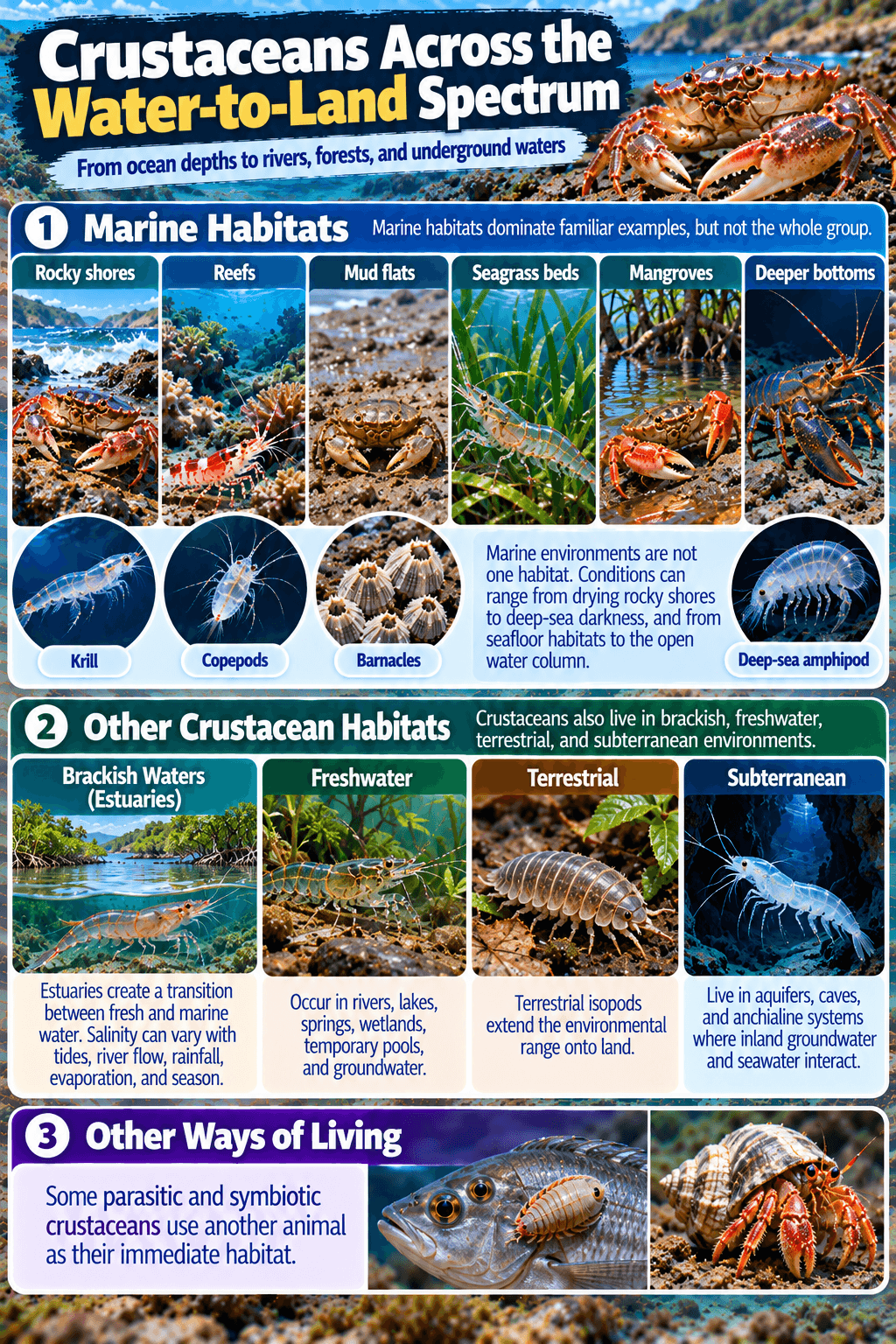
Marine habitats dominate familiar examples, but not the whole group
Many of the crustaceans people recognize most easily are marine. True crabs occupy rocky shores, reefs, mud flats, seagrass beds, mangroves, and deeper bottoms. Lobsters and many shrimp live on or near the seafloor, while krill and numerous copepods spend much of their lives in the water column. Barnacles settle on hard surfaces ranging from exposed rocks to animals and human-made structures.
Marine environments themselves are not one habitat. A crab living in an intertidal crevice experiences drying, wave force, and rapid temperature change. A deep-sea amphipod lives in permanent darkness under high pressure. A copepod in the open ocean may spend its life moving through a three-dimensional water column. The label marine therefore describes salinity and connection to the sea, not one set of living conditions.
Brackish, freshwater, terrestrial, and subterranean representatives
Estuaries create an important transition between fresh and marine water. Salinity can vary with tides, river flow, rainfall, evaporation, and season. Crustaceans living there may tolerate a wider salinity range than close relatives from more stable environments, but tolerance still differs by species and life stage.
Freshwater crustaceans occur from large rivers and lakes to springs, wetlands, temporary pools, and groundwater. Terrestrial isopods extend the environmental range onto land. Subterranean species live in aquifers, caves, and anchialine systems where inland groundwater and seawater interact. Some parasitic and symbiotic crustaceans even use another animal as their immediate habitat.
Coastal and Intertidal Habitats

Rocky shores, estuaries, mangroves, seagrass, mud, and sand
Coasts provide a patchwork of crustacean habitats. Rocky shores offer crevices and hard surfaces for crabs, amphipods, isopods, and barnacles. Estuarine mud and sand can support burrowing shrimp, crabs, mysids, copepods, ostracods, and other small forms. Mangrove roots and leaf litter create shelter and feeding surfaces, while seagrass beds add dense three-dimensional structure above soft sediment.
Different microhabitats can exist only meters apart. An exposed rock face, a shaded crack, a tide pool, and a submerged patch of algae may differ in temperature, moisture, oxygen, wave exposure, and predator access. Small crustaceans often respond to these fine-scale differences rather than to a broad label such as “coast.”
Tides, salinity change, and exposure challenges
Intertidal crustaceans experience conditions that can change within hours. Water may cover them at high tide and retreat at low tide. Temperatures can rise in shallow pools or on exposed rock. Evaporation can increase salinity locally, while rain can dilute it. Waves can create strong mechanical forces.
Species cope in different ways. Some shelter beneath rocks, enter burrows, close protective plates, remain in moist crevices, or time activity to favorable tidal periods. Others tolerate temporary aerial exposure. None of these strategies should be treated as universal. A behavior that protects a shore crab may be irrelevant to a permanently submerged copepod living nearby.
Open-Ocean and Planktonic Habitats
Copepods, krill, and pelagic life
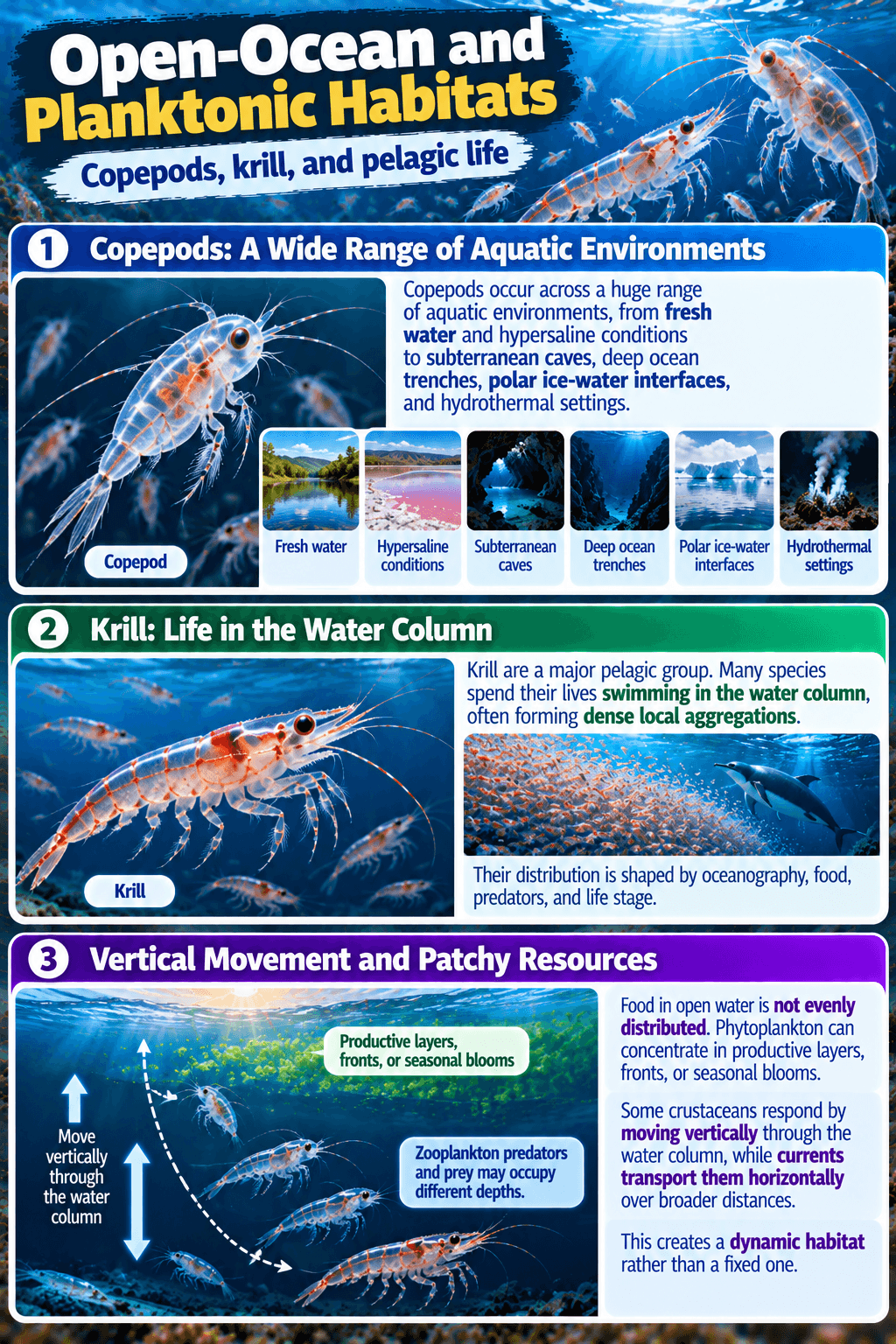
Open water may look structurally simple compared with a reef or forest floor, but it changes with depth, light, currents, food patches, temperature, and season. Copepods are especially important examples because they occur across a huge range of aquatic environments. The Smithsonian notes that copepod habitats extend from fresh water and hypersaline conditions to subterranean caves, deep ocean trenches, polar ice-water interfaces, and hydrothermal settings. Smithsonian’s copepod research overview illustrates how misleading it is to think of them only as surface plankton.
Krill are another major pelagic group. Many species spend their lives swimming in the water column, often forming dense local aggregations. Their distribution is shaped by oceanography, food, predators, and life stage. Antarctic krill are especially associated with cold Southern Ocean systems, but Antarctic ecology should not be generalized to all krill species worldwide.
Vertical movement and patchy resources
Food in open water is rarely distributed evenly. Phytoplankton can concentrate in productive layers, fronts, or seasonal blooms. Zooplankton predators and prey may occupy different depths during day and night. Some crustaceans respond by moving vertically through the water column, while currents transport them horizontally over broader distances.
That combination of active movement and passive transport creates a habitat that is dynamic rather than fixed. A planktonic crustacean can actively choose depth over short distances while still being unable to overcome large-scale currents. Its immediate habitat may therefore change over a single day.
Deep-Sea Habitats
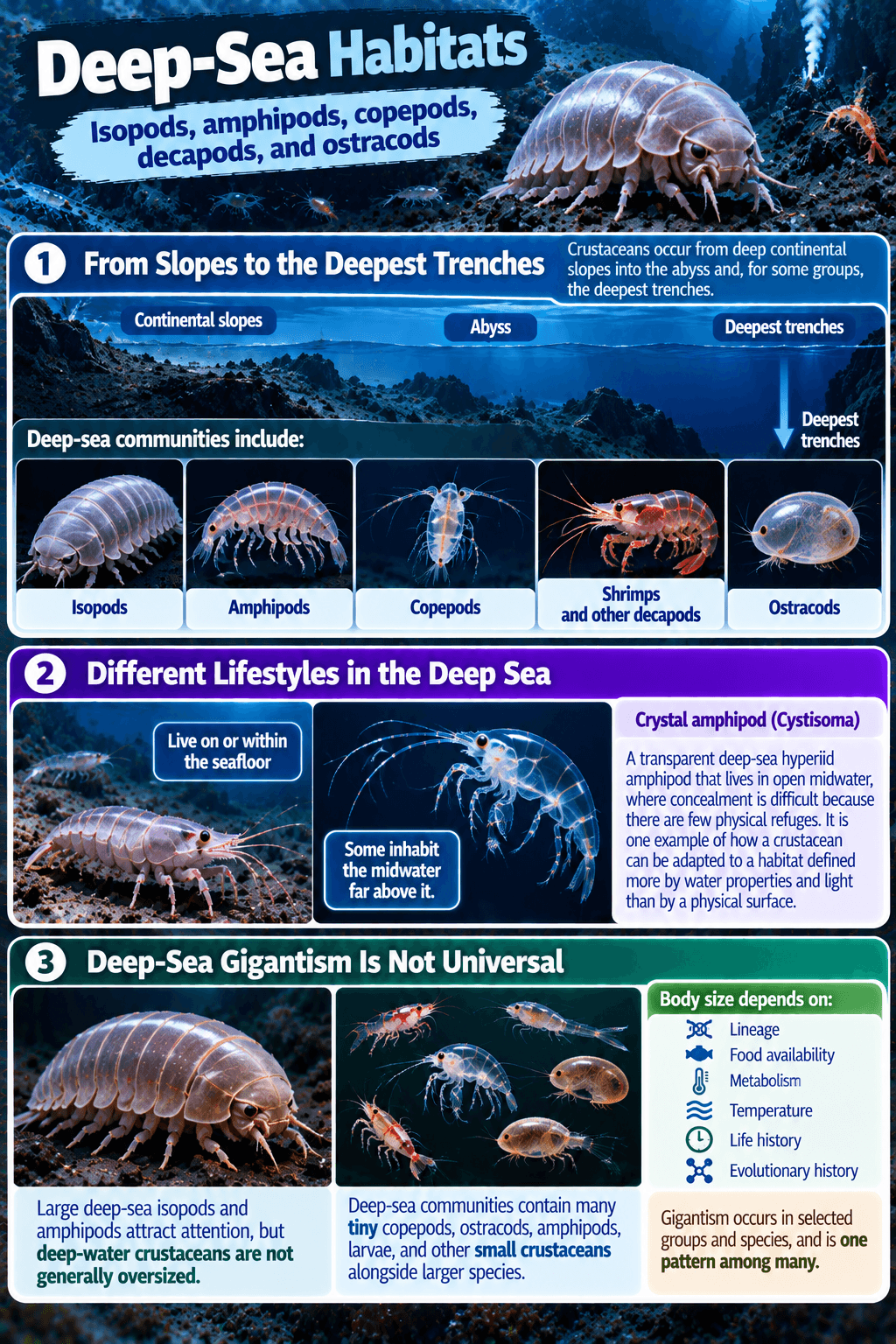
Isopods, amphipods, copepods, decapods, and ostracods
Crustaceans occur from deep continental slopes into the abyss and, for some groups, the deepest trenches. Deep-sea communities include isopods, amphipods, copepods, shrimps, other decapods, ostracods, and additional lineages. Some live on or within the seafloor, while others inhabit the midwater far above it.
The midwater illustrates how specialized these habitats can be. The crystal amphipod, Cystisoma, is a transparent deep-sea hyperiid amphipod that lives in open midwater, where concealment is difficult because there are few physical refuges. It is one example of how a crustacean can be adapted to a habitat defined more by water properties and light than by a physical surface.
Why deep-sea gigantism is not universal
Large deep-sea isopods and amphipods attract attention, which can make it seem as though deep-water crustaceans are generally oversized. They are not. Deep-sea communities contain many tiny copepods, ostracods, amphipods, larvae, and other small crustaceans alongside larger species.
Body size in the deep sea depends on lineage, food availability, metabolism, temperature, life history, and evolutionary history. Gigantism occurs in selected groups and species. It is better treated as one interesting pattern among many than as a defining feature of deep-sea crustaceans.
Polar and Sea-Ice Environments
Cold-water and seasonal constraints
Polar crustaceans live in environments shaped by cold temperatures, strong seasonality, changing daylight, ice cover, and highly seasonal food production. Copepods, amphipods, krill, and other crustaceans may be important consumers and prey in these systems.
Antarctic krill show how closely habitat can be tied to sea ice. NOAA Fisheries describes winter sea ice in parts of the Antarctic Peninsula region as providing access to ice-associated algae when open-water phytoplankton production is reduced. NOAA Fisheries’ Antarctic krill research overview also emphasizes that sea-ice conditions are changing, so habitat quality can shift over time rather than remaining constant.
Not every polar crustacean uses ice in the same way. Some live beneath or within ice-associated communities, some remain in open water, and others occupy the seafloor. The relevant habitat is species-specific, even within the same cold region.
Freshwater Habitats
Rivers, streams, lakes, ponds, and wetlands
Freshwater environments contain an extensive crustacean fauna. Rivers and streams support crayfish, amphipods, isopods, copepods, ostracods, and freshwater shrimp in different regions. Lakes and ponds can contain both bottom-dwelling species and tiny planktonic crustaceans such as copepods and branchiopods. Wetlands add shallow, vegetation-rich habitats with strong seasonal changes.
Flow is one of the major differences among freshwater habitats. A fast stream creates different mechanical and oxygen conditions from a quiet pond. Lakes can develop temperature and oxygen layers with depth. Wetlands may flood and dry seasonally. Crustaceans occupy these habitats through different combinations of behavior, physiology, life cycle, and body form.
Crayfish, freshwater shrimp, copepods, branchiopods, ostracods, amphipods, and isopods
Crayfish are among the most visible freshwater crustaceans, but they should not dominate the picture. Freshwater shrimp occur in many tropical and temperate systems. Copepods and ostracods may be abundant even when they are easy to overlook. Amphipods and isopods can live among vegetation, stones, springs, caves, and groundwater.
Branchiopods add another set of strategies. Daphnia and related water fleas can thrive in lakes, ponds, and temporary waters. Fairy shrimp and tadpole shrimp include species strongly associated with temporary pools. Their presence shows that freshwater crustaceans range from long-lived rivers and lakes to habitats that may disappear for part of the year.
Freshwater crustaceans as part of a larger animal community
Freshwater crustaceans live alongside fish, insects, mollusks, amphibians, reptiles, birds, and mammals, but their habitat biology is best understood from the crustacean perspective. A crayfish uses shelter, sediment, and oxygen conditions differently from a fish. A planktonic copepod experiences water movement at a much smaller scale than a turtle or beaver. Habitat loss and degradation become especially important when considering crustacean conservation.
Keeping that scale in mind helps explain why the same lake can contain many crustacean habitats at once: open water, vegetation, bottom sediment, shoreline detritus, submerged wood, springs, and animal hosts.
Temporary and Variable Waters
Fairy shrimp, brine shrimp, tadpole shrimp, and Daphnia-like examples
Some crustaceans specialize in waters that are highly seasonal, saline, or temporary. Fairy shrimp and tadpole shrimp can occur in rain-filled pools that later dry. Brine shrimp occupy saline environments where conditions may fluctuate strongly. Daphnia-like branchiopods occur in a wide range of ponds and lakes, including habitats with pronounced seasonal change.
Temporary water creates a simple problem with a difficult solution: the adult aquatic animal cannot remain active after the water disappears. Some species solve this through resistant resting stages that persist in sediment until favorable conditions return.
Dormant or resistant eggs in selected species
Vernal pool fairy shrimp provide a clear example. The U.S. Fish and Wildlife Service explains that their resting eggs, or cysts, remain in the dry pool bed and can survive harsh conditions until rain returns water to the pool. The U.S. Fish and Wildlife Service species profile shows how a life stage, rather than the active adult, can bridge the dry season.
That strategy should not be generalized to every branchiopod or every temporary-water crustacean. Dormancy type, desiccation tolerance, hatching cues, and the fraction of eggs that hatch can vary. The broad pattern is that some crustaceans use resistant stages to survive periods when their aquatic habitat temporarily disappears.
Terrestrial Crustaceans
Woodlice and pill bugs
Woodlice, pill bugs, sowbugs, and roly-polies are terrestrial isopod crustaceans, not insects. They are among the clearest examples of a crustacean lineage living on land. Many occur beneath logs, stones, bark, leaf litter, or other cover where humidity is higher and temperatures are buffered.
Living on land did not erase their aquatic ancestry. Their respiratory structures and body surfaces still create important water-balance constraints. A Journal of Crustacean Biology study comparing marine-littoral and terrestrial oniscidean isopods found major differences in aerial and aquatic respiration and water permeability among species. Research on aerial and aquatic respiration in Oniscidea helps explain why humid microhabitats remain biologically important even for crustaceans that spend their adult lives on land.
Land crabs
Some crabs spend much of their adult activity on land, including forest, coastal, mangrove, and island environments. The degree of terrestriality varies greatly. Some remain closely tied to shorelines, while others travel well inland. Moisture remains important because their respiratory surfaces must function without drying excessively.
Reproduction can also keep land crabs linked to water, although the details differ among species. Many release larvae into marine or brackish water, while other crustaceans show different developmental patterns. It is therefore safer to describe land use and reproductive dependence separately rather than claim that every terrestrial crab follows one life cycle.
Semi-terrestrial amphipods
Some amphipods occupy beaches, wrack lines, moist soil, caves, or other settings at the border between aquatic and terrestrial life. Beach-associated forms may hide beneath decaying seaweed during the day and become more active when humidity is favorable.
These species illustrate that habitat categories can overlap. An animal can be strongly associated with land while still depending on coastal moisture and marine material. “Terrestrial” does not necessarily mean physiologically independent of water.
Moisture and water-balance constraints
The major challenge for terrestrial crustaceans is not simply breathing air. It is maintaining gas exchange while limiting water loss. Damp shelters, nocturnal activity, clustering, reduced exposure, and specialized respiratory surfaces can all contribute, depending on the lineage.
This is why woodlice commonly appear beneath logs or stones and why many land crabs remain associated with humid regions or moist retreats. The habitat may be on land, but water balance still helps determine where the animal can remain active.
Caves, Groundwater, and Anchialine Systems
Remipedes, amphipods, isopods, copepods, shrimp, and crayfish
Subterranean waters contain some of the least familiar crustaceans. Groundwater amphipods and isopods can live in aquifers and springs. Cave crayfish and shrimp occur in selected freshwater systems. Copepods can occupy tiny groundwater spaces. Remipedes are especially associated with anchialine caves, where coastal groundwater and seawater meet below ground.
Anchialine systems can be chemically and physically layered, with strong differences in salinity and oxygen over short vertical distances. A Journal of Crustacean Biology review describes anchialine caves as inland, submerged cave systems with salinity stratification and emphasizes their exceptional crustacean diversity. The review of crustaceans from anchialine and marine caves provides useful context for why these habitats are treated as distinct subterranean environments.
Eye reduction, pigmentation loss, and sensory changes only where supported
Cave crustaceans can show traits such as reduced eyes, reduced pigmentation, elongated sensory appendages, or low metabolic rates, but none of those traits should be assigned automatically to every subterranean species. Caves differ in light, food, oxygen, hydrology, and connection to surface environments.
Some cave species are restricted to a single groundwater system or a small set of connected caves. That narrow range can make exact locality information sensitive when conservation is a concern. Educational descriptions should focus on habitat type and biology rather than exposing precise sites for rare species.
Animal Hosts as Habitat
Symbiotic and parasitic crustaceans
For some crustaceans, the immediate habitat is another animal. Parasitic copepods can live on the skin, gills, or internal tissues of fish and other hosts. Cymothoid isopods attach to or live within fish. Rhizocephalan barnacles are highly modified parasites of other crustaceans. Other crustaceans form less harmful associations or live temporarily on larger animals.
Host-associated living changes what “habitat” means. Temperature, water chemistry, host behavior, immune defenses, and access to food can all matter. A species may have a wide oceanic range only where a suitable host is present, so host distribution can become part of its effective environmental range.
Common Habitat Myths
Crustaceans do not all live in the ocean
Marine crustaceans are extremely diverse, but fresh water, groundwater, caves, and land also contain crustacean lineages. A pill bug under a log and a crayfish in a stream are as genuinely crustacean as a shrimp on a reef.
Terrestrial crustaceans are not fully independent of moisture
Living on land does not mean crustaceans have escaped water-balance constraints. Terrestrial isopods and land crabs still rely on respiratory and physiological systems that work best within species-specific moisture conditions. Their distribution on land is therefore shaped partly by access to humid refuges.
Deep-sea crustaceans are not all giant
Giant isopods and unusually large amphipods are memorable, but they represent selected evolutionary outcomes. Many deep-sea copepods, ostracods, amphipods, and other crustaceans are small. The deep sea contains a broad size spectrum rather than a general trend toward giant animals.
How Habitat Shapes Breathing, Movement, Feeding, and Reproduction
Breathing and water balance
Habitat sets the physical conditions for respiration. Aquatic species extract oxygen from water through gills or other respiratory surfaces, while terrestrial crustaceans must keep gas-exchange surfaces functional in air without losing too much water. Oxygen concentration also varies among tide pools, lakes, sediments, caves, deep water, and warm coastal zones.
The same species may experience changing oxygen conditions as tides, temperature, or water flow shift. This is one reason habitat descriptions matter biologically: “water” is not one respiratory environment.
Movement, feeding, and reproduction across habitats
Movement changes with habitat structure. Crabs may walk over rock or mud, shrimp swim or burrow, copepods move through open water, and woodlice crawl through litter. Feeding follows the same pattern. Open-water grazers encounter suspended food, while detritivores on a forest floor or mud flat encounter particles concentrated on surfaces. The physical structure of each environment also shapes how crustaceans move.
Reproduction can also be tied to habitat. A temporary-pool crustacean may depend on resistant eggs. A land crab may use terrestrial adult habitat but release larvae into water. A cave species may complete its life cycle entirely underground. Habitat is therefore not merely the place an animal is found. It helps shape the options available throughout its life. Where a species lives influences the ecological work it can perform, connecting habitat with crustacean ecosystem roles.
FAQ
Can crustaceans live on land?
Yes. Terrestrial isopods such as woodlice and pill bugs live on land, and some crabs spend much of their adult lives in terrestrial environments. They still face strong moisture and water-balance constraints, so humid shelters and access to suitable respiratory conditions remain important.
Do crustaceans live in freshwater?
Yes. Freshwater crustaceans include crayfish, shrimp, copepods, branchiopods, ostracods, amphipods, and isopods. They occur in rivers, streams, lakes, ponds, wetlands, springs, temporary pools, caves, and groundwater. The exact groups present vary by region and habitat.
Are there crustaceans in caves?
Yes. Cave and groundwater crustaceans include remipedes, amphipods, isopods, copepods, shrimp, and crayfish. Some are highly specialized subterranean species, while others use caves as only part of their habitat. Traits such as eye reduction or loss of pigmentation occur in some species but are not universal.
What crustaceans live in the deep sea?
Deep-sea crustaceans include isopods, amphipods, copepods, shrimp and other decapods, ostracods, and additional lineages. They occur both on the seafloor and in deep midwater. Some species are unusually large, but many deep-sea crustaceans remain small.
Final Thoughts
Crustacean habitats stretch from rocky shores and open ocean to rivers, temporary pools, damp forests, groundwater, caves, polar ice, and the bodies of other animals. Marine environments contain immense crustacean diversity, but they are only part of the picture.
The most useful way to understand where crustaceans live is to connect each habitat with its challenges. Salinity, oxygen, moisture, depth, temperature, food, water movement, and reproductive needs all influence which crustaceans can live in a place and how they use it. That perspective explains why a copepod in polar water, a fairy shrimp in a temporary pool, a remipede in an anchialine cave, and a pill bug beneath a log can all belong to the same broad crustacean story.

Ethan Walker is the founder and research editor of Animal Fact Central. He creates and reviews educational animal facts content using trusted wildlife, pet care, and science-based sources. His work focuses on making animal behavior, adaptations, habitats, and species facts clear, accurate, and engaging for everyday readers.
Read More Details About Ethan Walker: https://animalfactcentral.com/ethan-walker/
2 thoughts on “Where Do Crustaceans Live? Marine, Freshwater, and Terrestrial Habitats”